
Cinderella Is Dead and the Big Ten Killed Her — March Madness 2026 Just Proved College Basketball Has Become a Super League
Summary
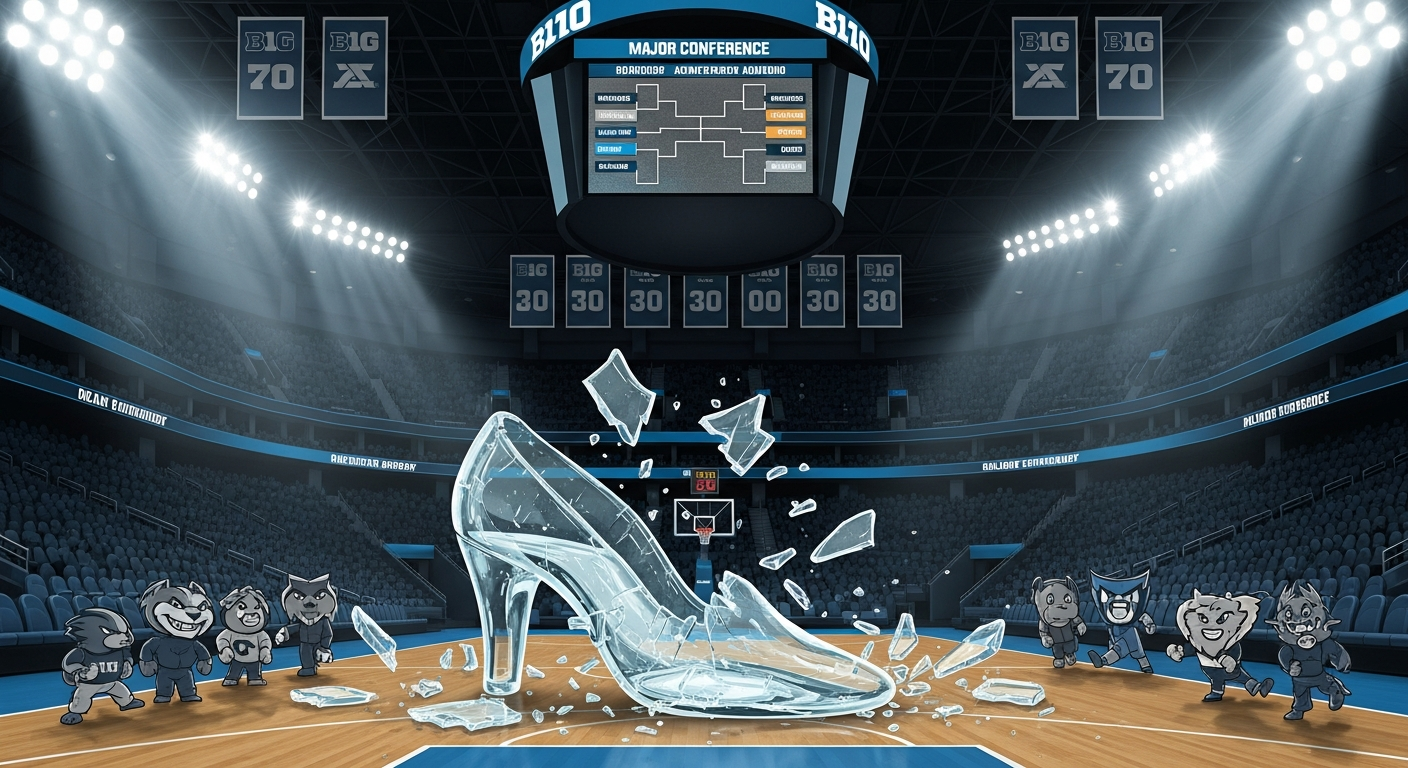
For the second consecutive year, not a single mid-major team has advanced to the Sweet 16 in the 2026 NCAA Tournament. With the Big Ten sending a record six teams, the mega-conference talent black hole is now complete, and the structural gap created by NIL and the transfer portal is swallowing the very essence of March Madness — its madness.
Key Points
Two Straight Years of All-High-Major Sweet 16s — The Only Such Occurrence in History
Following 2025, the 2026 Sweet 16 once again features exclusively power conference teams — the only two instances of this in the entire history of the NCAA Tournament. George Mason's 2006 Final Four run, FGCU shaking up the Sweet 16 in 2013, Saint Peter's charging to the Elite Eight as a 15-seed in 2022, and 16-seed Fairleigh Dickinson toppling Purdue in 2023 — these legendary Cinderella stories happened just three to four years ago, yet they already feel like ancient history. Double-digit seed victories dropped to just four, the lowest since 2007, and none of them survived past the second round. This is not a statistical anomaly repeating itself. It is evidence that the power structure of college basketball has been fundamentally restructured.
Big Ten's Record Six Teams in the Sweet 16 — The Mega-Conference Arrives
Michigan (1-seed), Purdue (2-seed), Illinois (3-seed), Michigan State (3-seed), Nebraska (4-seed), and Iowa (9-seed) advanced to the Sweet 16, setting a new conference record. This ties the ACC's six teams in 2016 and sits just behind the SEC's record seven teams last year. The Big Ten sent nine teams to the tournament and posted a staggering 13-3 record (81.3% win rate) through the first weekend. In the South Region, three Big Ten teams — Nebraska, Iowa, and Illinois — landed in the same bracket, only the third time in history this has happened. With USC, UCLA, Oregon, and Washington now absorbed into the 18-team Big Ten, the conference has become a self-contained ecosystem where national-level competition is completed entirely within its own borders, much like an NFL conference.
NIL's $20.5M Cap and the Transfer Portal Created a Talent Black Hole — Small School Stars Are Evaporating
The House v. NCAA settlement legalized direct athlete compensation of up to $20.5 million per school annually starting in the 2025-26 season. The problem is that the bulk of this budget goes to football (an estimated $15 million), and even the basketball allocation at power conference schools dwarfs what mid-majors can offer. The transfer portal has become a talent superhighway accelerating this imbalance. Players who spent two to three years developing at mid-major programs now routinely transfer to power conference schools chasing NIL offers. The foundation of past Cinderella teams — experienced upperclassmen with years of built-up chemistry — has become impossible to construct when the portal reshuffles rosters annually. As The Ringer noted, mid-majors have been reduced to farm systems for the programs they once shocked.
March Madness Identity Crisis — The Madness Has Left the Building
The raison d'etre of March Madness was unpredictability. When Butler reached the national championship game in 2010, when VCU made the Final Four, that madness forged the tournament's reputation as the most thrilling event in American sports. But the 2026 tournament, after a day of first-round excitement, quickly converged toward predictable outcomes. The Sweet 16 matchups read like seedings fulfilled — 1 vs 4, 2 vs 3. The $3.3 billion March Madness betting market was hotter than ever, but the actual on-court drama is diminishing. CBS/Turner broadcast rights, NCAA revenue distribution, and sportsbook revenues will all hit record highs, yet the very unpredictability that fans loved is being systematically eliminated by the logic of money.
Europe's Super League Debate Is Becoming Reality in American College Basketball
When the European Super League proposal was announced in 2021, fans revolted, arguing it would destroy the essence of competition, and the plan collapsed. But in American college basketball, an essentially identical phenomenon is unfolding — and nobody is taking to the streets. Three mega-conferences — Big Ten, SEC, and Big 12 — are monopolizing talent, media revenue, and recruiting power while every other conference is being pushed to the periphery. The argument that Real Madrid competing against third-division clubs is meaningless maps perfectly onto the reality of Michigan sharing a tournament bracket with California Baptist. The difference is that Europe rejected its super league, while American college basketball is embracing it as the natural evolution of the market.
Positive & Negative Analysis
Positive Aspects
- Game Quality Has Been Elevated Across the Board
Having only power conference teams in the Sweet 16 means every game is a high-level matchup. Pairings like Michigan vs. St. John's and Purdue vs. Texas feature teams loaded with NBA draft prospects, guaranteeing premium basketball. Teams forged through 18 grueling Big Ten games arrive tournament-tested and battle-hardened. Some argue that the intensity and quality of Sweet 16 play has actually improved. Instead of lower seeds stalling for time with defensive-only strategies, both teams now play aggressive, dynamic basketball, making for a more watchable product from the second weekend onward.
- Athlete Compensation Is Finally Just
The House v. NCAA settlement and NIL represent a historic turning point, finally providing fair compensation to student-athletes who were exploited for decades. The era of coaches earning $10 million while players received only scholarships is over. Talent flowing to programs that offer better compensation is a natural principle of free markets, and framing it as a problem amounts to nostalgia for an inherently unfair system. Athletes securing economic stability during their college years is one of the most progressive changes in the history of American college sports.
- Global Talent Pipeline Is Accelerating
With NIL compensation now available, American college basketball has become a more attractive pathway for international players. Athletes who previously would have gone straight to European professional leagues are now spending one to two years at US colleges preparing for the NBA. This raises the overall quality of tournament play and positions college basketball as a true global talent pipeline. The Big Ten's absorption of LA-based schools like USC and UCLA has given it a Pacific Rim recruiting advantage for international prospects as well.
- Media Revenue and Exposure Are Maximized
Power conference dominance of the Sweet 16 maximizes TV ratings and media value. The more national brands like Michigan, Duke, and Purdue survive deep into the tournament, the higher the broadcast rights value for CBS/Turner becomes, and the larger NCAA media revenue distribution grows. This creates a virtuous cycle that expands the financial pie for all of college sports. First-round viewership for the 2026 tournament hit an all-time high, driven by the pull of brand-name programs drawing even casual viewers into the action.
Concerns
- The Underdog Mythology That Defines the Tournament Is Dying
What made March Madness the most beloved sporting event in America was the David-versus-Goliath narrative. George Mason in 2006, VCU in 2011, Loyola Chicago in 2018, Saint Peter's in 2022, Fairleigh Dickinson in 2023 — without these stories, March Madness is just a lesser version of the NBA Playoffs. Tens of millions of Americans fill out brackets hoping for the moment a school they have never heard of topples Duke. When those moments disappear, the cultural value of the tournament is fundamentally diminished regardless of ratings. Two consecutive years of complete mid-major elimination is not a statistical blip — it is a structural death sentence.
- Mid-Major Programs Face an Existential Crisis, Taking Communities with Them
Mid-major basketball programs are not just sports teams — they are community identities. Butler's Final Four run united all of Indianapolis. Gonzaga's success put the small city of Spokane on the national map. As talent drain accelerates, these programs lose competitiveness, which triggers declining ticket sales, donations, and media exposure. Long-term, some mid-major programs may be forced to withdraw from Division I or downsize entirely, eroding the diversity of the entire American college sports ecosystem.
- Intra-Conference Cannibalism — The Big Ten Is Eating Itself
Sending six teams to the Sweet 16 is impressive on paper, but it also means Big Ten teams are systematically eliminating each other. In the South Region, Iowa faces Nebraska with Illinois also present in the same bracket, demonstrating that no matter how dominant the Big Ten is, getting more than two or three teams to the Final Four is structurally difficult. Fans watching teams that already played each other twice during the regular season meeting again in the tournament find it lacking freshness, and the national tournament increasingly resembles an extended conference tournament.
- Title IX Collision and Financial Sustainability Questions
With the bulk of the House v. NCAA settlement's $20.5 million flowing to football and men's basketball, Title IX violation concerns have been raised. Female athletes have filed challenges to the settlement terms, and the outcome could completely restructure the current compensation framework. Additionally, smaller schools simply lack the financial capacity to approach the $20.5M cap, institutionally locking in the gap with power conferences. The constant roster churn driven by the transfer portal destroys the bond between fans and players, eroding the unique value of institutional belonging that distinguishes college sports.
- Distorted Incentives in the Betting Market
The collapse of parity also negatively impacts the $3.3 billion March Madness betting market. Fewer upsets mean less excitement for bracket challenges, and greater predictability may drive away casual bettors. Paradoxically, the NCAA grows more dependent on betting revenue while simultaneously destroying the very unpredictability that makes betting appealing. In the long run, this could weaken both fan experience and revenue models — a self-inflicted wound of the first order.
Outlook
The landscape revealed by the 2026 March Madness Sweet 16 is not a temporary phenomenon. I am convinced this represents a structural inflection point for American college basketball, and the situation will only intensify. Here is a detailed analysis across short-term, mid-term, and long-term horizons with scenario projections.
**Short-Term Outlook (Remainder of 2026 through 2027): Super League Acceleration**
The Big Ten and SEC's dominance will hold through the rest of this tournament. At least two Big Ten teams are likely to reach the Final Four, with Michigan the leading championship contender. When the transfer portal window opens in April for the 2026-27 season, expect a mass exodus of mid-major players who performed well in this tournament migrating to power conference programs.
One number demands attention: the House v. NCAA settlement's athlete compensation cap will increase progressively from $20.5 million in 2025-26 to $32.9 million by 2034-35. This upward trajectory means the economic incentive for talent concentration strengthens every single year. As the cap rises, power programs' recruiting arsenal grows more formidable, and the gap with mid-majors widens exponentially.
One wildcard is the Title IX litigation. If the lawsuit challenging the settlement's backpay provisions reaches a ruling in 2026, it could force a comprehensive restructuring of the compensation framework. This might temporarily slow talent migration by reducing the NIL budgets available for men's basketball.
The probability of a mid-major making the Sweet 16 in 2027 sits below 20% in my estimation. If three consecutive years of complete elimination materializes, this will no longer be classified as a trend — it will be defined as the new normal.
**Mid-Term Outlook (2027-2029): Tournament Format Reform Pressure**
If parity collapse persists for three to four consecutive years, serious pressure for NCAA tournament format reform will build. The current 68-team structure was designed on the premise that mid-majors would have meaningful opportunities, but if those opportunities have substantively vanished, the legitimacy of the structure itself comes into question.
I present three possible scenarios.
Bull Case (optimistic): The NCAA introduces mid-major protection rules. This could include reserving two to four protected Sweet 16 seeds for mid-major teams, or creating a dedicated mid-major preliminary round branded as something like the March Madness Classic. This approach mirrors how the UEFA Champions League grants automatic qualification spots to clubs from smaller leagues. Such measures would partially restore the narrative diversity of the tournament while maintaining mid-major fan engagement. I estimate a 25% probability of this scenario.
Base Case (baseline): The current trend calcifies. Power conferences dominate the tournament, and mid-major programs are reduced to providing first-round exits and participation experiences. NCAA tournament viewership remains strong, but bracket pool participation gradually declines. Because media revenue is so massive, the NCAA has weak incentives to change the structure. I estimate a 50% probability.
Bear Case (pessimistic): Power conference programs break away from the NCAA tournament to create their own super tournament. If the Big Ten, SEC, Big 12, and ACC organize their own 64-team postseason event with independent media contracts, the NCAA tournament would effectively be reduced to a Division II-level event. This mirrors the scenario of the European football Super League succeeding. While extreme for now, concrete discussions could begin around 2028-2029 if the media revenue opportunity is large enough. I estimate a 15% probability.
Internal changes within the Big Ten are also expected. The 18-team format creates scheduling constraints, and as the gap between the conference's top and bottom teams widens, a de facto two-tier structure — an upper Big Ten and a lower Big Ten — may emerge. This would resemble the relationship between the top six or seven clubs in the English Premier League and the rest.
**Long-Term Outlook (2029-2032): Fundamental Redefinition of the American College Sports Model**
The most consequential long-term question is one of identity: what is college sports? A system that pays athletes salaries, features a transfer market, and distributes media revenue is fundamentally indistinguishable from professional sports. The rationale for universities — educational institutions — to remain the operators of this system grows thinner by the year.
Around 2030, the legal question of college athletes' employment status is likely to be definitively resolved. The National Labor Relations Board has already begun deliberations, and if athletes are officially classified as employees, an entirely different regulatory dimension — labor law, collective bargaining, union formation — comes into play. When that moment arrives, the current NCAA system will effectively dissolve, transitioning into a university-affiliated professional league model.
The future of March Madness hinges on this transition. If college basketball fully professionalizes, the tournament will no longer be a stage for amateur student-athletes chasing dreams — it becomes an expanded G-League. The complete extinction of Cinderella stories would be the least of its transformations; the cultural meaning of the tournament itself would be fundamentally altered.
I believe March Madness ten years from now will be an entirely different event from what it is today. It will still be an economic behemoth, but March Madness as a symbol of the American dream — where a small school can slay a giant — died in 2025-2026. The fact that all sixteen Sweet 16 teams in 2026 are from power conferences is the opening line of the obituary.
The supreme irony is this: college basketball tried to build a fairer system for its players, and in the process lost the very thing that made the tournament special — the belief that anyone could win. Were justice and magic mutually exclusive all along? That is the most uncomfortable question the 2026 March Madness poses.
Sources / References
- How College Basketball Crushed the Cinderella — The Ringer
- Big Ten Leads All Conferences with Six Teams in Sweet 16 — Eleven Warriors
- Bracket Reset: NCAA Tournament down to a Sweet 16 of high-majors — The Washington Post
- March Madness Upsets Decline as NIL and Transfer Portal Impact Mid-Majors — National Today
- How NIL Is Reshaping March Madness 2026 — SportsEpreneur
- Big Ten March Madness domination continues with 6 league teams making Sweet 16 — Yahoo Sports
- Is This the End of Cinderella in Mens March Madness? — Sports Illustrated