
Iran Just Declared It Will 'Boycott America but Not the World Cup' — The Moment FIFA's Political Neutrality Lie Finally Collapsed
Summary
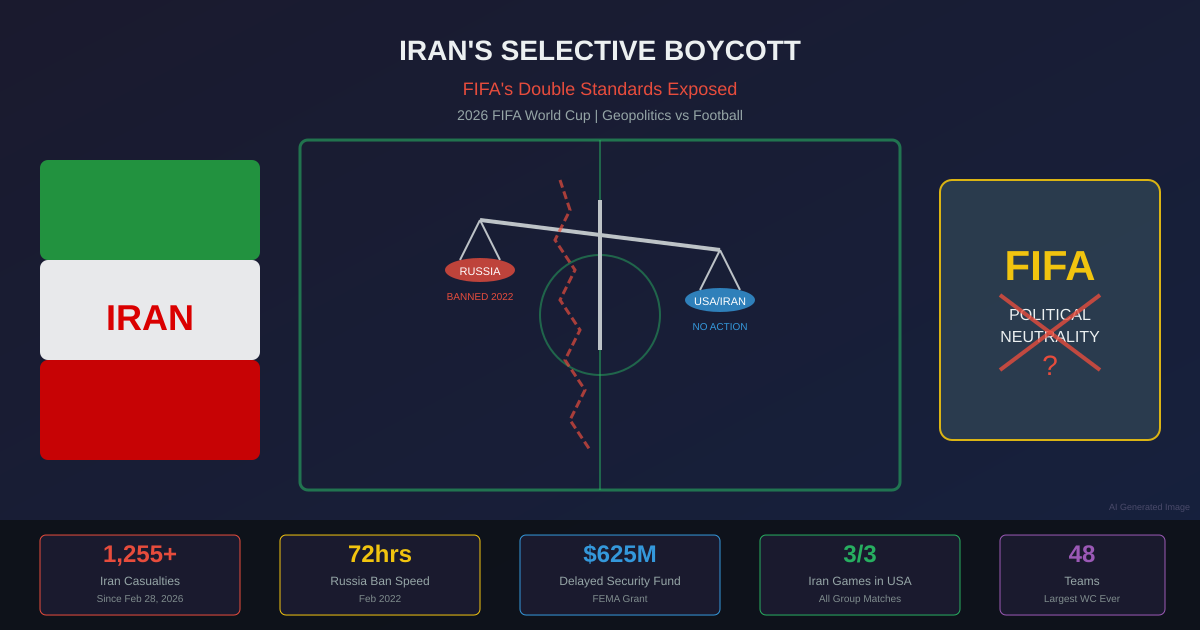
Iran's football federation declared an unprecedented selective boycott, refusing to play in US-hosted venues while insisting on staying in the tournament. With FIFA rejecting the request to relocate matches and declaring it cannot resolve geopolitical conflicts, the same organization that expelled Russia within 72 hours in 2022 is now telling a nation under bombardment to follow the schedule — exposing a double standard that can no longer be ignored.
Key Points
Iran's Unprecedented Selective Boycott Declaration
Iranian Football Federation (FFIRI) president Mehdi Taj officially announced on March 19th that Iran will boycott America but not the World Cup. Iran is scheduled to play all three group-stage matches (vs New Zealand, Belgium, Egypt) in the United States. Their request to relocate these matches to co-host Mexico was rejected by FIFA on March 17th despite Mexican President Claudia Sheinbaum expressing willingness to host. FIFA cited finalized ticketing, broadcasting, and venue arrangements. While Iran's sports minister declared complete withdrawal, the federation chief advocates selective boycott, with approximately 90% of the squad reportedly agreeing with the approach.
FIFA's Political Neutrality Double Standard — Russia Ban in 72 Hours vs Iran Inaction
In February 2022, FIFA and UEFA suspended all Russian teams within four days of Russia's invasion of Ukraine, expelling them from World Cup qualifying playoffs with 72 hours notice. Yet in 2026, with US-Israeli airstrikes killing over 1,255 people in Iran including Supreme Leader Khamenei, FIFA has imposed zero sanctions on the aggressor nation. Instead, it demands the victim nation comply with the existing match schedule. The International Sports Law Journal describes FIFA's approach as adaptive neutrality — standards that shift depending on which power is involved, effectively mirroring Western sanctions rather than applying universal principles.
Host Nation President Essentially Admits He Cannot Guarantee Participant Safety
President Trump stated Iran was welcome to participate but questioned whether it was appropriate for them to be there, implying he could not guarantee their safety. Iran's team responded that the only country that could be excluded is one that merely carries the host title yet lacks the ability to provide security for participating teams. The $625 million FEMA security fund was delayed over two months due to a DHS shutdown, only disbursed in March. Intelligence briefings warn of extremist targeting, transportation infrastructure attacks, and civil unrest — all while FIFA expects a nation at war with the host country to send its team.
Historical Lessons from Sports Boycotts and Iran's Dilemma
The 1980 Moscow Olympics boycott saw 60+ countries withdraw, but it was the boycotting nations' athletes who lost their once-in-a-lifetime opportunity while the Soviet Union won 80 gold medals. The 1984 LA Olympics retaliation boycott followed the same pattern. Iran's selective boycott reflects these historical lessons — attempting to send the political message while preserving players' stage. However, with all three group matches in the US and most knockout matches also on American soil, the approach faces a fundamental physical impossibility that makes it more of a diplomatic statement than an executable strategy.
FIFA Governance Reform Pressure and International Sports Order Paradigm Shift
Sports law scholars consistently note that the moment FIFA expelled Russia in 2022, the genie was out of the bottle. The era when political neutrality could demand silence about other injustices ended. FIFA's zero sanctions against Israel amid the Palestine conflict, and now demanding compliance from bombed Iran rather than bombing America, further crystallizes the organization's structural Western bias. This crisis will trigger governance reform debates beyond Iran's March 31 participation deadline, forcing FIFA to either acknowledge the Russia ban was political from the start, or create new universal standards applicable to all member nations including the United States.
Positive & Negative Analysis
Positive Aspects
- Effectiveness of Political Messaging Through Sport
Iran's selective boycott declaration has globally highlighted FIFA's double standards. The asymmetry between Russia's expulsion and Iran's abandonment is now under intense media and academic scrutiny. This delivers a far more powerful political message than a simple boycott. In sports boycott history, the declaration itself often carries greater impact than the actual execution, creating sustained international discourse around institutional hypocrisy.
- Attempting to Protect Athletes While Taking Political Stand
Unlike past Olympic boycotts where athletes were unilaterally sacrificed, Iran is attempting a creative approach to preserve players' World Cup participation rights while delivering a political message. The reported 90% squad consensus suggests a collaborative rather than top-down decision, which is noteworthy. This could set a precedent for future sports disputes that prioritizes athlete rights over pure political signaling.
- Catalyst for FIFA Governance Reform
This crisis clearly exposes the structural problem of FIFA's political neutrality being selectively applied. With the International Sports Law Journal formally identifying adaptive neutrality as a pattern, governance reform discussions now have academic foundations. The long-term implications could drive transparency and fairness improvements across international sports governing bodies, potentially leading to meaningful rule changes at the December 2026 FIFA Congress.
- Strengthening Mexico's Diplomatic Standing
President Sheinbaum's offer to host Iran's matches reaffirmed Mexico's tradition of neutral diplomacy. The principle of maintaining diplomatic relations with every country contrasts sharply with US unilateral foreign policy, positioning Mexico as a potential mediator on the international sports stage. This diplomatic capital could serve Mexico's international interests well beyond the 2026 World Cup.
Concerns
- Physical Impossibility of Selective Boycott
All three of Iran's group-stage matches are scheduled in the United States, making boycotting America while playing in the World Cup a logical contradiction. Even if Iran advances to knockout rounds, most matches are hosted in American cities. Iran must ultimately choose between going to America and playing, or withdrawing entirely. The selective boycott is emotionally understandable but not an executable strategy, reducing it to a diplomatic gesture without practical follow-through.
- Career-Ending Consequences for Iranian Players
The World Cup comes once every four years, and for Iran's 23-man squad, it represents peak career opportunity. If political withdrawal is finalized, irreversible career damage occurs for these players. The 1980 Moscow Olympics precedent shows that American swimming gold medal favorites lost their entire competitive window. The cost of boycotts falls on athletes, not politicians. The conflicting signals between the sports minister's withdrawal declaration and the federation chief's participation stance are creating psychological pressure on players who have no control over the situation.
- Dangerous Precedent of FIFA Political Intervention
If FIFA sides with Iran by sanctioning the US or relocating matches, it establishes a precedent requiring FIFA intervention in every geopolitical conflict. While the Russia ban already opened Pandora's box, further political involvement risks transforming FIFA from a sports body into something resembling the UN Security Council. If sports organizations must take positions on every conflict, the fundamental nature of international sports competition changes irreversibly.
- Security Funding Delays Revealing US Hosting Vulnerabilities
The $625 million FEMA security fund's two-month delay exposed how US World Cup security preparations are vulnerable to political disruption. Combined with intelligence warnings about extremist targeting and immigration-related civil unrest, fundamental questions arise about safety at an event drawing 5 million+ spectators from 48 countries. Beyond the Iran situation, the stability of the security infrastructure itself is concerning for all participants.
- Iran's Internal Messaging Confusion Weakening Its Position
Iran's sports minister declares complete withdrawal, the federation chief advocates selective boycott, and the squad holds yet another position. These inconsistent messages weaken Iran's international standing and provide FIFA convenient cover to maintain the status quo. Without a unified strategy, the dispersed voices dilute political messaging power and effectively give FIFA an excuse to do nothing while appearing to respect institutional process.
Outlook
The coming weeks represent a watershed moment for Iran's national team and the 2026 FIFA World Cup as a whole. Breaking the situation into short, medium, and long-term perspectives reveals just how far-reaching the implications truly are.
In the short term (March–June 2026), Iran faces a participation deadline of March 31st. With FIFA's official rejection of the venue relocation request, Iran's options are severely constrained. Three scenarios emerge.
Bull Case: US-Iran tensions temporarily ease through diplomatic channels, and Iran's national team receives special safety guarantees to compete on American soil. This would preserve FIFA's peace through sport narrative, though the spectacle of Iranian players competing in a nation bombing their homeland would itself become a historic image. The 1998 France World Cup precedent (Iran beating the US 2-1) exists, but crucially, the two nations were not in active military conflict at the time. Probability estimate: below 15%.
Base Case: Iran ultimately declares withdrawal, and an AFC replacement team is slotted in. India, Bahrain, and Iraq are potential replacements, though Iraq's own participation is uncertain due to airspace closures from the Iran war. While FIFA regulations permit team replacement, it would cause group composition disruption and competitive degradation — Belgium and Egypt would essentially get an automatic-qualification group. Probability estimate: approximately 55%.
Bear Case: Iran's boycott triggers a domino effect with other Middle Eastern nations (Saudi Arabia, Qatar) declaring solidarity boycotts. With 156,000 Dutch citizens already signing boycott petitions and European sympathy growing, the tournament's legitimacy could face severe damage, potentially echoing the 60-nation boycott of the 1980 Moscow Olympics. Probability: below 10%, but rises sharply if the Iran conflict escalates.
In the medium term (H2 2026–2027), this crisis will cast a shadow over the World Cup regardless of Iran's participation decision. Whether Iran participates or not, the fact that a World Cup was held while the host nation was bombing a qualified participant will define the 2026 tournament's historical legacy.
On FIFA governance, the December 2026 FIFA Congress is expected to feature intense debate over redefining the political neutrality principle. The central question: will FIFA officially acknowledge that the 2022 Russia ban violated political neutrality, or will it establish new regulations applying identical standards to all acts of aggression? The former legitimizes Russia's reinstatement demands; the latter makes US sanctions discussions inevitable. Either path is a political minefield for FIFA.
Commercial impacts cannot be ignored. The 2026 World Cup's broadcast rights are estimated at approximately $12 billion, and Iran's absence could trigger $300–500 million in viewership declines across Middle Eastern and Asian broadcast markets. Iran has particularly passionate football fandom (22 million average viewers for Asian World Cup qualifiers), meaning Iran's empty seat represents commercial losses far exceeding one team's withdrawal.
In the long term (2027–2030), this episode could fundamentally reshape the paradigm of international sports governance. As sports law scholars consistently note, the moment FIFA expelled Russia in 2022, the genie was out of the bottle. The era when political neutrality could be invoked to demand silence about other injustices has ended.
Three specific changes are anticipated. First, major international sports bodies including the IOC, FIFA, and UEFA will accelerate efforts to amend political neutrality clauses or at minimum establish humanitarian crisis response provisions. While CAS dismissed the Russian Football Union's appeal, an Iranian challenge could yield different results — Russia was the aggressor, but Iran is the victim.
Second, the 2030 World Cup host selection (Spain-Portugal-Morocco joint hosting confirmed) will feature unprecedented geopolitical risk assessment. Having experienced two major political crises — Qatar's human rights controversies in 2022 and the US-Iran military conflict in 2026 — FIFA will inevitably elevate host nation diplomatic stability as a core evaluation criterion.
Third, athlete-driven political voice will expand. The reported 90% squad consensus on Iran's boycott signals that players are no longer passively following national or federation political decisions. This connects to the broader trend of sports athlete political activism strengthened since the 2020 BLM movement. Political expression by athletes at international events will intensify, and FIFA's Article 11 (political neutrality) will face ongoing challenges.
Ultimately, Iran's selective boycott is not about a single football match — it is a fundamental question about the legitimacy of the entire international sports order. If FIFA genuinely pursues peace through sport, that peace must apply equally to all nations. Peace that is harsh toward Russia but lenient toward America is not peace — it is hegemony. Until this question finds its answer, the 2026 FIFA World Cup stands not as a celebration, but as an institution on trial.
Sources / References
- FIFA rejects Iran's request to move World Cup matches from US to Mexico — Al Jazeera
- Iran to boycott World Cup in US but will not withdraw from 2026 event — Al Jazeera
- Iran soccer chief: We'll boycott U.S., but not the World Cup — ESPN
- Iran's potential withdrawal from the 2026 World Cup explained — CBS Sports
- FIFA's Political Double Standards: Neutrality or Opportunism — FERW
- FEMA Awards Historic $625 Million for World Cup Security — FEMA
- Iran cannot participate in the FIFA World Cup, sports minister says — Al Jazeera