
Housing Is No Longer a Human Right — 3.4 Billion People Prove It
Summary
The 2026 UN-Habitat World Cities Report reveals that 3.4 billion people — more than one in three humans on Earth — lack access to safe and adequate housing, with over a billion living in informal settlements and slums. The global housing shortage expanded from 251 million units in 2010 to 288 million units by 2023, while the house-price-to-income ratio climbed from 9.3 to 11.2 over the same period, placing homeownership increasingly out of reach for ordinary people across income levels. A structural transformation, not merely a supply shortfall, drives the crisis: public investment in housing development across OECD countries was slashed by approximately 90 percent between 2009 and 2016, creating a vacuum filled by private equity, REITs, and algorithmic rent-management platforms that treat housing as a yield-generating asset rather than a place to live. In the United States, 74 percent of extremely low-income renters spend more than half their income on housing costs, while EU home prices rose 5.1 percent year-over-year in Q1 2026, confirming that the crisis respects no geographic or income boundary. This analysis argues that proven working models — Finland's Housing First, Singapore's HDB, and Tokyo's government-designed supply architecture — demonstrate that the solutions are known and documented, and that what separates crisis countries from success stories is not a blueprint gap but a sustained failure of political will.
Key Points
The 90 Percent Investment Cut That Rewrote the Rules of Housing
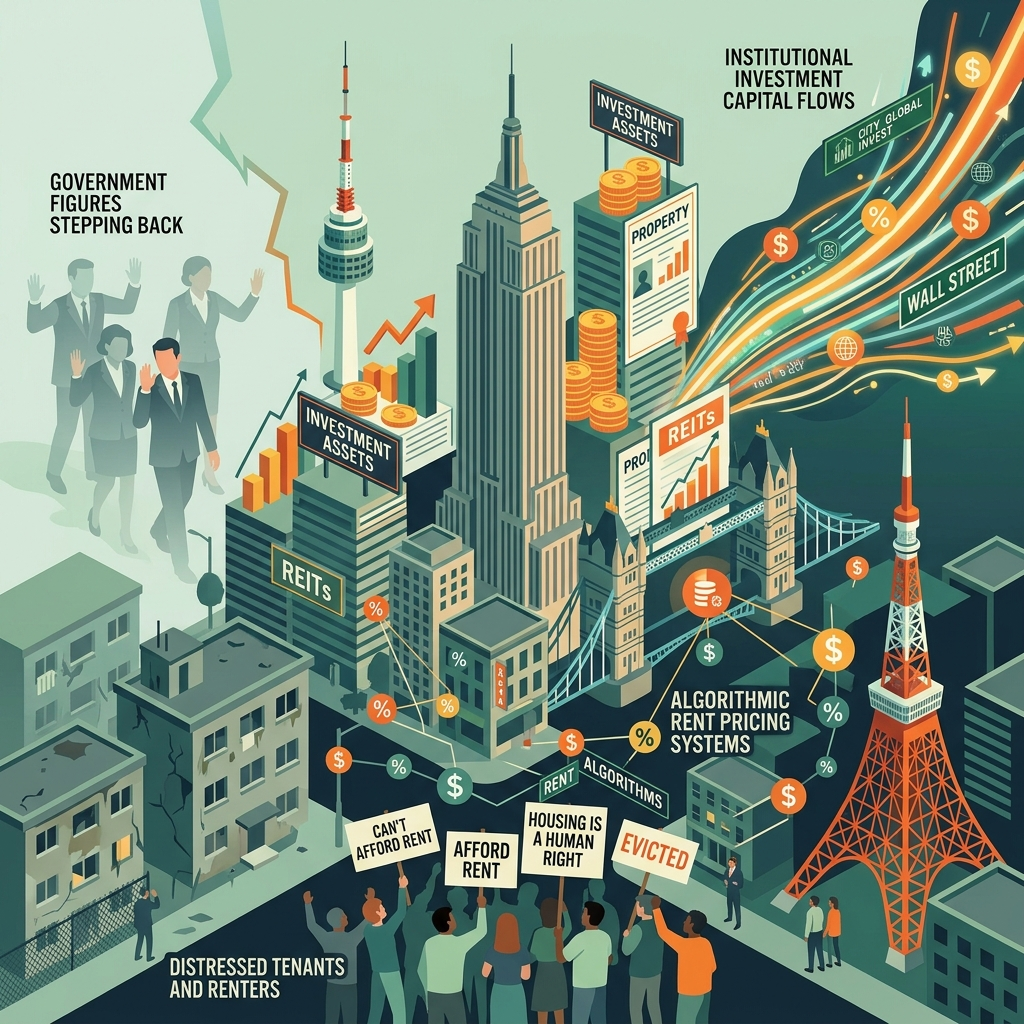
The most consequential structural factor behind today's global housing crisis is a deliberate and documented government withdrawal from the sector. Public investment in housing development across OECD countries fell by roughly 90 percent between 2009 and 2016 — a figure verified through Al Jazeera's reporting on OECD data — while total housing and community amenity spending dropped by approximately 50 percent over the same period. This wasn't routine fiscal tightening; it was a coordinated retreat that fundamentally altered the character of housing markets across the developed world. The historical roots run deeper still: in the United States, the Reagan administration cut the federal housing budget by nearly 80 percent in the early 1980s, and since 1996 the federal government has allocated effectively nothing toward new public housing construction, resulting in the disappearance of more than 400,000 public units. Today, 75 percent of households that technically qualify for federal housing assistance cannot actually access it. A partial recovery of roughly 40 percent occurred after 2016, but the sector remains far below the 2009 baseline — and the structural outcome is visible in one striking number: in two-thirds of OECD countries, social rental housing accounts for less than 5 percent of total housing stock. The vacuum left by that withdrawal was filled by private equity, REITs, and global investment capital whose fundamental incentive is incompatible with housing affordability. When quarterly yield replaces human habitation as the organizing logic of a housing market, the crisis we're observing today is the predictable and structural result — not an accident or a mystery.
Algorithmic Rent Coordination — A New Category of Market Distortion
The RealPage case represents something qualitatively new in the history of housing market dysfunction, and it deserves more attention than it typically receives. This software platform allowed competing landlords to share nonpublic rental and vacancy rate data, then used an algorithm to coordinate pricing across the market — a structure the U.S. Department of Justice characterized as cartel-like behavior when it brought suit alongside more than 10 state attorneys general. The documented results from ProPublica's investigation are striking: one landlord began raising rents within a week of implementing the software and had increased them by more than 25 percent within 11 months. Approximately 17 million renters in California alone were estimated to have been affected by systems operating on this logic. The DOJ ultimately reached a settlement with Greystar, the largest landlord in the U.S., establishing an important legal precedent. But the broader implication is structural: when competitive market dynamics between landlords are replaced by algorithm-mediated coordination, the standard model of price competition benefiting renters breaks down entirely. An investor holding 1 to 3 percent of market units can generate outsized market-wide price effects if all participants are using coordinated pricing logic. This is precisely the gap between traditional property regulation and new technological reality that makes these systems dangerous. Technology has become the instrument of housing financialization, and it operates at a speed and scale that existing legal frameworks were not designed to monitor, let alone prevent.
78 Years of UN Housing Rights Declarations — The Enforcement Gap
The distance between what international law says about housing and what 3.4 billion people actually experience is one of the most glaring structural failures of the post-war international order. The 1948 Universal Declaration of Human Rights established housing as a human right — signed by 192 countries — but, as Housing Rights Watch documents, the UDHR carries no legal binding force whatsoever. The 1966 International Covenant on Economic, Social and Cultural Rights gave the commitment legal status, but permits such wide national discretion in implementation that real enforcement remains fundamentally limited. The Optional Protocol to the ICESCR, which only entered into force in 2013, requires individuals to exhaust all domestic remedies before filing a complaint with the UN Committee — a procedural barrier that makes it nearly useless for people facing immediate housing insecurity. The numbers document what this enforcement gap has produced: informal settlement populations grew from 895 million in 2000 to 1.13 billion in 2024, and 64 million people were evicted globally between 2003 and 2023, all while declarations were being reaffirmed in international forums. What distinguishes successful housing rights implementation from declaratory gestures is whether a government passes domestic law, funds the program, and creates institutional accountability for delivery. Finland, Singapore, and the UK have done this to varying degrees — and the results are visible in their outcomes. The lesson isn't that international declarations are worthless, but that they function at best as normative pressure; the actual mechanism for housing rights is domestic legal mandate combined with sustained public investment, period.
Why Short-Term Rental Regulation Alone Is Not Enough
Barcelona has run one of the most aggressive campaigns against short-term rental platforms of any major global city, cutting Airbnb listings from roughly 17,280 in 2020 to approximately 8,842 by 2024. And yet Barcelona city data shows monthly rents climbing from €688 in 2014 to €1,166 in 2024 — a 70 percent increase — with home prices up 60 percent over the same period. If cutting short-term rentals in half doesn't bend the rent curve, that is direct empirical evidence that platforms are not the primary structural driver of the crisis. World Habitat's analysis confirms that Airbnb contributes between 1.3 and 2.7 percent of annual rent increases in Berlin and 3.7 percent in Portugal — real and measurable contributions, but ones operating at the margin. The core issue is that eliminating one demand-side distortion leaves the underlying supply deficit and capital-flow dynamics entirely intact. When speculative capital finds the short-term rental route restricted, it redirects through algorithmic bulk-buying, institutional landlord platforms, and vacancy-holding strategies — and the pressure on rents continues through those alternative channels. This isn't an argument against short-term rental regulation; it's an argument for recognizing it as one necessary component of a broader structural response rather than a standalone solution. Cities that implement platform restrictions without simultaneously addressing public investment gaps and speculative capital entry will continue to see rents rise, as Barcelona has empirically demonstrated. That lesson is available for free — other cities should take note before treating platform regulation as a housing policy.
Proven Models Already Exist — The Missing Variable Is Political Will
The argument that we don't know how to solve the housing crisis is empirically wrong, and I want to push back on it directly. Three documented and verified models demonstrate what's achievable when governments make and sustain genuine commitment. Finland's Housing First program reduced long-term homelessness from 3,600 to 2,400 people between 2008 and 2015 — a 33.3 percent decrease — while driving Finland's total homeless population from roughly 20,000 in the mid-1980s to approximately 3,950 in 2021. World Habitat data shows that proper supported housing actually reduces emergency medical, social service, and criminal justice costs by an estimated €15,000 per person per year, making this a fiscally positive intervention over any reasonable time horizon. Finland is the only EU country to see meaningful homelessness reduction — validated against continent-wide comparison. Singapore's Housing Development Board provides public housing to 80 percent of the population, lifted homeownership from 29 percent in 1970 to 88 percent in 1990, and brought even the bottom 10 percent income tier to 84 percent homeownership. Japan's centralized development approval system and mixed-use zoning maintain a homelessness rate of 0.2 per 10,000 — compared to 17.5 in the U.S. and 54.4 in the U.K. — by designing supply conditions rather than leaving them to market equilibrium. The common thread across all three is active government involvement in designing and sustaining housing supply structures. The models are documented, validated by data, and replicable in principle. What is missing is not knowledge or technology but the political will to prioritize housing over the interests of capital that benefits from the current structure.
Positive & Negative Analysis
Positive Aspects
- Finland's Housing First — The Cost-Saving Case for Giving People Homes
Finland's Housing First program provides the most compelling empirical case that the counterintuitive approach — providing housing before requiring sobriety, employment, or other behavioral compliance — actually delivers better outcomes at lower systemic cost. Between 2008 and 2015, the program reduced long-term homelessness from 3,600 to 2,400 people, a 33.3 percent decline, while the longer historical arc tracked by World Habitat shows total Finnish homelessness falling from roughly 20,000 in the mid-1980s to approximately 3,950 by 2021. The financial case is as strong as the humanitarian one: providing properly supported housing reduces emergency healthcare, social service, and criminal justice expenditures by an estimated €15,000 per person per year, meaning this approach more than pays for itself over any reasonable accounting period. Finland is the only EU country where homelessness has declined meaningfully, which validates the result not just internally but against every other comparable society on the continent. The model is also exportable in principle: the housing-first logic does not depend on Finland's specific geography, culture, or prior institutional arrangements — it depends on domestic legal mandate, sustained funding, and implementation accountability. The challenge is political and fiscal, not conceptual or technical. For any government serious about housing outcomes, Finland's documented results represent the strongest available evidence that intervention works, that it costs less than the alternative when total system costs are counted, and that the approach can sustain positive results over decades rather than just electoral cycles.
- Singapore's HDB — Universal Public Housing That Works at Scale
Singapore's Housing Development Board stands as the most ambitious and successful public housing program in the world by any quantitative measure. The HDB provides public housing to 80 percent of the country's residents — a proportion unimaginable in most Western political contexts — and lifted homeownership rates from 29 percent in 1970 to 88 percent by 1990, transforming the country in a single generation through deliberate policy design. The program's most impressive achievement is its reach into lower-income brackets: even the bottom 10 percent of earners has achieved 84 percent homeownership, and the bottom 20 percent sits at 87 percent, demonstrating that this is genuine universal provision rather than a program benefiting only the middle class. Anti-speculation mechanisms are built into the structure: HDB mortgages carry a 2.6 percent interest rate, households are limited to one unit, and resale within five years is prohibited — provisions that structurally block the financialization that hollows out public housing programs elsewhere. Resident satisfaction scores are 93 percent for housing quality, 95 percent for neighborhood, and 90 percent for transit access, demonstrating that public housing can deliver quality outcomes, not merely housing access. The program carries a structural limitation in that migrant workers — roughly a quarter of Singapore's population — are excluded from the HDB system. But for citizens and permanent residents, Singapore has proven that universal, government-delivered homeownership is not an aspirational abstraction. It is a functioning reality, sustained across decades and validated by outcome data at every income level.
- UK Renters Rights Act — Legislative Teeth for Tenant Protection
The United Kingdom's Renters' Rights Act, passed in October 2025, represents a meaningful step toward redistributing bargaining power toward tenants using the one tool that actually has teeth: domestic legislation. The Act abolishes Section 21 no-fault evictions, which had allowed landlords to evict tenants without providing any reason — a provision housing advocates had been fighting to eliminate for years. All tenancies are converted to open-ended periodic agreements, with tenants able to exit with two months' notice while landlords face substantially higher bars for possession. Rent increases are limited to once per year with a minimum two-month notice requirement, and landlords are barred from evicting for possession or sale purposes within the first 12 months of any new tenancy. The eviction threshold for rent arrears rises from two months to three months. Mandatory landlord registration in a national database and a private rental sector ombudsman create institutional infrastructure that was entirely absent from the rental market before this legislation. These aren't symbolic protections — they create the enforcement architecture needed to make tenant rights real rather than theoretical. The prohibition on rental bidding wars and discrimination against benefit recipients and families with children extends the Act's scope into market dynamics that previous law left completely unregulated. If similar legislation spreads to other major housing markets, it would represent a structural shift in tenant negotiating power that no amount of short-term rental platform regulation achieves.
- EU's First-Ever Coordinated Affordable Housing Plan
The European Commission's December 2025 announcement of the first EU-wide Affordable Housing Plan marks a qualitative shift in how the bloc approaches a problem that individual member states have consistently failed to solve in isolation. The plan is organized around four pillars — increasing supply, mobilizing investment, supporting structural reform, and protecting vulnerable households — and reports €43 billion already deployed. In addition to the financial commitment, the plan includes legislative initiatives targeting short-term rental regulation, revisions to state aid rules that had historically blocked member states from investing in housing, and the creation of a pan-European investment platform for housing finance. The fact that coordination is happening at the EU level, rather than being left entirely to individual member states, represents genuine institutional progress: the cross-border nature of capital flows driving housing financialization has always required a cross-border response, and this plan at least begins to provide one. The €43 billion figure is absolutely insufficient relative to the scale of need — it doesn't approach 1 percent of the annual investment UN-Habitat estimates is required globally — but the plan's value lies partly in establishing a framework and accountability mechanism against which member states can be measured. If implementation is tracked rigorously and the investment base grows in subsequent EU budget cycles, this creates the institutional scaffolding for a more sustained and ambitious response.
Concerns
- Algorithmic Rent Coordination Is a Problem Traditional Regulation Cannot See
The structural threat posed by algorithmic rent-management platforms isn't just that they effectively raise rents — it's that they represent a fundamentally new category of market manipulation that existing property regulation frameworks were never designed to detect or address. RealPage's model of using nonpublic, competitively sensitive data shared across competing landlords and running it through a pricing algorithm earned the cartel-like behavior description from the U.S. Department of Justice for good reason: it describes coordination that operates outside the standard assumptions of competitive market behavior. The documented scale makes the threat concrete: one landlord raised prices more than 25 percent in 11 months after implementation; an estimated 17 million renters in California alone were affected by systems operating on this logic. The DOJ settlement with Greystar establishes a domestic precedent, but the problem is that the underlying technology has already proliferated globally, and algorithmic rent coordination does not require U.S. servers or corporate registration to function. Regulating it in one jurisdiction while it operates freely in others simply shifts the geography of harm. Traditional rent control laws operate on individual lease agreements; algorithmic coordination operates at the market level, affecting the pricing environment all landlords face simultaneously. The technology is also advancing faster than legislative processes: by the time a specific system gets regulated, successor architectures are already in deployment. This is not a problem any single housing ministry can solve unilaterally. It requires a cross-border regulatory framework with embedded technical expertise — and that framework currently does not exist anywhere in the world.
- Investment Gaps and the Political Pattern of Repeated Housing Budget Cuts
The arithmetic of the housing crisis is deeply unfavorable. UN-Habitat's estimate that achieving adequate housing globally by 2030 requires $3 to $4 trillion per year makes the EU's €43 billion commitment — meaningful as a political signal — look like well under 1 percent of annual need. In the United States alone, existing public housing carries an estimated $70 billion maintenance backlog, while the NLIHC documents a 7.2 million affordable unit shortfall for extremely low-income renters and just 35 available affordable units per 100 low-income households. The scale of intervention required is genuinely enormous by any current political standard. The structural problem beneath the funding gap is the pattern of political behavior that creates it. Housing budgets have historically been the first item cut when fiscal pressure rises: the Reagan administration's 80 percent federal housing budget cut in the early 1980s, the effective elimination of new public housing funding since 1996, and the approximately 90 percent reduction in OECD housing development investment between 2009 and 2016 are not isolated decisions. They are a recurring pattern of government retreat that repeats predictably in periods of economic stress. Nothing in the current institutional or political landscape guarantees the next recession or fiscal crisis won't reproduce those cuts. Housing investment is politically vulnerable because its benefits are diffuse and long-term, while its costs are concentrated and immediate — a structural incentive problem that makes sustained public commitment difficult in virtually every democratic system operating today.
- The Accelerating Expansion of Informal Settlements
The trajectory of informal housing is perhaps the most troubling indicator in the entire dataset. The population living in informal settlements and slums grew from 895 million in 2000 to 1.13 billion in 2024 — meaning 235 million additional people were pushed into substandard conditions over 24 years, averaging nearly 10 million per year. This trend is accelerating in the regions where it's already most severe: urbanization in the Global South is outpacing infrastructure development at rates that formal housing markets have shown no capacity to absorb. The global housing shortage growing from 251 million units in 2010 to 288 million by 2023, alongside a house-price-to-income ratio rising from 9.3 to 11.2, confirms that current investment levels are not keeping pace with need — let alone closing the existing gap. At current trajectories, the informal settlement population will likely exceed 1.2 billion before 2030. The UN-Habitat annual investment requirement of $3 to $4 trillion is not a ceiling to aspire to but a floor below which the problem continues growing; global public housing investment is presently a small fraction of that figure. The crisis is also not contained to regions where it's currently most visible: given that more than half of European and North American renters already pay above the 30 percent cost-burden threshold, and with house-price-to-income ratios continuing to rise, housing insecurity is extending into middle-class populations in developed economies.
- The Scalability Gap Between Proven Models and Most of the World
Finland's Housing First and Singapore's HDB are genuinely successful and empirically verified — and I want to be honest about the limits of what that proves. A significant share of the optimism about these models applying globally rests on assumptions that don't survive scrutiny at scale. Finland has a population of approximately 5.5 million. Singapore has approximately 5.9 million. Both countries benefit from highly centralized political decision-making structures that allow policy consistency and concentrated public investment over extended periods — the precise conditions that made Housing First and HDB achievable. Replicating that in the United States, India, or Brazil — with hundreds of millions of people, federal structures distributing veto power across jurisdictions, and electoral cycles rewarding short-term visibility — is not primarily a design challenge. The design is documented. It is a governance and political economy problem of an entirely different magnitude from anything Finland or Singapore ever had to navigate. Singapore's HDB also carries a structural limitation that often goes unmentioned: migrant workers, who constitute roughly a quarter of Singapore's total population, are excluded from the program entirely. The boundary between success of the model and success of the model for a specific subset of the population matters enormously if the goal is genuinely universal housing security rather than housing security for formal citizens. Success cases exist, they are real, and they matter as evidence that government-led approaches can work. But the distance between those models and a deployable solution for countries where the problem is worst is enormous, and bridging that distance is itself a challenge that no current international institution is adequately resourced to lead.
Outlook
Looking at the next six months, the U.S. housing market appears likely to remain stuck in an uncomfortable standoff. As of the week ending July 16, 2026, Freddie Mac's Primary Mortgage Market Survey put the 30-year fixed mortgage rate at 6.55 percent — significantly above the 5.8 percent 2026 target in the Fitch forecast (as of the November 2025 forecast) and Fannie Mae's projection of 5.9 percent by year-end 2026. Rate reductions are materializing, but more slowly than virtually every major forecaster assumed. J.P. Morgan projects U.S. home price growth of 0 percent for 2026, and the NAR affordability index sits roughly 35 percent below its pre-COVID level. The practical outcome is that would-be buyers who cannot qualify push into the rental market — directly compressing supply for the 74 percent of extremely low-income renters already spending more than half their income on housing. That structural pressure has no meaningful short-term release valve in the current environment.
Europe is running considerably hotter. Eurostat's Q1 2026 data shows EU-wide house prices up 5.1 percent year-over-year and rents up 3.0 percent, but country-level data tells the sharper story. Portugal posted 10.3 percent house price growth; Bulgaria 9.4 percent; Slovakia 9.1 percent. Croatia's rents surged 21.9 percent — a number that is difficult to characterize as anything other than an acute housing emergency. Only Slovenia (-0.9 percent) and Finland (0 percent) showed restraint. The UK's Renters' Rights Act entered early implementation in the latter half of 2025 and should provide some floor for tenant protections, but it does not address the underlying supply shortage driving prices. In the U.S., the DOJ's RealPage case produced a settlement with Greystar that creates a short-term precedent against algorithmic price coordination — but similar software has already proliferated globally, and technological prohibition at worldwide scale is a fundamentally different challenge from a domestic lawsuit settlement.
I want to flag one important transparency point before going further. The Fitch and Fannie Mae projections cited here were published in November 2025, making them approximately eight months old relative to today, July 2026. The gap between those forecasts (5.8–5.9 percent) and the Freddie Mac actual reading (6.55 percent) is substantial. Rates have not declined as projected. This means the medium-term scenarios I describe below are built on assumptions that were already relatively optimistic when first published, and the actual trajectory may be more constrained. Readers should weight the medium-term analysis with that lag clearly in mind — where reality and forecast diverge, reality has proven the harder figure.
On the medium-term horizon of six months to two years, the trajectory of interest rates remains the dominant variable. Fannie Mae's base case projects the 30-year fixed rate moving from 6.4 percent at end-2025 to 5.9 percent by end-2026. If that plays out, the modeled impacts are meaningful: home sales could rise from 4.72 million in 2025 to 5.16 million in 2026, a 9.3 percent increase. Mortgage origination volume could climb from $1.85 trillion to $2.32 trillion, a 25 percent expansion. The refinancing share could grow from 26 to 35 percent. Those are real improvements in market activity worth acknowledging.
But I want to be precise about why rate normalization alone doesn't resolve the housing crisis. When rates fall and demand recovers, the most likely near-term consequence is another price-increase cycle — because the underlying supply deficit remains unaddressed. And the refinancing windfall flows exclusively to people who already own property. For the 11 million extremely low-income renters facing a 7.2 million unit shortfall, a 50-basis-point rate reduction is effectively irrelevant. Rate improvement helps the affordability-constrained middle class; it does essentially nothing structural for the most excluded households.
The supply-side picture for the medium term shows a revealing split, based on Fitch's November 2025 forecast. Multifamily housing starts were projected to rise 13 percent, while single-family starts were expected to decline 5.5 percent. This tells you something specific about where developer incentives currently point: multifamily rental projects are more profitable in the present environment, so the market is generating more rental supply but not more homeownership pathways. J.P. Morgan's data shows Western and Sun Belt markets experiencing some price stabilization as pandemic-era oversupply works through, but that is a regional phenomenon rather than a national trend. Meanwhile, the EU's €43 billion Affordable Housing Plan requires not just financial commitment but land-use reform and construction workforce expansion in each member state before it translates into actual unit delivery — structural prerequisites that take years to develop from any starting point.
The divergence in estimates of the underlying housing shortage is itself a problem that rarely gets enough direct attention. J.P. Morgan estimates the U.S. housing shortfall at approximately 1.2 million units. Other estimates range from 4 million to 7.2 million homes across a variety of sources. NLIHC, focused specifically on the affordable segment, counts a 7.2 million unit gap on its own. Depending on which number informs a policy program, the required investment scale differs by a factor of three to six. A problem you cannot agree to measure is a problem you cannot coordinate to solve. Adding to the medium-term risk: Fitch's November 2025 forecast projected the serious delinquency rate rising from 1.4 percent in 2025 to 1.7 percent in 2026, suggesting that households under housing cost pressure are showing early financial stress signals that could intensify if the rate environment stays tighter than projected.
The most uncertain element of my medium-term analysis is the political will assumption. I've argued that government-led models work — Finland and Singapore are the evidence — but the honest problem is that in most democracies, housing policy is structurally subordinate to the four-to-five-year electoral cycle. The payoff horizon for serious housing investment is a decade or more; the tenure of a politician is far shorter. That incentive misalignment pushes governments toward visible short-term interventions rather than the structural investments that actually resolve the underlying problem. I may be overstating the likelihood that governments will sustain the commitment required, which means the optimistic elements of my medium-term outlook could be unrealistically weighted toward action.
Looking at the longer-term two-to-five-year horizon, the central question is whether the structural transformation of the past 40 years can be meaningfully reversed. My assessment is: partially, selectively, and only with genuine sustained political commitment. Finland's Housing First and Singapore's HDB are the two most compelling models. But their context matters critically: both have populations under 6 million, with centralized political structures that enable the policy consistency and concentrated public investment that made those programs achievable. Applying the same model in the United States, India, or Brazil — with hundreds of millions of people, federal structures, and multiple political veto points across electoral cycles — is not a design problem. The design is documented. It is a governance and political economy problem of an entirely different magnitude. That said, the core principle — government must actively design supply architecture and block speculative capital from distorting pricing — is scalable in principle. Tokyo's centralized development approval model could, in principle, be translated into federal-level development guidelines even within a decentralized system. The challenge is implementation, not concept.
The long-term trend that concerns me most is the trajectory of informal settlements. The population living in substandard informal housing grew from 895 million in 2000 to 1.13 billion in 2024 — 235 million additional people pushed into inadequate conditions over 24 years, averaging nearly 10 million per year. Reversing that before 2030 would require the $3 to $4 trillion annual investment that UN-Habitat estimates, and current global public housing investment represents a small fraction of that figure. If the house-price-to-income ratio continues rising beyond 11.2, housing insecurity starts extending into middle-class populations in developed economies — which is already happening in aggregate, given that more than half of European and North American renters are paying above the 30 percent cost-burden threshold.
If structural reversal is coming, I'd watch for three signals first. The first is OECD countries recovering housing development public investment to at least 50 percent of the 2009 peak — a return to half of where it was before the great retreat. The second is an international regulatory framework specifically targeting algorithmic rent-coordination software: not a domestic lawsuit but a cross-border legal standard with actual enforcement capacity. The third is at least one major economy's house-price-to-income ratio beginning a sustained decline from its current level. Any one of these would be meaningful evidence that a 40-year structural trend is changing direction.
The three scenarios laid out explicitly: The bull case sees rates fall in line with Fannie Mae's projection to 5.9 percent or below, the EU's Affordable Housing Plan accelerates into real unit delivery, and two or three major economies adapt Housing First or Tokyo-style supply liberalization to their local context. In this scenario, the upward movement in the price-to-income ratio stalls within five years and reversal begins in select markets. The base case is a continuation of current conditions: rates persist around 6 percent longer than projected, supply growth continues lagging demand, and housing investment remains subordinate to other fiscal priorities in most governments. The global shortfall keeps expanding beyond 288 million units. The bear case is a recession triggering unemployment spikes, delinquency rates well above the Fitch November 2025 projection of 1.7 percent for 2026, and another round of austerity-driven housing budget cuts. Reagan's 80 percent cut and the post-2009 OECD 90 percent reduction are the historical templates for that scenario — and no institutional guarantee exists that the next fiscal crisis won't reproduce them.
For individuals trying to navigate this environment: in the bull scenario, locking in a fixed rate during a rate-decline window is the tactically sound move. In the base case, the practical priority is keeping housing costs below 30 percent of income — the cushion that threshold creates matters enormously when other budget pressures mount. In the bear scenario, the first line of defense is understanding the specific legal protections your rental contract and jurisdiction actually provide. What matters beyond personal financial management, though, is making housing policy a first-order voting issue. Politicians do not voluntarily absorb the political cost of sustained public housing investment unless they believe their re-election depends on it. Housing that doesn't move votes remains an optional line item — and the structural problem keeps compounding year by year.
Sources / References
- World Cities Report 2026 — UN-Habitat
- The Gap 2026: A Shortage of Affordable Homes — NLIHC
- EU Housing Prices and Rent Trends Q1 2026 — Eurostat
- DOJ RealPage Rental Price-Fixing Case — ProPublica
- Affordability Crisis: How the Western Housing Crisis Spiralled — Al Jazeera
- Guide to the Renters Rights Act — UK Government
- European Affordable Housing Plan — European Commission
- Singapore HDB Policy Database — SDG16+
- How Japan Keeps Housing Available and Affordable — Inroads Journal
- Finland Housing First Programme — Centre for Public Impact
- Helsinki and Homelessness: Leading the Way — World Habitat
- The Sabotage of Public Housing — Homeward Bound Villages
- UN Housing Rights — Housing Rights Watch
- Fitch Housing Market Outlook Through 2027 — National Mortgage News
- Mortgage Rates Expected to Move Below 6 Percent by End-2026 — Fannie Mae
- U.S. Housing Market Outlook — J.P. Morgan
- Primary Mortgage Market Survey — Freddie Mac