
Africa Is Driving Out Africans — South Africa's Xenophobia Is Killing the Continental Dream
Summary
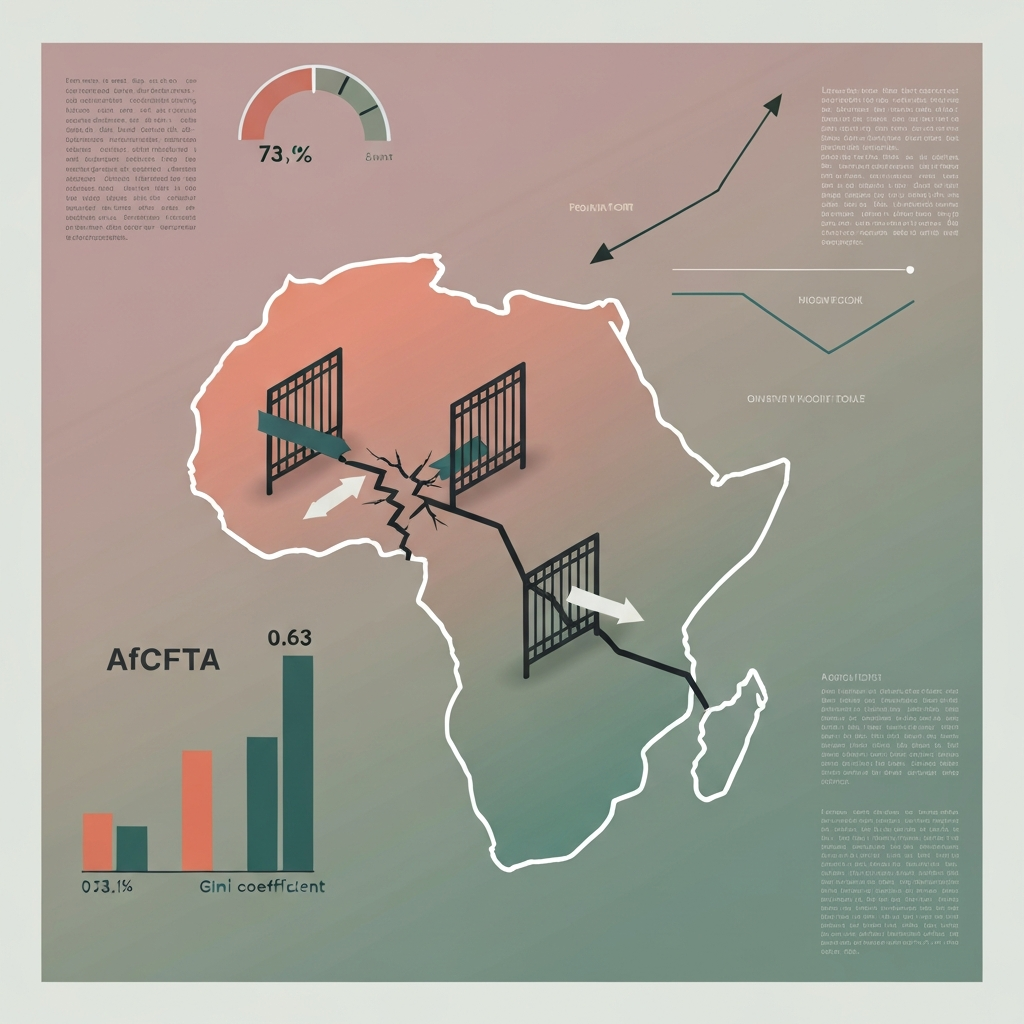
South Africa's xenophobic violence against African migrants escalated to international crisis levels in April 2026, prompting joint condemnation from the UN Secretary-General and the African Commission on Human and Peoples' Rights. Anti-immigrant sentiment has surged from 62.6% to 73.1% in just four years, as organized groups like Operation Dudula and March and March orchestrate systematic attacks on migrant businesses across Gauteng province. Structural economic failure drives this violence — unemployment stands at 31.4% and youth unemployment at 57% — yet World Bank research demonstrates that each immigrant in South Africa actually generates approximately two local jobs, exposing the economic fiction that animates anti-migrant rhetoric. The deeper crisis is a thirty-year paradox: the economic liberation promised when apartheid ended in 1994 has never fully arrived, and that accumulated disappointment is now exploding as rage directed at fellow Africans, directly threatening the African Continental Free Trade Area's vision of a unified $3.4 trillion market. With November 2026 local elections approaching and Operation Dudula formalizing as a registered political party, xenophobia is crossing from street violence into institutional politics — a transition that, if European precedent holds, is extraordinarily difficult to reverse once it gains electoral legitimacy.
Key Points
Anti-Immigrant Distrust Jumped 10.5 Points in Four Years — This Is Structural, Not Fringe
GovDem survey data drawn from 3,600 face-to-face interviews shows that distrust of African immigrants in South Africa climbed from 62.6% in 2021 to 73.1% by 2025 — a 10.5-point surge in four years that exceeds the rate of anti-immigrant sentiment shift recorded in the United Kingdom during the four years before the Brexit referendum. What is particularly striking is that this distrust is not concentrated in one demographic group: among Black respondents it runs at 73.17%, among white respondents 72.48%, among Indian respondents 75.22%, and among Coloured respondents 72.61% — statistically almost identical across racial lines. The data for employed respondents (70.06%) versus unemployed respondents (77.31%) is equally revealing: while economic hardship intensifies the sentiment, those with jobs are barely more tolerant than those without, indicating that economic anxiety alone does not explain the shift. Frontiers in Political Science research maps this distrust geographically against unemployment data and finds it concentrated precisely in Johannesburg's inner city, western Pretoria, and Durban townships where unemployment exceeds 50%. Afrobarometer's 2026 data adds the sharpest figure: 83% of South Africans say immigration should be reduced or banned entirely — the highest figure of any of the 38 African countries in the survey. The conclusion these numbers force is that South Africa's xenophobia is not the project of a fringe group. It is approaching something like societal consensus, built on the foundations of structural economic failure across three decades of democracy that did not deliver its promised economic liberation.
Thirty Years of Unfulfilled Promise — The Economic Root of the Violence
When Nelson Mandela stood before South Africa in 1994 and declared the arrival of a Rainbow Nation, the implicit social contract was twofold: political freedom and economic liberation for the Black majority. In 2026, the political freedom is largely intact, but the economic liberation has not arrived — and World Bank data delivers a particularly sharp indictment: South Africa's inequality has actually deepened since the end of apartheid, not narrowed. The Gini coefficient sits at 0.63 — the world's highest — with the top 10% holding 71% of national wealth while the bottom 60% share just 7%. Black Economic Empowerment policy created a class of Black elites but failed to shift conditions for the majority of working-class and poor Black South Africans, who remain locked out of the economic transformation the democratic era promised. StatsSA's Q4 2025 data records 7.8 million unemployed people, with youth unemployment at 57% among 15-to-24-year-olds and 44.3% among those aged 25 to 34 — meaning economic exclusion is not concentrated in one cohort but spans the full working-age spectrum. A full 34% of South Africans between 15 and 35 are NEET — not in employment, education, or training. This accumulated, multigenerational economic disappointment is the real fuel. Immigrant shopkeepers and street vendors are not the source of that failure; they are the most visible, most accessible surface onto which three decades of frustration are being redirected. Understanding this distinction is not a defense of migrants — it is a prerequisite for any accurate diagnosis of what has actually gone wrong in post-apartheid South Africa.
Operation Dudula's Formalization — From Vigilante Group to Political Institution
Operation Dudula began in 2021 in Durban as a grassroots anti-immigrant campaign whose name translates directly from Zulu as "push out." By 2026, it has expanded into a national organization and completed formal registration as a political party, declaring its intention to field candidates in Johannesburg, Ekurhuleni, and Tshwane for November's local elections. This transition matters enormously: when street violence becomes a political party, it gains institutional legitimacy and legal standing that vigilante action never had — access to ordinances, public budgets, and enforcement authority that no self-appointed citizen group possesses. HRW's 2026 report documented the group's most extreme manifestation: members blocking two Alexandra township clinics from treating a 1-year-old Malawian child because the family lacked identity documents, a refusal that contributed to the child's death and resulted in murder charges filed by opposition politicians. March and March, a separate but aligned anti-immigrant group, expanded into Gauteng in April 2026 and specifically targeted migrant businesses. The European political parallel is instructive and alarming: Marine Le Pen's National Rally entered the French parliament in 1986 and has expanded its vote share in every subsequent election cycle for four decades, never retreating once it gained institutional footing. ANC and DA are already incorporating harder anti-immigrant messaging into their platforms to avoid being outflanked by Operation Dudula's electoral debut, and the centrifugal pull this creates — drawing all parties rightward on immigration — is historically very difficult to reverse once it begins.
AfCFTA's Central Contradiction — South Africa Opens Markets to Goods, Closes Borders to People
The African Continental Free Trade Area is the most ambitious economic integration project in African history: a single market of 54 nations, 1.3 billion people, and a $3.4 trillion combined GDP. World Bank projections estimate that full implementation by 2035 could increase African incomes by $450 billion, grow intra-African exports by 81%, and lift 30 million people out of extreme poverty. South Africa, with the continent's largest industrial base and most sophisticated financial sector, stands to be among the primary beneficiaries — with manufacturing output potentially growing 28.6% under full AfCFTA conditions. The contradiction embedded in South Africa's xenophobia could not be more direct or more damaging. AfCFTA's long-term vision includes not just goods and services but labor mobility — yet the AU's Protocol on Free Movement of Persons has been ratified by only 4 of 54 member states, well short of the 15 required for it to enter force, and South Africa has not even signed it. A continental economic union cannot reach its potential if its largest economy treats the free movement of people as a threat rather than an asset. The deeper risk is contagion: if South Africa's economic nationalism provides a political template that Nigeria, Kenya, or other large economies can borrow to protect their own labor markets through similar anti-migrant logic, the protocol will never reach its threshold ratification number. AfCFTA would then remain a framework for goods trade only — a half-integration that delivers a fraction of its promised economic dividend.
Democracy's Paradox — Elections Are Making South Africa More Xenophobic, Not Less
The Journal of Peace Research's 2025 analysis of 45 countries using Comparative Study of Electoral Systems data established a finding that challenges comfortable assumptions about democratic societies: anti-immigrant attitudes among right-leaning voters reliably peak in the months before elections and soften in the months after. The researchers conclude that anti-immigrant sentiment is not fixed but highly responsive to elite cues and campaign messaging — meaning that political leaders choose to inflame it or contain it, and right now they are overwhelmingly choosing to inflame it. South Africa runs this experiment repeatedly and arrives at the same result every time. Major xenophobic violence erupted just before the 2008 national elections (62+ deaths, 100,000+ displaced), just before the 2015 local elections (7 deaths), and now, with November 2026 approaching, violence is again accelerating on exactly the same schedule. Frontiers in Political Science's 2026 analysis makes the mechanism explicit: the securitization of migrants is a strategy to disguise governance failures, giving politicians a visible target to blame for the structural economic problems they cannot or will not solve. The election mechanism, which should hold leaders accountable for failures like 31.4% unemployment, is instead giving those leaders a ready-made tool to convert those failures into electoral advantage — a cycle that is structurally very difficult to interrupt without the economic alternatives that South Africa cannot deliver before the next ballot is cast.
Positive & Negative Analysis
Positive Aspects
- International Condemnation Arrived Faster and With Greater Legal Specificity Than in Prior Crises
The international response to the April 2026 outbreak has been measurably faster and more coordinated than the responses to the 2008 or 2015 xenophobia waves. The UN Secretary-General issued a condemnation within 24 hours of the attacks becoming internationally visible, and the ACHPR followed the same day with a formal statement specifically calling out vigilante violence against migrants — a speed that contrasts sharply with the delayed, muted responses of earlier cycles. The International Commission of Jurists went further: it directly urged South Africa's High Court to apply international law protecting migrants and refugees from discrimination, framing the issue not merely as a political concern but as a live, enforceable legal obligation under existing treaty frameworks. These responses matter because they create documented accountability records that can be cited in subsequent legal proceedings and because they raise the political cost of continued government inaction or complicity. South Africa cares genuinely about its standing in BRICS and the G20, which means international reputation pressure represents a real, if imperfect, constraint on government behavior at the margins. When Nigeria recalled its ambassador in 2019 following comparable violence and organized an informal trade boycott, South Africa felt the diplomatic and economic pressure — demonstrating that external accountability mechanisms retain meaningful leverage when deployed consistently and with economic consequences attached.
- South Africa's Independent Civil Society and Judiciary Still Function as Genuine Guardrails
South Africa possesses one of the most active civil society ecosystems on the African continent, and it showed up clearly in April 2026. Daily Maverick tracked March and March's Gauteng expansion in real time with on-the-ground field reporting. GroundUp documented individual victim cases and community impacts. Legal aid organizations are providing court representation for migrants seeking protection orders, building a case-law base that strengthens future protections through precedent rather than requiring fresh legislation. The South African Human Rights Commission holds independent statutory authority to investigate xenophobic violence and has previously issued public findings that explicitly criticized government inaction — a function that matters more when the executive lacks political will to self-police. When the Economic Freedom Fighters filed murder charges in connection with Operation Dudula's blocking of medical care for a 1-year-old Malawian child, it demonstrated that parts of the political class retain the will to use legal tools against the violence. The Constitutional Court's track record on migrant rights provides additional structural protection: the landmark 2004 Khosa v. Minister of Social Development ruling guaranteed social security access to lawful migrants, and amending South Africa's constitution requires a two-thirds parliamentary supermajority — meaning the legal architecture protecting migrants is substantially more durable than ordinary policy and represents a meaningful backstop against the worst institutional outcomes.
- AfCFTA's Economic Logic Creates Structural Pressure Against Xenophobic Policy Over Time
AfCFTA does not merely represent an idealistic vision — it represents a concrete set of economic incentives that, over time, create self-correcting pressure against South Africa's anti-migrant posture. World Bank projections put South Africa's manufacturing growth potential under full AfCFTA at 28.6%, with intra-African export volumes continent-wide rising 81% overall — gains that South Africa, with its industrial base and financial sophistication, benefits from disproportionately compared to most other member states. When diplomatic friction over xenophobic violence begins converting into non-tariff trade barriers with Nigeria, Kenya, or Ghana, South African exporters bear direct costs and translate that commercial pain into political lobby pressure on the government. ILO/OECD data showing that immigrants contribute 9% of GDP and lift per-capita income by up to 5% is increasingly available to policymakers and business leaders who need economic counterarguments to counter political populism at the legislative level. The inflection point at which the economic cost of xenophobia becomes more politically visible than its short-term electoral benefit is the structural turning point that could shift government policy. AfCFTA provides the most powerful mechanism available to bring that inflection point forward, converting abstract integration rhetoric into concrete quarterly profit-and-loss consequences for South African businesses with continental exposure.
- South Africa's Constitutional Framework Is Among Africa's Strongest Rights-Protection Systems
The 1996 South African Constitution is widely regarded as one of the most rights-protective founding documents on the African continent, and the Constitutional Court has enforced it with a consistency that distinguishes South Africa from many regional neighbors operating under far weaker judicial independence constraints. Beyond the Khosa ruling on social security, the court has repeatedly applied international human rights law in cases involving migrants and asylum seekers, and has maintained its independence from executive pressure in ways that comparable institutions in neighboring countries have not managed to sustain. This matters significantly in a scenario where xenophobic politics gains legislative momentum at the local or provincial level: discriminatory ordinances and laws face genuine constitutional challenge in South Africa, and those challenges have historically succeeded in protecting rights against majoritarian override. The court's two-thirds amendment requirement creates a structural barrier meaning that even a strong electoral showing by anti-immigrant parties cannot rapidly reshape the constitutional framework without a parliamentary supermajority that remains politically implausible in the near term. For anyone tracking the long-term trajectory of this crisis, the Constitutional Court's independence is the single most important institutional variable determining how far the pessimistic scenario can actually reach before it hits a legally enforceable limit.
- Pan-African Cultural Connectivity Among Youth Offers a Long-Term Counterweight
The same digital generation that GovDem surveys identify as the most anti-immigrant age cohort is simultaneously the most connected to pan-African culture in South African history. Afrobeats, Nollywood, Ghanaian fashion, and East African digital content are daily consumption staples for South African youth who follow Nigerian influencers and stream Kenyan dramas without leaving Johannesburg's suburbs. This cultural contradiction — political hostility toward African migrants alongside enthusiastic daily consumption of African culture — creates a cognitive dissonance that can, over time, produce attitude shifts that political cycles cannot sustain forever. European integration research documents cases where cultural exchange preceded political tolerance: the generation that grew up on cross-border television and music developed different intuitions about continental solidarity than their parents held, helping lay groundwork for political integration that would have been impossible one generation earlier. The same dynamic is not guaranteed for South Africa, but the infrastructure for it — high-speed digital connectivity, pan-African content production, and generational networked culture spanning the continent — is already in place and growing at a pace that political xenophobia cannot easily suppress. This is a slow force operating on a five-to-ten-year timeline, but it is the one source of potential long-term de-escalation that does not depend entirely on elite goodwill or institutional reform.
Concerns
- Xenophobia's Institutionalization Through Electoral Politics Is a One-Way Ratchet
The most alarming development in South Africa's 2026 xenophobia crisis is not the street violence — it is Operation Dudula's formalization as a political party competing in November's elections. Europe's history offers the clearest warning here: Marine Le Pen's National Rally entered the French National Assembly in 1986 and has expanded its vote share in every subsequent electoral cycle for four decades, never retreating once it gained institutional footing. Germany's Alternative für Deutschland has similarly not lost ground after its initial parliamentary entry. Once anti-immigrant politics achieves institutional legitimacy through elections, it tends to become self-reinforcing rather than self-limiting, as parties gain access to funding, media platforms, and policy levers that amplify their reach with each successive cycle. If Operation Dudula or aligned parties capture 10 to 20% of the vote in Gauteng constituencies, discriminatory local ordinances — restricting migrant business licensing, imposing enhanced identity verification requirements, limiting migrant access to municipal services — gain realistic legislative paths that courts will be called upon to block one by one. The ANC's loss of its parliamentary majority in 2024 makes the temptation to compete on xenophobia's terrain even stronger than before, and both ANC and DA are already incorporating harder anti-immigrant messaging into their platforms according to multiple media reports. This centrifugal pull — drawing all parties rightward on immigration to avoid electoral losses — is a dynamic that is historically very difficult to reverse once it achieves sufficient electoral mass.
- Expelling Immigrants Creates an Economic Vacuum That Hits the Poorest South Africans Hardest
The economic feedback loop of anti-migrant policy works precisely backward from what its proponents claim. South Africa's informal economy represents approximately 28% of GDP, and UN DESA data indicates that 27.1% of migrants work in informal sectors — running the township shops, repair stalls, and distribution networks that large formal retailers never reach in working-class neighborhoods. When migrants flee violence or are expelled, the small-business ecosystem they built collapses, and the communities hit hardest are the poorest South African neighborhoods that depended on those services for affordable goods, nearby employment, and last-mile distribution that no formal supply chain provides. Prices rise for basic necessities, supply chains in informal settlements fracture, and the economic activity that supported multiple local livelihoods disappears simultaneously. World Bank research is explicit on the directional flow: each immigrant creates roughly two local jobs through business activity, meaning the reverse is equally true and equally painful in practice. South Africa's $35 billion in annual exports to the African continent faces additional risk from diplomatic deterioration with Nigeria, Kenya, and Ghana, whose governments face domestic pressure to respond to their nationals' mistreatment in South Africa. If even a fraction of that trade is disrupted by xenophobia-driven friction converting into non-tariff barriers, the economic cost falls on South African workers and exporters — not on the migrants who have already left the country.
- The AfCFTA Free Movement Protocol Is Being Effectively Buried by South Africa's Posture
AfCFTA's ultimate ambition — a fully integrated African single market including labor mobility — depends on the Protocol on Free Movement of Persons reaching its threshold of 15 ratifying member states. Currently, only 4 of 54 AU member states have ratified it: Mali, Niger, Rwanda, and São Tomé and Príncipe — well short of the entry-into-force threshold. South Africa, the continent's largest economy by most measures, has not even signed it, sending a powerful signal to other large economies about the political acceptability of opting out of the labor mobility dimension of African integration. With South Africa actively hostile to the underlying principle of free movement, the likelihood of Nigeria, Ethiopia, Kenya, or Egypt choosing to ratify diminishes substantially, because the political logic legitimizing South Africa's anti-migrant posture can be easily borrowed by any government facing economic pressure and needing a domestic scapegoat. If AfCFTA becomes a framework for goods trade only, stripped of labor mobility, it will produce a substantially smaller economic dividend than the World Bank's $450 billion projection assumes — and the countries that would benefit most from full integration, the poorest ones, lose the most from its failure to achieve completion. South Africa's xenophobia is not merely a local human rights problem; it is actively reshaping the ceiling of what African economic integration can achieve over the next decade.
- Women and Child Migrants Face Systematic Violence With Essentially Zero Institutional Protection
Within South Africa's xenophobic violence, women and child migrants occupy the most dangerous position and receive the least institutional protection — and the structural reasons for this protection gap are embedded in the political system itself, not in resource constraints or administrative capacity. HRW's 2026 report documenting the death of a 1-year-old Malawian child blocked from clinic care because the family lacked identity documents represents the extreme end of a documented pattern, not an isolated aberration. Georgetown Journal's 30-year dataset records 669 deaths, 5,310 looted properties, and 127,572 displaced persons from xenophobic violence between 1994 and 2024, establishing the cumulative human cost with statistical precision. Sexual violence against women migrants spikes during periods of xenophobic intensity, but language barriers, fear of retaliation, and profound distrust of South African police mean that most cases go unreported and unmeasured, making the actual scale of harm larger than any official figures can capture. Child migrants face de facto exclusion from public education in many municipalities, constituting a clear and ongoing violation of the UN Convention on the Rights of the Child to which South Africa is a signatory. The structural reason this will not improve before November's elections is straightforward and deeply troubling: no South African politician seeking votes from an electorate that is 73% anti-immigrant has a meaningful incentive to prioritize migrant women and child protection. The people most urgently in need of institutional protection are precisely those the democratic system has the fewest votes to gain by protecting.
- The Born-Free Generation Is Inheriting and Amplifying Xenophobia, Not Transcending It
South Africa's born-free generation — those born after apartheid's end in 1994 — was supposed to represent the country's break from its history of ethnic and racial division, freed from the psychological and political wounds of the apartheid era. The GovDem survey data tells a starkly different story: anti-immigrant sentiment among 18-to-24-year-olds runs at 74.12% — higher than any other age cohort in the survey, and higher than the national average. This generation carries no memory of the pan-African solidarity that sustained the anti-apartheid liberation movement, when neighboring countries harbored ANC activists at real political and economic cost to themselves. What they carry instead is the economic reality of 57% youth unemployment, Eskom's chronic power cuts that define daily life, and a political environment where "immigrants explain your economic problems" has been the dominant narrative for most of their politically aware lives. If this generational cohort hardens into exclusionary nationalism as its default political orientation — which the current trajectory strongly suggests — it will define South African politics for two to three decades, long after the current electoral cycle has concluded. The Depression-era generation's political trauma shaped European democratic instability for far longer than the immediate crisis of the 1930s lasted, and the mechanism here is analogous. South Africa's current political moment is not merely an election-cycle issue; it is a generational inflection point whose consequences will outlast any particular party's electoral fortunes and will ripple across the continent's integration prospects in ways that are difficult to reverse once they harden into institutional and cultural form.
Outlook
The next six months represent the decisive window for South Africa's xenophobia crisis, and I believe violence will intensify before it abates. The reason is simple: the November 4, 2026 local elections are approaching, and the political incentive to inflame anti-immigrant sentiment will only grow as polling day nears. Operation Dudula has completed its registration as a political party and intends to field candidates in Johannesburg, Ekurhuleni, and Tshwane — the economic core of South Africa. If the party campaigns successfully on anti-immigrant messaging, ANC and DA will face irresistible pressure to match that posture rather than challenge it. The IMF's 2026 growth forecast for South Africa stands at just 1.6%, meaning the structural unemployment driving this anger will not meaningfully improve before the vote. The Journal of Peace Research's finding that anti-immigrant sentiment peaks near elections is not merely an academic observation — it is a prediction, and South Africa is confirming it precisely on schedule.
International pressure will simultaneously intensify, though its practical effectiveness will remain limited. Nigeria's Diaspora Commission has already stated that conditions are deteriorating and demanded concrete protective measures for Nigerian nationals in South Africa. Within three months, I would expect the AU Peace and Security Council to formally place South Africa's xenophobia on its agenda, building on the ACHPR's April condemnation. The real diplomatic leverage is trade: if Nigeria pursues the informal boycott strategy it deployed in 2019, it could directly affect South Africa's $2.7 billion in annual exports to Nigeria. However, I am skeptical that AU institutional pressure alone can move South Africa's government when that government contributes roughly 15% of the AU's annual budget. The probability of meaningful multilateral sanctions actually reaching South Africa is, in my assessment, below 20% in the near term, though the informal economic pressure channels are more potent than the formal ones.
Looking further out — 2027 to 2028 — the most significant variable is what Operation Dudula and similar parties achieve in November. If they capture 10% or more in Gauteng constituencies, anti-immigrant politics moves from streets into local ordinances: restrictions on migrant business licensing, enhanced residence verification requirements, reduced migrant access to municipal services. This is not a hypothetical — it is the European pattern made concrete. Italy's Meloni government dramatically tightened immigration policy after winning on that platform. Local-level anti-immigrant legislation, once enacted, tends to create implementation precedents that migrate upward over time. Meanwhile, the earlier precedent of revoking Zimbabwe's Exemption Permit for over 180,000 legal residents suggests that the appetite for escalatory anti-migrant policy already exists within South Africa's mainstream government toolkit.
The economic consequences will become visible in the same 2027 to 2028 window. South Africa's informal economy represents roughly 28% of GDP, and the migrant-run small businesses within it provide the last-mile distribution that large retailers never reach in townships. When migrants flee and do not return, that supply disappears — and the resulting price increases fall hardest on the poorest communities, not the wealthiest ones. The inverse of the World Bank's "two local jobs per immigrant" finding will materialize in real economic terms. AfCFTA's tariff-reduction expansion is also scheduled for 2027, meaning South Africa's hostility toward continental migrants will collide directly with its obligations and interests as Africa's largest economy precisely when the economic stakes are highest. South Africa's annual exports to the continent run at approximately $35 billion; diplomatic friction with Nigeria, Kenya, and Ghana converting into non-tariff barriers could affect 10 to 15% of that figure.
The long-term question — the one that will define the next decade — is whether South Africa's xenophobia ultimately rewrites the trajectory of African continental integration. AfCFTA's full vision includes not just goods but services and labor mobility. With only 4 of 54 member states having ratified the free movement protocol, and the continent's largest economy actively hostile to the underlying principle, that vision is already a half-built structure. The EU offers the cautionary parallel: a single market without genuine labor mobility is structurally incomplete, and the services sector in particular cannot meaningfully integrate without people crossing borders. If South Africa's economic nationalism gives Nigeria, Kenya, or other large economies a political template to protect their own labor markets, the protocol may never reach its threshold ratification count. I put the probability of an "African Brexit effect" — South Africa's de facto withdrawal from the integration framework — at above 30% over a five-year horizon, and that is a number that should concern everyone invested in AfCFTA's $450 billion promise.
South Africa's demographic math adds a dimension that is easy to underestimate. The median age is 27.6 years, and the born-free generation — those with no lived memory of apartheid — now constitutes the bulk of the electorate. This generation did not experience the pan-African solidarity of the anti-apartheid liberation movement; what they experienced instead is 57% youth unemployment, chronic power shortages from Eskom's load-shedding, and a political narrative where "immigrants explain your problems" has dominated for most of their politically aware lives. GovDem data shows 74.12% anti-immigrant sentiment among 18-to-24-year-olds — the highest of any age cohort surveyed. At the same time, this same digital generation consumes Afrobeats, Nollywood, and pan-African cultural content at a saturation level previous generations never did. That internal contradiction — political hostility coexisting with cultural pan-Africanism — is the defining tension that will shape South African politics in the 2030s.
Scenario analysis, with my probability estimates: the optimistic outcome, which I assess at roughly 20% probability, involves international economic pressure and AfCFTA incentives converging to force genuine structural economic reform. In this path, South Africa pursues something resembling a genuinely redistributive BEE 2.0, anti-immigrant parties capture less than 5% in November elections, and the government moves toward signing the free movement protocol by 2028. The baseline outcome, at roughly 55% probability, is gradual deterioration with cyclical intensity: xenophobia spikes before each election and softens between them, government responds with immigration enforcement theater rather than economic reform, and AfCFTA advances on goods but human mobility remains effectively frozen. The pessimistic outcome, at around 25%, involves full institutionalization — Operation Dudula-aligned parties capture 20%+ in Gauteng, discriminatory local legislation passes, diplomatic relations with Nigeria and Zimbabwe degrade toward rupture, and South Africa's AfCFTA participation becomes nominal in practice even if formal in name. In this scenario, meaningful African economic integration is delayed by a decade or more, and the $450 billion income potential the World Bank identified recedes substantially.
The historical contrast with 2008 and 2015 is worth holding onto. Those earlier outbreaks were severe — 62 deaths and an estimated 100,000 displaced in 2008, 7 deaths in 2015 — but they occurred without formal political organization. Street violence can be suppressed by police, however imperfectly. Parliamentary legislation can only be challenged by courts. South Africa's Constitutional Court remains, in my view, the single most important institution standing between the baseline and the pessimistic scenario — because its constitutional limits on discrimination are considerably harder to legislate away than vigilante violence is to ignore. The court's independence under political pressure will be the defining institutional test of the next five years. South Africa's constitution contains some of the most robust rights protections on the African continent, and whether those constitutional values can hold against a rising tide of electoral xenophobia is the question the rest of Africa — and the world — will be watching closely in the years ahead.
Sources / References
- March and March expands into Gauteng as anti-immigrant sentiment surges ahead of elections (April 29, 2026) — Daily Maverick
- Statement condemning xenophobic attacks and vigilante conduct against foreign nationals in South Africa (April 27, 2026) — African Commission on Human and Peoples' Rights
- Structural analysis of immigrant securitization in South Africa — governance failure as the driving mechanism (2026) — Frontiers in Political Science
- New study finds immigrants in South Africa generate approximately two jobs for local workers — World Bank
- How immigrants contribute to South Africa's economy — 9% GDP contribution and per-capita income effects — ILO and OECD Joint Report
- The African Continental Free Trade Area — $450 billion income potential and 30 million poverty reduction projection — World Bank
- ICJ urges South Africa's High Court to apply international law protecting migrants and refugees from vigilante violence — International Commission of Jurists
- Rising distrust — anti-immigration sentiment surges from 62.6% to 73.1% based on 3,600-person face-to-face survey — GovDem Survey and Institute for Justice and Reconciliation
- Operation Dudula violence and 1-year-old Malawian child's death documented — Human Rights Watch 2026 World Report — South Africa
- Xenophobia as a pervasive crisis in post-apartheid South Africa — 30-year dataset: 669 deaths, 5,310 looted properties, 127,572 displaced — Georgetown Journal of International Affairs
- Electoral cycles and anti-immigrant attitudes — 45-country empirical analysis of election proximity effects on public opinion — Journal of Peace Research
- South Africa's xenophobia versus AfCFTA unity — the contradiction at the heart of continental integration (2026) — African Vibes