
44 Namibians' DNA Just Tore the Human Origins Textbook in Half
Summary
The "Out of Africa" hypothesis — the six-decade consensus that modern humans emerged from a single ancestral population — has received its most substantive empirical challenge to date through a landmark April 2026 Nature study led by researchers at UC Davis and McGill University. Analyzing freshly sequenced genomes from 44 Indigenous Nama people of southern Africa, alongside genomic data from 290 Africans across the continent, the researchers demonstrated that Homo sapiens did not descend from a single ancestral group but rather emerged through prolonged genetic exchange among at least two or more ancient populations over hundreds of thousands of years. The study places the earliest estimated population divergence at approximately 120,000–135,000 years ago and finds that just 1–4% of genetic differences between contemporary human populations trace back to variation between ancestral stem groups — a figure that delivers a decisive empirical blow to any biological claim of racial purity or hierarchy. Independent findings from Cambridge University's Nature Genetics research and Uppsala University's ancient genome study corroborate this multi-population ancestry model, demonstrating that ancestral mixing contributed ten times more genetically to modern humans than our well-known Neanderthal admixture. Beyond overturning a foundational scientific narrative, this discovery carries sweeping implications for precision medicine, public education, and the urgent need to address the structural underrepresentation of African genomes — currently less than 3% of global genomic databases — in the research that shapes global healthcare and our understanding of human biology.
Key Points
A 60-Year Paradigm Gets Its Reckoning
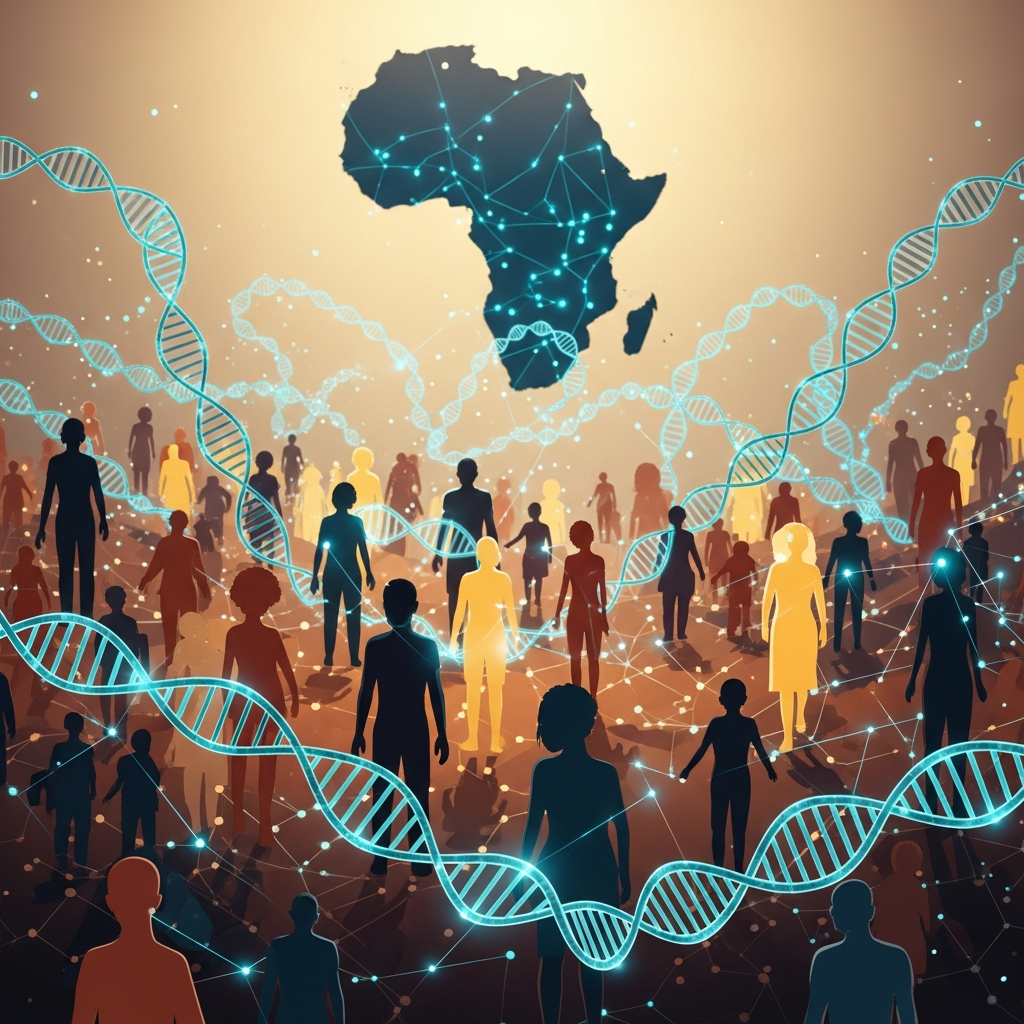
The "Out of Africa" theory has served as the cornerstone of paleoanthropology since the early 1960s, holding that anatomically modern Homo sapiens emerged from a single ancestral population in Africa roughly 150,000 to 200,000 years ago. Every major textbook in the field simplified this into a single directional arrow — a unified human family departing Africa and radiating across the globe — and for decades this narrative occupied the status of settled science rather than a testable hypothesis still open to empirical revision. The new Nature study, led by Brenna Henn at UC Davis and Simon Gravel at McGill University, directly challenges this foundation by demonstrating that at least two or more distinct ancient human groups were exchanging genes with each other for hundreds of thousands of years before converging into modern humans. The researchers sequenced fresh genomes from 44 Nama Indigenous people — members of the Khoe-San group, whose genetic lineage is among the oldest documented on Earth — and combined that data with genomic information from 290 additional Indigenous Africans spanning southern, eastern, and western regions of the continent. The earliest estimated population divergence in the dataset sits at approximately 120,000–135,000 years ago, implying that everything preceding that point looked dramatically different from the single-origin story that has structured our understanding of human prehistory for generations. Henn's own framing of the finding is striking: "We are proposing something people have never tested before." Gravel's algorithm tested hundreds of possible evolutionary scenarios and consistently found that models featuring inter-population gene flow provided far better explanations for the data than any single-origin model could offer. A separate Cambridge University study published in Nature Genetics confirmed that two ancestral populations diverged roughly 1.5 million years ago and then reunited approximately 300,000 years ago, with the genetic contribution of that mixing event estimated at ten times the contribution of Neanderthal admixture. The convergence of independent research teams arriving at similar conclusions substantially strengthens the credibility and urgency of the multi-population model.
What the Nama People's Genomes Revealed About Deep Human Diversity
The Nama people of southern Africa belong to the Khoe-San linguistic and cultural group, and their genetic profile is extraordinary by every available scientific measure. Studies of Khoe-San populations have consistently documented that 25% of their genetic variants are found nowhere else in the world, making them the bearers of a level of biological diversity that no other living population on Earth can match. Uppsala University's Mattias Jakobsson and his research team published a complementary study in Nature showing that roughly 80% of ancient genetic material from early humans is still preserved within living San communities — a finding that makes these populations, in a very real scientific sense, living archives of the deepest chapters of human evolution. By focusing on the Nama people specifically, Henn's team was able to reach further back into the genetic record than has ever been possible with any other population, revealing layers of ancestral structure that single-origin models had no analytical framework to accommodate. Yet here is the troubling paradox embedded in this discovery: while the Nama and other African populations carry the most profound genetic diversity on Earth, they represent less than 3% of the data in global GWAS databases, the genome-wide association studies that underpin modern medicine's understanding of disease risk and drug response. Africa is the continent with the greatest genetic diversity, and it is simultaneously the continent most systematically excluded from the genomic research that is shaping medical treatment for billions of people. The average African genome contains approximately one million more genetic variants than the average non-African genome — a staggering difference that means the full complexity of human genetic diversity remains almost entirely unmapped by mainstream science. This study didn't just reveal something important about human origins; it exposed how much the scientific community has been operating with a fundamentally incomplete dataset, and how many discoveries remain locked inside populations that have been chronically underinvested in and underrepresented.
The Biological Impossibility of Racial Purity — Confirmed at the Origin
When the Human Genome Project completed its work in 2003, it confirmed that 99.9% of the DNA across all human beings on Earth is identical, with the average difference between any two unrelated people amounting to just one nucleotide per thousand base pairs. This new study adds a critical layer to that picture: only 1–4% of genetic differences between contemporary human populations can be traced to variation between the ancestral stem groups that gave rise to modern humans. The implication is not subtle — any claim to racial purity, whether framed as a cultural identity, a biological characteristic, or a political ideology, runs directly against everything the genomic record shows about how our species actually formed. The evidence does not leave room for interpretation on this fundamental point. Neanderthals contributed between 1% and 4% of the genome of non-African modern humans, and modern humans reciprocally contributed approximately 6% of their genetic material back to Neanderthals — meaning that even the oldest and most structurally significant boundaries between human-adjacent species were permeable to genetic exchange. The 2023 National Academy of Sciences consensus report was unambiguous in stating that "race is a social construct, not an accurate biological category for describing genetic variation." This new research is the deepest archaeological confirmation of that conclusion, tracing the biological impossibility of purity not to recent cultural history but to the very earliest chapters of our species' existence on Earth. If modern humans themselves emerged through hundreds of thousands of years of inter-group exchange across ancient African populations, then purity was never a feature of the human story — it was always a retroactive fiction imposed on a history that was woven, from the very start, from many distinct and interacting threads.
Africa's Genomic Research Blind Spot — A Scientific Crisis With Clinical Consequences
The global genomics research apparatus has a well-documented structural bias: despite Africa being home to the greatest genetic diversity of any region on Earth, African-origin genomes account for fewer than 3% of the data in global GWAS databases. This is not a rounding error or a manageable gap in coverage — it is a fundamental flaw in how the scientific community has built its understanding of human biology and medicine over the past two decades. The H3Africa consortium's AGenDA project has been working to address this gap by sequencing whole genomes from more than 1,000 individuals across nine African countries, but the structural problem runs deeper than dataset composition alone. The majority of high-impact genomics research on African populations is still conducted by researchers at Western universities — UC Davis and McGill in the case of this study — with African populations as subjects rather than as partners or leaders. This extractive research model raises legitimate and urgent questions about data ownership, informed consent, benefit-sharing with source communities, and long-term scientific capacity building on the African continent. The clinical stakes of this imbalance are not abstract: because African patients are underrepresented in pharmacogenomic databases, treatment models for drug response and disease risk prediction are systematically less accurate for African-descent patients. The CYP2B6 genetic variant, which affects how patients metabolize the HIV antiretroviral efavirenz, is more prevalent in African populations and requires different dosing — a pharmacogenomic reality that only becomes clinically manageable when the underlying genomic data exists and is properly characterized. As the genomics market grows from $21.76 billion in 2025 to a projected $72.5 billion by 2033, the pressure to include African genomic data will intensify, and institutions like Nigeria's 54gene and South Africa's CPGR are positioning themselves to ensure that growth in African genomics is led by African researchers rather than extracted by Western ones.
The Political Misuse Trap — When Science Gets Weaponized Against Itself
The history of genetics being weaponized for political ends is not a hypothetical risk that researchers imagine in worst-case planning sessions — it is a documented, recurring pattern with deadly and well-documented precedents. Eugenics, built on distorted readings of genetics and evolutionary science, contributed to the deaths of at least 70,000 adults and 5,200 children in Nazi Germany alone, and was applied in sterilization programs and systematic social exclusion across the United States, United Kingdom, Canada, and other self-described liberal democracies. Aaron Panofsky's 2024 research, published in the Hastings Center Report, documented how white nationalist organizations actively monitor genetics journals, strip findings of their scientific context, and repackage them as support for racial hierarchies and biological arguments for separation. The 2019 El Paso shooter's manifesto explicitly cited genetics research as a justification for opposing racial mixing — a direct real-world example of scientific findings being converted into pretext for mass violence. The core message of this new Nature study — that humans emerged from multiple ancient groups — is precisely the kind of finding that can be surgically separated from its actual meaning, which is that exchange and convergence were constant and constitutive, and repurposed as a separatist argument that distinct origins mean distinct peoples with distinct destinies. The American Society of Human Genetics formally apologized in 2021 for the organization's historical participation in eugenics, which demonstrates that science's capacity for self-correction exists — but self-correction after the damage is done is insufficient. Proactive, sustained, and visible public communication from the researchers themselves is the only tool that can realistically hold the framing of a discovery this significant in honest territory before it gets captured by actors with entirely different agendas.
Positive & Negative Analysis
Positive Aspects
- Dismantling the Scientific Foundation of Racism at Its Deepest Root
The discovery that humanity emerged from a web of interacting ancient populations rather than a single pure ancestral group provides perhaps the most powerful and historically deep scientific argument yet against the concept of racial hierarchy or purity. The Human Genome Project established that 99.9% of human DNA is shared across all people alive today; this study now traces the origins of that shared uniformity to a history of constant exchange between ancient populations, meaning that genetic mixing was never an aberration from some pristine original state — it was the mechanism of human emergence itself. Combined with the National Academy of Sciences' 2023 formal declaration that race is a social construct rather than a meaningful biological category, this research removes the last credible scientific foothold for biological racism. The 1–4% figure for inter-group genetic variation traces ancestry-based difference to its deepest genetic root and finds it structurally minor — less significant, in fact, than the variation that already exists within any given population. If education systems and policy frameworks absorb this finding at the scale it deserves, it could meaningfully erode the justificatory logic available to race-based discrimination in law, medicine, and public life. Diversity was not a deviation from some original human standard — it always was the standard, built into our species from its very first chapters.
- Precision Medicine Gets a Long-Overdue Global Equity Correction
When African genomic research expands as a result of this study's momentum, the most direct and measurable beneficiary will be precision medicine — specifically, the millions of African-descent patients whose medical care is currently informed by datasets that do not adequately represent their biological reality. Current GWAS databases are over 97% non-African in origin, meaning that disease risk predictions and drug response models have been built almost entirely on non-African genetic variation, and then applied universally with systematically reduced accuracy for African-descent patients. This is not a theoretical equity concern — it is a documented clinical problem with real patient outcomes attached. CYP2B6 gene variants that affect how patients metabolize the HIV antiretroviral efavirenz require different dosing adjustments in African populations, adjustments that are poorly captured in current pharmacogenomic guidelines built predominantly from non-African data. As more African genomic data enters research databases in the coming years, treatment strategies for HIV/AIDS, tuberculosis, malaria, sickle cell disease, and a range of other conditions disproportionately affecting African populations will improve in ways that directly translate to saved lives. The average African genome carries approximately one million more genetic variants than the average non-African genome, meaning the potential discoveries waiting inside that unexplored diversity are immense — and the clinical benefits of unlocking them are not abstractions.
- Paleoanthropology and Ancient DNA Research Receive Their Strongest Investment Case Yet
The 2022 Nobel Prize in Physiology or Medicine awarded to Svante Pääbo for his work on ancient DNA signaled that paleoanthropology had earned recognition as a discipline capable of producing paradigm-shifting discoveries. This Nature study is the most powerful confirmation yet that such investment pays off in results proportional to the ambition of the questions being asked. DNA sequencing costs have collapsed from approximately $95 million per genome in 2001 to under $100 in 2024 — a reduction of nearly 950,000-fold — and that trajectory is continuing with no signs of plateauing. The global genomics market is projected to reach $72.5 billion by 2033, growing at an 18.2% CAGR, with Asia-Pacific growth leading at 19.0%. This market expansion will fund not just medical genomics but ancient DNA research that bears on fundamental questions about human origins, migration, and population history. Pääbo's technique of extracting DNA from ancient bone fragments opened the door; Henn and Gravel's methodological innovation of testing hundreds of evolutionary scenarios algorithmically has now walked through it to answer one of the most fundamental questions in science. The research pipeline this creates — increased investment, more African ancient DNA samples, improved recovery technology, expanded analytical frameworks — sets the stage for a decade of discoveries that will continue revising our understanding of human origins.
- A New and More Honest Story About Who Humanity Actually Is
The revelation that humans emerged through prolonged genetic exchange among multiple ancient populations rather than from a single pristine ancestral group is not simply an upgrade to a scientific model. It is a fundamental shift in the narrative that human civilization tells about itself — a shift comparable in cultural weight to Copernicus repositioning the Earth within the solar system. The clean "single-origin, global spread" diagram in every textbook has functioned as more than a scientific model; it has shaped how people conceptualize identity, ancestry, and belonging. Replacing it with a network model of multi-population exchange — a model in which diversity and mixing are primordial rather than derivative — has implications that extend into anthropology, history, philosophy, and the politics of identity. The Jebel Irhoud fossils in Morocco pushed back the emergence of Homo sapiens by 100,000 years, changing our timeline. This research changes our mechanism — the "how" of human emergence — and I believe that change is, in the long run, the more consequential one. A humanity that understands itself as the product of convergence rather than separation is better equipped to navigate the challenges of a deeply interconnected world, and the scientific record now unambiguously supports that self-understanding.
Concerns
- Political Misappropriation — The "Multiple Origins" Finding as a Separatist Weapon
The risk that "humans came from multiple ancient groups" gets weaponized as "therefore distinct groups are fundamentally separate entities" is not a hypothetical concern to be dismissed as overcautious — it is a documented pattern with deadly historical precedents that remains actively operative today. Aaron Panofsky's 2024 research in the Hastings Center Report confirmed that white nationalist organizations are already engaged in the systematic practice of mining genetics journals for findings that can be stripped of context and repurposed as evidence for racial hierarchy. The 2019 El Paso shooter's manifesto weaponized genetics research to argue against racial mixing, demonstrating that the pipeline from published science to violent political ideology is shorter than scientists often want to believe. Eugenics — the original systematic misappropriation of genetics research — contributed to the deaths of at least 70,000 people in Nazi Germany and was applied in forced sterilization programs across multiple liberal democracies in the twentieth century. The finding that modern humans emerged from multiple ancient populations is scientifically meaningful as evidence of constant exchange and convergence — but the separationist reading, which inverts this meaning entirely, is structurally available in the language of the finding itself. If the researchers and institutions involved do not engage in proactive, sustained, and technically precise public communication, the misreading will fill the vacuum that silence creates.
- The DNA Model vs. Fossil Record Gap — An Unresolved Scientific Tension
The multi-population ancestry model proposed in this study, while supported by compelling genomic evidence, does not sit comfortably with all available fossil evidence, and this tension represents a genuine and unresolved scientific challenge that the field will need to work through over the coming years. Paleoanthropologists have repeatedly observed that DNA-based evolutionary models often diverge from what the physical fossil record shows, and in a discipline where both lines of evidence should ideally converge, persistent divergence is a signal that something important remains unexplained. The discovery of Homo naledi in South Africa in 2013 — a hominin species that coexisted with modern humans far more recently than expected — demonstrated that the cast of characters in late human prehistory is still being discovered, and there may be additional ancient populations that neither fossil nor current DNA evidence has yet revealed. The hot, humid climate of sub-Saharan Africa severely degrades ancient DNA, meaning that the oldest and most scientifically valuable African ancient DNA samples are precisely the hardest to recover and sequence. This geographic and climatic bias in the ancient DNA record could systematically skew the models built from it in ways that are currently difficult to detect. I believe intellectual humility is warranted here: the multi-population model is the best current explanation for the genomic data available, but the best current explanation is not the same as the complete and final explanation.
- The Extractive Research Structure — Who Benefits From African Genomics?
This study's research subjects are the Nama Indigenous people of southern Africa, but its research leadership sits at UC Davis and McGill University — two North American institutions. This structural arrangement, in which African populations provide the biological material and global scientific insight while Western institutions receive the publications, the prestige, and the primary intellectual credit, represents the continuing operation of what critics call "extractive research" in the global south. It is a structural problem that has plagued international genomics research since the field began accumulating African samples in the 1990s, and its persistence despite decades of critique reflects how deeply the incentive structures of academic publishing and research funding are organized around Western institutional advantage. The data ownership and benefit-sharing questions this arrangement raises are not merely academic — the Nama people and their community have a legitimate claim to understand and participate in decisions about how their genetic material is used, published, and commercialized by institutions with which they have no ongoing governance relationship. African research institutions including Nigeria's 54gene, South Africa's CPGR, and the H3Africa consortium are working to change this dynamic by building local genomics capacity, but international partnerships in genomics still overwhelmingly run from West to Africa rather than between African institutions as co-equal participants. The ethical framework governing research involving Indigenous populations — which includes principles of free, prior, and informed consent and community benefit — requires ongoing reinforcement as African genomics becomes an increasingly lucrative and scientifically productive area of investigation.
- The Textbook Transition Gap — A Decade of Educational Confusion
The typical lag between a scientific paradigm shift in research journals and its incorporation into secondary and even university-level education runs between ten and twenty years, and this study's findings are no exception to that pattern. Major university textbooks may begin revising their human origins chapters within three to five years of this research becoming established consensus, but secondary school science curricula — governed by national and state-level adoption cycles — will likely not reflect the multi-population model until 2030 or 2031 in most countries. In the transition window between now and then, students around the world will be exposed to contradictory information: their textbooks describe a single-origin model while science news and educational media describe a multi-population model, and teachers caught between these two framings will often lack the updated training resources to navigate the gap confidently. This is not a hypothetical problem — it is the predictable consequence of every major paradigm shift in science education, from the displacement of the fixed continents model by plate tectonics to the incorporation of ancient DNA findings about Neanderthal admixture. Without proactive curriculum development support, teacher training, and standards updates, the transition creates a real risk of oversimplification, misinformation, and student confusion that could persist for a generation.
- The Science Communication Failure Risk — When "Textbook Was Wrong" Backfires
The framing "the textbook was wrong" is emotionally compelling and journalistically convenient, but it carries a real and underappreciated risk for public trust in science if it is not paired with equally compelling explanation of why that's actually a sign of scientific health rather than failure. The argument "if 60-year-old consensus was wrong, maybe the new consensus will be wrong too" is a structurally easy inference for a public already primed by decades of motivated anti-science messaging around climate change, vaccine safety, and dietary guidelines. Each high-profile scientific revision that gets communicated without adequate context provides ammunition for the general claim that "scientists don't really know anything" — a claim that, while empirically false, is rhetorically powerful and socially damaging. The correct framing — that science's greatest strength is precisely its capacity to revise itself when confronted with better evidence and better methods — requires more words, more nuance, and more trust in the audience than the "wrong textbook" shorthand demands. If science journalists, social media commenters, and even the researchers themselves default to the shock-value framing without adequately explaining the self-correcting mechanism, this discovery could paradoxically strengthen science skepticism rather than inspiring confidence in scientific progress. The responsibility for getting this communication right falls not just on the research team but on the entire institutional ecosystem — journals, universities, science journalists, and public education systems — that shapes how major discoveries enter the public conversation.
Outlook
In the short term — the next one to six months — the academic response to this paper is going to be explosive, and I'm not using that word loosely. This study will trigger at least three to five direct rebuttals or rapid-response papers in the months ahead. Researchers who have spent careers within the single-origin framework will not simply fold. The most likely defensive posture will be something along the lines of: "The complexity is contained within Africa; this is not a rehabilitation of multiregionalism." That reading is partially accurate, but it sidesteps the actual point being made. The debate isn't about whether Africa matters as the continent of human origins — everyone agrees on that. The question is whether a single ancestral population or a web of interacting populations gave rise to modern humans, and on that specific question, the data now clearly favors the web. This framing battle is going to play out in journal response letters, conference panel discussions, and peer review within the next few months.
Both the American Association of Biological Anthropologists and the European Human Genetics Conference are scheduled for later in 2026, and this study will almost certainly dominate the agenda at both. Henn and Gravel will very likely receive keynote invitations. The media pipeline is already activating — Smithsonian Magazine has published its initial coverage, and the distance from a Smithsonian report to a BBC or National Geographic documentary pitch is short when the finding is this consequential. I expect at least one major documentary on this research to enter development within three months of the Nature publication. The window for the research team to establish the correct framing in the public imagination is narrow, and I believe Henn and Gravel appearing on TED stages, major science podcasts, and YouTube platforms is not promotional activity — it is a scientific responsibility inseparable from the publication itself.
Social media framing deserves urgent attention in this same short-term window. The study's core message — that all modern humans emerged from multiple ancient populations that spent hundreds of thousands of years in genetic dialogue — is emotionally powerful and scientifically accurate. But "humans had multiple ancient origins" is only a few words away from being repurposed as "humans are fundamentally divided by origin." The difference between those two readings is the difference between the study's actual scientific conclusion and its weaponized inversion. Real-time monitoring of how this research gets framed on major platforms, combined with rapid-response science communication from the research team and their institutional partners, is not optional in the current information environment. The precedent established by how early and clearly the correct interpretation gets stated publicly will shape how this research is cited and misused for years to come.
In the medium term — roughly six months to two years from now — the defining development will be a technology-driven explosion in African ancient DNA research. DNA sequencing costs have fallen from approximately $95 million per genome in 2001 to under $100 in 2024, a reduction of nearly 950,000-fold. That trajectory continues: by 2027–2028, the cost per genome is likely to fall below $50, and simultaneously, advances in ultra-low-quantity DNA recovery techniques will make it feasible to extract usable data from ancient African samples that are currently too degraded to analyze. Sub-Saharan Africa's hot, humid climate has been one of the most brutal environments for ancient DNA preservation on the planet — but the technology is catching up faster than most researchers expected even five years ago. Ancient samples from equatorial Africa that were previously considered unworkable will begin yielding data within this decade, and that data will almost certainly force additional revisions to the models that emerge from the current study.
The global genomics market is projected to grow from $21.76 billion in 2025 to $72.5 billion by 2033, a compound annual growth rate of 18.2%. The Asia-Pacific region leads growth at 19.0% CAGR, indicating that genomics research capacity is diversifying beyond traditional Western centers. The H3Africa consortium's AGenDA project — which is sequencing whole genomes from more than 1,000 individuals across nine African countries — will attract substantially more attention and funding as a direct consequence of the visibility this study generates. My estimate is that by 2027–2028, African-origin genomes will represent between 5% and 8% of global GWAS data, up from less than 3% today. That statistical change has direct clinical consequences that cannot be overstated. Institutions like Nigeria's 54gene and South Africa's CPGR are scaling up precisely to ensure that African genomics is led by African researchers, and this study gives them a powerful argument to make that case to international funders.
The clinical implications of expanded African genomic research deserve their own dedicated attention. African populations carry an average of roughly one million more genetic variants than non-African populations. The systematic gap in pharmacogenomic representation means that drug response models are structurally less accurate for African-descent patients today. CYP2B6 gene variants that affect efavirenz dosing in HIV treatment, genetic risk factors for sickle cell disease, and population-specific tuberculosis susceptibility patterns all fall into this underdocumented space. As more African genomic data enters research pipelines over the next two to three years, treatment strategies for the diseases that disproportionately burden African populations will improve in ways that translate directly to saved lives. This is not an abstract academic benefit — it is a measurable clinical improvement with a documented mechanism, waiting on the data.
Looking out to the long term — 2028 through 2031 and beyond — the most certain transformation will be in formal education. Major university textbooks will begin replacing the "single-origin, global spread" arrow diagram with network-based models showing multi-population exchange. Secondary school science curricula, governed by national adoption cycles, will take longer to reflect the new consensus — likely from 2030 or 2031 onward in most countries. In the transition window between now and then, students will be exposed to contradictory information: textbooks maintaining single-origin models while news coverage reports something fundamentally different. Teachers without updated training resources will be caught in the middle, and without systematic curriculum support, there is a real risk of oversimplification or outright confusion in classrooms around the world. I believe this revision could be the most consequential update to evolutionary science education since Darwin's framework established the foundations — not because it overturns evolution, but because it reshapes the central narrative of how our specific species emerged.
At the deepest level, this discovery will exert sustained long-term pressure on institutional uses of racial categories across medicine, law, and policy. The National Academies issued a consensus report in 2023 calling on genetics researchers to reconsider how and why they use race and ethnicity labels. If the finding that humans emerged from multi-population exchange becomes genuinely internalized by the general public at scale — not just known to specialists, but understood and believed — the pressure on institutional frameworks that treat race as a stable biological category will intensify. Race-based prescribing guidelines in medicine, which apply population-level adjustments based on self-reported race rather than individual genotype, are increasingly understood to be inadequate, and the data from African genomic research will accelerate the transition toward genotype-based precision approaches. Census classification of race and the administrative uses of racial categories in public policy will face renewed academic and eventually political scrutiny. These are slow processes measured in decades, but their direction is now set.
Let me state my scenarios explicitly and honestly. The bull case — roughly 20% probability — sees African genomic data representation climb from 3% to over 20% within a decade, the multi-population model revised two or three additional times as new data arrives, and precision medicine for African-descent patients improving dramatically. The base case — roughly 65% probability — sees scientific consensus on multi-population ancestry solidify within three to five years, public education catching up by 2030–2031, and African genomic representation climbing gradually to 5–10%. Political misuse of the research remains a persistent background problem but is managed through proactive communication. The bear case — roughly 15% probability, and the one that genuinely concerns me most — sees the "multiple origins" framing weaponized by ethno-nationalist movements at scale, triggering a chilling effect on research communication that contracts both scientific transparency and public education simultaneously. I believe the quality of science communication over the next six to twelve months is the single most important variable determining which of these scenarios materializes, and I am watching that variable closely.
My honest final assessment is that the findings in this study are robust, reproducible, and scientifically consequential at a level that deserves the word "historic." What remains undetermined is whether the researchers and institutions responsible for translating those findings into public knowledge will do that work with the precision, nuance, and sustained engagement the moment demands. I am cautiously optimistic about that — but cautiously. The history of genetics being weaponized for political purposes makes optimism conditional. The framing that matters most in communicating this discovery is not "the textbook was wrong." It is "science corrected itself — and here is what the corrected version tells us about who we are." That second framing is not only more accurate; it is the version that teaches something genuinely important about how knowledge works and why that process is worth trusting.
Sources / References
- A Weakly Structured Stem for Human Origins in Africa — Nature
- Homo sapiens-Specific Evolution Unveiled by Ancient Southern African Genomes — Nature
- Genetic Study Reveals Hidden Chapter in Human Evolution — Cambridge University
- Human Genomic Variation — NIH Genome.gov
- DNA Suggests Modern Humans Emerged From Several Groups in Africa — Smithsonian Magazine
- DNA Research Just Rewrote the Origin of the Human Species — ScienceDaily
- Race and Ethnicity Labels in Genetics Research — National Academies
- Countering the Weaponization of Genetics — Hastings Center Report
- Genomics Market Size and Growth Analysis 2025–2033 — Grand View Research
- DNA Sequencing Costs Data — NIH Genome.gov