
One Atom Just Flipped a Century of Petrochemistry — The Day ETH Zurich Turned CO2 Into Methanol With a Single Indium Atom
Summary
The technology to extract methanol from atmospheric CO2 has reached the atomic scale. ETH Zurich anchored individual indium atoms on hafnium oxide, achieving 70% higher productivity than conventional catalysts. This is not an incremental improvement but a potential key to unlocking fossil-free chemistry.
Key Points
70% Higher Productivity With Single-Atom Catalyst
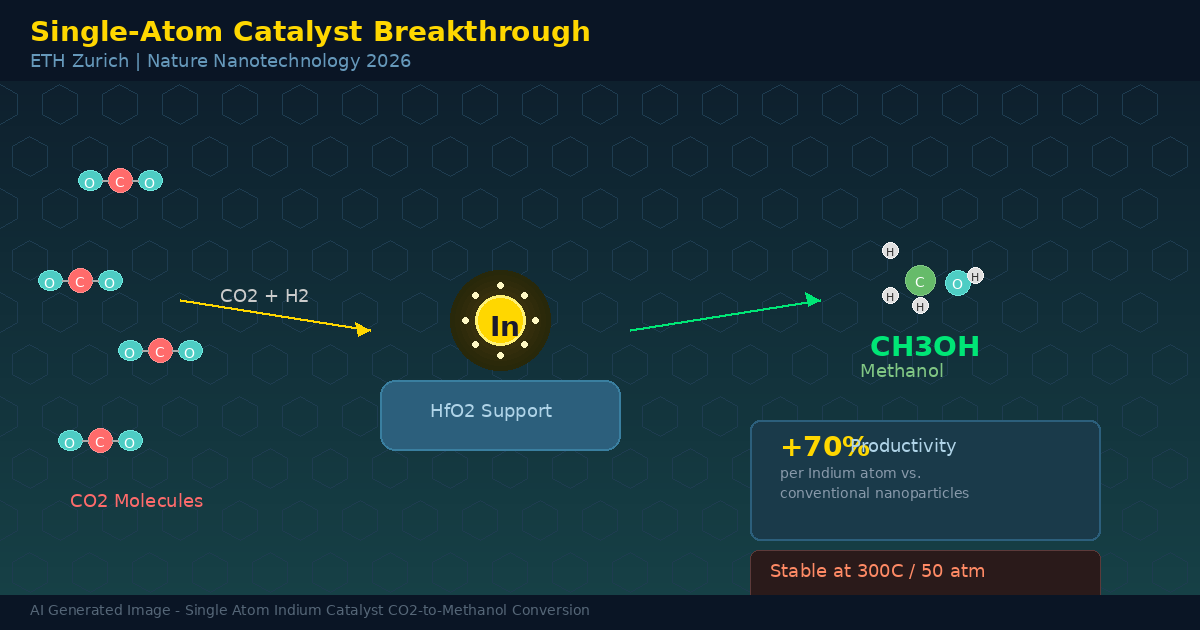
The ETH Zurich team anchored individual indium atoms on hafnium oxide surfaces, achieving up to 70% higher methanol productivity per indium atom compared to conventional indium-zirconium oxide nanoparticle catalysts. Published in Nature Nanotechnology, this result marks a critical milestone in shifting the catalyst design paradigm from nanoparticle clusters to the single-atom level. In conventional nanoparticles, only surface atoms participate in reactions while the bulk sits idle. In single-atom catalysts, every metal atom functions as an active site, dramatically improving precious metal utilization efficiency.
Flame Spray Pyrolysis: An Industrially Proven Synthesis Method
The team employed flame spray pyrolysis, combusting precursor materials at 2,000 to 3,000 degrees Celsius and rapidly cooling them to lock individual indium atoms onto hafnium oxide surfaces. The critical strength of this technique is that it is already used industrially. No entirely new equipment needs to be developed, meaning existing infrastructure can be leveraged for production. This lowers the lab-to-factory technology transfer barrier significantly compared to other advanced synthesis methods. The choice of hafnium oxide as the support material was decisive, as it holds atoms firmly while preserving their reactivity.
Stability Confirmed at 300C and 50 Atmospheres
The most common failure pattern in catalysis research is a technology that works perfectly in the lab but collapses under real industrial conditions. This single-atom indium catalyst remained stable at 300 degrees Celsius and 50 atmospheres of pressure, conditions that correspond to actual methanol synthesis plant operations. This is not a lab-only discovery but a demonstration of industrial applicability from the outset. It shows the research team approached the problem with practical applications in mind, providing a crucial data point for potential industrial partners evaluating the technology.
A $40 Billion Methanol Market at the Green Transition Crossroads
The global methanol market is valued at roughly $40 billion in 2026 and projected to grow to $52 billion by 2034. While most methanol currently comes from natural gas, the green methanol market is projected to explode from $3.16 billion in 2025 to $19.95 billion by 2035 at a staggering 21.5% CAGR. Companies like SABIC and Fairway Methanol are already investing in CCU-based methanol production, creating both the industrial demand and infrastructure needed for commercial adoption of single-atom catalyst technology.
From Trial-and-Error to Rational Catalyst Design
The most revolutionary value of single-atom catalysts lies not in the efficiency gain itself but in the methodological transformation of catalysis science. In nanoparticle clusters, isolating which atom performs which function was nearly impossible, and catalyst development was fundamentally a domain of trial and error. With single-atom catalysts, each atom behavior can be observed individually, enabling atomic-level elucidation of reaction mechanisms. This is the equivalent of cracking open catalysis black box, and combined with AI and machine learning, it opens the door to an era of data-driven rational design.
Positive & Negative Analysis
Positive Aspects
- Maximized Metal Utilization
Single-atom catalysts enable nearly 100% metal utilization by making every atom an active catalytic site. In conventional nanoparticle catalysts, the bulk of the metal was trapped inside, never participating in reactions. This approach produces far more methanol with the same amount of indium, translating to dramatic raw material cost reductions. At industrial scale, this difference could mean billions of dollars in savings across the global methanol supply chain.
- Industrially Proven Synthesis Method
Flame spray pyrolysis is already in industrial use, eliminating the need to develop entirely new equipment or processes. Existing infrastructure can be leveraged for single-atom catalyst production, making the barrier to industrialization significantly lower than other cutting-edge synthesis methods. This is a decisive factor that could meaningfully accelerate the commercialization timeline for this technology.
- Industrial Condition Durability Demonstrated
Stability at 300 degrees Celsius and 50 atmospheres, which are actual methanol synthesis plant operating conditions, has been confirmed. This contrasts with most catalysis research that only reports performance under lab conditions. The research design shows a focus on practical application from the beginning, which significantly de-risks the technology for potential industrial partners.
- Reaction Mechanism Transparency
Clean analytical signals from individual atoms enable atomic-level elucidation of reaction mechanisms, something impossible with nanoparticle catalysts. Combined with AI and machine learning-based catalyst screening, this transparency accelerates the transition from trial-and-error to data-driven rational design. The long-term potential to revolutionize research methodology across all of catalysis science cannot be overstated.
- A Viable Path to Fossil-Free Chemistry
Using CO2 as feedstock combined with green hydrogen from renewable energy makes climate-neutral methanol production achievable. This is no longer theoretical speculation but an industrially verifiable pathway that is opening now. It represents a realistic alternative to fossil-fuel-based production in the $40 billion methanol market, with significant implications for global carbon emission reduction targets.
Concerns
- Structural Scale-Up Challenges
Transitioning from laboratory milligram-scale to industrial kilogram-scale production remains the most formidable challenge in single-atom catalysis. Sintering, where atoms clump together during high-temperature processing, becomes progressively harder to control as scale increases. While the ETH team has achieved kilogram-scale production of platinum single-atom catalysts for automotive applications, this success does not automatically transfer to every metal-support combination.
- Limited Long-Term Operational Stability Data
While operation under harsh conditions has been confirmed, whether performance holds after thousands of hours of continuous operation is a separate question. Degradation mechanisms including support corrosion, active-site dissolution, and catalyst reconstruction often manifest only over extended time periods. Comprehensive long-term durability data must be established before any commercial deployment can proceed.
- Indium Supply Chain Risks
Indium is a rare metal with annual global production of only about 900 tons, with LCD panels and semiconductors already representing major demand centers. While single-atom catalysts reduce the amount of metal needed per unit of production, total demand at large industrial scale could still create meaningful price volatility. Parallel development of alternative metals or indium recycling technologies will be essential.
- Green Hydrogen Price Competitiveness Gap
Climate-neutral methanol production requires green hydrogen, currently priced at $4 to $6 per kilogram, which lacks competitiveness against natural-gas-based methanol. The IEA projects prices falling below $2 per kilogram by 2030, but achieving this target depends on renewable energy infrastructure expansion rates that carry significant uncertainty. Without closing this cost gap, industrial transition will remain slow regardless of catalyst performance.
Outlook
Within the next six months, the ripple effects of this research will first appear in academia. Thanks to the impact factor of a Nature Nanotechnology publication, catalysis research groups worldwide will jump into follow-up studies reproducing and modifying the indium-hafnium system. Research exploring the generalizability of flame spray pyrolysis to other metal-support combinations will intensify. The Swiss National Centre of Competence in Research (NCCR) Catalysis program, led by ETH Zurich, will stand at the center of this movement. The trend of surging publications on single-atom catalysts in top-tier catalysis journals is already well established, and this breakthrough will press the accelerator once more.
Another near-term trend worth watching is the convergence of machine learning and single-atom catalysis. AI-driven catalyst screening is already growing rapidly in academia, and the clean analytical data that single-atom catalysts produce is ideal training data for machine learning models. Within the next one to two years, a hybrid research cycle where AI predicts optimal metal-support combinations and laboratories validate them is highly likely to become standardized. This is a genuine game changer that could exponentially accelerate catalyst development timelines. Discoveries that previously took years could be compressed into months.
Looking at the medium term, pilot-plant-scale demonstrations could begin by 2027 to 2028. Since the ETH team has already proven stability under industrial conditions, collaborative research with chemical companies and technology transfer could proceed quickly. Companies like SABIC and Mitsui are already investing in CCU-based methanol production, so attempts to integrate single-atom catalysts into existing processes will emerge. With the green methanol market projected to grow at 21.5% annually, the incentive for corporate technology adoption is substantial. The European Union Carbon Border Adjustment Mechanism (CBAM), entering full implementation from 2026, will add regulatory pressure on carbon-intensive methanol production, further accelerating the technology transition.
The most critical validation item at the pilot stage will be long-term operational stability. Running for a few hours in a laboratory and running for thousands of continuous hours in a factory are problems of entirely different dimensions. Catalyst deactivation rate, regenerability, and poison tolerance must be rigorously evaluated during the pilot phase. Only after this data is secured can investment decisions be made and commercial plant designs begin in earnest.
Sketching out long-term scenarios, the most optimistic bull case sees single-atom-catalyst-based CO2-to-methanol conversion plants beginning commercial operations around 2030. If the International Energy Agency projection that green hydrogen prices will fall from today $4 to $6 to below $2 per kilogram by 2030 materializes, the economics problem is largely resolved. In this scenario, traditional fossil-fuel-based methanol plants begin gradually transitioning to CCU-based facilities, and structural change in the global methanol industry becomes visible. The shipping industry demand for green methanol fuel, with Maersk already ordering methanol-powered vessels, will serve as a powerful additional catalyst for market transformation.
In the base scenario, technological maturity is achieved but economic viability takes longer to secure. The pathway runs through pilot demonstrations in 2028 to 2029 and early commercialization in 2031 to 2032. This plays out if green hydrogen prices decline slower than expected or unforeseen technical challenges surface during scale-up. Even so, green methanol capturing 5 to 10 percent of the total methanol market by 2034 remains achievable. In this scenario, single-atom catalyst technology still establishes a firm position in both academia and industry, and begins expanding into other chemical reactions such as Fischer-Tropsch synthesis and ammonia synthesis.
In the bear scenario, industrial scale-up of single-atom catalysts proves far more difficult than anticipated. Sintering problems, catalyst lifetime limitations, and indium supply constraints act in concert to push commercialization beyond 2035. If natural gas prices remain low and the price gap with conventional methanol production fails to narrow, and if carbon pricing implementation is delayed, the momentum for market transformation weakens. However, even in this scenario the fundamental scientific value remains intact, and the revolution in catalyst design methodology continues to advance.
My reading is that reality will land somewhere between the base and bull cases. The use of flame spray pyrolysis, an industrially proven synthesis method, is the critical accelerating factor. Relying not on purely novel laboratory techniques but on existing industrial infrastructure can significantly speed up technology transfer. Additionally, global decarbonization pressure is intensifying from multiple directions simultaneously: the EU CBAM, the US Inflation Reduction Act green hydrogen subsidies, and shipping industry decarbonization regulations are all serving as external forces driving market transformation. A single catalyst will not change the world by itself, but the door of possibility that this catalyst has opened will not close again.
Sources / References
- Single atoms of indium on hafnia enable superior CO2-based methanol synthesis — Nature Nanotechnology
- Using individual atoms to achieve fossil-free chemistry — ETH Zurich
- Scientists turn CO2 into fuel using breakthrough single-atom catalyst — ScienceDaily
- Methanol Market Size to Surpass USD 52.12 Billion by 2034 — Precedence Research
- Green Methanol Market Size 2026 to 2035 — Cervicorn Consulting
- Carbon Capture And Utilization Market Size and Share Analysis 2031 — Mordor Intelligence
- Challenge and Chance of Single Atom Catalysis — American Chemical Society