
"The Most Thrilling Drive of My Life" — There Was Antimatter in the Back of the Truck
Summary
CERN's first antimatter truck transport signals the end of its monopoly on antimatter science — an unprecedented fusion of physics and engineering.
Key Points
BASE-STEP: A One-Ton Revolution That Traps and Moves Antimatter
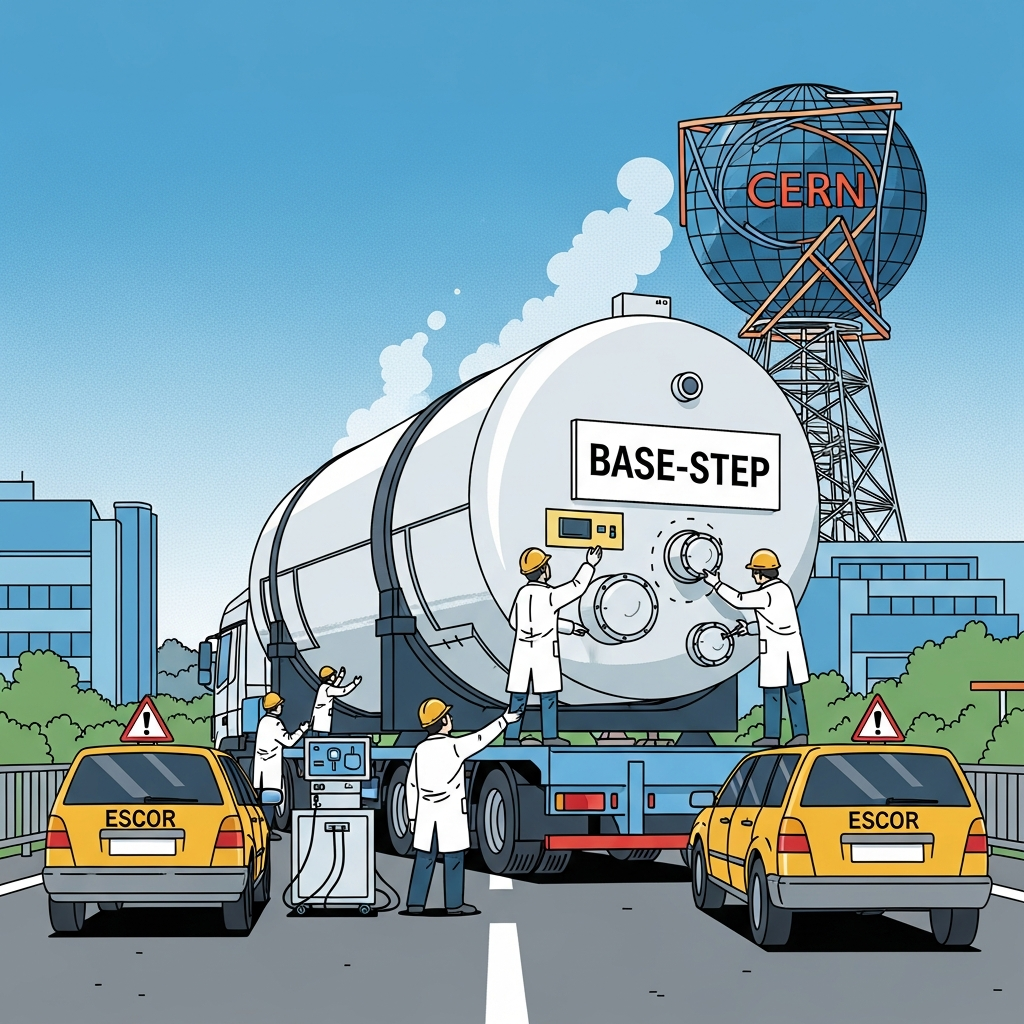
BASE-STEP — Symmetry Tests in Experiments with Portable Antiprotons — integrates gold-plated oxygen-free copper electrode stacks, a superconducting magnet maintaining temperatures below 8.2 Kelvin (-265 degrees Celsius), and a carbon steel vacuum chamber for external magnetic shielding into a single mobile apparatus weighing approximately 1 ton (1,000 kg). The device was originally designed to be car-sized but grew during development, yet the team still managed to keep it slim enough to pass through a standard doorway. Mounted on an aluminum frame compatible with forklifts and cranes, the trap features a smartphone interface for real-time antiproton monitoring. According to the BASE-STEP design paper published in Review of Scientific Instruments, the system can store antiprotons for over 1.08 years and maintain safe operation for 10 hours during power loss. This is not merely a physics experiment — it is a triumph of precision engineering at the intersection of cryogenic technology, ultra-high vacuum systems, magnetic shielding, and vibration absorption.
92 Antiprotons on a 30-Minute Drive — Humanity's First Antimatter Road Trip
On March 24, 2026, the BASE team loaded 92 antiprotons onto a truck and drove them across CERN's campus for 30 minutes at speeds of up to approximately 47 km/h (29 mph), escorted by convoy vehicles with flashing lights. Every single antiproton remained stable throughout the journey. This achievement built upon a 2024 precursor experiment in which the team successfully transported ordinary protons across CERN's campus for four hours with zero losses, as confirmed in a Nature publication. Antimatter is exponentially more demanding than ordinary matter — contact with residual gas molecules causes instant annihilation, requiring vacuum conditions far more extreme than those needed for protons. The fact that the team cleared this technical barrier marks the definitive proof of concept for antimatter mobility.
Escaping CERN's Magnetic Noise — 100 to 1,000 Times Greater Precision Awaits
CERN's Antimatter Factory sits adjacent to particle accelerators that generate electromagnetic noise at the level of billionths of a tesla — fluctuations that have imposed a hard ceiling on measurement precision for antiproton properties. The dedicated precision measurement facility under construction at Heinrich Heine University in Dusseldorf, Germany, scheduled to begin operations in 2029, will be free of this interference. According to Stefan Ulmer, measurements conducted at external facilities could achieve precision "at least 100 to 1,000 times higher than what is currently possible at CERN." The goal is to compare the charge-to-mass ratio and intrinsic magnetic moment of antiprotons against those of protons to hunt for CPT (charge-parity-time) symmetry violations. The BASE collaboration has already achieved parts-per-billion precision on antiproton magnetic moment measurements, constraining CPT-violating effects below 1.8 times 10 to the minus 24 gigaelectronvolts. Moving to an external facility is like relocating from a construction site to a soundproof studio when you are trying to hear a whisper.
The Matter-Antimatter Mystery — Where Did Half the Universe Go?
When the Big Bang occurred 13.8 billion years ago, matter and antimatter were produced in equal quantities — at least in theory. Yet the observable universe today is overwhelmingly composed of matter, with virtually no antimatter to be found. This matter-antimatter asymmetry remains one of the most profound unsolved problems in modern physics. As Professor Tara Shears explained, "Half the universe was antimatter when it began." The amount of CP violation predicted by the Standard Model is many orders of magnitude too small to account for the observed asymmetry, as confirmed by LHCb's 2025 landmark observation of CP symmetry breaking in baryon decays at 5.2 standard deviations. The ultimate objective of transporting antiprotons to quieter facilities is to compare proton and antiproton properties at unprecedented precision — and if even the slightest difference is found, it would crack open a door to physics beyond the Standard Model.
Democratizing Science — From CERN's Monopoly to a Pan-European Research Network
Until now, antimatter research has been the exclusive domain of CERN, the only facility on Earth capable of producing and storing antiprotons. Transport capability fundamentally disrupts this monopoly. Beginning with Dusseldorf, external laboratories including GSI in Darmstadt, Germany, and potentially RIKEN in Japan could conduct antimatter experiments independently. The ERC-funded STEP project (1.8 million euros, Project ID 852818) led by Christian Smorra already envisions a broader antimatter delivery program across Europe. Science News reports that scientists are planning "an antimatter delivery program to other laboratories across Europe." This decentralization reduces competition for CERN's limited beam time, enables more research teams to run parallel experiments, and allows independent cross-verification of results — elevating scientific credibility across the entire field.
Positive & Negative Analysis
Positive Aspects
- Ultra-Precision CPT Symmetry Testing Becomes Achievable
Conducting antiproton measurements in magnetically quiet environments outside CERN could improve precision by 100 to 1,000 times over current capabilities. This means scientists could detect or rule out differences between matter and antimatter at the level of one-trillionth (10 to the minus 12). The BASE collaboration's existing measurement already constrains CPT violation to below 1.8 times 10 to the minus 24 GeV, and the leap in precision enabled by external facilities could push this boundary by orders of magnitude further. If CPT symmetry violation is discovered, it would represent a Nobel Prize-caliber finding that fundamentally rewrites our understanding of why matter exists in the universe.
- Democratization and Decentralization of Antimatter Research
The CERN monopoly on antimatter science — born not from policy but from the simple fact that no one else could produce antiprotons — is now structurally breakable. The ERC's 1.8 million euro investment in the STEP project has laid the groundwork for an antimatter delivery program spanning multiple European institutions. Dusseldorf's Heinrich Heine University already has confirmed funding from Germany's Federal Ministry of Education and Research (BMBF). When multiple laboratories independently measure the same antiproton properties, the resulting cross-verification dramatically increases scientific confidence. This is not merely a logistical convenience — it is a structural upgrade to the epistemic rigor of the entire field.
- A New Paradigm Where Fundamental Science Meets Precision Engineering
BASE-STEP represents a convergence of cryogenic engineering, ultra-high vacuum technology, magnetic shielding, vibration absorption, and real-time monitoring systems — all compressed into a single mobile device. These technologies have direct spillover potential into adjacent fields. Quantum computing requires extreme cryogenic environments. PET (Positron Emission Tomography) scanners use antimatter particles for medical imaging. Deep space exploration demands vibration-resistant precision instruments. As Oxford professor Alan Barr observed, "Developing technology for difficult applications generates unexpected benefits elsewhere." The World Wide Web was born at CERN — the pattern of fundamental science spawning transformative applications repeats throughout history.
- Opening the Door to Physics Beyond the Standard Model
Ultra-precise antiproton measurements offer one of the most direct experimental routes to testing whether the Standard Model is complete. The 2025 LHCb observation of CP violation in baryon decays confirmed that the Standard Model's predicted CP violation is "many orders of magnitude too small" to explain the observed matter-antimatter imbalance. Something beyond the Standard Model must be responsible. By comparing proton and antiproton properties at 1,000 times current precision, researchers could detect the subtle signature of that new physics. This experimental program represents a concrete, achievable path toward answering one of humanity's oldest questions: why does anything exist at all?
- Strengthening Europe's Particle Physics Infrastructure
The development of antimatter transport capabilities positions Europe to consolidate its global leadership in fundamental physics. The EU's Horizon Europe framework, with 14 billion euros allocated for 2026-2027, could incorporate dedicated budget lines for antimatter transport and external research programs. As multiple European nations compete to host antimatter research facilities, investment flows into scientific infrastructure that benefits not just physics but the broader innovation ecosystem. Italy's INFN laboratories and Germany's GSI/FAIR facility (despite ongoing commissioning challenges) represent potential nodes in a future pan-European antimatter research network that would have no equivalent anywhere else in the world.
Concerns
- Extreme Technical Requirements and Uncertainty Around Long-Distance Transport
BASE-STEP currently operates autonomously for approximately 4 hours, but the journey to Dusseldorf takes 8 to 12 hours depending on route, border crossings, and safety protocols. Bridging this gap requires integrating a truck-mounted cryocooler generator capable of maintaining superconducting magnet temperatures below 8.2 Kelvin during transit — technology that remains unproven. The BASE-STEP design paper specifies 10 hours of safe operation during power loss, but highway vibrations, ambient temperature fluctuations, and unforeseen disruptions over an 8-to-12-hour journey present engineering challenges qualitatively different from a 30-minute campus drive. If the cryocooler fails and the superconducting magnet quenches (loses superconductivity), the entire antiproton cargo is lost.
- Inflated Public Expectations About Antimatter Energy Applications
Media coverage of antimatter transport will inevitably spawn headlines about "the antimatter energy era" and "antimatter-powered spacecraft." The reality demands a cold shower. Producing one gram of antimatter would cost tens of trillions of dollars by current estimates — NASA's figures suggest approximately $62.5 trillion per gram. Annual antimatter production at CERN could power a 100-watt light bulb for about 5 seconds, and all the antimatter ever produced in the facility's history would last only a few minutes. Antimatter's value lies not as an energy source but as a tool for probing the universe's deepest symmetries. When this distinction blurs in public discourse, the gap between expectation and reality breeds disillusionment with fundamental science investment.
- Astronomical Costs and Finite Basic Science Budgets
The full cost envelope for an antimatter transport program — CERN's Antimatter Factory operations, BASE-STEP development, receiving facility construction at multiple sites, road transport infrastructure — runs into the hundreds of millions of euros. Basic science budgets across Europe are not infinite. Germany's FAIR facility, a key potential partner for decentralized antimatter research, has faced over 1 billion euros in cost overruns and suffered fire damage in February 2026. Dedicating resources to antimatter external experimentation inevitably creates tension with other research programs competing for the same funding pool. In an era of fiscal austerity, every euro directed toward antimatter transport is a euro not spent on climate science, biomedical research, or fusion energy.
- The Complete Absence of a Regulatory Framework for Antimatter Road Transport
No international regulations or safety standards currently exist for transporting antimatter by road. With 92 antiprotons, the annihilation energy is too small to detect without specialized instruments, making the practical risk effectively zero. But scaling up is the explicit goal. As transport volumes grow from dozens to thousands of antiprotons, and as future experiments contemplate moving antihydrogen or other antimatter species, the absence of transport safety standards, accident response protocols, and cross-border regulatory coordination becomes a serious institutional gap. The journey from Geneva to Dusseldorf crosses Swiss, French, and German jurisdictions — three separate regulatory environments with no precedent for antimatter transit.
- Beam Time Competition Between Internal CERN Experiments and External Transport
Producing antiprotons for external transport requires dedicated allocations from CERN's Antiproton Decelerator beam time — a scarce resource already contested by six active antimatter experiments (AEGIS, ALPHA, ASACUSA, BASE, GBAR, and PUMA). CERN's 2026 accelerator schedule confirms that Run 3 has been extended through July with Long Shutdown 3 starting afterward, making beam time even more constrained. Diverting antiprotons for truck delivery creates a zero-sum competition with internal experiments whose scientists have spent years designing programs around existing beam time allocations. The resulting science-political tensions could slow rather than accelerate antimatter research if not managed through transparent allocation frameworks.
Outlook
Let me start with what happens in the next few months. The BASE team will repeat campus transport experiments in the second half of 2026, but this time they will stretch the duration from 30 minutes to several hours, stress-testing the trap's long-term stability under real road conditions. The critical engineering milestone is extending autonomous operation from the current 4 hours to 6, then 8 hours — each increment requiring refinements to thermal insulation, vibration dampening, and battery reserve management. In parallel, the team will begin testing truck-mounted cryocooler generators, transitioning from passive liquid helium cooling to an active cooling system that would, if successful, enable virtually unlimited transport duration. They will also experiment with increasing the number of antiprotons per trip from 92 to hundreds or thousands, since the CERN Media Kit confirms the trap can accommodate 100 to 1,000 antiparticles. Higher antiproton density per delivery means more experiments per transport run, dramatically improving research efficiency at receiving facilities.
Simultaneously, the experimental results will be submitted for publication in top-tier journals such as Nature or Physical Review Letters. This paper will generate ripples far beyond antimatter physics, resonating across cryogenic engineering, precision measurement science, and particle physics broadly. Other CERN antimatter teams — particularly ALPHA, which conducts antihydrogen spectroscopy, and AEgIS, which studies antimatter gravity — will begin evaluating whether transport technology could be adapted for their own experimental programs. By late 2026, at least one or two additional experimental collaborations are expected to initiate development of portable traps inspired by BASE-STEP or to propose formal collaboration agreements. The achievement will also feature prominently at the American Physical Society and European Physical Society annual conferences, accelerating global interest in antimatter transport as a viable experimental methodology. It is worth noting that CERN's 2026 Run 3 has been extended through July before Long Shutdown 3 begins, meaning the window for producing antiprotons for additional transport tests this year is narrower than it might initially appear.
The landscape transforms fundamentally over the next one to two years. By 2027-2028, the BASE team will attempt the actual 8-to-12-hour road journey to Heinrich Heine University in Dusseldorf. This is a qualitatively different challenge from a campus drive, and the gap between the two cannot be overstated. The route crosses Swiss, French, and German borders, requiring coordination of customs procedures for a cargo category that no regulatory framework has ever contemplated. Highway vibrations are orders of magnitude harsher than campus roads — potholes, lane changes, braking events, and the rhythmic resonance of sustained high-speed driving all threaten the ultra-stable electromagnetic environment that antiprotons require. Emergency response protocols must be established for a scenario that has never existed before: a truck carrying antimatter breaking down on the French autoroute. The probability of this first long-distance transport succeeding by early 2028 stands at roughly 50%. Cryocooler integration may prove more difficult than anticipated, and the vibration-isolation engineering required for sustained highway driving at up to approximately 47 km/h (29 mph) is genuinely uncharted territory. But even a failed first attempt would generate invaluable data for the cryogenic transport field, with immediate applications in quantum computer module transportation and long-distance deployment of superconducting cables. The IEEE has published research on vibration-free cryostat designs using helium gas heat exchange chambers and flexible laminated copper plates — precisely the kind of engineering that would need to be adapted for road transport.
The medium-term picture is where the structural implications become truly significant. The European Union's Horizon Europe framework, with 14 billion euros allocated for 2026-2027, provides a natural funding vehicle for dedicated antimatter transport and external experimentation budget lines. The 2026 update to the European Particle Physics Strategy will likely address decentralized antimatter research as a strategic priority for the first time. Germany's GSI/FAIR facility in Darmstadt, designed to produce antiproton beams at 100 times current CERN intensity, represents a potential second production node in a European antimatter network — though the facility faces significant commissioning challenges, having sustained over 1 billion euros in cost overruns and suffering fire damage in February 2026. Italy's INFN laboratories and France's national research infrastructure could follow as receiving facilities. When CPT symmetry violation measurement precision increases by 100 times or more, sensitivity reaches the level capable of detecting matter-antimatter asymmetries that the Standard Model cannot predict. First results from this enhanced precision could emerge in the 2028-2029 timeframe.
The science-political dynamics in this medium-term window are equally fascinating. As antimatter research breaks free from CERN's campus, national governments will begin competing to host antimatter receiving facilities. The German BMBF has already committed funding to the Dusseldorf facility, and Italy and France are likely evaluating similar investments. This competition for scientific prestige and infrastructure investment mirrors the earlier race to host particle accelerators — but with a crucial difference. Instead of each country needing to build a multi-billion-dollar accelerator, they need only construct a precision measurement laboratory and wait for the antimatter to arrive by truck. The barrier to entry has dropped by orders of magnitude, which means participation in frontier physics becomes accessible to a much wider set of institutions and nations. This is the deep structural promise of antimatter transport: it converts an exclusive club into an open network.
The real inflection point arrives after 2029. Heinrich Heine University's dedicated precision measurement facility is scheduled to begin operations that year, representing years of planning and construction specifically optimized for antiproton experiments in a magnetically silent environment. When it opens, antimatter research will have truly left CERN for the first time in a meaningful, sustained way. Measuring antiproton magnetic moments at 1,000 times current precision means detecting or ruling out differences between matter and antimatter at the level of one-trillionth — 10 to the minus 12. To put this in perspective, the BASE collaboration's current best measurement achieves parts-per-billion precision, constraining CPT-violating effects to below 1.8 times 10 to the minus 24 GeV. A thousandfold improvement would probe territory where many theoretical models predict new physics should appear. If a difference is found, it would constitute not merely a Nobel Prize but a fundamental turning point in human knowledge: the first experimental evidence explaining why matter exists in the universe while antimatter does not.
Alongside these precision measurements, antimatter gravity experiments could enter a transformative new phase. Testing whether antimatter falls or rises in a gravitational field — a question that sounds absurd until you realize it has never been definitively answered with high precision — becomes far more feasible in a vibration-free external environment. The ALPHA experiment at CERN has already confirmed that antihydrogen falls downward, ruling out the most exotic "antigravity" scenarios, but the precision of that measurement can be dramatically improved at an external facility. A definitive high-precision test of antimatter gravity would either confirm general relativity's universality or reveal cracks in our most successful theory of spacetime. Either outcome would be profound.
Looking further ahead, the most tantalizing scenario is antihydrogen transport. The current achievement involves bare antiprotons, but the ALPHA collaboration has already succeeded in creating and trapping antihydrogen — antiprotons bound to positrons. If antihydrogen becomes transportable, antimatter spectroscopy enters an entirely new dimension of possibility. Comparing the 1S-2S transition frequency of antihydrogen with that of hydrogen at extreme precision tests the deepest symmetry principles in all of physics. Hydrogen's 1S-2S transition has been measured to a precision of 1 part in 10 to the 15th power — one of the most precisely known quantities in science. The ALPHA collaboration's recent breakthrough, published in Nature Physics, improved antihydrogen 1S-2S spectroscopy precision by 100 times compared to 2016, with 70 times faster data collection. Achieving equivalent precision to hydrogen would constitute the ultimate test of matter-antimatter symmetry. Antihydrogen transport attempts are projected to begin in the early 2030s, though the technical demands are far steeper than for antiprotons alone — antihydrogen is electrically neutral and can only be confined in magnetic traps, not electric field traps, making stability during transport extraordinarily challenging. The trap design would need to maintain magnetic field gradients sufficient to confine neutral atoms while simultaneously withstanding the mechanical stresses of road transport.
In the bull case scenario, cryocooler integration proceeds smoothly, the Dusseldorf transport succeeds in 2028, and the first ultra-precision measurements between 2029 and 2030 detect a subtle CPT violation signal. The global physics community erupts. Fermilab in the United States and J-PARC in Japan rush to develop their own antimatter transport capabilities, and the European antimatter network expands from 2-3 nodes to 5-7 within a few years. Citation counts for antimatter-related papers surge by over 200% annually, and universities worldwide establish new graduate programs in transportable antimatter physics. CERN's recent achievement in improving antimatter production efficiency by a factor of 8, as noted by physicist Casey Handmer, means more antiprotons are available per beam cycle, making frequent deliveries economically viable. A golden age of fundamental physics begins. I estimate this probability at approximately 20%.
The base case scenario sees cryocooler challenges delaying long-distance transport to 2029-2030, with 2 to 3 European laboratories achieving antimatter experimentation capability. CPT symmetry measurement precision improves by 10 to 100 times, but no definitive discovery emerges yet. The boundaries of the Standard Model are drawn with unprecedented precision, constraining where new physics can and cannot hide. A 2025 theoretical paper on hypercharge breaking scenarios suggests that spontaneous breaking of U(1)Y gauge symmetry in the early universe could explain baryon asymmetry — exactly the kind of theoretical prediction that enhanced antiproton measurements could help confirm or refute. Annual investment in antimatter research grows by roughly 50% over current levels, and antimatter transport occurs at a frequency of once every 2 to 3 years. This is the most likely outcome at approximately 60% probability.
In the bear case, the truck-mounted cryocooler fails to overcome vibration-induced thermal instabilities, and the superconducting magnet quenches during a long-distance test, causing complete antiproton loss. Long-distance transport is postponed indefinitely, and political instability or economic recession in Europe triggers basic science budget austerity, canceling or dramatically scaling back external facility construction. FAIR's ongoing difficulties — commissioning delays, fire damage, and budget overruns — could cascade into a broader loss of confidence in decentralized antimatter infrastructure. I estimate this probability at approximately 20%. Even in this scenario, however, short-range campus transport still enables meaningful precision improvements over what is possible inside CERN's magnetically noisy accelerator hall, and the fundamental proof of concept — that antimatter can be moved safely — remains established and irreversible.
Regardless of which scenario unfolds, the principle that BASE-STEP has demonstrated is already irreversible. The ability to safely confine and transport antimatter has been proven, and that genie does not go back in the bottle. This technology will generate spillover effects into adjacent fields — quantum sensors requiring cryogenic portability, precision timekeeping systems, fundamental constant verification experiments, and medical isotope transport. The historical parallel is instructive: when the laser was first invented in the 1960s, it was mocked as "a solution looking for a problem." Today, lasers are indispensable across telecommunications, medicine, manufacturing, and a hundred other domains nobody anticipated in 1960. Antimatter transport technology may follow a similar trajectory, finding applications we cannot currently imagine.
By the mid-2030s, moving antiprotons between laboratories may be no more remarkable than shipping liquid nitrogen — a routine logistical operation rather than front-page news. The infrastructure for a pan-European antimatter network could be fully operational, with multiple receiving facilities running parallel experiments and comparing results. Young physicists who are today writing their doctoral proposals will take antimatter mobility for granted, the same way today's web developers take for granted that the internet was born at CERN as a tool for physicists to share data.
What we are witnessing is the first page of that transformation. And whether that book turns out to be ten pages or ten thousand, one thing is certain: 92 antiprotons taking a 30-minute drive did not merely travel down a road. They opened a new on-ramp to the universe's most fundamental secrets. That on-ramp, and the truck that drove down it, carries the same weight as the 12 seconds a wooden biplane spent aloft at Kitty Hawk in 1903. The Wright brothers proved that heavier-than-air flight was possible. The BASE team proved that antimatter is mobile. Everything that follows — from Dusseldorf to the discovery of why we exist — begins with this drive.
Sources / References
- BASE experiment at CERN succeeds in transporting antimatter — CERN
- Antimatter Transportation Media Kit — CERN
- Antimatter — CERN Official — CERN
- Physicists Just Took a Road Trip with a Load of Antimatter — Scientific American
- Did you remember to pack the antimatter? CERN takes antiprotons for a short drive — PBS News
- Researchers at CERN transport antiprotons by truck in world-first experiment — Physics World
- World's First Antimatter Delivery by Truck Signals a New Era in Physics — ScienceAlert
- CERN's most delicate road trip: scientists take antimatter out of the lab for the first time — Euronews
- Antimatter on the road: CERN truck ready for world-first transport — Phys.org
- Antiprotons from CERN Antimatter Factory make their first road trip — European Research Council
- Proton transport from the antimatter factory of CERN — Nature
- A parts-per-billion measurement of the antiproton magnetic moment — Nature
- Observation of charge-parity symmetry breaking in baryon decays — Nature
- Precision spectroscopy of the 1S-2S transition in antihydrogen — Nature Physics
- BASE-STEP: A transportable antiproton reservoir for fundamental interaction studies — Review of Scientific Instruments / arXiv
- World's first antimatter truck transport could solve Big Bang mystery — Interesting Engineering
- Antimatter traveled by truck for the first time — Science News
- Antimatter Breakthrough: CERN Scientists Successfully Transport Antiprotons in a Truck — The Debrief