
Blue Zones Aren't a Scam. That's Exactly What Makes Them Dangerous.
Summary
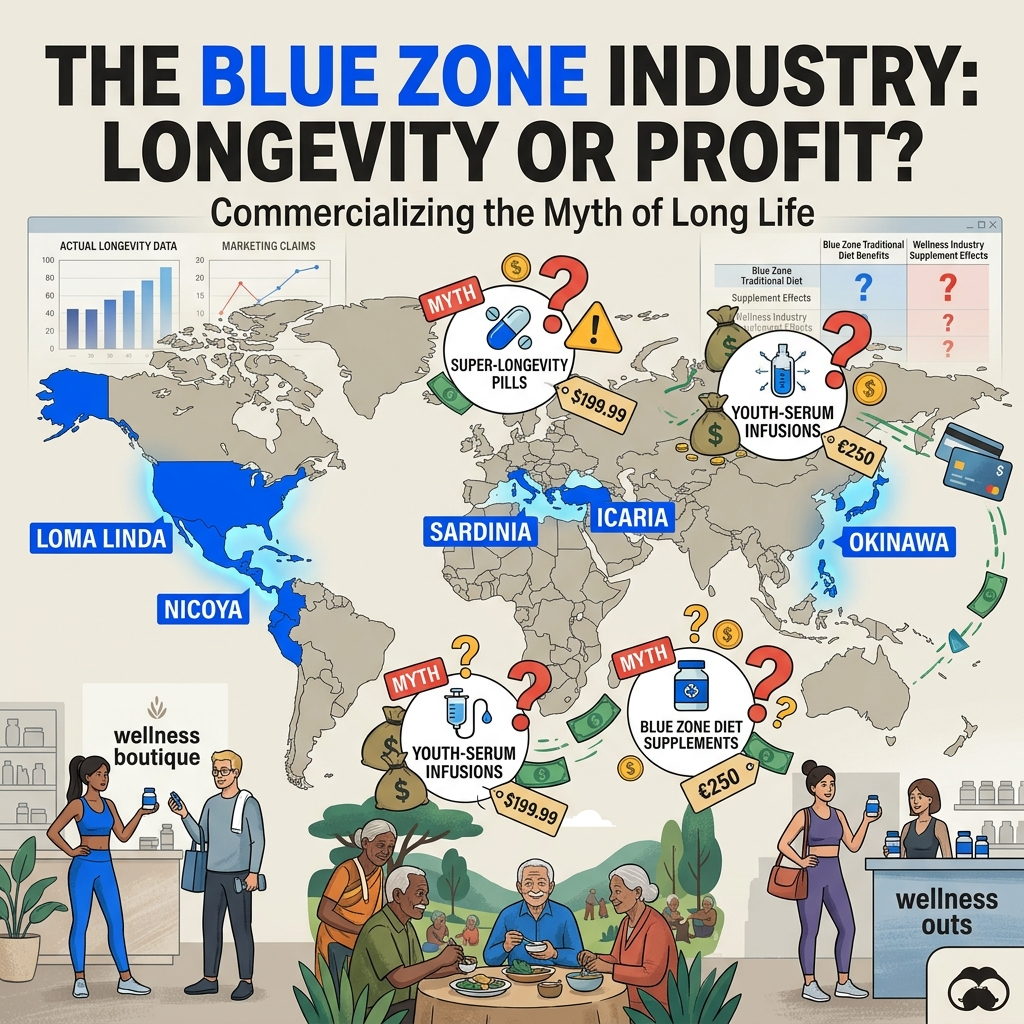
The Blue Zones longevity thesis occupies the contested boundary between population epidemiology and commercial wellness culture, drawing unprecedented scientific and public scrutiny through 2025 and 2026. Australian biologist Saul Newman's preprint analysis of UN mortality data from 236 jurisdictions argues that supercentenarian records correlate far more strongly with absent birth registration and pension fraud than with any identifiable lifestyle factor, a conclusion recognized with the 2024 Ig Nobel Prize in Demography and extended in his 2026 MIT Press book Morbid. A December 2025 peer-reviewed rebuttal by Austad and Pes in The Gerontologist countered that original Sardinian longevity data are cross-verified against civil registries dating to 1866 and seventeenth-century church documentation, leaving fewer than one documented discrepancy in the entire Sardinian archive. The Blue Zones brand was acquired for $78 million by Adventist Health and subsequently deployed to market a $600 million Miami luxury tower, a commercial trajectory that prompted co-creator Michel Poulain to publicly sever ties with the enterprise and describe it as progressively a business rather than a science. The structural question this controversy surfaces is not whether extraordinary longevity once existed in specific historical cohorts, but whether a phenomenon rooted in vanishing generational and community conditions can be honestly repackaged and sold as a $13.99 frozen meal kit or a $100,000-per-year city certification program. Neither side of the scientific debate has fully prevailed, yet both the critic and the defender implicitly agree that the social conditions enabling the documented longevity no longer exist in their original form.
Key Points
The Paper Chase — Newman's Deconstruction of Supercentenarian Data
Newman's 2019 preprint, drawing on UN mortality statistics from 236 jurisdictions over a 51-year span, produced a finding that reframed the entire Blue Zones conversation: supercentenarian record density correlates far more strongly with the absence of civil documentation systems than with any identifiable health or lifestyle variable. The aggregate figure is striking — only 6.6% of globally "verified" supercentenarians possessed original birth certificates, and in the United States, just seven individuals among roughly 500 listed as 110 or older had documentary proof of their birth year. When U.S. states introduced formal birth registration, supercentenarian counts in those states fell by 69 to 82 percent — a drop so consistent across jurisdictions that it is extraordinarily difficult to attribute to anything other than prior record inflation. Newman also identified an anomalous birthday clustering pattern: supercentenarian birth dates concentrated disproportionately on the 5th, 10th, 15th, 20th, 25th, and 30th of each month, the classic signature of people recording an approximate rather than verified date. Japan's 2010 government audit found 230,000 registered centenarians who were deceased or missing; Greece's 2012 audit found 9,000 pension-collecting centenarians already dead, blocking one billion dollars annually in fraudulent claims; Costa Rica's survey found 42% of centenarians had misreported ages. Newman won the 2024 inaugural Ig Nobel Prize in Demography for this work, and while his central paper remained under review at BMJ Public Health through at least nine rounds, the evidence base he assembled has been widely covered by Fortune, Al Jazeera, and Science News as a legitimate scientific challenge.
The Academic Rebuttal — Austad and Pes in *The Gerontologist*
The December 2025 peer-reviewed response by Steven Austad and Giovanni Pes, published in *The Gerontologist* under the auspices of the Gerontological Society of America, represents the most systematic scholarly defense of original Blue Zone longevity data assembled to date. For Sardinia specifically, the paper documented dual-source cross-verification using Italy's national civil registry — operational since 1866 — and handwritten seventeenth-century parish church records, with fewer than one documented discrepancy identified in the entire archive over the period examined. The centenarian concentration in Sardinia's Ogliastra province for the 1880–1900 birth cohort reached five times the European average and three times the broader Sardinian average, a magnitude that is statistically difficult to explain through administrative error alone. Pes described the methodology directly: "Blue Zones are not based on self-reports. They are based on meticulous cross-checking of records that often go back over a century." Ikaria's 90-plus population was measured at approximately three times the Greek national average as of 2009, and France's RNIPP registry showed 92% of supercentenarian candidates verified against both birth and death records — suggesting that documentation quality, not longevity itself, is the variable that explains much of Newman's finding. Austad also made what I consider the most intellectually honest observation in the entire debate: "Extraordinary claims about longevity demand extraordinary evidence, and the original Blue Zones meet and often exceed that standard" — a claim that remains substantially about Sardinia and less clearly established for all five designated zones simultaneously.
$78 Million Brand, $600 Million Tower — The Commercialization of Longevity
The transformation of a 2004 Belgian academic mapping exercise into a nine-figure commercial enterprise is one of the more instructive case studies in how scientific concepts get converted into consumer products during the wellness boom. Blue Zones LLC was acquired by Adventist Health for approximately $78 million in 2020, at which point the brand's commercial applications expanded well beyond books and municipal consulting. The brand was subsequently deployed in the marketing of a $600 million luxury residential tower in Miami that included cosmetic and plastic surgery facilities on the premises — a use case that Buettner himself ultimately moved to terminate, though not before the association had been established. Wellmark Blue Cross invested $25 million in Blue Zones projects across ten Iowa cities; official city certification alone carries an annual cost of $100,000. Two million meal kit units have been sold through 4,000 retail stores at prices ranging from $7 to $13.99 per package. Nine books and a 2023 Netflix documentary have extended the brand's cultural footprint. Michel Poulain, who drew the original Sardinian map in 2004, severed his relationship with Buettner approximately a decade ago after observing the commercial direction — stating that the enterprise had become "progressively a business" and calling Singapore's proposed Blue Zone designation "a joke." The academic origin story and the commercial reality that emerged from it are, in Poulain's assessment and in the evidence of the product catalog, two entirely different things.
The Okinawa and Nicoya Paradox — Generational Collapse of a Longevity Advantage
The most damaging evidence against the commercial Blue Zones proposition isn't Newman's preprint — it's what has happened to the original Blue Zone populations across time. Poulain and Herm's 2024 analysis in the *Journal of Internal Medicine* documents Okinawa's trajectory with data points that are difficult to misread: a centenarian rate seven times the Japanese national average in 1976 compressed to just twice the average by 2006, a male life expectancy ranking that fell from 4th to 42nd among Japan's 47 prefectures, and Japan's highest recorded male obesity rate at approximately 48.5%. Rosero-Bixby's 2023 study in *Demographic Research* documents Nicoya's parallel collapse: men born in 1905 showed mortality rates 33% below the Costa Rican national average, while men born in 1945 showed rates 10% above the national average — a reversal of over 40 percentage points across a single generational span. Buettner himself acknowledged in a STAT News interview that "all blue zones are waning right now," which is a remarkable admission for the owner of a brand premised on their continued relevance. These generational trajectories indicate that Blue Zone longevity was a temporary expression of specific social and economic conditions — the moai community networks and ikigai purpose structures of prewar Okinawa — that were dismantled by modernization, not a stable lifestyle template that can be exported through product distribution. Austad's own observation that Blue Zones "can appear and disappear" unintentionally provides the most precise summary of why Blue Zones as a commercial proposition faces a fundamental logical problem: you cannot reliably sell a lifestyle formula whose core advantage has already evaporated.
Structure vs. Choice — What the 14.6-Year Longevity Gap Actually Proves
Raj Chetty's JAMA study delivered a finding that should anchor every serious discussion of longevity: in the United States, men in the top 1% of income distribution live 14.6 years longer than men in the bottom 1%, with a comparable 10.1-year gap for women. From 2001 to 2014, life expectancy for high-income Americans increased by three years — while for the lowest-income Americans it increased by essentially zero. These numbers establish that the most powerful predictors of lifespan in the United States are income level, healthcare access, housing quality, and neighborhood safety — not the dietary or movement choices that Blue Zones products are designed to influence. Newman's statistical finding that higher elderly poverty rates correlate with higher supercentenarian record counts — not because poverty promotes longevity, but because poor documentation systems produce fraudulent registrations — adds an additional layer: the longevity inequality and the data integrity problem are both downstream of structural socioeconomic conditions, not individual lifestyle differences. The Blue Zones framework systematically frames longevity as a personal consumption choice while leaving the structural determinants undisturbed, which serves the commercial product ecosystem perfectly and the cause of health equity not at all. The ironically clarifying detail from Blue Zones community programs is that the measurable health improvements in Beach Cities and Fort Worth tracked most closely with increases in neighborhood social connection — not dietary change — which is precisely what the original science established as the actual mechanism. Longevity, both the research and the natural experiments confirm, is primarily a social and structural outcome. That insight cannot be purchased at $13.99.
Positive & Negative Analysis
Positive Aspects
- Measurable Community Health Metrics in Real Intervention Programs
The Blue Zones community intervention programs in Beach Cities, California and Fort Worth, Texas produced documented public health improvements that are worth taking seriously, even with methodological caveats. Between 2010 and 2017, Beach Cities recorded a 36% reduction in smoking rates, bringing the figure to 8.9% — substantially below both the California state average of 13.7% and the national average of 18.8%. Childhood obesity in Beach Cities elementary schools declined by 68% over the same period, and the city region achieved the top ranking on the Gallup Well-Being Index among 190 U.S. metropolitan areas in 2015. Fort Worth recorded a 31% smoking reduction, a 40% increase in regular exercise participation, and a 7% decrease in hypertension rates, with the city's overall Well-Being ranking climbing from 185th to 58th out of 190 metropolitan areas. These are directionally significant signals even though causal attribution specifically to Blue Zones programming — as opposed to concurrent national antismoking campaigns, elevated healthcare access in high-income communities, or secular trends — has not been established through independent peer-reviewed trials. The programs demonstrate that community-level health narratives, when applied at scale with institutional backing, can coincide with meaningful behavior change among the target population.
- Healthcare Cost Reduction Projections with Economic Policy Implications
Fort Worth's Blue Zones program generated healthcare cost reduction estimates that, while based on Gallup self-report methodology rather than independent clinical measurement, point toward a meaningful economic logic for public health investment at the city scale. Smoking rate reduction alone was estimated to prevent approximately $268 million in annual healthcare costs and reduce economic productivity losses by roughly $187 million — figures that provide a quantitative case for insurers and municipal governments to fund community health interventions. Wellmark Blue Cross's $25 million investment across ten Iowa cities reflects exactly this insurer-side calculation: if even a fraction of the projected healthcare cost avoidance materializes, the program generates positive return on investment before considering any wellness brand revenue. The economic rationale for structural community health intervention — as opposed to individual-level clinical treatment — is genuinely underexplored in U.S. health policy, and the Blue Zones programs, whatever their scientific limitations, have generated data that keeps that policy conversation active. The methodological concern is that these cost projections are derived from self-reported behavioral changes rather than actuarial claims data, so the actual economic impact requires longitudinal verification that has not yet been independently published. Nonetheless, as a policy-level argument for investing in community health infrastructure, the framework has contributed meaningfully to ongoing public health discourse.
- Catalyzing Academic Longevity Research Through Scientific Controversy
One underappreciated consequence of Blue Zones' commercial success is the volume and rigor of academic research it has indirectly generated. Poulain, Pes, Austad, Newman, Rosero-Bixby, and Olshansky are among the researchers who have produced significant scholarly work specifically in response to Blue Zones claims — work that has advanced the methodologies of biodemography, gerontology, and population epidemiology in substantive ways. The dual cross-verification system deployed by Austad and Pes for Sardinia, using 1866 civil registries and seventeenth-century church records, represents a methodological achievement in archival validation of longevity data that the field would likely not have developed at this level of precision without the Blue Zones controversy as a motivating context. Newman's finding about birthday clustering and documentation gaps has opened a productive sub-field examining the data quality of mortality statistics in low-documentation environments. The December 2025 publication in *The Gerontologist* and Rosero-Bixby's 2023 *Demographic Research* paper are both high-quality peer-reviewed contributions that emerged from the Blue Zones debate. As Austad observed, the fact that Blue Zones can "appear and disappear" creates a natural experiment for studying how modernization affects population health outcomes — which is scientifically valuable independent of any commercial application or controversy.
- Demonstrating that Narrative-Driven Health Communication Can Change Behavior
The Blue Zones programs offer evidence that a compelling narrative framework — even one with contested scientific foundations — can function as an effective public health communication tool at the community level. The health principle that "reduce smoking, increase physical activity, strengthen social connections, eat more plants" is not scientifically controversial; the controversy surrounds the longevity branding layered on top of it. If the Blue Zones narrative framework made those established recommendations more salient and actionable for a significant population segment — as the Beach Cities and Fort Worth metrics suggest it may have — then the narrative itself has produced social value that exists independently of the brand's scientific accuracy claims. This observation doesn't vindicate the commercial operation's longevity marketing language, but it does suggest that health communication strategy has something to learn from the Blue Zones approach, specifically its ability to generate community identity and peer norm shifts around health behavior. The most clinically established lifestyle interventions frequently fail not because the underlying science is weak but because the behavior change communication is insufficiently motivating — a problem the Blue Zones framework appears to address reasonably well in at least some implementation contexts.
Concerns
- Fundamental Data Integrity Crisis Across Multiple Blue Zone Countries
Newman's research exposed a data quality problem that is not merely peripheral to the Blue Zones argument — it strikes directly at the empirical foundation. The finding that only 6.6% of globally "verified" supercentenarians hold original birth certificates means that the vast majority of extreme longevity records rest on secondary documentation whose accuracy cannot be independently confirmed. The specific national audits that followed Newman's work in countries explicitly associated with Blue Zones are damaging: Japan's discovery that 82% of registered centenarians — 230,000 people — were deceased or missing; Greece's audit revealing that 72% of pension-collecting centenarians were already dead; Costa Rica's finding that 42% of its centenarian records contained misreported ages. Austad and Pes have made a compelling case for Sardinia specifically, where archival depth is unusual by global standards, but their verification work does not extend with equal rigor to Okinawa, Nicoya, Ikaria, or Loma Linda. Newman's birthday clustering finding — with supercentenarian birth dates statistically overrepresented on multiples of five — suggests a data artifact that exists at the system level, not just in isolated cases. The BMJ Public Health review saga, in which Newman's core paper underwent nine rounds of peer review without publication, introduces its own ambiguity — suggesting either that the methodology requires revision or that the finding is too disruptive for the peer review ecosystem to process through standard channels quickly.
- Scientific Concept Captured and Distorted by Commercial Franchise Logic
The trajectory from Poulain and Pes's 2004 Sardinian mapping exercise to a $78 million brand acquisition, a $600 million Miami luxury tower, and a frozen meal kit sold in 4,000 stores represents one of the more complete examples of scientific concept capture by commercial interests in the wellness sector. Co-creator Poulain's departure roughly a decade ago — with his explicit statement that "it was clear that progressively, blue zones were turning to business" — constitutes the strongest possible insider testimony that the scientific and commercial enterprises had become irreconcilably incompatible. Loma Linda's inclusion in the Blue Zones list, which Buettner acknowledged was driven by National Geographic's request for a U.S. location rather than by independent scientific assessment, indicates that commercial and media considerations shaped the conceptual framework from an early stage. The deployment of the Blue Zones brand to market cosmetic and plastic surgery facilities within a luxury residential tower illustrates how thoroughly a scientific-adjacent brand can migrate from its original context when commercial priorities dominate. Buettner's concurrent admission that "all blue zones are waning right now" and the continued sale of millions of meal kits premised on their relevance represents a contradiction that cannot be resolved on scientific grounds alone — it requires engaging the ethics of product marketing under conditions of acknowledged evidentiary deterioration.
- Structural Health Inequality Reframed as a Lifestyle Consumer Choice
The Blue Zones framework's most consequential harm may be the least visible: its systematic reframing of longevity as an outcome of individual consumer choices rather than a product of structural socioeconomic conditions. Chetty's JAMA data showing a 14.6-year male life expectancy gap between top and bottom income percentiles — with zero gains for the poorest Americans across 13 years — establishes that what determines who lives longest in the United States is income, housing quality, neighborhood safety, and healthcare access. The Blue Zones framing, which attributes longevity to diet, movement, and purpose practices that can theoretically be adopted by any consumer, systematically obscures this structural reality. Newman's finding that elderly poverty rates predict supercentenarian record density — because poorly documented populations produce inflated longevity statistics, not because poverty extends life — demonstrates that even the data infrastructure of longevity measurement is shaped by socioeconomic inequality. A product ecosystem that sells meal kits and city certifications to predominantly high-income consumers while attributing their longevity advantages to the lifestyle choices those kits represent is, in effect, providing ideological cover for the socioeconomic mechanisms that actually explain their health outcomes. The Beach Cities program's documented success in a high-income California coastal community, and the relative absence of equally rigorous documentation of Blue Zones effects in lower-income communities, reflects this structural bias in both the research and the commercial model.
- Regulatory and Consumer Protection Gaps in Health Claim Enforcement
The Blue Zones product ecosystem exists in a regulatory environment where health-adjacent marketing claims occupy a strategically ambiguous position: not specific enough to constitute verifiable medical claims subject to FTC and FDA pre-clearance requirements, but credible enough in their scientific-origin story to influence consumer purchasing behavior and city-level public health resource allocation. NielsenIQ's 2025 global survey of approximately 19,000 consumers across 19 countries found that 82% want health and wellness product labels to be more transparent and comprehensible, and 62% distrust health claims made by food and beverage companies — indicating widespread consumer awareness of the credibility problem without clear mechanisms for resolution. With 50% of Americans under 50 sourcing health and wellness information primarily from influencers and podcasters rather than medical professionals, the pathway by which scientific debate informs consumer understanding is long, indirect, and subject to significant distortion. The FTC's 2026 healthcare enforcement expansion creates new regulatory pressure, but Blue Zones-style programs — which rely on association with legitimate academic research rather than explicit medical claims — are structurally difficult to bring within standard false advertising frameworks. The $100,000 annual cost of official Blue Zones city certification, paid by municipal governments with public funds, represents a public resource allocation decision made on the basis of a commercial certification program's health claims — a use of public money that the current regulatory framework does not require to meet an independent evidentiary standard before approval.
- Co-Creator Departure Signals Irreconcilable Science-Commerce Conflict
Michel Poulain's departure from the Blue Zones enterprise approximately a decade ago is not merely a personal disagreement between collaborators — it represents a structural incompatibility between the scientific standards that produced the original concept and the commercial imperatives that govern its current applications. The original academic work was constrained by the norms of peer-reviewed population science: defined geographic scope, explicit methodology, conservative claims about generalizability. The commercial enterprise operates under entirely different incentives: maximum brand extensibility, maximum geographic expansion, maximum product line breadth. Buettner's acknowledgment that Loma Linda was included to satisfy a media organization's geographic coverage requirements rather than to meet scientific criteria demonstrates that these competing logics were in tension from the outset, not just after the brand became commercially successful. Poulain's description of Singapore's proposed designation as "a joke" and his statement that "everybody wants to be a blue zone" captures the commercial logic's endpoint: a brand that can expand indefinitely because its value is associative rather than empirically grounded. The researchers who generated the original scientific insights and the commercial enterprise that monetized them are operating in different epistemological worlds, and Poulain's departure made that separation explicit. When the scientist who drew the first map walks away from the brand, the map and the brand have become different objects entirely.
Outlook
In the next six months, the academic dimension of this debate is going to intensify significantly. AFAR — the American Federation for Aging Research — was expected to publish a formal consensus statement on the definition of Blue Zones in 2026, a development that could either legitimize or meaningfully constrain how the term gets applied in commercial contexts. Newman and biodemographer Jay Olshansky are reportedly co-authoring a paper that systematically tracks the generational decline of longevity advantages in original Blue Zone regions, which would provide the most rigorous documentation yet of the disappearing-advantage phenomenon.
With Morbid now published by MIT Press rather than circulating as a preprint, Newman's arguments will reach academic and general audiences simultaneously in a way that preprints simply cannot achieve. My assessment is that within six months, a pragmatic middle-ground position is likely to emerge in the scientific literature: that Blue Zone longevity was historically real in specific generational cohorts, and simultaneously unreproducible under current conditions. That synthesis — Austad's insight that Blue Zones can appear and disappear, converging with Newman's documentation of that very disappearance — represents the only position that both datasets can coherently support at the same time.
On the regulatory side, the environment is shifting faster than most stakeholders in the wellness industry appear to have registered. The FTC substantially strengthened healthcare sector enforcement in 2026, establishing a Healthcare Task Force focused specifically on unverified health claims in anti-aging, regenerative medicine, and stem cell therapy marketing. Influencer health claims and social media wellness content fell explicitly within the new enforcement scope. A joint FDA-FTC requirement for "credible scientific evidence" before making health-related product claims creates a structural challenge for Blue Zones branded products that make or imply longevity outcomes. Short-term, I expect Blue Zones marketing communications to quietly retreat from direct longevity language toward softer "healthy lifestyle support" framing — which is legally safer, and also more honest about what these products actually deliver to any individual consumer.
The medium-term picture — roughly six months to two years out — is one of genuine paradox. The Global Wellness Institute's 2025 report projects the global wellness economy growing from $6.8 trillion in 2024 to $9.8 trillion by 2029, at a compound annual growth rate of 7.6%. That market is four times the size of the global pharmaceutical industry. Wellness real estate, the sector that absorbed Blue Zones branding most aggressively, is growing at 15.2% annually — the fastest rate of any wellness sub-sector. Personalized medicine is a $147 billion category expanding at 9.3% annually. North American per-capita wellness spending already stands at $6,029. The core structural point is that consumer appetite for longevity-adjacent products does not diminish in proportion to scientific criticism. A credibility gap in one product category tends to redirect spending toward the next plausible-sounding narrative, not toward skepticism as a sustained consumer stance.
That migration dynamic is specific and real. Fifty percent of Americans under 50 currently get their primary health and wellness information from influencers and podcasters, with fewer than 20% citing medical professionals as their main source. In that information ecosystem, the lesson of a scientific debunking cycle is frequently not "consumers became more skeptical" but rather "the marketing sophistication of the next longevity wave increased." Blue Zones' commercial vulnerability might come less from the Newman-Austad debate than from displacement by precision longevity — genomics-based assessments, biomarker-tracked intervention protocols, and personalized supplementation programs that carry a more compelling scientific veneer than any regional cuisine. The longevity market is projected to expand from roughly $29–34 billion in 2026 to approximately $67 billion by 2035, at compound annual rates of 7.5 to 9.4%. That trajectory will continue regardless of what the academic literature ultimately concludes about Blue Zones specifically.
Over the medium term, I see the Blue Zones concept bifurcating into two distinct tracks that will diverge increasingly with time. The academic track will see researchers like Austad, Pes, and Poulain reframe Blue Zones as "contextual longevity research" — treating the appearance and disappearance of longevity clusters as the primary research subject itself, and using those natural experiments to trace how modernization, dietary transition, and social network dissolution reshape population health outcomes across generations. That is genuinely valuable science that stands entirely independent of any commercial application. The commercial track will persist — meal kits, city certifications, real estate branding — but will progressively shift its language from "longevity" toward "wellness lifestyle" as regulatory pressure builds. Poulain's departure will stand as the symbolic marker of that bifurcation: the moment when the science and the business formally and irreversibly separated.
Looking out two to five years, the longer-term structural shift I find most significant is the potential movement at the policy level from "lifestyle choice as the longevity variable" toward "structural determinants as the public health target." Chetty's JAMA research established a 14.6-year male life expectancy gap between the top and bottom income percentiles, with no life expectancy gains whatsoever for the lowest-income group across a 13-year observation period. Okinawa's moai didn't survive the dismantling of the social infrastructure that produced it. If the Blue Zones lesson gets taken seriously at the policy level — rather than the commercial level — it points toward investments in community infrastructure, income support, and healthcare access, not toward new product development cycles. Whether public health policy actually moves in that direction within five years is genuinely uncertain, given the lobbying capacity of the wellness industry and the political difficulty of structural redistribution arguments in most major markets.
There are scenarios where my read proves wrong, and intellectual honesty requires acknowledging them. If Austad, Pes, and collaborators produce comprehensive archival verification of Okinawan and Nicoya data at the same depth as the Sardinian documentation, Blue Zones could potentially emerge from this controversy as "the most rigorously validated health research ever conducted" — which would provide the commercial operation with a significant scientific lifeline. France's RNIPP national registry data already shows 92% of supercentenarian candidates verified against birth and death records, suggesting that in high-documentation environments, Newman's "paper shortage" critique narrows to a more geographically specific scope. It's also entirely possible that the scientific debate produces no measurable change in consumer purchasing behavior, given how thoroughly health information has migrated away from peer-reviewed channels and into the influencer ecosystem.
What I'd say to anyone navigating this debate about their own health choices is straightforward. Neither side of the scientific argument has fully prevailed, and both sides have legitimate evidence. But here is the thing both sides implicitly agree on, even if neither states it directly: the conditions that produced the longevity both Newman questions and Austad defends no longer exist in their original form. The Okinawans and Sardinians who lived extraordinarily long lives did so inside social structures — lifelong community bonds, embedded purpose, physical labor woven into daily existence — that were not sold to them and were not chosen from a product catalog. They were lived, collectively, across generations. The meal kit is not the lesson from Blue Zones. The lesson is the thing that cannot be shipped, cannot be certified, and does not appear on any label. And it is, by definition, the one thing the $6.8 trillion wellness industry cannot package and sell back to you.
Sources / References
- Are 'blue zones' real? A science and wellness industry clash — STAT News
- The validity of Blue Zones demography: a response to critiques — The Gerontologist
- The vanishing advantage of longevity in Nicoya, Costa Rica — Demographic Research
- Supercentenarian records exhibit patterns indicative of clerical errors and pension fraud — bioRxiv
- Are 'blue zones' a myth? Extreme aging is built on pension fraud and century-old lies — Fortune Europe
- The secret of 'Blue Zones' where people reach 100? Fake data, says academic — Al Jazeera
- The Global Wellness Economy Hits $6.8 Trillion — Global Wellness Institute
- Exceptional longevity in Okinawa — Journal of Internal Medicine