
When Netflix "Discovers" Your Favorite Restaurant, the Locals Get Priced Out
Summary
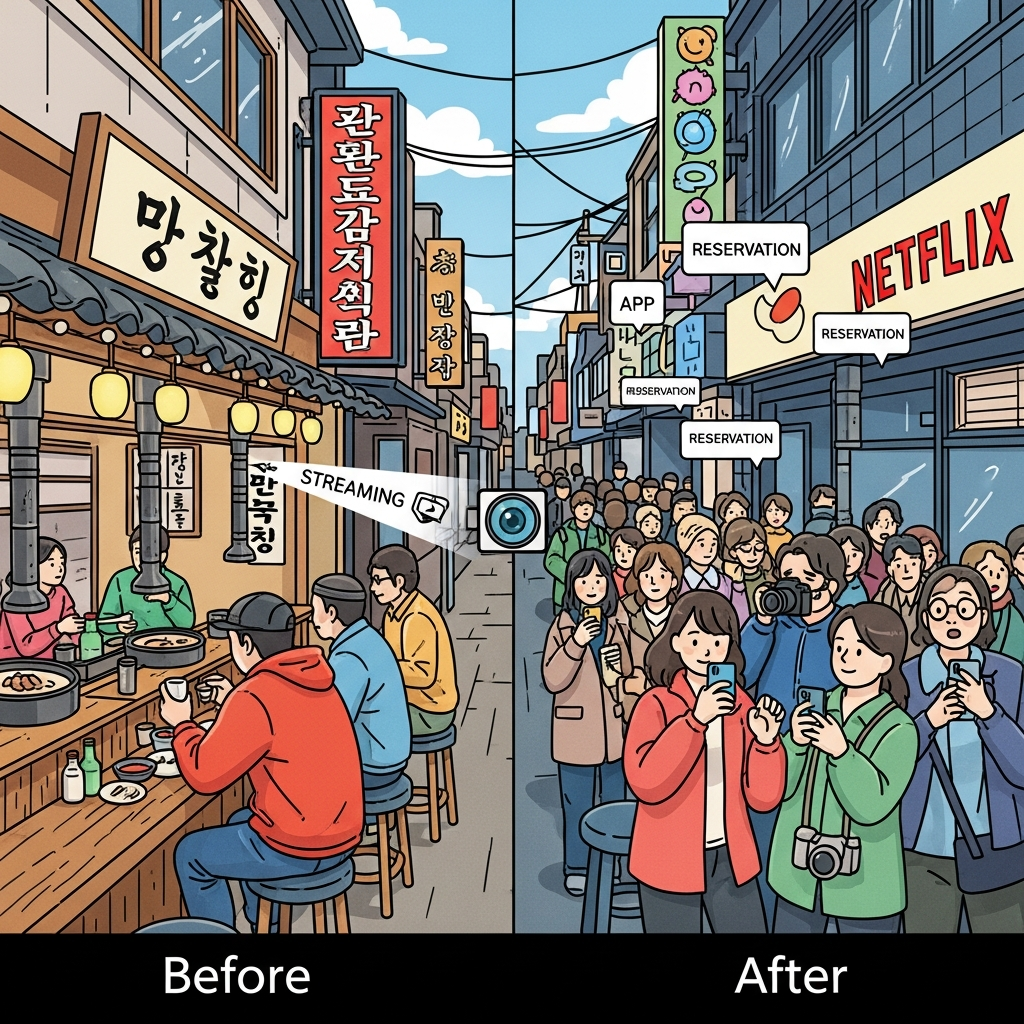
Following the global release of Netflix's Culinary Class Wars Season 2, restaurant reservations at featured establishments surged by an average of 303% within just five weeks — more than double the spike typically seen after a Michelin star announcement. South Korea's Ministry of Culture, Sports and Tourism responded by officially incorporating food tourism into its 2026 national strategy, marking perhaps the first instance of a single streaming title reshaping government policy at the national level. Yet the structural paradox at the heart of this phenomenon is stark: the primary beneficiary of the reservation explosion is Netflix's subscription model, not the restaurants that appear on screen, and the platform captures the vast majority of economic value generated while local regulars are systematically squeezed out. At the same time, streaming has demonstrably revived dying food traditions — from Northern Thai khao soi stalls to Shikoku udon joints — by giving them global visibility that no official heritage designation could match. Streaming food tourism is therefore not a passing fad but a structural inflection point that will determine whether the global food ecosystem democratizes or becomes a new form of cultural extraction on an industrial scale.
Key Points
The Culinary Class Wars Effect: A 303% Reservation Spike That Rewrote National Policy
Netflix's Culinary Class Wars (흑백요리사) Season 2 deployed a simultaneous 190-country release strategy that elevated Korean cuisine to a global tourist destination almost overnight. CNBC reported that featured restaurant reservations surged an average of 303% within just five weeks of release — a figure that more than doubles the 80–120% average spike typically seen in the wake of a Michelin star announcement. South Korea's Ministry of Culture, Sports and Tourism responded by formally embedding food tourism into its 2026 national strategy, making this arguably the first case in which a single streaming title shifted a country's entire tourism policy direction. Singapore's parallel data makes the economic case even more compelling: visitor arrivals grew only 2.3%, yet F&B tourism revenue jumped 15%, demonstrating that food tourists spend roughly 6.5 times more per capita than average visitors. The pattern is not isolated to Korea or Singapore — Netflix's Chef's Table turned obscure restaurants in Barcelona and Copenhagen into international pilgrimage sites, and Bangkok's Yaowarat Chinatown saw food tourism rise 40% after a street food documentary ran. What these cases collectively demonstrate is that the discovery engine of global culinary tourism has irreversibly migrated from Michelin guides to streaming algorithms, and that migration is now fast enough to reshape national economies within a single content cycle.
Platform Revenue Capture vs. Restaurant Structural Exclusion
The most fundamental structural problem in streaming food tourism is the extreme imbalance in the economic value chain. Netflix gained measurable subscriber growth in Asia and a 1.7% stock price lift from a single cooking competition season, yet featured restaurants receive only a one-time appearance fee with no ongoing revenue participation. The 303% reservation spike generates enormous tourism spending, but the largest shares of that spending flow to airlines, hotels, online travel agencies, and payment platforms — with direct restaurant revenue estimated at only 15–20% of total tourist expenditure attributable to the content. This structure is identical in logic to the music streaming royalty problem: Spotify generates billions in revenue while paying artists roughly $0.003–0.005 per stream, leaving the creators of the underlying value capturing only a fractional share of the economic upside their work generates. The restaurant provides the raw material of the story — the chef's craft, the kitchen's atmosphere, the food's cultural specificity — and the finished content product is sold globally at scale, but the factory floor receives far less than the distribution layer. If this imbalance calcifies permanently, restaurants will begin refusing streaming appearances, which over time would create a supply-side constraint that undermines the entire streaming food content ecosystem.
Local Community Displacement and the Restaurant Gentrification Effect
Behind the 303% reservation headline lies a systematic exclusion of the communities that gave these restaurants their identity in the first place. Seoul restaurants in Seongsu and Itaewon reported that overseas tourist reservations came to represent 60–70% of all bookings after airing, making it effectively impossible for longtime local regulars to find a seat. Food sociology frames neighborhood restaurants as core infrastructure of local identity and social capital — not just places to eat, but institutions that anchor a community's daily rhythms. When those institutions flip into tourist landmarks, the social cohesion they once sustained begins to unravel in ways that are hard to measure and even harder to reverse. This is the exact gentrification mechanism that Airbnb unleashed on residential housing markets, now operating on restaurant spaces. The damage radiates outward: commercial rents within a 200-meter radius of featured restaurants in Seoul have risen 25–35% on average, pricing out the low-margin neighborhood restaurants that never appeared on any streaming show. The result is that streaming content makes one restaurant famous while rendering an entire neighborhood's food culture economically unsustainable for the people who actually live there — a secondary gentrification effect that existing policy frameworks are almost entirely unequipped to address.
The Streaming Revival Paradox: Saving Food Cultures That It Also Destroys
Streaming food tourism is not simply destructive — and any honest analysis has to grapple with its genuinely positive effects on endangered food traditions. A traditional khao soi stall in Chiang Mai, Northern Thailand, saw young visitors increase 200% after a Netflix documentary, and when the owner was considering closing for lack of a successor, a young chef showed up asking to train. Shikoku's traditional Sanuki udon shops in Japan saw foreign visitors grow from 30,000 to 120,000 annually after streaming exposure — a 4x increase that brought real economic vitality to a rural region that desperately needed it. These cases illustrate a core paradox: a single Netflix episode can achieve what UNESCO Intangible Heritage designation rarely manages, which is to generate live economic demand rather than merely symbolic recognition. The risk embedded in this revival is equally real, however: food traditions that get revived through streaming tend to migrate toward tourist preferences, gradually standardizing away from their authentic forms into what might best be called touristified tradition. The line between genuine preservation and content-ready museum-ification of a living culture is blurry, and that blurriness is perhaps the deepest unresolved dilemma in the streaming food tourism equation.
The $1.2 Trillion Food Tourism Market and Its New Discovery Engine
The global food tourism market was valued at approximately $829 billion in 2024 and is projected to reach $1.2 trillion by 2028 — and the discovery mechanism driving that growth has fundamentally shifted away from traditional gatekeepers. The power to define what is worth eating and where has migrated from a concentrated set of elite critics and guidebooks to the algorithmic recommendation systems of Netflix, YouTube, and TikTok. The UN World Tourism Organization formally recognized this shift by putting media-driven food tourism on the official agenda at its 2026 World Forum on Culinary Tourism — a signal that the international community accepts how consequential this transition has become. In Korea, the proportion of foreign visitors citing food as their primary reason for visiting jumped from 37% in 2025 to 52% in the first half of 2026 — a swing of 15 percentage points in roughly 18 months, almost certainly driven by streaming content. What this power migration means is that the entities who control curation — the streaming platforms — now wield the ability to direct billions of dollars of tourist spending toward or away from specific cities, restaurants, and culinary traditions, without bearing proportionate responsibility for the consequences. That concentration of curatorial power without accountability is the structural issue that the $1.2 trillion growth trajectory makes increasingly impossible to ignore.
Positive & Negative Analysis
Positive Aspects
- Global Democratization of Culinary Discourse and the End of European Hegemony
For well over a century, the global conversation about great food was essentially controlled by French and Italian fine dining institutions, with the Michelin Guide serving as the ultimate arbiter of what counted as cuisine worth traveling for. Streaming food content has cracked that structure wide open in ways that institutional channels never managed, and the evidence is showing up in measurable shifts. Netflix's Culinary Class Wars putting Korean street food and neighborhood restaurants in front of global audiences contributed to a real, quantifiable shift: Asian restaurants on the 50 Best Restaurants list grew from 12 in 2020 to 19 in 2026. This is a genuine disruption of the food hegemony that France's haute cuisine spent more than a century building, and it represents a meaningful redistribution of cultural authority over what gets called world-class food. The access shift isn't just symbolic — viewers from London, New York, and São Paulo are now encountering the texture and complexity of khao soi, kimchi jjigae, and hand-pulled noodles as mainstream global food rather than exotic novelties. The result is a more plural, more democratic global culinary conversation, where small-budget neighborhood restaurants in Seoul or Chiang Mai can claim space in the same discourse as three-Michelin-star destinations in Paris — and that democratization has real downstream effects on culinary education, food travel, and cultural exchange.
- High-Value, Low-Volume Tourism Model for National Economies
Streaming-driven food tourism offers national governments a compelling alternative to the traditional tourism growth model, which typically involves maximizing visitor numbers and tolerating the overtourism consequences that follow. Singapore's data from 2026 makes the argument concisely: F&B tourism revenue rose 15% against a 2.3% increase in actual visitor arrivals, implying food tourists spend roughly 6.5 times as much per capita as average visitors. Korea's own data reinforces the pattern — food-motivated visitors stay an average of 1.8 days longer and spend about 40% more per trip than general tourists, making them dramatically more valuable on a per-visit basis. For policymakers watching infrastructure strain and resident quality-of-life deterioration from mass tourism, a model that grows revenue without growing footfall is enormously attractive — and it explains the Korean Ministry's unusually rapid policy pivot in 2026. This model offers a potential path toward tourism income that doesn't require tolerating the social and environmental costs of visitor volume maximization, an increasingly important consideration as overtourism backlash builds in cities from Amsterdam to Kyoto. When managed properly, food tourism represents a genuinely more sustainable growth model than the volume-chasing approach that has damaged so many destinations.
- Streaming as a More Effective Tool for Traditional Food Culture Preservation
Institutional preservation mechanisms — UNESCO designations, government subsidies, academic documentation — tend to produce archival results: the tradition receives acknowledgment but rarely generates the economic demand that keeps it genuinely alive and evolving. Streaming takes a fundamentally different path, one that creates actual customers rather than just recognition. When a Northern Thai khao soi stall appears in a globally distributed documentary, it doesn't just get acknowledged — it gets visitors who want to eat there and young chefs who want to learn there. Shikoku's Sanuki udon shops went from 30,000 to 120,000 annual foreign visitors following streaming exposure, bringing economic vitality that no preservation grant could replicate. Heritage ingredient farmers find new buyers when global demand for specific traditional foods materializes, creating an economic chain that incentivizes the continuation of traditional agricultural and culinary practices. The living preservation that streaming catalyzes — where a food tradition stays economically viable because enough people want to experience it — is arguably more durable than anything a museum or a designation can offer. The challenge, of course, is that tourist demand can distort the tradition it is supposedly saving, but the baseline alternative — the tradition quietly disappearing because no one is paying for it — is unambiguously worse.
- Zero-Cost Global Brand Platform for Small Neighborhood Restaurants
Before the streaming era, a small neighborhood restaurant's path to global recognition ran through Michelin stars, high-profile critic reviews, or expensive marketing campaigns — all requiring either extraordinary luck or significant capital that most small operators simply don't have. A single streaming appearance now compresses that entire process into one episode, giving a 500-square-foot Korean restaurant in a Seoul back alley simultaneous exposure to hundreds of millions of potential visitors worldwide at effectively zero direct marketing cost. The compound data from Culinary Class Wars Season 2 is striking: more than 70% of featured restaurants saw their Instagram followings multiply tenfold, and the combination of streaming reach and social media amplification creates a brand-building flywheel that traditional marketing simply cannot replicate at any price point. This matters beyond individual restaurants — it structurally opens global food tourism markets to thousands of small operators who previously had no viable entry point, dismantling the gatekeeping function that expensive PR operations and critic relationships used to perform. The long tail effect of streaming food content means that the global culinary conversation no longer needs to be dominated by a small set of famous restaurants with sophisticated marketing machines behind them, and that shift in access is structurally significant for the democratization of food culture worldwide.
Concerns
- Systematic Displacement of Local Regulars and the Unraveling of Food Community Infrastructure
The 303% reservation increase isn't experienced uniformly — for longtime regular customers, it often reads as something closer to a lockout from spaces that were once central to their daily lives. A restaurant in Seoul's Seongsu district reported that overseas tourist bookings came to represent more than 70% of all reservations after airing, meaning the regulars who showed up every week for years effectively lost their access to a space that had been part of their community routine. The owner described fielding calls from regulars who couldn't get a table as heartbreaking — a word that reflects not just inconvenience but genuine social loss. Food sociology understands neighborhood restaurants as critical social infrastructure — spaces where community bonds form, local identity coheres, and daily social life finds a rhythm that residents rely on in ways that go far beyond nutrition. When that infrastructure is converted into a tourist destination, the community functions it sustained don't just get inconvenienced; they get relocated, and often not replaced anywhere in the vicinity. This is the same gentrification playbook that Airbnb ran on urban housing markets, converting long-term community assets into short-term visitor services with the social costs borne by the community and the financial gains captured by the platform. As this pattern extends across restaurant districts, the risk isn't just losing individual table reservations — it's the progressive erosion of the daily lived food culture that made these neighborhoods interesting and worth filming in the first place.
- Structural Authenticity Erosion and the Mass-Production of the Original Experience
When a restaurant's daily covers jump from 50 to 200, the culinary equation changes whether the chef wants it to or not — the math of throughput simply overrides intention. Ingredient sourcing has to scale up, which often means switching from small local suppliers to larger distributors who can handle volume but whose products lack the specificity that made the original food compelling. Cooking processes get compressed to handle throughput, and menus get trimmed and standardized toward what the broadest range of international tastes can appreciate without complaint. Research suggests that more than 30% of Michelin-starred restaurants receive reviews saying the original taste is gone within a year of recognition — and the streaming surge arrives faster and at greater scale than any Michelin effect, compressing that timeline further. Feedback already accumulating on some Culinary Class Wars featured restaurants confirms the pattern in real time: Nothing like what I saw on the show. The tourists who bought plane tickets based on what they watched are being served a mass-produced approximation of a dining experience that no longer exists in its original form — a self-defeating irony given that the appeal of the content was precisely the authenticity it captured. The original experience has been commodified into a high-volume replica of itself, and the people who traveled the farthest to find it are often the last to understand what they're missing.
- The Streaming Bubble Lifecycle: Structural Debt from a Temporary Demand Spike
Streaming effects are explosive but short-lived in their concentrated intensity, and the financial obligations they generate in restaurants are anything but temporary. A Barcelona restaurant on Chef's Table saw reservations spike 250% for six months, then watched them drop 20% below pre-show levels a year later — a textbook spike and crash pattern that tourism economists have documented across multiple streaming-driven events in different markets. The danger lies in the structural costs a restaurant incurs to handle the surge: additional staff hired at 30–50% headcount increases, extended operating hours requiring overtime pay, physical renovations or equipment upgrades to handle volume, all of which create obligations that persist long after the tourist wave subsides. A restaurant that built its cost structure around peak-period demand finds itself over-leveraged during the inevitable normalization, operating with staffing and overhead designed for 200 covers in a period when demand returns to 60. Streaming food shows offer what might be described as a golden season of revenue and recognition — but with no exit plan, no planning support, and no transition mechanism for the period after the cameras move on to the next discovery. Several Culinary Class Wars featured restaurants are likely to face precisely this reckoning in the window between late 2026 and mid-2027, and the industry needs to start talking about it now.
- Platform-Community Value Distribution Gap: A Structural Unfairness That Compounds Over Time
At the core of streaming food tourism's economic model is a distribution problem that gets worse, not better, as the industry grows larger and the gaps between platform scale and restaurant capacity widen further. Netflix produces a show using a restaurant's food, chef, and cultural context as primary creative material — then monetizes that content globally across a subscriber base of 280 million people, generating both subscription revenue and stock price appreciation. The restaurant receives a one-time appearance fee. The tourism revenue that the show generates mostly flows through airlines, hotels, and OTAs, with only an estimated 15–20% reaching the restaurant whose creative output made the content compelling in the first place. The closest structural analogy is a Spotify artist earning $0.003 per stream while the platform generates billions in revenue — the raw material provider captures a fraction of the value created by the finished product, and the platform captures almost everything else. If this structural gap is not addressed by external pressure — industry guidelines, regulatory frameworks, or organized restaurant community action — the rational response from restaurants will eventually be to decline streaming offers. And that creates a content supply problem for platforms that depend entirely on authentic, locally rooted food stories: the system's sustainability requires sharing value with the very parties it is currently designed to extract value from.
- Secondary Gentrification: How One Featured Restaurant Can Destabilize an Entire Neighborhood
The economic damage from streaming food tourism doesn't stay contained within the walls of the featured restaurant — it radiates outward through the real estate market to affect the entire surrounding neighborhood in ways that are difficult to predict, nearly impossible to reverse, and systematically ignored by current policy frameworks. When tourist traffic concentrates around a streaming-famous restaurant, foot traffic in the district spikes, visibility increases, and commercial rents rise for every tenant on that block — regardless of whether they've ever been on television. Property data from Seongsu and Mangwon in Seoul shows commercial rents increasing 25–35% on average within a 200-meter radius of featured restaurants, and that rent increase hits the 20-year-old neighborhood pork belly joint that never made it on TV just as hard as it hits the featured restaurant itself. Low-margin neighborhood restaurants — the ones that have quietly served local residents for decades on thin margins built for a local customer base — cannot absorb those rent increases, and they close. The result is a secondary wave of community displacement in which streaming makes one restaurant globally famous and financially destroys several adjacent establishments that never sought the spotlight. The neighborhood's food culture diversity, which was the original source of its character and the very quality that attracted the content producers in the first place, gets systematically hollowed out. Current urban planning and tourism policy frameworks are almost entirely unprepared to detect, measure, or respond to this form of cascading neighborhood damage — making it one of the most insidious and least-addressed consequences of the streaming food tourism phenomenon.
Outlook
In the next six months or so — the near-term picture — the streaming food tourism wave shows no sign of cooling. Industry sources point to Netflix planning at least three more Asia-focused food content releases in the second half of 2026, with Disney+ and Amazon Prime also beefing up their food documentary lineups. The Korean government, having already committed to a food tourism strategy at the national level, is expected to move quickly on implementation: an F&B tourism center at Incheon Airport, a K-Food Trail circuit near major Seoul attractions, and expanded overseas Korean cuisine promotion budgets are all on the table. The ripple effect of this government activation could extend well beyond the Culinary Class Wars featured restaurants to boost Korean dining broadly across the country.
The most immediate risk in this near-term window, however, is what I'm calling the streaming bubble. That 303% figure is peak-of-the-season data — a five-week spike measured immediately after release. Historical patterns suggest this kind of explosive interest tends to deflate sharply within three to six months. A Barcelona restaurant featured on Chef's Table saw reservations jump 250% for six months, then watched them slide 20% below pre-show levels a year later. The mechanics are simple: a wave of "I've always wanted to try that" tourists floods in and exhausts itself, but by the time it recedes, the local customer base has already drifted away. Several Culinary Class Wars featured restaurants will likely hit this second-phase slump between late 2026 and early 2027.
Looking at the medium term — roughly six months to two years out — the industrial structure of streaming food tourism is poised for significant reorganization. The first major shift will be pressure toward revenue-sharing models between platforms and restaurants. The music industry offers the closest precedent: after years of conflict between artists and platforms over Spotify royalty structures, some form of systematic revenue sharing eventually became industry practice. In food content, demands for featured restaurant revenue participation will grow louder. The Korea Restaurant Association has reportedly been preparing a broadcast-featured restaurant protection guideline in the first half of 2026, and EU-level discussions about institutionalizing a content tourism impact assessment system have already begun. My prediction is that at least Korea and the EU will produce formal guidelines or recommendations on this issue by the end of 2027. This isn't wishful thinking — it's pattern recognition based on how similar platform-creator disputes in other industries have eventually resolved.
The second medium-term shift will be the emergence of formal food overtourism management systems. European cities have been experimenting with visitor caps and tourist taxes for years — now that framework is likely to extend into the food tourism domain. Monitoring systems for tourist footfall in restaurant-dense districts like Jongno or Mapo in Seoul, or dual-time reservation systems that separate tourist slots from local slots, could become practical solutions. Kyoto has already been running experiments to physically separate tourist and resident movement corridors; adapted versions for food districts are a natural next step. Given that the global food tourism market is expected to grow from $829 billion in 2024 to $1.2 trillion by 2028, sustainable management is a prerequisite for that growth to actually materialize. If the Kyoto model proves successful, I'd expect Seoul, Bangkok, and Singapore to roll out comparable systems before 2028.
The long-term picture — two to five years out — points toward an entirely new industrial ecosystem. The most transformative possibility is vertical integration: Netflix and its rivals evolving from pure content providers into full-stack experience companies. Imagine a Netflix Dining Experiences branded vertical selling cooking classes with featured chefs, location visit packages, and limited-menu tastings directly through the streaming platform. This isn't science fiction — Netflix has already moved into gaming, live events, and theme park partnerships. With its ad-supported subscriber base crossing 70 million in 2025, an experiential dining vertical is a logical commercial extension. Under this model, restaurants would shift from content subjects to experience partners, and the economics of participation would fundamentally change in their favor.
Simultaneously, international frameworks for protecting local food cultures will become more concrete in this timeframe. The UN Tourism organization started conversations about sustainable culinary tourism principles at its 2026 forum, and those conversations could crystallize into concrete guidelines linked to UNESCO's Intangible Heritage Protection system by 2028 or 2029. I'd put at least a 50% probability on streaming tourism impact assessments becoming mandatory in major tourist cities by 2030 — the parallel to environmental impact assessments on development projects is fairly direct. There's also a plausible technology layer emerging: blockchain-based culinary provenance certification systems that transparently track which communities a food tradition originated in and automatically route a portion of tourism revenue back to those communities. Pilot programs for something like this are plausible by 2029.
Mapping the scenario space, the optimistic case sees platforms and local communities develop genuine co-prosperity models. Netflix shares a defined percentage of subscription revenue with featured restaurants; national governments build systematic food tourism infrastructure; local resident reservation quotas become standard practice. Under this scenario, the global food tourism market grows 12–15% annually through 2030 while actually enhancing the diversity of local food cultures rather than flattening it. I'd give this scenario about a 25% probability. The core obstacle is that voluntary revenue sharing by platforms almost never happens without sustained external pressure — companies don't give up margin without a fight, and food communities have far less organized lobbying power than music industry unions.
The base scenario sees the current structure persist with only incremental improvement. A few leading markets issue guidelines; a handful of major platforms pilot voluntary revenue sharing; but structural imbalance doesn't meaningfully resolve. Food tourism grows at 8–10% annually, but specific hotspot locations cycle through repeated overtourism crises, local communities keep getting squeezed, and the conversation stays stuck in the same loop. This feels most likely to me — roughly 50% probability. Most industry transformations look like this: the problem gets named and acknowledged publicly, but genuine structural resolution takes far longer than advocates hope and involves far more friction than optimists expect.
The pessimistic scenario sees the downsides of streaming food tourism escalate into genuine social crises. Restaurant closures en masse, organized local community backlash, and food culture homogenization converging together, prompting governments to push through blunt regulatory responses. Certain countries could impose prior-approval requirements for foreign streaming platforms filming restaurants, or implement such sudden tourist caps that food tourism growth stalls altogether. I put this at about 25% — not negligible, especially if a large-scale streaming bubble collapse generates the political narrative that Netflix ruined our neighborhood. Once that story takes hold, it tends to produce overreaction that's hard to walk back.
One more thing worth flagging: my forecasts have clear blind spots. If Netflix suddenly pulls back on food content investment — or a global economic downturn crushes international travel demand — the streaming food tourism phenomenon loses its engine entirely. Conversely, if AI-powered personalized food recommendation systems advance fast enough to distribute tourist attention across thousands of restaurants rather than concentrating it on a handful of famous ones, the boom-and-bust concentration problem could solve itself organically. Either of those forces would scramble every scenario I've outlined. Anyone who claims confident certainty about where streaming food tourism goes from here should probably remember that food trend forecasters have a near-perfect track record of being wrong — the best-case outcome usually involves changes none of us anticipated.
A practical note to close. If you run a restaurant and a streaming offer comes in, don't sign immediately on the basis of the appearance fee alone. Evaluate whether the offer includes reservation management support, marketing consulting, a revenue-sharing clause, and — critically — an exit strategy for when the tourist wave inevitably subsides. If you're a traveler, actively visit the restaurants surrounding the famous one, not only the featured destination itself. The neighborhood economy needs your spending more than the already-overbooked headliner does. Most importantly: remember that the streaming version of a dining experience is an edited highlight reel, not the full picture. The real food culture lives just a few doors down, in spots the camera never noticed — and the choices you make when you travel there determine whether those places survive the spotlight next door.
Sources / References
- Culinary Class Wars Netflix Show Causes Food Tourism Increase — CNBC
- South Korea Ministry of Culture, Sports and Tourism 2026 Tourism Strategy Shift and Official Food Tourism Inclusion — Korea Herald
- Netflix's Culinary Class Wars Transforming South Korea's Fine Dining — Washington Times
- How Culinary Class Wars Is Shaping Food Travel Trends — CurlyTales
- The Culinary Class Wars Effect: How a Netflix Cooking Show Became a Global Food Tourism Engine — InsightTrendsWorld
- 2026 World Forum on Culinary Tourism — UN Tourism
- Food Tourism Research — UCF Hospitality