
The More Americans Avoid Europe, the More China Wins — Flag-Jacking and the Ritual of National Retreat
Summary
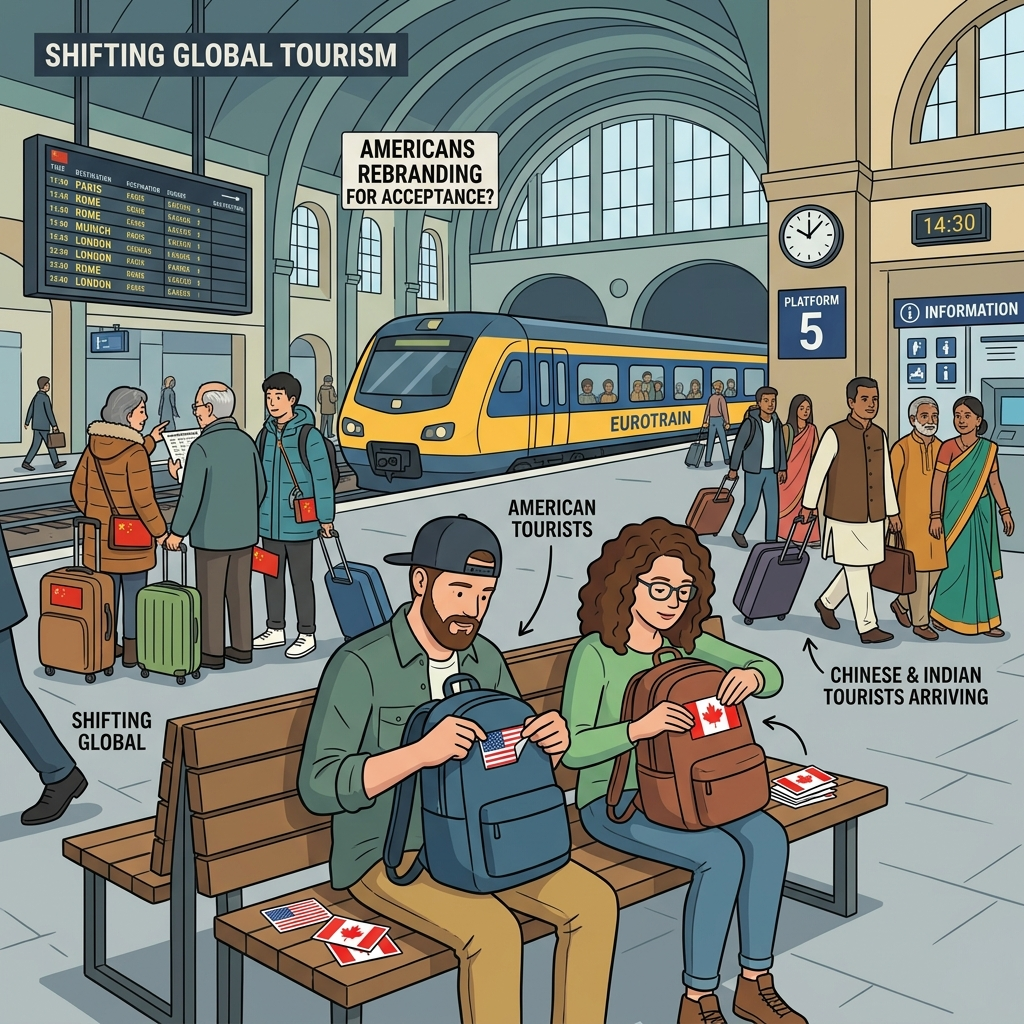
Flag-jacking — the act of American travelers concealing their nationality abroad by sewing Canadian maple leaf patches onto their backpacks — has surged to its largest scale since the Vietnam War era, signaling a deep rupture in how U.S. citizens perceive their national identity on the global stage. American bookings for European flights are down 7.3%, while Canadian visits to the United States have collapsed 21%, draining an estimated $4.5 billion from the American economy in 2025 alone. The tourism vacuum left by departing Americans is being rapidly absorbed by Chinese visitors (+28%) and Indian travelers (+9%), pointing to a structural realignment of global tourism geography rather than a temporary cyclical blip. The United States has become the sole country among 184 nations to register a decline in international tourism spending, a data point that transcends travel economics to signal a crisis of soft power and national brand credibility. Examining whether flag-jacking constitutes genuine civic resistance or merely a ritual of personal convenience — one that leaves policy entirely unchanged while gifting cultural ground to rival powers — is both urgent and long overdue.
Key Points
Flag-Jacking: From Vietnam-Era Fringe to 2025 Mainstream Phenomenon
Flag-jacking originated during the Vietnam War, when young American antiwar travelers pinned Canadian flags to their backpacks to avoid political confrontations in Europe over U.S. military policy. Similar behavior appeared during the Gulf War and the Iraq War, but always remained confined to a relatively small, politically motivated cohort — visible enough to inspire a Simpsons parody in 2005, but never penetrating mainstream travel culture in a meaningful way. What makes the 2025 and 2026 wave categorically different is the sheer breadth of the population now participating: middle-aged family travelers, corporate road warriors, and retired couples — groups that historically showed minimal interest in political signaling through travel accessories — are now engaging in flag-jacking at unprecedented scale. TikTok videos criticizing the practice accumulated over 200,000 shares, the Boston Globe and CNN both ran major feature investigations simultaneously, and the phenomenon entered mainstream cultural discourse in a way previous iterations never achieved. The critical distinction is not just the numbers but the demographic profile and the motivation: where Vietnam-era flag-jackers were making a deliberate political statement, a large proportion of today's practitioners are simply trying to avoid awkward conversations and travel more comfortably. That shift from political theater to personal convenience management tells us something important about how American cultural anxiety has evolved — and how the behavior's collective impact on soft power dynamics differs dramatically from its individual motivations.
The U.S. As the World's Only Tourism Outlier — What the Data Actually Reveals
WTTC's 2025 annual report contains a statistic that should command far more attention than it has received in mainstream media: the United States is the only country among 184 nations to register a decline in international tourism spending this year. Total inbound tourism spending dropped from $181 billion in 2024 to $169 billion in 2025 — a $12.5 billion year-over-year loss — while the global tourism market simultaneously reached a record $11.6 trillion, representing 9.8% of world GDP and supporting 366 million jobs worldwide. The contrast is not subtle: every other country on earth grew or held steady in international tourism, while the U.S. moved distinctively in the opposite direction. WTTC President Julia Simpson publicly described the situation as a "wake-up call" for the U.S. government, and that language is appropriately urgent given what the numbers show. This is not a cyclical fluctuation caused by an external shock — it is a policy-driven outcome, a direct consequence of visa friction, intensified border screening, and the accumulated reputational weight of sustained political controversy at home and abroad. The distinction between cyclical and structural causes matters enormously for any honest assessment of when and whether recovery is achievable, and the current evidence points firmly toward structural causes that do not self-correct without deliberate policy intervention.
Canada's Tourism Boycott: Structural Entrenchment, Not a Temporary Protest
Canada's withdrawal from American tourism has been documented as the largest sustained single-country departure from the U.S. inbound market in modern recorded history. The figures confirmed by Statistics Canada and CBC News are unambiguous: a 21% decline in Canadian visitors, a $4.5 billion loss in total tourism spending, and a 30.9% drop in vehicle crossings translating to 7.6 million fewer car trips across the border. At its peak in April 2025, Canadian flight bookings to the U.S. dropped as much as 76% year-over-year — a number that belongs in a wartime disruption, not a peacetime dispute between neighboring allies. Air Transat announced a complete withdrawal from all U.S. routes before June 2026, a carrier-level verdict that the trend is not cyclical but durable enough to justify permanent capacity reallocation. The most alarming data point is not the peak but the floor: through January and February 2026, the decline was still holding at 14.5% to 22%, with 59% to 62% of Canadians reporting that U.S. government policies had actively reduced their likelihood of visiting. Brunel University's academic research provides the theoretical context that makes this most troubling: politically motivated tourism boycotts tend to sustain suppressed visitor levels averaging 64% below pre-boycott baseline even a full year after the triggering political event has resolved. Meanwhile, Canadian outbound travel to other destinations grew 9.2%, with diverted demand flowing primarily to Mexico and Europe — reinforcing alternative infrastructure while the U.S. market remains unfavorable.
Chinese Tourism's 28% European Surge and the Quiet Transfer of Soft Power
The 28% increase in Chinese tourist arrivals across Europe during 2025 and 2026 is not a coincidence — it is the direct beneficiary of the demand vacuum created by American tourism's retreat, and understanding it requires thinking about the full supply-demand dynamics at play. European Travel Commission data shows that overall European international tourism grew 6.2% in this period, demonstrating that the continent has more than absorbed the loss of American visitors through Asian source market growth. Before the COVID-19 pandemic, China was the world's single largest outbound tourism market by annual volume, with approximately 160 million international trips per year, and a substantial portion of that latent demand has yet to fully reconstitute itself in the post-pandemic environment — meaning the 28% growth figure is an early-stage phenomenon, not a mature one. WTTC projects that China's total tourism economy, domestic plus outbound, will reach $4 trillion annually within a decade. The soft power implications are direct and measurable: tourism is the mechanism through which citizens of one country form their primary experiential impressions of another, and as European hotel operators adopt WeChat Pay and Alipay terminals, as museums prioritize Mandarin audio guides, and as restaurants design menus for Chinese taste preferences, those investments create infrastructure and institutional habits that shape cultural relationships for years after the initial investment is made.
The Perceived-Risk Trap and the Self-Fulfilling Prophecy It Creates
A Global Rescue survey found that 72% of American travelers are concerned about being perceived more negatively abroad than before, and 53% express specific anxiety about becoming direct targets of anti-American sentiment — numbers that would be deeply alarming if they reflected documented conditions on the ground. But travel guides, hospitality workers, and field researchers across Europe and beyond consistently report that American tourists are still received with curiosity, genuine warmth, and respect, and that political conversations — when they arise — rarely escalate into personal hostility against individual travelers. The gap between perceived risk and actual experienced risk is not a minor statistical quirk; it is the primary engine driving flag-jacking behavior and the tourism retreat more broadly. When large numbers of people act on a systematically inflated threat assessment, they do not merely protect themselves from an imaginary danger — they generate observable behavior that confirms the threat to outside observers, thereby amplifying the perceived risk for the next round of potential travelers. Social media plays a structurally critical role in this amplification: a small number of genuinely difficult traveler encounters become viral content that shapes the perceptions of millions who never have a difficult interaction themselves, while the overwhelming majority of positive, unremarkable interactions never trend. The result is a systematic and self-sustaining distortion of the risk landscape that pushes American travelers toward withdrawal and hiding behavior that, on net, makes the reputational situation measurably worse for everyone who follows.
Positive & Negative Analysis
Positive Aspects
- A More Globally Self-Aware American Travel Culture Is Emerging
The fact that American travelers are actively thinking about how their government's actions are perceived internationally is, taken on its own terms, a meaningful cultural evolution worth acknowledging. For decades, a persistent critique of American tourism was a tendency toward cultural insularity — a default assumption that American norms and expectations were broadly applicable everywhere, that other countries would naturally accommodate American preferences, and that the political context in which one travels is someone else's concern. The anxiety driving flag-jacking, however misdirected in its expression, reflects something genuinely more cosmopolitan: an awareness that traveling as an American is a politically legible act in ways it simply wasn't two or three decades ago. The Global Rescue survey finding that 72% of American travelers are actively thinking about their international image suggests a level of global self-awareness that, properly channeled, could produce more culturally sensitive travelers who engage more thoughtfully with local customs, histories, and political realities. That is a long-term positive for cross-cultural exchange, even if the short-term expression of that awareness — concealing one's nationality — is strategically counterproductive. The foundation of genuine global citizenship starts with recognizing that you are perceived as representing something larger than just yourself, and engaging honestly with that recognition rather than hiding from it.
- Europe's Forced Diversification Is Structurally Healthier Over the Long Run
Europe's tourism industry has historically carried some over-indexing on American visitors, and the forced diversification triggered by the U.S. market's retreat may ultimately strengthen the sector's resilience in ways that deliberate policy alone rarely achieves. Dependence on any single source market creates fundamental structural vulnerability to that market's political cycles, currency fluctuations, and external disruptions, as the post-2016 and post-2020 periods demonstrated repeatedly. The European Travel Commission is now actively building marketing relationships and service infrastructure with Chinese, Indian, and Southeast Asian source markets — a rebalancing that might otherwise have taken a full decade to accomplish under normal market conditions. Global tourism reached a record $11.6 trillion in 2025, and European international tourism grew 4% in Q1 of 2026, demonstrating that the continent is not merely surviving the American withdrawal but actively expanding through it. The lesson here extends well beyond Europe: tourism markets that successfully build diversified customer portfolios are fundamentally better positioned to absorb the volatility of any single market's political or economic disruptions, and the current period is delivering that lesson with unusual clarity and force to destination economies worldwide.
- A Necessary Global Conversation About Travel and National Identity Is Being Forced Open
The flag-jacking phenomenon has unexpectedly triggered a mainstream reckoning with a question that travel scholars have discussed in academic circles for decades without ever breaking through to public discourse: is a tourist a representative of their government, or an autonomous individual? That question does not belong exclusively to Americans traveling under a controversial administration. Korean travelers face questions about their government's policies in certain parts of Asia. Japanese tourists navigate historical tensions across multiple destination countries. Russian travelers abroad face extraordinary pressure to explain or repudiate the war in Ukraine. The 2025 ScienceDirect paper introducing "identity tourism" as an academic concept signals that this conversation is now being taken seriously in scholarly circles with real analytical rigor. If the discourse expands productively, it could lay the intellectual groundwork for a more cosmopolitan travel culture in which national identity is acknowledged as a real context but not treated as fully determinative of individual character — a culture where "I'm from here but I think this" is a normalized and respected position rather than a confession requiring explanation. That kind of travel culture would represent a genuine improvement in global cross-cultural exchange, and the current moment of friction and discomfort may ultimately prove to be the catalyst that makes it achievable.
- The Crisis Is Generating Real Industry Pressure for Structural Policy Reform
The U.S. tourism industry's $12.5 billion loss in 2025 has produced an unusual degree of coordinated political mobilization within a sector that typically avoids direct confrontation with federal policy. US Travel Association is actively and publicly lobbying for visa process streamlining, enhanced international tourism marketing investment, and border screening reforms that would meaningfully reduce the friction currently deterring inbound visitors before they even make a booking decision. When an industry of this economic scale — directly supporting over 20 million American jobs and contributing more than $180 billion annually to national income — marshals serious political pressure, it creates a genuine counterweight to the restrictive immigration and entry policies that have contributed to the current decline. Historical precedent suggests this kind of industry mobilization can produce real results: after the post-9/11 and Iraq War combined impact on American inbound tourism, the industry's economic voice contributed to a meaningful V-shaped recovery between 2004 and 2008. The current crisis may ultimately accelerate structural improvements in how the U.S. markets itself internationally and how accessible it makes itself to legitimate foreign visitors, creating policy reforms that outlast the current political cycle and benefit American tourism long after the immediate controversy has faded.
Concerns
- Tourism Workers Bear the Cost That Policymakers Will Never Feel
The most direct and immediate harm from America's tourism decline falls on the workers least equipped to absorb it and least responsible for causing it. WTTC reports that U.S. tourism supports over 20 million jobs, and the $12.5 billion spending loss is concentrated in gateway cities — New York, Miami, Los Angeles, Las Vegas, Orlando — where hotel staff, restaurant workers, tour operators, rideshare drivers, and retail employees are the first to face reduced hours and the first to be cut when occupancy drops. Industry surveys indicate the hotel sector alone shed approximately 98,000 positions by the end of 2025, with further contraction projected if the trend extends through 2026. Professor Usha Haley of Wichita State University has stated the ethical problem with precision: tourism losses are not experienced by the policymakers whose decisions generate them — they are experienced by the most economically precarious workers in an already low-margin service sector, disproportionately immigrants and people of color working non-union hourly positions with no savings buffer. This is the bitterest structural irony embedded in flag-jacking: hiding your American identity to express disapproval of a government policy simultaneously delivers an additional economic blow to the workers who are already the most harmed by that same policy. The protest and its collateral damage fall on completely different groups of people.
- Flag-Jacking Is Actively Poisoning an Already Strained U.S.-Canada Relationship
Canadians are not amused by flag-jacking, and their anger carries genuine cultural and diplomatic weight that is easy to underestimate from the American side of the border. The core grievance, expressed consistently across Canadian media and social commentary, is what many describe as "stolen valor" — Americans borrowing, without permission and without cost, the positive international image that Canada has spent decades carefully constructing through its actual foreign policy conduct, its multilateral engagement, and its cultural diplomacy. Canadian actor and commentator Zack Cameron's widely shared observation — "When the world gets mad at Americans, Americans run to the maple leaf" — captures the emotional texture of the Canadian response precisely. Beyond the cultural resentment, flag-jacking is adding an emotionally charged accelerant to a bilateral relationship already under severe stress from trade disputes, tariff conflicts, and immigration tensions. The Canadian boycott of American tourism has now persisted long enough — and hardened sufficiently, as evidenced by Air Transat's full route withdrawal — to indicate that the relationship damage extends well beyond any single political grievance and is beginning to affect long-term commercial and infrastructure decisions. Bilateral relationships between neighboring countries depend on the cumulative texture of everyday citizen interactions, and when those interactions become systematically hostile or avoidant, the repair process is far longer and more costly than either side typically anticipates at the outset.
- America's National Brand Is Accumulating Long-Term Damage That Outlasts Any Single Election
The normalization of hiding American identity abroad is not merely a travel trend — it is the behavioral expression of national brand erosion, and national brands, once significantly damaged, recover slowly and at extraordinary cost. The 2026 FIFA World Cup is being hosted in the United States — an event that should represent the single most powerful possible advertisement for American hospitality, cultural richness, and global openness — yet inbound arrivals were still running 14.1% below year-ago levels as of April 2026. The fact that the world's largest and most globally followed sporting event cannot arrest a structural decline in inbound tourism is a significant indicator of how deep the reputational damage already runs. Brunel University's research on political boycotts found that tourist arrivals can remain 64% below pre-boycott baseline a full year after the political trigger resolves — meaning the brand damage from the current period will materially outlast the current political cycle by years, possibly by an entire decade. For comparative context, China's Nation Brand Index ranking moved from 17th place in 2010 to 2nd in 2025, a trajectory built substantially on systematic, sustained tourism presence in globally visible places. Rebuilding a national brand after serious damage typically costs five to ten times what maintaining it would have required, and the opportunity cost of the lost years compounds on top of the direct expenditure.
- The Self-Fulfilling Prophecy Mechanism Is Making the Problem Structurally Worse
Perhaps the most architecturally dangerous aspect of flag-jacking is the self-reinforcing loop it creates and sustains. The baseline anxiety driving the behavior — that 72% of American travelers fear negative international perception — is not, on balance, grounded in documented patterns of hostility in the field. Travel industry professionals and guides consistently report that American tourists are well-received and that political conversations rarely turn personally hostile against individual travelers. But when large numbers of travelers act on a systematically inflated fear, they generate observable evidence that the fear is warranted, because "Americans hide their identity abroad" becomes a documented, widely reported social fact. An American wearing a Canadian patch, deflecting questions about their origin, and avoiding situations where their nationality might emerge is producing behavioral data that feeds back into the social media content that told them to hide in the first place. The amplification runs through TikTok, travel forums, and news features: a small number of genuinely difficult encounters become the viral content shaping perceptions of millions who never experience difficulty, while the vast majority of positive, unremarkable interactions never generate content at all. The result is a systematic and durable overestimation of risk that pushes American travelers toward withdrawal, which reduces American cultural presence in public spaces, which makes American culture feel less relevant and visible globally, which validates the declining perception — and the cycle continues.
Outlook
The next six months represent the first serious stress test of whether this tourism realignment is reversible or essentially permanent. The 2026 FIFA World Cup is being hosted in the United States, and it represents the most significant single opportunity for the country to reclaim momentum in inbound tourism. US Travel Association projected a 10.2% increase in inbound arrivals tied to World Cup activity, and on paper that sounds encouraging. But as of April 2026, international arrivals are already running 14.1% below year-ago levels, and hotel room rates in host cities are being quietly discounted below initial projections. My read: the World Cup will soften the decline in 2026, but it will not reverse the structural trend. Visa processing delays and intensified border screening remain unresolved, and those friction points alone are well-documented suppressors of inbound tourism regardless of how compelling the event itself might be.
The Canadian boycott is the most pressing near-term concern, and the data is unambiguous about its direction. Statistics Canada confirmed that Canadian visits to the U.S. were still down 14.5% to 22% through January and February of 2026. Air Transat's complete withdrawal from all U.S. routes before June 2026 is a carrier-level judgment that this trend is not cyclical — it's structural enough to justify permanently reallocating aircraft capacity. I expect the Canadian boycott to sustain at minimum a 15% decline through the second half of 2026. If U.S.-Canada trade negotiations do not reach a meaningful resolution by Q3, the $5 billion annual tourism loss figure will begin to be treated as the new normal by airlines, hotel operators, and travel agencies on both sides of the border. The flag-jacking phenomenon itself is likely to accelerate in the short term for a counterintuitive reason: as fewer Americans travel to Europe during peak summer season, the ones who do travel become more conspicuous, face more political questions, and experience stronger incentives to reach for the maple leaf patch. The feedback loop is self-sustaining until something externally disrupts it.
Over the medium term — six months to two years — the most consequential shift will be the structural reconfiguration of the European tourism customer base itself. The European Travel Commission has already pivoted its marketing strategy meaningfully away from American-centric campaigns and toward Asian source markets. China's 28% growth in European arrivals during 2025 and 2026 is an early indicator, not a ceiling. Before the COVID-19 pandemic, China was the world's single largest outbound tourism market by annual volume, with approximately 160 million international trips per year, and a substantial portion of that demand has yet to fully reconstitute itself. WTTC projects that within a decade, China's domestic and outbound tourism economy will reach $4 trillion annually. The implication for Europe is stark: accommodating Chinese tourists is not a temporary workaround for the absence of Americans — for many European operators, it may represent a structural upgrade to a higher-volume, faster-growing customer base.
The Indian market, while numerically smaller at 9% growth, carries even larger long-term significance when demographic projections are factored in. India is the world's most populous nation with a rapidly expanding middle class, and its outbound tourism sector is in the early phases of what will likely be a multi-decade expansion. Destinations that build the cultural fluency and service infrastructure to accommodate Indian travelers now will enjoy a compounding advantage as the market scales. The flag-jacking phenomenon, at this medium-term horizon, is also likely to evolve from a viral curiosity into a subject of serious cultural discourse. A 2025 paper in ScienceDirect introduced the concept of "identity tourism" — the idea that travel has become a mechanism for affirming or repudiating national identity, not just a leisure activity. By 2027, nationality-agnostic travel may be recognized as a deliberate lifestyle choice among certain demographics of Western travelers, with the travel retail market already responding through globe and compass patches marketed as national-flag alternatives.
Looking at a two-to-five year timeframe, the most serious scenario is one in which American soft power suffers a permanent one-tier downgrade through the tourism channel. The Brunel University study on politically motivated tourism boycotts found that, unlike economically-motivated ones, political boycotts sustain suppressed tourism levels averaging 64% below pre-boycott baseline even a full year after the triggering political event has resolved. That finding has direct implications here: even if the political climate in Washington shifts significantly in 2028 or 2029, the behavioral patterns being established now will persist well into the following decade. The National Travel and Tourism Office's goal of reaching 90.1 million inbound visitors by 2027 looks essentially unreachable at current trajectory. More broadly, the United States risks slipping from the global top tier of aspirational destinations — places travelers actively prioritize — into the second tier of places you can visit but don't feel compelled to. That perceptual shift, once it sets in the public imagination, is extraordinarily expensive to reverse.
The domino effects of this realignment are worth tracing carefully through their full chain. The first-order effect is American tourist withdrawal from Europe. The second-order effect is European tourism infrastructure pivoting its investment and services toward Asian visitors. The third-order effect is American cultural references becoming less visible, less heard, and less native in the spaces — the great museums, the luxury hotels, the commercial streets — where soft power is actually exercised day to day. If the day comes when Mandarin audio guides at the Louvre are accessed more frequently than English ones, that is not a tourism footnote. That is a generational transfer of cultural relevance. China's Nation Brand Index ranking moved from 17th in 2010 to 2nd in 2025 — a trajectory built in significant part on systematic tourism presence in globally visible places, while American presence plateaued and then declined. Tourism is the most democratic and widespread channel of soft power, and this is precisely the channel where the U.S. is currently retreating.
In terms of scenario analysis, the bull case — which I put at roughly 20% probability — requires a convergence of several developments that are possible but far from assured: a meaningful U.S.-Canada trade resolution before the end of 2026, significant relaxation of visa and entry screening friction, and a World Cup effect that exceeds current projections. Under these conditions, 2027 inbound tourism could recover toward the 2019 level of approximately 79.4 million visitors. The precedent exists — after the Iraq War, U.S. tourism staged a V-shaped recovery between 2004 and 2008 — but the conditions enabling that recovery, including an administration change and no digital boycott infrastructure, are not all present today. Oxford Economics characterized the U.S. tourism outlook as "modest gains only," and even that reads slightly generous given current data.
The base case, at roughly 55% probability, holds the current trajectory steady: the World Cup partially offsets the 2026 decline, the Canadian boycott persists at 15%+ suppression, and European and Asian visitor divergence from American visitor trends continues. Under this scenario, 2026 tourism spending stabilizes around $178 billion, well below pre-pandemic trajectory, and the U.S. tourism trade deficit approaches $70 billion. The bear case — 25% probability — involves the political boycott calcifying into durable behavioral norms, Chinese and Indian tourists cementing their structural presence in European infrastructure, and the U.S. suffering the Tourism Economics-projected maximum loss of $25 billion. Under the bear case, the structural decline is essentially irreversible within a five-year planning horizon without unprecedented government intervention. My overall assessment: plan for slow, limited normalization rather than swift recovery — and recognize that the longer the current dynamics run uninterrupted, the more expensive and difficult the eventual repair becomes.
Sources / References
- Americans flag-jack Canadian identity to dodge global scorn — Boston Globe
- U.S. Economy Set To Lose $12.5BN In International Traveler Spend — WTTC
- Europe loses hold on American tourists, woos Chinese and Indian travellers — European Travel Commission via Yahoo Finance
- Canadian land travel to the U.S. fell more than 30% in 2025 — CBC News / Statistics Canada
- Canada's Travel Boycott Cost the US $4.5 Billion in 2025, With No Sign of Reversal — The Deep Dive
- Some American travelers are flag jacking and Canadians aren't happy — CNN
- US Policy Shifts Are Impacting American Travelers Global Perception — Global Rescue
- Chinese tourism boycotts cause ongoing damage, study shows — Brunel University
- International tourist arrivals up 4% in 2025, reflecting strong travel demand — UN Tourism
- Key global trends defining tourism in 2026 — Oxford Economics