
What's Left of K-pop When You Take the 'K' Out? — HYBE Already Has an Answer
Summary
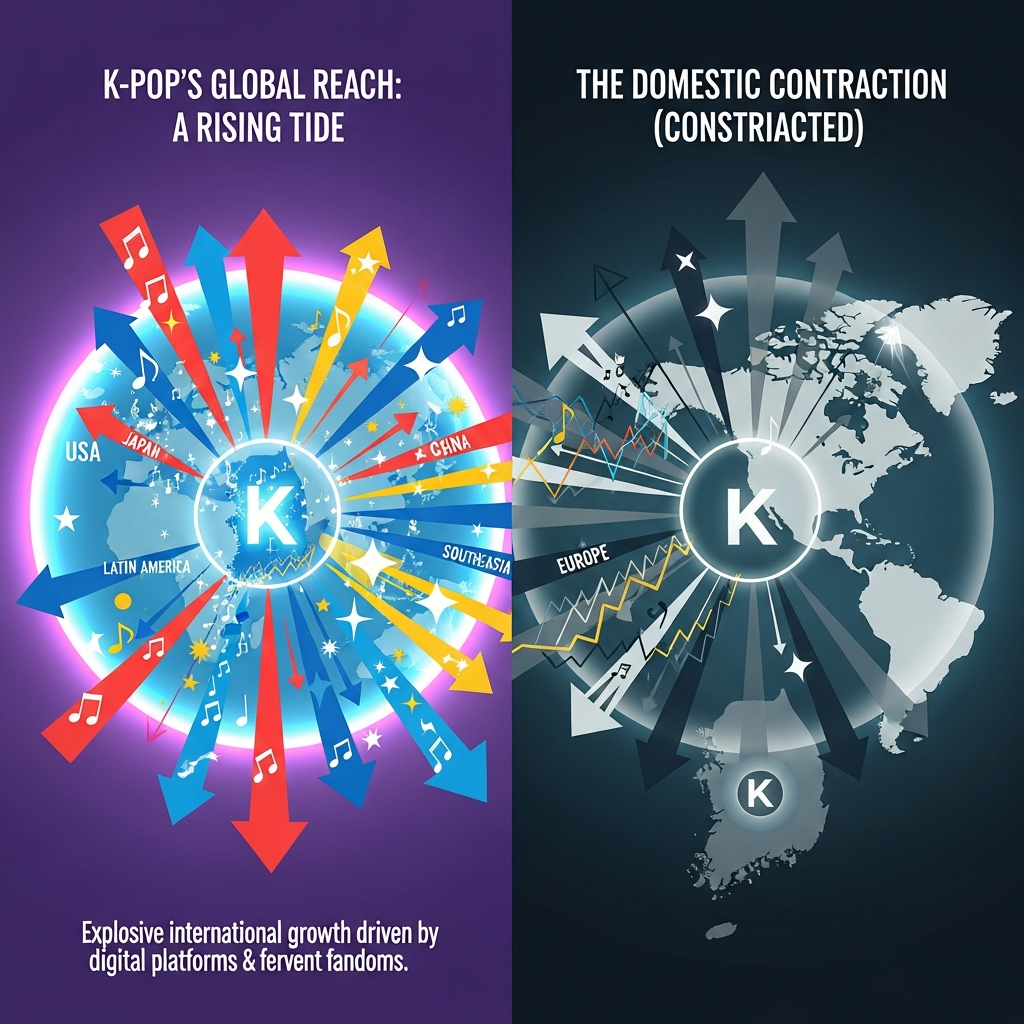
K-pop's relentless global expansion strategy is paradoxically and systematically dismantling the core "K-ness" that defined the genre and fueled its rise. South Korea's domestic K-pop digital consumption has collapsed 49.7% from its 2019 peak, HYBE's non-Korean trainee ratio has hit 28%, and flagship releases including BTS's ARIRANG and BLACKPINK's DEADLINE EP have shifted toward predominantly English-language content, introducing a fundamental fracture in the genre's musical identity. MIDiA Research data confirms that only six songs appear in both the Korean domestic Hot 100 and the global K-Songs chart's top 25, proving that two structurally divergent versions of K-pop now run in parallel — one engineered for the homeland, another engineered for global consumption. The commercial apparatus continues to break records — BTS's 2026 world tour projects $1.4 billion in revenue across 85 shows in 23 countries, Korea has climbed to 11th in Brand Finance's 2026 Global Soft Power Index, and the global K-pop events market is forecast to grow from $14.28 billion in 2024 to $22.91 billion by 2030 — yet HYBE's stock fell up to 40% within two months of BTS's chart-breaking comeback, exposing a structural disconnect between market dominance and investor confidence. Whether K-pop's systematic erasure of its own Korean identity represents the ultimate completion of South Korean soft power or an act of cultural self-destruction is now the single most pressing unresolved question in global entertainment.
Key Points
South Korea's K-pop Domestic Consumption Has Collapsed 49.7% — The Homeland Is Walking Away
Circle Chart's official data reveals that South Korea's domestic K-pop digital consumption has dropped 49.7% from its 2019 peak, and the downward trajectory shows no sign of flattening. Total domestic digital consumption for the top 400 songs fell an additional 6.4% year-over-year in 2025 alone, physical album sales dropped 9% from 116 million copies in 2023 to 93 million in 2024, and the number of million-seller albums shrank from nine to seven with not a single release clearing three million copies — a threshold that SEVENTEEN had cleared without difficulty just a year prior. Circle Chart data journalist Kim Jin-woo put the cause plainly: "Many groups are converging on a narrow range of genres and English lyrics to optimize for global accessibility, and this is starting to exhaust domestic interest." The structural logic of that diagnosis is damning — the more K-pop optimizes for global palatability, the more it alienates the Korean-language domestic audience that constituted its original base and its foundational credibility. The consequence is not merely a revenue shortfall but a talent discovery and development pipeline problem: Korea's domestic market historically served as the testing ground where breakout potential was identified before global deployment, and as that market hollows out, the earliest-stage commercial signal that an act has genuine mass appeal disappears with it. Korean listeners are responding to this cultural drift by shifting consumption toward ballads, indie music, and — in one of K-pop's sharpest contemporary ironies — Western pop that they're now streaming directly rather than through the K-pop intermediary. Music critic Lim Hee-yun's assessment that "the era when idols dominated charts through mass fan activity is over" is not hyperbole. It is a data-backed diagnosis of a structural migration that the industry has been publicly slow to acknowledge.
HYBE's 28% Non-Korean Trainee Ratio — K-pop Manufacturing as Global Franchise
Korea Herald's reporting confirmed that approximately 28% of HYBE's Korean label trainees hold non-Korean nationalities, while SM, JYP, and YG declined entirely to disclose their own ratios — a silence the industry should interpret as a meaningful data point rather than an absence of information. HYBE's joint venture with Universal Music's Geffen Records produced Katseye, featuring only one Korean member among six and performing primarily in English, yet operating entirely within K-pop's trainee development system, choreography infrastructure, and fandom commerce mechanics. Industry veterans openly classify Katseye as "not a K-pop group" — which misses the more important observation: HYBE is not trying to export Korean idols, it is exporting the K-pop production system and using it to manufacture idols locally in every market it enters. CEO Jason Jaesang Lee's formal statement that the goal is to "diversify HYBE's global portfolio beyond K-pop" is not hedged corporate communication — it is a declaration that the K-pop brand is now a means to a globalization end rather than an end in itself. Katseye's commercial validation has been decisive: "Gnarly" entered the Billboard Hot 100 and Beautiful Chaos debuted at No. 4 on the Billboard 200, proving that non-Korean K-pop groups can achieve mainstream commercial results and removing the last argument for keeping the production system nationally anchored. HYBE's fifth global headquarters in Mumbai, its partnership with Tyla's African management team, the Santos Bravos debut in Latin America, and the 2026 India-wide auditions all point toward the same destination: a global entertainment franchise that runs on K-pop methodology but is no longer organically connected to Korean culture as anything more than a historical origin label.
The Global-Domestic Chart Split — Two K-pops Are Already Running in Parallel
MIDiA Research's 2026 analysis provides the most forensically clear picture of how completely K-pop's global and domestic markets have diverged from each other. Only six songs appear in both the Korean domestic Hot 100 and the global K-Songs chart's top 25, and at the top-ten level that overlap shrinks to just three songs. Of the global K-Songs top ten, eight tracks have English as their primary language, with Korean featuring in just one. The Big 4 labels simultaneously dominate global K-pop charts and account for less than 25% of the Korean domestic top 25 — a statistical combination that would have seemed impossible a decade ago, when domestic chart performance and global breakthrough potential were tightly correlated signals. MIDiA Research characterized this as "an emerging bifurcation within K-pop" and concluded that "global popularity no longer implies domestic popularity" — a finding that inverts one of the foundational assumptions of how the K-pop industry has understood its own growth model. The reality is starker than even that framing suggests: the K-pop consumed globally and the K-pop consumed in Korea are not the same music, and the divergence is accelerating as global-facing groups shift to English lyrics and globally-optimized production while domestic audiences migrate toward genres that feel culturally proximate and emotionally resonant in ways that English-language K-pop increasingly does not. This structural bifurcation has implications beyond the chart data itself — when a genre's global commercial face and its domestic cultural foundation are heading in opposite directions simultaneously, the identity question becomes strategically urgent for every new group deciding which audience to prioritize.
BTS ARIRANG at 641,000 Units vs. HYBE Stock Down 40% — The Paradox of Record-Breaking Failure
The commercial statistics attached to BTS's ARIRANG are genuinely staggering: three consecutive weeks at No. 1 on the Billboard 200, 641,000 equivalent album units in the first week, 532,000 pure album sales, 208,000 vinyl copies constituting the highest group vinyl figure since 1991, 2.53 billion total streams, and 10.18 million equivalent album sales in aggregate. By any conventional metric, this was the greatest commercial achievement in BTS's history and one of the most impressive album launches in the modern music industry. And yet HYBE's stock dropped 24% in the immediate aftermath and continued declining, falling up to 40% within two months of the announcement — while Q1 2026 simultaneously set an all-time revenue record at ₩69.83 billion and produced a ₩19.66 billion operating loss. The Bang Si-hyuk capital markets investigation and the ₩43.1 billion ADOR-NewJeans lawsuit added governance-level risk on top of fundamental concerns about post-tour revenue sustainability and the durability of BTS's commercially-pivoted musical direction. The market's cold-shouldering of BTS's record-breaking comeback reflects three structural concerns operating in parallel: legal and governance risk at the leadership level, uncertainty about whether the album's American hip-hop and R&B pivot sustains engagement beyond the core fanbase over the medium term, and deep skepticism about revenue stream durability once the world tour cycle concludes. This paradox — the greatest commercial performance in a K-pop company's history coinciding with sustained investor flight — is perhaps the single most diagnostic data point for understanding the moment K-pop is in right now.
The Fandom Exploitation Model Is K-pop's Real Export — And That's a Problem
Goldman Sachs estimates the global superfan monetization market at $4.5 billion — roughly one-sixth of the entire $30 billion global music industry — and K-pop pioneered the architecture that Western entertainment corporations are now actively benchmarking and replicating for their own deployment. HYBE's Weverse platform has 13.37 million monthly active users with 90% based outside Korea; DearU's Bubble has approximately two million paid subscribers generating recurring revenue through idol-to-fan direct messaging subscriptions. Academics have characterized the practice of assigning idols monthly minimum message quotas as contractual performance obligations — "the commodification of relational labor" — and the broader fandom commerce system, including photo card randomization driving multiple-copy album purchases and fan sign access gated behind bulk buying, is now being exported to India, Africa, and Southeast Asia, regions where consumer protection frameworks are considerably less developed than in Korea. South Korea's 2026 trainee contract reforms represent a meaningful domestic acknowledgment that this system crossed ethical lines requiring legislative correction. But those reforms apply only within Korean domestic jurisdiction and do not constrain HYBE's foreign subsidiaries operating in markets with younger fanbases and more economically vulnerable consumer populations. Universal Music's investment in Weverse and Spotify's launch of a superfan monetization tier signal that Western corporations have moved from observation to active replication. As this infrastructure scales globally beyond Korean regulatory reach, the probability of high-profile incidents generating sustained negative international coverage increases substantially — and reputational damage to K-pop's global brand from a single major controversy in an emerging market would be difficult for any amount of chart success to quickly offset.
Positive & Negative Analysis
Positive Aspects
- K-pop's Production Methodology Is Becoming the Global Entertainment Standard
The most genuinely transformative aspect of K-pop's globalization is not that specific songs have found worldwide audiences — it is that K-pop's production architecture has evolved into a methodology that the global entertainment industry is now actively studying, benchmarking, and attempting to replicate in its own operations. As NPR's analysis put it precisely, K-pop has become "not a sound, but a workflow and a multinational production system" — which represents the same evolutionary trajectory that Hollywood achieved with narrative filmmaking, transforming from a national industry into a globally referenced operational grammar that every other market learns from and measures itself against. The 2026 peer-reviewed academic paper from Tsinghua University, Zhejiang University, and Nanyang Technological University frames K-pop's core identity as residing in its "production system, fandom relationship, and performance aesthetic" rather than in ethnic composition, suggesting the methodology is genuinely portable across cultural contexts in ways a purely ethnicity-bound definition of the genre would not permit. Universal Music's investment in Weverse, Spotify's introduction of a superfan monetization tier, and Live Nation's growing partnerships with K-pop agencies for global touring infrastructure all signal that Western entertainment corporations have moved decisively from curiosity about K-pop's model to active adoption of its most commercially valuable elements. If Korean companies maintain structural ownership of the most important components of this methodology — the platform infrastructure, the trainee development know-how, the fandom commerce mechanics — they stand to benefit economically as the methodology's originators and primary operators even as individual content becomes less distinctively Korean in cultural character. This represents a real and substantial strategic asset whose long-term value should not be dismissed even by observers skeptical of de-Koreanization's cultural costs.
- Korean Soft Power Is at a Historically High Watermark
Brand Finance's 2026 Global Soft Power Index ranks Korea 11th in the world — up from 15th in 2024, a four-position advance in just two years that almost certainly reflects the accumulated momentum of K-pop's sustained global cultural presence. In the Culture and Heritage subcategory, Korea ranked 7th globally; in Food, 10th — categories that reflect the genuine breadth of Korean cultural influence extending well beyond music. The Korean government has set a target of $36 billion in annual cultural exports by 2030, with current exports already at $13 billion annually and growing. Physical album exports reached $301.7 million in 2025, up 3.4% from the prior year, while K-pop's streaming footprint generates 75% of its consumption volume outside Korea. The multiplier effects of K-pop's global reach extend far beyond the genre's direct commercial revenue: Hallyu tourism grew from 63,000 visitors in 2020 to 1.765 million in 2023, an extraordinary trajectory, and total inbound tourism reached 18.6 million between December 2024 and November 2025. K-pop fans who discover Korean music follow natural consumption pathways into Korean drama, Korean cosmetics, Korean food, and Korean travel — generating a value chain whose total economic impact substantially dwarfs K-pop's direct commercial performance. This accumulated soft power capital represents a genuinely durable asset that will take years to depreciate even as de-Koreanization accelerates, because brand equity built over two decades of distinctively Korean cultural output does not evaporate on a single strategic pivot.
- K-pop's Global Commercial Metrics Remain Genuinely Powerful
Whatever structural concerns surround K-pop's identity trajectory, the genre's commercial performance metrics in the current period are objectively strong and carry real economic weight. The global K-pop events market is projected to grow from $14.28 billion in 2024 to $22.91 billion by 2030 at an 8.2% CAGR. The K-pop production market is forecast to expand from $10 billion in 2024 to $21.58 billion by 2033. Luminate's 2025 data places Korea as the world's fourth-largest music export market by on-demand streaming volume and the largest among non-English-speaking countries — a position with real strategic significance in a streaming-dominated industry. Seven of the global top ten best-selling albums in 2025 were K-pop releases. BTS's 2026 world tour alone projects $1.4 billion in revenue across 85 shows in 23 countries, with a reach that no other musical act outside the Western pop mainstream can approach. Physical album exports grew 3.4% year-over-year in 2025, demonstrating that the physical merchandise economy remains commercially viable even as streaming dominates consumption. These are not vanity metrics — they represent real economic weight that translates into label revenue, venue partnerships, merchandise ecosystems, and the ongoing financial rationale for continued investment in K-pop production infrastructure. As long as these numbers remain in this range, the K-pop industry retains the resources to potentially navigate its structural identity challenges rather than being overtaken by them.
- New Market Growth Potential Represents a Transformative Long-Term Opportunity
HYBE's expansion into India, Africa, and Latin America is not merely a revenue diversification play — it is a calculated bet on some of the most demographically powerful entertainment markets in the world, markets that the global music industry has historically underserved and where K-pop's systematic, data-driven approach to talent development and fan engagement could provide genuine structural advantages over less methodologically rigorous competitors. Sub-Saharan Africa's music market grew 22.6% year-over-year in 2024, crossing $110 million annually, driven by structural factors — smartphone penetration, streaming platform expansion, youth demographics — that are secular rather than cyclical. India is the world's most populous country and has an entertainment market whose full commercial potential has barely been tapped by international music industry players operating at scale. HYBE's fifth global headquarters in Mumbai, the 2026 India-wide auditions under Bang Si-hyuk's oversight, and the Santos Bravos Latin America debut that sold out the Auditorio Nacional in Mexico City collectively represent a geographically diversified growth strategy that, if even partially successful, would transform K-pop's commercial geography in ways that reduce its structural dependence on the North American and East Asian markets that have driven growth to date. A K-pop ecosystem generating meaningful revenue from four or five geographic centers would be considerably more resilient to any single market's downturn — including the domestic Korean market decline that currently represents the industry's most acute near-term structural risk.
Concerns
- Brand Identity Dilution May Destroy K-pop's Most Irreplaceable Competitive Asset
K-pop captured global attention not by becoming better at imitating Western pop but by being dramatically, unapologetically different from it. The genre's core differentiating formula — Korean-English code-switching that made lyrics simultaneously exotic and approachable, melody-forward topline construction that pushed vocal hooks to their absolute limit, within-track genre pivots that Western A&R departments would never approve, and visual performance spectacle at a scale mainstream Western acts had largely abandoned — created a product with no direct global equivalent that fulfilled consumer demand the Western music industry was not serving. NPR's analysis identified precisely what HYBE's "multi-home, multi-genre" strategy is dismantling: that differentiation, systematically and deliberately, in the name of global scalability. MIDiA Research's finding that eight of the global K-Songs chart's top ten tracks have English as their primary language represents K-pop having actively erased the language dimension of its own most distinctive characteristic. The competitive risk of this erasure is concrete: in a global pop landscape where K-pop is "just pop," Korean entertainment companies compete head-to-head with Universal, Sony, and Warner — labels with larger talent pools, deeper songwriter networks, superior radio promotion infrastructure, and dominant algorithmic positioning on every major streaming platform. Korean companies win in that competition today specifically because K-pop is not just pop. Remove that distinction, and the competitive moat that justified premium valuations and outsized investor interest disappears with it. No strategic framework for cultural industry competition suggests that a non-Western entrant wins a head-to-head contest against entrenched Western giants by becoming progressively more similar to them.
- Domestic Fandom Collapse Is Undermining K-pop's Foundational Development Infrastructure
The 49.7% collapse in South Korea's domestic K-pop digital consumption is not a market correction that will naturally normalize — it is evidence of a structural migration away from a genre that is no longer speaking to its home audience in culturally proximate ways. Big 4 labels dominate global charts while accounting for less than 25% of the Korean domestic top 25, a statistical combination that reflects genuine cultural divergence rather than ordinary competitive dynamics. Korean listeners are shifting consumption toward ballads, indie music, and direct consumption of Western pop, bypassing K-pop as a cultural intermediary. Physical album sales declined from 116 million copies in 2023 to 93 million in 2024, million-seller releases dropped from nine to seven, and not a single release cleared three million copies. Music critic Lim Hee-yun's observation that the era of chart dominance through organized mass fan purchasing is over is supported fully by the quantitative record. The domestic Korean market is not simply one revenue source among others — it is the environment in which new groups are identified, commercially tested, and developed before global deployment. As that environment hollows out and the cultural feedback loops that once made domestic success a reliable predictor of global resonance break down, the industry loses the creative laboratory function that produced its most successful global exports. An industry that can no longer reliably develop domestically compelling content may also be losing the instincts and infrastructure needed to identify globally compelling talent at the earliest stages when intervention and development still have the most impact.
- Small-to-Midsize Agency Destruction Is Hollowing Out K-pop's Creative Diversity
K-pop's historical capacity for genuine creative innovation has depended critically on a diverse ecosystem of small-to-midsize agencies operating outside the Big 4's risk-averse commercial logic and willing to take creative and financial gambles that large organizations structurally cannot. BTS itself originated at Big Hit Entertainment, which at the time of BTS's debut was a small agency that survived early commercial failures only through the founder's personal commitment to a single group. The globalization strategy and English-language pivot now dominating industry direction are capital-intensive initiatives that only organizations with substantial reserves can sustain, and smaller agencies are being systematically priced out of the competitive landscape as a consequence. Purple Kiss, Weeekly, and Everglow have already disbanded or suspended activity — these are only the cases prominent enough to attract industry-wide coverage. Even HYBE, operating at the industry's peak scale, recorded a ₩42 billion operating loss in Q3 2024 despite tripling concert revenues, signaling that structural margin pressure is real even at the top. The 2026 regulatory reforms — mandatory revenue disclosure, bans on school withdrawal pressure for underage trainees, legal requirements for mental health counseling access — are ethical necessities, but each one adds compliance costs that smaller agencies cannot absorb without restructuring or exiting. As smaller agencies leave the market, K-pop loses the creative laboratories where its most genuinely experimental and generationally defining work has historically been developed, and the industry risks becoming an oligopoly producing commercially optimized content that is technically proficient but creatively conservative.
- Globalizing the Fandom Exploitation Model Creates Ethical and Reputational Risk at Scale
The fandom commerce infrastructure K-pop developed — photo card randomization driving multiple-copy album purchases, fan sign event access gated behind bulk buying thresholds, idol-to-fan messaging platforms packaging emotional connection as paid subscription products, monthly message quotas assigned to performers as contractual obligations — has been characterized by academic researchers as "the commodification of relational labor," a system in which the appearance of personal connection is packaged and sold as a repeatable commercial transaction at scale. Goldman Sachs estimates the global superfan monetization market at $4.5 billion, and K-pop pioneered the architecture driving a substantial portion of that valuation. South Korea's 2026 trainee contract reforms represent a meaningful national acknowledgment that elements of this system crossed ethical lines requiring legislative correction — but those reforms apply only within Korean domestic jurisdiction and do not constrain HYBE's foreign subsidiaries. As HYBE's multi-home strategy deploys this infrastructure in India, Africa, and Southeast Asia — markets with younger fanbases, lower average consumer incomes, and consumer protection frameworks that are considerably less developed than Korea's — the potential for the model's most exploitative elements to operate without effective regulatory constraint is substantial. Universal Music's Weverse investment and Spotify's superfan tier demonstrate that Western corporations are moving from observation to active replication of K-pop's monetization architecture. A single major controversy involving aggressive monetization practices directed at economically vulnerable young fans in an emerging market could inflict disproportionate and lasting reputational damage on K-pop globally — damage that no chart performance record or revenue milestone can quickly undo, because the cultural credibility that sustains fan investment is far harder to rebuild than it is to destroy.
Outlook
The variables most likely to shape K-pop's near-term trajectory over the next six months are identifiable, even if their outcomes remain genuinely uncertain. The single biggest test is the BTS 2026 World Tour: 85 shows, 23 countries, projected revenue of $1.4 billion. This tour is K-pop's most visible argument that it still commands unrivaled dominance in the global live music market — a claim that matters enormously to HYBE's valuation narrative and to the industry's collective pitch to investors. But there is a cautionary precedent embedded in recent history: at BTS's Seoul comeback concert, an expected attendance of 260,000 materialized as 100,000 in practice. If the global leg consistently draws below-capacity crowds, the narrative around K-pop's live market power will take fast and serious damage. HYBE's Q2 2026 earnings release warrants equally close attention. Q1 set a revenue record at ₩69.83 billion, but a one-time cost from Bang Si-hyuk's employee stock donation produced a ₩19.66 billion operating loss. As the full tour revenue begins hitting the books in Q2, adjusted operating income should improve — but two legal overhangs remain. The Bang Si-hyuk capital markets investigation and the ₩43.1 billion ADOR-NewJeans lawsuit are not peripheral noise. They represent governance-level uncertainty that institutional investors cannot ignore, and the market is pricing them accordingly.
A second immediate variable that rarely gets the attention it deserves in international coverage is whether South Korea's domestic K-pop consumption finds a floor or continues declining. The top 400 tracks posted a 6.4% year-over-year drop in 2025. If that trend sustains into 2026, the domestic market will have entered what I'd characterize as structural freefall. Physical album sales have already slid from 116 million copies in 2023 to 93 million in 2024. A trajectory toward sub-80 million in 2026 is plausible and would breach a meaningful psychological threshold for the industry. When physical sales drop to that level, the cascading effect on mid-tier agencies — already struggling to push any single release past three million copies — will accelerate the wave of group disbandments and label closures already underway. Purple Kiss, Weeekly, and Everglow have been early casualties. They will not be the last. The industry needs to stop treating the domestic audience's disengagement as acceptable collateral damage in a globalization strategy, because the domestic market is not merely a revenue source — it is the talent development and creative testing pipeline that feeds everything else.
Looking further out across the six-month to two-year medium-term horizon, the central structural question is whether HYBE's multi-home global strategy begins delivering measurable commercial results that justify its cost structure. The company has established its fifth global headquarters in Mumbai, partnered with Grammy-winning artist Tyla's management team for the African market, and debuted Santos Bravos in Latin America to a sold-out Auditorio Nacional in Mexico City — a promising early signal. India-wide auditions launched in 2026 under Bang Si-hyuk's direct oversight, but translating those auditions into a commercially viable debut-ready idol group requires a minimum of one to two years. Sub-Saharan Africa's music market grew 22.6% year-over-year in 2024, crossing $110 million annually, providing favorable macroeconomic conditions for HYBE's entry. But whether K-pop's production methodology — built around very specific cultural assumptions about fan-idol relationship structures, collectible merchandise mechanics, and performance aesthetics rooted in Korean entertainment tradition — can be transplanted wholesale into markets with radically different consumer behavior and cultural context is an entirely different question from whether those markets have commercial potential. The business logic for expansion is clear. The cultural portability of this specific model is not, and the gap between those two things creates real strategic exposure that the optimistic revenue projections routinely understate.
The regulatory environment is a medium-term structural wildcard that the industry has been systematically underweighting in its strategic calculus. South Korea's trainee standard contract reforms that took effect January 1, 2026, mandate periodic revenue disclosures, prohibit compelling underage trainees to withdraw from school, and legally guarantee mental health counseling access — all meaningful protections the industry resisted for years before finally accepting legislative intervention. But every reform item carries compliance costs, and those costs distribute very differently based on organizational scale. HYBE can absorb them as part of normal operating overhead. Many smaller agencies genuinely cannot without fundamentally restructuring their business models. The most likely outcome is accelerated market concentration — the Big 4 consolidating further, potentially thinning to a Big 2 or Big 3 structure over the coming years as smaller operations fail to clear the new compliance cost baseline. Here is the counterintuitive consequence that deserves more attention: as market concentration increases, the strategic pressure on surviving large agencies to pursue global expansion as their primary growth lever also intensifies. Domestic market stagnation leaves internationalization as the only viable high-growth path available. This means de-Koreanization does not decelerate when the industry consolidates — it accelerates. The regulatory reforms intended to protect workers are, paradoxically, creating structural incentives for the surviving companies to pursue the very strategy most likely to hollow out Korea's cultural ownership of K-pop.
The two-to-five-year horizon is where the most fundamental questions reside, and they orbit a single issue: will the term "K-pop" still mean anything coherent by 2028 or 2030? My view is that it will not — or more precisely, that it will simultaneously mean two incompatible things. One version of K-pop will be the domestic Korean idol music ecosystem: performing primarily in Korean, culturally rooted in the Confucian fan-idol relationship model, serving a shrinking but loyal domestic audience that has increasingly differentiated taste from global K-pop consumers. The second will be a globally distributed pop format produced using K-pop methodologies — systematic trainee development pipelines, synchronized group choreography, fandom commerce infrastructure — with increasingly tenuous and ornamental connections to Korea itself. The K-pop production market is forecast to grow from $10 billion in 2024 to $21.58 billion by 2033 at an 8% CAGR, and those projections almost certainly price in the latter, more globalized and de-Koreanized version of the market. The critical question those projections don't answer is what fraction of that growth flows back to Korea.
When HYBE manufactures Indian idols in Mumbai and cultivates African artists in partnership with local management teams, the K-pop methodology gets deployed and the K-pop brand gets leveraged — but the economic multipliers, the tourism revenue, the cultural prestige, the downstream consumer spending on Korean products, accrue primarily to host markets rather than Seoul. K-pop's global commercial scale could expand substantially while Korea's cultural ownership of that scale quietly contracts. That divergence is already visible in embryonic form in today's data. Over a five-year horizon, it becomes structural and largely irreversible.
The Hollywood parallel is instructive here, though it is typically deployed more optimistically than the evidence warrants. Yes, Hollywood became the operational grammar of the global film industry. But in achieving that status, it progressively hollowed out the distinctively American cultural content of its largest commercial productions. The highest-grossing contemporary blockbusters are engineered for maximum global palatability — cultural specificity is actively managed as a liability rather than cultivated as an asset. K-pop is heading down exactly that road on an accelerated timeline.
By 2030, K-pop may generate more revenue from India and Southeast Asia than from Korea, perform more in English and local languages than in Korean, and feature more non-Korean than Korean performers as a matter of statistical majority. Luminate's 2025 data already shows that 75% of K-pop streaming happens outside Korea, and that proportion continues growing each year. South Korea's 11th-place soft power ranking is real and genuinely hard-earned. But I am skeptical that ranking survives intact once the de-Koreanization of K-pop reaches its logical endpoint. Soft power built on cultural distinctiveness and soft power built on a globally distributed production franchise are not equivalent instruments and do not produce the same downstream dividends in diplomatic relationships, tourism conversion, or trade preference.
Mapped onto concrete scenarios, here is how I assess the probability distribution of outcomes. The bull case — which I estimate at roughly 20% probability — requires K-pop's production methodology to achieve the same status that Hollywood's narrative grammar achieved in global film: the operational standard that every major market adopts and references, while Korean companies maintain sufficient structural ownership of the methodology to claim ongoing cultural credit and real economic participation. In this scenario, the K-pop events market reaches its projected $22.91 billion by 2030, HYBE's multi-home strategy delivers genuine commercial breakthroughs in India and Africa, the superfan monetization model creates a $4.5 billion platform segment dominated by Korean technology platforms like Weverse and Bubble, and Korea's government achieves its target of $36 billion in annual cultural exports by 2030. The core precondition for this outcome is that HYBE and its peers maintain an identifiable and economically meaningful thread connecting the global K-pop brand to Korean cultural origin — which the current strategic direction does not suggest is a priority, making this a genuinely optimistic scenario rather than a base expectation.
The base case — which I assess at approximately 55% probability — is a structural equilibrium where global expansion and domestic hollowing-out proceed simultaneously without either overwhelming the other in aggregate industry figures. Domestic consumption continues its gradual decline, but global streaming revenues and live event economics offset the erosion. Two parallel K-pops operate simultaneously without converging: a locally rooted, Korean-language domestic scene serving a smaller but engaged audience, and a globally distributed, English-dominant production format engineered for the international market. The superfan monetization market absorbs the physical album revenue decline, keeping overall industry revenue stable in real terms while the revenue mix shifts dramatically toward digital and live. Market structure consolidates toward Big 2 or Big 3. Innovation becomes increasingly centralized in large organizations rather than distributed across a diverse ecosystem, and the genre gradually loses the creative volatility — the willingness to experiment radically with sound, format, and concept — that has historically been K-pop's most enduring competitive advantage. This is not a catastrophic outcome for the industry, but it represents a meaningful and likely irreversible diminishment of what made K-pop culturally distinctive.
The bear case — which I estimate at 25% probability — is the self-destruction scenario. Domestic market collapse accelerates past the point where global revenue growth can compensate. The de-Koreanization of K-pop eliminates its differentiating distinctiveness while simultaneously failing to achieve competitive parity with established Western pop on global platforms and streaming algorithms that heavily favor English-language content from major Western labels. Streaming growth, already decelerating to 1% in 2024, signals market saturation. The fandom exploitation model triggers regulatory backlash and reputational damage in major emerging markets as consumer protection frameworks in those markets mature and targeted advocacy builds. HYBE's concurrent legal entanglements generate governance-level uncertainty that constrains its ability to execute on the multi-home strategy at precisely the moment execution matters most. In this scenario, K-pop's global commercial footprint remains significant in absolute dollar terms, but the genre loses its status as a culturally distinctive phenomenon and becomes one of several competing global pop production formats — with no inherent structural reason why the Korean-based version should maintain a competitive advantage over rivals operating with lower production costs and more direct cultural alignment with their primary target markets.
I should be transparent about where my analysis could be wrong. The academic argument made rigorously in the 2026 Tsinghua-Zhejiang-NTU paper is that K-pop's identity resides not in ethnicity but in a "production system, fandom relationship, and performance aesthetic." If that framework is correct, then de-Koreanization is not a threat to K-pop's identity at all — it is the natural global maturation of a methodology that was never inherently national to begin with, and my concern about origin-identity erosion rests on a category error about what K-pop fundamentally is. There is also the argument that Korean soft power is a composite effect — K-drama, K-beauty, K-food, and culinary tourism each contributing independently — such that K-pop's trajectory doesn't determine the whole complex's performance, and the brand resilience of the broader Korean cultural cluster is more robust than any single component's dilution would suggest. I've engaged both counterarguments seriously, and they don't move me off my core position. But intellectual honesty requires acknowledging them as genuine counterweights, not straw men.
What I'd urge anyone following this story closely — whether you're an investor, a policy analyst, a cultural observer, or simply someone who finds K-pop genuinely interesting as a global phenomenon — is to resist tracking it exclusively through quarterly earnings releases and chart positions. The BTS 2026 world tour gross and HYBE's next earnings report will dominate the headlines, and those numbers matter. But the structurally consequential story is operating at a different level: a cultural product that became globally transformative specifically because of its distinctive national identity is now systematically dismantling that identity in pursuit of universal scalability. The outcome of that experiment will be cited as a case study for decades — not just in music industry strategy, but in the broader literature on how non-Western cultural exports navigate the tension between global ambition and cultural authenticity. K-pop's physical album exports reached $301.7 million in 2025, and 75% of global K-pop streaming happens outside Korea. The genre has never been commercially stronger. It has also, arguably, never been closer to the moment when 'K' becomes merely a historical prefix rather than a live cultural commitment. Watch the structural data — not just the chart data.
Sources / References
- Is K-pop's global strategy backfiring? — Korea Herald
- K-pop's global bifurcation: a genre at a crossroads. — MIDiA Research
- HYBE posts record Q1 revenue of $477M. — Music Business Worldwide
- BTS Earns 7th No. 1 Album on Billboard 200 With ARIRANG. — Billboard
- Rethinking the 'K' of K-pop. — International Journal of Cultural Studies (Sage)
- How the West was won: K-pop's great assimilation gambit. — NPR
- South Korea ranks 11th for global Soft Power. — Brand Finance
- Nearly 30% of Hybe K-pop trainees are non-Koreans. — Korea Herald
- BTS comeback draws a smaller crowd. — CNBC
- K-Pop Fan Platform 2026: Inside the $4.5 Billion Superfan Wars. — Seoulz