
Tilly Norwood's "Misaligned" Is Perfectly Named — But the Real Misalignment Isn't What You Think
Summary
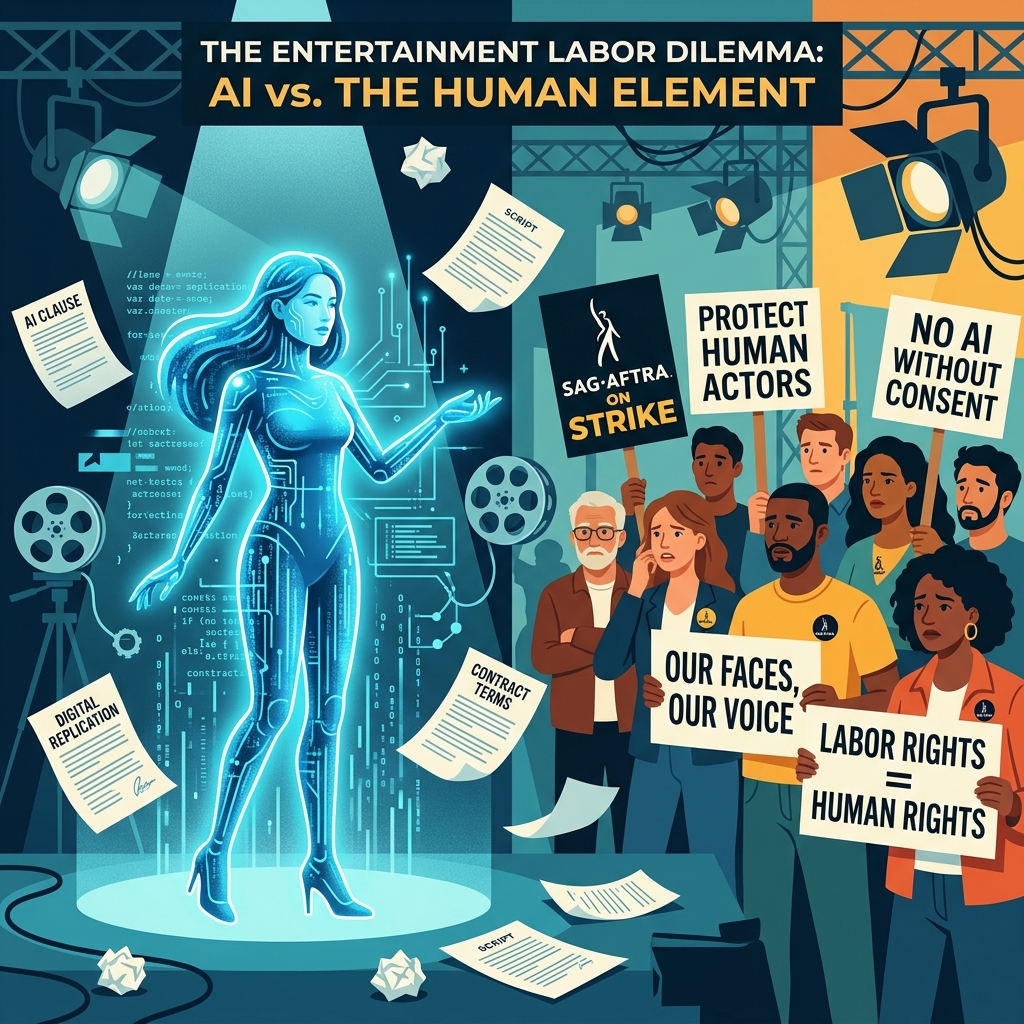
The announcement of Tilly Norwood — an AI-generated performer created by London-based startup Particle6 — as the lead of a feature film titled "Misaligned" has sent shockwaves through Hollywood and reignited one of the entertainment industry's most urgent debates about labor, consent, and the future of human creativity. SAG-AFTRA responded with a formal statement condemning the use of "stolen performances," while major stars including Emily Blunt, Whoopi Goldberg, Melissa Barrera, and Mara Wilson publicly opposed the project in increasingly forceful terms. Beneath the celebrity outrage, however, lies a structural problem far older than any AI startup: the decades-long practice of major studios embedding digital-likeness clauses into actor contracts without meaningful consent or fair compensation for the performers affected. With 41,000 film and television jobs lost in Los Angeles County over just three years and 40% of China's top short dramas now featuring AI performers, Tilly Norwood is a symptom of systemic exploitation — not its original cause. This essay argues that SAG-AFTRA's most effective fight should target not a single synthetic actress but the legal vacuum enabling unconsented AI training data practices — a vacuum that Hollywood studios themselves helped construct and normalize over the course of decades.
Key Points
Unconsented Training Data Is the Real Core of This Controversy
The Tilly Norwood debate is fundamentally not about whether an AI actor can or should exist — it is about where the data used to create her originated, and whether the people whose work generated that data had any meaningful say in the matter. SAG-AFTRA's official statement made this explicit: the union charged that Particle6 built its system by training on the work of countless professional performers without their permission or compensation. Particle6 has declined to disclose its training dataset, and CEO Eline Van der Velden's defense — that the system does not pull specific data unless a performer's name is explicitly typed into a prompt — deflects the real issue rather than addressing it. The concern is not about one-to-one replication of any single individual actor. The concern is about the collective, aggregate harvesting of hundreds of thousands of performers' expressive patterns without consent or remuneration. Mara Wilson crystallized the central argument with a single direct question: she asked why, if Particle6 synthesized the faces of hundreds of living women to create this character, the company didn't simply hire one of those women directly. The music industry has already begun navigating this exact problem — Warner Music moved from suing AI company Suno for copyright infringement to establishing a licensing partnership — but the film and television industry lags far behind that evolutionary curve. Refusing to disclose training data provenance doesn't just create a public relations vulnerability; it creates a fundamental ethical legitimacy deficit that no marketing strategy can bridge.
SAG-AFTRA's Anger Is Legitimate — But the Target Is Wrong
SAG-AFTRA's forceful response to Tilly Norwood is completely understandable, and the union's stated concerns are both morally and logically coherent. A statement condemning AI performers for stealing performances, displacing actors from jobs, and devaluing human artistry carries genuine persuasive force. Emily Blunt's televised reaction and Melissa Barrera's assertion that any agency signing with Particle6 is betraying its clients both reflect how deeply threatening the synthetic-actor development feels to working performers at every career level. Major agencies including Gersh and WME declined to represent Tilly Norwood, and UK Equity along with Canada's ACTRA issued formal opposition statements, creating a genuinely international coalition of resistance. My view, however, is that this substantial collective energy is being directed at the wrong target. Shutting down Particle6 — a small, underfunded independent startup — does not reverse the tide of AI-generated performers when China already reports 40% AI-actor penetration in its short-drama market as of 2026. The real fight must be waged against the systemic legal vacuum that permits AI companies to harvest performer data without consent, and against the studio apparatus that created and normalized the logic of treating human performers as interchangeable digital assets across several decades. Targeting the symptom while leaving the underlying disease untreated is not a viable long-term strategy.
Hollywood Studios Are the Original Architects of Performer Digital Exploitation
The most consistently overlooked fact in the entire Tilly Norwood controversy is that major Hollywood studios — not AI startups — pioneered the structural treatment of actors as replaceable digital resources. The classic studio system of the 1920s through the 1950s bound performers to exclusive seven-year contracts and claimed complete ownership of their image and likeness as a matter of routine corporate practice. That system technically ended decades ago, but its underlying philosophy simply evolved and adapted rather than disappearing. As recently as the 2023 strikes, major studios were reportedly attempting to secure permanent digital scans of background actors for a single day's wages, retaining those scans for unlimited future deployment without additional compensation. The digital de-aging of Brad Pitt in 2008's The Curious Case of Benjamin Button and the posthumous digital recreation of Peter Cushing in Rogue One: A Star Wars Story are widely celebrated examples of a decades-long practice of deploying actor likenesses without those performers being physically present on set or receiving additional payment. Particle6 is an easy target precisely because it's small and unusually explicit about what it's doing commercially. But the logic of treating human performers as digital raw material was normalized by major studios long before Tilly Norwood's Instagram account was created. Van der Velden's own background as a working actor who claims firsthand knowledge of that exploitation makes her choice to replicate its structural logic genuinely worth criticizing — but that criticism shouldn't come at the cost of obscuring who actually wrote the original playbook.
The Concept of Authentic Performance Is Standing on Shakier Ground Than It Appears
SAG-AFTRA's argument that Tilly Norwood possesses no lived experience and no genuine emotion resonates powerfully at first encounter — but push that logic to its logical conclusion and you reach genuinely difficult philosophical territory. The idea that authentic performance necessarily originates from real interior emotional experience is not a universal truth about what performance fundamentally is; it is a principle rooted in specific acting methodologies — Stanislavski's system and Meisner technique — that became dominant in the American acting tradition during the twentieth century. What an audience actually experiences in a theater or on a screen is not a performer's interior life: it's a projected, mediated, technically processed representation of expression that has passed through cameras, lighting, editing, and sound design before reaching any viewer. If audiences are genuinely moved by an AI-generated performance, the philosophical question of whether that emotional response carries full legitimate value becomes quite complicated to resolve cleanly. An NRG survey found that 56% of current audiences believe AI actors cannot match human quality, with only 7% saying the gap has already closed — but those figures describe 2026's specific technology level, not a permanent ceiling on what AI systems will eventually become. This is not an argument for synthetic actors. It is an argument that the defensive line of authentic performance requiring human interiority may prove harder to hold than it currently appears, and that labor advocates would be wise to ground their legal frameworks in consent and compensation rather than in contested philosophical theories about what makes a performance genuinely real.
The Global AI-Actor Market Has Already Crossed the Point of No Return
The danger of focusing all opposition on Tilly Norwood as an individual figure is that it obscures the actual scale of what is already happening across the global entertainment landscape. The generative-AI media and entertainment market is projected to expand from $2.24 billion in 2025 to $21.2 billion by 2035, a compound annual growth rate of 25.2% — and those numbers are grounded in adoption trends already observable in the present market, not in speculative forecasting. In China, MIT Technology Review reported that 40% of the top 100 short dramas featured AI performers as of January 2026, up from under 10% just twelve months earlier; the Chinese micro-drama market carries a total valuation of approximately $14.5 billion, roughly double the size of China's theatrical box office. Against this backdrop, the 90% production cost reduction that Particle6 claims represents an economic force that studios and streaming platforms will find extraordinarily difficult to resist on a sustained basis. Paul Schrader — a director whose credits include Taxi Driver and Raging Bull — has identified the genuine industry turning point as the moment when an AI-lead film actually makes money commercially, and has positioned that moment as imminent. The LA County employment collapse — 41,000 jobs lost in three years — is not a projection about the future. It is the documented present-tense reality of an industry that is already mid-transition, and the trend line has not inflected upward.
Positive & Negative Analysis
Positive Aspects
- Real Democratization of Filmmaking Access Is a Genuine Possibility
AI actor technology carries genuine potential to dramatically lower the cost of professional-quality film production in ways that could open opportunities for creators who have historically been structurally excluded from high-production-value storytelling. If Particle6's claimed 90% production cost reduction proves durable at scale, independent filmmakers and content creators in developing economies — Nigeria's Nollywood, Southeast Asian independent cinema, documentary traditions across Latin America and sub-Saharan Africa — could gain access to character-driven production quality that has historically required Hollywood-scale budgets. Toronto Metropolitan University's Owais Lightwala has specifically noted AI's potential as a democratizing tool for marginalized creators who face structural barriers to traditional production resources and financing. The concentration of global media storytelling power in a small number of major studios and streaming platforms is a genuine cultural problem — and any technology that meaningfully reduces the production cost barrier deserves at least partial credit as a counterforce against that concentration. The caveat is obvious and important: democratization only functions as genuine democratization if the economic benefits accrue broadly to creators rather than concentrating in the hands of AI companies, investors, and the same major studios already dominating the landscape.
- Consent-Based Digital Licensing Could Open a Meaningful New Revenue Stream for Performers
When AI actor technology is paired with the right legal and contractual framework, it has real potential to create income opportunities that currently do not exist for the majority of working performers. The present reality is stark: only 12.08% of SAG-AFTRA members earn more than $1,000 per year from their union work, meaning the vast majority of professional performers are already cobbling together income from multiple sources to survive economically. A consent-based digital licensing model — in which an actor explicitly authorizes specific uses of their digital likeness and receives royalty payments each time those uses occur — would represent a meaningful new income channel, particularly for performers whose active career years have wound down due to age, health, or shifting market preferences. The music industry's evolution from the streaming wars provides a relevant parallel: Warner Music's pivot from suing AI company Suno for copyright infringement to establishing a commercial licensing partnership demonstrates that adversarial phases of creative-industry-versus-AI-technology conflicts tend to eventually give way to cooperative models. SAG-AFTRA's current significant-additional-value contract requirement and the ongoing NO FAKES Act legislative process are collectively building the legal scaffolding that could make consent-based licensing contractually enforceable rather than merely aspirational.
- This Controversy Is Driving Essential Global Conversations About AI Training Data Transparency
Whatever else it has produced, the Tilly Norwood controversy has accomplished something concretely important: it has pulled the deeply technical question of AI training data consent out of specialized legal forums and placed it squarely in the center of mainstream public discourse, where policymakers and lawmakers must now engage with it directly. SAG-AFTRA's formal statement, the cascade of high-profile celebrity responses, and the formal opposition declarations from UK Equity and Canada's ACTRA have collectively made it structurally impossible for policymakers to treat the consent question as an internal technical matter confined to industry specialists. The NO FAKES Act's unanimous passage through the Senate Judiciary Committee — with its proposed $750,000-per-platform liability provision for violations — directly reflects the impact of amplified public attention on the speed and substance of legislative action. Without this specific controversy, debates about AI training data consent would likely have remained largely confined to copyright attorneys and technology policy specialists arguing in academic papers and closed-door policy forums. The heat generated by Tilly Norwood is raising transparency standards not just for the film industry but for every domain where AI systems are trained on human creative output — music, literature, visual art, and beyond — which constitutes a genuine structural contribution to a better long-term policy landscape.
- The Controversy Is Forcing the Entertainment Industry Toward Active Adaptation
One underappreciated dimension of the Tilly Norwood situation is that it has compelled the entertainment industry to begin constructing adaptive regulatory and contractual frameworks rather than simply hoping the AI challenge dissolves on its own. SAG-AFTRA's 2026 contract language requiring demonstrated significant additional value before synthetic performers can be deployed — approved by 89% of the union board — represents a substantive, forward-looking industry response rather than pure passive resistance to change. The emerging Tilly Tax discussions reflect a pragmatic recognition that the underlying technology cannot realistically be eliminated and must therefore be priced in ways that protect human performers economically. Van der Velden's own observation — that the filmmakers who will lead the next decade are those who combine decades of storytelling instinct with new tools — implies a future of human-AI creative collaboration rather than pure performer displacement, even when that observation comes from within the synthetic-actor development community. Adaptation forced by crisis is not ideal, but it is substantially better than the alternative of an industry caught entirely flat-footed by a transition already well underway.
Concerns
- Structural Mass Displacement of Actor Employment Is Already Happening Right Now
The numbers are not projections about a potential future — they are current, documented, present-tense reality. Los Angeles County lost 41,000 film and television jobs between 2022 and 2025, representing a full 25% of the entire regional industry workforce wiped out in just three years. An additional 6,700 positions disappeared in the twelve months through May 2026, extending the trend without any sign of reversal. Of SAG-AFTRA's total membership, only 12.08% earn more than $1,000 annually from union work — meaning the vast majority of professional performers are already living below any reasonable definition of a sustainable acting income in a notoriously expensive industry hub. Into this existing employment crisis, the arrival of AI performers capable of reducing production costs by 90% introduces not merely competition but something closer to an existential economic threat. For producers and studio executives operating under constant margin pressure from streaming subscriber metrics and content cost containment mandates, synthetic actors are not a philosophical question about artistry — they are an economic lever with no obvious countervailing financial argument. The World Economic Forum projects that 92 million job categories will face displacement globally by 2030, and acting is positioned to be among the earliest and most severely affected sectors.
- Unconsented Data Harvesting Is Being Systematically Disguised as Technical Innovation
The defensive logic that Particle6 employs to deflect questions about its training data — that the system does not pull specific data unless a performer's name is explicitly entered into a prompt — establishes a dangerous and potentially industry-defining precedent for how AI companies can claim ethical legitimacy while operating in a deeply ethically problematic manner. Under this reasoning, any AI company could ingest billions of examples of human creative work without obtaining consent, then successfully defend itself in public debate by claiming it never explicitly reproduced any single individual work. The structural analogy is precise: it is equivalent to photographing every book in a public library, synthesizing a new book from all of them, and then arguing the result is original because no individual book was directly transcribed. The legal gray zone exists because courts have not yet issued definitive rulings on whether AI training data use constitutes fair use or copyright infringement in the entertainment context — but using that legal ambiguity as a shield for practices that would clearly fail any common-sense consent test is ethically indefensible regardless of current legal exposure. Refusing to disclose training dataset provenance doesn't just damage public trust in Particle6 specifically; it corrodes trust in AI-generated content broadly, creating a credibility deficit that the entire sector will eventually need to reckon with.
- The Collapse of Entertainment Employment Creates a Cascade Beyond Just Acting
What AI actors displace is not only the individual performer's salary and screen time — it is an entire interconnected employment ecosystem built around human performers. When a working actor stands on a production set, the shoot simultaneously requires makeup artists, hair stylists, stunt coordinators, costume designers, lighting technicians, set construction crews, production assistants, and on-set logistics managers; dozens of adjacent jobs are economically attached to each individual performer's presence. AI actors eliminate that entire dependent structure in a single substitution. The scale of this cascading displacement effect is already visible in hard data: Los Angeles County filming days declined from 36,792 in 2022 to 19,694 in 2025 — a 47% reduction in three years that ripples far beyond guild membership. Entertainment industry layoffs in 2025 increased 18% year-over-year, with more than 17,000 positions eliminated across the sector, affecting crew roles that have no equivalent digital substitute. These effects extend well beyond guild members and into local economies dependent on production activity: restaurants near studio lots, hotels hosting visiting crews, transportation services, and retail businesses in production-adjacent neighborhoods all absorb the contraction. SAG-AFTRA's resistance to synthetic performers is, in structural terms, a defense not just of its membership but of a regional economic ecosystem with no easy replacement.
- Cultural Homogenization and Reinforced Beauty Standards Are Concrete and Measurable Risks
Tilly Norwood's physical design — blonde, white, conventionally slender by Hollywood standards — has been flagged explicitly in SAGE academic analysis as representative of the default aesthetic bias embedded in AI-generated human image systems. If AI actor technology scales to global dominance while continuing to reproduce Western, Eurocentric beauty and body standards as its default training output, the result could be a net reversal of the slow but real gains in cultural representation diversity that mainstream entertainment has achieved over recent decades. China's micro-drama market, where 40% of top productions already feature AI performers, represents a live and large-scale test case — but the question of what aesthetic standards those AI actors are encoded with has received virtually no critical scrutiny from regulators or cultural commentators. JaLi Research CEO Sarah Watling has warned that utilities tend to get monopolized as adoption scales — and if AI actor generation concentrates in a small number of platforms operating from shared aesthetic training data, cultural expression across global entertainment could converge rapidly toward a narrower and narrower homogeneous default. The technology is not inherently and irreversibly homogenizing, but without deliberate, active effort to train genuine diversity of representation into AI systems from the ground up, cultural homogenization is simply the path of least economic resistance.
Outlook
In the near term, "Misaligned" is still in early development, so no one is buying a ticket just yet. But the announcement itself has already sent a powerful signal to every corner of the market. The NO FAKES Act passed the Senate Judiciary Committee unanimously on June 18, 2026, and now awaits a full Senate floor vote. If enacted, the bill would impose liability of $5,000 per violation against individuals and $750,000 per platform for unauthorized AI replicas of real people. I believe this legislation passes within the calendar year — it has unusually strong bipartisan support, and the Tilly Norwood controversy has driven public awareness of the consent issue to a level that would have seemed unimaginable just eighteen months ago. SAG-AFTRA has already moved proactively, inserting language into 2026 contracts requiring studios to demonstrate significant additional value before deploying synthetic performers — a provision approved by the union's board with an overwhelming 89% vote.
The next six months will almost certainly see what industry commentators are already calling the "Tilly Tax" take concrete shape — a per-use fee on AI performers designed to compress the cost advantage that synthetic actors currently hold. Forbes analysis puts a star-level human actor at roughly $15 million all-in with risk premiums, compared to approximately $5 million for an AI performer. Even if a Tilly Tax doubles the AI casting cost to $10 million, the economic advantage of going synthetic remains substantial for most production contexts. Any purely cost-based regulatory approach will run directly into this fundamental arithmetic problem. The math still favors AI actors across the vast middle market of streaming content, advertising, and short-form video, regardless of what supplemental fees are imposed at the top end of the market.
There's another near-term variable that deserves serious attention: the box office fate of "Misaligned" itself will function as a market referendum on the entire AI-actor concept. The closest historical analogy is "Final Fantasy: The Spirits Within" from 2001 — the first major feature film attempt to deploy fully computer-generated human performers in leading roles. That film cost $137 million to produce and collapsed catastrophically at the box office, effectively freezing investment in the synthespian concept for the better part of a decade afterward. If "Misaligned" suffers a similar commercial failure, investor enthusiasm for AI-actor ventures will cool rapidly and SAG-AFTRA's leverage will strengthen significantly in future negotiations. But if the film posts commercially meaningful numbers, it becomes the validation moment Paul Schrader identified as decisive — the movie where an AI lead actually makes money. Tilly Norwood's YouTube series "AI Commissioner" has accumulated more than 700,000 views, confirming real public curiosity. Whether that curiosity converts to theater ticket purchases remains a wide-open question.
Looking at the medium term — roughly six months to two years out — my expectation is that AI actors will penetrate deepest where they are least visible to casual audiences. Background performers, commercial models, short-form digital content, and social media video are the categories where AI actors already hold crushing economic advantages, and where audience resistance to synthetic performers is lowest precisely because viewers rarely think consciously about who's on screen. China's rapid adoption trajectory validates this prediction. According to MIT Technology Review, 40% of China's top 100 short dramas featured AI performers as of January 2026, up from under 10% just twelve months earlier. The Chinese micro-drama market carries a total valuation of approximately $14.5 billion — roughly double China's entire theatrical box office. That production model will migrate to Southeast Asia, India, and ultimately to Netflix, Amazon, and their global competitors, where relentless pressure to reduce content spending makes synthetic performers an offer that is structurally difficult to refuse.
On the regulatory front, the medium-term picture will look markedly different than today's reactive crisis mode. If the NO FAKES Act passes in the United States, the paradoxical effect may be to legitimize and accelerate a regulated AI-actor market rather than suppress one. Legal clarity gives studios and financial backers the certainty required to commit to large-scale investments within a compliant structure. Europe's EU AI Act will almost certainly incorporate entertainment-specific provisions in its high-risk AI categories, and with UK Equity and Canada's ACTRA already on record formally opposing synthetic performers, some form of international regulatory coordination becomes structurally inevitable. I project international AI-actor guidelines emerging around 2027 to 2028. The most important insight here is this: no regulatory framework can reverse the underlying technology. The decisive variable is who designs the consent-and-compensation framework first — because the jurisdiction that establishes that architecture will hold a structural competitive advantage in the AI entertainment economy for years. The music industry's trajectory is instructive: Warner Music moved from suing AI company Suno for copyright infringement to establishing a licensing partnership. Opposition almost invariably converges toward cooperation under sufficient economic pressure.
In the longer-term view of two to five years, three distinct scenario paths diverge from the present moment. In the optimistic scenario, AI actor technology crosses the uncanny valley threshold somewhere around 2027 to 2028, consent-based licensing becomes the industry standard, and performers begin earning royalties from authorized uses of their digital likenesses. Under this outcome, more than 50% of short-form content features AI actors by 2030, and supporting-role synthetic performers become routine in theatrical films. For the 87.92% of SAG-AFTRA members who currently earn under $1,000 annually from union work, digital licensing fees could represent a genuine new income stream — a meaningful diversification of earning opportunity in a profession where stable income has always been exceptional. In the baseline scenario, SAG-AFTRA's significant-additional-value requirement constrains AI-actor adoption in high-visibility productions while synthetic performers proliferate steadily in backgrounds, commercials, short content, and independent film. Perhaps 15 to 25% of entertainment budgets shift toward AI-generated content by 2030, while A-list human actors retain their star power in prestige productions. In this scenario, AI actors expand the total content market rather than displacing human performers on a strict one-for-one basis.
In the pessimistic scenario, aggressive enforcement of the NO FAKES Act combined with adverse court rulings on AI training data expose companies like Particle6 to existential legal liability. "Misaligned" fails commercially and triggers a sharp investor pullback from AI-actor ventures. Chinese-style mass AI content generates significant quality backlash and viewer attrition. Under this outcome, widespread AI-actor adoption remains confined to narrow niches through 2028, and SAG-AFTRA achieves something resembling a de facto industry moratorium through contract leverage. I personally assign the highest probability to the baseline scenario — but China's accelerating adoption speed and the structural cost pressure on streaming platforms push my probability distribution noticeably toward the optimistic end. A Taylor & Francis academic study found that audiences shown an AI-actor label reported significantly lower viewing intention. Whether that labeling effect persists as technology quality improves and consumer familiarity grows is genuinely uncertain.
The final dimension worth examining carefully is the cascade effect that ripples far beyond acting itself. When a human performer stands on set, the production requires makeup artists, hair stylists, stunt coordinators, costume designers, lighting technicians, set construction crews, and on-set logistics staff — dozens of adjacent jobs attached to each individual performer. AI actors eliminate that entire dependent employment ecosystem. The evidence for this cascading effect is already materializing in hard data: Los Angeles County filming days collapsed from 36,792 in 2022 to 19,694 in 2025, a 47% reduction in just three years. Entertainment industry layoffs in 2025 increased 18% year-over-year, with more than 17,000 positions eliminated across the sector. These are not forecasts — they are current documented conditions. Whatever my specific scenario projections turn out to be, the most urgent imperative right now is building the legal, contractual, and technical infrastructure — consent frameworks, compensation mechanisms, transparency requirements — before the next synthetic performer completes the journey from Instagram to the multiplex. Who we choose to blame matters far less than what kind of system we decide to build.
Sources / References
- Tilly Norwood, AI 'actor' denounced by actors union, to star in feature film — NBC News
- Tilly Norwood's New Movie Rekindles Hollywood Concerns That AI 'Actor' Is Just Ripping Off Human Performances — Variety
- SAG-AFTRA Statement on Synthetic Performer — SAG-AFTRA
- AI Actor Tilly Norwood Will Headline New Feature Film — Forbes
- How Chinese short dramas became AI content machines — MIT Technology Review
- Unable to Stop AI, SAG-AFTRA Mulls a Studio Tax on Digital Performers — Variety
- S.4591 NO FAKES Act of 2026 — Congress.gov
- AI's Not the Enemy, It's the Key — Tilly Norwood, Digital Culture Ethics, and Performer Rights — SAGE Journals