
The Day Bollywood Sold Its Soul to Nationalism — How India Traded 50 Years of Soft Power for a Single Box Office Hit
Summary
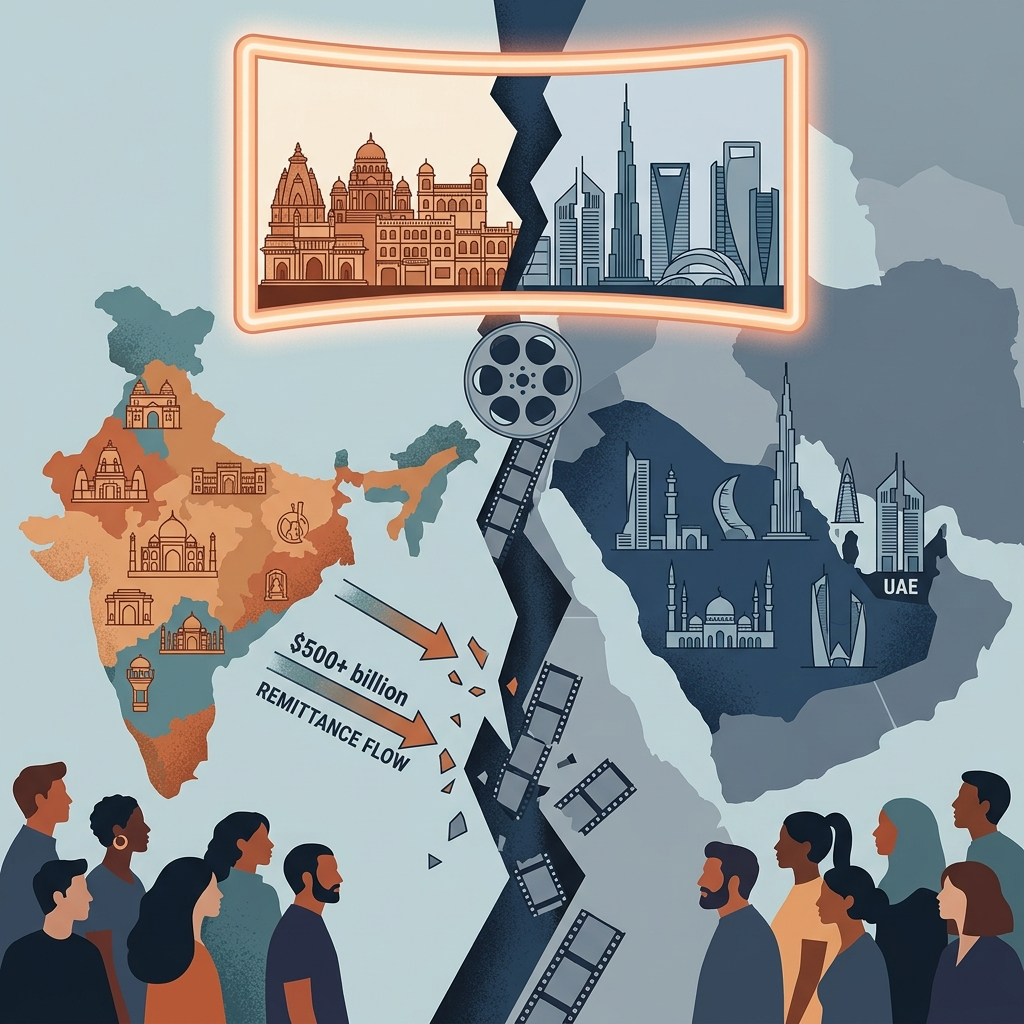
The theatrical release of *Dhurandhar*, starring Ranveer Singh, has crystallized a structural crisis at the intersection of cinema, geopolitics, and economic interdependence: the film simultaneously shattered domestic box office records in India and was banned across all six Gulf Cooperation Council nations for depicting Pakistani and Muslim characters in ways deemed hostile and discriminatory. This dual outcome exposes a profound self-contradiction at the heart of Bollywood's current commercial formula — Hindu nationalist narratives generate dependable domestic revenue while systematically dismantling the soft power infrastructure that India spent five decades constructing, with the GCC hosting nine million Indian migrant workers whose annual remittances of approximately $51 billion represent 38 percent of India's total overseas income. The contrast between this era and the Shah Rukh Khan period — when Bollywood's inclusive, universalist storytelling made Indian cinema beloved from Pakistan to East Africa — illustrates precisely how the shift toward enemy-designating narratives constitutes a qualitative reversal in soft power strategy, trading long-term global cultural influence for short-term domestic applause. The *Dhurandhar* incident is not an isolated controversy but a pivotal inflection point that reveals the "domestic optimization trap" facing the world's third-largest film market: a commercial formula that thrives inside 1.4 billion-person borders while foreclosing the global expansion that would allow Indian cinema to truly compete with Hollywood and the Korean Wave. If Bollywood continues this trajectory, India risks cementing its cultural identity as a giant domestic market rather than a global cultural force, ceding international space to competitors in ways that historically take two to three decades and enormous resources to reverse.
Key Points
The Unprecedented Significance of a Simultaneous Six-Nation GCC Ban
The decision by UAE, Saudi Arabia, Bahrain, Kuwait, Oman, and Qatar to collectively ban *Dhurandhar* at precisely the moment it was breaking domestic box office records in India is, to my knowledge, without direct precedent in the history of Indian cinema. Previous Bollywood films have run into difficulties in individual countries — *Fighter* faced pushback in certain markets, and several films dealing with the Kashmir narrative have been denied distribution in Pakistan — but a coordinated simultaneous refusal from all six GCC members is qualitatively different in kind from any of those incidents. The official basis for the ban focused on anti-Pakistan and anti-Islamic characterizations, with the line "You cannot trust a Baloch" attracting specific and sustained attention as an example of ethnic targeting rather than individual characterization. What makes the GCC's coordinated response especially significant is the distinction between cultural discomfort and social stability calculation: Gulf governments were not primarily expressing aesthetic displeasure or diplomatic solidarity with Pakistan, but rather making a practical judgment that content explicitly dehumanizing one of two large South Asian communities sharing physical space in their cities constituted a threat to domestic order. I read this not as a one-off regulatory decision but as an institutional signal — the kind of coordinated policy action that tends to establish precedent rather than remain isolated. The fact that this ban represents an escalation from the 2023 *Fighter* situation, where friction was more localized, suggests that the Gulf's collective patience with Bollywood's nationalist escalation has reached a defined threshold.
India's Remittance Economy and the Structural Contradiction of Cultural Provocation
India's overseas remittances are the world's largest at approximately $135 billion annually, and the Gulf Cooperation Council region accounts for roughly $51 billion of that total — 38 percent of the national figure — generated by nine million Indian workers across the six GCC states. These numbers alone make the Gulf the single most economically important external relationship in India's macroeconomic architecture, with the possible exception of certain bilateral trade relationships. The per-state dependency figures make the stakes even more concrete: Kerala, with more than 35 percent of its state GDP derived from Gulf remittances, Telangana, Andhra Pradesh, and several northern Indian states all operate with structural fiscal dependencies on the continued willingness of GCC countries to employ and support Indian workers at current levels. The social license enabling that employment — the cultural perception of Indians as broadly trustworthy, professionally valuable, and compatible with Gulf social norms — is not a separate, soft variable that can be treated in isolation from the economic relationship. It is the cultural infrastructure on which the financial flows depend. When Bollywood's most commercially prominent productions repeatedly depict Islam and Pakistan in explicitly hostile terms, the erosion of that cultural goodwill is not a matter of feelings or diplomacy. It is a material risk to a $51 billion annual financial transfer that sustains millions of Indian households and stabilizes the balance of payments of several Indian states. The comparison I keep returning to is straightforward: the entire Indian film industry generates $2 to $3 billion in global revenue per year. The remittance corridor at risk is seventeen times larger.
The Shah Rukh Khan Era Versus the Dhurandhar Era — A Fundamental Shift in Soft Power Posture
The transition from the Bollywood of the 1990s and early 2000s to the Bollywood of the nationalist blockbuster era represents more than a change in popular taste or commercial fashion. It represents a fundamental reversal in the underlying strategic logic of India's most globally visible cultural export. During the peak of the Shah Rukh Khan era, Indian cinema traveled freely and was consumed with genuine affection across Pakistan, the Gulf, Southeast Asia, and East Africa simultaneously — not because of government soft power campaigns or diplomatic programming, but because the films themselves operated on a framework of emotional universalism that made them accessible and resonant for audiences who shared none of India's specific political context. *Dilwale Dulhania Le Jayenge*, *Kuch Kuch Hota Hai*, and a dozen similar films became beloved across South Asia and beyond because they dramatized love, family, belonging, and sacrifice in terms that required no prior political alignment to appreciate. Pakistani audiences did not watch Shah Rukh Khan despite being Pakistani; they watched him because his films made them feel that their emotional world was understood and respected. The current nationalist formula operates on an entirely different and antithetical principle: it generates its emotional charge precisely by identifying and dehumanizing an enemy, which means it can only work for audiences who already accept that enemy designation. The pool of potential global viewers for that kind of content is definitionally restricted to people who share India's BJP-era political framework — a small fraction of the world audience compared to what the universalist formula could reach.
The Gulf's Pragmatic Social Stability Calculation and What It Signals to India
The most common misreading of the GCC ban that I encounter frames it as an expression of anti-Indian bias or knee-jerk solidarity with Pakistan. Both interpretations miss what is actually happening in the decision-making process of Gulf governments, and getting this wrong leads to dangerously incorrect conclusions about what the ban means and what it demands in response. GCC states host, in aggregate, nine million Indians and five million Pakistanis living and working in immediate physical proximity — in the same apartment buildings, on the same construction sites, in the same retail districts. The maintenance of functional, peaceful coexistence between those two large South Asian communities is not a diplomatic nicety for Gulf governments. It is an operational necessity for the labor-dependent economic models that GCC states run. A major Indian film that explicitly brands Baloch people as untrustworthy and frames Pakistani identity as inherently adversarial to Indian interests is, from the perspective of a Gulf interior ministry, a piece of content designed to introduce communal tension into a carefully managed multiethnic labor environment. The ban is a cold, unsentimental application of public order logic, not a statement of cultural favoritism. I would also note that this ban represents something more structurally consequential than a simple regulatory decision: it is the first time the Gulf has used coordinated content restriction as a visible signal of its limits to India's cultural assertiveness. That signal will be remembered the next time an Indian production is submitted for Gulf distribution, and the next time after that.
The Invisible Victims — Indian Muslims, the Baloch Diaspora, and the Hidden Costs of Nationalist Cinema
The constituency that receives the least attention in the public debate around *Dhurandhar* and the nationalist film genre is also, in my assessment, the one sustaining the most direct and concrete harm: India's approximately 200 million Muslim citizens and the worldwide Baloch diaspora. When Bollywood's commercially dominant narrative frames Indian national identity as synonymous with Hindu nationalist identity, and consistently positions Muslims and Pakistanis as the adversarial other in that national story, Indian Muslims are placed in a structurally impossible position that has no clean resolution available to them. They carry Indian passports, they are full legal citizens, they have served in the Indian military, contributed to the Indian economy at every level, and built lives as Indians — and yet the most internationally visible cultural product India exports to the world routinely casts their religious identity as the nation's primary threat. The Indian Muslim worker in Dubai or Abu Dhabi faces a particular form of double erasure that I think deserves explicit recognition: not fully included in the "India" that the film celebrates, and simultaneously associated in the eyes of Gulf neighbors and colleagues with the country producing content those neighbors find politically threatening. For the Baloch diaspora, the "You cannot trust a Baloch" line crystallizes this into something even more specific and brutal: an already politically marginalized ethnic group — many of whose members left Pakistan precisely because of violence and institutional neglect — finds itself turned into a stock villain in the world's third-largest film industry's most commercially successful genre. These costs never appear on any production company's profit statement. They are real, they are measurable in human terms, and they will eventually generate consequences that cannot be managed with box office data.
Positive & Negative Analysis
Positive Aspects
- Domestic Market Economic Boost and Increased Film Industry Investment
*Dhurandhar*'s massive domestic success — reportedly crossing $230 million at the Indian box office within two weeks — represents a genuine and substantial economic contribution to the Indian entertainment ecosystem. The film's returns generate significant downstream value for the roughly 300,000 people directly employed by the Indian film industry, as well as for adjacent sectors including OTT licensing, theatrical distribution chains, soundtrack licensing, promotional merchandise, and theme park integration. For investors evaluating the commercial viability of large-budget Hindi cinema, a blockbuster of this scale serves as a proof of concept that justifies continued capital deployment into ambitious productions, which in turn drives improvements in technical quality — VFX capability, sound design, production infrastructure — that benefit the industry broadly. It would be intellectually dishonest to look purely at the distributional and diplomatic consequences of the nationalist formula without acknowledging that the commercial case for it is, on its own terms, genuinely strong within the domestic market context. The 1.4 billion-person Indian market rewards this formula reliably, and the economic reality of that reward shapes incentives for every participant in the industry's value chain in ways that criticism from outside the domestic audience simply cannot override through argument alone.
- National Unity and Patriotic Solidarity Among a Diverse Population
India is, by almost any measure, one of the most internally complex nations on earth — 28 states, 22 constitutionally recognized languages, dozens of ethnolinguistic communities, major religious fault lines, and persistent regional autonomy pressures from northeast India to the south. Nationalist cinema of the *Dhurandhar* variety provides, at minimum, a temporary mechanism for catalyzing a shared emotional experience across that enormous internal diversity. Reports from the opening weekend described audiences across very different Indian regions waving national flags together in theaters, responding to the same scenes with the same emotional intensity — a form of collective catharsis that, whatever its ideological underpinnings, does create a real if transient experience of national belonging. For a government managing the extraordinary challenge of holding a continent-scale democracy together across profound internal divisions, the existence of a commercial cinema that generates this kind of voluntary shared emotional experience carries genuine political utility. I want to be precise: I do not think this constitutes healthy or durable national unity, and I think the mechanism — unifying around a designated external enemy — is structurally corrosive in the long run. But the short-term effect of emotional solidarity is real, and dismissing it entirely would be analytically inaccurate.
- Reinforcing Public Support for India's Defense and Security Posture
India's defense expenditure, running at approximately 2.4 percent of GDP, places it among the top five military spenders globally in absolute terms. The political sustainability of that spending level — in a democracy with enormous competing demands for social investment — depends significantly on a public that perceives security threats as real, immediate, and requiring robust military response. Films in the *Dhurandhar* genre serve a function here that is documented in media studies: they make abstract security narratives visceral, personalized, and emotionally urgent in ways that make defense expenditure feel legitimate and necessary to audiences who might otherwise question the trade-offs involved. The mechanism is not meaningfully different from what happened in the United States in the post-9/11 period, when a wave of films valorizing military action tracked closely with high public support for the Iraq and Afghanistan interventions. I want to characterize this accurately as an observed effect rather than an endorsement: nationalist cinema demonstrably builds the domestic political environment in which sustained military investment becomes publicly palatable. Whether that is a feature or a defect depends entirely on one's assessment of India's security needs and political values — but the effect itself exists and shapes real policy outcomes.
- International Media Attention and the Global Visibility Paradox
There is a counterintuitive irony embedded in the *Dhurandhar* situation that deserves acknowledgment: the Gulf ban has made this film, and by extension Bollywood's nationalist turn, the subject of international media coverage and analytical attention at a level that even a straightforwardly successful global release rarely achieves. BBC, Al Jazeera, Reuters, and dozens of international outlets ran coverage of the ban. Academic researchers at institutions studying soft power, cultural diplomacy, and South Asian geopolitics are now writing about this event. Major international think tanks like the Lowy Institute have published analytical pieces placing this controversy within the broader framework of India's global cultural positioning. In a media environment where attention is the scarcest resource, controversy generates a kind of visibility that genuine quality sometimes cannot. The question is whether this particular form of visibility — being discussed primarily as a case study in cultural provocation and diplomatic failure — can be converted into something commercially or strategically useful, and I am genuinely skeptical. Being famous for making enemies is not the same as being influential, and the track record of controversially banned content converting notoriety into lasting cultural impact is not encouraging.
Concerns
- Irreversible Erosion of India's Accumulated Soft Power Capital
Bollywood was, for five decades, perhaps the single most effective instrument of Indian soft power in the world — arguably more consequential than any number of diplomatic programs, trade agreements, or international development initiatives. The ability of Indian cinema to generate genuine affection for India across populations that had no particular reason to be pro-India was a strategic asset of enormous value that worked passively, continuously, and at relatively low cost. The transition to nationalist filmmaking as the dominant commercial formula is systematically and, I would argue, irreversibly degrading this asset in real time. Soft power is definitionally dependent on the voluntary engagement of the audience; the moment your cultural export tells a meaningful portion of potential global audiences that their identity is your nation's designated enemy, those audiences do not engage with your culture voluntarily anymore — they engage with it defensively, if at all. The historical precedents for soft power recovery should give Indian policymakers serious pause: Japan needed approximately four decades of anime, video games, cuisine, and consumer electronics to rebuild its global cultural goodwill after World War II; Germany required over three decades after reunification to restore the depth of cultural trust that supports genuine diplomatic influence. India is not currently experiencing either of those recovery processes. It is in the early stages of degradation, and the trajectory, if uncorrected, leads to a point of diminishing return that becomes progressively harder and more expensive to reverse.
- Gulf Remittance Economic Destabilization and Cascading GDP Risk
The most direct and quantifiable economic risk from the nationalist film trajectory runs through the Gulf remittance corridor that is structurally fundamental to India's macroeconomic stability. India's central bank uses Gulf remittances as a critical source of foreign exchange to defend the rupee, and states like Kerala, Telangana, and Andhra Pradesh have fiscal structures that could not function at current service levels without remittance inflows. The pathway from cultural friction to economic consequence does not require dramatic political action — it operates through accumulated micro-disadvantages in visa policy, employment preference, business licensing, and professional advancement that compound quietly over years before reaching a threshold that registers in macroeconomic data. A two to five percent reduction in Gulf-to-India remittances within a five-year horizon — which I consider a genuinely plausible scenario if the nationalist film trend continues uninterrupted — translates to $1 to $2.5 billion in annual lost inflows, or 0.3 to 0.5 percent of India's total GDP. That figure is not catastrophic in isolation, but it compounds with other vulnerabilities, and for Kerala in particular, even a five percent remittance reduction would represent a fiscal shock requiring emergency state-level response. The core asymmetry here is stark: the film industry is trading $2 to $3 billion in annual global revenue against a remittance corridor seventeen times that size.
- Social Marginalization of India's 200 Million Muslim Citizens
India's Muslim community, representing approximately 14 percent of the total population, faces a documented pattern of increasing social and economic marginalization that nationalist cinema both reflects and actively amplifies. Multiple research studies in media effects have established that repeated exposure to narratives framing a minority group as the adversarial other correlates with measurable increases in discriminatory attitudes and behaviors toward members of that group in everyday contexts. The *Dhurandhar* release cycle generated documented spikes in anti-Muslim commentary on Indian social media, consistent with patterns observed following previous nationalist film releases. The specific position of Muslim-Indians working in the Gulf adds an additional layer of complexity: they are Indian citizens being sent into a labor market that their country's cultural exports are actively rendering hostile, while simultaneously being excluded from the national identity narrative those exports project. Over time, the accumulation of these structural signals — your country's cinema treats you as the enemy, your fellow citizens who cheered that cinema work alongside you in the Gulf — produces forms of alienation and community fragmentation that damage India's long-term social cohesion in ways that cannot be addressed through economic development alone. The social bill for this process, when it eventually comes due in the form of intensified communal tension and deepened institutional distrust, will be far larger than any box office revenue ever generated by the nationalist formula.
- Declining Competitive Position in the Global Content Market
Bollywood's position in the global content market is already under sustained pressure from the Korean Wave, Nigerian Nollywood, Turkish drama, and the continued global dominance of Hollywood, and the nationalist formula accelerates the competitive decline rather than arresting it. Global OTT platforms invest in content on the explicit criterion of cross-cultural transmissibility — the ability to find audiences across political and linguistic contexts — and content that requires ideological alignment with a specific nationalist framework as a viewing prerequisite is, by definition, the opposite of what these platforms are optimizing for. When Korean content was securing Academy Award wins, 94-country streaming chart leadership, and billions in global licensing fees, it was doing so entirely through stories that asked nothing of international audiences except their emotional engagement. The divergence in cultural export revenue between Korea — at $10 to $12 billion annually and growing — and India — at under $4 billion and stagnant — is not primarily a function of production budget, technical quality, or marketing reach. It is a function of narrative architecture: one industry builds for the world, the other has decided the world is optional. The long-term competitive trajectory is straightforward: if Bollywood continues its current formula, by 2035 Indian cinema will be a massive domestic industry and a shrinking presence in global culture, while the content industries of countries with smaller domestic markets but universalist storytelling frameworks continue to expand their international footprint at India's expense.
- Diplomatic Isolation Risk and Damage to India's Multilateral Relationships
India's relationship with the Gulf Cooperation Council spans energy supply (GCC nations provide approximately 40 percent of India's crude oil imports), bilateral investment flows, infrastructure contracting, and a labor migration corridor that is foundational to India's current account stability. This multi-layered economic interdependence provides considerable resilience against any single cultural controversy triggering a dramatic rupture, but it does not immunize the relationship against the slow erosion of trust and goodwill that cultural disrespect accumulates over time. The specific mechanism I'm concerned about is not a dramatic diplomatic rupture but rather a quiet recalibration of Gulf governments' preference ordering when they face choices where India and a competitor — say, China or a Southeast Asian country — are viable options for a contract, an investment, or a bilateral concession. In a world where everything else is roughly equal, the country that has consistently demonstrated cultural respect gets the marginal preference. India, through its nationalist cinema, is systematically spending down the cultural capital that would otherwise generate those marginal preferences. China is simultaneously spending up its Gulf influence through infrastructure investment, weapons sales, and strategic partnership frameworks. The competitive displacement is not theoretical — it is already visible in Saudi Arabia's deepening strategic partnership with Beijing and the UAE's adoption of Huawei 5G infrastructure. Cultural contempt, accumulated across enough film releases and enough years, becomes a factor in those decisions in ways that are extremely difficult to reverse once they have registered in policy memory.
Outlook
Let me walk through how I see this developing across three time horizons, because the implications run considerably deeper than any single film's distribution situation.
In the immediate near term — the next one to six months — the most predictable outcome is that the Gulf ban will register as essentially painless for the production house in purely financial terms. *Dhurandhar*'s Gulf revenue likely represented somewhere between five and eight percent of its total projected earnings, which against a $230 million domestic haul is a figure that rounds down to statistical noise in any production company's accounting. The people making the next production decisions will look at those numbers and conclude, reasonably within their own analytical frame, that the Gulf cost them very little. That conclusion isn't entirely wrong on the immediate financials. But it is profoundly wrong about what the numbers are actually measuring and what is actually at risk. The five to eight percent box office miss on this one film is not the primary threat. The primary threat is the slow, compounding erosion of a $51 billion annual remittance ecosystem — and that erosion never appears in any filmmaker's income statement, because it operates on an entirely different institutional time horizon than a theatrical release cycle.
What I expect to happen in those same six months, running concurrently, is a replication cycle that will compound the problem before anyone with institutional power recognizes the pattern. *Dhurandhar*'s domestic success will greenlight at least three to five similar nationalist productions almost immediately. The "Pakistani villain" film genre is now as institutionally established in Bollywood as the gangster drama, the wedding comedy, or the rural period epic — it has its own producer networks, established distribution pipelines, proven marketing frameworks, and a confirmed audience profile. Genre logic demands escalation: the second film in a profitable cycle needs to push beyond the first to feel fresh, the third needs to go further than the second, and the fourth must find something even more visceral to justify its existence alongside its predecessors. The scene that felt provocatively edgy in *Dhurandhar* becomes the new minimum threshold. I would fully expect at least two more Indian films to receive GCC bans within the next twelve months, and with each successive ban the Gulf regulatory posture will harden progressively — moving from reactive, case-by-case evaluations to systematic, presumptive skepticism toward Indian content as a category.
Looking out six months to two years, the mid-term window reveals two dynamics that should concern anyone thinking seriously about India's long-term international standing. The first is institutional drift in how the Gulf governs Indian content access. Once a regulatory body shifts from evaluating individual films on their own merits to applying a default skeptical lens to an entire national cinema based on accumulated grievance, the damage extends far beyond the films that actually warrant scrutiny. The romance director, the art house filmmaker, the social comedy writer — none of them are producing nationalist propaganda, but they now face increased bureaucratic friction entering the Gulf market because their national cinema's reputation has been systematically degraded by a different subset of producers. This is a textbook collective action failure: a concentrated group of well-capitalized producers extract short-term nationalist profits while distributing the resulting reputational costs across the entire ecosystem of Indian filmmakers who depend on Gulf market access. Those filmmakers have no effective mechanism to prevent the damage being done in their name, and most of them don't yet fully appreciate its scale.
The second mid-term dynamic is subtler but ultimately more consequential: the gradual erosion of the social and professional standing of Indian workers across the Gulf region. Nine million Indians living and working in the GCC have historically occupied a relatively stable and respected position — skilled, professionally reliable, and broadly perceived as compatible with Gulf social norms. Cultural friction generated by high-profile films rarely manifests as overt policy discrimination in a direct one-to-one way. It manifests as accumulated micro-disadvantages: slightly longer processing times for visa renewals, additional documentation requirements for business license applications, marginally cooler responses to community event funding requests, imperceptibly slower trajectories of advancement within Gulf-owned employers. None of these individually constitute anything that would be reported or recognized as a crisis. Accumulated over two to three years, they can translate into a measurable decline in the economic position of Indian nationals across the region. Within a five-year horizon, a two to five percent reduction in Gulf-to-India remittances is a plausible and defensible scenario — representing $1 to $2.5 billion in annual lost inflows, or 0.3 to 0.5 percent of India's total GDP. For Kerala, where Gulf remittances account for over 35 percent of the state economy, even a modest percentage reduction would register not as a rounding error but as a genuine economic crisis requiring urgent government response.
For the long-term five-year horizon, I see three distinct scenarios, each with meaningfully different implications for India's global cultural and economic position. The optimistic bull case — which I'd assign roughly 20 percent probability — is that the industry finds its way to a deliberate dual-track architecture. Nationalist films get routed to OTT platforms for domestic consumption, where they can generate revenue without requiring GCC theatrical distribution or the international legitimacy that theatrical release implies. Internationally distributed theatrical releases, by contrast, follow a framework of inclusive, universal-theme storytelling that can travel across political and cultural contexts without requiring any audience member to share the filmmaker's nationalist premise. A handful of forward-thinking producers pioneer this model, demonstrate that it is commercially viable at scale in global markets, and create competitive pressure that gradually pulls the broader industry toward the same architecture. Under this scenario, by 2030 Bollywood has found a sustainable way to serve domestic nationalist demand while preserving its international brand credibility. I hold this at 20 percent because voluntary profit-channel self-limitation at this scale requires a degree of long-term strategic discipline that commercial film industries almost never exhibit without being directly compelled by market forces far more painful than anything currently visible on the horizon.
The base case — which I assign 50 percent probability as the most realistic path — is gradual deterioration without the kind of acute crisis that would force a genuine reassessment. Nationalist films continue to be produced and to succeed domestically, the Gulf continues to apply accumulating friction, both sides manage to avoid the kind of open confrontation that would demand high-level diplomatic attention, and the result is a slow and steady bleed that is too diffuse for any single stakeholder to mobilize against. India's Gulf market share for theatrical cinema declines roughly ten to fifteen percent annually. Five years from now it sits at approximately half its 2026 level. Domestically, India's film market growth of eight to ten percent per year absorbs the financial loss comfortably, so no major production company in Mumbai feels acute enough pain to abandon the nationalist formula. But the soft power trajectory under this scenario is quietly catastrophic. By 2030, the international conversation about Indian cinema has shifted from "a global cultural force to be reckoned with" to "a very large domestic industry with limited international reach." The knock-on effects on tourism revenues, international student recruitment, and foreign direct investment — all of which benefit from a positive and aspirational "India brand" premium — accumulate to what I'd estimate as several billion dollars in annual opportunity cost, mostly invisible in any single budget line but very real in aggregate.
The bear case — which I assign 30 percent probability — is a contagion scenario where the Gulf ban establishes a precedent that propagates progressively across the broader Muslim-majority world. Malaysia, Indonesia, Bangladesh, Turkey, and potentially Egypt begin applying enhanced and systematic scrutiny to Indian content, each finding institutional cover in the GCC's collective action as a validating precedent. Bilateral tensions between India and the Islamic world, which have been simmering across multiple fronts, bleed from the cultural sphere into trade negotiations, infrastructure project bidding, and labor migration policy in ways that become increasingly difficult to disentangle. The most consequential version sees GCC governments tightening Indian labor visa allocations or restricting Indian firms from participating in major Gulf infrastructure projects — not as a direct and explicit response to any single film, but as the cumulative expression of a diplomatic relationship in which India has demonstrated consistent cultural disrespect. Saudi Arabia's Vision 2030 and the UAE's economic diversification agenda are already on a deliberate trajectory of reducing structural dependence on South Asian labor. If cultural diplomacy continues to deteriorate at the current rate, these governments have both the strategic incentive and the operational roadmap to accelerate that transition well ahead of their original timelines. India would find itself in a situation where the window to course-correct has quietly closed while attention was elsewhere.
The Korean Wave comparison provides, I think, the clearest and most instructive calibration point for understanding what India is actually forfeiting. BTS addressed the United Nations General Assembly and spoke about self-discovery, mental health, the universality of youthful searching, and the shared human experience of uncertainty — topics that required no knowledge of Korean domestic politics to engage with. *Parasite* won the Academy Award for Best Picture without requiring any audience member in any country to understand or accept any Korean political premise. *Squid Game* reached number one in 94 countries by dramatizing economic desperation, the brutality of competitive systems, and the dark logic of survival in a way that felt viscerally true in Lagos, London, Mexico City, and Seoul simultaneously. Korea's cultural exports have grown to an estimated $10 to $12 billion annually, with tourism, consumer goods, cosmetics, and food creating multiplier effects that extend the cultural export base several times over. The thread running through every success in that portfolio is a consistent, deliberate refusal to designate enemies. India has three times Korea's population, an older and technically more sophisticated film tradition, and a diaspora network that spans every continent on earth. The gap in global cultural influence is not a function of talent, resources, or storytelling capacity. It is a function of whether your dominant cultural export invites the world to see itself in your stories or tells part of the world it doesn't belong in them.
The macro-level lesson here extends well beyond Bollywood to any content industry facing structural pressure to serve a nationalist domestic market at the cost of global cultural ambition. Soft power functions exclusively through voluntary audience engagement — you cannot pressure anyone into finding your culture appealing, and you cannot build durable cultural influence by branding your potential audience's identity as the enemy of your national narrative. India has the raw ingredients to be the world's most influential cultural exporter by 2035. The single obstacle is a commercial formula that systematically mistakes domestic box office applause for global cultural appeal, and a production culture that has decided the domestic market is large enough to make the rest of the world's opinion irrelevant.
History offers a sobering and instructive guide to what happens when this trade gets made repeatedly and without correction. Japan needed approximately 40 years of manga, anime, video games, and cuisine to rebuild its global cultural goodwill after World War II. Germany required more than three decades following the fall of the Berlin Wall to fully restore international cultural trust at the depth required to support genuine diplomatic influence. The production decisions being made in Mumbai's studio boardrooms in 2026 are actively building a soft power deficit that will come due at precisely the moment India's government is most loudly and ambitiously trying to project the country as the world's next great power. That is not a coincidence. It is a direct and traceable consequence of choices being made right now, and when the invoice arrives, it will be denominated in decades, not in box office receipts.
Sources / References
- Bollywood's Bluster and the Gulf Block: India's Soft Power Paradox — Lowy Institute
- The Dhurandhar Gulf Ban and Bollywood's Anti-Pakistan Narrative — Balochistan Pulse
- Six Gulf Nations Ban Dhurandhar Over Alleged Anti-Pakistan Content — National Herald India
- Bollywood Nationalism and the Gulf Market: A Recurring Collision — The Quint
- Dhurandhar and the Revenge Film: How Bollywood's New Nationalism Turns Cinema into a Smokescreen — RMN Stars
- Why Is Dhurandhar Controversial? — Britannica