
Hollywood's 4,000 Signatories Got It Wrong — This Mega-Merger Might Actually Save Cinema
Summary
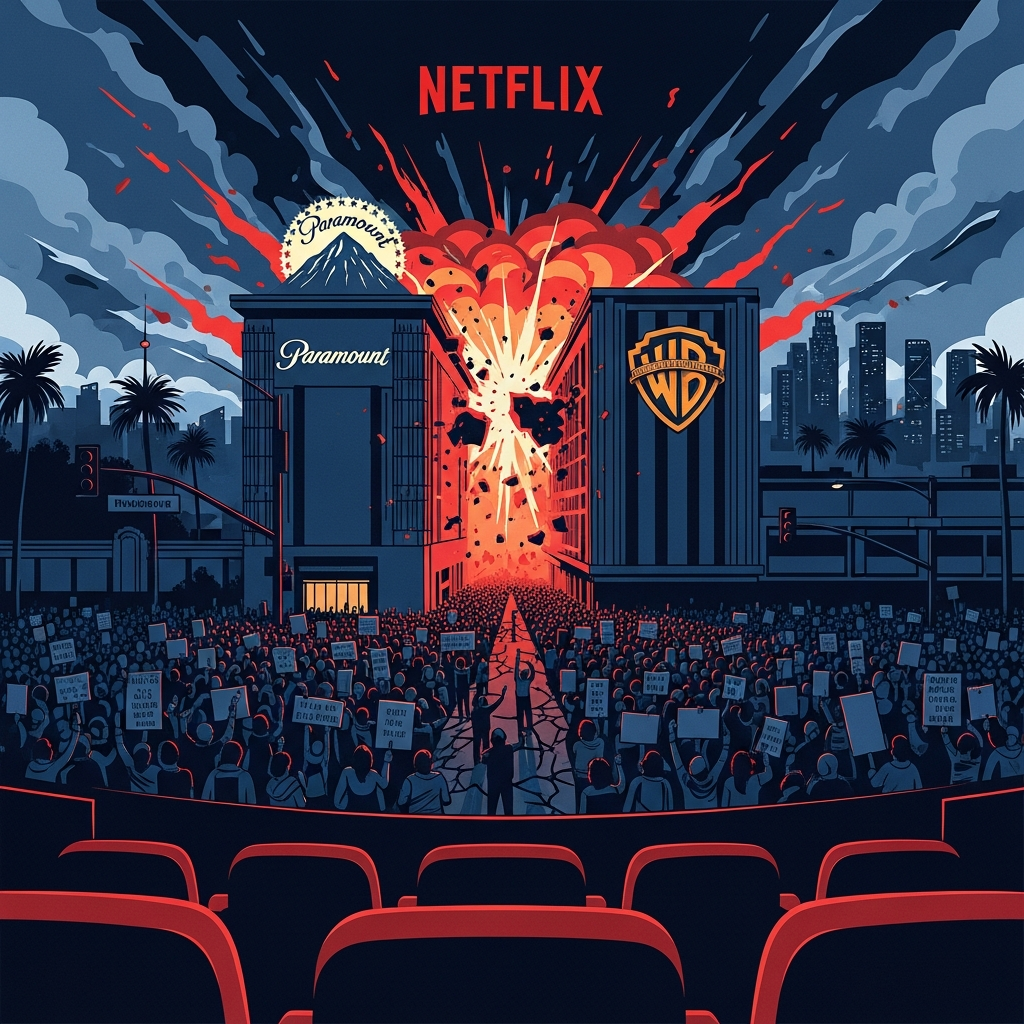
The $111 billion Paramount–Warner Bros. Discovery mega-merger has fractured Hollywood opinion, with more than 4,000 industry figures — including Denis Villeneuve, Robert De Niro, and Sofia Coppola — signing an open letter demanding the deal be blocked. Contrary to the petition's central claim, a structural analysis of the media industry reveals that the anticipated creative destruction is misattributed: Hollywood's creative erosion has been progressing for over a decade through IP franchise addiction and institutional risk aversion that operates entirely independent of studio headcount. Theatrical exhibition's post-pandemic contraction — North American box office stabilized at roughly $8.5 billion versus the pre-pandemic $11.4 billion peak — represents a structural equilibrium that predates the merger and cannot be reversed simply by blocking this deal. The antitrust landscape, shaped most directly by the AT&T–Time Warner precedent, places the probability of outright regulatory blockage near 5%, with conditional approval representing the overwhelmingly dominant scenario. Most counterintuitively, Netflix — which competed directly in the WBD acquisition auction and lost — appears positioned as the transaction's most unexpected beneficiary, primed to exploit its rival's integration turbulence to expand talent pipelines and content investment with minimal competitive friction.
Key Points
The 4,000 Signatories Are Targeting the Wrong Culprit
The open letter at blockthemerger.com carries some of the most celebrated names in modern cinema — Denis Villeneuve, Robert De Niro, Sofia Coppola, J.J. Abrams — and its central argument is that shrinking the major studio pool from five to four will accelerate Hollywood's creative decline. This is emotionally resonant and empirically fragile in equal measure. When Disney consumed 20th Century Fox in a $71.3 billion deal in 2019, the studio count dropped from six to five, and the same chorus of creative-destruction warnings filled every industry trade. What actually followed over the subsequent years tells a more complicated story than the petition's logic would predict. A24 became the gold standard of prestige filmmaking, winning multiple Academy Awards for projects that no major studio would have green-lit. Neon distributed Parasite, which became the first foreign-language film to win Best Picture in Oscar history. The independent sector — the very sector that supposedly collapses when majors consolidate — experienced a creative renaissance precisely because the major studios voluntarily vacated the mid-budget, artistically adventurous space to concentrate their capital on franchise IP. The real driver of Hollywood's creative homogenization is not studio headcount — it's the institutional imperative to produce a Spider-Man reboot for the twelfth time, restart Batman for the fifth, and recycle established IP because Wall Street demands predictable, quantifiable franchise returns that original stories cannot guarantee in advance. That institutional pressure operates with equal force whether there are five studios or four. The 4,000 signatories are raising legitimate anxiety about Hollywood's creative direction, but until the petition targets IP franchise addiction and investor-cycle risk aversion as primary causes, it remains a protest aimed at a structural symptom rather than the underlying disease.
Netflix Lost the Auction — And Is Quietly Winning Because of It
The most underreported dimension of this story involves a company whose name doesn't appear in the merger documents at all. Netflix directly competed in the WBD acquisition auction — Reed Hastings personally led the bid — and came in second to Paramount. Since losing that competition, Netflix has maintained a silence that is notably unusual for a company typically eager to shape narrative around competitive events. When a major platform loses a high-profile acquisition battle and then goes quiet, the operating assumption should be that they've run the numbers and concluded losing was the strategically superior outcome. The reasoning is straightforward: while Paramount+WBD spends the next two to three years grinding through merger integration — cancelling projects, restructuring organizational hierarchies, navigating culture clash between HBO's prestige ethos and Paramount's franchise machine — Netflix operates against a competitor that is simultaneously distracted, talent-hemorrhaging, and financially constrained by debt service obligations. The Disney-Fox integration offers the clearest historical parallel: Ryan Murphy signed a landmark Netflix deal worth approximately $300 million in the period immediately following that merger announcement, at a moment when Fox was institutionally incapable of counter-offering. The same talent migration dynamic will almost certainly recur here, and the A-list showrunners and directors most likely to initiate those conversations are precisely the people Paramount+WBD can least afford to lose during an integration. Netflix enters 2026 holding 280 million subscribers, a near-zero legacy debt load, and the organizational freedom to move aggressively on content investment while its nearest consolidated rival is institutionally constrained. Losing the auction may prove to be the best outcome Netflix could have engineered.
Theaters Were Already Dying Before This Deal — And That's the Point
Cinema United and theater chain executives at CinemaCon 2026 portrayed the Paramount+WBD merger as an extinction-level event for theatrical exhibition. The diagnosis is accurate about the crisis — but wrong about the causal chain. The theatrical exhibition sector's contraction is structural and predates this merger by years: North American box office attendance has settled at 20 to 30 percent below pre-pandemic norms, with revenues stabilizing around $8.5 billion annually versus the $11.4 billion peak achieved in 2019. That gap has persisted through multiple theatrical cycles and reflects a durable shift in viewing behavior, not a temporary post-COVID adjustment. Here's the counterintuitive implication: a merged Paramount+WBD with dramatically expanded financial resources arguably creates stronger economic incentives to maximize the theatrical window than either studio maintains independently. The merged entity needs theatrical revenue to service its debt, fund its streaming investment, and justify the acquisition price — all of which points toward more ambitious theatrical releases, not fewer. Premium format growth supports this thesis: IMAX, 4DX, and Dolby Cinema presently represent roughly 25 percent of North American box office revenue, and that share is projected to exceed 50 percent by 2030 as standard exhibition consolidates. The only studio capable of reliably producing films that fill those premium screens at scale is one with annual content investment exceeding $250 billion — which is precisely what the merged entity would have. Theaters are not dying because of this merger; they're evolving toward a premium-experience model that the merger's scale economics actually enable rather than threaten.
The Streaming Market Is Consolidating Into a Big Three — Whether You Like It or Not
The structural logic of streaming market consolidation has been building for several years, and the Paramount+WBD merger is less a cause than an acceleration of an already-established trend. If the deal closes as expected, a combined Paramount+/Max platform would exceed 100 million subscribers and establish a clear third major player in the streaming landscape for the first time — behind Netflix at 280 million and Disney's combined portfolio (Disney+, Hulu, ESPN+) at roughly 200 million. That Big Three configuration exerts enormous competitive pressure on every platform below the threshold. Peacock, operating with a subscriber base under 40 million, faces the most acute viability challenge: it doesn't have the content investment scale to compete independently with three platforms spending multiples of its budget. Apple TV+ has financial runway that allows sustained losses, but the strategic rationale for a hardware company operating a standalone streaming platform at scale diminishes when three dominant players define the competitive baseline. Amazon Prime Video survives by virtue of e-commerce bundling logic that is entirely separate from content strategy. The implication for creators and independent producers is significant: the buyer market they've operated in over the past several years — seven or eight platforms competing aggressively for content, generating a genuine seller's market — compresses to four or five buyers at most, shifting negotiating leverage toward platforms and away from creators. Licensing rates, production budgets, and deal terms will face structural downward pressure as a direct consequence of this market rationalization. This is the real mechanism through which consolidation affects creative economics, and it's a more honest framing than the studio-count argument.
The DOJ Review Reality: Conditional Approval Is the Base Case
The political opposition to this merger is substantive and well-organized: the DOJ has issued subpoenas to open a formal antitrust investigation, Senators Warren and Schumer have publicly registered opposition, and a coordinated campaign involving 4,000 industry signatories and a dedicated advocacy website has generated significant media pressure. What historical evidence suggests, however, is that the probability distribution of actual regulatory outcomes looks very different from the intensity of the opposition rhetoric. American antitrust enforcement in the modern era has effectively never blocked a major media merger outright — the closest comparable case, the DOJ's lawsuit against AT&T's Time Warner acquisition in 2018, resulted in a court loss for the government and an unconditional merger approval. Based on the available precedents and the current regulatory posture of the Trump administration, my estimate for this transaction is approximately 50% probability of conditional approval with two to three remedy conditions attached, 15% probability of unconditional approval, 5% probability of outright blockage, and 30% probability of deal abandonment due to negotiating breakdown over required concessions. The most likely remedy conditions are a CNN divestiture, transfer of specified sports broadcasting rights, or binding theatrical fair-dealing commitments. European competition authorities represent an additional variable: Screen Daily's regulatory analysis suggests the EU review process could require six to twelve months independently and attach additional local content quota requirements. The bottom line is that the regulatory question is not whether this merger gets approved but what conditions come attached to that approval — and whether the principals find those conditions tolerable.
Positive & Negative Analysis
Positive Aspects
- Scale Economics: $250 Billion-Plus in Annual Content Investment
When Paramount and WBD combine their content budgets, the resulting annual investment exceeds $25 billion — surpassing Netflix's approximately $18 billion and creating the largest single content-spending entity in the history of media. That level of investment capital changes the operational calculus for creative risk-taking in ways that matter practically and not just theoretically. HBO produced Euphoria, The Last of Us, and Succession — projects that were artistically ambitious, commercially uncertain at the time of commission, and culturally transformative in their impact — because a large parent company provided the financial buffer to absorb the risk of being wrong. Scale creates the portfolio diversification that makes creative failure survivable: when you have twenty-five major productions in various stages of development simultaneously, the failure of any single project doesn't trigger an existential funding crisis. Disney's post-Fox acquisition management of the FX network illustrates the dynamic — rather than collapsing the acquired network's creative identity, Disney actually expanded FX's experimental series output, because the scale of the parent company allowed it to absorb FX's occasional misfires. The threshold at which a content portfolio becomes genuinely self-reinforcing — where you can run high-stakes experimental projects alongside commercial anchors without either constraining the other — is somewhere in the $20-25 billion annual investment range. The merged Paramount+WBD would be operating solidly within that territory, and the creative upside of that financial architecture is materially underrepresented in the public debate about this deal.
- IP Portfolio Diversity That Actually Exceeds Disney's Range
Under a single corporate umbrella: Mission: Impossible, Top Gun, Transformers, and Star Trek from Paramount. DC Universe, Harry Potter, The Lord of the Rings, The Matrix, and the full Warner Bros. back catalog. The combined IP portfolio's genre range is substantially broader than Disney's primary concentration in Marvel superhero properties and Star Wars, which despite their commercial dominance represent a relatively narrow slice of the storytelling spectrum. This diversity matters operationally because it creates cross-franchise synergy opportunities that neither studio could pursue independently: theme park expansions spanning fantasy, science fiction, action, and superhero genres simultaneously; merchandising programs addressable to radically different demographic segments; gaming licensing that can fund prestige productions without touching content budgets; and live entertainment that draws on IP bases with 40-plus years of established audience loyalty. The global fandom infrastructure around Harry Potter and Star Trek alone represents an asset whose full commercial exploitation has been limited by the fragmented ownership structure. A single entity controlling both could rationalize that development in ways that generate meaningful additional revenue streams while simultaneously reducing single-franchise concentration risk. If one IP performs below expectations in any given cycle, the portfolio's breadth provides natural hedging that Disney's Marvel-heavy structure does not. Building an IP portfolio with this range from scratch would take decades and cost multiples of the merger price.
- Consumer Streaming Fatigue Gets Real Relief
American consumers currently subscribe to an average of 4.7 streaming services, spending over $50 monthly on entertainment subscriptions that frequently overlap in catalog and compete for the same finite hours of viewing time. Paramount+ and Max merging into a single platform with a unified catalog directly addresses that fatigue by eliminating one monthly payment while combining the content libraries that justified both. The strategic value proposition — HBO originals alongside Paramount blockbusters, prestige television alongside theatrical event releases — is arguably more compelling as a single offering than either platform delivers independently. In the early phase of the combined platform's operation, the merged entity will maintain competitive pricing to minimize subscriber migration loss, which means consumers get enhanced value at the same or lower price point before any eventual price optimization. The competitive pressure that consolidation creates across the broader streaming market further benefits consumers: Netflix and Disney+ will be compelled to either match value improvements or maintain pricing discipline to avoid losing subscribers to the newly competitive combined offering. There's a second-order effect worth noting too: fewer total streaming platforms means less time spent navigating between services to find what you want to watch, which is a genuine quality-of-life improvement that the subscriber fatigue data consistently identifies as a top consumer friction point.
- The Paradoxical Lifeline for Theatrical Exhibition
The theater industry's opposition to this merger is understandable but strategically counterproductive, because the economic logic of the merged studio's position actually creates stronger incentives for theatrical investment, not weaker ones. The combined entity carries debt service obligations that require maximizing revenue at every stage of the content lifecycle — and the theatrical window remains the highest-margin revenue stage for event films, generating both direct box office revenue and the marketing amplification that drives downstream streaming conversions. IMAX, 4DX, and Dolby Cinema premium format revenues have grown from roughly 15% of North American box office five years ago to approximately 25% today, and this premium tier's growth trajectory has been consistent and accelerating. The films that drive premium format attendance — large-scale action, fantasy, science fiction spectacles produced with maximum visual ambition — are precisely the films that require the production budgets that only a $25-billion-plus annual content operation can sustain at scale. Top Gun: Maverick generated over $100 million in IMAX revenues alone, demonstrating the financial logic of theatrical-first investment for premium blockbusters. The vinyl record analogy is apt: a format that seemed terminally displaced by digital distribution found a durable commercial niche among the audience that prioritized the physical, premium version of the experience. Theaters that position themselves as premium event venues rather than general-purpose entertainment destinations are writing the same story — and they need studios capable of filling those venues with productions commensurate with the ticket price.
- Global Market Competitiveness Against Netflix's Local Content Strategy
Netflix has spent aggressively over the past several years on local content production — Korean dramas, Indian films, Spanish series, Brazilian originals — and in doing so has meaningfully eroded the global market share that Hollywood studio content historically commanded. A merged Paramount+WBD has the financial scale and geographic infrastructure to mount a genuine competitive response to this strategy. Warner's European and Asian distribution networks, combined with Paramount's historically strong Latin American market presence, create a foundation for integrated global localization that neither studio can execute independently at sufficient scale. Specifically, the Warner Bros. distribution infrastructure in Asia and Europe, combined with Paramount's relationships across Latin American markets, enables the kind of regionalized content commissioning and local talent partnerships that Netflix has used to penetrate markets that previously imported predominantly American content. European regulatory requirements mandate that streaming platforms serving EU markets maintain local content at 30 percent or more of their total catalog — a compliance requirement that becomes dramatically more efficient to satisfy through consolidated infrastructure. In Asian markets, particularly in streaming-growth regions, the combined entity's negotiating scale for K-content and J-content licensing improves meaningfully when a single buyer is representing both platforms simultaneously. This global competitive dimension is consistently underweighted in domestic coverage of the merger, but for the combined entity's long-run subscriber growth trajectory, the international market strategy is arguably more important than the domestic streaming consolidation story.
Concerns
- Integration Will Produce a 2-3 Year Content Quality Dip
The Disney-Fox merger is the most directly applicable historical precedent for what the Paramount+WBD integration will look like operationally, and it is not an encouraging benchmark. Hundreds of in-development projects were cancelled. Thousands of employees across creative, production, marketing, and administrative functions lost their jobs. Organizational restructuring and culture clash produced turbulence that persisted for over two years and directly degraded the content output from the acquired entity during that period. The Paramount+WBD combination is larger in scope and involves two organizations with more divergent creative philosophies: HBO built its brand on prestige television that prioritizes artistic ambition and long-form storytelling, while Paramount Pictures operates primarily as a franchise manufacturing engine optimized for predictable commercial returns. These are not compatible organizational cultures, and the process of deciding which culture governs the merged entity — or attempting to maintain both in productive tension — will generate exactly the kind of institutional confusion that drives talent toward the exits. The most important single indicator to track is the fate of Casey Bloys, HBO's Chief Content Officer, whose institutional knowledge and creative relationships represent the accumulated intellectual capital of HBO's prestige brand. If Bloys departs — and the integration environment creates ample motivation for a well-regarded executive to negotiate a premium exit — the creative infrastructure that produced HBO's last decade of acclaimed television goes with him. Rebuilding that institutional culture inside a merged conglomerate is not a problem that can be solved with a budget allocation. It is a generational challenge that, if mishandled, permanently diminishes one of television's most valuable creative brands.
- The Theater Market Power Problem Is Real and Historically Familiar
A merged Paramount+WBD will control an outsized share of annual theatrical releases and a disproportionate portion of the films that drive premium-format attendance at major chains. That structural position creates negotiating leverage over theater operators that, at the extreme, could be exploited in ways that damage the exhibition sector and reduce audience access to non-Paramount+WBD content. The contemporary equivalent of block booking — conditioning access to high-demand blockbusters on theaters' acceptance of less commercially appealing films from the same studio's catalog — becomes a more viable strategy when a single entity controls the content that chains depend on to sell premium-format tickets. The historical irony is striking: the original Paramount Decrees of 1948 were issued specifically to address anti-competitive studio practices in film distribution, and the same company name appearing in an analogous structural position 78 years later invites a level of regulatory scrutiny that the studio's history uniquely justifies. For independent filmmakers and smaller distributors, the practical consequence of this market power concentration is significant: when premium screen allocations and promotional resources are commanded by a dominant supplier, the practical ability of films from A24, Neon, or any independent distributor to secure equitable exhibition terms diminishes in proportion to the dominant supplier's leverage. AMC and Regal, the largest chains, would find their own negotiating positions weakened by increased dependence on a single mega-supplier — a structural shift that reduces the exhibition sector's ability to maintain independent programming decisions.
- $700 Billion-Plus in Combined Debt Is a Structural Constraint on the Deal's Core Logic
WBD entered the transaction already carrying over $43 billion in legacy debt from the Discovery-WarnerMedia combination — debt that has been a persistent drag on the company's financial flexibility and content investment capacity throughout its short post-merger existence. Add the financing required to complete the Paramount acquisition and the combined entity's total debt load could exceed $70 billion. At prevailing interest rates, annual debt service obligations could consume $30 to $40 billion in cash flow — a structural constraint on content investment that directly and materially undermines the scale-economy thesis that is the primary financial argument for the merger. The 4,000-signature petition focuses on creative risk, but the honest version of the job-loss concern is financial rather than philosophical: when an organization carrying $70 billion in debt needs to find $5 to $7 billion in annual cost synergies to justify its capital structure, the cost reductions come from people, not from spreadsheet abstractions. Four thousand to five thousand positions in marketing, distribution, legal, and finance represent the realistic scope of the restructuring, and these are not the creative talent whose names appear in trade stories — they are the production coordinators, the marketing analysts, the distribution logistics professionals, and the administrative infrastructure that makes the actual work of making and releasing films operationally possible. The risk that debt-service pressure constrains content investment to the point where the merged entity cannot deliver on its scale-economy promises is the most structurally serious concern in the entire deal, and it deserves more analytical attention than it is currently receiving.
- CNN's Future and the News Media Concentration Risk
Warner Bros. Discovery's most consequential non-entertainment asset — CNN, one of the few remaining globally recognized broadcast news brands — is included in the merger, and its fate under a combined entity controlled by David Ellison is genuinely uncertain in ways that carry implications beyond entertainment industry economics. David Zaslav, WBD's current CEO, already executed a significant restructuring of CNN's operations and editorial staffing during his tenure — a restructuring that generated substantial industry controversy and prompted concerns about the direction of the network's journalism. A full ownership transition under a merged conglomerate creates conditions for further restructuring that could compromise CNN's editorial independence and institutional journalistic standards. The DOJ may require CNN divestiture as a regulatory condition, which would theoretically protect the network's independence — but a forced sale in the context of an antitrust remedy typically produces acquirers motivated by price rather than editorial mission, and the journalistic outcomes of that scenario are difficult to predict optimistically. The concentration of news media ownership in entertainment conglomerates is a democratic governance concern that operates on a longer timeline than merger financial analysis, but it deserves serious consideration as a component of this deal's societal cost. The upcoming 2026 U.S. midterm election cycle adds particular salience to questions about CNN's editorial independence during a period of significant political turbulence, and the legitimacy of any investigation into whether merger-related ownership pressures influence coverage deserves to be taken seriously rather than dismissed as hypothetical.
- The Creator Marketplace Shrinks and Negotiating Leverage Shifts Permanently
The streaming content arms race of 2020 through 2023 created a genuine seller's market for creators, independent production companies, and showrunners: seven or eight well-capitalized platforms competed aggressively for the same finite supply of bankable talent and commercial-quality projects, driving deal terms, licensing fees, and production budgets to historically elevated levels. When the Paramount+WBD merger contributes to the market consolidation into a Big Three structure, that seller's market transforms into a buyer's market. The reduction from seven or eight serious buyers to four or five changes the fundamental negotiating dynamics for anyone selling content into the streaming ecosystem. Licensing rates face structural downward pressure. Production budgets normalize toward the lower end of the range that was achievable in the competitive peak period. Showrunners and directors who could previously run competitive negotiations between multiple platforms find their leverage diminished when fewer alternatives exist. The $20 to $50 million mid-budget films and limited-series that were the streaming era's signature creative contribution — projects that no major studio would produce for theatrical but that streaming platforms funded because they needed differentiated content — become harder to finance when the number of potential buyers shrinks. This is the specific mechanism through which consolidation damages creator economics, and it is a more accurate framing of the risk than the studio-count argument the petition advances. It's also a structural consequence of market consolidation that a DOJ blockage of any single merger cannot prevent, because the underlying trend toward streaming rationalization will continue regardless of whether this particular transaction closes.
Outlook
I put the probability of this deal closing at 70%. And if it does, the media industry's structural landscape will shift in ways that make the current controversy look like the warm-up act. Let me walk through what I actually expect to happen across three time horizons — because the short-term, mid-term, and long-term stories are each distinct, and conflating them produces the confusion that the 4,000-signature petition seems to be operating under.
In the short term — the next one to six months — the DOJ antitrust review is the central question. My estimate: roughly 50% probability of conditional approval with two or three regulatory remedies attached, 15% probability of unconditional approval, and only 5% probability of outright blockage. The remaining 30% represents the scenario in which Paramount and WBD negotiate in good faith through the review process but ultimately walk away when the required concessions prove too structurally damaging. The most likely remedy conditions would be a CNN divestiture, the transfer of certain sports broadcasting rights, or binding fair-dealing commitments with theater chains. The AT&T–Time Warner precedent matters enormously here: the DOJ took that case to court, lost, and the merger closed. Regulatory agencies have learned from that outcome, and the current political environment under the Trump administration is measurably less aggressive on media antitrust than the Biden era was.
The 4,000-signature campaign and the blockthemerger.com petition carry real political symbolism but limited legal force. Senators Warren and Schumer can amplify pressure on the DOJ — and they will — but the agency's ultimate determination rests on economic analysis of market concentration, not creative-community sentiment. Historical precedent offers zero examples of a media merger blocked primarily due to creator opposition. AT&T–Time Warner drew similar objections from the creative sector, and the court ruled on economic grounds alone.
Concurrent with the regulatory review, the most important short-term signal to watch is talent movement. When a major merger is announced, A-list creators don't wait for the deal to close before entertaining conversations with competing platforms. The Disney-Fox integration saw Ryan Murphy sign a landmark Netflix deal worth roughly $300 million within months of the merger announcement — and that directly degraded Fox's subsequent content pipeline. At Paramount+WBD, the person whose decision matters most is Casey Bloys, HBO's Chief Content Officer. If Bloys stays through the integration, HBO's prestige brand has a fighting chance of surviving the transition intact. If he leaves, the institutional knowledge and creative relationships that built the HBO legacy go with him, and rebuilding that culture inside a merged conglomerate is a generational challenge.
In the mid-term — roughly six months to two years post-close — the most significant transformation will not be what happens inside the merged entity but what happens to the rest of the streaming market around it. A combined Paramount+/Max platform crossing 100 million subscribers creates a genuine Big Three structure in streaming for the first time. Netflix holds 280 million. Disney's portfolio sits around 200 million. The new combined entity occupies a clear and defensible third position. Everything below that tier faces existential pressure. Peacock is the obvious first casualty: its subscriber base is too small to justify standalone operation at the required content investment levels. Apple TV+ has the financial runway to absorb losses indefinitely, but at some point the board asks why. Amazon Prime Video survives because streaming is literally bundled into the core e-commerce subscription, making it operationally impossible to separate — but its strategic relevance in the content arms race diminishes as the Big Three pull away.
The creator marketplace implications of this mid-term consolidation are the dimension most underappreciated in current coverage. When streaming platforms competed ferociously for content in 2020 through 2023, creators and independent production companies operated in a genuine sellers' market — multiple buyers competing aggressively drove licensing fees, production budgets, and creator deal terms to unprecedented levels. When that same market consolidates from seven or eight serious buyers down to four or five, the dynamic reverses completely. Buyers gain negotiating leverage. Licensing rates face downward pressure. The $20 to $50 million mid-budget projects that flourished in the streaming boom become harder to fund because fewer platforms are willing to take the risk. This is the concrete mechanism through which the merger actually damages creator economics — not through a direct studio-count argument, but through a buyer-market compression that the petition hasn't articulated clearly.
Looking further out — the two to five year horizon — I believe this merger will be remembered as the opening move of what I'm calling the Traditional Big Three versus Tech Big Three era of media. Disney, Paramount+WBD, and whatever Comcast/NBCUniversal becomes through its own inevitable consolidation represent the legacy studio bloc. Netflix, Amazon, and Apple represent the tech-native bloc. These two clusters are fighting a fundamentally different battle: the legacy studios are defending content ownership and theatrical heritage while scaling streaming, and the tech companies are treating content as a premium feature layered on top of device ecosystems, cloud services, and advertising infrastructure. The traditional studios can't win on technology. The tech companies haven't figured out how to build genuine cultural institutions. That tension is what the next decade of media looks like.
Theaters deserve their own long-term forecast. My expectation: by 2030, North American screen count will decline 25 to 30 percent from current levels. However — and this is the counterintuitive part — the revenue of surviving theaters may remain stable or even grow modestly. The reason is the premium format transition. IMAX, 4DX, and Dolby Cinema currently represent roughly 25 percent of total North American box office. By 2030, I expect that share to exceed 50 percent. The audience that remains committed to theatrical moviegoing is the audience willing to pay a premium for an experience that streaming cannot replicate. The studio capable of producing the films that fill those premium screens most reliably is the studio with a $250 billion-plus annual content budget — which is exactly what the merged Paramount+WBD would have.
The bull scenario — which I assign roughly 30% probability — looks like this: the DOJ approves the deal with minimal conditions, integration proceeds more smoothly than the Disney-Fox benchmark, and by 2028 the merged entity becomes a genuine content powerhouse capable of challenging Netflix. The combined platform's subscriber base pushes past 150 million. HBO's brand identity survives the transition intact. The shared IP portfolio — Mission: Impossible alongside DC, Harry Potter alongside Star Trek — produces cross-franchise synergies that no individual studio could have engineered. The merged studio reinvests in theatrical with 20-plus major releases annually, and premium format box office revenues recover toward pre-pandemic levels. In this scenario, the deal delivers on every promise its architects have made.
The base scenario — which I assign 45% probability — is messier but ultimately stable. The DOJ approves the deal with two or three meaningful conditions: most likely a CNN divestiture and binding theatrical fair-dealing commitments. Integration consumes two to three years, costs somewhere between 4,000 and 5,000 jobs, and produces a measurable dip in content output quality during the transition. By 2029, the dust settles and the combined entity occupies a solid second or third position in the streaming landscape. Theaters receive 15-plus major releases annually from the combined studio. The merged platform stabilizes around 120 million subscribers. Not the triumphant version of this deal — but a functional one that justifies the transaction on long-run financial grounds.
The bear scenario — which I assign 25% probability — involves either a collapsed deal or a catastrophically botched integration. In the deal-collapse version, regulatory conditions prove too onerous — particularly if CNN divestiture is required — and one party walks. Both studios re-enter the market weakened, WBD's $43 billion in legacy debt becomes existential without merger cost synergies, and the resulting distress sales create a different kind of industry disruption. In the integration-failure version, the merger closes but the culture clash between HBO and Paramount's organizational DNA proves irreconcilable, the debt load suppresses content investment below the competitive threshold, and within three years the combined entity is itself a restructuring candidate.
Let me be transparent about what could invalidate my analysis. The Trump administration's antitrust posture on media has been less aggressive than the Biden era, but CNN's inclusion in this deal is a genuine political wildcard — the relationship between certain political figures and CNN's editorial positions could make the DOJ's decision more ideologically charged than standard economic analysis would predict. A second potential disruptor is AI-driven production cost reduction. If generative AI meaningfully compresses the cost of producing high-quality content within two to three years, the "scale is necessary" premise of this merger weakens substantially — because the economic advantage of a $250 billion content budget diminishes if the underlying production costs fall by a factor of five or ten. Finally, a global recession severe enough to impair debt service on a $70 billion liability creates a scenario where the merged entity, not the independently operating studios, is the first casualty of a credit cycle downturn.
For practical advice: if you subscribe to both Paramount+ and Max, keep an eye on bundle migration offers when the deal closes — there will almost certainly be promotional pricing designed to retain subscribers through platform consolidation. If you work in Hollywood's industrial support functions — marketing, distribution, legal, finance — update your resume now, not because the sky is falling, but because the historically documented pattern of these integrations says your department will be among the first to face redundancy decisions. And if you care about Hollywood's creative future more broadly, the most direct action available to you is supporting the films that demonstrate demand for originality exists. The ticket you buy for an A24 film or a Neon acquisition carries more signal than any petition, because it speaks directly to the financial calculus that determines what gets made next.
Sources / References
- Paramount-Warner Bros. Deal Fully Explained: Netflix, Ellison, and What Comes Next — Variety
- Over 4,000 Industry Names Sign Petition to Block Paramount-WBD Merger — Variety
- CinemaCon 2026: Theater Industry Reacts to Paramount-Warner Bros. Merger — Deadline
- Cinema United CEO Warns of Market Power Abuse in Paramount-Warner Merger — Deadline
- Warner Bros. Discovery Shareholders Approve Paramount Merger Deal — CNBC
- Warner Bros. Discovery Approves $110B Paramount-Skydance Merger; Regulators Up Next — NPR
- DOJ Issues Subpoenas in WBD-Paramount Antitrust Probe — CNBC
- How Long Will Regulators Probe the Paramount-WBD Merger, and What Remedies Could They Require? — Screen Daily