
K-pop's Frankenstein — Digital Twins Born from an Artist's Voice, Memory, and Personality
Summary
Galaxy Corporation is pursuing a dual IPO in Seoul and New York as a trillion-won unicorn, spearheading its 'The Day After Tomorrow' digital twin project and robot idol initiatives that learn an artist's voice, personality, and memory data. With 75–80% of revenue concentrated in a single artist — G-Dragon — the company faces deep structural vulnerability, even as a wave of simultaneous idol departures across the industry fuels its AI replacement strategy. Critics argue this approach does not solve K-pop's exploitative structure but merely swaps the subject of exploitation from human beings to data, raising the fundamental question of whether this experiment will revolutionize K-pop's business model or erode the emotional economy that sustains fandom.
Key Points
An 80% Revenue Bet on One Person in a Trillion-Won Gamble
Galaxy Corporation's growth story is undeniably impressive. The company went from 41.6 billion won in annual revenue in 2023 to 298.8 billion won after signing G-Dragon — a sevenfold surge — while posting its first-ever operating profit of 12.5 billion won since its founding in 2019. But there is a number that CEO Choi Yong-ho himself has acknowledged: G-Dragon-related revenue accounts for 75–80% of the total. Settlement costs jumped from 3.7 billion won to 73.7 billion won year-over-year — roughly a twentyfold increase — and industry insiders estimate the bulk of that went to G-Dragon. The deal included a 20-billion-won signing bonus, half of which was structured as stock options representing roughly 2% equity, with an unconventional contract pegged not to a time period but to the completion of 100 concerts. This tells you everything about how dependent this company is on a single individual. It may call itself a unicorn, but the horn on that unicorn is essentially one man.
'The Day After Tomorrow' — The Fantasy of Eternal IP
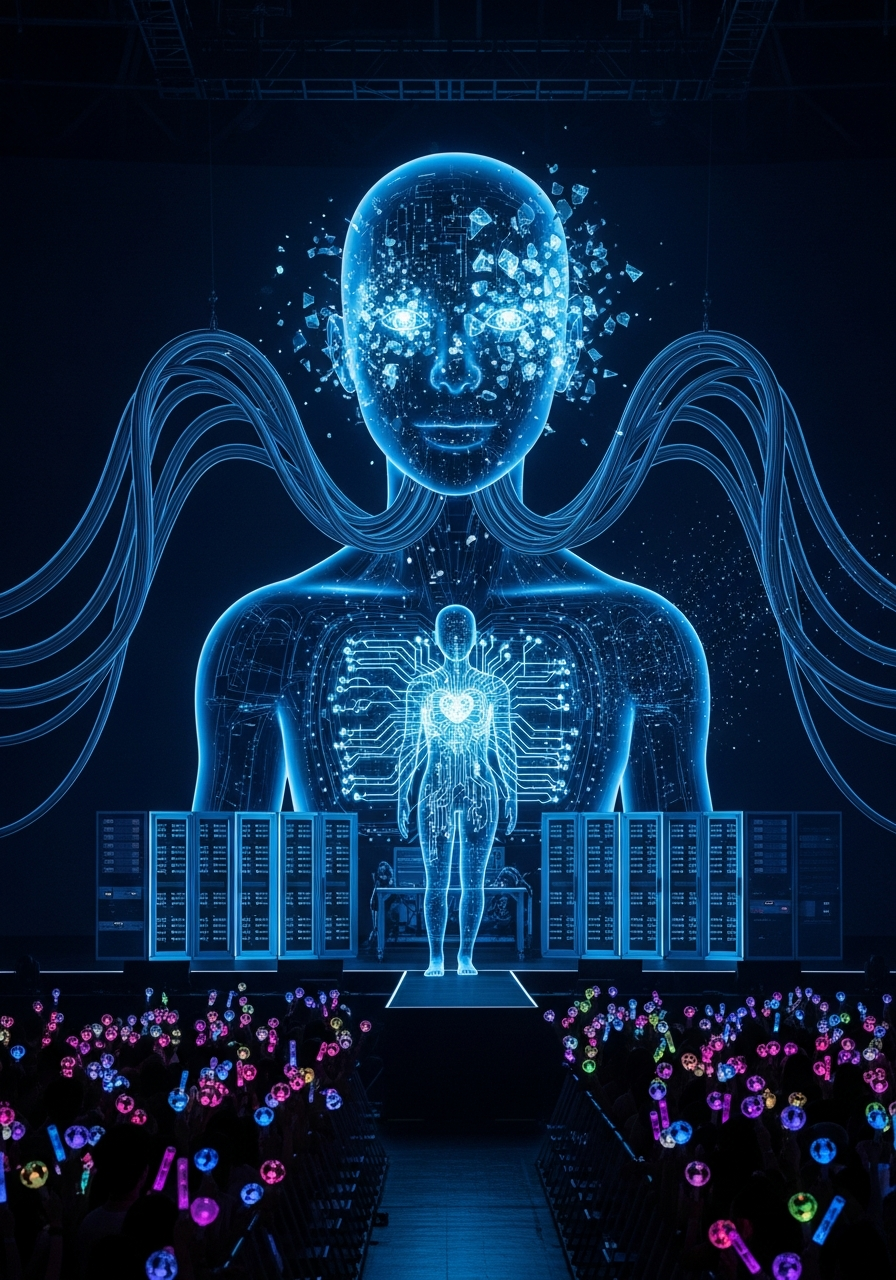
Galaxy Corporation's flagship ambition, 'The Day After Tomorrow,' aims to create digital twins trained on an artist's voice, personality, and memory data — digital replicas that continue producing content and interacting with fans even after the artist retires or passes away. The company uses the phrase 'permanent fan connection,' but let's be honest: this is effectively a declaration to turn artists into perpetual revenue-generating machines. The concept envisions a digital clone taking over where a human career ends, generating new content and maintaining fan relationships indefinitely. But a critical question remains unanswered. How much real control does the artist have over their digital twin's eternal activities? When the 100-concert contract expires, who owns the accumulated voice data, personality profiles, and memory records? If this project is to be genuine innovation rather than a sophisticated new form of exploitation, it needs to design the boundaries of rights before it designs the boundaries of technology.
The Irony of Robots Filling the Seats That Human Idols Abandoned
March 2026 will be recorded as one of the most unusual months in K-pop history. ENHYPEN's Heeseung left the group to pursue a solo career, while NCT's Mark declined to re-sign with SM Entertainment within days of each other. NCT's Ten saw his SM contract expire and transitioned to a hybrid mode — still participating in NCT and WayV activities while pursuing a solo career at a new agency. NewJeans' Danielle departed, and Katseye's Manon announced a temporary hiatus for health and wellbeing. Music critic Lim Hee-yun points to the structural cause: social media and personal channels now allow artists to communicate directly with fans and monetize their own platforms without an agency. In an era where a single sponsored post can fetch tens of millions of won, senior idols have diminishing reasons to stay in a group and split revenue. And it is precisely at this moment that Galaxy Corporation declares it will fill the void left by departing humans with AI and robots — idols that never leave, never complain, never trigger contract disputes. The question is whether this represents the evolution of an industry or the ultimate insult to human artistry.
From Robot Parks to AI Glasses — The Reality Behind the Tech Showcase
Galaxy Corporation's technology roadmap reads impressively on paper. A 16,500-square-meter robot park in Seoul's Songpa district is set to open on Children's Day, May 5th, with plans for over 1,000 robotic performances annually. AI glasses called 'White Whole,' featuring real-time translation and artist-perspective cameras, are slated for release within the year. Meanwhile, entirely separate from Galaxy Corporation, an independent creator known as 'Orion' used the Suno AI platform to produce a three-member AI boy group called GLXE, which debuted in December 2025 — illustrating how AI idol experiments are spreading across the broader industry. At ComeUp 2025, a humanoid robot dressed in G-Dragon-inspired attire even performed choreography on stage. The problem is that none of this is generating meaningful revenue yet. Industry observers note that Galaxy Corporation's actual profits still come from G-Dragon's concerts and offline events — the classic K-pop agency model. The gap between the technological vision and business reality remains vast.
The Dual IPO Gamble — What a Simultaneous Seoul and New York Listing Really Means
Galaxy Corporation's plan to list simultaneously on both the Korea Exchange and NASDAQ is ambitious to the point of audacity. The visit by a NASDAQ vice chairman to Galaxy's headquarters generated headlines, but a courtesy visit and an actual listing are fundamentally different things. For a dual IPO targeting late 2026, the company would need to file S-1 documents and complete a roadshow — a process requiring at least six months. During that window, investors will demand concrete numbers: how G-Dragon's 100-concert tour is progressing, what percentage of revenue AI ventures actually contribute, and whether virtual idol fandoms like GLXE are growing at a measurable rate. Right now, all of these figures remain unknown quantities. The dual listing strategy is essentially a bet that the narrative of 'K-pop meets AI' will be compelling enough to overcome the fundamental reality of a company where one artist accounts for four-fifths of the topline. Wall Street has seen plenty of story stocks before, and the ending is not always kind.
Positive & Negative Analysis
Positive Aspects
- Explosive Revenue Growth and First Profitability
Galaxy Corporation's financials tell a compelling short-term story. Revenue surged from 41.6 billion won in 2023 to 298.8 billion won in 2025 — more than a sevenfold increase — while the company posted its first operating profit of 12.5 billion won since its founding. This trajectory is remarkable for any entertainment company, let alone one that was burning cash just two years ago. The speed of this turnaround demonstrates a real capacity for execution, even if the sustainability of that execution remains an open question. For investors with a high risk tolerance, the growth curve alone makes Galaxy Corporation one of the most interesting plays in the K-pop space right now.
- First-Mover Advantage in the AI Entertainment Convergence
While major agencies like HYBE, SM, and JYP are all quietly experimenting with AI — HYBE acquired Supertone for voice synthesis, SM has deployed AI in aespa's music videos, JYP established Blue Garage as its tech subsidiary — Galaxy Corporation is the first to make AI the explicit centerpiece of its corporate identity and IPO narrative. Being first carries risk, but it also carries reward: Galaxy sets the terms of the conversation, attracts the early capital, and builds the proprietary datasets that become barriers to entry. The digital twin global market is projected to grow from $39.75 billion in 2026 to $122.24 billion by 2030 at a CAGR of 32.4% according to MarketsandMarkets, and whoever establishes the template for entertainment-specific applications of this technology stands to capture outsized value.
- Structural Hedge Against the Idol Departure Crisis
The March 2026 wave of idol departures exposed a vulnerability that every K-pop agency faces: human artists leave. They grow, they want creative control, they want a larger revenue share, or they simply burn out. Galaxy Corporation's AI and digital twin strategy, whatever its ethical implications, is an attempt to address this structural fragility. If a digital twin can continue generating content and fan engagement after an artist's active period ends, it creates a recurring revenue stream that traditional agencies simply cannot match. The virtual idol market is projected to reach $22.6 billion by 2035 from roughly $2 billion in 2026, growing at a CAGR of 35.8% according to BusinessResearchInsights. PLAVE's success — with first-week album sales exceeding one million copies — has already demonstrated that virtual performers can build genuine, paying fandoms.
- Diversified Revenue Streams Beyond Traditional Agency Models
Galaxy Corporation is not just signing artists and booking concerts. The robot park, AI glasses, and digital twin platform represent multiple potential revenue verticals that extend far beyond what a typical K-pop agency can offer. The 16,500-square-meter robot park alone, if it achieves even modest attendance figures, creates a physical entertainment asset with recurring revenue potential. AI glasses with real-time translation could tap into the massive global K-pop fan base that currently faces language barriers at concerts. This diversification, if executed properly, could fundamentally change how entertainment companies are valued — from talent-dependent agencies trading at low multiples to technology platforms commanding premium valuations.
- Strategic Dual-Market IPO Positioning
The simultaneous Seoul and NASDAQ listing strategy, if successful, would give Galaxy Corporation access to two of the world's deepest capital markets and dramatically increase its visibility among global investors. Korean entertainment stocks have historically been undervalued by international markets partly due to limited accessibility. A NASDAQ listing solves that problem overnight and positions Galaxy alongside global tech companies rather than regional entertainment firms. The NASDAQ vice chairman's visit to headquarters suggests genuine institutional interest, and the 'AI meets K-pop' narrative is precisely the kind of story that resonates with growth-oriented American investors looking for the next frontier in creator economy infrastructure.
Concerns
- Critical Single-Artist Revenue Dependency
The most glaring vulnerability is impossible to ignore: 75–80% of Galaxy Corporation's revenue depends on G-Dragon. This is not diversification — it is concentration risk at a level that would make any serious investor uncomfortable. Settlement costs exploded from 3.7 billion won to 73.7 billion won year-over-year, roughly a twentyfold increase, with the bulk presumably flowing to G-Dragon. The contract is structured around 100 concert completions rather than a fixed term, meaning G-Dragon could theoretically fulfill his obligations and walk away. If he does, or if an injury or controversy sidelines him, Galaxy Corporation loses not just most of its revenue but the entire narrative that underpins its trillion-won valuation.
- Unresolved Legal and Ethical Minefield Around Digital Twins
The 'Day After Tomorrow' project operates in a legal vacuum. Korea's AI Basic Act, passed in January 2026, addresses general AI governance, and the EU AI Act's Article 50 transparency requirements take effect in August 2026, but neither framework specifically addresses the ownership and rights surrounding digital twins created from a living person's voice, personality, and memories. Who controls the digital twin after the artist's contract ends? Can an artist demand the deletion of their data? What happens when a digital twin generates content that the original artist finds objectionable? These are not hypothetical concerns — they are inevitable legal battles that will shape this entire industry, and Galaxy Corporation is building its IPO thesis on technology that may be significantly constrained by future regulation.
- The Authenticity Problem — Can Fans Love a Copy?
K-pop fandom is fundamentally an emotional economy built on parasocial relationships with real human beings. Fans invest time, money, and emotional energy because the idols are alive, imperfect, and capable of surprise. A digital twin that perfectly replicates an artist's voice and mannerisms but lacks genuine consciousness or agency may fascinate initially, but it strips away the very unpredictability that makes fandom compelling. The robot park faces a similar challenge: a robot performance may be a novelty the first time, but repeat visits depend on emotional connection, and that is something machines cannot manufacture. If the core product — emotional authenticity — is compromised, the entire value proposition collapses regardless of how sophisticated the technology becomes.
- AI Revenue Contribution Remains Essentially Zero
For all the ambitious talk about digital twins, robot parks, and AI glasses, the uncomfortable truth is that none of Galaxy Corporation's AI ventures are currently generating material revenue. Industry insiders consistently note that the company's actual money comes from G-Dragon's concerts and offline events — the same model that every traditional K-pop agency uses. The gap between the 'AI entertainment company' branding and the 'concert promoter with good PR' reality is enormous. Investors considering the dual IPO need to ask a hard question: are they buying into demonstrated AI revenue, or are they buying a narrative? At current valuations, the market is pricing in AI success that has not yet materialized, and history is littered with tech companies that never bridged the gap between vision and revenue.
- Replacing Exploitation Rather Than Solving It
The most damning critique of Galaxy Corporation's AI strategy is that it does not actually solve K-pop's well-documented problems with artist exploitation — it simply changes who gets exploited. When human idols were the product, the industry faced criticism for grueling training systems, restrictive contracts, and disproportionate revenue splits. Digital twins and AI idols eliminate the human complaints, but that is not the same as eliminating the exploitative structure. It merely removes the entity capable of objecting. If K-pop's future is artists whose voices and personalities are extracted, digitized, and monetized in perpetuity while the original humans lose control over their own likeness, the industry has not evolved — it has just found a more efficient way to extract value from creative labor.
Outlook
In the short term, 2026 will be a year where expectations and risks coexist at extreme ends of the spectrum for Galaxy Corporation. The robot park opening in Seoul's Songpa district on May 5th is the first real test. Whether the target of over 1,000 robotic performances annually is realistic, and whether audiences will actually pay to watch robots perform, will be answered in the months that follow. I expect curiosity-driven demand in the initial period, but repeat visit rates will likely prove extremely low. A robot performance is novel the first time, but from the second visit onward, the absence of human spontaneity and emotional transmission becomes impossible to ignore. Robots can replicate choreography with mechanical precision, but they cannot replicate the moment when a performer locks eyes with a fan in the third row and improvises a gesture that becomes the defining memory of that concert.
The release timeline for the AI glasses 'White Whole' also deserves scrutiny. Real-time translation and artist-perspective cameras are technically interesting concepts, but price point, battery performance, and the actual user experience inside a concert venue will determine commercial viability. As Apple Vision Pro demonstrated, the gap between an attractive hardware concept and actual user adoption is enormous. In the specific environment of a K-pop concert — dark venues, dense crowds, loud audio, constant movement — whether AR glasses enhance immersion or become an awkward distraction is something that cannot be determined without large-scale real-world usage data. The history of wearable tech is a graveyard of devices that sounded revolutionary in press releases but gathered dust in drawers.
The dual IPO timeline carries significant uncertainty as well. The NASDAQ vice chairman's visit to headquarters was a positive signal, but a visit and a listing are entirely different dimensions of the same conversation. If the company targets a second-half 2026 IPO, it needs at minimum six months for S-1 filing and roadshow completion. During that interval, concrete numbers must be presented: progress on G-Dragon's 100-concert tour, measurable AI revenue contribution figures, and demonstrable fandom growth for virtual idol projects. As of now, every one of these figures remains an unknown quantity. The digital twin global market may be projected to reach $122.24 billion by 2030 according to MarketsandMarkets, growing at a CAGR of 32.4% from its 2026 base of $39.75 billion, but Galaxy Corporation's specific share of that market is entirely speculative at this point.
In the medium term, between 2027 and 2028, I expect the entire K-pop industry to begin seriously exploring coexistence models with AI. Whether Galaxy Corporation leads or fails, the conversation it has ignited will transform the industry regardless. SM Entertainment has already produced aespa's 'Rich Man' music video entirely with AI. HYBE acquired Supertone to develop proprietary voice synthesis technology. JYP established Blue Garage as its dedicated tech subsidiary. By 2027, three or four major agencies will likely have announced their own digital twin or virtual idol projects publicly. The virtual idol market, projected to grow from approximately $2 billion in 2026 to $22.6 billion by 2035 at a CAGR of 35.8% according to BusinessResearchInsights, offers a prize large enough to attract every major player.
But the critical bottleneck is not technology — it is the legal framework. Korea's revised trainee standard contract, updated in 2026, strengthened protections for human artists but contains no provisions whatsoever for digital twin rights. Korea's AI Basic Act, passed in January 2026, establishes general governance principles but does not specifically address the ownership of AI-generated likenesses derived from living performers. The EU AI Act's Article 50 transparency requirements, which take effect on August 2, 2026, will add another layer of regulatory complexity for any company operating in European markets. This legal vacuum will produce the first major dispute between 2027 and 2028. An artist terminates their contract but the agency continues operating their digital twin. A lawsuit over digital twin revenue distribution dominates K-pop industry headlines. The outcome of copyright litigation against generative AI music platform Suno may also arrive during this period, and that verdict could define the legal framework for the entire digital twin industry.
Fandom market reactions will also diverge during the medium term. I predict a clear split between 'purist fandom' and 'tech-accepting fandom.' Purist fans will place even greater value on human idols' imperfections and real-time interactions, and paradoxically, the emergence of AI will drive up the 'scarcity premium' on human performers. The live concert market for human artists may actually benefit from the contrast — when audiences can compare a technically perfect but emotionally hollow AI performance against a flawed but genuine human one, the value of authenticity becomes viscerally apparent. Meanwhile, tech-accepting fans will adapt naturally to relationships with AI idols and digital twins capable of 24-hour interaction, personalized content, and infinite availability. PLAVE has already proven this market exists with first-week album sales exceeding one million copies across consecutive releases. This divergence could either expand the total fandom economy or fragment it — the outcome depends largely on whether the two segments grow the pie or cannibalize each other.
There is also the competitive landscape to consider. Galaxy Corporation may have grabbed headlines, but it is far from the only player moving in this direction. HYBE's acquisition of Supertone gives it arguably the most sophisticated voice synthesis technology in the industry, and HYBE's scale — managing BTS, SEVENTEEN, and other global acts — means it can deploy that technology across a far larger roster. SM Entertainment's aespa project has been quietly building the conceptual vocabulary of AI-human coexistence for years, and the fully AI-generated 'Rich Man' music video was less a one-off experiment and more a proof-of-concept for a systematic content pipeline. JYP's Blue Garage subsidiary is investing in fan interaction platforms that could easily incorporate digital twin functionality. If all three majors launch competing digital twin products by 2028, Galaxy Corporation's first-mover advantage shrinks considerably, and the question becomes whether its technology is genuinely superior or merely earlier. Being first to market matters only if you can stay ahead, and in entertainment technology, the company with the largest artist catalog typically wins regardless of who innovated first.
The global dimension adds another layer of complexity. K-pop's international audience — spanning Southeast Asia, Latin America, North America, and Europe — represents both an opportunity and a regulatory headache for digital twin technology. Each jurisdiction has different rules around likeness rights, data protection, and AI-generated content. The EU's GDPR already imposes strict constraints on biometric data processing, and adding AI Act requirements on top creates a compliance burden that could prove prohibitively expensive for a mid-size company like Galaxy Corporation. Meanwhile, the United States has a patchwork of state-level digital likeness laws, with California, New York, and Tennessee all adopting different approaches. A dual IPO strategy that targets both Korean and American investors inherently means subjecting the business to both regulatory regimes simultaneously, and the compliance costs alone could consume a significant portion of the capital raised.
In the long term, between 2029 and 2031, I see three distinct scenarios.
The bull case envisions Galaxy Corporation successfully completing its dual IPO, with AI ventures accounting for more than 30% of total revenue, and digital twin technology becoming an industry standard. Robot parks expand beyond Seoul to Tokyo, New York, and Mumbai. Annual revenue surpasses 500 billion won as the company evolves into a full-fledged enter-tech enterprise. The broader K-pop industry surpasses 15 trillion won in total market size, and a hybrid ecosystem where human and AI idols coexist becomes the new normal. Under this scenario, Galaxy Corporation's early bet on AI infrastructure pays off handsomely, and the company is valued more like a technology platform than an entertainment agency. I assign this scenario a probability of roughly 15–20%.
The base case sees Galaxy Corporation succeeding with its Korean market IPO but postponing the NASDAQ listing to 2029 or later. AI ventures contribute 10–15% of total revenue, with experiential businesses like AI glasses and robot performances proving more commercially viable than the more ambitious digital twin concept. The company signs additional major artists to reduce G-Dragon dependency but fundamentally remains a 'traditional agency that leverages technology' rather than a true technology company. Across the industry, AI idols carve out a niche market but fail to enter the mainstream. The regulatory environment creates enough friction to slow digital twin commercialization without killing it outright. This is the most likely outcome, and I assign it a probability of 50–55%.
The bear case unfolds when G-Dragon completes his 100 concerts and declines to re-sign, perhaps establishing his own label instead. Revenue collapses, and the IPO plans are shelved indefinitely. AI ventures fail to generate returns commensurate with the massive investment, and enterprise value drops to the 300–400 billion won range. Legal disputes over digital twin rights force a halt to 'The Day After Tomorrow,' and the robot park operates at a persistent loss before eventually scaling down. Tightened regulations around artist data rights undermine the legal foundation of the entire digital twin strategy. The signing bonus, the stock options, the unconventional 100-concert contract structure — all of it looks less like visionary deal-making and more like a one-sided bet that went wrong. In this scenario, Galaxy Corporation becomes a cautionary tale that future business school case studies cite as evidence of what happens when a trillion-won valuation is built on a single individual's willingness to keep showing up. I estimate this scenario at 25–30% probability.
Stepping back to the broader picture, the core issue here is not whether one company succeeds or fails. It is a structural question about whether the K-pop industry can escape its obsession with finding 'perpetual revenue sources.' The finite nature of human idols — the fact that they grow, change, and eventually leave — is precisely why fans project emotions onto them and spend money. The impermanence is not a bug; it is the feature. The knowledge that your favorite artist will not perform forever is what makes tonight's concert precious, what makes this comeback meaningful, what makes the parasocial bond feel urgent and real.
Ironically, the emergence of AI idols will likely make this truth more visible, not less. Fans who experience technically flawless but emotionally vacant AI performances will rediscover the depth of authenticity that lives in human imperfection — in the cracked voice during an emotional ballad, in the unrehearsed laugh during a fan meeting, in the visible nervousness of a rookie's first stage. Galaxy Corporation's trillion-won experiment, regardless of whether it succeeds or fails on its own terms, has a strong chance of paradoxically proving that K-pop is ultimately about human beings, not technology.
The regulatory trajectory will be crucial in shaping outcomes across all three scenarios. Korea's AI Basic Act is a starting point, but specific entertainment-industry provisions for digital twin rights, data ownership after contract termination, and posthumous likeness usage remain entirely unwritten. The EU's approach, with Article 50's transparency requirements coming into force in August 2026, may create a de facto global standard that Korean companies must meet to access European markets. Any company building a business on the assumption that today's legal vacuum will persist is making a dangerous bet. The first high-profile lawsuit — and it will come — will reshape the entire landscape overnight.
Of course, all of this is a story for five years from now. In the immediate term, Galaxy Corporation's stock price and G-Dragon's 100-concert countdown will dominate market attention. The company's next earnings report will be scrutinized for any sign that AI ventures are beginning to contribute measurable revenue, and the market will be unforgiving if the answer is still zero. And on May 5th, the look in the eyes of children lining up at the Songpa robot park will be the most honest first data point about the future of AI idols. If those children are mesmerized, the door is open. If they lose interest after fifteen minutes and ask to go see a real person perform instead, Galaxy Corporation will have its answer — and so will the rest of the industry.
Sources / References
- K-pop Startup Aims to Make Artists Optional — Korea Portal
- Galaxy Corp. signs G-Dragon with record-breaking deal — The Korea Herald
- Galaxy Corp. unveils AI glasses, robot park plans — The Korea Herald
- K-pop has a generative AI problem — Dazed Digital
- Galaxy Corporation Eyes Nasdaq with AI Digital Twins Concept — Outlook India
- K-pop idol departures signal industry shifts — The Korea Herald
- 갤럭시코퍼레이션 첫 흑자 달성 — 헤럴드경제
- Galaxy Corp. explores dual IPO amid Nasdaq visit — The Korea Herald