
The Cannes Film Festival Banned AI Upstairs — And Screened 5,500 AI Films Downstairs
Summary
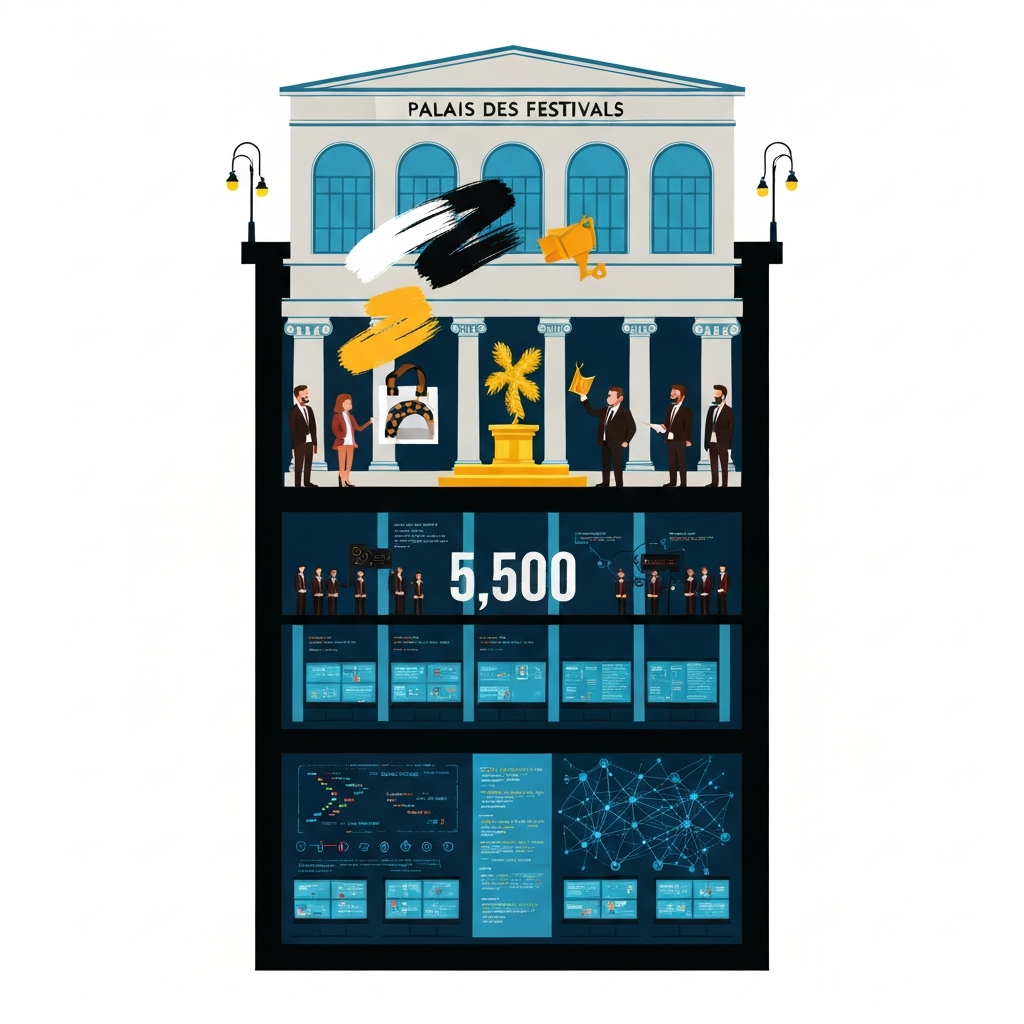
The 79th Cannes Film Festival has officially banned films made with generative AI from its competition sections, declaring that "cinema is not a collection of data but a personal vision." Yet in the very same building — the Palais des Festivals — the World AI Film Festival (WAIFF) is simultaneously screening over 5,500 AI-made films submitted from 117 countries, an arrangement that required explicit approval from the Cannes organizing committee itself. This paradoxical co-hosting reveals a calculated dual strategy: maintaining the aura of artistic purity upstairs while quietly capturing AI industry momentum downstairs. Netflix's acquisition of InterPositive threatens to automate up to 90% of outsourced VFX jobs across India, South Korea, and the Philippines, expanding the stakes well beyond European artistic principles and into the material livelihoods of Global South workers. SAG-AFTRA's newly negotiated AI provisions cover only 160,000 American actors, leaving Global South VFX workers doubly excluded from both established labor protections and the AI policy conversation entirely. Under jury president Park Chan-wook, the 79th Cannes has become the most symbolically charged battleground for the defining cultural power clash of 2026: European humanism versus American Big Tech capitalism.
Key Points
The Structural Paradox of Cannes's AI Ban and WAIFF Co-Hosting
The 79th Cannes Film Festival banned generative AI films from its official competition sections — including Competition, Un Certain Regard, and Directors' Fortnight — declaring that cinema is not a collection of data but a personal vision. Jury president Park Chan-wook's appointment lends Asian auteurist authority to this European humanist principle, creating a symbolically potent combination that the Cannes organizing committee leveraged deliberately. Yet the World AI Film Festival, screening over 5,500 AI films from 117 countries, operates in the same Palais des Festivals building during the same week — an arrangement requiring explicit approval from that very same organizing committee. This means Cannes is simultaneously declaring AI inhuman upstairs while renting space to an AI film festival downstairs, constituting a dual strategy that maintains artistic brand scarcity while avoiding exclusion from the AI industry trend. The arrangement is less hypocrisy than shrewd brand management: it serves as the most condensed visual metaphor for how institutions in 2026 are attempting to navigate the AI transition without picking a losing side. By banning AI films from the Palme d'Or race, Cannes elevates its premium positioning by one more notch, while WAIFF's presence within the same building signals that the festival ecosystem is not ignoring the technology but rather relegating it to a separate and arguably subordinate tier. The result is an institution that has successfully placed bets on both outcomes simultaneously.
The Human Creativity Myth and the Historical Pattern of Tool Phobia
Cannes's ban rests on the premise that cinema emerges from uniquely human experience and emotion, but film history reveals a recurring pattern where every major new tool was initially denounced as a threat to artistic integrity. The editing machine, synchronized sound, CGI, and digital cameras all faced intense backlash upon introduction, only to be absorbed as standard filmmaking tools within a generation. The counterargument that generative AI differs qualitatively because it generates intent rather than merely executing it is valid and deserves serious engagement rather than dismissal. However, the boundary between generating intent and executing intent is far blurrier than commonly assumed, and the cognitive distance between a director instructing an actor to act sad and prompting an AI to create a sad scene has not been convincingly proven to represent an essential ontological difference. What both processes share is a human mind making a creative choice and delegating execution to an external agent — the modern filmmaking chain already spans cinematographers, editors, VFX artists, and sound designers who each interpret the director's intent. This historical lens suggests that Cannes's ban may be simultaneously a genuine expression of artistic conviction and the latest iteration of a pattern that has been repeating since cinema's birth.
Netflix-InterPositive Acquisition and the Global VFX Labor Crisis
Netflix's acquisition of Ben Affleck's AI production company InterPositive earlier in 2026 represents a seismic shift in film industry economics, with the core objective being AI automation of VFX pipelines that have historically been outsourced to workers across the Global South. According to Rest of World's reporting, this acquisition puts up to 90% of global outsourced VFX workers at risk of displacement, with the most vulnerable populations concentrated in India, South Korea, and the Philippines. Per-title post-production costs are estimated to decrease by 30 to 50 percent once InterPositive's technology is deployed across Netflix originals, representing pure margin gain for Netflix but direct livelihood loss for tens of thousands of workers. While Cannes debates the philosophical threat of AI to human creativity on its upper floors, the actual existential threat is already unfolding in Global South labor markets — not as a hypothetical future but as an accelerating present. The bitter irony is that these workers were already trapped in exploitative subcontracting structures characterized by low pay, long hours, and unstable freelance arrangements before AI entered the picture, and the AI debate has added a second layer of exclusion by denying them a voice in the conversation about their own futures.
The Cultural Power Clash Between European Humanism and American Big Tech
The Cannes AI ban and Netflix's InterPositive acquisition are not merely a technology debate — they represent a collision over global film culture dominance between Europe and the United States, fought through aesthetic principles on one side and economic efficiency logic on the other. Cannes champions the inviolability of human vision as a European humanist principle, while Netflix operates on American Big Tech capitalism's core logic of scale, efficiency, and disruption. This clash extends into regulatory philosophy, with the EU AI Act mandating transparency labeling for AI-generated content while the US Copyright Office requires only sufficient human creative contribution for copyright protection, creating fundamentally different legal frameworks for the same technology. Since 2024, the European film industry has been strengthening the exception culturelle doctrine against the global expansion of Netflix and Disney, and the Cannes AI ban represents the latest and most publicly visible weapon in this defensive strategy. However, if American and Chinese Big Tech companies dramatically lower content production costs through AI automation, the economic foundation of European cinema's cultural exception may erode regardless of how many festivals maintain bans.
SAG-AFTRA's AI Provisions and the Double Exclusion of the Global South
SAG-AFTRA's 2025 contract with AI provisions represents meaningful progress for Hollywood labor rights, but this protective framework applies exclusively to approximately 160,000 actors within the United States, leaving the global workforce of film production entirely outside its coverage. VFX subcontract workers in India, South Korea, and the Philippines fall entirely outside SAG-AFTRA's jurisdiction, and in these countries, unions capable of negotiating AI protections are either absent or lack meaningful bargaining power. The loudest voices in the Cannes AI debate are European artists and American union leaders — while the rotoscoping artists in Mumbai, CG compositing teams in Seoul, and color graders in Manila face the most direct impact from AI automation yet have virtually no platform in this conversation. This double exclusion constitutes the most uncomfortable truth of the entire controversy. When the European elite declares let us protect human creativity, the critical unasked question is whether that human includes Global South workers, and the honest answer is that it does not yet.
Positive & Negative Analysis
Positive Aspects
- Forcing a Serious Reflection on What Makes Human Creation Unique
Cannes's AI ban has effectively posed the fundamental question of what makes human-made cinema different to the global film community, and this alone carries significant value regardless of whether the ban itself proves sustainable over time. Without this debate, the film industry might have drifted uncritically toward technology-driven efficiency and cost reduction as the sole decision framework for every production choice. Cannes is the first A-list festival to explicitly raise the distinction between what technology makes possible and what is artistically meaningful, setting a conversation marker that Venice, Berlin, and TIFF must now publicly respond to. This cascade of responses creates an international discourse space where different cultural definitions of human creativity can be compared, contrasted, and debated in ways that would not otherwise happen on any organized global stage. Whether the ban survives or not, the reflection it has triggered is an essential process for cinema to consciously redefine its identity in the AI era rather than having that identity eroded passively.
- Accelerating Discussion of AI Content Quality Standards and Transparency
The debate triggered by Cannes's ban has simultaneously elevated practical questions about how to evaluate AI content quality and ensure transparency about AI involvement in creative works. Among the 5,500 AI films submitted to WAIFF, quality variance will be extreme, and this variance itself functions as a natural experiment for establishing what good AI cinema actually means in practice. By drawing its own line, Cannes has paradoxically created an incentive for WAIFF to develop its own rigorous quality standards. More importantly, the transparency discussion has gained significant momentum, with the EU AI Act's labeling requirements now actively extending into film industry conversations about mandatory disclosure systems for production credits. If a standardized transparency framework takes hold across multiple markets, audiences gain the informational infrastructure to distinguish human-made from AI-assisted films and make genuine choices — enabling healthy market segmentation rather than opaque confusion about what they are actually watching.
- Galvanizing Film Worker Protection Discussions Worldwide
Cannes's AI ban has lit a fire under film worker protection discussions that extend well beyond Hollywood, arriving at a moment when this conversation is most urgently needed across the global production ecosystem. Coming right after SAG-AFTRA's 2025 AI contract provisions exposed the limitation of protecting only American actors, Cannes's decision effectively sets a baseline for AI-response negotiations in European film labor markets that would not otherwise exist. Reports have already emerged that France's CNC and Germany's FFA are discussing AI-free production bonuses for qualifying films. If this discussion continues to build momentum, it could catalyze policy debates in India, South Korea, and the Philippines, where VFX subcontracting dependence is highest and worker vulnerability is greatest relative to the speed of AI deployment. Whether these ripple effects actually reach Global South workers in a meaningful form remains uncertain, but the fact that the conversation has begun at all represents a positive externality of Cannes's decision.
- Providing a Legitimate Development Space for the AI Film Ecosystem via WAIFF
Cannes's decision to ban AI from its competition sections while simultaneously permitting WAIFF to operate in the same building has paradoxically given AI cinema a legitimate, officially adjacent development space that it would not otherwise possess at this stage. By operating within the physical orbit of the world's most prestigious film brand — sharing its lobby, its street presence, and its festival atmosphere — WAIFF has elevated AI filmmaking from underground digital art experiment to an emerging genre recognized as a distinct category worthy of institutional attention. The explosive growth from WAIFF's 2024 debut to over 5,500 submissions in 2026 demonstrates the gravitational pull of this newly legitimized space. For AI filmmakers worldwide, this represents access to an international context for recognition and comparative evaluation that simply did not exist before — which incentivizes genuine quality competition and artistic ambition rather than mere technical demonstration.
Concerns
- The Selective Application Problem of Artistic Purity Claims
Cannes's human vision principle appears consistent on the surface, but its actual application reveals significant selectivity that fundamentally undermines its credibility as a coherent artistic position. It is virtually certain that many films in the 2026 official competition already use AI-based tools for color correction, noise reduction, upscaling, and a range of other post-production tasks that are now industry standard. The ban targets films that use generative AI as a core creative tool, but the boundary between core and auxiliary AI usage is left undefined, and who determines this distinction remains entirely opaque. Without clear standards, the ban effectively functions as a self-reporting system that filters out only films that publicly acknowledge AI involvement in their creative process. The perverse result is that films quietly using AI pass through while films that transparently disclose AI usage are excluded — directly contradicting the transparency values that Cannes's artistic principle supposedly upholds as a matter of integrity.
- Deepening the Double Exclusion of Global South VFX Workers
As the Cannes AI ban debate unfolds centered almost exclusively on European and Hollywood perspectives, the structural exclusion of Global South VFX workers is becoming entrenched in the very conversation that purports to defend human creativity. India alone has approximately 200,000 VFX artists whose livelihoods depend on Hollywood and OTT subcontracting relationships, with South Korea and the Philippines each home to tens of thousands of additional post-production workers in similarly precarious positions. These workers were already trapped in exploitative structures characterized by low pay, long hours, and unstable freelance contracts long before generative AI entered the production chain. AI automation does not resolve these pre-existing structural problems — it threatens to eliminate the labor entirely. SAG-AFTRA's protections cover only American actors, and Cannes's human creativity declaration protects only the status of European art-house filmmakers, leaving Mumbai's rotoscoping artists and Manila's color graders with no meaningful shield against displacement that is already underway.
- The Risk of European Self-Isolation from AI Film Technology Development
If Cannes's AI ban spreads as the default position across the broader European film industry, Europe risks self-isolating from the development curve of AI filmmaking technology at a moment when competitive gaps compound very rapidly. Netflix, Disney, and Warner Bros. in the United States are already actively integrating AI video generation tools into their production workflows at scale, while ByteDance in China and major Korean studios are building AI-based content production pipelines. If the European film industry maintains human creation principles as an institutional posture while delaying AI tool adoption, the per-title production cost gap with American and Chinese competitors could become structural within five to ten years. This is not a question of cultural influence in isolation but of the economic foundation that makes cultural influence financially sustainable over time. Europe can theoretically maintain a quality-over-quantity strategy, but this requires European film funds and government subsidies to increase substantially enough to compensate for the AI cost differential.
- Entrenchment of Existing Film Power Structures Under the Banner of Human Creativity
Behind Cannes's stated goal of protecting human creativity lies the less comfortable possibility that the ban functions to preserve existing film power structures by raising barriers to entry for newcomers who lack access to traditional production infrastructure. Currently, access to Cannes's official competition is effectively limited to filmmakers with established connections to production companies, distribution networks, and the financing structures of the European-Hollywood axis. If generative AI dramatically lowers production costs, independent filmmakers from developing countries could potentially create festival-quality work for the first time in cinema history, fundamentally democratizing who gets to participate in prestige cinema. Cannes's ban forecloses this democratization potential, reinforcing the power structure that has dominated international cinema for decades under the very banner of protecting the human creativity that those excluded voices represent. AI's potential to lower filmmaking's entry barriers is being blocked under the rhetoric of human creativity — which creates an ironic contradiction with Cannes's own stated commitment to cultural diversity.
Outlook
Let me start with the nearest future. The Cannes Film Festival opens May 12 and runs through May 24, and during these 13 days the upstairs official competition and the downstairs WAIFF will run simultaneously, generating a flood of comparative media coverage from global outlets. The most decisive moment, in my assessment, will come immediately after the Palme d'Or announcement on closing day, May 24. How jury president Park Chan-wook frames the selection — and what language he uses around "human creativity" — will set the terms of the debate for the rest of 2026. If he explicitly invokes AI and emphasizes the inviolability of human creation, the ripple effects on subsequent festivals like Venice and Berlin will be direct and substantial. If he deliberately avoids mentioning AI, the Cannes ban may quietly be recorded as a one-time experiment rather than a precedent-setting move.
Simultaneously, WAIFF needs at least three to five breakout works from its 5,500 entries to create the public perception that "AI films can actually be worth watching." The media narrative emerging from the intersection of these two events will determine the terrain of the film-versus-AI debate for the second half of 2026. Watch for whether any WAIFF work goes viral on social media during the festival window — that alone could shift the conversation more than any jury statement. The two-week Cannes window, despite its brevity, is structurally positioned to produce the most consequential cultural data point on AI and cinema that 2026 will generate.
Looking at the short-term window from June through November 2026, the chain reaction across global film festivals is the critical variable. The Venice Film Festival in September, the Toronto International Film Festival in September, the Busan International Film Festival in October, and Berlin's program announcements by year-end will all face the question of whether to follow Cannes's AI ban. I estimate a roughly 70% probability that Venice will follow Cannes, given the strong cultural alliance among European festivals. TIFF sits at around 50-50, because Netflix and Disney exert significant influence in the North American market, and AI-assisted independent films have already screened in TIFF's Discovery section. Busan, considering Asia's market pragmatism and the Korean film industry's relative openness to AI tools, is more likely to adopt a middle path like "mandatory AI disclosure" rather than a blanket ban.
By the end of 2026, when all four major festivals have declared their positions, the global festival ecosystem's AI response will have reached its first equilibrium point. This equilibrium will tell us whether the Cannes ban is the opening move of a coordinated global resistance or an isolated European act. The speed and consistency of the festival response will also directly influence how studios calibrate their AI investment decisions for 2027 and beyond — which means the next six months carry disproportionate weight relative to their calendar length.
Moving to the medium-term window of six months to two years, genuinely fascinating structural changes begin. The core issue is the evolution of Hollywood's AI policy. SAG-AFTRA negotiated new contract provisions including AI clauses in 2025, but these provisions focus on "prohibiting digital replication of actors" and "requiring written consent for AI use." The problem is that generative AI's development velocity has already begun to outpace the definitions in this contract. Between late 2026 and 2027, as video generation models like Sora, Runway, and Pika evolve by two to three more generations, the standard will shift from "digitally replicating existing actors" to "generating full performances of entirely fictional people." At that point, SAG-AFTRA's current protective framework becomes functionally meaningless, and the collision between the union and studios at the next contract renewal in 2027 to 2028 is likely to be even more intense than the 2023 strikes. Entirely novel regulatory ideas such as "mandatory minimum human actor presence ratios" will be seriously debated at this juncture.
In the same medium-term window, the fallout from Netflix's InterPositive acquisition will fully materialize. Once InterPositive's AI VFX pipeline begins actual deployment in Netflix original productions, per-title post-production costs are estimated to decrease by 30 to 50 percent compared to current levels. This is pure profit for Netflix but represents direct revenue loss for VFX subcontractors in Mumbai, Seoul, and Manila. If Rest of World's estimate that up to 90% of global outsourced VFX workers face displacement proves accurate, the impact extends beyond film industry restructuring to a shock wave across the digital labor markets of developing countries. Policy responses such as India enacting digital labor protection legislation or Korea's KOCCA launching large-scale AI transition support programs by 2027 are entirely plausible. The speed and scale of these policy responses will be a survival-level variable for Global South film workers.
In the long-term view of two to five years, the truly fundamental question emerges. When the quality of generative AI films reaches a point where they become indistinguishable from human-made films, the concept of "human creativity" itself will need redefinition. I believe this tipping point has a high probability of arriving between 2028 and 2029. Already in 2026, current AI video generation tools produce visually impressive footage in 30-second segments, and if this technology advances for two more years, coherent five-to-ten-minute narrative sequences become feasible. At that point, the question "was this made by a human or by AI" begins to lose practical meaning. Just as today nobody judges artistic merit based on whether a film used CGI, generative AI is likely to be absorbed as a transparent tool. From this perspective, Cannes's 2026 ban decision will become a historically fascinating time capsule — there's a 65% chance the reaction ten years from now will be "oh right, that was controversial back then," and a 35% chance it will be "thank goodness Cannes drew that line or the unique domain of human cinema would have been lost." I'm placing my bet on the former.
Breaking this down into bull, base, and bear scenarios clarifies the range of possibilities. The bull scenario sees Cannes's ban becoming the global festival standard, with "human-made films" and "AI films" coexisting as separate but equally respected categories by 2028. In this path, WAIFF builds independent authority as the premier AI film event, and both ecosystems grow healthily. The base scenario — which I assign a 55% probability — sees only Cannes and Venice maintaining the ban while TIFF, Busan, Sundance, and others adopt conditional acceptance with disclosure requirements, resulting in a fragmented transitional period lasting three to four years. The bear scenario sees AI film technology advancing faster than expected, with an AI film winning a major audience or critics' award at a prominent commercial festival by 2027 to 2028, making Cannes's ban appear anachronistic and forcing its reversal. I put this path at roughly 20% probability — but if it materializes, the impact on Cannes's brand itself would be seismic.
I should also honestly flag the conditions under which this outlook could be wrong. The biggest counterargument is that generative AI film quality may not improve as rapidly as projected. Current AI-generated video is impressive in short segments, but maintaining emotional coherence across a 90-minute feature narrative is an entirely different challenge, and this challenge might not be solved by 2028. In that case, Cannes's ban would persist as more symbolic than practically consequential, and the debate itself would quietly fade. Another counterargument centers on audience attitudes: if audiences genuinely begin assigning a premium to the "made by humans" label, a natural market separation would emerge organically, rendering Cannes's ban unnecessary. My final recommendation for readers is to track three things during this Cannes: whether Park Chan-wook mentions AI in his closing remarks, whether any WAIFF screening goes viral on social media, and whether Netflix makes any InterPositive-related announcements during the festival window. The combination of these three signals will set the direction of the film-versus-AI debate for the remainder of 2026.
Sources / References
- Cannes 2026 AI Ban — Official Selection Policy — AI Films Studio
- Netflix InterPositive acquisition and VFX AI automation — Rest of World
- Netflix acquires Ben Affleck AI company InterPositive — Deadline
- Seven talking points from the World AI Film Festival in Cannes — Screen Daily
- Cannes at a crossroads — the future of AI and film — FSU News
- Avatar AI likeness lawsuit analysis — IndieWire
- Cannes 2026 jury revealed — Park Chan-wook, Demi Moore, Chloe Zhao — World of Reel