
Taylor Swift's Night of 33 VMAs — Why Award Numbers Can't Prove Greatness
Summary
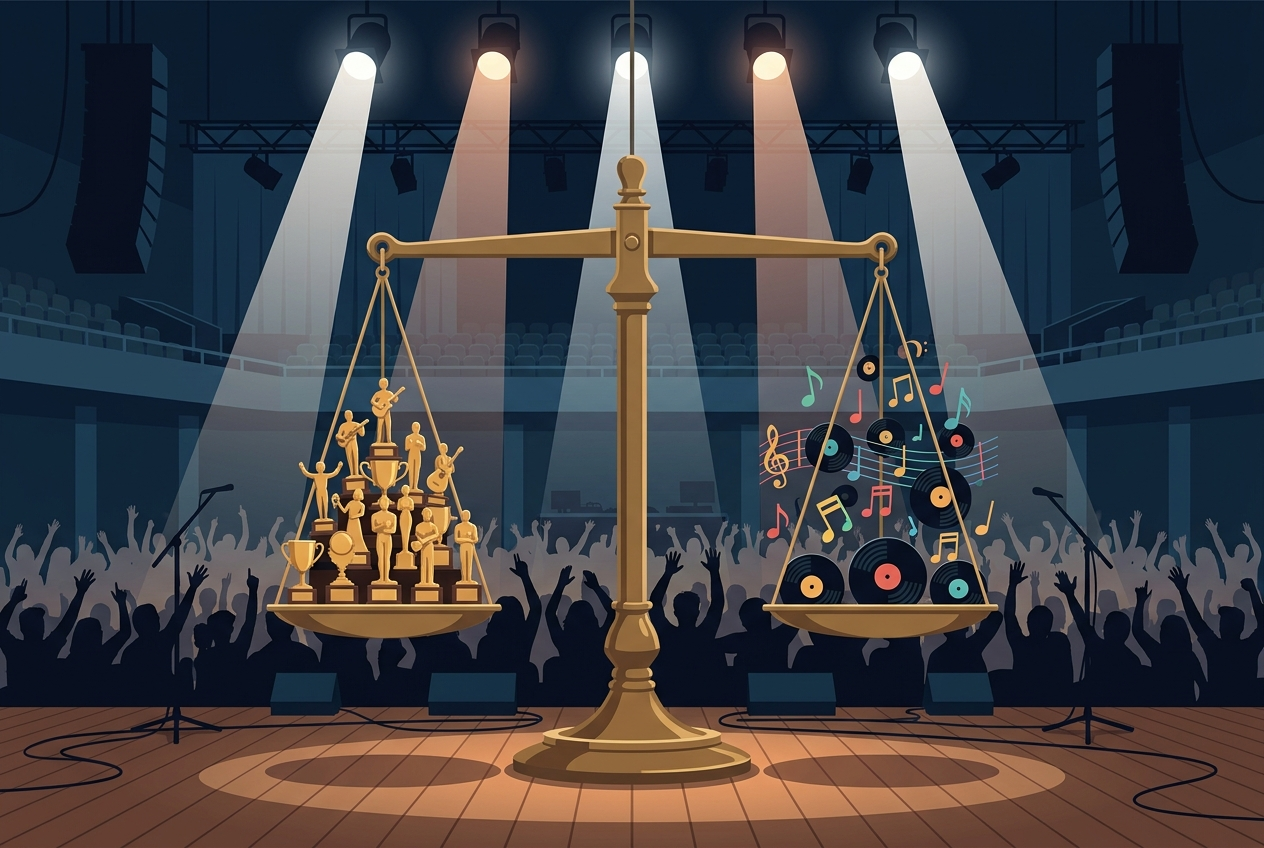
On September 27, 2026, Taylor Swift claimed three trophies at the MTV Video Music Awards — Video of the Year for "The Fate of Ophelia," Best Direction for "Opalite," and the newly created Artist Director Honor — pushing her career total to 33 and making her the most decorated artist in the award show's four-decade history, surpassing Beyoncé's previous record of 30. That comparison, however, contains structural asymmetries the headlines never mention: Beyoncé's 30 includes 26 solo wins plus 2 from her Destiny's Child years and 2 from Jay-Z collaborations, while Swift's 33 is entirely solo, and Beyoncé separately holds the all-time Grammy record with 35 wins — a number no other artist in history has matched. The same night saw Madonna return to the VMA stage for the first time in 23 years, earning 7 of her 13 nominations and generating a peak audience of more than 15 million during her opening performance, yet, at least on my feed, the thing everyone kept sharing the next day was a deceptively edited Charli XCX clip that multiple outlets quickly debunked. Total viewership hit 8.43 million (CBS 7.61M plus MTV 686K), a 51 percent increase over 2025's 5.6 million and the highest since 2015 — though that headline obscures the fact that MTV's own share was just 686,000, while the 2015 record was built on 12.73 million viewers on MTV alone. The Georg Solti case — a Hungarian conductor who held the all-time Grammy record with 31 wins from 1997 until Beyoncé surpassed it in 2023, yet registers almost no cultural footprint in pop history — demonstrates most clearly that award tallies measure compatibility with a given institution's criteria, not artistic greatness itself. The night of 33 is not a story about Swift versus Beyoncé; it is a story about how award shows manufacture records, create new categories to sustain their own relevance, and transform from evaluation bodies into event platforms to survive.
Key Points
The Math of 33 vs. 30 — Counting Different Things as If They Were the Same
Swift's 33 and Beyoncé's 30 are not equivalent units of the same measure, and treating them as a simple comparison produces a misleading headline that sounds definitive while ignoring nearly everything that would make it honest. Beyoncé's 30 includes 26 solo wins alongside 2 from Destiny's Child and 2 from Jay-Z collaborations, while Swift's 33 reflects an entirely solo career — a meaningful accounting difference that vanishes the moment the two numbers appear side by side. The more decisive contextual gap is that Beyoncé holds the all-time Grammy record with 35 wins, a total no artist in history has matched, positioning her in a completely different dimension at the institution that specifically evaluates musical craft through professional jury judgment. Award counts only make meaningful comparisons when they come from the same institution, the same era, and the same counting methodology — stacking VMAs against Grammys, or mixing group tallies with solo tallies in the same figure, produces a number that looks like a comparison while actually measuring nothing coherent. The underlying impulse to reduce two extraordinary, incomparable careers to a single line of arithmetic is exactly the kind of reductiveness that flattens genuine cultural contribution into fan-war scorekeeping. I think the "33 vs. 30" framing is one of the most structurally misleading sports-style narratives in recent entertainment coverage, and understanding why it misleads matters more than the number itself does. The only honest approach to these numbers is to keep them in their original institutional context — VMAs for the VMAs, Grammys for the Grammys — and resist the pressure to synthesize them into a single verdict that neither institution ever intended to produce.
What the Newly Created Artist Director Honor Actually Signals About Award Shows
The Artist Director Honor — defined to recognize someone "whose work behind the camera has expanded the possibilities of music video and advanced the art of visual storytelling" — is a meaningful and legitimate distinction, but the circumstances of its creation reveal something important about how award shows sustain their own cultural relevance. Even without this honorary award, Swift's two competitive wins this year would have brought her career total to 32, which already surpasses Beyoncé's 30 — meaning the record was broken at 32, and the honorary award added number 33. The 2020 Tricon Award for Lady Gaga established a clear precedent: the VMAs create new categories at specific moments for specific recipients, and honorary awards announce their recipients in advance by design, so none of this is hidden or improper in the procedural sense. What I find worth examining is the deeper logic it exposes — an institution that has already given someone the most trophies in its history creates a new award to give them one more, generating a headline that says "33!" instead of "32!" and capturing the narrative premium of a larger number. The ceremony needs the record, and the record validates the ceremony — it's a self-sustaining loop in which both parties benefit, and understanding that loop is essential to understanding why new award categories keep appearing at convenient moments. Swift's achievement as a director is genuine; the timing of this new category's creation is the part that deserves scrutiny, and directing that scrutiny at the institution rather than the artist is the only fair place to aim it.
How Madonna's Historic Comeback Was Upstaged by a Debunked Clip
Madonna's 23-year absence from the VMA stage ended with an opening performance that generated a peak audience of more than 15 million, a 7-win sweep from 13 nominations, and her first VMA win in 27 years — by any conventional metric, the single most historically significant event of the entire evening. Yet the moment that dominated social media wasn't the comeback; a clip of Charli XCX appearing expressionless during what was falsely framed as Swift's acceptance speech spread across platforms with the implicit suggestion of a feud being confirmed in real time. Multiple outlets including E! Online quickly established that the footage was actually taken during the Video Vanguard presentation to Nirvana's surviving members — Dave Grohl, Krist Novoselic, and Pat Smear — an entirely different moment from the one being described. The correction circulated, and from my view, the corrected story still lost the attention contest to the fabricated narrative, which tells us something uncomfortable about how engagement algorithms function at major televised events. This is not a failure of fact-checking — the fact-checking worked quickly and clearly. It's a demonstration of how systems designed to reward conflict-adjacent content will amplify that content regardless of its accuracy, and how award ceremonies built around competing fandoms generate exactly the raw material those systems run on most efficiently. To me, it felt like the genuinely historic moment on stage got outpaced by a ten-second fabrication, and that asymmetry is one of the most instructive data points about the attention economy that this entire night produced.
The Viewership Rebound Illusion — CBS's Pull, Not the VMA Brand
The headline number — 8.43 million viewers in 2026, up 51 percent from 5.6 million in 2025, highest since 2015 — looks like a triumphant resurgence for a ceremony that has spent years fighting streaming-era irrelevance, but disaggregating the figure reveals the real architecture of that rebound. CBS delivered 7.61 million viewers; MTV contributed 686,000 — and in 2015, MTV alone pulled 12.73 million, meaning the channel that gives the VMA its name now accounts for a small fraction of a typical strong broadcast audience. The 51 percent jump over 2025 is real, but the cause isn't renewed faith in the VMA brand; it's the specific narrative draw of Madonna's comeback and Swift's record-breaking moment, two events that would have generated television audiences at almost any broadcast venue. Meanwhile, the 2026 Grammys drew 14.4 million on the same CBS network — down from 15.4 million the year before, declining for the second consecutive year — demonstrating that the CBS infrastructure alone doesn't produce audiences, and that what produces audiences is the story. The VMA got the story right this year; whether it can manufacture an equivalent story in 2027 is the question that defines its next chapter. Ultimately, this viewership data tells us something the ceremony itself would prefer to obscure: the audience is tuning into the broadcast network's event, not into MTV's award show, and those are increasingly different things.
Georg Solti and the Fundamental Paradox of Award Tallies
The argument for taking award numbers seriously as measures of artistic greatness runs directly into Georg Solti, the Hungarian classical conductor who died in 1997 holding the all-time Grammy record with 31 wins — a record he kept until Beyoncé surpassed it in 2023, meaning that for more than two decades after his death, no active artist in any genre had won more Grammys than a classical conductor most people under forty cannot identify. Solti's 31 wins do not make him greater than The Beatles, Michael Jackson, or Aretha Franklin — no serious argument positions it that way — yet numerically, he beat them all for longer than many current music fans have been alive, and the fact that this feels immediately and obviously wrong is itself the proof of the argument. This paradox is the clearest evidence available that award tallies don't measure greatness; they measure fit between an artist's output and a specific institution's evaluation criteria across a specific timeline. If that conclusion feels obviously correct when applied to Solti versus the pop canon, the same logic holds equally when applied to any cross-category, cross-institution award comparison — including the "33 vs. 30" framing at the VMAs. The number 33 being larger than 30 tells you that Swift's output has been more consistently compatible with the VMA's criteria, voting structure, and available categories than any other artist's output across any equivalent career window. That's a real achievement. What it isn't is a proof of greatness, and the Solti case is the sharpest reminder available that these two things have never been the same.
Positive & Negative Analysis
Positive Aspects
- The VMAs Created Official Recognition for Artists Who Direct Their Own Work
The Artist Director Honor, whatever the circumstances of its creation, formally acknowledges that an artist's contribution behind the camera deserves its own category of recognition — a meaningful institutional step that raises the profile of the director-artist as a distinct creative identity. Swift's record of writing and directing 18 of her 60 music videos positions her clearly as a committed visual storyteller, not merely a performer who occasionally signs off on video treatments. Having already surpassed David Fincher's three Best Direction wins, her directing career represents a genuine accumulation of work in a form that most performers never engage with this seriously or consistently. Without some form of official recognition specific to this contribution, the music video directorial role risks remaining invisible in the broader cultural accounting of an artist's legacy — reduced to a footnote in a discography rather than a recognized thread of the creative output. I think this new category, imperfect as it is, encourages future artists to invest more seriously in the visual dimension of their work by demonstrating that the investment can be formally recognized and not just commercially rewarded.
- The Viewership Rebound Proved That Event Television Still Works
The 51 percent jump from 5.6 million to 8.43 million, with a peak of more than 15 million during Madonna's opening, is concrete evidence that the live broadcast ceremony format isn't dead — it just needs the right content to justify the appointment. The combination of a genuinely historic comeback and a record-breaking achievement created conditions where millions of people chose to watch something together in real time rather than catch highlights asynchronously the next day. In an era when simultaneous co-viewing is increasingly rare for any content category outside sports, the ability to generate a 15 million-plus peak moment is a significant demonstration of cultural pull that no on-demand format can replicate. This is the argument that traditional broadcast entertainment has always made for its own continued relevance, and this night backed it up with actual viewership data that advertisers and rights holders can point to. For the award show industry, the evening confirmed that the event model can produce appointment television numbers when the narrative stakes are high enough to demand real-time attention.
- Madonna's Return Built a Cross-Generational Bridge That Streaming Can't Replicate
Seeing Madonna share a stage with Sabrina Carpenter and Charli XCX wasn't just a nostalgia exercise — it was a physical manifestation of the lineage from the MTV generation to the streaming generation, produced in real time in front of a live audience and shared simultaneously by viewers of radically different ages. Madonna's 13 nominations — the most of any artist at the show — confirmed she was present as a current competitor, not a museum piece, which gave the cross-generational moment a competitive legitimacy it wouldn't have had if she were simply booked as a tribute act. The 27-year gap between her last VMA win and this 7-win sweep is one of the longest comeback arcs in any major award show's history, and it demonstrates that genuine artistic longevity can produce a more powerful cultural moment than any amount of manufactured buzz around a current release. I think this is the specific kind of value that award show ceremonies, and essentially only award show ceremonies, can generate: a shared room where different eras of musical culture acknowledge each other's weight at the same moment. Streaming algorithms personalize and fragment; this ceremony congregated, and that congregation quality has a cultural texture that no recommendation engine can produce.
- Rapid Community Fact-Checking Corrected the Fake Charli XCX Narrative Quickly
The deceptively edited Charli XCX clip was debunked quickly and publicly by multiple outlets including E! Online, which correctly identified the footage as coming from the Video Vanguard presentation to Nirvana's surviving members rather than from Swift's acceptance speech — and that correction speed represents a genuine improvement over the information ecosystem of several years ago. In an earlier period, a fabricated entertainment narrative of this kind could circulate for days without authoritative correction reaching the same audience that received the original false claim, allowing a misleading story to calcify into received wisdom before any counter-narrative took hold. The fact that the correction arrived while the clip was still spreading represents meaningful progress in the real-time information hygiene around major televised events. I think the speed of institutional fact-checking in the entertainment space has genuinely improved, and this episode is a data point worth acknowledging even if the correction didn't fully suppress the original claim's momentum. As live broadcasting becomes more tightly coupled with social media real-time commentary, this kind of rapid contextual correction is becoming a necessary infrastructure layer for any ceremony that wants to control its own narrative.
Concerns
- New Honorary Awards Inflate the Record and Erode the Meaning of Each Win
When an award show introduces a new honorary category in the same cycle where an existing record is being approached, the resulting record is built partly on category architecture rather than competitive achievement — and that distinction matters for how seriously anyone should take the number. The 2020 Tricon Award for Lady Gaga and the 2026 Artist Director Honor for Swift establish a visible pattern: the VMAs expand their category structure in ways that generate records, and records generate the headlines that justify the ceremony's continued cultural relevance. As categories multiply, the total win count needed to reach "all-time record" becomes progressively lower, which means each new record carries less informational weight than the previous one, even as the headline number gets larger. The irony is that the institution's appetite for headline-generating records actually degrades the value of the trophies it's trying to celebrate, because a trophy that exists primarily to push a number higher is a trophy that communicates something about the award show's self-interest rather than the artist's achievement. I think this category inflation is the VMAs' deepest long-term credibility problem — the mechanism that makes records easier to manufacture is the same mechanism that makes those records harder to take seriously.
- Fabricated Content Systematically Outcompeted Genuine Artistic Achievement for Attention
The Charli XCX clip episode is a specific case of a general structural problem: award ceremonies generate content that engagement algorithms amplify selectively, and the content those algorithms amplify most reliably is conflict-adjacent, regardless of whether it's accurate or contextually meaningful. Madonna's comeback — 23 years away, 15 million peak viewers, 7 wins from 13 nominations — was objectively more newsworthy, more historically significant, and more artistically meaningful than a deceptively edited clip of someone's facial expression. Yet the clip dominated the post-show conversation in the critical first-day window when most attention is concentrated and most of the cultural narrative gets established. This is a problem the VMAs cannot solve from inside the ceremony itself; it's a function of how the platforms that distribute and amplify post-ceremony content are designed to prioritize engagement signals over factual accuracy or cultural significance. Award shows are structurally vulnerable to having their actual content upstaged by the parasocial drama their own fan-voting format generates, and the more their survival depends on social media amplification, the more exposed they are to this specific vulnerability every single cycle.
- A Channel That Doesn't Air Music Videos Lacks Full Authority to Judge Them
MTV dropped "Music Television" from its logo in 2010, and its programming has been dominated by reality television for the better part of two decades, meaning the channel that hosts the VMA is no longer regularly engaged with music video culture as a living practice. The authority of a music video award derives in meaningful part from the awarding institution's active engagement with the form it's evaluating — a film festival's prestige rests partly on its programming identity, and a music video award's credibility rests partly on its host channel's relationship to music video as a current medium. When that relationship is largely historical rather than active, the claim to represent the highest standard in the form becomes harder to sustain on institutional grounds, regardless of how much cultural memory the brand carries. The fact that 7.61 million of the 8.43 million 2026 VMA viewers came through CBS rather than MTV makes the institutional identity question more acute: the ceremony is increasingly a CBS broadcast that happens to use MTV's name and trophy design. I believe this structural contradiction will become a progressively larger credibility problem as music video culture continues to develop on YouTube, TikTok, and streaming platforms, while the brand issuing the trophies remains primarily a reality television channel with an illustrious music past.
- Award Number Comparisons Manufacture Rivalry Where None Needs to Exist
The "33 vs. 30" framing converts two distinct, incomparable careers into a competitive narrative that neither Swift nor Beyoncé created or invited, and the rivalry it manufactures is one of the award system's most consistently damaging exports to fan culture. Beyoncé's 30 VMAs include group and collaborative wins while Swift's 33 are entirely solo — these are already different units being compared as if identical — and Beyoncé simultaneously holds the Grammy record no artist in history has matched, which positions the VMA comparison as a selective scoreboard telling a deliberately incomplete story. Fan communities on both sides are handed a numerical talking point that, by design, produces exactly the kind of ongoing conflict that algorithm-driven platforms reward with maximum reach and minimum editorial judgment. The most honest observation about this framing is that it serves the award show and the media outlets covering it far more than it serves either artist — the visibility and the ad revenue generated by the rivalry belong to the institutions, while the emotional cost of the proxy war belongs to the fans who fight it. I think anyone who covers entertainment has a responsibility to be transparent about this dynamic rather than presenting the "33 vs. 30" frame as straightforward reporting, because the frame is itself a product being sold.
Outlook
In the short term — the next six months — the most pressing question is whether the viewership rebound this VMA generated can be repeated. The 51 percent jump from 5.6 million in 2025 to 8.43 million in 2026 was driven by a very specific combination: Madonna's 23-year comeback and Swift's all-time record, two conditions that produced genuine event-television energy on a broadcast network. But event-dependent ceremonies face a structural trap. Every cycle, they need to manufacture something of equivalent or greater narrative weight just to maintain the audience they captured. I think this is the VMA's most fundamental vulnerability right now. MTV's own share — 686,000 out of 8.43 million — confirms that the channel itself isn't the draw. The broadcast is the draw. The next question is whether the 2027 VMAs can find a story as compelling as "Madonna returns after 23 years and Swift breaks all-time records," and I wouldn't bet on that coming easy.
Swift's 33 will generate cascading effects across fan communities in ways that are already visible. The record now functions as a benchmark that competing fandoms will measure their own artists against, and in fan-voted ceremonies, benchmark awareness accelerates organized voting campaigns. When a number becomes the target, the voting behavior around it becomes more strategic, more coordinated, and more intense. That dynamic can boost ratings and create pre-show buzz — which benefits the VMA brand — but it also accelerates the perception that fan-voted categories are popularity contests rather than evaluations of artistic merit. The more systematically fans approach VMA voting as a scoreboard game, the harder it becomes to argue that the trophies reflect anything other than organizational capacity. I think this tension will become more visible within the next award cycle, and it will force the VMAs to think harder about how much of their credibility they're trading away in exchange for fanbase engagement.
Madonna's return generated a 15 million-plus peak that has almost certainly shifted the booking calculations of every major award show thinking about entertainment strategy for the next two years. The economic logic is straightforward: a performer who hasn't appeared at a venue in 23 years can generate more viewership in one opening number than many contemporary artists at peak activity. The implication is that other ceremonies — including the Grammys and major international equivalents — are now looking at their rosters of long-absent legends and running the same math. I expect a wave of "first appearance in X years" booking announcements across the awards calendar in the near future, as programmers try to replicate the Madonna formula. This is a reasonable short-term strategy, but it also commits ceremonies to becoming increasingly retrospective events — celebrations of pop music's past more than arbiters of its present.
The Grammy's two consecutive years of decline — from 15.4 million in 2025 to 14.4 million in 2026, both on CBS — represents a different kind of signal than the VMA's rebound. The VMAs bounced because they had a manufactured spectacle. The Grammys declined despite having the same distribution platform. That asymmetry tells me the Grammy's problem is structural, not logistical. I believe the Recording Academy will respond within the next six months with some form of format experimentation: expanded fan participation components, more aggressive pursuit of viral performance moments, or changes to the telecast structure designed to front-load the highest-energy content. Whether those adjustments can actually reverse the trend depends on something the Grammys cannot easily manufacture — a moment as culturally charged as Madonna walking back onto a stage after 23 years away. The risk is that in trying to become more VMA-like to capture that energy, the Grammys erode the professional-jury credibility that distinguishes them from the VMAs in the first place.
Looking at a medium-term horizon of one to two years, the category inflation dynamic that created the Artist Director Honor will almost certainly continue and intensify. Award shows have been adding categories for decades — the VMAs have restructured their category architecture repeatedly — and each new category creates more surfaces on which wins can accumulate. This makes "all-time records" progressively easier to reach and simultaneously dilutes the weight of each individual trophy. I expect the next major VMA-style honorary category to be framed around social impact, global cross-cultural reach, or digital innovation — all legitimate values, but also conveniently applicable to artists who already dominate the existing leaderboard. As the category count grows, the record-breaking narrative gets cheaper to produce, which is exactly the inverse of what makes a record feel meaningful. The institution's appetite for headlines ends up devaluing the very currency it's printing.
The relationship between the VMA brand and CBS is worth watching closely over the next two years. Right now, the VMAs need CBS far more than CBS needs the VMAs — 7.61 million of the night's 8.43 million viewers came through the broadcast network. That dependency creates leverage. If CBS decided to launch its own music entertainment event, or if a major streaming platform made a serious bid to host the next generation of music video recognition, the VMA's institutional position would become genuinely precarious. The trophy's name and history still carry weight, but institutional inertia only protects incumbents for so long. I think the real power negotiation between content brand and distribution platform will start becoming visible within this time frame. The VMA has the narrative legacy. CBS has the audience. The party that can credibly walk away first holds the stronger hand.
On a longer horizon of two to five years, I believe award shows are completing a transformation from evaluation institutions into pure event platforms, and the 2026 VMAs provided a clear preview of what that looks like at its best. The 8.43 million who tuned in weren't primarily interested in who won Best Video Editor. They came to witness a moment — Madonna on stage, Swift breaking a record, the possibility of something memorable happening live. The trophy was a prop. The acceptance speech was content. The ceremony was theater. Think of the Super Bowl halftime show: nobody watches it primarily to evaluate the performers' musical merit. They watch because the stage is enormous, the history is real, and something unexpected might happen. Award shows are heading toward that model, whether deliberately or not, and there is no obvious force that reverses this trajectory.
For artists, this long-term shift changes the incentive structure around participation in ways that are already becoming visible. Streaming metrics, social reach, and tour revenue are more concrete indicators of market value than any trophy count. A Spotify Wrapped recognition reaches 200 million people in a day. A VMA win reaches 8.43 million in a primetime broadcast window. The math on which generates more direct commercial impact isn't close. As this gap widens, I think artists will increasingly treat award show participation as a promotional decision rather than a recognition-seeking behavior. Madonna attended the VMAs on her own terms after 23 years away. She returned because it served her campaign, not because she needed the institution's validation to complete something. That posture — present when it suits you, absent when it doesn't — is the relationship most major artists will adopt with traditional award shows as the decade continues.
The award comparison culture — "33 vs. 30," who has the bigger number — will also erode as category inflation accelerates. Solti's 31 Grammys held the all-time record for more than twenty years and currently means almost nothing to the generation that grew up with streaming. Numbers without narrative context decay. The cultural permanence of "Lemonade" reshaping American music or "All Too Well: The Short Film" expanding the formal possibilities of music video storytelling will survive in the cultural conversation long after any trophy count has been superseded by a larger number. What remains is the work and the impact. The most plausible long-term scenario is a hybrid model: broadcast ceremonies maintain their event function, streaming data and social engagement progressively inform category outcomes, and the trophies themselves become signifiers of cultural moments rather than authoritative verdicts on artistic quality. That's not a death for the award show — it's a reinvention. The question is whether the institutions currently running these shows understand that's what's happening, and whether they're building toward it intentionally or stumbling into it blind.
Sources / References
- 2026 VMAs Highlights: Madonna, Taylor Swift — CBS News — 2026 VMAs Highlights: Madonna, Taylor Swift
- Taylor Swift VMAs: How Many Wins? — TODAY — Taylor Swift VMAs: How Many Wins?
- VMAs 2026 Ratings: Most-Watched Since 2015 — The Wrap — VMAs 2026 Ratings: Most-Watched Since 2015
- VMAs 2026: Charli XCX Did Not Shade Taylor Swift — E! Online — VMAs 2026: Charli XCX Did Not Shade Taylor Swift
- Madonna Wins 7 VMAs — Her First in 27 Years — Yahoo Entertainment — Madonna Wins 7 VMAs — Her First in 27 Years
- How Relevant Are Awards in the Age of Spotify Wrapped — MidiaResearch — How Relevant Are Awards in the Age of Spotify Wrapped