
Borrowed the Music, Erased the People — BTS's Arirang Exposes K-pop's Blind Spot
Summary
BTS's animated teaser for their fifth studio album 'Arirang' sparked a whitewashing controversy by depicting Howard University — a historically Black institution — with a predominantly white audience, despite the video's intent to honor the 1896 history of seven Korean students who were welcomed by the HBCU during the era of racial segregation. This contradiction epitomizes K-pop's systemic failure to acknowledge its deep debt to Black culture, from which it borrowed R&B vocals, hip-hop production, and street fashion aesthetics without providing systematic credit or compensation. The controversy raises uncomfortable questions about the boundary between cultural appropriation and appreciation, racial sensitivity in global entertainment, and the exclusion of Black fans within K-pop fandoms, exposing the inconvenient truth that K-pop cannot claim global cultural legitimacy while erasing the people whose culture made it possible.
Key Points
Honoring While Erasing — Howard University's Whitewashing
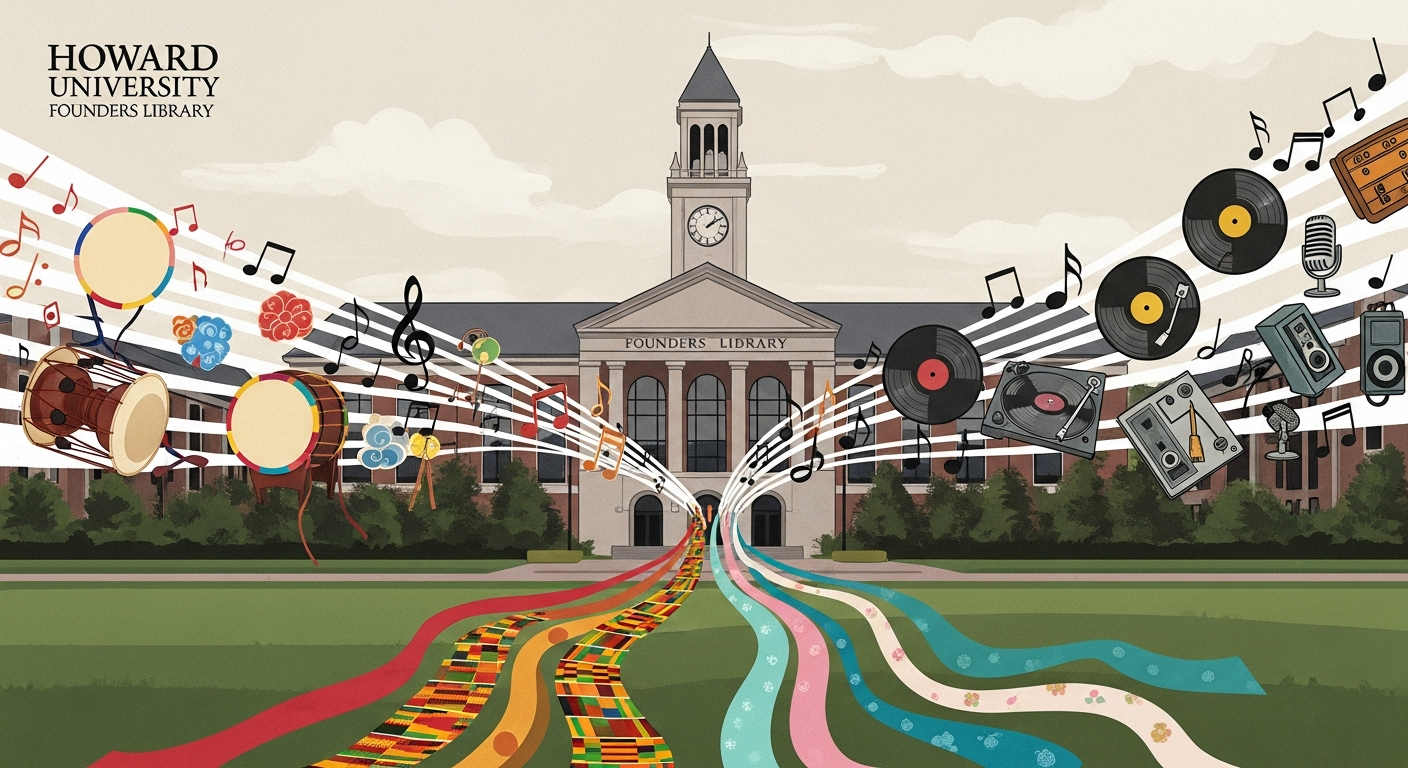
BTS's 'Arirang' album teaser was intended to pay tribute to the 1896 moment when Howard University admitted seven Korean exchange students during the era of racial segregation. But the one-minute animation released on March 13 filled Howard's campus bleachers with an overwhelmingly white audience, with only a couple of Black faces barely visible in the crowd. In 1896, Howard was an HBCU where Black students formed the overwhelming majority, making this depiction a direct contradiction of historical reality. On top of that, the Founders Library appeared in the background — a building that was not actually constructed until decades later — exposing a failure of historical accuracy as well. This was not a matter of artistic license. It was the fundamental contradiction of expressing gratitude while erasing the very people to whom that gratitude was owed.
K-pop's Borrowing from Black Music and the Systematic Absence of Credit
K-pop has grown since the late 1990s by directly borrowing vocal styles, dance choreography, production techniques, and fashion from Black musical traditions — R&B, hip-hop, and street culture chief among them. The case of SM Entertainment taking singer Micah Powell's song 'Devil' from a workshop and releasing it as a Super Junior track while compensating him a mere $200 has become a symbolic example of this structural imbalance. The form of borrowing has evolved from the overt imitation of early K-pop to today's sophisticated internalization, but the systems of credit and compensation have not developed at all. With K-pop commanding a 3-4% share of the U.S. music market and annual exports exceeding $9 billion, continuing to grow without systematically crediting its cultural roots threatens the legitimacy of the entire industry.
Exclusion and Structural Racism Against Black Fans Within K-pop Fandoms
Despite the decisive role Black fans played in K-pop's breakthrough into the U.S. market, they face systematic exclusion within fandom spaces. When they raise concerns about cultural appropriation, they are met with accusations of being 'too sensitive,' and in severe cases they endure racial slurs and doxxing. In early 2026, Manon — the sole Black member of global girl group KATSEYE — went on hiatus amid growing attention to the racism she faced within the fandom. Research from USC Annenberg found that the K-pop industry maintained deliberate silence even during the 2020 Black Lives Matter movement. The contradiction of excluding fans from the very culture you have borrowed the most from is not merely a moral failing — it is a sustainability risk for the industry itself.
The Forgotten 1896 History of Korean Students and Howard University
In 1896, seven young Koreans from Joseon enrolled at Howard University with the assistance of Seo Gwang-beom, the Korean envoy to the United States. At a time when racial segregation was legal and white universities refused students of color, it was a Black university that opened its doors. The students lived for free in Clark Hall, and their campus performances became such a sensation they were covered by The Washington Post. Afterwards, the ethnologist Alice C. Fletcher recorded six wax cylinders in her home with students Ahn Jeong-sik, Lee Hui-cheol, and Son Yong — and among those recordings was the first known recording of 'Arirang' in the United States. Those cylinders are now preserved at the Library of Congress, and they are the very historical moment that inspired BTS's album.
HYBE's 15.55% Stock Plunge and Compounding Risks
HYBE's stock dropped 15.55%, driven primarily by the BTS comeback concert's disappointing attendance of 100,000 against a projected 260,000. The whitewashing controversy was not the direct cause of the plunge, but it compounded the market's growing unease about HYBE as a whole. Rather than issuing a formal apology, HYBE merely added a disclaimer to the video describing it as 'a modern reimagining that may differ from actual historical events.' This episode demonstrated that racial sensitivity issues can become a compound financial risk for the K-pop industry. Yuanta Securities projected HYBE's operating profit at 493.3 billion won this year — an 899% increase over 2024 — suggesting the album's commercial success could offset the blow. But the 15.55% drop is an unmistakable warning signal for investors. With the 82-show world tour's economic ripple effect estimated between 2.9 trillion and 100 trillion won, the impact of cultural controversies on a revenue structure of this scale is forcing the entire industry to reconsider its risk management framework.
Positive & Negative Analysis
Positive Aspects
- Global Rediscovery of a Forgotten History
The story of seven Korean students and their 1896 connection to Howard University was virtually unknown in both Korea and the United States. By making this history the concept for their album, BTS brought it to the attention of tens of millions of fans worldwide. Howard Dig published an in-depth article systematically documenting the historical link between Korean and Black culture, and interest surged in WETA Boundary Stones's archives and the Library of Congress's Arirang wax cylinder recordings. Whatever the flaws in execution, the sheer fact that this history was brought back into the spotlight carries genuine educational and cultural significance.
- Catalyzing a Conversation on Racial Sensitivity Within K-pop
This controversy forced the K-pop industry into a serious conversation about racial sensitivity that it had long avoided. HYBE's disclaimer addition and the 15.55% stock drop — though primarily driven by disappointing concert attendance — sent a clear message across the industry: ignore this at your financial peril. The response fell short of a proper apology, but it was noticeably different from the complete silence that characterized the industry during 2020's BLM movement. The fact that concrete proposals like the Inside Higher Ed op-ed's suggestions — visiting Howard University, establishing scholarships — are now being discussed within the industry represents meaningful progress in itself.
- New Channels of Dialogue Between Korean and Black Communities
The Hilltop, Howard University's student newspaper, used the controversy as an occasion for in-depth reporting on the historical relationship between Korea and HBCUs, while BTS fans launched self-directed study sessions about the 1896 history. Major Korean outlets including The Korea Herald and Asia Business Daily covered the controversy, spreading the conversation about racial sensitivity into Korean public discourse. This kind of cross-cultural dialogue at the grassroots level is rare and genuinely valuable — it is driven not by diplomatic protocol but by shared cultural engagement. This mutual increase in understanding carries real potential to develop into substantive collaboration and solidarity between the two cultures, in ways that go beyond the entertainment industry into education and civic life.
- Mounting Pressure for Global Diversity Policies
This incident is applying concrete pressure on the K-pop industry to adopt diversity policies that meet global standards. Just as Hollywood introduced inclusion riders, intimacy coordinators, and other new roles and checklists in the wake of MeToo, it has now become realistic for K-pop to add cultural sensitivity review stages to its content production process. The cost of such measures is modest relative to the budgets major agencies already spend on music video production and global marketing campaigns. This goes beyond mere controversy avoidance — it is an investment in content quality that can strengthen competitiveness in the global market and reduce the risk of expensive PR crises down the line.
- Clarifying the Line Between Appropriation and Appreciation
This controversy has sparked a substantive discussion about the boundary between cultural appropriation and cultural appreciation — a distinction that had long been left vague and unaddressed. The basic principle is taking shape within the K-pop context: appreciation requires respect for and acknowledgment of the source culture, while appropriation extracts profit without either. Concrete examples are now being cited in fandom discussions, academic writing, and media commentary to illustrate where that line falls. As this conversation matures, it has the potential to raise the standard of cultural accountability not just for K-pop but across the global entertainment industry, providing a framework other sectors can adapt.
Concerns
- The Recurring Pattern of Performative Apologies
Every time a racial controversy erupts in K-pop, the same formula plays out: controversy breaks, social media outrage swells, the agency issues an official apology, it blows over in a week or two, and then a similar controversy happens again. During 2020's BLM movement, K-pop fandoms expressed solidarity through hashtags, but nothing led to structural change within the industry. If HYBE's 15.55% stock dip — primarily caused by disappointing concert attendance — proves to be a temporary blip quickly recovered through the album's commercial success, the conclusion that 'money was made so everything is fine' risks becoming an industry-wide norm.
- The Growing Sophistication of Black Music Borrowing Without a Credit System
Where early K-pop overtly imitated Black culture, today's K-pop has internalized R&B vocal techniques, hip-hop production, and street fashion so seamlessly that it presents them as though they were native to the genre. The more polished the borrowing becomes, the more the origins fade from view, and with them fades the perceived need for credit and compensation. K-pop agencies remain structurally dependent on the talents of Black choreographers, songwriters, and producers while failing to provide them with fair credit or compensation — and that structure is becoming more entrenched, not less. The sophistication of the assimilation makes it harder for casual listeners to even recognize the debt, which in turn makes it easier for agencies to claim the style as their own original creation.
- Structural Worsening of Racism Within Fandoms
The case of Manon — the sole Black member of global girl group KATSEYE — going on hiatus in February 2026 amid a backdrop of fandom racism illustrates how serious the problem has become. When Black fans point out cultural appropriation, they face attacks for being 'too sensitive,' along with doxxing and racial slurs. Unless this environment improves, K-pop will sink deeper into the contradiction of systematically excluding the very people whose culture it has borrowed from most heavily. This is not merely a moral issue — it is a business risk that could affect 10-15% of U.S. market revenue.
- Rising Risks to Global Brand Partnerships
Sponsorship deals between K-pop artists and global brands represent a multi-billion-dollar annual market. If racial sensitivity controversies keep recurring, global corporations with increasingly stringent ESG standards may begin to perceive partnerships with K-pop artists as a liability. Brands in the U.S. and European markets, which place diversity and inclusion at the core of their values, are especially likely to shy away from artists entangled in racial controversies. This could lead to a contraction in ancillary revenue streams that dwarf music sales.
- Deepening Identity Crisis for the Industry
As the pressure mounts for K-pop to acknowledge its debt to Black culture, the genre will increasingly confront the existential question: what is K-pop, really? Acknowledging the influence of Black music while maintaining a Korean identity is possible, but it requires honest and mature cultural dialogue. If the industry avoids that conversation, it risks a deepening identity crisis caught between criticism as 'a derivative of Western music' and marketing claims of 'Korean originality.' Over the long term, this could weaken K-pop's cultural appeal itself.
Outlook
In the immediate term over the next few months, the commercial performance of BTS's 'Arirang' album will determine the short-term trajectory of this controversy. The album dropped on March 20 with over 5 million pre-saves — rewriting K-pop history in the process — and an 82-show world tour with an estimated economic impact ranging from $2.1 billion to $72 billion. HYBE's 15.55% stock drop, driven primarily by the comeback concert's disappointing turnout of 100,000 versus the projected 260,000, stings but is far from fatal. If Yuanta Securities' projected 899% operating profit growth versus 2024 — to 493.3 billion won — materializes, the financial fallout from this controversy will likely register as little more than a blip on the quarterly report. But the more critical short-term question is what concrete actions HYBE and BTS take beyond adding a mere disclaimer. An Inside Higher Ed op-ed suggested BTS visit Howard University to experience the historical significance of HBCUs firsthand, and establish scholarships or cultural exchange programs. If HYBE takes such tangible steps within three to six months, this controversy could be recorded as a genuine turning point for the K-pop industry. If they settle for a disclaimer and bury everything under sold-out tour headlines, trust with the Black community will be damaged to an irreparable degree. Realistically, the probability of HYBE announcing an official partnership with Howard University within six months sits at about 40% — plausible if someone in HYBE's American executive team grasps the gravity of this issue.
Sources / References
- K-Pop Group BTS Called Out For 'Whitewash' Of Howard University Campus In Album Teaser — Black Enterprise
- BTS Misrepresents Howard as Predominantly White in Video — Inside Higher Ed
- Before BTS: How Howard University Helped Elevate Korean Culture and How Black Culture Influenced K-Pop — The Dig at Howard University
- BTS revisits 'Arirang' at Howard. Why has it sparked racial debate? — The Korea Herald
- BTS album teaser controversy sparks discussion among Howard students — The Hilltop
- Before K-Pop there was the Arirang: The First Korean students at Howard University — WETA Boundary Stones
- Rethinking the K-pop industry's silence during the Black Lives Matter movement — USC Annenberg
- HYBE shares plunge 15% as BTS comeback concert draws far less fans than expected — The Korea Times
- BTS comeback draws a smaller crowd than hoped, hitting parent company Hybe's shares — CNBC
- BTS mega world tour sparks target-price upgrades for HYBE — KED Global
- Manon's Katseye Hiatus Reflects Racism Black Girl Group Members Face — Rolling Stone
- Katseye's Manon breaks her silence after a hiatus that exposed a long pattern of Black girl group members being sidelined — TheGrio
- Got S(e)oul?: The Cultural Implications of Performing Blackness in K-pop on South Korean Youth — University of Texas
- The Impact of African-American Musicianship on South Korean Popular Music — Harvard University
- BTS's 'Arirang' Backlash Explained: The History, the Harm — Just Add Color
- Founders Library - Wikipedia — Wikipedia
- BTS' 'Arirang' Has Best Spotify First Day of 2026, Eclipsing Harry Styles — Variety
- BTS' world tour projected to unleash economic boom surpassing Taylor Swift's impact — The Korea Times
- HYBE posts record annual revenues of $1.86bn for 2025 as operating profit plunged 73% — Music Business Worldwide
- K-pop industry raked in $900 million from overseas last year — The Korea Herald
- Higher image raised Hallyu exports last year to KRW 19.54T — Korea.net