
The Real Reason Taylor Swift's 41 Awards Should Make You Uncomfortable
Summary
Behind Taylor Swift's record-breaking 41 iHeartRadio wins lies a tangled web of fan-vote structural bias, streaming algorithm winner-take-all dynamics, and Ticketmaster monopoly controversies. While Swiftnomics boosts city economies, smaller artists are losing their stage.
Key Points
The Structural Backdrop Behind a Record-Breaking 41 Wins
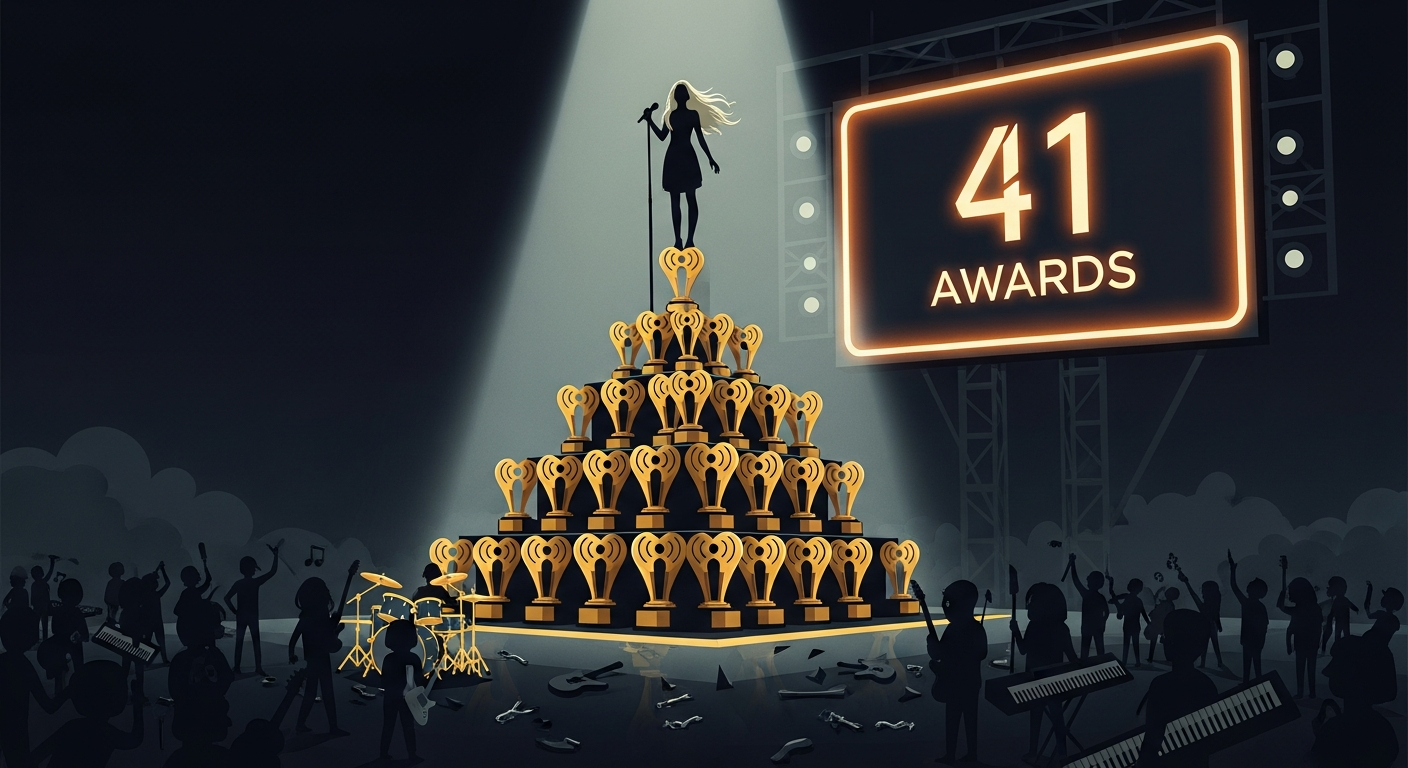
Taylor Swift claimed seven awards at the 2026 iHeartRadio Music Awards, pushing her cumulative total to 41 and setting the all-time record across the ceremony's twelve-year history. The iHeartRadio awards are determined entirely by fan voting conducted online through iHeartRadio accounts, running roughly ten weeks from January 8 through March 19, with the nominee receiving the most votes in each category declared the winner. The Swifties, one of the most organized fandoms in modern pop culture, leverage social media campaigns and coordinated vote drives to deliver overwhelming turnout year after year. In this system, the scale and discipline of a fandom matter far more than musical craftsmanship or critical acclaim.
At the 2026 ceremony, Swift swept Artist of the Year, Pop Album of the Year for The Life of a Showgirl, Favorite Tour Style for the Eras Tour, and Best Lyrics for The Fate of Ophelia, among seven total categories, also setting a single-night record. The fan-vote categories span eleven separate awards, including Favorite Lyrics, Best Music Video, Favorite Tour Style, and Favorite TikTok Dance. While automated voting is prohibited, there are no meaningful guardrails against organized mass mobilization. The question that needs asking is whether fan voting genuinely reflects popular sentiment or structurally favors the artist with the most disciplined base. That question extends well beyond Swift herself and cuts to the legitimacy of every fan-vote award show.
Swiftnomics: The Economic Earthquake the Eras Tour Left Behind
The Eras Tour ran for 21 months, staged 149 shows, drew a total audience of 10,168,008, and generated official gross revenue of $2,077,618,725 according to Pollstar's roughly $2.2 billion estimate, making it the first tour in history to cross the $2 billion threshold. That figure is roughly double the second-place Coldplay Music of the Spheres World Tour, which grossed $1 billion over two and a half years. But the economic impact extended far beyond ticket sales, rippling through every city's GDP in measurable ways. Two shows in Denver added an estimated $140 million to Colorado's GDP. Six shows in Los Angeles generated $320 million. Toronto saw $282 million from six performances. Australia tallied $766 million across Sydney and Brisbane dates, while Japan recorded $228 million.
Chicago's hotel revenue hit an all-time high of $39 million during an Eras Tour weekend. A nationwide study published by GlobeNewsWire projected that the total North American economic impact for 2023 and 2024 reached approximately $7 billion. The average per-attendee spend, covering tickets, lodging, transportation, merchandise, and food and beverage, rose to $1,572 in 2024, a 21 percent increase over the prior year. Tour merchandise alone accounted for roughly $240.8 million in revenue. The concert film Taylor Swift: The Eras Tour pulled in $261.7 million at the global box office. Numbers this large gave birth to the term Swiftnomics, proving that a single artist can move macroeconomic indicators. Yet behind these dazzling figures lie average ticket prices exceeding $1,800 and a Ticketmaster system meltdown that locked millions of fans out entirely.
The Winner-Take-All Machine and the Algorithm's Complicity
The global recorded music market grew 6.4 percent in 2025 to reach $31.7 billion, according to IFPI's Global Music Report 2026, yet the fruits of that growth are concentrating in fewer and fewer hands. On Spotify, only 1.4 percent of all artists earn more than $1,000 per year, and the average per-stream payout sits between $0.003 and $0.005. Taylor Swift's catalog alone has generated an estimated $415 million from 108 billion streams, a sum that exceeds the combined income of tens of thousands of independent artists. The structural problem is compounding: streaming algorithms preferentially recommend music that is already popular, creating a feedback loop that starves emerging talent of exposure.
Adding a new variable to this equation is AI-generated music. A joint study by Deezer and Ipsos found that by 2025, 34 percent of all new tracks uploaded to Deezer were fully AI-generated, at a rate of roughly 50,000 per day, up dramatically from 10 percent in January 2025. AI music still accounts for only 0.5 percent of total streams, but 70 percent of that volume has been identified as fraudulent streaming. The European Parliament has adopted a resolution by an overwhelming majority demanding algorithmic transparency obligations for streaming platforms and fair remuneration for artists, calling for pre-digital-era royalty rates to be recalibrated to modern standards. The net effect is an accelerating winner-take-all dynamic where the top 1 percent captures an ever-larger share of revenue, and the Swift phenomenon is its most dramatic expression. When the value of music is measured solely by how many people listen for how long, the future of diversity looks bleak.
The NFL-Pop Crossover: Birth of a Media Empire
At the 2026 iHeartRadio Music Awards, Taylor Swift and her fiance Travis Kelce made their first joint appearance at an award ceremony, setting social media ablaze. The couple, who began dating in 2023 and announced their engagement in August 2025, dominated headlines when Swift mentioned in her Pop Album of the Year acceptance speech that her fiance makes her feel free and happy every day. That single moment turned an already-viral narrative into a cultural supernova.
The measurable impact of the Swift-Kelce union on viewership and commerce has been staggering. The Swift effect pushed NFL regular-season average viewership to 17.9 million, a 7 percent increase and the highest mark since 2015. Super Bowl LVIII attracted 123.4 million viewers. Female viewership among teenagers surged 53 percent, and viewership among women over 35 rose 34 percent. Kelce's jersey sales exploded by 400 percent. Twenty percent of Super Bowl viewers said they were rooting for the Chiefs specifically because of the Swift-Kelce relationship. A Chiefs-versus-Jets game that Swift attended drew 27 million viewers, the highest-rated Sunday broadcast since the previous Super Bowl. This synergy feeds advertisers, broadcasters, and social platforms alike with content gold, accelerating the formation of what increasingly looks like a media empire. Whether the degree to which a personal relationship is commercially leveraged constitutes a healthy cultural norm is a question worth examining.
The Global Diversity Dilemma in the Music Market
The 2026 iHeartRadio Music Awards introduced three independent K-pop categories for the first time: Favorite TikTok Dance, Favorite Debut Album, and Favorite K-pop Collab. BTS's J-Hope, Stray Kids, and other acts took home wins. BTS's Netflix comeback concert BTS THE COMEBACK LIVE: ARIRANG drew 18.4 million global viewers, surpassing the 98th Academy Awards combined ABC and Hulu viewership of 17.9 million, and topped the Netflix non-English TV chart at number one in 24 countries. The simultaneously released album Arirang sold 3.98 million copies on its first day and logged 110 million Spotify streams within 24 hours, setting an all-time K-pop album record.
Yet the marquee awards, Artist of the Year, Song of the Year, and the like, remain the exclusive domain of English-language acts, with K-pop confined to its own separate room. K-pop commands roughly 3 percent of the global market, and 2025 K-pop album exports surpassed $300 million for the first time. South Korea is now the fourth most-streamed country on earth, behind only the United States, the United Kingdom, and Canada. Rose's APT. claimed the number-one spot on the IFPI 2025 Global Singles Chart, making her the first non-Western artist ever to do so. Despite all of this, the evaluation systems of mainstream award shows remain locked in an Anglo-American framework. Whether the creation of K-pop-specific categories represents a step toward genuine diversity or a mechanism that legitimizes exclusion from the main stage depends on your point of view. What is undeniable is that while Taylor Swift was collecting 41 trophies, thousands of talented artists from around the world had to share three niche categories among themselves.
Positive & Negative Analysis
Positive Aspects
- A Powerful Engine for City Economies and Tourism
Every city the Eras Tour visited experienced explosive economic effects across hotels, restaurants, transportation, and retail. Denver saw $140 million, Los Angeles $320 million, Toronto $282 million, Australia $766 million, and Japan $228 million in estimated impact. Chicago broke its all-time hotel revenue record. The projected total North American economic impact for 2023 and 2024 reached approximately $7 billion. Average per-attendee spending rose to $1,572 in 2024, up 21 percent from the prior year. These figures have redefined the upper limit of what a single artist can contribute to a regional economy and have created a virtuous cycle where city tourism boards are investing more aggressively in securing major concert events.
- A Catalyst for Growth Across the Entire Music Industry
Taylor Swift's The Life of a Showgirl sold over 4 million copies in its first week, the largest weekly sales figure since 1991, and its vinyl sales of 1.33 million set the all-time modern weekly record. These landmark performances benefit the broader music industry, not just Swift personally. The global recorded music market grew for the eleventh consecutive year to $31.7 billion in 2025, and mega-artists like Swift play a significant role in driving that expansion. Record labels, distributors, and music technology companies throughout the ecosystem share in the uplift, as blockbuster releases create halo effects that draw listeners deeper into catalogs and discovery playlists.
- Cultural Influence as a Role Model for Women Artists
Taylor Swift made the unprecedented decision to re-record her earlier albums to reclaim ownership of her master recordings, fundamentally shifting the conversation around artist rights in the music business. As she noted in an acceptance speech, there was a time when she did not think of herself as an artist at all. Her career arc sends a powerful message to young women in music that they can take ownership of their creative output. In an industry still marked by gender imbalance, the fact that a woman holds the all-time wins record carries symbolic weight. This kind of cultural impact carries a value that defies financial quantification.
- Innovation in the Fandom Economy and Participatory Democracy
The organizational discipline the Swifties bring to fan voting demonstrates that fandoms have evolved beyond passive consumers into active agents of cultural decision-making. Their dominance in fan-vote award shows presents one model for participatory democracy in the digital age. This model returns cultural evaluation authority, traditionally monopolized by industry insiders and critics, to the general public. On the merchandising front, Eras Tour attendees spent an average of $40 per person on merchandise, generating approximately $240 million in revenue and proving that fandoms function as economic actors in a new business model with substantial commercial viability.
- Pioneering the Entertainment-Sports Convergence Market
The relationship between Taylor Swift and Travis Kelce has created a novel crossover model that cross-pollinates the audiences of two massive markets: pop music and the NFL. Female teen NFL viewership surged 53 percent, viewership among women over 35 jumped 34 percent, and Kelce jersey sales spiked 400 percent. Super Bowl LVIII drew 123.4 million viewers, and 20 percent of those viewers said they rooted for the Chiefs because of the Swift-Kelce relationship. The media value of Swift's NFL presence reached an estimated half-billion pairs of eyes. This convergence provides advertisers and brands with unprecedented cross-marketing opportunities, and the blurring of boundaries between entertainment and sports is opening new growth avenues for both industries.
Concerns
- Acceleration of Winner-Take-All Dynamics Threatening Smaller Artists
The reality that only 1.4 percent of artists on Spotify earn more than $1,000 per year illustrates the music industry's extreme polarization. While Swift's catalog generates an estimated $415 million, the vast majority of artists receiving $0.003 to $0.005 per stream cannot sustain themselves on music alone. Streaming algorithms form a feedback loop by preferentially recommending already-popular tracks, steadily shrinking the exposure available to emerging artists and niche genres. One superstar shining is admirable in isolation, but when that brilliance obscures the existence of thousands of talented artists, it raises serious concerns about the health of the industry as a whole.
- Ticketmaster's Monopoly and the Erosion of Fan Access
The Ticketmaster system collapse during the 2022 Eras Tour presale exposed the monopoly problem in the live performance market to the entire world. Thousands of fans waited for hours only to lose their tickets, and the debacle ultimately triggered a Department of Justice antitrust lawsuit. A settlement was reached on March 5, 2026 and announced on March 9, requiring Live Nation to pay $280 million in damages, cap service fees at 15 percent, open 50 percent of venue-owned tickets to competing platforms such as StubHub, Vivid Seats, and Eventbrite, release exclusive agreements at 13 amphitheaters, and submit to an eight-year consent decree. However, 26 states and Washington D.C. rejected the terms as insufficient and vowed to continue litigation. With concert ticket prices exceeding $1,800, live music is becoming a privilege reserved for the economically comfortable, undermining the democratic accessibility that has always been a core value of music.
- A Credibility Crisis for Fan-Vote Award Shows
The fact that a single artist has amassed 41 wins at one award show raises fundamental questions about the evaluation system itself. Fan voting structurally favors the artist with the most passionate and organized fanbase, and that does not necessarily correspond to the greatest musical achievement. As a result, fan-vote ceremonies become increasingly indistinguishable from popularity contests, functioning less as platforms that celebrate musical diversity and more as rituals that reconfirm existing popularity rankings. If other artists cannot surpass the Swifties' mobilization power regardless of the quality of their work, the credibility of these awards as a meaningful measure of musical merit is in serious jeopardy.
- Structural Exclusion of Non-English-Language Artists
The introduction of three dedicated K-pop categories at the 2026 iHeartRadio Music Awards may look like a step toward diversity on the surface, but in practice it can function as a mechanism that separates non-English-language artists from mainstream competition. Despite BTS's Netflix comeback concert drawing 18.4 million viewers and topping charts in 24 countries, despite the Arirang album selling 3.98 million copies on day one, and despite Rose's APT. becoming the first non-Western act to top the IFPI Global Singles Chart, recognition in the marquee categories remains limited. K-pop holds roughly 3 percent of the global market, album exports exceeded $300 million, South Korea is the fourth most-streamed country, and Spotify K-pop streams grew 362 percent from 2018. Yet mainstream award evaluation systems have barely moved beyond their Anglo-American center of gravity. Whether giving K-pop its own separate room constitutes genuine inclusion or a polite refusal of entry to the main stage deserves sober examination.
- Excessive Commercialization of Celebrity Relationships and Privacy Erosion
Media outlets and brands are aggressively capitalizing on the impact that Taylor Swift and Travis Kelce's relationship has on NFL viewership, advertising revenue, and social media virality. Every moment, from their joint appearance at the award show to Swift mentioning her fiance in an acceptance speech, is consumed as content. The degree to which a private relationship is openly evaluated for its commercial value represents a troubling symbol of the entertainment industry's over-commercialization. Even if the two share genuine affection, the phenomenon of that sincerity being monetized raises uncomfortable questions about the commodification of human relationships and the erosion of celebrity privacy.
Outlook
In the short term, the second half of 2026 is poised to be a period where the Taylor Swift phenomenon and structural shifts in the music industry accelerate simultaneously. The most immediate variable is the practical impact of the Ticketmaster-Live Nation antitrust settlement reached on March 5, 2026 and announced on March 9. Under the settlement terms, a 15 percent cap on service fees will apply, exclusive arrangements at 13 amphitheaters will be released, and 50 percent of tickets at owned venues must be sold through competing platforms such as StubHub, Vivid Seats, and Eventbrite, all under the supervision of an eight-year consent decree. However, it is critical to note that this settlement has not yet received federal judicial approval, and 26 states plus Washington D.C. have declared the terms insufficient and vowed to continue their own litigation. Whether the $280 million settlement fund will deliver meaningful compensation to the fans who were harmed remains an open question that the coming months will begin to answer.
During the same period, the impact of BTS's full group comeback on the global music landscape deserves close attention. Their Netflix comeback concert drew 18.4 million global viewers, topping Netflix charts in 24 countries and landing in the weekly top 10 in 80 countries. Social media impressions reached 2.62 billion, more than four times the NFL Christmas special's 632 million. The simultaneously released album Arirang sold 3.98 million copies on its first day and logged 110 million Spotify streams within 24 hours, setting all-time K-pop records on both counts. These numbers signal that K-pop's global influence remains formidable. Yet the fact that dominance in streaming metrics and viewership does not automatically translate into recognition at marquee award ceremonies suggests that the glass ceiling conversation between K-pop and English-language award shows will intensify in the near term, not diminish.
Taylor Swift's The Life of a Showgirl, the number-one album in the United States for 2025, is expected to continue its award-season sweep through the first half of 2026. With over 4 million copies sold in its opening week and approximately 3.985 million total copies moved in 2025, combined with 2.093 billion streams, the album's dominance across both digital and physical formats shows no sign of fading. As a direct consequence, the streaming algorithm feedback loop that funnels ever more listeners toward Swift's catalog will only strengthen, further entrenching the visibility advantage that mega-artists enjoy over everyone else.
In the medium term, over the next six months to two years, substantive discussions about restructuring the music industry's revenue distribution framework are likely to begin in earnest. Spotify paid out more than $11 billion to the music industry in 2025, yet the stark reality that only 1.4 percent of artists earn more than $1,000 per year is drawing intensifying criticism as an unsustainable structure. Average per-stream payouts of $0.003 to $0.005 fall far below survival levels for the vast majority of working musicians. The European Parliament has already adopted a resolution by an overwhelming majority demanding algorithmic transparency obligations for streaming platforms and calling for pre-digital-era royalty rates to be recalibrated to modern standards. Legislative responses to these issues could spread outward from Europe over the coming eighteen months.
Particularly worth watching is whether the artist support programs Spotify announced for 2026 deliver tangible results. The platform has promised to direct half of all royalties to independent artists and labels, but serious doubt remains as to whether this can address the structural winner-take-all problem. Unless the fundamental volume-based compensation model, which rewards listening time above all else, undergoes meaningful reform, the economic disadvantages facing niche genres and emerging artists will persist. The gap between the rhetoric of artist empowerment and the reality of per-stream economics remains wide, and that gap is where the industry's credibility is most vulnerable.
The rapid growth of AI music generation technology is another medium-term variable that demands close monitoring. According to the Deezer-Ipsos joint study, 34 percent of all new tracks uploaded to Deezer in 2025 were fully AI-generated, arriving at a rate of roughly 50,000 per day, up sharply from just 10 percent in January 2025. The global AI music market is projected to grow from $6.65 billion in 2025 to $60.44 billion by 2034, at an annual growth rate of 27.8 percent. The finding that 97 percent of listeners could not distinguish AI-generated songs from human compositions underscores the technology's disruptive potential. As AI-produced music floods streaming platforms, the share of streams available to human artists could shrink meaningfully. Conversely, for artists like Swift who possess powerful personal brands and irreplaceable live performance capabilities, AI represents a negligible competitive threat. The most likely outcome is that technological advancement widens the gulf between superstars and everyone else rather than leveling the playing field.
Meanwhile, the entertainment-sports convergence trend is set to accelerate over the medium term. The crossover synergy that the Swift-Kelce partnership has demonstrated will almost certainly inspire imitation, with other high-profile artists and athletes pursuing similar pairings. This could lead to expanded formal partnerships between U.S. professional sports leagues such as the NFL and NBA and the music industry. The convergence will bring the positive effects of market creation alongside the troubling normalization of packaging private relationships as commercial content.
In the long term, over the next two to five years, the global music market's governance structures and value-assessment frameworks could undergo fundamental transformation. The current $31.7 billion global market is failing to achieve genuine diversity because of three reinforcing barriers: an Anglo-American-centric evaluation system, exposure bias driven by streaming algorithms, and monopolistic structures in the live performance market.
In the most optimistic Bull scenario, the Swift phenomenon paradoxically becomes a catalyst for structural reform. The Ticketmaster antitrust settlement sets a binding precedent that strengthens monopoly regulation across global performance markets. Streaming platforms adopt artist-centric revenue distribution models, most notably user-centric payment systems that allocate each subscriber's payment directly to the artists they actually listen to rather than pooling all revenue and distributing it by total stream share. Award shows transition to hybrid evaluation systems that combine fan voting with expert panels assessing musical achievement. In this scenario, non-English genres, K-pop, Latin music, and Afrobeats among them, are integrated into main categories at major ceremonies, bringing genuine global music democracy within reach. The global music market surpasses $40 billion by 2030 as the pie expands, creating a virtuous cycle that channels more opportunities toward mid-tier and emerging artists rather than concentrating them at the top.
In the Base scenario, the current winner-take-all architecture persists with marginal improvements. Certain Ticketmaster practices are reformed, but the fundamental monopolistic structure of the live performance market remains intact. Streaming revenue distribution discussions advance but produce only incremental change. Two or three mega-artists continue to dominate the market, and K-pop expands its influence within dedicated categories while the wall separating those categories from the marquee awards endures. AI music explosively increases the total volume of available content but does not materially alter revenue concentration patterns. The global music market grows at a moderate annual rate of 5 to 7 percent, reaching approximately $35 to $38 billion by 2030.
In the most pessimistic Bear scenario, the winner-take-all structure deepens to a degree that seriously damages the music industry's diversity and long-term vitality. AI-generated music floods streaming platforms, driving down streaming revenues for human artists to the point where only top-tier superstars can sustain themselves through live performances and brand partnerships. The Ticketmaster settlement proves toothless, ticket prices continue climbing, and live music completes its transformation into a luxury good accessible only to the affluent. A mass exodus of mid-tier and small artists begins, hollowing out the ecosystem's foundational layer. Over time, this erosion of the creative base undermines even the innovation capacity of those at the top, setting off a destructive cycle. Fan-vote award shows devolve into oligarchies controlled by a handful of massive fandoms, losing whatever musical authority they once possessed.
I believe the most probable trajectory over the next three to five years tracks closely to the Base scenario. There is, however, one critical swing factor: the willingness of regulators to act. As the Ticketmaster antitrust settlement demonstrates, when governments show genuine resolve to intervene in market structures, the path from Base toward Bull opens up. Conversely, if regulatory response to the AI music flood and platform monopoly consolidation arrives too slowly, elements of the Bear scenario will bleed into reality.
There is one more issue that deserves examination here: the future of fan-vote award shows. If the iHeartRadio Music Awards maintain their current format, the pattern where the artist with the most organized fandom sweeps the board will simply repeat itself in perpetuity. The number 41 becoming 51 or 61 is a matter of when, not if. Solving this requires a transition to a hybrid model that blends fan engagement with expert musical evaluation. The dilemma is that the ceremony has no incentive to abandon fan participation, which is its core marketing proposition. Change will likely come only when the show's authority erodes to the point where advertisers and viewers begin to turn away, a tipping point that may be closer than the organizers realize.
On the global diversity front, the long-term signals are more encouraging. The commercial success of non-English music, from Bad Bunny in Latin music to Burna Boy in Afrobeats to BTS in K-pop, is approaching critical mass. The K-pop market is projected to grow at 6.36 percent annually to reach $14.88 billion by 2033. Spotify K-pop streams grew 362 percent between 2018 and 2023. Rose's APT. topping the IFPI Global Singles Chart as the first non-Western artist is a signal flare of structural change. Non-English music's share of the $31.7 billion global market is steadily increasing, and if this trend persists, major award shows will face mounting pressure within five years to restructure their Anglo-American-centric category frameworks. The creation of K-pop-specific categories is a transitional step; the ultimate destination must be an integrated competitive framework that transcends language and genre if we are to call this a truly global music market.
Regarding streaming economy reform, the user-centric payment system stands out as the most realistic alternative to the current model. The prevailing pro-rata model pools all subscription revenue and distributes it in proportion to total streams, which structurally favors mega-artists. A user-centric model, by contrast, allocates each individual subscriber's payment directly to the artists that subscriber actually listened to, providing fairer compensation to niche artists. Deezer has introduced its Artist-Centric Payment System, which pays double per stream to artists with at least 1,000 monthly streams and 500 or more unique listeners. In January 2025, Deezer partnered with French collecting society Sacem to apply this model to publishing rights for the first time globally. SoundCloud has operated a user-centric model since 2021, with over 135,000 participating artists and an experimental licensing agreement with Warner Music Group. Full adoption by major platforms like Spotify and Apple Music is likely three to five years away. Even when user-centric payment arrives, it will not dramatically reduce the absolute revenue of Swift-tier artists. The real transformation lies in improving income for the middle tier, the working musicians who form the backbone of musical diversity.
Ultimately, the answer to whether Swiftnomics is a blessing or a curse depends entirely on how the system evolves. Criticizing the Taylor Swift phenomenon itself is beside the point. She has played the game optimally within the rules as they exist. The real question is whether those rules are designed to serve only a handful of winners or to provide fair opportunity for all. If you love music, you should hold in your mind the fact that right now, somewhere, an artist is creating something extraordinary but will never be discovered because algorithms have buried it. Behind the stage where 41 trophies gleam, thousands of invisible artists exist. That is the real reason this number should make us uncomfortable.
Sources / References
- Taylor Swift Takes Home Seven Awards at iHeartRadio Music Awards 2026, Extending Her Record for Most Wins — Variety
- Taylor Swift Wins Artist of the Year at 2026 iHeartRadio Music Awards — Billboard
- Taylor Swift and Travis Kelce Make Awards Show Debut at 2026 iHeartRadio Music Awards — The Hollywood Reporter
- Taylor Swift Shouts Out Travis Kelce in iHeartRadio Music Awards Speech — Rolling Stone
- DOJ Rips Into Ticketmaster Monopoly in Court: 'Today, the Concert Ticket Industry Is Broken' — Fortune
- Global Music Report 2026: Global Recorded Music Revenues Grow 6.4% — IFPI
- From $11B in 2025 Payouts to What We're Building for Artists in 2026 — Spotify Newsroom
- Taylor Swift's 'The Life of a Showgirl' Is Luminate's Top Album of 2025 in U.S. — Billboard
- As the Taylor Swift Eras Tour Ends, a National Study Projects Nearly $7 Billion in Economic Impact Across North America — GlobeNewsWire
- Taylor Swift's 'Eras Tour' Smashes All-Time Touring Record, Surpasses $2 Billion — Pollstar
- Music Streaming Sector: EU Must Ensure Just Pay for Artists and Fair Algorithms — European Parliament
- Deezer and Ipsos Study: AI Fools 97% of Listeners — Deezer Newsroom
- NFL's Taylor Swift Effect One Year In: The Pop Star Has Changed Sports — Sportico
- BTS's 'Comeback Live' Special Drew 18.4 Million Views on Netflix — Billboard
- K-pop Artists Occupy Majority of Top Ten Positions in 2025 IFPI Global Album Sales Chart — allkpop
- Ticketmaster and Live Nation Antitrust Settlement Deal, Explained — FindLaw
- Deezer and Sacem Partner for Fairer Remuneration of Publishing Rights with the Artist-Centric Streaming Model — Deezer Newsroom