
'Project Hail Mary' Just Hauled In $81 Million — The Day a Streaming Giant Seized the Theatrical Crown
Summary
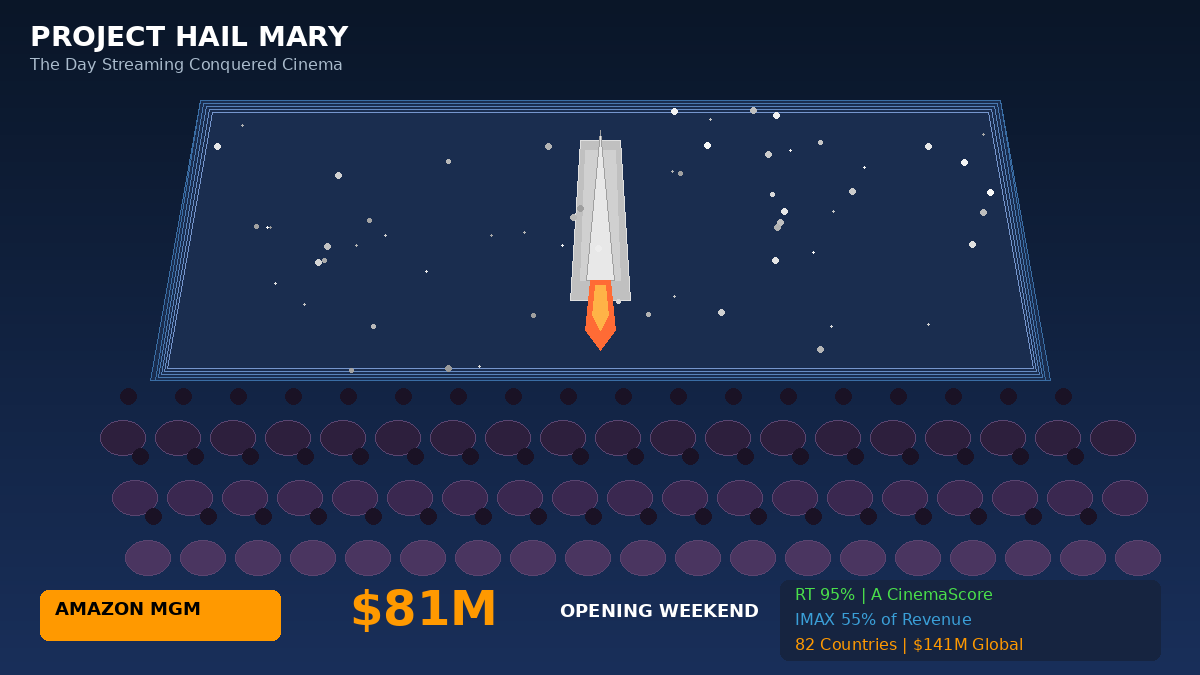
Ryan Gosling's sci-fi epic 'Project Hail Mary' stormed the box office with $80.5 million domestically and $140.9 million worldwide in its opening weekend, crowning itself Amazon MGM's all-time biggest debut. A streaming company sitting atop the theatrical throne signals a fundamental power shift in Hollywood's hierarchy.
Key Points
Amazon MGM Shatters Its All-Time Opening Record
Project Hail Mary pulled in $80.5 million domestically and $140.9 million across 82 countries in its opening weekend. That figure obliterates Amazon MGM's previous best — Creed III's $58 million back in 2023 — by a staggering 39 percent. It also claimed the title of biggest opening of 2026, cruising past Scream 7's $63 million February debut.
The numbers behind the numbers are equally jaw-dropping. A 95% critics score and 96% audience score on Rotten Tomatoes, paired with a CinemaScore of A, make this one of those vanishingly rare cases where critical acclaim and commercial success explode in tandem. The message is unmistakable: a film bankrolled by a streaming company just outgunned every traditional studio on their own turf.
A Streaming Giant's Theatrical Pivot — The Anti-Netflix Strategy
Amazon MGM has committed to releasing 14 films theatrically in 2026, scaling up to 15 annually by 2027. Their model is precise: a 45-day exclusive theatrical window, followed by paid VOD, then streaming on Prime Video. This is the diametric opposite of Netflix's approach, which treats theatrical runs as grudging Oscar-campaign obligations rather than genuine revenue channels.
Amazon MGM Studios head Jennifer Salke declared at SXSW that the studio is committed to theaters 'financially and philosophically.' Project Hail Mary's triumph validates that pledge with hard dollars. The lesson it teaches is profound: in the streaming era, abandoning cinemas is not the answer. A hybrid model that treats theatrical and streaming as complementary — not competing — channels may be the real winning formula.
The Andy Weir Universe — A Second Blockbuster From Sci-Fi Novel Adaptations
This marks the second time an Andy Weir novel has been converted into a major box office force. Ridley Scott's 2015 adaptation of The Martian, starring Matt Damon, opened at $54.3 million and ultimately earned $630 million worldwide, nabbing seven Academy Award nominations including Best Picture. Project Hail Mary has already surpassed The Martian's opening by 49 percent, signaling an even stronger launch trajectory.
A fascinating throughline connects both films: Drew Goddard, who penned The Martian's screenplay, also wrote Project Hail Mary's script. Same source author, same screenwriter, but a completely different directorial vision — and the result is an even bigger commercial splash. Weir's novels have now established themselves as Hollywood's most bankable original sci-fi IP.
Premium Formats Commanded 55% of Revenue — The Premiumization of Cinema
The most telling data point from Project Hail Mary's opening is that IMAX, Dolby Cinema, and other premium large formats accounted for 55 percent of total ticket revenue. IMAX alone generated $27.6 million worldwide, with China's IMAX network delivering a staggering 34 percent of that market's total opening — a record for an original sci-fi title in the format.
These figures transcend simple box office metrics; they map out cinema's future. Audiences are increasingly indifferent to standard screenings that approximate what they can get at home, but they are willing to pay premium prices for immersive experiences impossible to replicate in a living room. Phil Lord and Christopher Miller's decision to shoot most space sequences in IMAX aspect ratios was a strategic bet on this exact trend — and it paid off spectacularly.
Zero Greenscreen — How Practical Filmmaking Created the Difference
Directors Phil Lord and Christopher Miller made a radical choice: not a single frame of greenscreen was used in the entire film. The spacecraft interiors were built as complete practical sets, while deep-space sequences were shot against black or color-shifting backdrops, with VFX reserved exclusively for exterior spaceship shots. This approach dramatically increased production costs and timelines, but the payoff in performance authenticity and audience immersion was incomparable.
The film's $248 million budget (reduced to $200 million after tax incentives) absorbed much of this practical-set strategy. But the results justified every dollar. As Rotten Tomatoes' critical consensus puts it — 'a visually dazzling space odyssey' — the tactile realism of practical sets created a viewing experience that stands in stark contrast to the CGI-saturated blockbusters audiences have grown numb to.
Positive & Negative Analysis
Positive Aspects
- Validation of the Streaming-Theatrical Hybrid Model
Amazon MGM has proven that a 45-day theatrical exclusive followed by VOD and streaming can maximize revenue across both channels. The theatrical release builds buzz and brand recognition, which then drives Prime subscription growth when the film hits the platform — a virtuous cycle realized in practice.
This model achieves what Netflix has never managed to demonstrate. Amazon has shown with hard data that theatrical and streaming are not a zero-sum game but a complementary relationship that amplifies total returns.
- Commercial Viability of Original Sci-Fi IP Reaffirmed
In a Hollywood dominated by franchises and reboots, an original sci-fi novel adaptation posting an $81 million opening is an industry-shaking event. It proves that even without Marvel or DC branding, the combination of powerful source material, star power, and exceptional quality can deliver blockbuster-scale results from original content.
This gives Hollywood studios genuine incentive to diversify beyond franchise dependency and invest in high-quality original projects. Andy Weir's consecutive home runs spotlight the untapped commercial value of novel-based IP.
- Premium Theater Experience Market Potential Confirmed
The 55% premium-format revenue share provides theater chains with an unambiguous investment thesis. It justifies AMC, Regal, and other chains' capital expenditure on converting standard auditoriums into IMAX and Dolby Cinema installations.
IMAX's $27.6 million worldwide haul demonstrates that cinemas are transitioning from 'places to watch content' to 'places to buy experiences.' In an era where 4K home TVs are ubiquitous, premiumization is arguably cinema's only viable survival strategy — and this film validates that hypothesis.
- Ryan Gosling Cements Global Box Office Bankability
After Barbie's $1.4 billion global haul in 2023, Gosling has now shattered opening records again with Project Hail Mary. His genre-agnostic drawing power — from comedy to hard sci-fi — positions him as arguably the most commercially reliable actor in Hollywood today.
Notably, Gosling also served as producer on this project, reflecting the growing trend of A-list actors driving projects from inception to completion rather than simply being cast in them.
Concerns
- The Dangerous Gamble of a $248 Million Production Budget
A pre-incentive budget of $248 million is extraordinarily high for an original sci-fi property. Adding marketing costs, the break-even point likely exceeds $500 million globally. While the $141 million opening is powerful, the film still has a long road to profitability.
Had this film underperformed at opening, Amazon's entire theatrical strategy would have faced existential scrutiny. Streaming companies investing heavily in theatrical distribution win praise when they succeed — but face accusations of 'burning cash for vanity' when they don't.
- Structural Ceiling on Theatrical Revenue in the Streaming Era
Even with a strong opening, the knowledge that the film arrives on Prime Video after just 45 days diminishes the urgency to see it in theaters. The 'I'll just wait for streaming' psychology could produce steep second-week drops. The Martian converted its $54.3 million opening into a final $630 million — an 11.6x multiplier — but achieving similar legs under a 45-day window is structurally far more difficult.
Theater chains recognize this problem. Shorter exclusive windows shrink their revenue opportunity, potentially intensifying long-term friction between cinema operators and streaming platforms.
- Premium Format Dependence Creates Unequal Viewing Access
If 55% of revenue came from premium formats, the flip side is that standard-screen performance fell short of expectations. Audiences in smaller cities or developing nations without IMAX or Dolby Cinema access are excluded from the optimal viewing experience the directors intended.
As films are increasingly optimized for premium formats, the experience quality gap between premium and standard screens widens, deepening the polarization of cinema attendance. Viewers without premium access are more likely to choose 'wait 45 days and stream it' — a vicious cycle that erodes theater industry's broader base.
- One Hit Does Not Validate an Entire Strategy
Extrapolating Project Hail Mary's success to validate Amazon MGM's entire theatrical strategy is premature. One blockbuster among 14 planned releases proves nothing about the remaining 13. If subsequent theatrical releases underperform, the glory of $81 million fades quickly.
Theatrical distribution carries substantial incremental costs — marketing, exhibition deals, revenue sharing. Sustaining theatrical-grade marketing spend across 14 titles while maintaining streaming original budgets creates a dual financial burden whose long-term sustainability remains unproven.
- The Original Sci-Fi Success Formula Is Not Easily Replicated
Project Hail Mary's triumph rests on a highly specific constellation of factors: a bestselling source novel, an A-list star in Ryan Gosling, a proven directing duo in Lord and Miller, a proven screenwriter in Drew Goddard, a $200-million-plus budget, and a radical no-greenscreen production approach.
Average original sci-fi films lacking this exact combination cannot realistically expect comparable results. If the industry misreads one exceptional success as a genre-wide renaissance, it risks triggering a wave of reckless investments and painful write-downs.
Outlook
The equation of streaming-cinema coexistence is slowly revealing its solution.
Project Hail Mary's $81 million opening is not merely a box office record. It is a credible answer to the question Hollywood has struggled with for a decade: what role should theaters play in the streaming era? And that answer turns out to be far more interesting than anyone predicted.
In the short term, the next six months become a proving ground for whether Amazon MGM's hybrid model is a one-off miracle or a sustainable strategy. Following Project Hail Mary, the studio has Masters of the Universe, The Thomas Crown Affair remake, and several other theatrical releases queued up. These titles need to deliver at least moderate commercial success for Amazon's theatrical strategy to earn recognition as a replicable system rather than a lucky accident.
If Project Hail Mary ultimately crosses $500 million globally, it will be recorded as the first definitive proof that a streaming company's theatrical strategy can genuinely work. The Martian converted its $54.3 million opening into $630 million — an 11.6x multiplier. Project Hail Mary has the audience reception and critical momentum to achieve a similar trajectory. However, the 45-day theatrical window's impact on long-tail performance will be tested in real time by this very film.
Looking at the medium-term horizon of one to two years, Project Hail Mary's success has the potential to catalyze a realignment of distribution strategies across Hollywood. Netflix may finally be compelled to take theatrical distribution seriously. The platform has historically treated cinema runs as minimal Oscar-qualifying exercises, but watching Amazon generate real theatrical revenue could force a strategic rethink.
Disney+, Apple TV+, and other streaming platforms will benchmark against the Amazon model. Disney already commands theatrical distribution expertise, but Apple TV+ lacks a clear theatrical strategy. Project Hail Mary's success poses an uncomfortable question for Apple: should we be investing more aggressively in theaters?
The exhibition industry itself faces a transformative moment. The data point that premium formats captured 55 percent of revenue sends an unambiguous signal to theater chains. The remodeling trend — reducing standard auditoriums while expanding premium installations — will accelerate. AMC has already announced premium expansion plans, and global chains like CGV and Cineplex are expected to follow suit.
As premium format dominance strengthens, filmmaking itself will evolve. Directors will begin designing shoots around IMAX and Dolby Atmos from the earliest pre-production stages. Christopher Nolan pioneered the 'premium-format-first' philosophy; Project Hail Mary shows it spreading to mainstream directors like Phil Lord and Christopher Miller. This elevates cinema's visual and auditory quality — but simultaneously widens the experience gap between premium and standard audiences, creating a double-edged sword for the industry.
In the long-term view of three to five years, the resurgence of the 'sci-fi novel adaptation' category deserves close attention. With Andy Weir delivering consecutive blockbusters through The Martian and Project Hail Mary, Hollywood studios will rush into a land grab for sci-fi novel IP. Bidding wars for Weir's next work have likely already begun. Authors like Ted Chiang, Liu Cixin, and Becky Chambers will find their works attracting far more attention from major studios.
The driving force behind this trend is clear: franchise fatigue. As exhaustion with the Marvel Cinematic Universe accumulates, audiences are hungry for fresh worlds and new stories. Sci-fi literature represents decades of accumulated creative wealth while simultaneously offering built-in audiences through proven readerships. Project Hail Mary's source novel has sold over 45 million copies — a reader base that guarantees enormous initial marketing momentum for any film adaptation.
Under the bull case scenario, Project Hail Mary crosses $700 million globally, and Amazon MGM's theatrical strategy becomes the industry standard. The 45-day window gains acceptance as the optimal equilibrium point, prompting other streaming platforms to adopt similar models. The exhibition industry recovers profitability through premiumization, and original sci-fi films achieve franchise-level drawing power, ushering in a new Hollywood era.
Under the base case scenario, the film lands between $400 and $500 million globally — enough to recoup its investment but not a transformative blockbuster. Three or four of Amazon MGM's 14 theatrical releases achieve meaningful box office results, and the hybrid model earns the verdict of 'viable but not universally applicable.' Premium formats' importance is confirmed, but the concurrent decline of standard screens deepens cinema's polarization.
Under the bear case scenario, the 45-day window triggers steep second-week drops, and the film finishes below $300 million globally, yielding poor return on investment. Amazon internally concludes that 'theatrical costs outweigh benefits,' and the 2027 theatrical slate is reduced. Premium format concentration accelerates mainstream audience flight from cinemas, and the structural decline of the exhibition industry continues.
I lean toward the base case playing out. Project Hail Mary is undeniably a meaningful success, but one film's triumph does not contain enough data to rewrite Hollywood's entire rulebook. What truly matters is how Amazon MGM's remaining theatrical releases perform over the next six to twelve months. Only then can we distinguish between 'hybrid model victory' and 'a single stroke of luck.'
One thing is certain, though. Cinema is not dead. It is transforming. For audiences who crave premium experiences, theaters remain irreplaceable spaces. Streaming is not killing cinema — it is forcing cinema to redefine itself. What Project Hail Mary ultimately proves is this simple truth: audiences want to see great films in great environments. As long as that desire persists, cinema has a future.
Sources / References
- Project Hail Mary Box Office: Ryan Gosling Film Scores Year's Biggest Debut With $80 Million — Variety
- Box Office: Project Hail Mary Opening to $80M In U.S. — Deadline
- Project Hail Mary Blasts Off to Huge $81M Box Office Opening — Hollywood Reporter
- Project Hail Mary becomes Amazon's highest-grossing debut — Fortune
- Why Project Hail Mary and Ryan Gosling Soared This Weekend — IndieWire
- Amazon MGM Will Release 12-14 Films Theatrically In 2026 — Deadline
- 5 Reasons Why Ryan Gosling's Project Hail Mary Dominated The Box Office — SlashFilm