
'Suggested' — How One Word in a Farewell Letter Crashed a $660 Billion Pension System
Summary
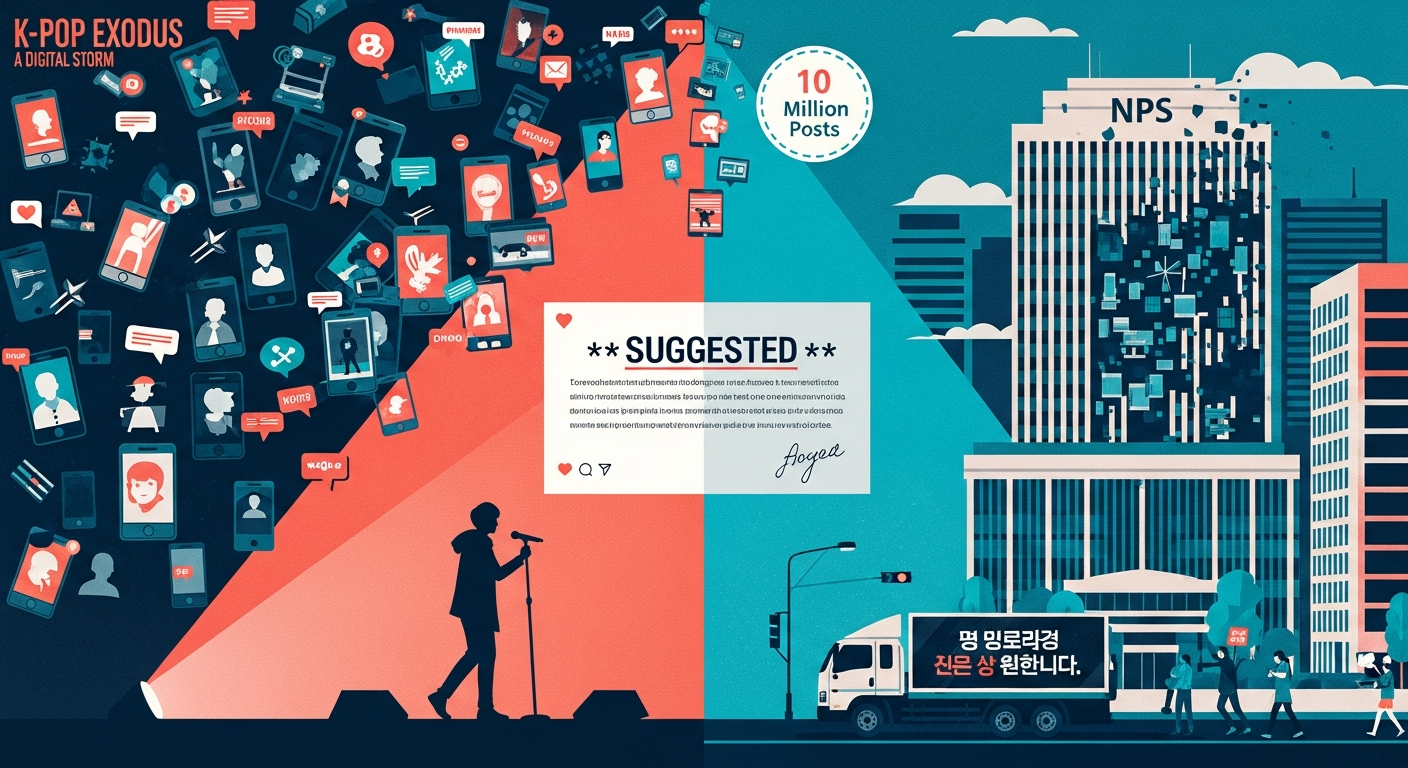
ENHYPEN member Heeseung's departure announcement triggered 10 million social media posts and paralyzed South Korea's $660 billion National Pension Service — an unprecedented collision of fandom power and institutional finance. A single word in his handwritten farewell letter, 'suggested,' has blown open the structural contradictions hiding beneath K-pop's glittering surface and raised existential questions about idol autonomy in an industry approaching its biggest contract renewal wave in history.
Key Points
10 Million Posts: The Biggest Social Media Firestorm in Recent Memory
On March 10, 2026, Belift Lab announced Heeseung's departure from ENHYPEN, and within hours the internet essentially broke. Over 10 million posts flooded X (formerly Twitter), making it one of the single largest social media reactions ever recorded for any event. A Change.org petition demanding Heeseung's return surpassed 1 million signatures in just two days and ultimately closed with over 2.08 million signatories. Meanwhile, 18 protest trucks lined up outside HYBE's headquarters in Seoul, turning the corporate lobby into something resembling a political demonstration. These numbers reveal that K-pop fandoms function less like consumer groups and more like highly organized political actors capable of mass mobilization on a timeline that would make most advocacy organizations envious.
Fans Crashed a $660 Billion Pension Fund — Targeting Institutional Investors Directly
International fans flooding the service lines of South Korea's National Pension Service (NPS) was genuinely without precedent in K-pop history. Within two hours, over 1,500 emails and phone calls overwhelmed the NPS international support center — temporarily paralyzing its operations. The NPS holds a 7.54% stake in HYBE, making it the third-largest shareholder, and fans had done their homework. NPS CEO Kim Seong-ju was forced to issue an official statement clarifying that we do not interfere with K-pop group compositions or member changes. The sheer absurdity of a national pension fund having to publicly address an idol group lineup change tells you everything about how far this situation escalated.
One Word — Suggested — Lit the Fuse on an Autonomy Debate
The core of the controversy traces back to a single word in Heeseung's handwritten letter to fans, where he described his departure as a direction suggested by the company. Belift Lab's official statements emphasized mutual agreement and Heeseung's distinct musical vision, but fans immediately zeroed in on that passive construction. If a 24-year-old main vocalist genuinely wanted to leave his group to pursue a solo career, there would be no reason to use the word suggested — a word that implies the initiative came from somewhere else. That one word is what generated the 2.08 million petition signatures and the 18 protest trucks outside HYBE headquarters.
HYBE's Double Standard — Why Can BTS Members Go Solo But Heeseung Can't Stay?
The most devastating argument fans have marshaled is the inconsistency within HYBE's own roster. BTS members have pursued extensive solo careers while maintaining their group membership. TXT's Yeonjun balances solo and group activities simultaneously. Over at SM Entertainment, EXO has operated with a similar dual-track system for years. So the obvious question becomes: why is Heeseung the only artist who apparently has to leave his group entirely in order to go solo? When different rules apply to different artists under the same corporate umbrella, the explanation almost certainly comes down to business calculations rather than artistic ones.
The K-Pop 7-Year Curse Arrives in Full Force in 2026
ENHYPEN debuted in November 2020 and is now in its sixth year, with the first contract renewal window approaching in 2027. Under South Korea's Fair Trade Commission standard contract framework, exclusive entertainment contracts have a maximum duration of seven years. This means the entire wave of groups that debuted in 2019-2020 is simultaneously approaching contract expiration. SEVENTEEN, BLACKPINK, and Monsta X are all entering critical contract negotiations in 2026. The Heeseung situation looks less like an isolated incident and more like the opening shot of what could be a systemic upheaval across the K-pop industry.
Positive & Negative Analysis
Positive Aspects
- Heeseung's Solo Career Potential Could Be Enormous
Freed from the constraints of a seven-member group dynamic, Heeseung has the opportunity to fully realize his artistic vision as a solo performer. His vocal range and stage presence have been widely acknowledged even within the crowded ENHYPEN lineup, and solo activities would give him the creative control that group schedules inherently limit. The K-pop solo market has proven spectacularly profitable — Jungkook's Seven and Jimin's Like Crazy both demonstrated that established group members can achieve massive commercial success independently.
- A Six-Member ENHYPEN Could Find a New Identity and Thrive
History is littered with K-pop groups that not only survived member departures but actually flourished afterward. EXO lost three members between 2014 and 2016 and went on to achieve some of their biggest commercial successes as a smaller unit. The group's Billboard chart jump of 92 spots amid the controversy suggests that public attention translates into commercial engagement.
- Fan Activism Has Proven Itself as a Legitimate Force for Industry Accountability
The ENGENE response demonstrated something remarkable: a fandom capable of organized, multi-platform, internationally coordinated action that forced responses from both a major entertainment corporation and a sovereign pension fund within 48 hours. The 2.08 million petition signatures, 18 protest trucks, and the NPS hotline campaign represent a new template for fan-driven accountability.
- The Crisis Is Forcing Unprecedented Industry Transparency
The Heeseung situation has cracked open a conversation about K-pop contract structures, decision-making processes, and artist autonomy that the industry has historically preferred to keep behind closed doors. South Korea's Fair Trade Commission is already updating trainee contract regulations for 2026.
- HYBE's Multi-Revenue Strategy Gets a Real-World Stress Test
HYBE has deliberately built a portfolio model with multiple revenue streams across numerous acts precisely to withstand situations like this. HYBE's revenues soared 39% year-over-year to a record $349 million in Q1, driven by tours and merchandise from SEVENTEEN, j-hope, ENHYPEN, and other acts.
Concerns
- The Suggested Problem — Artist Autonomy Remains a Fundamental Question
The single most troubling aspect of this entire situation is the unresolved tension between Belift Lab's narrative of mutual consent and Heeseung's own language of a suggested direction. Despite multiple corporate statements, the company has never directly addressed why Heeseung used that specific word.
- Fandom Overreach Risks Delegitimizing Valid Concerns
Crashing a national pension fund's service lines is the kind of action that generates headlines but also invites backlash. The NPS serves millions of Korean retirees and future pensioners, and disrupting its operations crosses a line that many observers found difficult to defend.
- The Fandom Is Splitting, and the Fractures May Be Permanent
The ENGENE fandom is experiencing a painful internal division between those who support Heeseung's solo journey and those who believe the remaining six members deserve undivided loyalty. Historically, member-departure-driven fandom splits in K-pop tend to be permanent rather than temporary.
- HYBE's Credibility Has Taken a Significant Hit at the Worst Possible Time
HYBE is simultaneously navigating the BTS military return cycle, managing the BTS comeback whose crowd numbers disappointed — HYBE claimed 100,000 attendees while government estimates ranged between 40,000 and 80,000, triggering a stock sell-off. The Heeseung controversy lands on top of these existing pressures.
- The 7-Year Curse Anxiety Is Now Spreading to Every Active Fandom
The Heeseung situation has transformed the 7-year curse from an abstract industry concept into an immediate, visceral anxiety for fans of every group approaching contract renewal. SEVENTEEN fans, BLACKPINK fans, Stray Kids fans — every fandom whose group debuted between 2017 and 2020 is now watching the ENHYPEN situation as a potential preview of their own future.
Outlook
Let me start with what's likely to unfold over the next few months. Heeseung's solo album is probably coming in the second half of 2026, most likely Q4. HYBE has every financial incentive to move quickly — a solo debut while public attention is still elevated maximizes both commercial impact and narrative control. The longer they wait, the more the story becomes about the controversy rather than the music.
ENHYPEN as a six-member group will likely continue activities without a significant break. The group's 92-spot jump on Billboard amid the controversy is a data point that HYBE's strategists will not have missed — controversy drives engagement, and engagement drives revenue. Expect a comeback or at least a fan-oriented release within Q3 2026.
The fandom split is going to be the most painful and commercially significant short-term consequence. Right now, ENGENEs are fractured along roughly three lines: those who follow Heeseung exclusively, those who remain loyal to the six-member ENHYPEN, and a diminishing middle group trying to support both. Based on precedents like EXO and GOT7, I'd estimate a 15-25% net revenue decline in the first 18 months before stabilization.
BTS's comeback situation adds another layer of complexity to HYBE's near-term outlook. The BTS reunion concert in Seoul drew what HYBE officially described as 100,000 attendees, but South China Morning Post reported that government estimates placed the actual figure between 40,000 and 80,000 — a significant discrepancy that triggered a sell-off in HYBE stock.
Looking at the medium term — roughly one to three years out — the ENHYPEN contract renewal in 2027 becomes the central event. Given everything that has happened, the remaining six members have significant negotiating leverage. The broader 7-year curse wave is the industry's medium-term earthquake. SEVENTEEN's contract situation with Pledis/HYBE, BLACKPINK's continued dynamics with YG, Stray Kids' relationship with JYP — all of these negotiations are happening in the shadow of the Heeseung precedent.
South Korea's Fair Trade Commission (FTC) is likely to accelerate regulatory attention on entertainment contracts during this period. The NPS situation created an entirely novel precedent in the intersection of fandom activism and institutional finance.
Looking at the long-term horizon — three to five years and beyond — I believe we're witnessing the early stages of a fundamental transformation in the K-pop labor model. The direction of change is toward what I'd call the athlete model — where performers operate with individual representation that negotiates specific terms for specific activities, rather than the all-encompassing exclusive contract that currently dominates K-pop.
Fan activism as an institutional force is here to stay, and its tactics will evolve. Future campaigns will likely be more targeted and more effective: shareholder proposal submissions, organized social media campaigns timed to earnings calls, coordinated engagement with financial media to shape investor narratives.
In the bull case — roughly a 20% probability — Heeseung's solo career explodes commercially, ENHYPEN thrives as six, and HYBE's stock recovers. The base case — roughly 50% probability — involves mixed results across the board. The bear case — roughly 30% probability — is where multiple things go wrong simultaneously.
There's one wildcard scenario worth mentioning: a reversal. If public and financial pressure becomes intense enough, there's a non-zero chance — perhaps 5-10% — that Belift Lab finds a face-saving way to reintegrate Heeseung into ENHYPEN before the 2027 contract renewal.
The music industry economics also merit closer examination. Solo tours typically generate lower per-show revenue than group tours but can achieve higher margins due to lower production costs. Based on comparable situations, I'd estimate it takes 18-24 months before the new configuration reaches revenue equilibrium.
I want to end with a broader point about what this situation reveals. The K-pop industry has spent the last decade building one of the most successful cultural export machines in human history, with combined revenues exceeding $10 billion annually. But the engine that powers this machine — the trainee system, the exclusive contracts, the corporate control over artistic decisions — is fundamentally a labor model that was designed for an era when idols had no independent leverage and fans had no organized voice. Both of those conditions have changed irrevocably. Heeseung's departure letter, with its single devastating word, didn't create these contradictions. It just made them impossible to ignore any longer.
Sources / References
- A K-Pop Star Left His Group. 10 Million Posts Made It One of the Biggest Reactions Social Media Has Ever Seen — Yahoo Entertainment / TIME
- K-pop fans crash NPS service lines over ENHYPEN Heeseung exit — The Korea Herald
- HEESEUNG Leaves ENHYPEN: Read His Full Letter to Fans — Billboard
- ENHYPEN Label Says HEESEUNG's Band Exit Is Most Fulfilling Approach — Billboard
- K-pop fans crash service lines of South Korea's US$900bil pension fund — The Star (Bloomberg)
- HYBE revenues soared 39% YoY to record $349M in Q1 — Music Business Worldwide
- K-pop contract renewal trends — The Korea Herald
- International ENHYPEN fans send over 10 protest trucks to HYBE — allkpop
- Fans flood Korea's pension fund over ENHYPEN exit — The Korea Times
- Petition to bring back Heeseung ends with more than 2 million signatures — Manila Bulletin
- 18 Trucks at HYBE, 513K Signatures — Inside the ENGENE Meltdown — KCL HQ
- NPS: We don't interfere with K-Pop groups — allkpop
- ENHYPEN Jumps 92 Spots on Billboard Amid Heeseung's Exit — Outlook Respawn
- Belift Lab reaffirms Heeseung will not return to Enhypen — The Korea Herald
- BTS comeback crowd disappoints, triggering HYBE stock sell-off — South China Morning Post
- South Korea Reforms K-pop Trainee Contracts for 2026 — Outlook Respawn