
ChatGPT Changed the World. So Why Is OpenAI Burning $14 Billion a Year?
Summary
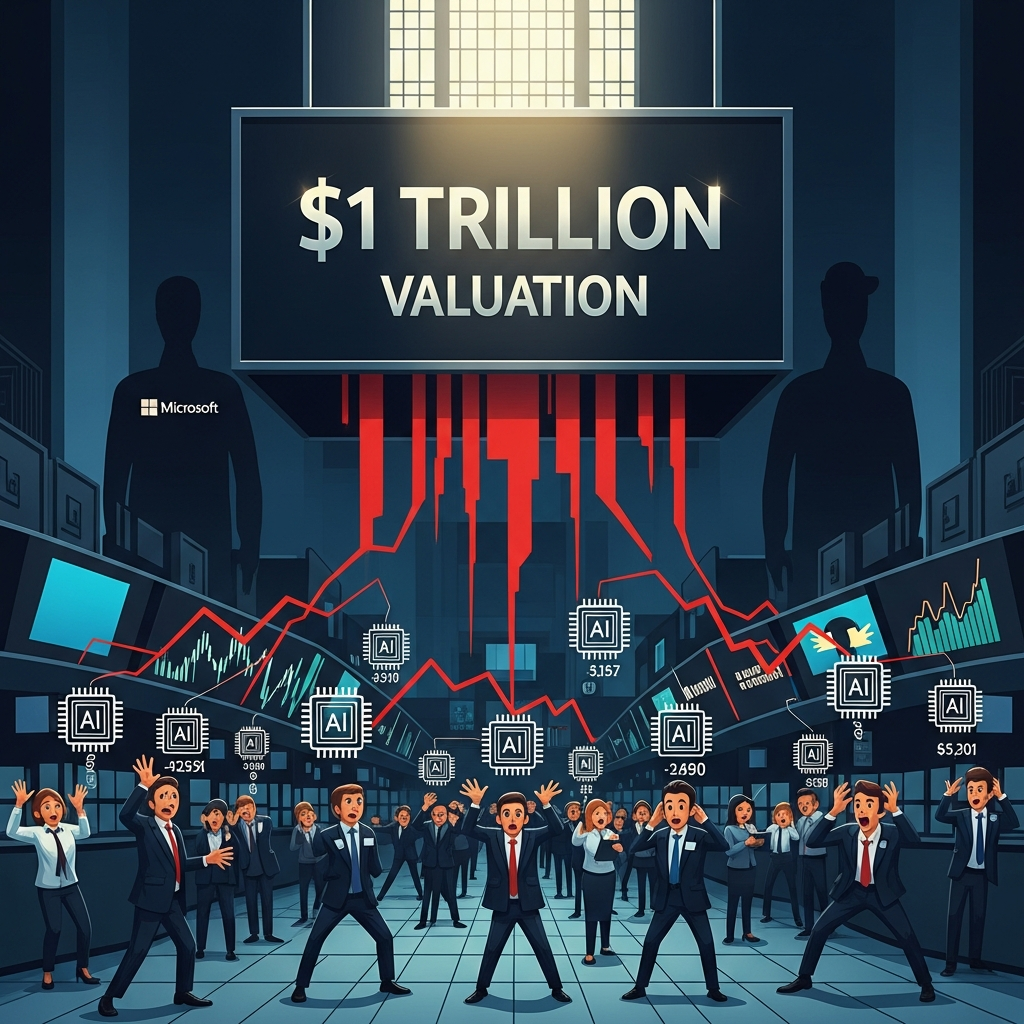
On May 22, 2026, OpenAI filed a confidential S-1 with the SEC, officially setting in motion what could become the largest technology IPO in history, targeting a valuation between $852 billion and $1 trillion with Goldman Sachs and Morgan Stanley as lead underwriters. The financial reality is staggering: the company posted a negative 122% operating margin in Q1 2026, meaning it loses $1.22 for every dollar it earns, with OpenAI's own internal forecasts projecting $14 billion in net losses for 2026 alone and $44 billion in cumulative losses through 2028. ChatGPT's web traffic market share collapsed from 87% to 56.7% in just fourteen months, Google Gemini quadrupled its share in the same window, and Anthropic quietly surpassed OpenAI's $25 billion ARR with $30 billion of its own while spending one-quarter as much to train its models. HSBC's semiconductor research team projects a $207 billion funding shortfall by 2030, even assuming revenue hits $213 billion that year, making this IPO not a victory lap but a survival prerequisite to honor $600 billion in computing contracts already signed. This analysis examines whether the outcome resembles Amazon's eventual profitability after years of deliberate infrastructure losses — or WeWork's governance-driven valuation collapse — by working through the deal's financial structure, competitive dynamics, and probability-weighted scenarios from 2026 through 2030.
Key Points
The $1.22-Per-Dollar Paradox: OpenAI's Structural Deficit Explained
OpenAI's Q1 2026 financials reveal the most counterintuitive financial structure in modern technology: $5.7 billion in quarterly revenue paired with $6.95 billion in operating losses, producing a negative 122% operating margin. That figure is the non-GAAP number, which strips out stock-based compensation entirely — the actual losses are materially larger than the headline discloses. The inverse economics here represent the core structural problem: unlike traditional SaaS businesses where scale drives fixed costs down as a percentage of revenue, every additional ChatGPT query generates a proportional marginal inference cost with no depreciation dynamic to smooth it out over time. The math at the projected full-year scale becomes genuinely alarming — if OpenAI meets its $30 billion revenue target for 2026 while maintaining the same margin structure, annual losses would exceed $36.6 billion. Meanwhile, the P/S ratio of 65 times places OpenAI at a multiple more than four times Snowflake, itself considered the richest-valued SaaS company on the market, and more than ten times Salesforce, with both comps being profitable. The market is pricing in a permanent AI monopoly premium that the competitive data suggests may be dissolving considerably faster than the valuation currently acknowledges.
HSBC's $207 Billion Warning: Why This IPO Is Mandatory, Not Optional
Understanding what this IPO actually is — rather than what press coverage says it is — requires engaging seriously with HSBC's semiconductor analyst team's infrastructure projections. Between 2025 and 2030, OpenAI's data center lease obligations total $792 billion cumulatively, with annual infrastructure costs peaking at $620 billion in the early 2030s driven by the computing commitments already contractually signed. Even in the scenario where OpenAI hits HSBC's $213 billion revenue forecast for 2030, cumulative free cash flow remains negative through the end of that year — a funding shortfall the firm calculated at $207 billion. This is not a discretionary investment gap but an obligation gap: OpenAI has already committed to $600 billion in computing contracts that simply cannot be honored without raising this capital. The IPO is not a celebration of arrival but a prerequisite for honoring existing commitments, and the fundraising will not end at the IPO itself — additional equity issuances are structurally inevitable, which means ongoing dilution for IPO-era investors across the period when cumulative losses are highest. Any investment thesis that does not account for this dilution trajectory is working from an incomplete financial model.
ChatGPT's Market Share Collapse and the Revenue Reversal Nobody Wants to Talk About
Perhaps the most underreported story embedded in the OpenAI IPO narrative is what has already happened to its competitive position. ChatGPT's web traffic share dropped from 87% to 56.7% in just fourteen months — a 30 percentage point collapse — even as absolute weekly active users grew to 905 million. The apparent paradox resolves when you recognize that the AI market itself expanded faster than OpenAI: Google Gemini quadrupled from 6% to 25.5% market share in the same period, and Claude has become the preferred enterprise tool, winning roughly 70% of head-to-head competitive evaluations against OpenAI models among enterprise buyers. ChatGPT's U.S. mobile daily active user share fell below 40% for the first time in the product's history. Most decisively, Anthropic's ARR crossed $30 billion in April 2026, overtaking OpenAI's $25 billion — while Anthropic's model training costs run at one-quarter of OpenAI's per-model expenditure. The 65 times P/S ratio is only defensible if OpenAI retains something close to permanent market leadership, and the live data above provides clear evidence that assumption is eroding while investors are being asked to price it as permanent.
Microsoft's 27% Stake, 20% Revenue Claim, and $250 Billion Cloud Obligation
The ownership and revenue-sharing structure surrounding OpenAI is unusually complex for a company pursuing a standard public market listing. Microsoft holds 27% of shares on a diluted basis, worth approximately $135 billion at the lower end of the target valuation range. The OpenAI Foundation — the original nonprofit board — retains 26%, bringing the combined stake of these two non-retail entities to 53% before the IPO is even priced. Beyond the equity concentration, Microsoft collects 20% of OpenAI's revenue through 2030 under their restructured partnership agreement, subject to a $38 billion total cap — meaning roughly a fifth of every dollar OpenAI earns for the next four years flows directly to Microsoft. There is also a $250 billion Azure cloud purchasing commitment running across six years, which functions as a large fixed-cost obligation baked structurally into OpenAI's expense base. The 2032 expiration of Microsoft's technical IP license creates a pivotal strategic transition point that will reshape the entire partnership dynamic, and how OpenAI navigates that transformation will substantially determine whether it can maintain genuine operational independence in the decade following the IPO.
From Nonprofit Safety Mission to $1 Trillion PBC: The Identity Transformation
The organizational evolution OpenAI has undergone is not merely a legal restructuring — it represents a fundamental redefinition of institutional identity that every investor should understand before committing capital. The company launched in 2015 as a nonprofit with an explicit mandate to build artificial general intelligence that is safe and beneficial for all of humanity; it is now a Public Benefit Corporation pursuing a $1 trillion market capitalization on the public markets with standard equity incentives for all shareholders. In October 2025, the capped-profit structure that limited investor returns was dissolved in favor of a normal equity arrangement, and the word "safely" was removed from the organization's stated mission. The OpenAI Foundation retains 26% of the new PBC, creating an enduring structural tension: the Foundation's mandate to prioritize humanity's interests may not always align with the profit-maximization obligations owed to public shareholders when those interests conflict. The November 2023 episode in which Sam Altman was abruptly fired by the board and then reinstated within five days demonstrated that this governance tension can produce acute crises with almost no warning. WeWork's S-1 ultimately collapsed not because its business was entirely fictional but because governance disclosures destroyed institutional trust at a critical moment — and OpenAI's dual-mission governance architecture carries a version of the same embedded risk that cannot be fully engineered away through legal structure alone.
Positive & Negative Analysis
Positive Aspects
- Verified $25B ARR and 905 Million Weekly Active Users Make This Real
The most important distinction between OpenAI and WeWork is the verifiable reality of its revenue base, and that distinction matters enormously for any honest comparative analysis. OpenAI enters the IPO with $25 billion in annualized recurring revenue, 905 million weekly active users, more than 50 million paid subscribers, and 9 million enterprise customers — numbers that are auditable, real, and large by any historical standard for a company at this stage. Paid conversion has improved from 2.58% in February 2025 to approximately 6% in Q1 2026, indicating that the monetization engine is moving in the right direction even if the absolute rate remains low relative to the user base size. The breadth of revenue streams — consumer subscriptions, API access, enterprise licensing agreements, and nascent advertising — provides meaningful diversification relative to a single-product company dependent on one revenue line. This scale of active user adoption makes an overnight collapse scenario structurally implausible, and the company has genuine empirical data with which to refine and optimize its monetization approach over time. The user base is Facebook-scale; the critical unresolved question is whether the financial model can evolve to match the extraordinary reach of the platform.
- ChatGPT Advertising Proved Its Early Signal — and the Long-Term Ceiling Is Enormous
ChatGPT's advertising pilot achieved $100 million in annualized run-rate revenue within six weeks of launch, which represents one of the fastest advertising ramp velocities recorded for any digital product at scale, and it provides a concrete proof point that AI-native advertising is a viable business rather than a theoretical assumption. The internal 2027 target of $11 billion represents a substantial step-up, but it is grounded in a structural opportunity that is genuinely enormous: Google's search advertising franchise generates more than $200 billion annually, and conversational AI interfaces represent a credible challenger to the traditional keyword search paradigm that has anchored that market for two decades. Unlike inference costs — which scale linearly with every additional query — advertising revenue carries a near-zero marginal cost per additional impression once the inventory and targeting infrastructure is in place. HSBC projects 3 billion regular ChatGPT users by 2030, and if paid conversion climbs from 6% to 20%, the incremental revenue opportunity is estimated at $194 billion in additional addressable revenue. Advertising, in my view, represents the single most powerful structural lever available to OpenAI for improving unit economics without requiring a breakthrough reduction in inference cost curves — which makes the 2027 advertising revenue trajectory the most critical single metric to monitor after the IPO listing.
- First-Mover Infrastructure Lock-In Creates a Barrier Competitors Cannot Quickly Replicate
The $600 billion in computing contracts that currently read as a liability on the financial statements simultaneously function as a competitive moat that no new AI entrant can easily replicate from a standing start. No AI startup attempting to compete with OpenAI today can simply approach a hyperscaler and secure equivalent infrastructure at equivalent scale — the compute is largely committed, and power supply constraints are severe enough that even Microsoft has an $80 billion backlog of unfulfilled Azure orders due to physical capacity limitations. The partnership restructuring in April 2026 also removed the AGI exclusivity clause that previously limited OpenAI to Azure, giving it the option to diversify toward AWS and Google Cloud — adding supply-side flexibility that meaningfully narrows the infrastructure dependency risk that previously created leverage for Microsoft. Early-mover advantages in foundation model training data, researcher talent pipelines, and long-term enterprise customer relationships compound over time in ways that are difficult for later entrants to overcome quickly. These structural advantages will not guarantee profitability on their own, but they do create a meaningful ceiling above which any competitor must climb — and that ceiling rises with each passing quarter as OpenAI's scale and customer base compound.
- A Concrete Internal Road Map: The 2029 Profitability Case Has Specific Numbers
OpenAI's internal financial projections, reported by The Information and widely cited in subsequent financial media coverage, are not vague aspirational statements — they are specific, model-grounded targets with identifiable underlying drivers. The 2029 road map calls for $100 billion to $125 billion in revenue, a 70% gross margin, and $14 billion in net profit, built on three converging structural drivers: GPU generation improvements reducing per-query inference costs, advertising and agentic AI revenue streams adding high-margin incremental revenue on top of the subscription base, and rising enterprise contract volumes improving average revenue per user across the business. If even half of that scenario materializes by 2030 rather than 2029, the company is viable and the capital destruction period ends before the cumulative loss ceiling becomes existential. HSBC's independent forecasts of 3 billion ChatGPT regular users by 2030 with a 20% paid conversion rate suggest the user-base arithmetic can arithmetically support the revenue targets even in a partial success scenario. Amazon spent seven years in sustained operating losses before AWS created an outcome that nobody at IPO time anticipated or modeled — that precedent does not guarantee OpenAI a similar payoff trajectory, but it establishes that the time horizon investors need to underwrite is not categorically unusual for a platform-stage technology company making long-duration infrastructure bets.
Concerns
- Inverse Economics: The More OpenAI Sells, the More It Loses
OpenAI's most fundamental structural problem is a cost architecture that moves in the same direction as its revenue rather than diverging from it as scale increases. When a company earns $5.7 billion in a quarter and simultaneously loses $6.95 billion in the same quarter, the only sustainable escape routes are either a dramatic reduction in the variable cost per query or a decisive shift toward revenue streams with genuinely different cost profiles — and neither is certain to materialize on the timeline the valuation implies. Amazon's infrastructure costs were largely capital expenditure that depreciated into fixed operating costs over time, which is precisely why the Amazon comparison is structurally misleading — OpenAI's inference compute costs are query-proportional variable costs with no depreciation dynamic that compresses them as a percentage of revenue over time. OpenAI's own internal forecasts acknowledge $44 billion in cumulative losses from 2023 through 2028, and that figure assumes the positive scenario of improving inference cost curves and successfully ramping multiple new revenue streams simultaneously. If inference costs do not fall as fast as projected, or if the advertising revenue ramp underdelivers the 2027 target, the structural deficit compounds rather than narrows, and each additional equity raise required to close the capital gap dilutes prior shareholders further. Investing in a company at 65 times P/S with a negative 122% operating margin requires an exceptionally high threshold of conviction specifically about the trajectory of that operating metric over the next 36 months.
- The AI Monopoly Premium Justifying 65x P/S Is Eroding in Real Time
The entire valuation logic of 65 times price-to-sales rests on a single load-bearing assumption: OpenAI maintains something close to permanent dominance over the AI market it helped create. That assumption is now contradicted by publicly available market data. Anthropic's ARR of $30 billion surpassed OpenAI's $25 billion in April 2026, while Anthropic's model training costs run at one-quarter of OpenAI's — the competitor generating more revenue is simultaneously doing so more efficiently, which is precisely the competitive dynamic that destroys monopoly pricing power over time. Google Gemini's monthly active user base reached 900 million in 2026, doubling within one year, while ChatGPT's web traffic share fell 30 percentage points in the same window. Meta's open-source Llama models are applying structural downward pressure on API pricing across the entire commercial AI market, compressing the price premium that any closed-source AI provider can sustain regardless of brand strength. CNBC's warning that "cheap AI could derail OpenAI and Anthropic's IPOs" captures the directional risk precisely: in a market moving from oligopoly toward commoditization, a 65 times P/S multiple requires a narrative of durable dominance that the live competitive data no longer fully supports at any honest reading.
- EU AI Act Full Enforcement and the Global Regulatory Overhang
The EU AI Act enters full applicability on August 2, 2026 — a date that will almost certainly overlap with OpenAI's S-1 public disclosure and roadshow period, creating a regulatory news cycle at the worst possible moment for investor sentiment formation around the deal. The Act has explicitly extraterritorial scope, meaning it applies in full to OpenAI despite the company being headquartered in the United States — and the penalty structure is severe enough to be material in any financial model. Violations of high-risk AI system requirements carry fines of 3% of global annual revenue, while violations of prohibited AI provisions can reach 7%. On OpenAI's projected $30 billion in 2026 revenue, the maximum potential fine exposure is $2.1 billion — large enough to materially affect any valuation model. OpenAI has signed the GPAI Code of Practice, committing to privacy-protective data logging, content watermarking, and 10-year document retention obligations, each of which adds operating cost that is difficult to model precisely. U.S. regulatory pressure on AI systems is building independently of the EU framework, with multiple Congressional and agency-level proceedings underway. Regulatory risk should be treated as a structural discount factor priced into the multiple — not a one-time risk event that can be discounted after the IPO.
- Unjustifiable Valuation Multiple in a Sustained High-Rate Environment
The macroeconomic backdrop for this IPO is structurally unfavorable in ways that are largely outside OpenAI's operational control. New Fed Chair Kevin Warsh took office in May 2026 with CPI running at 3.8% and PPI at 6.0% — both three-year highs — and CME FedWatch data showed less than 3% probability of any rate cut before year-end, with some market positioning actively anticipating a rate increase rather than a cut. High interest rates mechanically discount future cash flows more aggressively, which is structurally punishing for companies like OpenAI where the entire profitability thesis is a future event projected to arrive in 2029 or later. At a 65 times P/S multiple, the embedded optimism about that future profitability payoff is already maximally priced in at the moment of listing — any deterioration in the macro environment or revenue trajectory compresses the multiple from both directions simultaneously. Comparable public companies reinforce the valuation tension: Snowflake trades at roughly 16 times and Salesforce at roughly six times, both profitable, both significantly cheaper. Sustaining 65 times P/S in a high-rate environment against profitable comps requires a near-flawless execution record at a company that has not yet reported a single profitable quarter in its operating history. That is not an impossible standard — but it is an unforgiving one at this price.
Outlook
Let me map out how I expect this to unfold across three time horizons, starting with the near-term dynamics and working forward to 2030 and beyond.
The IPO timeline itself is the first embedded risk, and one I think the market is systematically underpricing. Under confidential S-1 filing rules, the full prospectus remains sealed until 15 days before the roadshow begins. That puts the likely S-1 public disclosure window in late July to early August 2026. The timing problem I keep coming back to is this: the EU AI Act enters full enforcement on August 2, 2026 — almost exactly the day OpenAI's prospectus will appear for the first time. Institutional investors absorbing the S-1 will simultaneously be processing that this company operates under a regulatory framework capable of levying fines up to 7% of global revenue for serious violations. That dual-information moment — IPO prospectus and major new liability framework arriving together — is not an environment that underwriters want, and I believe this timing overlap represents a meaningful, systematically underappreciated drag on institutional book-building.
The lockup expiration window creates a second near-term vulnerability that is easier to quantify. Standard post-IPO lockup periods run 90 to 180 days after listing. In OpenAI's case, that means the supply held by Microsoft at 27%, the Foundation at 26%, and the investors from the March 2026 private funding round — where $122 billion was raised at an $852 billion post-money valuation — could all become eligible for public sale within six months of the listing date. My estimate is 15% to 25% downward price pressure at or around the lockup expiration window. The relevant precedent is ARM Holdings, which surged roughly 70% in the weeks after its 2023 IPO and then corrected more than 20% when the lockup window opened. OpenAI's pre-IPO shareholder base is considerably larger and more concentrated than ARM's was, which amplifies rather than reduces the overhang risk. This should be a central input to any timing strategy around the IPO entry.
Moving to the medium-term picture, roughly the 2027 window, this is where the real verdict on the IPO narrative begins to form. OpenAI's internal advertising revenue target for 2027 is $11 billion. The pilot program gave a genuinely encouraging signal — $100 million ARR in six weeks is a striking early velocity for any digital advertising product. But scaling from $100 million to $11 billion requires 110-fold growth in a single year in one of the most competitive advertising markets on earth. Google's search advertising franchise generates over $200 billion annually, and if ChatGPT can capture even 5% of that addressable market, $10 billion is arithmetically achievable. The complication is that Google is pushing Gemini into AI-native search with the full weight of its advertising infrastructure and distribution advantages. At the same time, hyperscaler AI capital expenditure is projected to surpass $800 billion in 2027, meaning OpenAI's infrastructure costs keep rising even as it tries to demonstrate meaningful unit economic improvement. Revenue must grow substantially faster than costs, for an extended period, for the bull narrative to hold.
On the competitive landscape, Anthropic is likely to complete its own public market debut by mid-2027. Anthropic's valuation already exceeds OpenAI's pre-IPO mark at $900 billion to $950 billion, its models train at one-quarter of OpenAI's cost, and as of April 2026 it already generates more ARR. When two public companies with comparable P/S multiples trade simultaneously in the same AI sector, capital allocators naturally gravitate toward the more capital-efficient operator — this is a mechanical market dynamic, not a speculative prediction. Adding xAI at a $244 billion valuation and Meta's open-source Llama models applying downward pressure on API pricing across the industry, the CNBC analysis headlined "Cheap AI could derail OpenAI and Anthropic's IPOs" reads not as sensationalism but as a sober structural observation about where the competitive floor is moving.
The bull case — which I assign a 20% to 25% probability — requires something close to the Amazon playbook replaying in the AI context. The necessary and simultaneous conditions are: GPU-driven inference cost reductions accelerating sharply from 2027 onward as next-generation chipsets achieve meaningful efficiency gains, ChatGPT capturing material and durable share in the global search advertising market before Google fully transitions its own search product to Gemini, and paid conversion rates climbing from today's 6% toward 15% or better by 2029. If all three materialize on schedule, OpenAI's internal road map — $100 billion to $125 billion in 2029 revenue at a 70% gross margin producing $14 billion in net profit — becomes achievable. At that outcome, a 2029 P/E ratio in the 70-times range is aggressive but not irrational for a platform at inflection. The critical caveat that makes me assign only 20% to 25% probability: all three variables must cooperate simultaneously, each has independent failure modes, and any single miss slides the profitability timeline to 2031 or later, which at that point may not be early enough to satisfy the investors who bought in at $1 trillion.
The base case — which I put at 45% to 50%, making it my modal single forecast — sees intensifying competition moderating revenue growth while inference costs improve only gradually, pushing the path to sustained profitability into 2031 or 2032. The key structural assumptions are: ChatGPT's market share stabilizing in the 45% to 50% range by 2028 rather than collapsing further, the revenue gap with Anthropic narrowing back into a genuine two-player duopoly dynamic rather than a continuing Anthropic lead, and the advertising ramp delivering somewhere in the range of $5 billion to $7 billion by 2027 rather than the full $11 billion internal target. HSBC's own analysis supports this framing: even projecting $213 billion in 2030 revenue in an optimistic scenario, it still expects cumulative free cash flow to remain negative through the end of that year. Under this scenario, sustained high interest rates through 2027 could push actual IPO pricing 20% to 30% below the stated target range — landing the deal at $600 billion to $700 billion. This is a survival outcome rather than a triumph, and it is the most probable single path based on current evidence.
The bear case — which I assign 25% to 30% probability, a figure higher than most mainstream commentary would acknowledge — is structurally a WeWork replay under different surface conditions. The specific catalyst combination that triggers this scenario: EU AI Act enforcement creating immediate compliance cost spikes and investor hesitation at the precise moment of the IPO roadshow, open-source AI models reaching commercial-grade performance and stripping OpenAI's enterprise pricing power in the most profitable segment, and a governance crisis resembling the November 2023 Sam Altman board-firing episode recurring at maximum possible damage to investor confidence. WeWork filed at a $47 billion valuation, watched governance disclosures destroy institutional trust within weeks of the S-1 appearing publicly, withdrew the offering entirely, and filed for bankruptcy in late 2023. SoftBank's total loss reached $14.4 billion. An analogous event at a $1 trillion valuation would produce a catastrophic outcome on an order of magnitude approximately ten times larger. The Foundation's 26% stake creates a structural tension between shareholder value maximization and a humanity-benefit mandate that legal restructuring alone cannot fully resolve.
Over the longer horizon — three to five years — 2029 becomes the year of maximum informational value and the moment when the company's trajectory becomes definitively legible. OpenAI has explicitly committed to profitability that year in its internal financial documents. Sustaining the projected $44 billion in cumulative losses from 2023 through 2028 while remaining operational requires not just IPO proceeds but repeated additional capital raises along the way. Each successive raise dilutes prior shareholders. An investor entering at the 2026 IPO could realistically see their ownership stake reduced by 20% to 30% through subsequent equity issuances before the 2029 profitability date arrives — whether or not the profitability actually arrives. Amazon spent roughly seven years essentially flat after its 1997 IPO before AWS unlocked a parabolic upside nobody at listing time anticipated. Whether OpenAI has an equivalent hidden revenue stream — a category-defining business not yet visible in its current product mix — remains genuinely unknown. That is not necessarily a reason to avoid the investment; it is a reason to price the uncertainty correctly rather than assuming the answer is yes.
Looking beyond 2030 at the market structure question, I expect the current ChatGPT-centric AI landscape to reorganize around three to five dominant platforms: Google, Microsoft in partnership with OpenAI, Anthropic, Meta, and potentially one Chinese platform — ByteDance or Baidu — depending on geopolitical developments. There is no structural guarantee OpenAI holds the top position in that reorganized landscape, particularly given that Anthropic already leads on ARR in mid-2026. If Microsoft builds out its own AI capabilities more aggressively and begins reducing strategic dependence on OpenAI — a process that becomes much easier after the technical IP license expires in 2032 — the entire strategic rationale for the current partnership transforms in ways that are hard to model from today's vantage point. I put the probability of OpenAI existing as an independent company at or above $1 trillion market cap in 2030 at roughly 40%. The probability it gets absorbed into a larger platform through M&A: approximately 30%. The probability it survives as an independent company but at a materially lower valuation: the remaining 30%.
There are wild cards capable of invalidating every scenario I've laid out, and intellectual honesty requires acknowledging them. The most consequential would be an AGI-level or AGI-adjacent capability breakthrough arriving in 2027 or 2028. Every financial projection above assumes gradual, incremental improvement in model capability and cost efficiency. A genuine intelligence discontinuity — a qualitative leap rather than an incremental step — would expand the total addressable market by an order of magnitude and potentially make today's $1 trillion valuation look like an obvious bargain in retrospect. The second wild card is geopolitical: if escalating U.S.-China AI competition leads Washington to formally designate OpenAI as a national AI champion and direct large-scale federal procurement its way, the revenue trajectory could decouple from commercial market dynamics entirely. Both scenarios are real, neither is easy to assign a precise probability to, and both should factor into any honest accounting of what this company might become.
If you are an individual investor considering participation in this IPO, my practical advice is to avoid rushing the entry. Watch two full earnings cycles after the listing before committing capital. Three metrics deserve particularly close attention in those quarters: whether operating margin improves past negative 100% on a clear sequential trend line showing consistent movement, whether quarterly advertising revenue exceeds $500 million showing the 2027 target is within range, and whether paid conversion rates have crossed 8% showing the monetization engine is genuinely accelerating. If all three indicators are moving in the right direction by mid-2027, you will have real forward-looking evidence to work with rather than optimistic projections embedded in an S-1. Factoring in lockup expiration dynamics, the first half of 2027 may represent a structurally better entry point than the IPO itself, once the supply overhang from Microsoft, the Foundation, and private investors has had time to clear. The fundamental question this IPO poses is not whether you believe AI will transform the world. The question is whether this specific company can bend its cost structure toward profitability within three years — and whether whatever price the market assigns at listing properly compensates for the considerable execution risk that transformation requires.
Sources / References
- OpenAI had a negative 122% operating margin in Q1 2026 — Where's Your Ed At
- Is OpenAI profitable? HSBC forecasts $207B data center shortfall — Fortune
- Next phase of OpenAI-Microsoft partnership — OpenAI Official
- Evolving our structure: OpenAI PBC transition — OpenAI Official
- OpenAI IPO confidential filing May 2026 — Enterprise DNA
- OpenAI's own forecast predicts $14B loss in 2026 — Yahoo Finance (The Information)
- ChatGPT market share slip as Google rivals close the gap — Fortune
- Anthropic just passed OpenAI in revenue — SaaStr
- Kevin Warsh Fed Chair nomination and rate outlook — CNBC
- Cheap AI could derail OpenAI and Anthropic's IPOs — CNBC
- EU AI Act regulatory framework — European Commission Official
- Big Tech AI capex reaches $725B in 2026 — Statista