
SpaceX Pulled In $85.7 Billion and Its Only Pitch Was 'Trust Us'
Summary
SpaceX (SPCX) completed the largest IPO in U.S. history on June 12, 2026, raising $85.7 billion on Nasdaq — yet within 16 trading days the stock had plunged 31% from its all-time high of $225.64, revealing structural vulnerabilities the blockbuster headline numbers barely concealed. Of the company's three business units, only Starlink is profitable, generating $11.4 billion in revenue and $4.4 billion in operating income in 2025, while xAI burned through $6.35 billion in operating losses that same year — compounded by the unprecedented mass departure of all 11 co-founders between February 2025 and March 2026. SpaceX's announcement of a $25 billion inaugural investment-grade bond offering made it unmistakably clear that a meaningful portion of IPO proceeds were earmarked to retire debt accumulated from the xAI merger, triggering a 16.4% single-day collapse. The valuation chasm is equally extreme: Morningstar's fair-value estimate of $63 stands against a Wall Street consensus range of $156–$178, with NYU finance professor Aswath Damodaran independently valuing the enterprise at $1.25–$1.3 trillion — still 37% below the current $2.02 trillion market cap. SpaceX is unquestionably the greatest space company in human history, but at 141 times trailing revenue, the stock appears to reflect excessive faith in Starlink's monopoly and unfounded optimism about xAI's potential, priced to perfection at a moment when execution is anything but.
Key Points
The Record-Breaking IPO Whose Proceeds Are Paying Off Old Debt
SpaceX made history on June 12, 2026, listing on Nasdaq at $135 per share and raising $85.7 billion — the largest IPO ever conducted in the United States. Underwriters issued 638,888,888 shares and exercised the full overallotment option, pushing the total well beyond the initial $75 billion target. The opening session looked triumphant: the stock closed at $161 on day one for a 19.2% gain. But an uncomfortable truth surfaced quickly. On June 22 — just ten days after listing — SpaceX announced a $25 billion inaugural investment-grade bond offering structured across five tranches, with proceeds earmarked primarily to retire the $29.1 billion in bridge financing that had accumulated to fund the xAI merger. In practical terms, approximately 30 cents of every IPO dollar investors paid was already owed to creditors before they received their shares. The bond attracted $89.1 billion in orders, proving enormous market appetite, but equity investors read the subtext clearly: this was not growth capital, it was liability management. The stock fell 16.4% in a single day, and the broader 31% decline from the all-time high of $225.64 followed as the market absorbed the implications of a company that raised record amounts of capital primarily to clean up a balance sheet strained by an acquisition that has so far produced little visible return.
Of Three Divisions, Only Starlink Turns a Profit
SpaceX's 2025 SEC S-1 filing lays out a financial picture that is simultaneously impressive and deeply troubling depending on which line you are reading. Total revenue came in at $18.7 billion, but the GAAP net loss was $4.9 billion — and the divergence between business units explains everything. Starlink, the connectivity segment, generated $11.4 billion in revenue with $4.4 billion in operating income and an extraordinary 63% EBITDA margin, serving 10.3 million paying subscribers across 155 countries. This is the business. The rocket launch division posted $4.09 billion in sales but ran at a $657 million operating loss, with costs driven by Starship development and launch infrastructure investment. And xAI contributed $3.2 billion in revenue against a stunning $6.35 billion operating loss — nearly twice its revenue in losses. The Q1 2026 picture is equally stark: Starlink provided $3.26 billion of the $4.7 billion total and produced $1.19 billion in profit, while xAI generated $818 million in sales against $2.47 billion in quarterly operating losses. The whole-company free cash flow for Q1 2026 was negative $9.1 billion: $1 billion in operating cash inflows offset by $10.1 billion in capital expenditures. Goldman Sachs forecasts the company will not achieve positive free cash flow on a consolidated basis until 2031 — five years from today. When investors buy SpaceX at a $2 trillion market cap, what they are genuinely buying is Starlink's monopoly, with rocket ambitions and an AI experiment attached.
All 11 xAI Co-Founders Walking Out Was a Mass No-Confidence Vote
The complete departure of xAI's 11 founding co-founders between February 2025 and March 2026 is unprecedented in the history of major AI organizations. These were not junior employees — they included world-class researchers from Google DeepMind, OpenAI, and Microsoft, the kind of talent that defines a technical organization's capabilities. The exodus began with Christian Segedi in early 2025, then accelerated through Igor Babuschkin, Greg Yang, Toby Pohlen, Zihang Dai, Guodong Zhang, and Kyle Kosic, followed by reasoning team lead Tony Wu and Jimmy Ba departing within 24 hours of each other in February 2026. Pre-training lead Manuel Kreuz left in mid-March, and Ross Nordeen — described internally as Musk's operational right hand at xAI — followed at the end of March, completing the sweep. According to The Next Web's reporting, the root cause was a fundamental cultural incompatibility between xAI's research-driven ethos and SpaceX's operations-first management style after the merger. Elon Musk himself acknowledged that xAI was not built right, and Reid Hoffman stated bluntly in a Fortune interview that it was a complete train wreck. Into this context, SpaceX announced the $60 billion all-stock acquisition of Cursor maker Anysphere just five days after the IPO — an acquisition the market widely read as an admission that xAI could not produce a competitive AI coding tool organically. The additional concern is that Cursor's market share by Ramp corporate spending data had already declined from 41% in June 2025 to 26% by May 2026, meaning SpaceX paid a premium price for a declining-share asset.
Morningstar at $63 vs. Wall Street at $178: What a $100 Gap Really Means
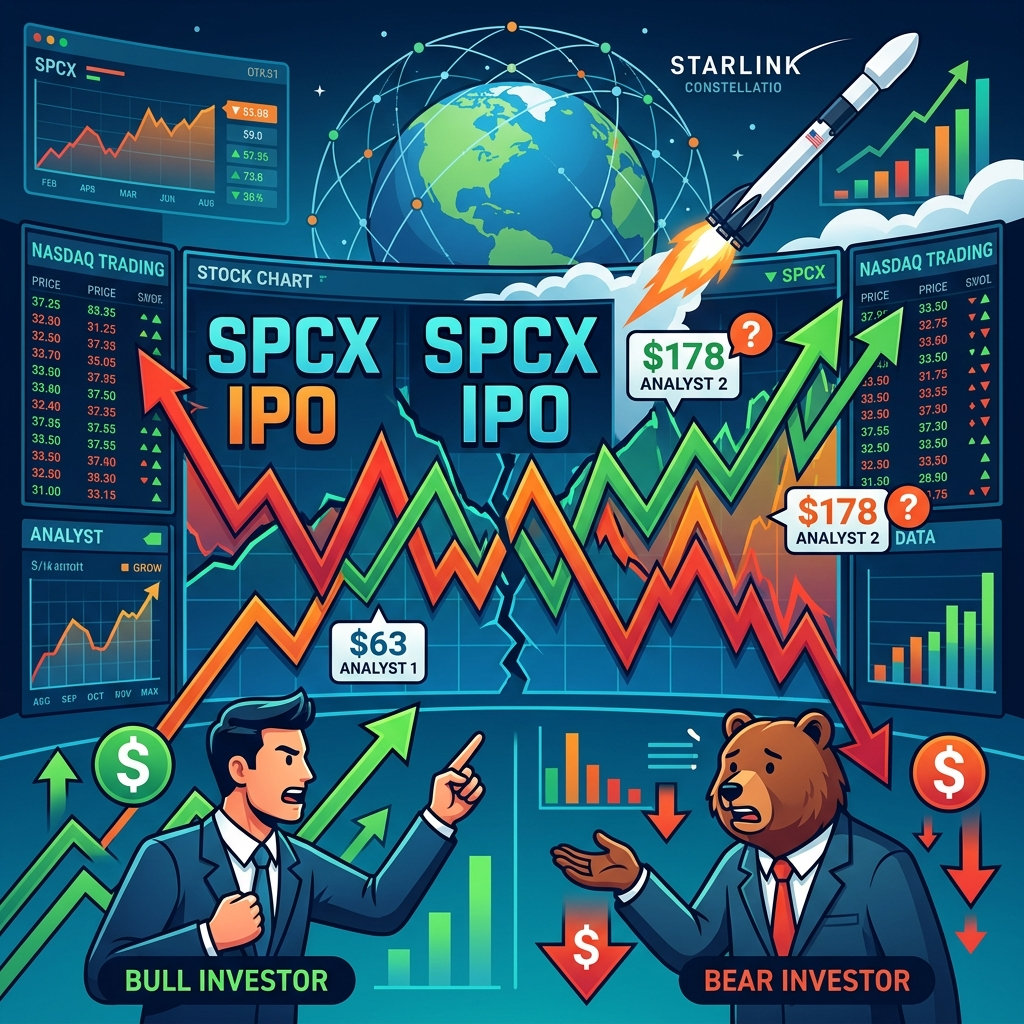
The spread between the most bearish and most bullish analyst targets on SpaceX is unlike anything currently seen on a major U.S. listed company: Morningstar's $63 fair value sits against Oppenheimer's $250 target, with a factor-of-four difference between them. Morningstar built its estimate using a probability-weighted DCF model that requires two unproven technologies — full Starship reusability and orbital data centers — to both succeed before 2028 for the optimistic scenario to materialize, and assigned that joint outcome only a 7% probability. CFRA issues a sell rating at $115, emphasizing over-dependence on Starship as a single point of execution failure. Wall Street consensus sits in the $156–$178 range. Wolfe Research targets $175, Oppenheimer raised its target to $250 after factoring in the Cursor acquisition, and KGI Securities lands at $227. NYU professor Aswath Damodaran produced an independent three-segment valuation arriving at $1.25–$1.3 trillion in enterprise value — itself 37% below the current $2.02 trillion market cap even after raising his AI revenue assumptions to $80–$160 billion. In my view, this $100-plus divergence is not primarily a disagreement about discount rates or terminal growth assumptions — it reflects a philosophical divide about whether SpaceX is a mature business with a calculable value or a generational vision requiring belief rather than a model.
Nasdaq 100 Inclusion and the Problem of Passive Buying Distorting Price Discovery
The confirmed July 7, 2026 addition of SpaceX to the Nasdaq 100 index has created a fascinating and deeply uncomfortable dynamic: mechanical forced buying at any price, entirely disconnected from anyone's assessment of the company's worth. The scale of this forced buying is significant. JP Morgan estimates $4.3 billion in passive inflows from Nasdaq 100 rebalancing alone, rising to $7.3 billion when Russell index rebalancing is included. SpotGamma takes a more expansive view, projecting immediate forced purchases of $22–$27 billion. The Invesco QQQ ETF alone tracks more than $500 billion in assets; at SpaceX's expected index weight of 0.47–0.70%, this translates into a mathematical certainty of multi-billion-dollar buying regardless of anyone's view on the business. Looking further out, S&P 500 inclusion — if and when it occurs — would add an estimated $8–$12 billion in additional passive inflows. The structural concern is that SpaceX's relatively limited public float means this concentrated buying could produce price movements that are disproportionate to the underlying demand signal, temporarily inflating the stock beyond levels that would otherwise be sustainable. The Tesla precedent is instructive and sobering: when it joined the S&P 500 in December 2020, the stock surged dramatically around inclusion and then declined approximately 75% from its peak over the following two years.
Positive & Negative Analysis
Positive Aspects
- Starlink's Dominant Monopoly and Explosive Subscriber Growth
Starlink currently operates more than 9,500 satellites in low Earth orbit, maintaining an effective monopoly on mass-market LEO satellite internet with no serious challenger in sight for the near term. The subscriber trajectory is remarkable: from 2.3 million in 2023 to 4.4 million in 2024, 8.9 million by end of 2025, and 10.3 million by March 2026 — a 4.5-fold increase in three years. Annual revenue has scaled correspondingly, from $7.7 billion in 2024 to $11.4 billion in 2025, with 2026 projected at $15.5 billion, representing 35%-plus year-over-year compounding. Amazon's Kuiper project has deployed only 153 satellites and remains years away from being a meaningful competitive alternative; OneWeb focuses on enterprise B2B markets and does not compete for Starlink's consumer and SMB base. The broader satellite internet market is forecast to exceed $40 billion by 2030, and Starlink enters that growth phase as the clear first mover with the largest constellation, the broadest geographic coverage, and an established brand. The 63% EBITDA margin demonstrates pricing power and operating leverage that few technology businesses achieve at this scale, and the SaaS-like recurring revenue model from 10.3 million monthly-paying subscribers provides substantial revenue visibility.
- $100.8 Billion Cash Position and Proven Capital Market Access
As of June 19, 2026, SpaceX holds $100.8 billion in cash and cash equivalents — a combination of IPO proceeds and prior cash balances that gives the company one of the largest single-entity cash reserves in corporate history. This position provides meaningful protection against short-term liquidity concerns despite the current negative free cash flow burn rate of approximately $36 billion annually. Even at that aggressive pace of cash consumption, the company has roughly three years of runway before requiring additional capital raises under a conservative scenario. More importantly, SpaceX has already demonstrated that it can access investment-grade debt markets at favorable terms: the June 2026 $25 billion bond offering attracted $89.1 billion in orders — nearly 3.6 times oversubscribed — confirming that institutional credit markets view SpaceX as a credible borrower. Future capital needs can be met through additional bond issuances, secondary equity offerings, or asset-level financing for Starlink on a standalone basis, all at reasonable cost of capital given demonstrated investor demand. The combination of substantial cash reserves and proven capital market access significantly reduces the risk of a funding crisis even as the company continues to invest heavily in Starship development and xAI infrastructure.
- Structural Demand Boost from Nasdaq 100 Inclusion and Index Flows
The July 7, 2026 Nasdaq 100 inclusion creates a sustained structural demand improvement for SpaceX shares that operates independently of any fundamental business development. The Nasdaq 100 is tracked by approximately $1.4 trillion in assets under management, with the QQQ ETF alone accounting for more than $500 billion. At an expected index weight of 0.47–0.70%, the initial rebalancing purchase requirement runs to tens of billions of dollars regardless of anyone's view on SpaceX's intrinsic value. JP Morgan's $4.3 billion near-term estimate and SpotGamma's $22–$27 billion estimate bracket the likely range of forced buying, with the true figure dependent on the final assigned weight and the speed of institutional rebalancing. Beyond the initial inclusion, every subsequent net inflow into Nasdaq 100-tracking funds will generate proportional incremental SpaceX purchases in perpetuity. Future S&P 500 inclusion could drive an additional $8–$12 billion in forced buying. This structural demand floor does not substitute for fundamental value creation, but it meaningfully reduces the probability of a disorderly downside move in the near and medium term.
- Irreplaceable Position in the Global Space Launch Market
SpaceX's Falcon 9 and Falcon Heavy rockets have reshaped the global launch industry through reusability, achieving dominant market share across commercial, civil, and national security satellite deployment. NASA, ESA, and essentially every private company with large satellite constellation ambitions rely on SpaceX as their primary or backup launch provider. The 2025 rocket launch division revenue of $4.09 billion is currently loss-making, but this reflects massive ongoing investment in Starship development rather than structural unprofitability in the underlying launch business. If Starship achieves full and rapid reusability, per-kilogram launch costs fall by an order of magnitude from current Falcon 9 pricing — a transformation that would make existing competitors structurally uncompetitive and dramatically expand SpaceX's own Starlink constellation economics. No other company currently operating has demonstrated anything close to SpaceX's launch cadence, reusability track record, or development velocity. The long-duration optionality embedded in the space launch business — covering orbital manufacturing, lunar logistics, Mars colonization, and space-based computing — is genuinely without precedent in any other publicly traded company.
Concerns
- Mass xAI Co-Founder Departure and Deep AI Business Uncertainty
The complete departure of all 11 xAI co-founders between February 2025 and March 2026 is without precedent in the modern history of major AI organizations and cannot be explained away as normal talent attrition. These were senior researchers from Google DeepMind, OpenAI, and Microsoft — the exact profiles that define technical capability at leading AI labs — and they left in a concentrated window immediately following the SpaceX merger. The Next Web's reporting identifies a fundamental cultural incompatibility as the cause: xAI was built as a research organization, and SpaceX operates as an execution-first engineering machine; the merger imposed one culture on the other without apparent resolution. Elon Musk openly acknowledged that xAI was not built right, and Reid Hoffman called it a complete train wreck in a Fortune interview, adding that the organization is now on its third attempted rebuild. The Grok model family has not meaningfully closed the benchmark gap against OpenAI's GPT-4o or Anthropic's Claude. The $6.35 billion in 2025 operating losses and $2.47 billion in Q1 2026 alone represent a staggering capital burn for a business that has not demonstrated product-market leadership in any AI segment. The $60 billion Cursor acquisition reads less like a strategic opportunity and more like a panicked attempt to purchase market relevance that xAI could not create organically.
- Deepening Free Cash Flow Deficit and Five Years to Breakeven
SpaceX's most serious financial vulnerability is its pace of cash consumption, and the trajectory is not improving. The 2025 full-year free cash flow was negative $13.8 billion. Q1 2026 alone produced negative $9.1 billion in free cash flow — $1 billion in operating inflows overwhelmed by $10.1 billion in capital expenditures. Annualizing Q1 2026 implies a pace of negative $36 billion annually, a rate at which even $100.8 billion in cash lasts only about three years without additional capital raises. Goldman Sachs does not forecast positive consolidated free cash flow until 2031 — five years from today. The simultaneous capital demands are substantial: Starship development is an open-ended program requiring continuous billion-dollar investment; xAI's compute infrastructure needs significant expansion to remain competitive with OpenAI and Anthropic; and the Cursor acquisition integration will require additional resources over multiple years. The market is increasingly sensitive to this cash burn dynamic, which is exactly why the June 22 bond offering announcement triggered such a violent equity sell-off: investors understood that the IPO windfall was not going to last. Any deterioration in Starlink's growth rate or delay in Starship commercialization risks accelerating the timeline to the next mandatory capital raise.
- Historical Overvaluation Risk at 141x Trailing Revenue
SpaceX's current price-to-sales ratio of 141x on 2025 revenue is not just elevated by normal technology sector standards — it is extraordinary by any valuation framework applied to any publicly traded company. The aerospace sector trades at an EV/EBITDA of 13.81x. The internet services sector averages 14.56x EV/EBITDA. The broad technology sector averages 21.42x. Cloudflare, considered a high-growth premium SaaS company, was viewed as richly priced at 30x P/S during its IPO — SpaceX is trading at nearly five times that multiple. Even on forward 2026 estimated revenue, the P/S ratio is approximately 78x. The combined market capitalization of the top 20 publicly traded space companies is $2.2 trillion less than SpaceX alone. Damodaran, who raised his AI revenue assumptions materially in his latest analysis, still concluded the current stock price is not justified by any reasonable set of assumptions. Valuation multiples of this magnitude require sustained revenue growth rates above 30% annually for many years while simultaneously achieving meaningful improvements in profitability. Any disappointment could trigger rapid and severe compression of the multiple, with a 55–70% decline implied by a re-rating toward sector-comparable P/S levels between 25–35x.
- Strategic Questions Around the $60 Billion Cursor Acquisition
The acquisition of Anysphere — maker of the Cursor AI coding assistant — for $60 billion in all-stock consideration, announced just five days after the IPO, raises strategic questions that become more pressing the more closely you examine them. The immediate concern is Cursor's trajectory: market share data from Ramp's corporate card spending analytics shows a decline from 41% in June 2025 to 26% by May 2026, a meaningful trend in the wrong direction. Paying a record price — the largest VC-backed startup acquisition in history — for a product with declining market share is an unusual strategic posture that suggests defensive motivation rather than offensive opportunity. The investment thesis rests on a synergy argument: xAI's compute infrastructure combined with Cursor's developer distribution creates a powerful AI coding platform that neither could build alone. That logic is coherent in theory, but the execution risk is severe. Successfully integrating a $60 billion acquisition requires organizational stability, clear leadership, and shared technical vision — precisely the qualities that are most uncertain in an xAI that has lost every one of its founding co-founders and is on its third leadership rebuild. Hoffman's characterization of xAI as a premium CoreWeave — essentially a compute rental business — suggests the market views xAI as lacking genuine AI product differentiation, making the Cursor acquisition look like a subscription to someone else's roadmap rather than an expression of internal capability.
Outlook
Let me walk through how I see this playing out across three time horizons: near-term (one to six months), medium-term (six months to two years), and long-term (two to five years). For each horizon I will sketch a bull, base, and bear scenario, because the range of plausible outcomes here is genuinely extreme and the honest answer is that very smart people disagree by enormous margins on what this company is worth.
The biggest near-term catalyst is the Nasdaq 100 inclusion on July 7, 2026. The mechanics are worth understanding precisely. JP Morgan estimates $4.3 billion in passive inflows from the Nasdaq 100 change alone, rising to $7.3 billion when Russell index changes are included. SpotGamma goes considerably further, estimating immediate forced buying in the $22–$27 billion range. The QQQ ETF alone tracks more than $500 billion in assets; at SpaceX's expected index weight of 0.47–0.70%, the math produces a certainty of multi-billion-dollar forced purchasing irrespective of any investor's view on business fundamentals. The complicating variable is SpaceX's relatively low public float — when that scale of forced buying converges on constrained available supply, the price impact can be disproportionately large in the short run.
In the near-term bull case, index inclusion mechanics drive the stock back toward $180–$200, particularly if $27 billion in passive buying hits a thin float. A Q3 2026 earnings surprise — Starlink subscriber growth beating estimates or xAI's quarterly losses beginning to visibly narrow — would add further momentum. In the base case, the inclusion effect is already substantially priced in, and SPCX drifts sideways in a $155–$175 range as the mechanical event fades and fundamental questions reassert themselves. In the bear case, the opening of options trading introduces a wave of institutional short sellers whose positioning offsets passive buying pressure, potentially retesting the $135 IPO price support level or lower.
Tesla's December 2020 S&P 500 inclusion offers the most relevant historical precedent here, and it is sobering. The stock surged sharply in the weeks around inclusion and then spent the following two years falling roughly 75% from its peak. Index inclusion is a mechanical event, not a valuation endorsement. The investors who bought Tesla because index funds had to are mostly not happy about it. QQQ holders will own SpaceX whether they want to or not, and that is structurally different from choosing to buy based on a view on the company's worth.
Moving to the medium term, three variables will dominate the narrative: Starlink's growth trajectory, xAI's ability to narrow operating losses, and Starship's commercial progress. On Starlink, the fundamentals remain the strongest part of the SpaceX story by far. The subscriber base is forecast to grow from 10.3 million today to 16.8 million by end of 2026, with revenue scaling from $11.4 billion to $15.5 billion — approximately 36% year-over-year growth. The global satellite internet market is projected to exceed $40 billion by 2030, and for now Starlink is the only fully operational mass-market option. Amazon's Kuiper has just 153 satellites deployed, making it a serious future threat but not a present-day competitive reality. The medium-term key risk on Starlink is whether Kuiper reaches meaningful scale in 2027–2028 and initiates a pricing war that compresses the current 63% EBITDA margin; Starlink's current ARPU of $65 is vulnerable to any sustained pricing pressure.
On xAI, the medium-term story depends almost entirely on the Cursor acquisition. SpaceX paid $60 billion for Anysphere just five days after its IPO, which I read as a defensive acknowledgment that xAI could not build a leading AI coding tool organically. The problem is that Cursor's market share, measured by Ramp corporate card spending data, has already declined from 41% in June 2025 to 26% by May 2026. That is a premium price for a declining asset, with the investment thesis that combining xAI's compute infrastructure with Cursor's distribution creates a powerful compound platform. The logic is theoretically coherent, but successfully integrating a $60 billion acquisition inside an organization from which all 11 co-founders have already departed is not a trivial execution challenge. Reid Hoffman's description of xAI as essentially a "premium-priced CoreWeave" — a GPU rental business dressed up as an AI company on its third rebuild — is a critique that deserves serious weight. In the medium-term base case, quarterly xAI losses narrow from $2.47 billion toward $2–$3 billion, but profitability remains out of reach.
Looking out two to five years, SpaceX's ultimate fate hinges on Starship. If the vehicle achieves full and rapid reusability, per-kilogram launch costs fall by an order of magnitude, making Starlink satellite deployment dramatically cheaper, and opening the door to orbital data centers, space-based manufacturing, and eventually crewed Mars missions. In this scenario, Morningstar's 7%-probability bull case becomes a reality and the company's true total addressable market approaches SpaceX's own stated estimate of $1.6 trillion rather than the $129 billion external consensus. Morgan Stanley and Goldman Sachs project 2028 revenue as high as $160 billion under this scenario; at a 30% free cash flow margin, that implies a market cap well above $3 trillion and a stock price of $250–$310. I put the probability of this outcome at 15% or lower. The historical precedent is uncomfortable: Cisco in the early 2000s traded at P/S multiples above 30x on the logic of internet infrastructure dominance before falling 80%; SpaceX's current P/S of 141x is more than four times higher than Cisco's peak.
In the long-term base case, Starlink grows steadily, xAI losses gradually diminish but overall company free cash flow remains negative, and Starship achieves partial commercialization on a delayed timeline. Market cap settles in the $1.8–$2.2 trillion range, implying a stock price between $135 and $175 — roughly the midpoint between Damodaran's $1.25–$1.3 trillion independent assessment and the current level. In the bear case, annual revenue growth decelerates below 30%, and the current forward P/S of approximately 78x compresses toward 25–35x as the market re-rates SpaceX closer to comparable technology businesses. That multiple compression implies a market cap of $600–$900 billion, a 55–70% decline from current levels, and is consistent with Morningstar's per-share target of $63. The simultaneous occurrence of growth deceleration, Starship delays, Kuiper competitive entry, and regulatory pressure on Starlink's spectrum rights could realistically produce this outcome.
Several counterarguments deserve honest engagement before I close. The cash argument is legitimate in the short term: SpaceX holds $100.8 billion in cash as of June 19, 2026, and its proven access to investment-grade credit markets at tight spreads means raising capital is not an existential concern. With quarterly free cash flow running at negative $9.1 billion — or roughly negative $36 billion annually — the math suggests approximately three years before additional capital infusions become necessary, though the company could raise that capital at reasonable cost given demonstrated bond demand. The Nasdaq 100 inclusion argument also has genuine near-term validity: the forced buying dynamic is real, mathematical, and will happen regardless of views on fundamentals. And the Starlink-as-standalone-value argument is sincere — a satellite internet near-monopoly with 63% EBITDA margins and SaaS-like recurring revenue is genuinely exceptional. But even assigning Starlink a generous satellite communications premium on a standalone basis falls well short of justifying a $2 trillion total enterprise value once xAI's ongoing losses and the rocket division's capital intensity are properly accounted for.
The broader market implication of SpaceX's trajectory extends far beyond this one name. The largest IPO in history either validates or fatally discredits the "vision premium" framework that has powered an entire generation of cash-burning moonshot companies. If SpaceX sustains a $2 trillion valuation, it creates a template — and an aspiration — for every other company with a grand narrative and deeply negative free cash flow. If it compresses toward fundamental value, the recalibration of expectations for similar companies will be swift and significant across the entire growth equity landscape. The outcome of the world's largest IPO will set the benchmark for how markets price ambition versus cash flow for years to come.
For individual investors, the clearest near-term opportunity is around the July 7 index inclusion — but recognize that is a bet on index mechanics, not business value. The rational entry point for a long-term position is after Q3–Q4 2026 earnings confirm whether xAI losses are meaningfully narrowing and whether Cursor is reversing its market share decline. The most defensible long-term entry, in my view, is when FCF-positive becomes foreseeable and Starship commercialization is tangibly visible — likely 2029–2030 at the earliest. By then, the uncertainty premium will be substantially reduced, and you will know whether you are buying the greatest space company in history at a fair price or a satellite internet company wrapped in rocket mythology at 141 times sales. This article is for informational purposes only and does not constitute investment advice. All investments carry the risk of capital loss, and past performance is not indicative of future results. Every investment decision should be made based on your own judgment and at your own risk.
Sources / References
- SpaceX Raises $85.7B in Record-Setting IPO Ahead of Nasdaq Debut — CNBC
- SpaceX IPO Day One Live Updates — CNBC
- SpaceX Investor Relations — Announces Pricing of $25 Billion Inaugural Bond Issuance — SpaceX IR
- SEC — SpaceX S-1 Registration Statement, Full Financial Statements — U.S. Securities and Exchange Commission
- SpaceX Stock Falls 31%, Analyzing the $20 Billion Bond Offering — TradingKey
- Damodaran on Finance — Revisiting the SpaceX Valuation: A Fresh Look — Damodaran Substack
- All xAI Co-Founders Have Departed as Musk Rebuilds Under SpaceX — The Next Web
- Reid Hoffman on SpaceX, Musk, OpenAI, and Anthropic — Fortune
- SpaceX Added to Nasdaq 100 — CNBC
- SpaceX IPO and Index Changes: Passive Flow Analysis — SpotGamma
- SpaceX Acquires Cursor Maker Anysphere for $60 Billion — CNBC
- Starlink Revenue 2025-2026: Subscriber Count, ARPU, and Path to Profitability — ValueAdd VC
- The $2 Trillion Question: Can SpaceX's IPO Valuation Possibly Make Sense? — Wall Street Prep