
Micron Crashed 30% After a 196% Revenue Surge — But Google Isn''t the Real Culprit
Summary
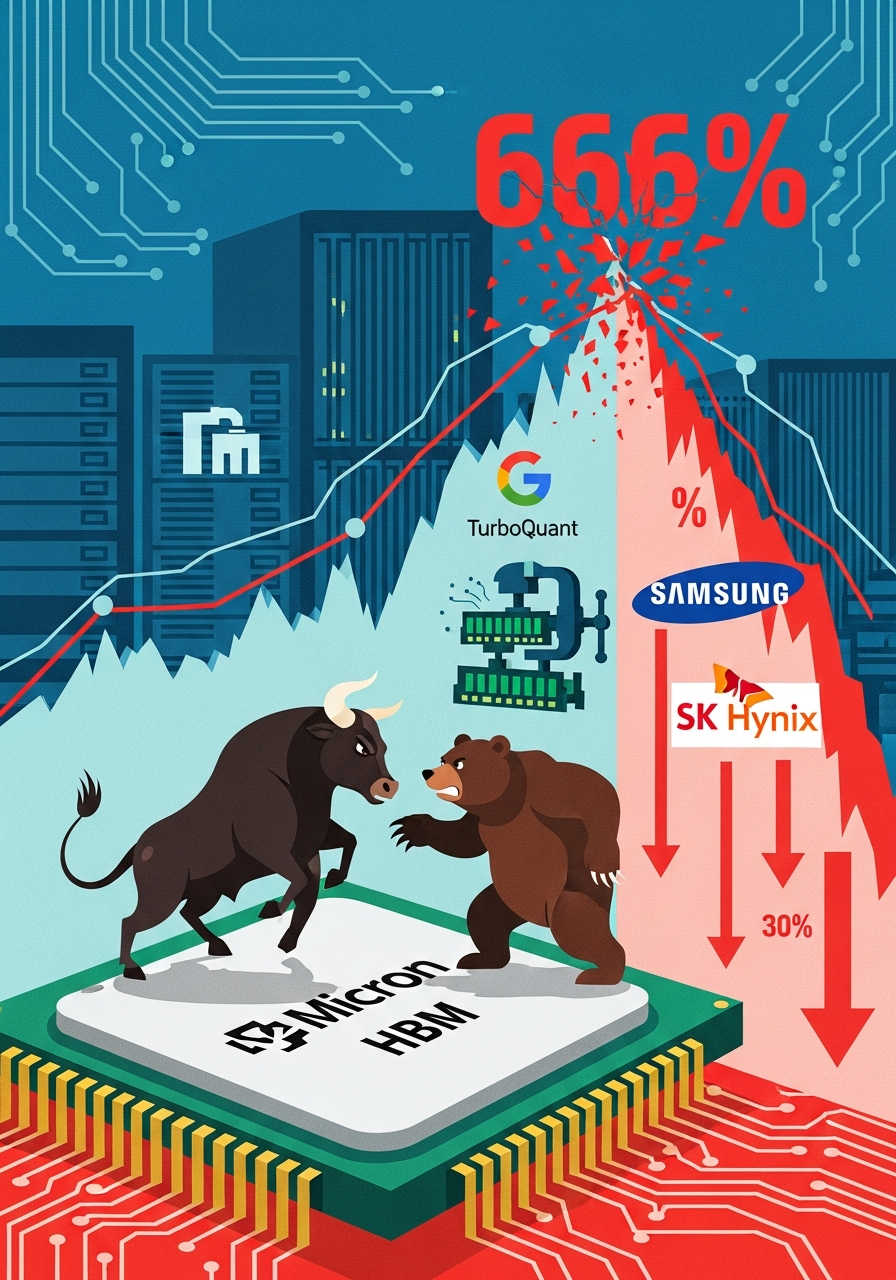
Micron delivered a historic quarter with 196% revenue growth and EPS that crushed estimates, yet the stock plunged 30%. Google''s TurboQuant is being blamed for threatening memory demand, but the real culprit behind the unraveling of a 666% rally lies elsewhere.
Key Points
The Paradox of a 30% Crash Despite Record-Shattering Earnings
Micron posted $23.86 billion in revenue for Q2 FY26, a staggering 196% increase from $8.05 billion in the year-ago quarter. Earnings per share came in at $12.20, crushing the Street estimate of $8.81 by over 38%. Yet the market responded to this flawless report card by hammering the stock down 30%. This was never about the earnings being disappointing — it was about the 666% rally from the April 2025 low creating a level of expectations that no results, no matter how spectacular, could satisfy. The market demanded perfection-plus from Micron, and even a historic quarter fell short of that impossible bar. In the end, this crash was not a failure of fundamentals but a failure of expectations.
What TurboQuant's 6x Compression Actually Means
Google's TurboQuant is a quantization technique that compresses AI model memory usage by up to 6x, and its announcement sent the market into a panic over collapsing memory demand. But this reaction fundamentally misunderstands the technology. Quantization has been used across the AI industry for years, and TurboQuant is an incremental improvement along that same trajectory, not a paradigm shift. More importantly, when memory efficiency improves, the barrier to AI adoption drops — small and mid-sized businesses that previously could not afford the memory costs can now enter the market. This is the Jevons Paradox in action: total memory consumption is more likely to increase, not decrease. Historically, every time GPU efficiency improved, the size and complexity of AI models grew even faster in response.
The Structural Resilience of the HBM Supercycle
The HBM (High Bandwidth Memory) market is projected to reach $54.6 billion in 2026, representing 58% year-over-year growth. Micron has already sold out its entire 2026 HBM production allocation, and SK Hynix and Samsung are in a similar position. Unlike commodity DRAM, HBM is a high-value-added product that is physically required in AI accelerators, driven by demand factors entirely separate from software optimizations like TurboQuant. NVIDIA's next-generation Blackwell GPUs, AMD's MI400 series, and even Google's own TPU v6 all require significantly more HBM per unit than their predecessors. The hardware upgrade cycle proceeds regardless of software efficiency gains, and in fact, more powerful hardware enables more complex software in a virtuous cycle.
The Psychology of Profit-Taking After a 666% Rally
A 666% gain from the April 2025 low is, by itself, a window into the extremes of investor psychology. At that level of appreciation, virtually no positive catalyst can sustain further upside, while even a minor negative headline can trigger a massive wave of selling. TurboQuant simply served as that trigger — the match that lit an already-soaked fuse. This is a textbook case of the disposition effect and loss aversion operating simultaneously, as behavioral finance would predict. Early investors were desperate to lock in enormous unrealized gains, while those who entered mid-rally panicked at the sight of their profits eroding. The fact that Samsung, SK Hynix, and Western Digital all crashed in sympathy confirms that a sector-wide profit-taking domino was already primed to fall.
Structural Vulnerabilities Exposed in the Global Memory Ecosystem
The fact that a single stock's crash dragged Samsung Electronics, SK Hynix, and Western Digital down in chain-reaction fashion reveals just how tightly interconnected the memory semiconductor ecosystem really is. These three companies control over 95% of the global DRAM market, which means a shift in sentiment toward any one of them immediately cascades into a sector-wide valuation reset. This episode particularly exposed the fragility of a sector that had become overly reliant on the AI semiconductor narrative. However, that same structural tightness cuts both ways — the oligopoly's pricing power, sky-high barriers to entry, and the still-intact structural growth driver of AI mean that when sentiment does recover, the rebound will carry equally powerful momentum.
Positive & Negative Analysis
Positive Aspects
- Record Earnings That Prove the Fundamentals Are Intact
Micron''s Q2 FY26 revenue of $23.86 billion and EPS of $12.20 are historically unprecedented numbers. Revenue growth of 196% year over year signals that memory semiconductor demand is in a structural growth phase, not just a cyclical uptick. A stock decline accompanied by this level of fundamental improvement can be interpreted as a healthy process of valuation decompression. Once the market reprices the stock on an earnings basis rather than a narrative basis, current levels could represent a compelling entry point for medium- to long-term investors.
- Fully Sold-Out HBM Guaranteeing Revenue Visibility
The fact that Micron''s entire 2026 HBM production is already sold out effectively means revenue for at least the next year is locked in. This provides the most important thing investors look for: earnings predictability. Long-term supply agreements with AI accelerator manufacturers create a fundamentally different and more stable revenue structure compared to the spot-market volatility of commodity DRAM. Given the AI investment roadmaps of NVIDIA, AMD, Google, and Microsoft, there is a strong probability that even 2027 HBM volumes will be pre-sold ahead of schedule.
- The Jevons Paradox Points to Demand Expansion, Not Contraction
Efficiency technologies like TurboQuant are more likely to expand memory demand than shrink it. Historically, every improvement in computing efficiency has led to faster growth in computing usage. When cloud costs declined, the cloud market exploded. The same principle applies here: if memory efficiency improves 6x, the flood of enterprises and individuals who previously could not afford AI adoption will enter the market, driving total memory consumption higher. This is precisely the mechanism that 19th-century economist Jevons documented when steam engine efficiency improvements caused coal consumption to surge rather than decline.
- Pricing Power of the Memory Oligopoly
Samsung Electronics, SK Hynix, and Micron collectively control over 95% of the global DRAM market. This oligopolistic structure acts as a natural mechanism preventing oversupply. In past memory downturns, coordinated production cuts by the Big Three have successfully managed price declines. The HBM market is even more concentrated — it is effectively a duopoly between SK Hynix and Micron, with even higher technical barriers to entry. This translates to even stronger pricing power and margin protection in the segment that matters most for future growth.
- Structural Expansion of AI Infrastructure Investment
Global hyperscaler capital expenditure is projected to reach approximately $700 billion in 2026, with roughly $450 billion directed specifically toward AI infrastructure. The capex plans of Microsoft, Google, Amazon, and Meta have not been revised downward in any way since the TurboQuant announcement. This confirms that the primary demand driver for AI memory is hardware expansion, not software efficiency. The data center construction pipeline alone virtually guarantees rising memory demand for the next three to five years.
Concerns
- The Latent Risk of AI Infrastructure Investment Deceleration
While hyperscaler AI spending continues to expand, a failure to achieve satisfactory return on investment could trigger a pullback. Some Wall Street analysts are already warning about potential AI capex fatigue. If AI service monetization cannot keep pace with the rate of investment, the growth trajectory of memory demand could flatten sharply. The dot-com bubble offers a cautionary precedent — massive overinvestment in fiber optic infrastructure in 2000 contributed directly to the prolonged bust that followed.
- Persistent Geopolitical Risks
Escalating tensions across the Taiwan Strait, the intensifying US-China semiconductor war, and Middle East instability tied to Iran all pose threats to the entire memory semiconductor industry. Micron generates significant revenue from China and has already been subjected to one round of sanctions through a Chinese cybersecurity review. If US export restrictions on China tighten further, Micron''s market access could be additionally constrained, throwing cold water on the otherwise rosy HBM outlook.
- Uncertainty Around the Pace of Technological Change
TurboQuant may be just the beginning. Beyond quantization, a range of memory-reducing technologies — sparsity, knowledge distillation, neuromorphic computing — are advancing simultaneously. If any one of these achieves a revolutionary breakthrough, it could produce genuine demand destruction where the Jevons Paradox fails to operate. The fact that big tech companies like Google and Meta are investing heavily in memory cost reduction is a long-term headwind that memory makers cannot afford to ignore.
- Potential for Further Decline as Valuation Normalizes
Even after a 30% correction from the 666% rally, Micron''s valuation may still sit above its historical average. Memory semiconductors are notorious for the valuation trap at cycle peaks — P/E ratios look deceptively low when earnings are at their cyclical highs. If current elevated profits turn out to be a temporary peak rather than a new baseline, there is room for the stock to fall further even at seemingly attractive multiples. Past memory cycles have seen stocks decline an additional 50% or more after earnings peaked.
- The Memory Sector''s Excessive Dependence on the AI Narrative
The current valuation of the memory semiconductor sector leans heavily on the AI growth story. Traditional memory demand from PCs, smartphones, and conventional servers remains in a tepid recovery, and the share of AI in total revenue may be overestimated by the market. If the AI narrative weakens for any reason, multiple contraction could occur regardless of actual changes in fundamentals. The chain-reaction sell-off in Samsung and SK Hynix when Micron crashed already demonstrated the vulnerability of this narrative dependence.
Outlook
Let me start with what is likely to happen to Micron''s stock over the next few months. To be blunt, short-term volatility is going to be brutal. The extreme whipsaw from a 666% rally to a 30% crash lays bare the fact that market participants are in a state of acute psychological instability, and in that kind of environment, virtually any headline can trigger outsized reactions in either direction. I expect Micron to chop between roughly $80 and $120 until the next earnings report, which is scheduled for June 2026. The options market backs this up — implied volatility is currently sitting above the historical 90th percentile, which tells you that even the derivatives market is pricing in wild swings from here.
There is also a cascade effect that deserves close attention in the near term. Micron''s crash dragged Samsung Electronics down 15%, SK Hynix down 18%, and Western Digital down 22%, effectively vaporizing roughly $200 billion in combined market capitalization across the memory sector. A drawdown of that magnitude triggers forced portfolio rebalancing among institutional investors, which in turn creates additional selling pressure in a self-reinforcing loop. That said, history shows that when an entire sector sells off in lockstep like this, the recovery tends to be just as synchronized. Once a floor is established, the snap-back rally could be substantial.
For the TurboQuant narrative to fully wash out of the market, investors need at least one or two more quarters of hard earnings data. The market wants to see in cold numbers whether HBM demand actually took a hit from TurboQuant. I believe those numbers, when they arrive, will confirm that memory demand not only held up but actually increased. The reasoning is straightforward: NVIDIA''s Blackwell platform requires more than double the HBM capacity compared to the previous-generation Hopper, and volume shipments of these GPUs kick off in the second half of 2026. No amount of software optimization changes the fact that when hardware physically demands more memory per unit, aggregate demand rises.
There is one more critical near-term variable that could settle this debate sooner. Micron''s already-published Q3 FY26 guidance points to quarterly revenue of $33.5 billion (plus or minus $750 million), gross margins of approximately 81%, and EPS of $19.15 (plus or minus $0.40) — all record figures that handily surpass prior Wall Street consensus. This guidance amounts to an official rebuttal of TurboQuant fears. With HBM volumes already sold out for the full year, the fact that revenue guidance actually surged higher rather than declining demonstrates that memory demand is structurally strong, not crumbling under the weight of a compression algorithm.
Moving to the medium-term outlook of six months to two years, the picture shifts considerably. This period will mark an acceleration of structural transformation across the memory semiconductor industry. The single biggest catalyst is the full-scale ramp of HBM4. Compared to today''s HBM3E, HBM4 delivers double the bandwidth and at least 1.5 times the capacity, with per-unit pricing expected to exceed $200 — roughly three to four times the HBM3E price point. If Micron manages to close or reverse its technology gap with SK Hynix in HBM4, the resulting revenue mix improvement could push the company''s margins to an entirely new tier.
Whether AI infrastructure spending holds up is the central question for the medium term. Combined capital expenditure from the four major hyperscalers — Amazon, Google, Microsoft, and Meta — is projected at approximately $700 billion for 2026, with roughly $450 billion flowing directly into AI infrastructure. Goldman Sachs estimates that cumulative hyperscaler capex from 2025 through 2027 will exceed $1.15 trillion. Breaking that down, Amazon plans roughly $200 billion, Google $175 to $185 billion, Microsoft north of $120 billion, and Meta between $115 and $135 billion. A huge chunk of this money goes into data center servers, and every server needs memory. Even if TurboQuant squeezes more efficiency out of each gigabyte, when the total fleet of servers is expanding by double-digit percentages year over year, total memory consumption does not decline.
The supply side of the equation reinforces the supercycle thesis just as powerfully. Samsung Electronics has set its 2026 semiconductor capex at roughly $20 billion — an 11% year-over-year increase — with the bulk going toward 1C-process HBM production and P4L wafer capacity expansion. SK Hynix''s board approved an additional $15 billion investment targeting M15X fab expansion, bringing its annual capex to approximately $20.5 billion, a 17% increase year over year. Micron itself has lifted 2026 capex above $25 billion, concentrating on new fabs in Idaho and New York. Combined, these three companies are spending over $60 billion a year on capacity expansion. If TurboQuant truly threatened to shrink memory demand, there is no rational reason for these firms to be pouring tens of billions of dollars into new fabs. Their capital allocation decisions speak louder than the market''s panic.
The broader semiconductor ecosystem''s response to TurboQuant is also telling. On an investor call shortly after the TurboQuant announcement, NVIDIA drew a clear line: memory efficiency improvements are a prerequisite for expanding AI workloads, not a headwind for HBM demand. AMD made no changes to its plans to ship HBM4 as standard on the MI400 series. Intel, paradoxically, used the moment to signal it would accelerate its own push into the HBM market — a move that, if anything, validates HBM''s growth potential rather than undermining it. When the companies that actually design and manufacture the hardware unanimously say memory demand is not declining, then perhaps the market that panicked over a single software optimization was the irrational actor in the room.
This is where the Jevons Paradox warrants a deeper dive. In the 19th century, economist William Stanley Jevons dismantled the popular assumption that more efficient steam engines would reduce coal consumption. His core argument was that when efficiency improves, the number of industries adopting the technology multiplies, and total consumption surges rather than falls. This maps precisely onto AI memory. If TurboQuant allows an inference workload that once required eight A100 GPUs to run on just two, companies will not pocket the savings and call it a day — they will redeploy those freed-up resources into more AI services, larger models, and entirely new use cases. The evidence is already there: AI API pricing has fallen more than 90% since 2024, yet API call volumes have exploded by more than 100x over the same period. When the cost of something drops, people use vastly more of it. That is not speculation — that is what the data shows, and it is exactly the dynamic Jevons described nearly two centuries ago.
Another factor that will loom increasingly large over the medium term is the rise of edge AI. As artificial intelligence begins running locally on smartphones, vehicles, robots, and IoT devices rather than in distant data centers, the memory capacity required per device increases dramatically. Qualcomm''s latest Snapdragon processor requires a minimum of 16GB LPDDR5X for on-device AI capabilities — double the premium smartphone standard from just two or three years ago. In the automotive world, a single vehicle targeting Level 4 autonomous driving is projected to carry 256GB or more of memory. When you multiply that by billions of edge devices being deployed worldwide, it creates an entirely separate pool of massive memory demand that has nothing to do with data center HBM.
The long-term outlook — two to five years out — is where things get genuinely fascinating. I project the global memory semiconductor market will expand from its current $150 billion scale to north of $250 billion over this horizon. And this is not just an AI story. AI, edge computing, autonomous driving, robotics, AR/VR, and quantum computing auxiliary systems are all emerging simultaneously as memory-hungry applications. The humanoid robot market in particular could be transformative: when that sector begins scaling in earnest around 2028, each robot will require hundreds of gigabytes of memory for real-time perception, planning, and motor control. Picture a future in which millions of humanoid robots from Tesla Optimus, Figure AI, and 1X NEO are rolling off production lines — memory demand in that scenario goes parabolic.
Micron''s evolving business portfolio also matters enormously in the long run. Today, HBM accounts for roughly 25% of Micron''s revenue. By 2028, that share is projected to climb above 40%. Because HBM carries operating margins two to three times higher than conventional DRAM, even modest shifts in revenue mix translate into outsized profitability improvements. On top of that, the commercialization of next-generation CXL (Compute Express Link) memory pooling technology could fundamentally reshape data center memory architecture, opening an entirely new growth vector for pure-play memory companies like Micron.
Now let me lay out the scenarios. In the most bullish case, Micron''s stock breaks through $200 by late 2027, setting fresh all-time highs. The preconditions are AI infrastructure investment sustaining 30%-plus annual growth, Micron capturing technology leadership in HBM4, and efficiency technologies like TurboQuant actually accelerating the democratization of AI so that total memory demand overshoots forecasts. I assign roughly a 30% probability to this outcome. The simultaneous ramp of NVIDIA Blackwell Ultra and AMD MI400 could serve as the catalysts that ignite explosive HBM demand.
The base case — and in my view the most probable path at roughly 50% — sees Micron''s stock grinding higher to the $140 to $160 range by mid-2027. In this scenario, the TurboQuant overhang dissipates within one to two quarters as earnings data confirms continued demand strength. The HBM market grows broadly in line with projections, though some competitive intensification from Samsung''s catch-up efforts may pressure margins at the edges. AI infrastructure investment keeps growing but the rate of acceleration moderates somewhat. This is the most realistic trajectory as I see it.
The bear case, however, carries risks that no one should dismiss. If AI capex fatigue materializes — if hyperscalers start questioning the ROI on their colossal spending and begin pulling back — while geopolitical flashpoints (a Taiwan Strait crisis, a sharp escalation of the US-China semiconductor war) simultaneously ignite, Micron could slide into the $80 to $100 range. If a truly revolutionary memory-reduction technology emerges beyond TurboQuant — something that breaks the Jevons Paradox and causes genuine demand destruction — the memory supercycle itself could end prematurely. I put this scenario at roughly 20% probability. Even in this downside case, though, Micron''s raw fundamentals (annualized revenue north of $90 billion) would put a floor under the stock, making a 2008-style total collapse unlikely.
A final word for anyone reading this. If the 30% drop has you rattled, take a step back and look at the full picture. This is a company that transformed itself from an $8 billion quarterly revenue business to a $24 billion one in the span of a single year. One compression algorithm does not unwind a fundamental shift of that magnitude. Yes, a 30% haircut after a 666% run-up stings if you were trading the momentum, but for anyone with a one-to-two year horizon, this kind of correction is how you get a rational entry price into a secular growth story. One important caveat: do not go all-in. Between geopolitical tail risks and the inherent volatility of AI investment cycles, dollar-cost averaging is the smart play here. If the stock still has not recovered after the market fully processes the TurboQuant scare, then my thesis is wrong and you should reassess quickly. But sitting here today, I remain firmly convinced that the correction of a 666% rally does not mark the death of the memory supercycle.
Sources / References
- Micron Technology Reports First Quarter Fiscal 2026 Results — Micron IR
- Google Unveils TurboQuant AI Memory Compression Algorithm — TechCrunch
- HBM Market to Reach $54.6 Billion in 2026, Up 58% YoY — TrendForce
- Micron Shares Plunge Despite Record Earnings on TurboQuant Fears — Reuters
- Memory Chip Stocks Tumble as Google AI Compression Sparks Demand Concerns — Bloomberg
- The Unvarnished Truth About Google's TurboQuant: Jevons Paradox Prevails — Wccftech
- Micron Q2 2026 Earnings: Revenue Triples, Stock Faces Profit-Taking — IndexBox
- TurboQuant: Redefining AI Efficiency with Extreme Compression — Google Research
- Micron Stock Sinks Into Bear Market After Stunning 666% Rally — Benzinga
- Micron: HBM Sold Out for 2026, Wall Street Is Still Underpricing — Seeking Alpha
- AI Capex 2026: The $690B Infrastructure Sprint — Futurum Group
- Big Tech AI Spending Approaches $700 Billion in 2026 — CNBC
- SK Hynix Completes World's First HBM4 Development — SK Hynix Newsroom
- Inside NVIDIA Blackwell Ultra: The Chip Powering the AI Factory Era — NVIDIA Developer Blog
- Google's TurboQuant Unlikely to Weaken Memory Demand: Analysts — Korea Times
- SK Hynix Commits Additional $15 Billion, Escalating Fab Expansion Race — TrendForce
- Micron Revenue Nearly Triples, Beating Estimates Amid Memory Demand Surge — CNBC
- Samsung and SK Hynix Shares Drop After Google Unveils TurboQuant — CoinCentral
- Micron Technology Reports Second Quarter Fiscal 2026 Results — Micron IR