
Commodity Prices Just Hit a 6-Year Floor — The Moment 'The Great Deflation' Splits Winners from Losers
Summary
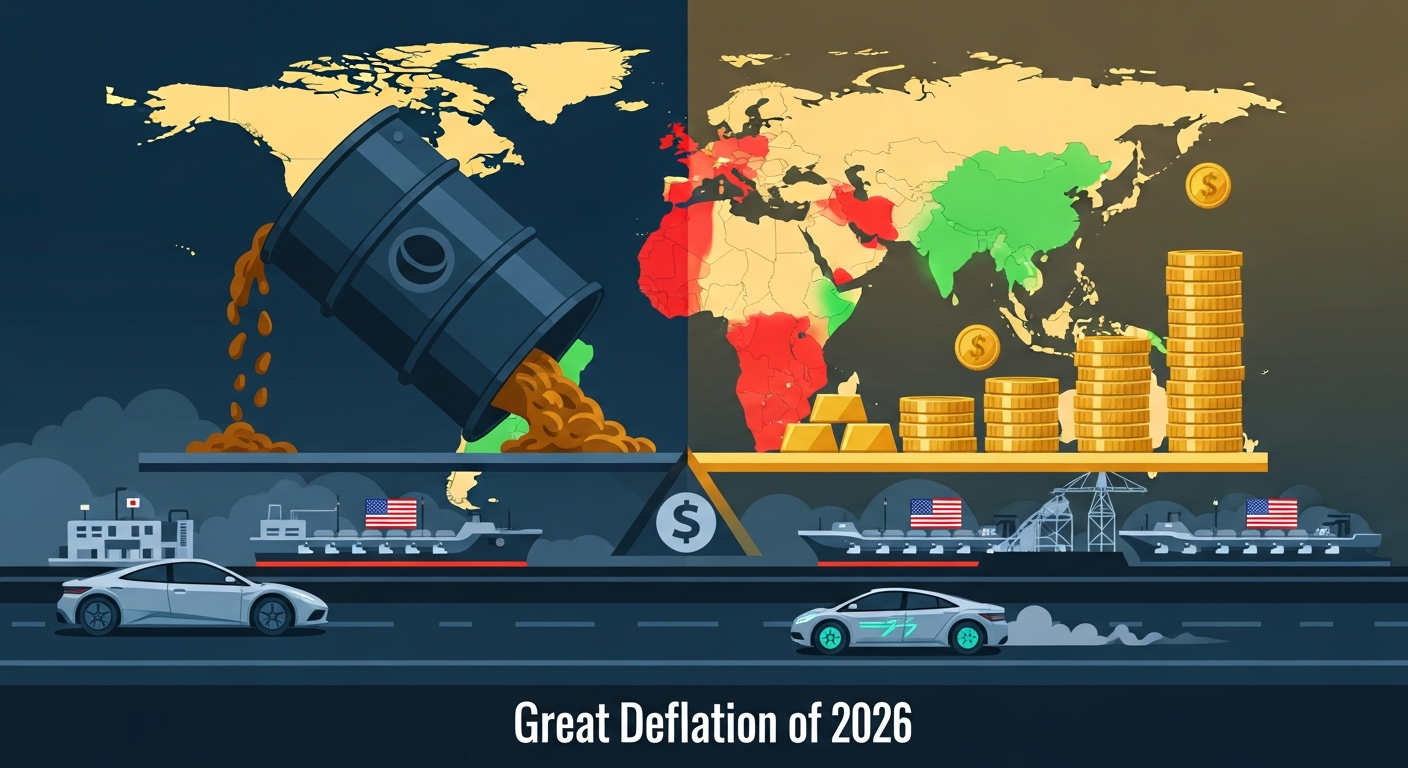
The World Bank has officially declared 'The Great Deflation.' A 1.2 million barrel-per-day oil surplus, China's EV revolution, and the production explosion from the 'Americas Quintet' have killed the commodity super-cycle, pushing two-thirds of developing nations into fiscal emergency.
Key Points
World Bank Projects 6-Year Low for Commodity Prices — 4 Consecutive Years of Decline
The World Bank's March 2026 Commodity Markets Outlook projects global commodity prices will fall 7% in both 2025 and 2026, hitting six-year lows. Brent crude is projected to average just $60 per barrel, with the energy sector overall facing a 10% drop.
1.2 Million Barrel Daily Oil Surplus — The Era of Structural Oversupply
The global oil market sits on a structural surplus of 1.2 million barrels per day, the third occurrence of this magnitude in 30 years. Unlike previous temporary shocks, this surplus is driven by the Americas Quintet's technology-driven production expansion.
China's EV Revolution Permanently Destroying Oil Demand
Over 50% of new cars sold in China are electric, cutting oil consumption by nearly 10% YoY. The global EV fleet displaced over 1 million barrels per day in 2024, with projections to quadruple by 2040.
Two-Thirds of Developing Nations Face Fiscal Emergency — 'Lost Decade' Warning
The World Bank warns that two-thirds of developing nations depend on commodity exports for over half their revenue. Angola derives 30% of GDP, 65% of government revenue, and 95%+ of exports from oil. Venezuela's projected 2026 inflation stands at 682%.
OPEC+ Market Share Falls to 46% — Oil Power Shifts to Western Hemisphere
OPEC+'s global oil production share has fallen from 53% in 2016 to 46% in 2025-2026. The Americas Quintet has effectively neutralized the cartel's price-setting power through technological innovation.
Gold Surges Amid Deflation Paradox — Signal of Global Monetary Order Rewrite
J.P. Morgan forecasts gold at $6,300/oz by year-end 2026, while BNP Paribas predicts $6,000. Central banks are purchasing an average of 585 tonnes per quarter — a structural expression of distrust in dollar hegemony.
Positive & Negative Analysis
Positive Aspects
- Structural cost reduction for energy importers
Japan's trade deficit is structurally narrowing toward balance by 2026-2027. India is sprinting at 7.4% GDP growth fueled by food price stabilization and falling energy costs.
- Global inflation relief
Energy-driven inflation from 2022-2023 is structurally easing, giving central banks room to cut rates and improving margins for aviation, logistics, and manufacturing.
- Improved food security for developing nations
Sufficient supply of rice, wheat, and corn is reducing import costs, providing direct relief to low-income households in Africa and Asia.
- Healthy shift in energy security paradigm
The 1.2M barrel surplus and diversified supply sources prove that energy security now depends on supply diversification rather than cartel membership.
- Catalyst for accelerated EV transition
Regulatory environments and consumer preference shifts in China and Europe have reached an irreversible level, making the oil crisis an opportunity for EV manufacturers.
Concerns
- Developing nation fiscal collapse and 'lost decade' risk
Two-thirds of developing nations depend on commodities for over half their export revenue. Four consecutive years of price decline structurally weakens their fiscal foundations.
- Gulf state U.S. asset selloff could shock global finance
Saudi Arabia, UAE, and Kuwait hold over $300B in U.S. Treasuries and $1.11T in total financial assets that may be liquidated under fiscal pressure.
- OPEC+ weakening cascades into geopolitical instability
Diminishing oil revenues erode social contracts in petrostates, with subsidy cuts, public service reductions, and unemployment potentially triggering social unrest.
- Oil industry adaptation time running out — asymmetric transition speed
With 50% of Chinese new car sales being EVs and projections of 70-80% by 2030, structural oil demand decline is accelerating faster than petroleum economies can adapt.
- Permanent end of commodity super-cycle
EV revolution, China's de-industrialization shift, and Americas Quintet infrastructure are all irreversible changes, making 'wait for recovery' strategies unviable.
Outlook
Let me be blunt: when I first read this World Bank report, the word that came to mind was 'brutal.' The forecast that global commodity prices will hit six-year lows in 2026 was somewhat predictable. But the truly shocking part hides behind those numbers. Two-thirds of developing nations depend on commodity exports for more than half their revenue, and that floor is collapsing beneath them. This is not a simple price correction. This is the moment that separates national destinies.
What makes this fascinating is how the same phenomenon is a blessing for some and a catastrophe for others. Japan sees its trade deficit shrinking as energy import costs plummet. India is sprinting at 7.4% GDP growth. Meanwhile, Nigeria and Angola are watching their currencies nosedive. The World Bank's warning of a 'lost decade' is not hyperbole — it has already begun.
It all starts with oil. As of March 2026, the global oil market sits on a structural surplus of 1.2 million barrels per day. A surplus of this magnitude has occurred only twice in the past thirty years: during the 1998 Asian financial crisis and the 2020 COVID-19 lockdowns. But here is the critical difference. Those were temporary shocks. The 2026 surplus is structural.
Why structural? First, the 'Americas Quintet' — the United States, Brazil, Canada, Guyana, and Argentina — are simultaneously ramping up production at explosive rates. Brazil has launched two additional FPSOs at the Buzios field, pushing production to 4.0 million barrels per day. Guyana is adding 250,000 barrels per day through the Uaru project, preparing to join the million-barrel club. Argentina's Vaca Muerta shale play now accounts for over 60% of national production, reaching 810,000 barrels per day.
Second, China's electric vehicle revolution is permanently reshaping oil demand. Over 50% of new cars sold in China are now electric, cutting the country's oil consumption by nearly 10% year-over-year. When the world's largest oil importer starts buying structurally less oil, you are not looking at a temporary blip — you are witnessing a tectonic shift. Third, China's economy itself is pivoting from heavy industry toward high-tech manufacturing and services. The era of China as the world's insatiable commodity vacuum is ending.
The World Bank's latest Commodity Markets Outlook projects commodity prices will fall 7% in both 2025 and 2026 — four consecutive years of decline. Brent crude is projected to average just $60 per barrel. The energy sector overall faces a 10% drop. Yet in the middle of this Great Deflation, gold is sprinting in the opposite direction. J.P. Morgan has raised its year-end 2026 gold forecast to $6,300 per ounce, while BNP Paribas predicts $6,000.
This divergence between collapsing commodities and soaring gold tells a deeper story. It is not simply safe-haven demand. This is a signal that the global monetary order is being rewritten. Central banks are purchasing an average of 585 tonnes of gold per quarter — a structural expression of distrust in dollar hegemony.
Meanwhile, OPEC+'s power is visibly shrinking. The cartel's share of global oil production has fallen from 53% in 2016 to 46% in 2025-2026. The Americas Quintet has effectively neutralized the traditional cartel's price-setting power through technological innovation and aggressive investment. The world has reached a point where a major producer could vanish overnight without sustaining prices above $90 per barrel.
I believe this is not a mere price cycle but a tectonic shift in global economic power structure. Historically, the end of commodity super-cycles has always accompanied someone's downfall. The 1980s oil price collapse accelerated the Soviet Union's economic disintegration. The 2014-2016 commodity downturn plunged Brazil and Russia into simultaneous recession. But the 2026 deflation is fundamentally different from its predecessors. This time, there is no super-cycle waiting to return.
Electric vehicles have already displaced over 1 million barrels per day of oil consumption, and this figure is projected to quadruple by 2040. China will not return to heavy-industry centrism. The Americas Quintet's production infrastructure, once built, operates for decades. The implication is clear: for commodity-dependent developing nations, the strategy of 'waiting for prices to recover' no longer works.
Just look at Saudi Arabia. The kingdom's fiscal breakeven oil price sits between $94 and $108 per barrel, while the World Bank projects an average of $60. If this gap shows no sign of closing, can Vision 2030 really work? The Public Investment Fund's decision to cut spending by 20% across its portfolio is a signal that the crisis has already begun.
I see this deflation splitting the world into three distinct groups. First, the 'deflation beneficiaries' — Japan, India, South Korea, Germany — energy-importing nations that receive a massive economic tailwind from falling costs alone. India's 7.4% GDP growth is the poster child. Second, the 'adaptable petrostates' — Saudi Arabia and the UAE, nations with massive sovereign wealth funds and diversification strategies that will suffer but can adjust. Third, and most dangerously, the 'trapped commodity dependents' — Nigeria, Angola, Venezuela — nations with no sovereign wealth fund, no diversification strategy, and no time.
There is one more variable that demands attention: the scale of Gulf states' U.S. financial assets. Saudi Arabia, the UAE, and Kuwait alone hold over $300 billion in U.S. Treasury securities, and when adding corporate stocks and bonds, the total reaches $1.11 trillion. If oil export revenues decline, these nations may be forced to sell U.S. assets to fund domestic spending. This is not merely a Gulf problem — it could send shockwaves through the U.S. bond market and the broader dollar system.
The most immediate benefits appear in energy-importing nations. Japan's trade deficit is structurally narrowing toward balance by 2026-2027 as commodity costs fall. India's 7.4% GDP growth is fueled by food price stabilization and falling energy costs simultaneously. The global inflation relief effect is equally significant — the energy-driven inflation that tormented the world in 2022-2023 is structurally easing, giving central banks room to cut rates and improving margins for energy-intensive industries like aviation, logistics, and manufacturing.
The concerns, however, are severe. The most dangerous is the potential fiscal collapse of developing nations. Angola derives 30% of GDP, 65% of government revenue, and over 95% of goods exports from oil. Nigeria's exports are losing competitiveness to cheaper Brazilian and Guyanese alternatives. Venezuela's projected 2026 inflation stands at 682%. The weakening of OPEC+ could cascade into geopolitical instability, as diminishing oil revenues erode the social contracts that maintain political stability in petrostate societies.
In the short term (1-6 months), commodity markets will be heavily buffeted by the U.S.-Iran ceasefire negotiations. On March 25, Iran officially rejected Trump's 15-point ceasefire plan delivered through Pakistan, yet markets had already reacted. The mere expectation of diplomatic breakthrough sent Brent crude plunging 6.1% in a single day to $98 per barrel. This is a crucial signal: markets are already pricing in the assumption that the war premium is not permanent.
If any form of ceasefire materializes, the normalization of the Strait of Hormuz would likely drive oil prices rapidly toward the World Bank's projected $60 per barrel. Even if the war drags on, the Americas Quintet's structural supply growth and China's EV transition are lowering the ceiling on oil price spikes, making sustained prices above $120 per barrel increasingly difficult. Gold will likely maintain or exceed $5,500-6,000 per ounce amid this uncertainty.
In the medium term (6 months to 2 years), the Great Deflation's winners and losers will become starkly apparent. India and Southeast Asia will leverage cheap energy to strengthen manufacturing competitiveness. Japan and South Korea will enjoy a golden era of trade balance improvement. Meanwhile, commodity-dependent economies like Nigeria, Angola, and Venezuela will face the triple burden of currency devaluation, widening fiscal deficits, and social unrest. Saudi Arabia will stand at a crossroads between accelerating Vision 2030 or scaling back its massive investments. OPEC+'s influence will continue to wane — a cartel with 46% market share cannot dictate global prices as it once did.
In the long term (2-5 years), the fundamental question is whether the commodity super-cycle can ever return. I believe the answer is no — at least for oil. If China's EV penetration reaches 70-80% of new car sales by 2030, and the global EV fleet has already displaced 1 million barrels per day, no force can reverse this trend. Peak oil demand has either passed or is passing now.
This crystallizes into three scenarios. In the bull case, commodity-dependent nations seize this crisis as a catalyst for economic diversification, deflation beneficiaries drive global growth, and the world transitions to a more balanced energy regime. In the base case — the most likely outcome — the gap between winners and losers widens, global inequality deepens, some commodity-dependent nations fall into debt crises, but systemic collapse is avoided. In the bear case, simultaneous fiscal crises across commodity-dependent developing nations shake global credit markets, Gulf asset selloffs deliver a shock to the dollar system, and geopolitical instability escalates into additional conflicts.
The Great Deflation is not a cause for celebration — it is a warning. When commodity prices fall, energy importers catch their breath, but the weakest links in the global economy begin to snap. While Nigeria's export competitiveness crumbles against cheap Brazilian oil, while Angola's non-oil economy fails to grow, while Venezuela's inflation hits 682%, are we really going to call this 'a natural market correction'?
The death of the commodity super-cycle is proof that the speed of energy transition has outpaced humanity's capacity to adapt. In a world where EVs permanently erode oil demand, the Americas Quintet dismantles OPEC's power, and gold surges as the last safe haven standing, the real question is not 'when will prices recover' but 'how fast can you adapt to this new reality.'
Sources / References
- The Great Deflation: World Bank Projects 2026 Commodity Prices to Hit Six-Year Lows — FinancialContent / MarketMinute
- Commodity Prices to Hit Six-Year Low in 2026 as Oil Glut Expands — World Bank
- Brazil, Guyana, and Argentina support forecast crude oil growth in 2026 — U.S. Energy Information Administration (EIA)
- Iran rejects U.S. ceasefire offer, demands sovereignty over Strait of Hormuz — CNBC
- What to Know About Trump's 15-Point Peace Plan After Iran's Rejection — TIME
- The worst oil crisis in history comes at a good time for China's troubled EV giants — CNN
- A new high? Gold price predictions from J.P. Morgan Global Research — J.P. Morgan
- Saudi Arabia's policy trilemma: Oil, debt and deficits in 2026 — AGBI (Arabian Gulf Business Insight)