
The Religion That Kept Its Secrets So Well It Erased Itself from History
Summary
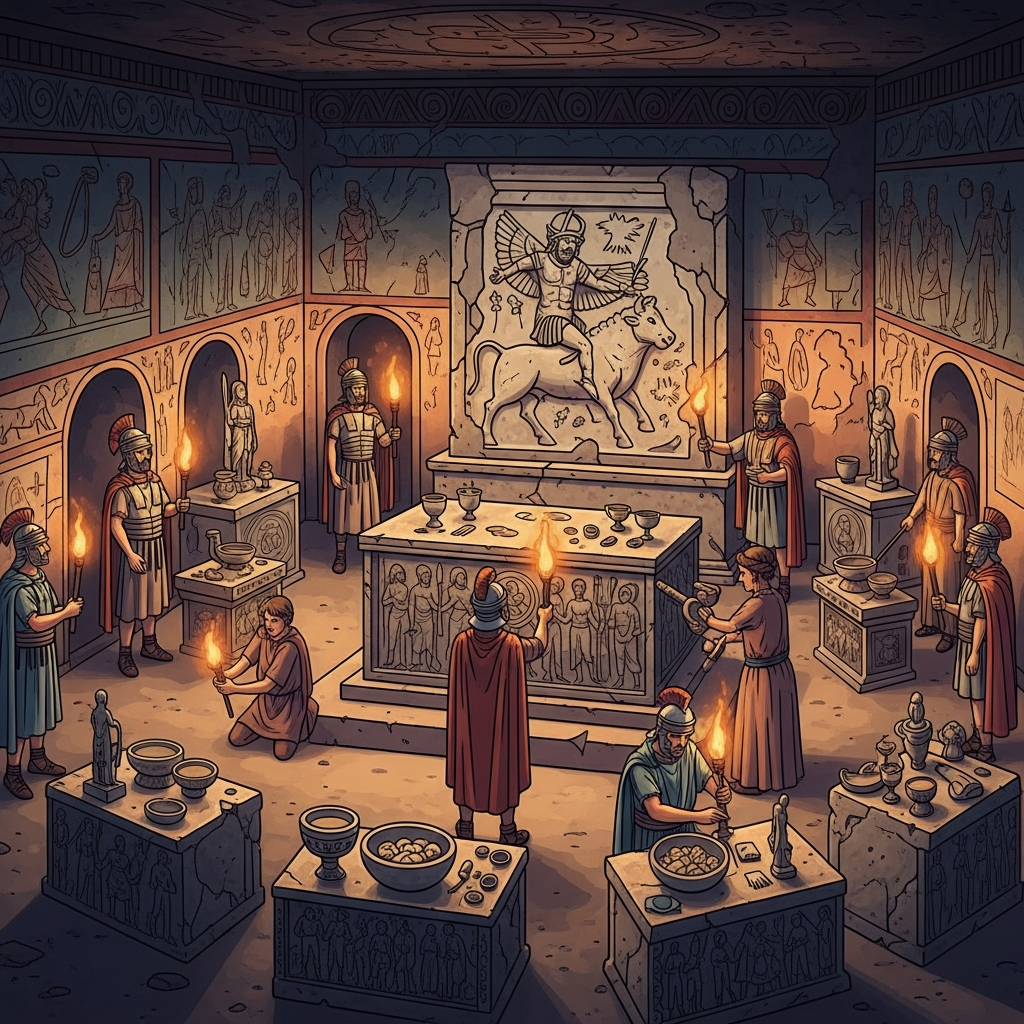
Mithraism was a large-scale mystery religion that competed directly with early Christianity for the spiritual allegiance of Rome's legions throughout the first through fourth centuries CE, constructing a network of underground sanctuaries across every major military frontier of the empire. The Mithraeum excavated beneath Zerzevan Castle in southeastern Turkey stands as the best-preserved Mithraic shrine from the Roman period, sealed underground for approximately 1,700 years until its discovery in 2017, featuring a nearly intact tauroctony relief, original altar, and surviving polychrome wall paintings. Scheduled for UNESCO World Heritage Committee review in July 2026, the site represents not merely an archaeological milestone but a convergence of religious history, heritage politics, and Turkey's deliberate nation-branding strategy. The deeper irony at the heart of Mithraism's story — that its absolute commitment to secrecy was both the engine of its explosive growth among soldiers and the structural flaw that guaranteed its eventual extinction — provides a historically unprecedented case study in organizational self-destruction through excessive closure. In an era when global cultural heritage discourse is shifting toward recovering histories deliberately suppressed by political and religious victors, the Zerzevan Mithraeum arrives as the most dramatic physical evidence yet of what gets buried when one tradition conquers another.
Key Points
The Historical Scale and Hidden Influence of Mithraism
Mithraism operated as a large-scale organized religion throughout the Roman Empire from the first through the fourth centuries CE, achieving a particularly powerful grip on the empire's military class while leaving almost no written record of its actual doctrines or beliefs. Scholars estimate that a minimum of 1,000 Mithraea — the specialized underground sanctuaries required for the cult's rituals — existed at the height of the movement across Roman territory from Britannia to Syria, with approximately 420 confirmed through archaeological discovery to date. The London Walbrook Mithraeum, the layered Mithraeum beneath Rome's Basilica of San Clemente, and the site at Saarbrücken in modern Germany represent only the most notable examples of a network that was systematically dismantled after Christianity achieved imperial ascension. Before the Edict of Milan in 313 CE, Mithraism functioned as the de facto unofficial religion of the Roman legions — a claim that is not hyperbolic when one considers the geographic density of Mithraea along every major military frontier. The cult extended beyond soldiers to encompass merchants, minor officials, and freedmen, making it a significant social institution across multiple male demographic segments. The near-total absence of Mithraism from mainstream history education today is itself evidence of the cult's most consequential feature: its prohibition on external communication and written transmission of doctrine meant that when the political climate shifted, there was simply nothing surviving to be taught. The result is a massive and largely unacknowledged gap in popular understanding of what Roman soldiers actually believed, a gap that the Zerzevan discovery is beginning, for the first time in centuries, to fill.
The Archaeological Significance of the Zerzevan Mithraeum
The Mithraeum excavated beneath Zerzevan Castle by Dicle University's archaeological team in 2017 occupies a singular position in the global inventory of Roman-era religious sites — it is the most intact Mithraic sanctuary ever found anywhere in the world. The site's tauroctony relief retains original polychrome pigmentation after 1,700 years of sealed underground storage, a preservation condition that researchers describe as unique in Roman religious art and perhaps in ancient religious iconography more broadly. The altar and surrounding wall paintings survived without the physical disturbance that most known Mithraea suffered after Christianization — being buried under new church construction, partially demolished for building material, or looted across the medieval period. Zerzevan Castle's specific history explains the preservation: the fortress was effectively abandoned after the fifth century CE, and no subsequent occupiers had reason or opportunity to construct Christian religious architecture over the existing Mithraic sanctuary. The excavation is currently approximately 70% complete, and project director Professor Aytaç Coşar has publicly indicated the possibility of additional religious infrastructure in the unexcavated portions of the castle complex. The unique combination of site integrity, symbolic completeness of the tauroctony, and documented co-presence of a Christian chapel within the same fortress walls makes Zerzevan not merely a well-preserved example of a known type, but the single most valuable physical witness we have to the lived religious reality of Rome's frontier military communities — a category of evidence that has been almost entirely absent from the historical record until now.
The Paradox of Secrecy as Both Engine and Cause of Extinction
The defining irony at the center of Mithraism's historical arc is that the same structural feature driving its explosive initial growth within Rome's military culture — extreme, enforced secrecy — is precisely the mechanism that guaranteed its eventual demographic and institutional collapse. In Mithraism's growth phase, the absolute requirement of secrecy operated as a powerful psychological and social technology: the sense of possessing a cosmic truth available only to initiated brothers generated intense in-group loyalty and spread rapidly through the homogeneous, high-trust environment of Roman military units. The seven-grade initiation hierarchy — from Raven through Bride, Soldier, Lion, Persian, Sun-runner, and Father — created a gamified structure that incentivized upward movement and long-term engagement within the community. But that same hierarchy, combined with the absolute prohibition on external communication, meant that Mithraism produced no written doctrinal record, conducted no public outreach, and recruited exclusively from a single narrow demographic: initiated male soldiers. The exclusion of women — half the Roman Empire's population — was not an incidental limitation but a foundational doctrinal commitment, and it made intergenerational transmission structurally impossible in the way that Christianity's household-based evangelism made it structurally inevitable. When the political environment shifted after 313 CE, Christianity could absorb, adapt, and continue through its written texts and open community structures; Mithraism had no equivalent fallback mechanism. This pattern — closed system achieves rapid initial dominance, then collapses catastrophically when the external environment changes — maps almost exactly onto what organizational theorists now call the "closed innovation trap," and Mithraism's case may be its most historically dramatic instance.
The Multilayered Politics of the 2026 UNESCO Nomination
Turkey's UNESCO World Heritage nomination for Zerzevan Castle is best understood as a document serving at least three simultaneous objectives, only one of which is straightforwardly about cultural preservation in any neutral sense. The first objective is tourism infrastructure development for Diyarbakır province — a chronically underdeveloped region whose annual visitor count of approximately 50,000 is expected by the Ministry of Culture to reach 200,000 or more following a successful designation. Historical precedent within Turkey strongly supports this expectation: Ephesus experienced roughly triple the visitor numbers within three years of its UNESCO inscription, and Cappadocia's designation accelerated a fourfold growth in regional tourism revenues. The second objective is nation-branding: framing Turkey as the steward of multi-civilizational heritage — Roman, Persian, Christian, and Islamic layers coexisting in one site — provides a powerful counter-narrative to sustained international criticism of Turkey's human rights record and democratic governance. The third objective, harder to discuss openly, involves selective emphasis: Diyarbakır is also the historical and cultural heartland of Kurdish civilization in Turkey, and a heritage policy that channels international investment into a Roman archaeological site while maintaining restrictions on Kurdish cultural expression creates a structural contradiction that outside observers are entirely justified in raising publicly. The broader UNESCO system's well-documented drift toward functioning as a competitive cultural Olympics — where nation-state totals of inscribed sites are tracked as prestige indicators — means that Zerzevan enters a nomination process already shaped more substantially by state interests than the original World Heritage Convention was designed to permit.
Religious Palimpsest — The Physical Evidence of Deliberately Erased History
The concept of the religious palimpsest — layers of sacred meaning inscribed over one another, with earlier layers deliberately concealed — finds its most dramatically material expression in the history of how Mithraism was suppressed following Christianity's imperial rise. Following the establishment of Christianity as the Roman state religion, Mithraea across the empire were not simply closed down; they were physically destroyed, repurposed, or buried under new Christian construction in a deliberate act of symbolic overwriting that erased competing sacred spaces from the visual landscape of Roman cities. Rome's Basilica of San Clemente — where a complete Mithraeum lies directly beneath the current fourth-century church structure, with the church literally built on top of the pagan temple — is the most famous example, but it is representative of a widespread pattern estimated to have affected hundreds of Mithraic sites across Europe and the Middle East. The near-miraculous preservation of the Zerzevan Mithraeum is explained entirely by the castle's abandonment: with no subsequent community to build over it, the underground sanctuary survived untouched for fourteen centuries after Mithraism itself was gone. This creates an odd historical result in which the best-preserved evidence of a major Roman religious tradition owes its survival precisely to the absence of human attention — a case where neglect functioned as the most effective form of heritage protection possible. The Zerzevan discovery has reinvigorated scholarly interest in identifying additional subsurface Mithraea across Europe, where thousands of unexcavated church basements and urban foundations may still conceal physical remains of Rome's most secretive faith, waiting for excavations that no one has yet thought to conduct.
Positive & Negative Analysis
Positive Aspects
- Fundamentally Expands Scholarly Understanding of Roman Religious Diversity
The Zerzevan excavation and its growing international profile are already driving a genuine recalibration of how academics study Roman religious history — a field long dominated by a narrative arc treating Roman polytheism as a mere prelude to Christianity rather than as a complex, dynamic religious ecosystem in its own right. Mithraic studies publications increased by over 40% in 2024 relative to the prior year, and dedicated research teams at Oxford, Heidelberg, and Yale have expanded substantially in both size and funding. This is not simply quantitative growth in a niche specialty — it represents a qualitative shift toward taking seriously the religious lives of the people who actually built and defended the empire, as opposed to the theological positions of the institutions that eventually replaced them. The cross-disciplinary implications are equally significant: the intersection of archaeology, religious studies, military history, and art history that Mithraism research requires is producing new methodological frameworks that will benefit the study of other poorly-documented ancient religious movements, including the Eleusinian Mysteries, Isis worship, and the Dionysian cult. From my perspective, the deepest educational value here is not narrowly academic but broadly civic: a generation of students who learn Roman history as including Mithraism and other mystery cults alongside Christianity will come out with a substantially more accurate and intellectually honest picture of what the ancient world actually looked like at ground level, and that shift in historical understanding has real-world implications for how we think about religious diversity and pluralism today.
- Delivers Real Tourism Revenue to One of Turkey's Most Economically Vulnerable Regions
Diyarbakır province sits in southeastern Turkey's Anatolian plateau, a region that has been chronically underserved by Turkey's tourism economy, which has historically concentrated infrastructure investment and international marketing around the western coastline and major urban centers. A UNESCO World Heritage inscription for Zerzevan would create the first major internationally recognized archaeological draw for this region, with Turkey's Ministry of Culture projecting annual visitor numbers could grow from roughly 50,000 to over 200,000. Comparable Turkish sites that received UNESCO inscription — Ephesus, Göbekli Tepe, the Cappadocia volcanic landscape — all experienced visitor growth multiples of three to five times within the first three years of designation, and based on those precedents, I estimate Diyarbakır province could be generating 80 to 100 million dollars annually in tourism-related revenue by 2028. Beyond the headline revenue figure, the more durable economic impact comes from the supply chain effects: hotel construction, restaurant development, trained guide employment, transport connections, and the general infrastructure upgrade that follows sustained international visitor presence. In a region with historically elevated unemployment and limited economic diversification options, the tourism multiplier effect is not a trivial benefit — it is a structural opportunity with the potential to reshape the regional labor market. The precedent from other UNESCO designations is clear enough that the question is not whether economic benefit would materialize, but whether local institutions have the capacity to absorb and distribute it equitably across the full population.
- Contributes to the Global Movement to Restore Histories Suppressed by the Victors
The Zerzevan Mithraeum arrives in a global cultural heritage moment defined by intense and often contentious debate about which suppressed histories deserve recovery and who bears responsibility for that work. France passed its colonial cultural property repatriation law in 2026. The British Museum's negotiations over the Benin Bronzes are accelerating. Indigenous cultural heritage movements are gaining meaningful legal standing across multiple jurisdictions worldwide. All of these conversations share a common underlying structure: the acknowledgment that existing history reflects the deliberate choices of powerful actors about what to preserve and what to erase, and that contemporary institutions bear some degree of moral responsibility for correcting those choices where possible. Mithraism was erased not through colonial extraction but through deliberate religious-political suppression — its sanctuaries physically overwritten, its practices criminalized, its doctrines rendered irrecoverable by design. The Zerzevan discovery provides perhaps the most materially vivid illustration available anywhere in the world of what that kind of deliberate erasure actually looked like in practice: a room sealed for 1,700 years because the religion inside it lost a political contest. I believe the Zerzevan nomination could serve as a conceptual bridge between classical archaeology and the broader global heritage justice movement, enriching both conversations and making the case that the question of "who controls the historical record" is not merely academic but urgently contemporary.
- Potential to Become a Landmark Case for Digital Heritage Preservation Technology
The physical constraints of the Zerzevan Mithraeum — a sealed underground chamber with extremely sensitive environmental conditions that could be destabilized by heavy visitor foot traffic — create an unusually strong institutional incentive to deploy advanced digital preservation technology here before physical access becomes a conservation crisis. Photogrammetry and high-resolution 3D scanning can already produce complete digital twins of enclosed archaeological spaces at millimeter precision, and machine learning image analysis is being used at other Roman sites to recover faded pigment details that are invisible to conventional photography and human visual inspection. Full deployment of these technologies at Zerzevan is anticipated between 2027 and 2028. Once a virtual tour platform is operational — whether through Google Arts & Culture, Matterport, or a dedicated institution-managed application — the global audience for this site will be orders of magnitude larger than anything physical infrastructure could support. I project that virtual engagement could reach ten times the physical visitor count by 2030, fundamentally changing both the economics and the conservation management of the site. If Zerzevan becomes the proving ground for this model — unlimited digital access paired with strict physical conservation protocols and minimal foot traffic — it could establish a template applicable globally to vulnerable underground sites that cannot sustain significant tourist volumes without irreversible environmental damage to the very features that make them worth preserving in the first place.
- Offers Historical Evidence of Religious Coexistence That Speaks to Contemporary Divisions
The physical fact at the heart of the Zerzevan discovery — that Roman soldiers stationed on the military border with a Persian empire they were actively fighting were simultaneously practicing a religion rooted in Persian culture — is a statement about the complexity of civilizational boundaries that is genuinely difficult to dismiss or rhetorically reframe. Within the same fortress walls, a Christian chapel and a Mithraic sanctuary coexisted for some portion of the fourth century CE, meaning that at the actual frontline of Rome's civilization, the religious identities of soldiers were far more fluid and pluralistic than the triumphalist church history written after Constantine would have anyone believe. In an era when "clash of civilizations" framing continues to shape geopolitical narratives and domestic political mobilization across multiple countries, physical evidence demonstrating that the borders between civilizations were always more permeable than ideological framings claim carries real and meaningful argumentative weight. I want to be careful not to romanticize this — the coexistence within Zerzevan's walls was the product of military pragmatism during a specific transitional period, not a deliberate multicultural policy commitment. But the material evidence of that pragmatic pluralism is still a meaningful and difficult-to-dismiss counterweight to any ideology that treats civilizational boundaries as natural, permanent, or historically inevitable rather than constructed, contested, and contingent.
Concerns
- Tourist Overcrowding Risk — The Disneyfication of a Fragile Underground Site
UNESCO World Heritage inscription is widely treated as a guarantee of preservation, but the historical record of what actually happens to many designated sites after inscription is considerably more troubling than this assumption suggests. Machu Picchu experienced serious ground subsidence and irreversible trail erosion before emergency visitor caps were imposed, and the damage accumulated in the years before those caps remains only partially reversible today. Angkor Wat's surrounding water table was compromised by tourism infrastructure overload during its peak growth years. Egypt's Valley of the Kings lost measurable intensity in wall painting color in the decades following mass tourism development. The Zerzevan Mithraeum presents a particularly acute version of this risk because it is a sealed underground chamber whose extraordinary preservation was achieved specifically through 1,700 years of essentially zero human traffic. The microclimate inside — temperature, humidity, atmospheric CO2 concentration — has been stable for centuries, and that stability is what kept the pigments intact. A sudden influx of visitors breathing, sweating, and generating body heat inside that enclosed space could begin destroying the painted tauroctony that survived everything else history threw at it, and could do so within a single decade of sustained tourist access. Turkey's heritage authorities will need to implement a rigorous environmental monitoring and visitor management system before any large-scale access is permitted — and implementing such systems requires financial commitment, technical expertise, and political will that has not consistently materialized at other sensitive heritage sites around the world.
- Political Instrumentalization and the Double Standard of Selective Preservation
Turkey's framing of the Zerzevan nomination as evidence of its "multi-religious civilizational heritage" is intellectually coherent as a branding strategy while being politically incoherent when examined against Turkey's domestic cultural heritage policy in the same region. Diyarbakır is not only the site of a Roman fortress — it is the historical and cultural capital of Kurdish civilization in Turkey, home to significant Ottoman-era Armenian architectural heritage and to Kurdish traditions of oral history, music, and language that have faced state suppression for decades. A heritage policy that directs substantial international resources toward excavating a Roman Mithraeum while simultaneously restricting Kurdish-language education, limiting Kurdish cultural institution funding, and failing to restore Kurdish architectural heritage damaged in the urban conflicts of the mid-2010s is making an implicit and highly legible statement about which histories within this city deserve official recognition and protection. This is not a uniquely Turkish problem — selective heritage development driven by state interest is a near-universal pattern in UNESCO nominations worldwide — but the specific contradictions in Diyarbakır are acute enough that critics are entirely justified in raising them publicly and insistently. I strongly believe that a principled commitment to cultural heritage preservation must extend uniformly across a society's full historical layers, not selectively applied to the ones that happen to serve current diplomatic and tourism agendas while the others continue to be marginalized or suppressed.
- The Spread of Academic Over-Interpretation and Viral Misinformation
Mithraism's academic record is uniquely sparse — we have almost no written sources from inside the cult itself, only scattered external references and the physical evidence of the Mithraea — and this creates an epistemological situation in which every major interpretive claim about the religion is more tentative than it typically appears in popular presentations. The problem is that this tentativeness disappears almost instantly when Mithraic content enters digital popular culture at scale. The claim that "Mithraism invented Christmas" — a narrative conflating the Sol Invictus festival date with Mithraic religious practice and over-applying the synthesis scholarship of Franz Cumont — is already among the most-shared pieces of misinformation about ancient religion online, and UNESCO designation will amplify its reach considerably further. The more serious academic risk is that Zerzevan's prominence will attract underfunded or ideologically motivated researchers who treat the site's physical evidence as confirmation for pre-formed conclusions about Christian origins — a pattern that has generated enormous quantities of poor-quality scholarship around other high-profile archaeological finds throughout history. The field genuinely needs better public communication infrastructure: science journalists who understand the actual state of Mithraic scholarship, institutional media engagement from universities with serious research programs, and clear public explainers about what we know, what we don't know, and why the uncertainty itself is historically significant and intellectually interesting rather than a deficiency to be papered over with confident assertions.
- Diyarbakır Lacks the Preservation Infrastructure and Specialist Personnel Required
Approving a UNESCO World Heritage Site designation and successfully managing one are entirely different institutional challenges, and the gap between them is particularly wide in this specific case. Diyarbakır is not a city with deep institutional infrastructure for high-volume heritage tourism management — it is geographically remote from Turkey's major archaeological management centers in Istanbul and Ankara, and it currently lacks the density of trained conservation scientists, archaeological site managers, environmental monitoring specialists, and interpretive tourism professionals that sustained world-class heritage management requires over the long term. The comparison with Turkey's established heritage destinations is sobering in its implications: Ephesus has decades of accumulated site management experience and a sophisticated visitor flow system, yet it still struggles with measurable preservation pressures during peak tourist season. Zerzevan, starting effectively from zero in terms of professional heritage infrastructure, faces a considerably steeper climb to reach comparable management quality. The financial promises announced by Turkish tourism authorities — a 50-million-dollar investment in cultural corridor development — need to be evaluated in the context of Turkey's historical track record of announcing ambitious cultural investment plans and executing them at a fraction of the stated scale, on much longer timelines than initially indicated. In the best case, UNESCO inscription marks the beginning of a long institutional development process. In a plausible alternative, it is an event that generates visitor demand far exceeding what local infrastructure can safely or sustainably absorb.
- A Failed UNESCO Bid Could Collapse Excavation Funding and Academic Momentum
The current wave of global attention and academic excitement around Zerzevan is substantially entangled with the anticipation of the UNESCO nomination outcome, and this creates a significant structural vulnerability for the site's long-term research prospects. If the July 2026 nomination is rejected, deferred, or simply overshadowed by other geopolitical events during the committee session, the funding and attention environment for Mithraic studies could contract sharply and rapidly. Turkey's government has invested real political capital in this nomination, which means a negative result carries domestic institutional costs that could translate directly into excavation budget cuts — preliminary estimates from Turkish cultural policy circles suggest a reduction of 20–30% in provincial archaeological funding following a failed nomination. The global media cycle is merciless in its logic: a story that doesn't produce a decisive positive outcome tends to disappear from coverage almost immediately, and academic funding committees are not entirely immune to the cultural attention economy's dynamics. The deeper problem is that Mithraism's scholarly importance is entirely independent of whether it receives a particular administrative designation in July 2026. The value of completing the Zerzevan excavation is real whether UNESCO approves the bid or not. I believe the international academic community should be actively working right now to establish independent, institutionally stable funding streams for Mithraic research that are not contingent on a single political vote — the history is simply too important and too fragile to leave hostage to the outcome of one committee session.
Outlook
The Zerzevan Mithraeum's journey plays out across four distinct domains simultaneously — archaeology, tourism economics, popular culture, and geopolitical heritage politics — and the trajectories in each domain will interact in ways that are genuinely hard to predict in advance. What I can offer is my best analysis, organized across short-term (2026), mid-term (2027–2028), and long-term (2029–2031) horizons, with specific scenarios and probability estimates wherever the evidence supports that level of precision. The honest starting point is this: the UNESCO vote in July 2026 is a genuine inflection point, but regardless of how that vote goes, the broader dynamics it has set in motion are already irreversible. Mithraism has re-entered the global conversation, and no single committee decision will put it back in the ground.
In the short term, the decisive event is the World Heritage Committee session scheduled for July 2026. Based on publicly available information, Turkey submitted the Zerzevan nomination following its addition to the Tentative List in 2024, and ICOMOS — the International Council on Monuments and Sites, UNESCO's primary advisory body — completed its on-site evaluation during the second half of 2025. I put the probability of full inscription at approximately 60–65%. The case for approval rests on three strong pillars: the site's extraordinary preservation state, its uniqueness as the most complete surviving Mithraeum anywhere in the Roman world, and its strong narrative value as physical evidence of civilizational encounter on the Roman-Persian frontier. The main risk factors are Turkey's current geopolitical positioning, which may affect the voting behavior of certain member states, and potential ICOMOS concerns about the specificity and enforceability of Turkey's conservation management plan. A "referral" outcome — where the committee requests additional information before making a final decision — carries a probability of around 20%.
If inscription is confirmed, the immediate economic consequences will be substantial and move quickly. Turkey's Ministry of Culture has already signaled preliminary plans for a "Zerzevan Cultural Corridor" development project, and discussions about expanding direct flight routes into Diyarbakır's international airport are reportedly underway. Based on comparable UNESCO inscription cases within Turkey — Ephesus saw visitor numbers roughly triple within three years of inscription, and Cappadocia's landscape designation accelerated a fourfold growth in regional tourism revenues — I estimate annual tourism revenues for Diyarbakır province could reach 80 to 100 million dollars by 2028, from a current baseline well below 30 million. Infrastructure investment to accommodate this demand is likely to reach 50 million dollars, which translates into meaningful short-term employment in a region with chronically high unemployment. If the bid fails or is deferred, I expect a 20–30% cut in the provincial archaeological excavation budget as political attention and funding momentum dissipate rapidly.
Looking further out — approximately 2027 to 2028 — the most consequential developments will unfold simultaneously in academic scholarship and popular media. On the scholarly side, the Zerzevan excavation is still only about 70% complete. Excavation director Professor Aytaç Coşar has indicated publicly that additional religious infrastructure may exist in the unexcavated portions of the fortress complex. If a second Mithraeum surfaces — or more dramatically, any form of Mithraic textual material — that would represent an archaeological event comparable in significance to major Dead Sea Scrolls-level discoveries for early religion scholarship. I put the probability of a significant mid-excavation find at around 25–30%, and in that scenario I'd expect global academic funding for Mithraic studies to more than double within two years. Even without a dramatic new discovery, the current publication momentum — Mithraic studies papers up over 40% in 2024 — will continue building, as major universities with expanding Mithraic research teams are unlikely to contract that investment.
On the popular culture front, the "secret religion of the Roman army" narrative is nearly irresistible for streaming platforms hungry for fresh historical content. Netflix, HBO, and Disney+ have all demonstrated a willingness to fund ambitious historical documentaries and docudramas on ancient topics, and Mithraism is essentially untouched as a mainstream subject while being loaded with dramatic elements: secret rites, underground temples, blood sacrifice, military brotherhood, and ultimate disappearance. I expect at least two to three documentary or docudrama projects to be formally announced by 2028. The serious risk here is one I've already raised: popular media treatments of Mithraism have already begun amplifying over-interpretations and factual errors at scale. Academic institutions will need to be proactively engaged in these productions to prevent the Zerzevan discovery from becoming the source material for a wave of confidently wrong popular mythology circulating under the guise of historical documentary.
Over the longer term — roughly 2029 to 2031 — I believe the deepest significance of this discovery will register in religious sociology and the broader study of how religions die. The Mithraism case is historically unusual because the primary driver of extinction was not external persecution but internal structural design: the cult built itself around secrecy, gender exclusion, and occupational specialization in ways that made it demographically unsustainable across generational turnover. The Pew Research Center's 2025 data showing global religiously unaffiliated population growing from 16% in 2015 to 22% by 2025 is prompting exactly the kind of question where Mithraism's trajectory becomes directly relevant: is contemporary religious decline primarily driven by external sociocultural pressure, or is it structurally prefigured in how religious institutions themselves are designed? The Mithraism case offers a 2,000-year-old comparative dataset for that question, and I expect it to begin appearing explicitly in religious sociology literature within the next three years as researchers draw the parallel more directly.
Digital preservation technology will also reshape what's possible at Zerzevan over this timeframe. Photogrammetry and millimeter-resolution 3D scanning can already produce complete digital twins of enclosed archaeological spaces, and machine learning image analysis is being applied at other Roman sites to recover faded pigment patterns invisible to conventional photography. Full digital twin implementation at Zerzevan is expected between 2027 and 2028. Once a virtual tour platform is operational — whether through Google Arts & Culture, Matterport, or a dedicated application — the number of virtual visitors will dwarf physical visitors, potentially by a factor of ten or more by 2030. This matters not just for access but for preservation: if virtual engagement can satisfy the majority of global curiosity about this site, the physical Mithraeum can be managed under a strict protective protocol with minimal foot traffic. The Zerzevan site has the structural characteristics to become a template for the emerging model of cultural heritage management — unlimited digital access paired with near-zero physical footprint — and if it succeeds in that role, the implications for other vulnerable underground sites globally will be substantial.
Let me close with a structured scenario analysis that tries to capture the range of realistic outcomes. In the optimistic scenario — call it the bull case, roughly 25% probability — UNESCO inscription is confirmed in July 2026, additional excavation reveals a major textual or structural find, and Zerzevan becomes one of the decade's defining archaeological stories. Annual tourism revenues in the province could approach 250 million dollars by 2030, Diyarbakır could emerge as an international archaeological destination on the level of Petra or Pamukkale, and Mithraism could secure a permanent place in mainstream Western history education. In the base case — roughly 50% probability — inscription succeeds, academic and tourism growth proceeds steadily, and Mithraism is genuinely reestablished as a serious chapter in the history of Western religion. Annual visitors reach 150,000 to 200,000 by 2028, revenues settle at 80 to 100 million dollars, and the academic renaissance in Mithraic studies becomes a durable if modest structural shift in the field. In the bear case — roughly 25% probability — the UNESCO nomination is deferred or rejected, funding contracts sharply, and the story fades from international attention before its full potential is realized. The excavation slows, the popular culture moment passes, and Mithraism drifts back toward the footnotes where it has spent most of its post-extinction existence.
My ultimate judgment is this. The Zerzevan Mithraeum is not a temporary news event — it is a long-duration story whose consequences are still actively unfolding. Whether or not UNESCO confirms inscription in July 2026, the discovery has already accomplished something irreversible: it has returned one of history's most significant hidden religions to the global conversation. The question of whether humanity has the will and the institutional infrastructure to correctly interpret and preserve what it is now recovering is, in the end, more consequential than the UNESCO vote itself. Mithraism kept its secrets for nearly two thousand years. The secret is out now, and what we choose to do with it will say something important about who we are in 2026 — and what kind of relationship we are prepared to have with the full, unedited complexity of our own past.
Sources / References
- Zerzevan Castle: Exploring the World's Best-Preserved Mithraeum — National Geographic
- Zerzevan and Its Environs: Official Tentative List Entry — UNESCO World Heritage
- Mithraic Mysteries: Historical Overview and Analysis — World History Encyclopedia
- Mithras Temple Found at Zerzevan Castle: Archaeological Details — Ancient Origins
- Mithraism: The Secretive Cult of Ancient Rome — The Collector
- Zerzevan Castle Mithraeum Ready for UNESCO World Heritage Nomination — Hurriyet Daily News