
The Golden Lion Is Dead — And It Wasn't Russia That Killed It
Summary
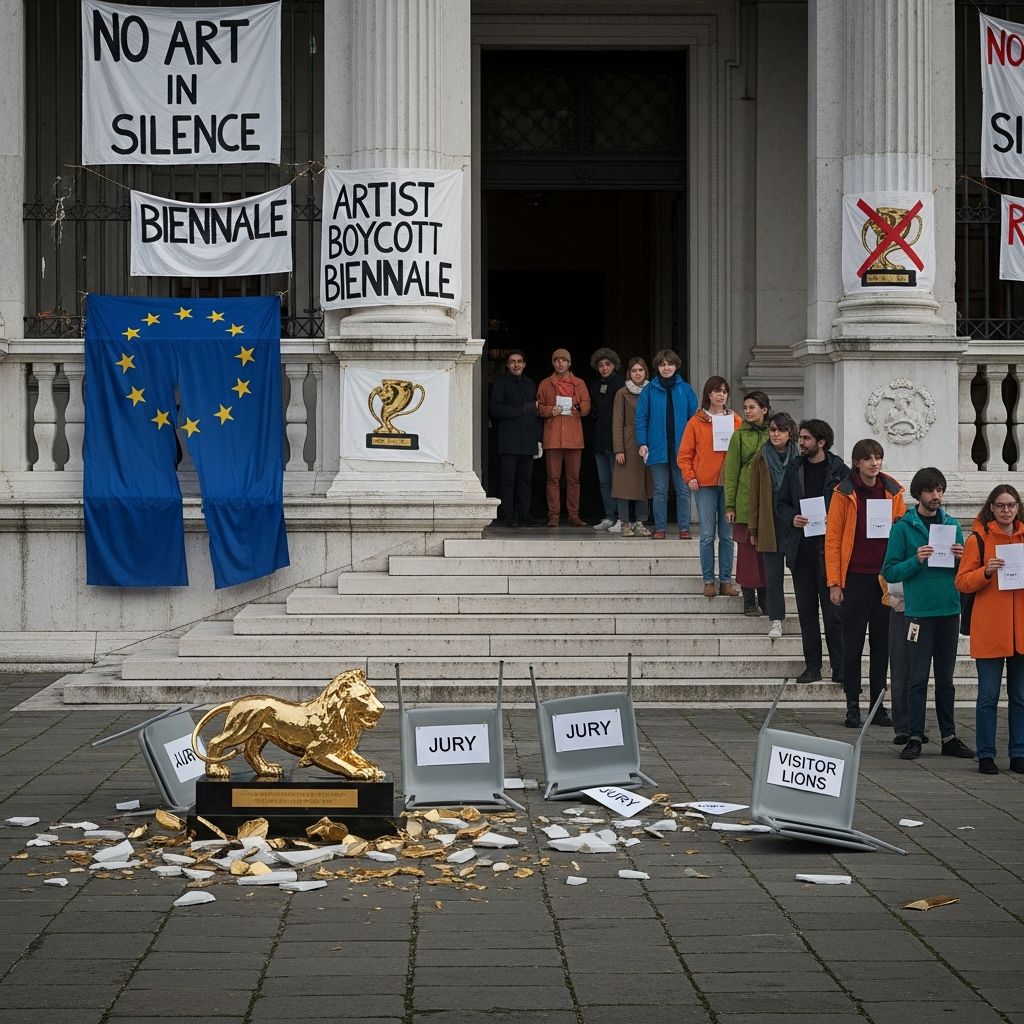
The 61st Venice Biennale erupted into unprecedented institutional crisis in 2026 when its entire five-member jury resigned collectively and over 81 artists withdrew from award consideration, effectively abolishing a 131-year tradition of the Golden Lion prize. The jury had declared they would not recognize national pavilions of countries whose leaders face ICC charges for crimes against humanity — targeting Russia and Israel — but rather than compromising, they chose to walk out entirely when Italy's Ministry of Culture launched an investigation into their statement. In the vacancy they left behind, the Biennale introduced the Visitor Lions, a popular vote open to any ticketholder who visits both venues, inadvertently handing Russia and Israel a far wider audience than any expert panel could have provided. The crisis unfolded against the backdrop of In Minor Keys, the posthumous exhibition of Koyo Kouoh — the first African woman ever appointed to direct the Venice Biennale, who died in May 2025 before the show opened — whose carefully constructed platform for marginalized voices became the year's most contested geopolitical battleground. The European Union's subsequent freezing of €2 million in Biennale funding set a dangerous new precedent for politically motivated interference with arts institutions, exposing the deep structural flaw in a national pavilion competition system that traces its current form to Benito Mussolini's fascist government in 1930.
Key Points
The Jury Walkout and the End of 131 Years of Golden Lions
On April 22, 2026, the five-member Venice Biennale jury released a joint statement declaring they would not consider pavilions of nations whose leaders face ICC charges for crimes against humanity — effectively targeting Russia and Israel. Italy's Ministry of Culture launched an immediate investigation, and rather than retreat from their position, the jury resigned collectively on April 30. This triggered a cascading response: 81 artists across the main exhibition and 22 national pavilions withdrew from award consideration in solidarity with the departing jurors. The 131-year tradition of the Golden Lion, dating to the Biennale's founding in 1895, was effectively abolished within weeks of the opening. Politically, the opening days became a theater of competing signals: Pussy Riot and FEMEN staged smoke-bomb protests at the Russian Pavilion, Italy's Culture Minister boycotted the opening ceremony, and Deputy Prime Minister Salvini visited the Russian Pavilion in an explicit show of political alignment. In the history of major international art events, no jury had ever resigned collectively over geopolitical principles before this moment, making it a genuinely unprecedented precedent for the relationship between arts institutions and global politics. The jury's action, whatever its strategic costs, established that expert panels can treat their professional conscience as a tool of institutional resistance — a message that will reverberate across Cannes, Documenta, Art Basel, and the Turner Prize for years to come.
Visitor Lions: What Happens When Tourists Replace Jurors
The absence of a jury left the Biennale facing an institutional vacuum, and the solution it chose — the Visitor Lions — may prove more consequential than the jury walkout itself. Under the new system, any ticketholder who visits both the Arsenale and Giardini venues is eligible to vote for the best artist in the main exhibition and the best national pavilion, with winners announced at the November 22 closing ceremony. Both Russia and Israel are included as eligible pavilions, meaning the principled act of expert exclusion has resulted in those same countries being presented to a vastly larger audience of lay voters. The 2024 Biennale attracted 699,304 visitors; even a 10% participation rate produces roughly 70,000 ballots, replacing five professional jurors with an enormous crowd. Critics in the art world were blunt: visitors averaging four to six hours on-site cannot meaningfully evaluate 111 artists across two venues, and the system structurally favors work that is visually spectacular, politically legible, or positioned near the venue entrance. The Biennale officially framed the change as consistent with its founding spirit of openness and dialogue, but what it actually represents is the end of closed-door expert authority over the world's most prestigious art award. The ripple effects across other major prizes are already being felt in editorial and curatorial circles globally.
Koyo Kouoh's In Minor Keys and the Cruelest Irony of 2026
Koyo Kouoh — Cameroonian curator, director of the Zeitz Museum of Contemporary Art Africa, and the first African woman ever appointed to direct the Venice Biennale — passed away in May 2025 at 57, before the exhibition she had designed could open. By the time she died, she had already defined the theoretical framework, selected the participating artists, and completed the catalogue; her colleagues carried the work to completion as her posthumous gift to the field. The show, In Minor Keys, was designed to center voices that mainstream contemporary art has treated as peripheral — to give center stage to artists from the global south, from communities structurally excluded from the dominant gallery and museum circuit. What happened next is one of the sharpest ironies in recent art history: a show conceived to amplify marginalized voices became the year's most contested geopolitical battleground, with Kouoh's name invoked simultaneously by every faction as a rhetorical resource. The exhibition generated global coverage in CNN, BBC, NPR, and The Guardian that it almost certainly would not have received without the controversy, and search interest in African contemporary art reportedly surged over 340% year-on-year. That increased visibility is real, and it serves Kouoh's lifelong mission in certain ways — but the terms under which it arrived, with her legacy fragmented into competing political claims, represent a failure of institutional stewardship that the Biennale's governance structure has no current mechanism to address.
The EU's €2 Million Freeze and What It Means for Arts Independence
The European Union's decision to freeze €2 million in Biennale funding — citing Russia's participation as the grounds — was endorsed by a vast majority of EU member states at a heated meeting of culture ministers, according to Euronews reporting. The frozen amount represents approximately 8% of the Biennale's operating budget, and while its symbolic significance far exceeds its financial scale, the institutional precedent is the alarming part. For the first time in the EU's cultural funding history, money has been withheld from a major international arts institution explicitly on geopolitical grounds, establishing a template that governments and funding bodies can now reference. The EU's Creative Europe program distributes approximately €385 million annually to cultural organizations across Europe, and if politically conditional disbursement becomes normalized, the chilling effect on smaller institutions — particularly in Eastern and Southern Europe, where EU funding dependency is highest — could be severe. Governments have never needed to ban programming explicitly when they control the funding pipeline; Cold War cultural history demonstrates this mechanism operating reliably in both directions. The European Parliament has already received formal questions about the suspension of EU funds at the Biennale, indicating this is not a one-time diplomatic gesture but the beginning of a policy conversation that will reshape how arts funding conditionality is understood and applied across Europe.
Mussolini's Stadium: The Structural Original Sin Behind Every Crisis
The Venice Biennale's national pavilion system traces its current architecture to 1930, when Benito Mussolini's government issued Royal Decree Law No. 33 placing the Biennale under state control and formalizing the national pavilion competition structure. The permanent pavilion buildings in the Giardini — constructed by individual nations in their preferred architectural styles between 1907 and the early 1930s — are, as the Biennial Foundation describes them, a map of the world order rendered in stone and mortar. They were designed to make art a vehicle for national prestige and soft power projection, structurally identical in logic to an Olympic competition. The same dynamic produced the 1968 crisis, when student revolutionaries exposed the contradiction between the Biennale's artistic claims and its fascist-era governing statutes — leading to an 11-year suspension of the Golden Lion from 1969 to 1979. In 1974, director Carlo Ripa di Meana canceled national pavilions for the year and renamed the event antifascist. The 2026 crisis is structurally identical to these predecessors, with new geopolitical actors filling the same structural roles. Currently approximately 30 countries hold permanent pavilion buildings in the Giardini — overwhelmingly European powers — while African and Southeast Asian nations occupy temporary spaces in the Arsenale, encoding the very inequalities Kouoh's curation was designed to challenge. Until the national pavilion system is fundamentally reconceived, every major geopolitical crisis will produce a version of this same confrontation.
Positive & Negative Analysis
Positive Aspects
- A Historic Precedent for Ethical Responsibility in Art Institutions
The collective resignation of all five jury members — over a principled refusal to award nations facing ICC charges — is genuinely unprecedented in the history of major international art events. Before 2026, the expected role of an art jury was limited to evaluating artistic quality; the Venice jury expanded that role to include geopolitical accountability, and they backed their position by walking away entirely rather than compromising. This creates a reference point that juries at the Cannes Film Festival, Documenta, Art Basel, and the Turner Prize can now explicitly invoke when facing similar institutional pressures. It establishes, for the first time in a major institutional context, that experts can treat their professional conscience as a tool of resistance against political pressure — and that the cost of principled action can be accepted voluntarily rather than imposed. Over the long term, this precedent may push international art governance toward more explicit ethical frameworks for jury composition, selection criteria, and participation standards. The fact that 81 artists and 22 national pavilions joined the withdrawal in solidarity demonstrates that the art community broadly recognized the moral validity of the position, even when the strategic consequences were contested. That scale of collective action — unprecedented in Biennale history — is itself a form of institutional pressure that will be difficult for future governing bodies to ignore.
- Koyo Kouoh's Legacy Reaches a Global Audience It Couldn't Have Reached Otherwise
Without the crisis, In Minor Keys would almost certainly have remained within the specialist art media circuit — covered by Artforum, ArtReview, Frieze, and The Art Newspaper, appreciated by curators and collectors, and largely invisible to general audiences. The controversy changed that entirely, placing Kouoh's name and her exhibition in global news across CNN, BBC, NPR, The Guardian, and dozens of major international outlets simultaneously. Search interest in African contemporary art reportedly surged over 340% year-on-year, a scale of attention that no curated show could have generated through ordinary critical reception alone. The argument Kouoh spent her career making — that African art belongs at the center of global discourse, not its margins — is now a live debate in mainstream media rather than an art world conversation. Galleries, museums, and collectors who had no previous engagement with African contemporary art are now paying attention in ways they weren't before May 2026. Kouoh's vision of African art as a primary participant in global cultural conversation, rather than a specialty category within it, is being realized at a scale she may not have anticipated even in her most ambitious projections. The circumstances are painful; the outcome, measured by the spread of her life's work, is genuinely positive and aligns with what she spent her career building toward.
- The National Pavilion Debate Has Finally Left Academic Circles
For decades, the structural inequity of the national pavilion system has been documented by art historians, curators, and scholars — the permanent Giardini buildings concentrated among European powers, the African and Southeast Asian nations consigned to temporary Arsenale space, the Olympic-style competition framework inherited from a fascist government. The critique has been thorough, well-founded, and almost entirely confined to specialist literature and conference rooms. The 2026 crisis changed that: the question of why art is organized as a national competition has now reached general audiences who had never thought about it before, and the structural unfairness is visible in mainstream news coverage rather than academic journals. De-pavilion reform proposals that previously circulated only among curators and researchers have entered policy discourse, and the African Union's longstanding request for a single continental pavilion is now public knowledge. The Biennial Foundation's framing of the Giardini as a map of the world order rendered in stone and mortar is being quoted in venues that reach millions of readers rather than hundreds. Visibility created by this crisis is the necessary first condition for any meaningful reform to become politically feasible, and without the 2026 confrontation, that visibility was not coming soon. For reform advocates, this may be the most durable positive consequence of an otherwise chaotic series of events.
- A Necessary Global Reckoning With Art's Political Entanglements
The 2026 Venice crisis revived the oldest and most consequential debate in contemporary art: should cultural institutions be politically neutral, or should they take political positions, and if the latter, on what grounds, by what process, and with what accountability? The crisis dramatized nearly every position on that spectrum simultaneously — the jury's principled refusal, the Biennale's appeal to neutrality and openness, the EU's political funding conditionality, the Italian government's internal division between the Culture Minister and the Deputy Prime Minister, and the artists' collective solidarity withdrawal. Art schools and cultural policy institutes across the world have reportedly launched new seminars and research initiatives in direct response to what happened in Venice. The concept of institutional neutrality in arts funding and programming is being critically reassessed in academic and policy contexts that have real downstream effects on how governments fund culture. In a post-pandemic environment where cultural budgets face sustained pressure, the question of what values arts funding is expected to serve directly affects institutional survival. This crisis forced that question into the open in a way that a decade of conference panels could not, and the resulting public debate is more informed and more urgent than it was before May 2026.
Concerns
- Russia and Israel Gain Paradoxical Democratic Legitimacy
The jury's original intention was to deny Russia and Israel the legitimacy of expert recognition by excluding their pavilions from award consideration. The actual outcome is dramatically different: with the jury gone and Visitor Lions in place, both pavilions now stand before hundreds of thousands of lay visitors rather than five professional jurors — a quantitatively and qualitatively larger audience than any Golden Lion would have provided. Russia's pavilion, though closed to the general public throughout the exhibition period, received a politically explicit endorsement through Salvini's visit and can now construct a narrative of cultural survival against Western institutional censorship. Israel's pavilion, briefly occupied by over 100 protesters and subject to sustained pressure campaigns, can frame its continued participation as democratic persistence in the face of intimidation. Both countries have been handed more compelling and durable narratives by the attempt to exclude them than any award could have generated — a pattern visible in the history of Olympic boycotts, UN censure motions, and economic sanctions regimes. This dynamic — principled exclusion producing a more powerful victim-and-survivor story than inclusion would have — is a recurring failure mode in international cultural diplomacy, and 2026 Venice is its most spectacular recent illustration.
- The Collapse of Expert Judgment Threatens Contemporary Art's Evaluative Framework
The abolition of the Golden Lion is not just the end of one award. It is a rupture in the evaluative framework that has structured contemporary art's sense of its own quality standards for over a century. If the Visitor Lions model is perceived as successful — if it generates attendance increases, media coverage, and commercial interest — other major expert-judged awards face real pressure to follow the same path. The Turner Prize, the Marcel Duchamp Prize, and the Hugo Boss Prize could face demands for democratization within years, and the pressure will be difficult to resist if it is framed as a question of accessibility versus elitism. Contemporary art already struggles against the widespread public perception that it is inaccessible or self-referential. Removing expert adjudication doesn't solve that problem — it changes the selection criteria from artistic ambition to visual impact, political legibility, and social media shareability. Experimental, conceptual, and formally challenging work — precisely the kind that has historically driven the field forward — is structurally disadvantaged in a system that optimizes for immediate popular appeal. Replacing the Michelin Guide with Google reviews doesn't make the restaurant world more democratic; it starts selecting for different qualities, and the change tends not to be reversible once it becomes normative.
- The EU Funding Freeze Sets a Chilling Precedent for Political Interference
The European Union's decision to freeze €2 million in Creative Europe funding — explicitly because Russia participated in the Biennale — is a genuinely dangerous institutional precedent, regardless of how defensible it appears in the immediate context. The Creative Europe program distributes approximately €385 million annually to cultural institutions across Europe, and it operates on the assumption that arts funding decisions are made on cultural merit rather than geopolitical grounds. The 2026 freeze has shattered that assumption. If political conditionality becomes a normalized feature of EU arts funding — if institutions can expect funding suspension whenever they host participants from diplomatically inconvenient nations — the chilling effect will be severe, particularly for smaller organizations in Eastern and Southern Europe with limited alternative revenue sources. These institutions will not wait for the funding to be threatened; they will pre-emptively adjust their programming to avoid the risk. The government doesn't need to issue an explicit ban when making the financial consequences of non-compliance visible is sufficient to produce self-censorship. This is the historical mechanism of state influence over cultural production, and it works in precisely this way whether the state in question is a liberal democracy or an authoritarian government.
- Tourist Voting Is Structurally Biased Against Serious Art
The most fundamental problem with Visitor Lions is not philosophical — it is logistical. Venice Biennale visitors spend an average of four to six hours on-site, viewing 111 participating artists across two massive venues, the Arsenale and the Giardini. Meaningful engagement with the full range of work within that time constraint is physically impossible, and the actual pattern of visitor movement reflects this: works positioned early in the primary route, works that are visually striking from a distance, and works that have been heavily promoted on social media before the visit receive disproportionate attention. Visitor Lions ballots will inevitably reflect this pattern — not because visitors lack aesthetic sensitivity, but because the conditions of their visit structurally prevent deep engagement. The ArtPrize competition in Grand Rapids, Michigan — which has run a popular vote since 2009 alongside a juried track — has consistently found that public and expert selections diverge, with popular voters favoring work that is immediately legible, visually spectacular, or emotionally straightforward. Furthermore, the geographic composition of Biennale visitors — heavily skewed toward Italian and European nationals — means that the popular judgment is not globally representative. The stated goal of democratizing art judgment runs directly into the reality that this particular democracy is weighted toward exactly the audiences whose tastes Kouoh's exhibition was designed to challenge.
- Koyo Kouoh's Legacy Is Being Weaponized by Incompatible Factions
Perhaps the most ethically troubling dimension of the 2026 crisis is the way Koyo Kouoh's name and curatorial vision have been instrumentalized by every faction simultaneously. The jury's supporters argue she would have stood on principle, as they did. The Biennale's management claims the Visitor Lions fulfills her democratic vision of expanding participation. Reports indicate the Russian delegation has invoked her name in support of universal cultural inclusion. Critics of the boycott cite her commitment to all voices, including those from countries under international pressure. The result is that a single curator's carefully articulated vision — built over a lifetime of work, encoded in a posthumous exhibition about marginalized voices — has been disassembled into disconnected fragments and reassembled to serve incompatible political arguments. Kouoh cannot speak in her own defense, and her colleagues, while able to interpret her intentions, have no institutional mechanism to prevent others from overriding those interpretations with their own. The Biennale's governance structure contains no provision for protecting the integrity of a deceased director's curatorial vision against political appropriation, and this absence represents the most lasting wound the 2026 crisis will inflict on Kouoh's actual legacy.
Outlook
In the immediate short term, the most consequential thing to watch is the Visitor Lions result, due when the Biennale closes in November 2026. Whatever the outcome, I expect it to reignite the underlying controversy — because there is structurally no result that resolves the core contradiction. If Russia's or Israel's pavilion scores highly among visitors, two narratives will collide instantly: the public recognized genuine artistic merit versus this is political tourism masquerading as aesthetic judgment. If both pavilions score poorly, jury supporters will claim vindication while critics of popular voting will argue the result simply encodes the political biases of the visiting demographic. There is no outcome that settles this. The 2024 Biennale attracted 699,304 visitors; if even 10% participate in Visitor Lions voting, roughly 70,000 ballots replace the judgment of five professional jurors. The quantitative gap is overwhelming. The qualitative gap — whether scale and quality are measuring the same thing — is the argument that November's announcement will make impossible to ignore.
The EU funding freeze also demands short-term attention. The suspended €2 million represents approximately 8% of the Biennale's operating budget. Italy's Ministry of Culture has signaled willingness to cover the gap, but has not identified the specific source of replacement funds. Within the next six months, I expect the Italian government will find the money — the Biennale is too significant a cultural asset to allow it to falter for lack of funding. But the direction of that rescue matters enormously. If Italy's current far-right coalition assumes the primary funder role, the question of institutional independence shifts significantly. Deputy Prime Minister Salvini's visit to the Russian Pavilion was not a casual tourist impulse — it was a deliberate political signal from a faction that has decided the Biennale is a useful instrument in the broader European culture war. Watch for personnel changes at the Fondazione La Biennale di Venezia over the next three to six months; those changes will reveal more about where institutional power is actually moving than any official press statement ever will.
Looking at the medium-term picture, the most significant ripple effect will be felt across other major international art events. Documenta 16 is scheduled for Kassel in 2027, the Venice Architecture Biennale follows in 2028, and annual events like Art Basel and Frieze are already watching the Visitor Lions experiment carefully. If the popular voting model generates the kind of media attention and attendance boost that some predict — controversy has historically been good for Biennale numbers, with 2022 setting a record of 800,000 visitors — there will be a genuine commercial argument for other events to experiment with participatory adjudication. My estimate is that at least two major international art events will introduce some form of audience participation mechanism by 2027. What I think this looks like in practice is not full replacement of expert juries, but a hybrid model: expert panels determine a shortlist, and public voting chooses among finalists. Pure expert-only authority over major prizes appears to be ending in some form. The hybrid is where I think things settle, at roughly 70% probability.
EU arts funding policy is likely to undergo significant restructuring over the medium term as institutions process the implications of this precedent. The Creative Europe program — approximately €385 million annually — has now demonstrated that it can be politically weaponized against institutions that host geopolitically inconvenient participants. If this logic is formalized or simply repeated without challenge, European cultural institutions face a stark choice: pre-emptively exclude contentious participants to protect funding, or maintain programming independence and risk financial penalties. Larger, well-endowed institutions can absorb that tension. Smaller organizations in Eastern Europe, the Baltic states, and Southern Europe — where EU funding represents a disproportionate share of operating revenue — face genuine existential pressure. By the 2027 EU budget review, I would expect formal lobbying from cultural institutions for explicit protective language in Creative Europe's mandate, shielding programming decisions from political funding conditionality. A right-leaning Parliament is unlikely to prioritize arts independence over geopolitical signaling, which makes the outcome of that lobbying genuinely uncertain.
Over the longer horizon, the most structurally significant question is the fate of the national pavilion system itself. A de-pavilion movement has been building since at least 2024, with curators pushing for selection based on artistic merit rather than national passport. The African Union has formally requested a single continental pavilion rather than fragmented country-by-country representation. Koyo Kouoh's legacy — the argument that the Biennale should serve the global south, voices that don't travel through elite gallery networks — has given this movement new symbolic weight. I put the probability of meaningful structural reform to the national pavilion system by 2030 at approximately 40%. The most plausible reform scenario is a hybrid: roughly half the available space maintained as national pavilions, with the remaining half reconceived as curator-selected thematic presentations without national affiliation. Full abolition is effectively off the table — individual governments have invested too heavily in their Giardini buildings across too many decades to voluntarily surrender that infrastructure. Mussolini's stadium proves more structurally durable than anyone might want.
The deeper question of who gets to define artistic quality — and by what mechanism — is now permanently open in a way it wasn't before this crisis. Three competing authority channels are emerging simultaneously in the contemporary art world. The first is traditional expert adjudication: biennials, museum curators, prize committees operating as they always have. The second is algorithmic populism: Visitor Lions-style audience voting, Instagram engagement metrics, and streaming platform data as proxies for cultural value. The third is decentralized community judgment: DAO-based evaluation models emerging from NFT communities and blockchain art markets. The global art market, valued at approximately $59.6 billion in 2025, will be shaped by how these three channels compete and eventually reach equilibrium. The genuine irony is that Koyo Kouoh's vision of amplifying marginalized voices may actually be better served by decentralized models than by the expert panels she worked within — expert panels have historically been primary gatekeepers of exactly the exclusions her curation was designed to dismantle. Whether decentralized alternatives produce actual equity or just a different structural bias is the question contemporary art will debate for the next decade.
The scenario breakdown, as I see it, looks like this. The optimistic case — roughly 15% probability — is that Visitor Lions produces a genuinely surprising result: a conceptually demanding, politically challenging work from the global south wins convincingly, demonstrating that engaged visitors can recognize artistic depth when given adequate context. This would significantly rehabilitate the reputation of popular judgment in art contexts and create momentum for well-designed hybrid models. The base case — approximately 55%, most likely — is that Visitor Lions produces exactly what critics expect: visually spectacular, Instagram-friendly work dominates, expert commentary is dismissive, and within two to three years the Biennale introduces partial restoration of expert judgment in hybrid form. The bear case — about 30% — is that Visitor Lions becomes a site of organized manipulation: national pavilions mobilize coordinated voting blocs, results are contested, and the award system's credibility collapses entirely. In the bear scenario, major galleries and museums decouple from the Venice platform, and the institution drifts toward elaborate tourist entertainment. The São Paulo Biennale's loss of prestige from its 1990s peak is the cautionary precedent, and it happened faster than anyone predicted.
There are conditions under which my analysis breaks down, and I want to be clear about them. If the Visitor Lions experiment produces a genuinely surprising and widely celebrated outcome, the entire narrative shifts substantially. At the macro level, fiscal pressure could also accelerate national pavilion decline faster than any reform movement: if climate-related or economic crises force deep cuts to government cultural budgets globally, some countries may simply find they can no longer sustain a Venice presence, and structural collapse driven by fiscal constraint is historically faster and less deliberate than planned reform. For readers tracking this story, I'd suggest watching three specific metrics when November's results arrive: the total voter participation rate, the geographic distribution of voters by nationality, and the type of work that wins — conceptual versus visually spectacular. Those three data points will reveal more about what this experiment actually produced than any institutional press release. The future of art's most important prize is being decided in real time, and the outcome matters far beyond the art world itself.
Sources / References
- More Than 70 Venice Biennale Artists Withdraw from Awards — The Art Newspaper
- The Venice Biennale Jury Resigns — NPR
- Venice Biennale 2026: International Jury Resigns — ArtReview
- EU Countries Back Suspension of Funding for the Venice Biennale over Russian Participation — Euronews
- What Did the Golden Lion Die Of? On Judgment and Disavowal at the Venice Biennale — e-flux
- Venice Biennale Ditches Golden Lions for 2026 Edition — Artforum
- Protests and Boycotts Rock the Prestigious Venice Biennale — NPR