
Art's Neutrality Was Always a Lie — 131 Years of the Venice Biennale Come Undone
Summary
For the first time in its 131-year history, the Venice Biennale 2026 experienced an unprecedented institutional rupture when all five members of its international jury resigned simultaneously in collective protest, marking the gravest legitimacy crisis the event has ever faced. The resignations were triggered directly by the Biennale's decision to permit national pavilions from Israel and Russia — both countries facing serious accusations of international humanitarian law violations — exposing the deep structural contradictions of an institution that has long claimed political neutrality while operating through an explicitly national architecture inherited from the era of European imperialism. The late Koyo Kouoh, the first African woman to serve as Venice Biennale curator, had designed the exhibition under the theme "In Minor Keys," a radical invitation to center peripheral voices and suppressed narratives; her untimely death before the opening transformed her visionary program into the ironic backdrop for the loudest geopolitical controversy the contemporary art world has witnessed in a generation. More than 70 participating artists joined a boycott of the awards process, constituting the largest collective protest in Biennale history, while the institution's response — replacing professional jury judgment with a public "Visitors' Lion" vote — raised urgent questions about institutional accountability, the value of expert curation, and whether popularity can serve as a substitute for aesthetic judgment. This crisis marks not simply an operational disruption but a watershed moment for global cultural governance, definitively dismantling the long-maintained fiction that art exists outside political reality and demanding that every major cultural institution in the world confront the same unavoidable question: in the face of documented atrocity, what does institutional silence actually mean?
Key Points
The Jury's Mass Resignation — The First Collective Act of Conscience in 131 Years
On May 1, 2026, all five members of the Venice Biennale's international jury resigned simultaneously — an act entirely without precedent in the event's 131-year history. In their joint public statement, the jurors declared that it was "impossible in good conscience to adjudicate work from nations in serious violation of international humanitarian law," a direct reference to Israel and Russia, whose national pavilions the Biennale's organizing body chose to permit despite substantial international pressure. What distinguishes this resignation historically is not merely the act itself but its character: these were not five individuals acting independently on the basis of personal discomfort, but the formally constituted, officially designated decision-making core of one of the world's oldest and most prestigious cultural institutions, resigning in coordinated unison with a shared declaration. The Biennale's subsequent inability to recruit any replacement jury members is equally significant — in 2026, accepting a Venice Biennale jury seat has become an act of moral exposure that no prominent art world figure was willing to risk, meaning the institution's reputational damage extends far beyond the five who resigned. More than 70 participating artists extended the protest to the awards process itself, transforming what began as five coordinated acts of conscience into the largest collective protest in Biennale history and mounting a fundamental challenge to the institution's core legitimacy that cannot be dismissed as marginal.
The National Pavilion System's Structural Contradiction — The 131-Year "Art Is Neutral" Myth
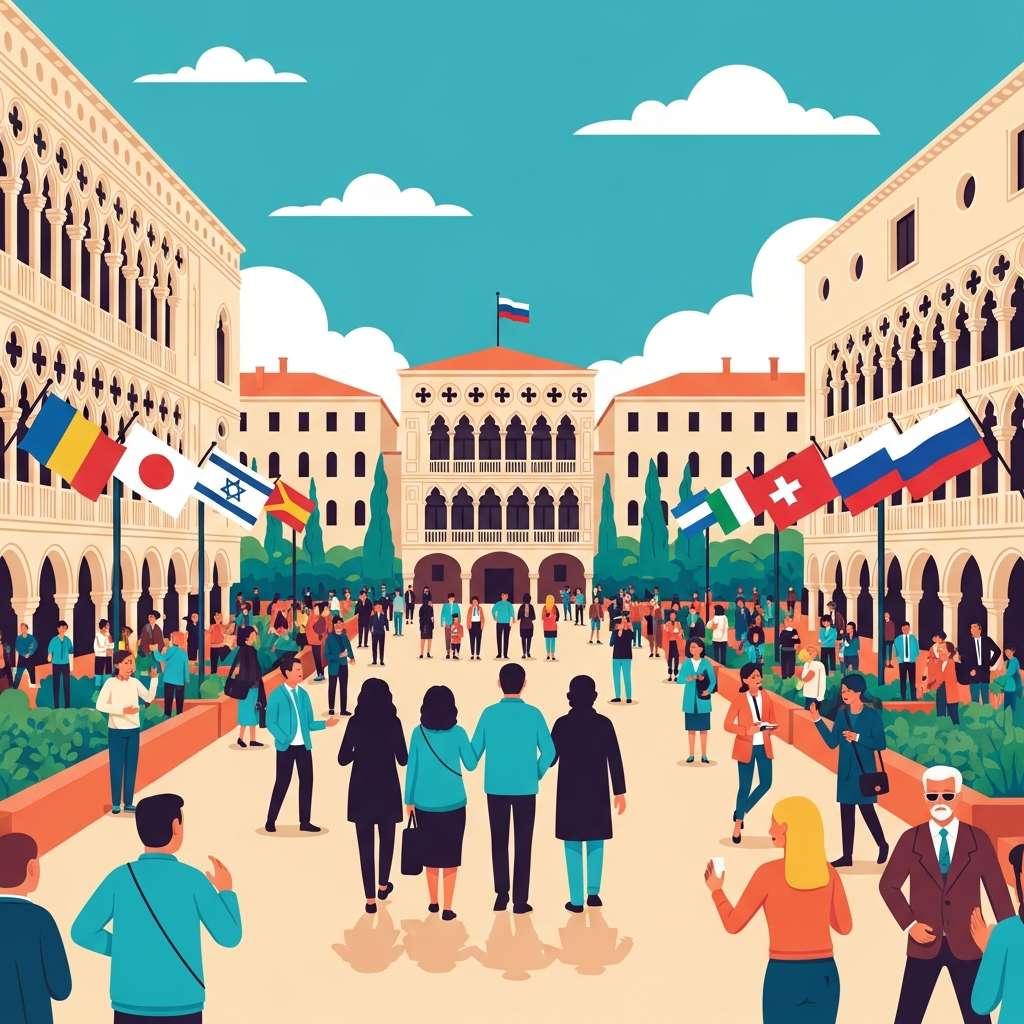
The Venice Biennale was founded in 1895, shortly after Italian unification, as a vehicle for national cultural competition — effectively a soft-power Olympics where states could assert cultural prestige before international audiences. The Giardini's 30 permanent national pavilions, physically owned by their respective governments, have preserved this 19th-century imperial logic essentially unchanged for well over a century: the state selects the artists, provides the funding, and presents the exhibition under the national flag. Within this structure, the claim that "art is separate from politics" is not merely debatable — it is structurally incoherent. Every decision about which nations may participate is itself a political act, and the decision to include all applicants without distinction is a political position, not the absence of one. When the International Criminal Court has issued arrest warrants against a state's leadership and the United Nations has formally documented serious violations of international humanitarian law, permitting that state a prestigious international cultural platform while declaring neutrality constitutes, in effect, tacit endorsement. The physical layout of the Giardini itself encodes this political history in concrete and stone: the dominant Western powers secured the most prominent positions during the era of European imperialism, while later-arriving nations exhibit in secondary spaces — a spatial hierarchy that was never neutral and has never been meaningfully reformed.
Koyo Kouoh's Legacy and the Deepest Irony — "In Minor Keys" Swallowed by the Loudest Noise
Koyo Kouoh, the Cameroonian-born director of the Zeitz Museum of Contemporary Art Africa and the first African woman appointed as curator of the Venice Biennale, chose "In Minor Keys" as her theme — a radical program to amplify peripheral voices, suppressed histories, and cultural narratives that dominant Western institutions have systematically marginalized or erased. Her curatorial vision represented one of the most conceptually ambitious challenges to the Biennale's Eurocentric structural assumptions in the event's history, and she was uniquely positioned — by background, institutional role, and intellectual vision — to give it real institutional form. But Kouoh died before the exhibition opened, and in her absence, the Biennale she designed as a festival of small voices became the arena for the most deafening geopolitical argument the contemporary art world has witnessed in living memory. The Israel-Palestine and Russia-Ukraine conflicts — precisely the current-day examples of dominant power systematically erasing smaller voices — flooded the space her curatorial framework had prepared for a different kind of conversation entirely. The deepest irony is that the Biennale, operating without its architect, has demonstrated in real time exactly the mechanism she sought to critique: dominant institutional inertia continues to function, and the loudest narrative drowns out the minor keys, precisely when there is no curator strong enough to hold the frame against it. Her absence has become, paradoxically, the most powerful argument for everything she was trying to say.
The Visitors' Lion Vote — Democratic Art Evaluation or the Institutionalization of Irresponsibility?
The Biennale's decision to replace its resigned professional jury with a "Visitors' Lion" public vote presents itself as a democratization of cultural judgment — giving ordinary exhibition-goers the power to determine the most prestigious award in contemporary art. But the deeper reality is that this represents an institutional transfer of responsibility rather than a genuine expansion of democratic participation, and the distinction matters enormously. Professional art evaluation synthesizes technical accomplishment, conceptual depth, art-historical context, and broader social significance in ways that specialized expertise enables — a form of knowledge that cannot be replaced by visitor preference without fundamentally changing what is being measured and recognized. Under a public vote system, the operative question shifts from "what work is most artistically significant?" to "what work attracts the most attention?" — and in an environment dominated by intense political controversy, those two questions have dramatically different answers. The deeper irony, noted by critics within the boycott movement itself, is that public vote systems favor controversy and visibility, potentially giving the national pavilions the jury sought to distance itself from a structural advantage in popular attention. This decision — made under acute crisis pressure rather than considered institutional deliberation — risks setting a precedent that could spread to other cultural events, gradually eroding the role of specialized expertise in determining what the art world collectively considers most significant and most worthy of recognition.
EU Sanctions and Cultural Autonomy — A Legal Precedent Being Made in Real Time
The European Parliament's warning that Russia's Venice Biennale participation may violate the EU's existing sanctions packages represents a genuinely unprecedented legal development: the potential first-ever application of international diplomatic sanctions to a cultural event. In sport, the institutional and legal framework for this kind of action already exists and has been exercised — the IOC required Russia to compete under a neutral flag at the Paris 2024 Olympics, and FIFA excluded Russia from the 2022 World Cup qualifying process. In the cultural sector, no equivalent framework has ever been established, and the Venice case is constituting the test for whether one will be created. If the EU's interpretation is formalized through official legal channels, every international cultural event in Europe will face new obligations regarding participant countries under diplomatic sanctions — obligations that cultural institutions were never designed to evaluate or enforce. The ethical complexity is considerable: excluding a national athletic team from a sporting competition is relatively clear-cut, but excluding an individual artist — who may be presenting explicitly anti-war work and who may personally oppose their government's actions — solely on the basis of their nationality raises profound questions about whether exclusion in the name of human rights can itself constitute a form of the suppression that human rights principles are designed to prevent. How this legal question is resolved will define the parameters of cultural institutional autonomy for the next generation, and Venice is now the unavoidable test case.
Positive & Negative Analysis
Positive Aspects
- A Historic Restoration of Moral Agency in the Art World
The simultaneous resignation of all five jury members represents a watershed moment for the art world's sense of its own moral agency — a faculty that major cultural institutions have systematically suppressed for decades under the cover of claimed neutrality. For the better part of the 20th and early 21st centuries, art institutions deflected difficult ethical questions by retreating behind the shield of "our role is art, not politics," a position that conveniently insulated them from accountability while allowing them to accept state funding, confer prestige on national programs, and host governments without scrutiny. The five jurors' decision to resign collectively and publicly, with a joint statement citing specific geopolitical realities, is a declaration that this era is ending — that the people who constitute cultural institutions are no longer willing to subordinate their ethical judgment to institutional convenience and career protection. Historical parallels are instructive: the boycott of White-owned galleries by Black artists during the Civil Rights era and the global cultural boycott of apartheid South Africa both represented similar moments when individual conscience asserted itself against institutional complicity, and both produced lasting structural changes that once seemed impossible. The Venice resignation stands in this historical tradition, and its long-term consequences for how cultural institutions understand their own moral responsibilities are likely to be as significant as any legislative reform.
- Individual Conscience Scaling Into Organized Collective Movement
The involvement of more than 70 artists in the awards boycott represents a qualitative shift in how the art world's political conscience operates — a transformation from isolated individual statements into organized, sustained collective action with genuine institutional weight. In prior episodes of art world political protest, the typical pattern involved one or two prominent figures releasing personal statements, generating a few days of media coverage, and then dissolving back into professional life without institutional consequence or structural change. The Venice 2026 situation is structurally different: the jury's institutional resignation provided an anchor point around which participating artists organized in a way that transformed individual moral positions into a sustained collective movement with growing numbers and public visibility. This kind of multi-layered coalition — institutional actors and individual practitioners acting in visible coordination — is historically the most effective mechanism for producing durable reform in cultural systems. The public visibility of the boycott signatory list has also created a form of professional accountability that is relatively new to the art world, making participation in the resistance movement a matter of public identity rather than purely private choice, which significantly raises the stakes for institutions and individuals who decline to respond to the moment.
- The Public, Permanent Demolition of the "Art Is Neutral" Fiction
The Venice jury resignations have accomplished something in the realm of cultural discourse that decades of academic critique and sustained artist activism had failed to achieve at scale: a public, widely witnessed, and effectively irreversible demolition of the "art is separate from politics" fiction. This fiction functioned as the single most convenient tool available to cultural institutions seeking to avoid accountability — whenever an artist made political statements, they were told to "stick to art"; whenever an institution made a controversial decision, "art's neutrality" served as the institutional shield. The jurors, by resigning publicly with a specific, politically grounded joint statement, shattered this shield before a global media audience. CNN, NPR, The Guardian, and The Conversation all framed their coverage around the thesis that "art institutions cannot remain separate from politics" — editorially endorsing the jurors' position as a matter of verified fact rather than contested opinion. Going forward, no major cultural institution will be able to invoke "we are neutral" with the same ease or credibility. The fiction has not merely been challenged — it has been publicly and permanently retired, witnessed by an audience too large to allow quiet reversal.
- Kouoh's Vision Realized — Paradoxically but With Real Force
There is a profound and painful irony in the fact that Koyo Kouoh's vision for "In Minor Keys" has been realized — not in the way she intended, but with a global reach and emotional force that her curated exhibition alone could not have generated. Kouoh designed the Biennale as an occasion to amplify peripheral voices and suppressed stories, to challenge the dominance of Western cultural narratives, and to create institutional space for conversations that powerful organizations prefer to avoid. The crisis that erupted around the Biennale has done exactly this, on a global scale: the voices of artists from conflict zones, the moral arguments of the resigned jury, the protests outside the contested national pavilions, and the collective action of more than 70 artists have forced the world's sustained attention onto precisely the questions her curatorial framework was designed to raise. Her name has become a symbol rather than merely a curatorial credit — a touchstone for reform arguments that will dominate Biennale discussions for years to come. The grief of her absence and the power of her intellectual legacy are now inseparable, and that inseparability is itself a form of the minor-key resonance she was reaching for when she accepted the most prestigious curatorial appointment of her career.
- A Catalyst for Long-Overdue Global Cultural Governance Reform
The Venice crisis is already functioning as a catalyst for structural changes extending well beyond a single art event, operating as the trigger for a long-overdue reformation of global cultural governance frameworks. The European Parliament's sanctions warning, the likely reverberations through Documenta and the Gwangju Biennale, the potential initiation of UNESCO multilateral discussions — these represent a multi-layered institutional response that is historically rare in its pace and cumulative scale. Large institutional systems — cultural, legal, intergovernmental — typically change very slowly, requiring sustained pressure over many years before structural reform occurs. The Venice jury resignations, occurring at the precise intersection of multiple acute geopolitical crises and a global conversation about institutional accountability, have compressed that timeline in ways that individual events rarely achieve. If the comparison to sport is instructive, the IOC and FIFA required years of sustained political pressure before formally acting against Russia — the art world is moving toward analogous institutional decisions on a compressed timetable, and the Venice Biennale 2026 is the primary catalyst for that acceleration.
Concerns
- Replacing Expert Judgment With Public Popularity — Structural Risk to Cultural Standards
The Biennale's decision to substitute a public "Visitors' Lion" vote for its resigned professional jury is, whatever its democratic framing, a structural retreat that risks permanently degrading the quality of cultural judgment that has made the Venice prize meaningful and market-relevant for 131 years. Expert art evaluation is a form of specialized knowledge requiring deep engagement with art history, technical craft, international contemporary practice, and conceptual frameworks — it cannot be replicated by visitor preference without changing what is fundamentally being measured and recognized. Under a popular vote system, the question shifts from "what work demonstrates the most significant artistic achievement?" to "what work generates the most public attention?" — and in a politically charged environment, those questions have dramatically different and often opposing answers. The more dangerous long-term consequence is the precedent being set: if the Venice Biennale normalizes the replacement of expert panels with public popularity contests during institutional crises, other cultural events facing similar pressures will be tempted to follow the same path, gradually eroding specialized expertise in cultural evaluation across the global art ecosystem. The Biennale had creative options for reconstituting a jury under new parameters — it chose instead to abandon expert judgment entirely, a decision that appears expedient in the short term but represents a significant institutional self-diminishment with consequences that will outlast this edition.
- The Structural Paradox — The Boycott Harms Individual Artists, Not Governments
The deepest structural problem with the awards boycott is that its actual costs fall almost entirely on individual artists rather than on the governments whose policies motivated the protest in the first place. Artists exhibiting in national pavilions are overwhelmingly individuals whose personal political views bear no necessary relationship to their government's conduct: a Russian artist may have created explicitly anti-war work for the Russian pavilion, and an Israeli artist may hold profound and publicly expressed opposition to their government's military policies. The boycott reduces these complex individuals to national labels, evaluating their work through the lens of their passport rather than their artistic practice — which is precisely the categorical logic the boycott coalition is ostensibly opposing. This structural paradox — that the instrument of protest replicates the reasoning of what is being protested — is recognized within the boycott movement itself but has not yet produced any resolution. The history of art contains many cases where artists used their platform to directly oppose their government: Russian artists who defied Socialist Realism at personal risk, Israeli artists who have been among the most vocal international critics of occupation policy. Punishing these voices through nationality-based exclusion from awards consideration is, on close examination, a reproduction of the same categorical thinking the boycott is designed to challenge.
- The Risk of Moral Purity Competition Becoming Internal Art World Censorship
There is a real and serious risk that this moment of genuine ethical clarity will evolve into a social enforcement mechanism within the art world that operates through the logic of compulsion rather than conscience, producing a new conformism with different content but the same suppressive structure. Social media platforms are already circulating lists of artists who have not signed the boycott, and the framing of "silence equals complicity" is being applied in ways that leave no institutional room for private disagreement, good-faith divergence of political opinion, or professional neutrality. The art world's history contains dark precedents for politically enforced aesthetic and political conformity — Soviet Socialist Realism and the Hollywood blacklist of the McCarthy era both operated through the mechanism of social and professional sanctions for non-compliance with approved positions. The current boycott is not comparable in scale or state sponsorship to those historical cases, but the underlying mechanism — professional and social consequences for declining to adopt the publicly approved position — is structurally similar and carries genuine risks of eventually suppressing the diversity of voice and perspective that genuine artistic vitality depends on. A movement that began in defense of artistic conscience will have fundamentally undermined itself if it ends by creating a new enforced conformism, even one with more sympathetic politics than previous versions.
- Long-Term Threat to Cultural Institutional Autonomy From Externally Imposed Legal Frameworks
If the European Parliament's sanctions warning is formalized into binding legal guidance applicable to cultural events, the consequences for cultural institutional autonomy could be severe and structurally difficult to reverse. A legal framework applying diplomatic sanctions to cultural events would effectively transform cultural institutions from autonomous artistic organizations into instruments of government foreign policy, required to make participation decisions based on diplomatic criteria rather than curatorial or artistic judgment. The precedent in sport provides an incomplete template: excluding a national athletic team from a sporting competition is relatively unambiguous, because the team straightforwardly represents the national program in a well-defined competitive context. Excluding an individual artist on the basis of national identity — particularly an artist whose work may constitute direct opposition to their government's conduct — is a fundamentally different action with far more complex ethical implications. A legal framework blunt enough to apply cleanly across diverse situations will likely produce unjust outcomes in specific cases; a framework nuanced enough to account for those cases may be too complex to enforce consistently. Either outcome represents a significant cost to cultural institutions' capacity to function as genuine spaces of artistic freedom and cross-border cultural exchange, which has historically been one of their most important social functions in periods of political conflict.
- The Economic and Reputational Damage — A Self-Inflicted Wound With Lasting Consequences
The Venice Biennale occupies a unique position as both the world's most prestigious contemporary art event and a major engine of Venice's regional economy, and the damage this crisis is inflicting on both dimensions may prove significantly harder to reverse than the institution currently acknowledges. The 2024 edition drew over 700,000 visitors and generated hundreds of millions of euros in regional economic activity; sustained controversy combined with high-profile boycotts and the absence of credible jury adjudication creates conditions for meaningful attendance declines, sponsor withdrawals, and decreased national participation from delegations reassessing the reputational calculus of association with a troubled event. In the art market, a Venice award has historically produced a significant multiplier effect on an artist's market value and career trajectory — an award issued under contested circumstances by popular vote rather than expert jury carries a fraction of that market authority, reducing the incentive for the most ambitious artists and national programs to invest maximum resources in Biennale participation. Over the longer term, if the Biennale's global credibility continues to erode, competing events — Documenta in Kassel, Art Basel in various editions, Frieze in London and New York — stand to capture the prestige and market influence that Venice has historically commanded. The 131-year legacy of institutional authority is an asset, but it is not inexhaustible, and an institution that cannot navigate a legitimacy crisis with strategic clarity will find that prestige is considerably easier to lose than to rebuild.
Outlook
Let me be direct about what the next six months look like. The Venice Biennale 2026 runs through November 23, and these six months — the first in the event's history without a functioning international jury — will constitute an unrepeatable stress test of institutional crisis management. The boycott numbers will grow. More than 70 artists have signed the awards boycott at time of writing, and I expect that number to exceed 100 before the end of summer. The symposia, public programs, and parallel events built around the Biennale calendar will be dominated by this debate, and additional gallerists, critics, and institutional collectors will publicly decline participation in award-adjacent activities. The question is no longer whether the protest movement will expand — it is how large it will grow before November.
The newly introduced "Visitors' Lion" public vote — the Biennale's replacement for professional jury adjudication — is scheduled to open voting in September, and this vote will become the next flashpoint in the controversy. If works from the most contested nations receive strong public attention and high vote counts, the boycott coalition will interpret this as confirmation that controversy has replaced artistic merit as the primary currency of cultural recognition. If those works receive minimal votes, the Biennale administration will declare vindication for its democratic model. Neither result ends the argument — it simply relocates it to a new stage. What I find more significant than the vote outcome itself is the precedent being established: for the first time in its history, the Venice Biennale has outsourced its most consequential aesthetic judgment to a general audience of tourists and occasional visitors. That decision — made under crisis pressure rather than institutional deliberation — will define debates about cultural authority for years to come, well beyond this particular edition.
The European Parliament's legal warning demands close attention in this near-term window. EU legislators have signaled that Russia's Biennale participation may constitute a violation of the bloc's existing sanctions packages against Russia. If that interpretation is formalized through official EU legal process, the Venice Biennale 2026 would become the first cultural event in modern history subject to the formal application of international diplomatic sanctions — a development without precedent and with enormous downstream implications for every cultural institution in Europe. I expect some form of legal clarification to emerge from EU institutions before the year's end. The Italian government is caught in a structurally difficult position: the Biennale is simultaneously Italy's most prestigious cultural brand and a cornerstone of Venice's regional economy. The event drew over 700,000 visitors in 2024, generating hundreds of millions of euros in economic activity. Sustained controversy could translate to a 10-15% attendance decline this year — tens of millions of euros in losses — creating political pressure that will pull Italy's Ministry of Culture into what has so far been framed as a purely institutional dispute.
Looking six months to two years ahead, the ripple effects across the international exhibition circuit will become the dominant story. The Venice Biennale sets the global standard for contemporary art practice and institutional ambition. What happens here does not stay in Venice — it travels to every biennial, triennial, and major international survey exhibition on the calendar. Documenta in Kassel, the Sydney Biennale, the São Paulo Biennale, the Gwangju Biennale — each of these events will be navigating the precedent Venice has established when they convene their next editions. I expect at least two or three major international art events to face analogous controversies over national participation before 2027. Documenta is particularly exposed: it already endured a serious antisemitism controversy in 2022 and faces strong pressure to redesign its participation frameworks for its next edition. The Venice precedent gives every curator, jury member, and institutional director in the global circuit an unavoidable question to answer publicly — and the cost of offering no answer will be significantly higher after 2026 than it was before.
The more structurally consequential medium-term development will be discussion of reform to the national pavilion system itself. I believe the Biennale will attempt some form of partial structural restructuring between 2027 and 2028. The most realistic scenario involves a hybrid model — maintaining the existing national pavilions while substantially expanding the proportion of thematically curated international presentations, from the current roughly 30% of the program to something closer to 50% or above. This would allow artists to be evaluated on the merits of their work rather than their national identity, giving the Biennale institutional latitude to step back from the most politically explosive participation decisions. Eliminating the national pavilions entirely is legally impossible — thirty countries own physical buildings in the Giardini, and those property rights cannot be dissolved by institutional preference alone. But restructuring the awards architecture to privilege thematic over national presentation would effectively reduce the national pavilion's cultural weight without requiring any nation to surrender its property deed. I also assign a 30-40% probability to the European Commission publishing formal guidance on the relationship between cultural institutional autonomy and diplomatic sanctions compliance before 2027, representing the first-ever attempt to legally codify this tension.
Looking two to five years ahead, the deepest long-term implication of the Venice crisis is the emergence of what I would call a new framework for global cultural governance. Between 2028 and 2030, I expect UNESCO to begin formal multilateral discussions around participation standards for major international cultural events. This path has already been traveled in sport: the IOC required Russia to compete under a neutral flag at the Paris 2024 Olympics, and FIFA excluded Russia from the 2022 World Cup qualifying rounds. The art world is following a trajectory that sport navigated five to ten years earlier, and the Venice crisis is the event that will accelerate that convergence. The critical ethical difference remains: excluding a national athletic team is relatively unambiguous, because the team directly represents a national sporting program. Excluding an individual artist — who may be presenting explicitly anti-war work, and who may personally oppose their government's actions with considerable courage — solely on the basis of their nationality is a fundamentally different act with far more complex ethical implications. This tension will not be quickly resolved and will remain one of the art world's most active and contested debates for at least a decade.
A longer-term structural possibility worth naming directly is what I call the partial de-nationalization of the Biennale. I assign roughly 35% probability to the Venice Biennale experimenting with diaspora-based or cultural-region-based pavilion models before 2030. The 2024 edition already saw major critical recognition for presentations organized around African diaspora themes rather than national borders, and Kouoh's own curatorial philosophy pointed directly toward this kind of structural rethinking of how cultural identity is organized in exhibition space. Framing exhibition groups around shared cultural experience, migration histories, and lived reality — rather than the passport an artist carries — would allow work addressing displacement and state violence to be framed as "an artist confronting war" rather than "the Russian pavilion." This would represent the most fundamental structural transformation in the Biennale's 131-year history, changing not just the awards system but the event's foundational organizing logic. Reports suggest the African Union and certain Asian cultural foundations are already in early discussions about continental or regional participation models, and if those conversations advance meaningfully, the existing nation-state-centered architecture will face its first serious challenge from within.
The scenarios map out as follows. In the bull case — roughly 25% probability — the Biennale uses this crisis as genuine institutional fuel for transformation: the 2028 edition launches a hybrid model with transparent participation standards and a reconstituted jury with a broadened mandate, and Venice establishes a new global model for culturally engaged international exhibitions that can honestly confront geopolitical realities without retreating into false neutrality. The base case — most likely at around 50% probability — involves incremental, reluctant reform: the national pavilion structure is preserved, the awards system is quietly adjusted, unofficial guidelines for contested participation are developed, and the jury is reconstituted with less prominent figures carrying less institutional risk. The controversy fades gradually without fundamental resolution, and the structural contradictions are deferred rather than addressed. The bear case — roughly 25% probability — sees the Biennale refuse meaningful structural change, triggering an escalating boycott that eventually draws the formal withdrawal of major Western nations' official participation, sharply diminishing the event's global authority and accelerating the shift of the contemporary art world's center of gravity toward Asia and Africa.
Let me be honest about the conditions that could make this analysis wrong. If the Israel-Palestine and Russia-Ukraine conflicts move toward ceasefire or armistice within the next year, political pressure on the Biennale will ease substantially, and structural reform momentum could dissipate before it produces institutional change. There is also a real risk of boycott fatigue within the art world itself: if every major political crisis generates an automatic cultural boycott, artists face an exhausting and professionally dangerous choice between creative practice and political positioning, and a counter-reaction will eventually emerge. My larger point stands, however: do not read this story as art world news. What is happening at the Venice Biennale is a compressed, intensified version of the question every major institution — university, corporation, media organization, sporting body, museum, foundation — is currently navigating in some form. Can a powerful institution claim neutrality in the face of documented political violence? The Biennale's answer, however it unfolds, will serve as a preview for the rest of us. The age when that question could be deferred indefinitely is over.
Sources / References
- Venice Biennale Russia Israel controversy — CNN
- Venice Biennale jury resignation proves art cannot remain separate from politics — The Conversation
- Venice Biennale 2026 jury resigns en masse — ArtNews
- More than 70 Venice Biennale artists withdraw from awards — The Art Newspaper
- Venice Biennale 2026 international jury resigns — ArtReview
- The Venice Biennale jury resigns — NPR
- Curatorial text by Koyo Kouoh — La Biennale di Venezia
- Venice Biennale Israel Russia protests pavilion — Forward