
Cannes 2026: The Main Stage Flopped, the Sidelines Exploded — And the Power Shift Is Real
Summary
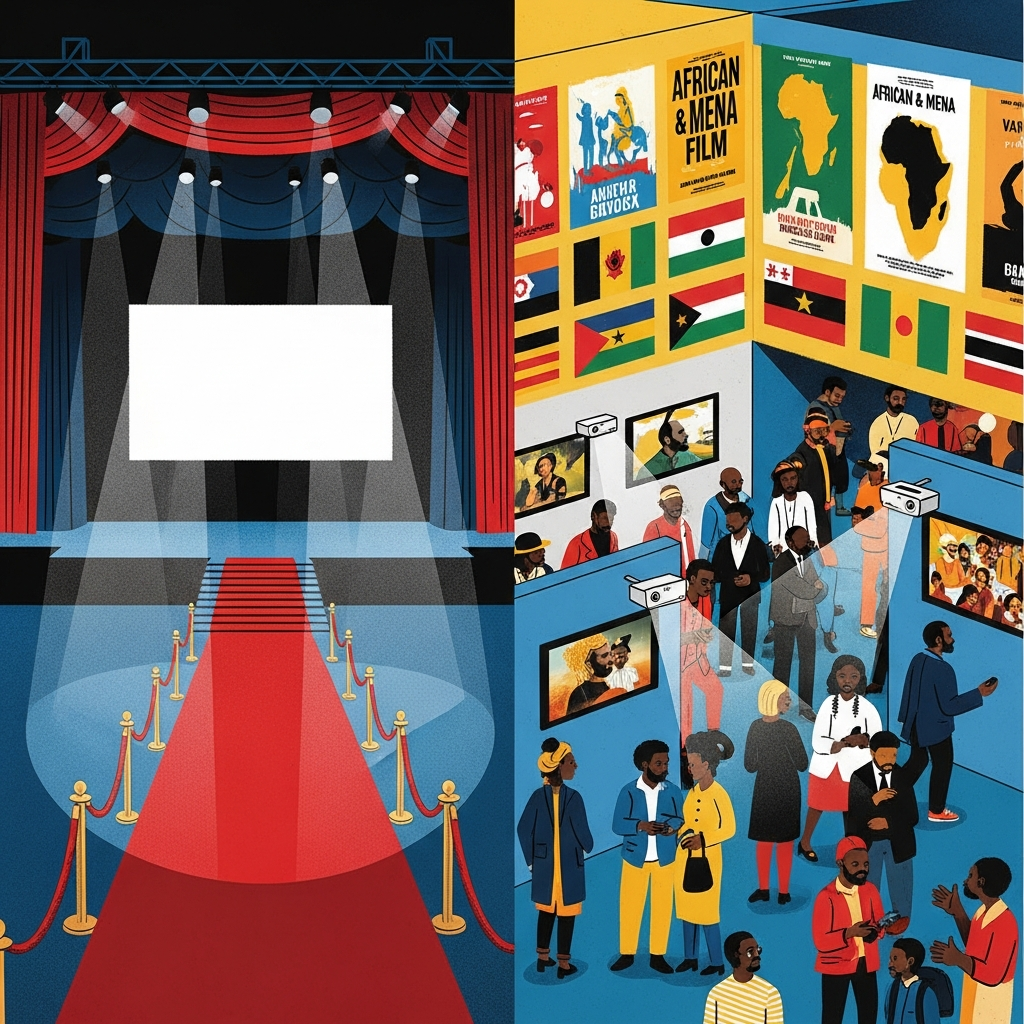
The 2026 Cannes Film Festival's main competition has drawn fierce international criticism after failing to include a single Black director among its selections, reigniting a structural diversity debate that has persisted for decades despite repeated pledges of reform. Simultaneously, African and MENA filmmakers are achieving unprecedented visibility across Cannes' parallel and non-competitive sections — Un Certain Regard, Directors' Fortnight, and the Marché du Film — creating a striking paradox where the sidelines are outperforming the main stage in energy, relevance, and market impact. This contradiction exposes a deep structural bias baked into Cannes' century-old selection criteria, which have long centered European auteur cinema as the self-evident universal standard of cinematic excellence while systematically disadvantaging non-Western filmmakers before they even submit a screener. Against this backdrop, Africa's film industry — led by Nollywood's annual output of over 2,500 films and a market now valued at approximately $6 billion — is demonstrating a growing ability to reach global audiences entirely outside the Cannes gatekeeping apparatus, turbocharged by major OTT investments from Netflix and Amazon. The broader trajectory points unmistakably toward a multipolar global cinema ecosystem in which Cannes retains symbolic prestige but loses its monopoly as the definitive arbiter of world cinema within the next five years, as the real locus of power migrates from festival competition slates to market deals, streaming platforms, and self-sustaining regional film industries.
Key Points
The Structural Bias in Cannes Main Competition
The absence of a single Black director from Cannes 2026 main competition is not a selection oversight — it is the predictable outcome of roughly a century of accumulated institutional bias that has never been fundamentally addressed. Cannes artistic director and selection committee have operated within a self-reinforcing framework that defines European auteur cinema as the universal gold standard of film excellence, a framework so naturalized that it rarely has to justify itself explicitly. Inside that framework, Nollywood genre-driven kinetic energy, East Africa experimental documentary tradition, and the narrative forms native to non-Western storytelling cultures are structurally disadvantaged before a single screener is reviewed. The 2018 moment — when the world discovered that only two women had ever won the Palme d Or in Cannes history — generated enormous pressure and resulted in measured, marginal adjustments to committee composition, but it did not touch the underlying selection criteria that produce the patterns. This is not uniquely a Cannes problem: it reflects a broader challenge facing Western-origin cultural institutions that claim universal relevance while being constituted by and for a specific regional tradition. The deeper question the 2026 lineup forces us to confront is not why no Black directors? but rather who decides what counts as world-class cinema, and what cultural assumptions are embedded in that judgment? The answer to that question reveals not a system that failed to achieve its stated ideals, but a system that is operating precisely as it was designed to operate — which is why cosmetic reforms at the margins have consistently failed to change the outcome.
The Sideline Paradox: When the Margins Outshine the Main Stage
The most counterintuitively significant development at Cannes 2026 is happening not in the Lumiere Theatre but in the parallel and non-competitive sections where the festival official prestige hierarchy does not apply. Un Certain Regard, Directors Fortnight, and the Marche du Film have collectively become the site of a genuine cultural and commercial eruption, with African and MENA filmmakers achieving a scale of visibility and market engagement that would have been inconceivable five years ago. The Zouaoui Brothers Afrobeat-infused reimagining of Virginia Woolf is generating critical buzz that cuts across cultural boundaries; directors from Congo, Rwanda, Morocco, and Sudan are represented in numbers that signal a structural shift rather than token inclusion. The AfroCannes Pavilion is drawing global investors and distributors at record volume, creating deal-making opportunities that translate directly into production financing and distribution agreements. This dynamic has a historical precedent that is worth naming explicitly: Motown Records was founded by Black musicians who had been systematically excluded from white-owned major labels, and what they built in that space of exclusion did not just survive — it fundamentally reshaped American popular music and proved that cultural power does not require institutional permission to develop. Africa sideline strategy at Cannes 2026 may be following the same structural logic: the energy and investment that the main competition refused to accommodate has concentrated in the spaces the main competition does not control, and those spaces are now generating the deals, the visibility, and the industry relationships that actually determine long-term cinematic influence.
The Marche du Film: Where Real Power Actually Lives
One of the most clarifying realizations about Cannes 2026 is that the festival actual center of gravity has always been the Marche du Film, not the competition screenings — and this year African deal flow is making that visible in ways that are hard to ignore. Cannes red carpet and competition announcements generate the cultural mythology and the global press coverage, but the Marche is where films find their financing partners, distribution agreements, and co-production relationships — the commercial infrastructure that determines whether a film actually reaches audiences beyond its national premiere. This year, African film-related transactions at the Marche are projected to increase by more than 40% compared to 2024, and Nigerian and Ghanaian production houses are closing global distribution deals without a single main competition credit to leverage. What this means structurally is that the Palme d Or, for all its symbolic weight, is increasingly one path to market access among several available to competitive international productions — and for African filmmakers specifically, it may be a less efficient path than direct market engagement through the Marche and the AfroCannes Pavilion. An industry that measures its progress in deals closed rather than trophies won is an industry building structural leverage that does not disappear when the next Cannes cycle brings a new selection committee with new aesthetic priorities. The migration of real power from the competition stage to the market hall is not a consolation narrative for those who did not make the competition — it is a description of where cinema commercial future is actually being negotiated.
How OTT Platforms Are Dismantling Cannes Gatekeeping Function
For roughly a century, Cannes functioned as the primary gateway to international visibility for non-English-language films — if you wanted a global audience, you needed Cannes to discover you. That gatekeeping function is being systematically dismantled by OTT platforms, and the implications for African cinema specifically are profound. Netflix alone invests over $100 million annually in Nigerian original content and operates a platform capable of delivering films to a global audience of 270 million subscribers simultaneously — a reach that dwarfs anything Cannes can offer even in its most high-profile competition year. Amazon and Disney+ are accelerating their own African market investments, creating a competitive OTT landscape for African content that generates both financing and distribution at scales the festival circuit cannot match. The global African diaspora audience — estimated at approximately 200 million people worldwide — represents a market that OTT platforms can reach directly and efficiently, making the Cannes discovery narrative structurally irrelevant for productions targeting that audience. This does not mean festivals are becoming irrelevant across the board — there are specific functions where festival selection still provides unique value. But the idea that Cannes functions as a necessary passage point for African films seeking global reach is becoming increasingly anachronistic, and the filmmakers who understand that are already building distribution strategies that treat Cannes as optional rather than essential.
Nollywood and Africa Self-Sustaining Film Ecosystem
The most underappreciated dimension of the Cannes 2026 diversity conversation is the degree to which African cinema growth has been self-generating rather than dependent on Western institutional validation. Nollywood is already the world second-largest film industry by production volume, generating over 2,500 films annually in a market valued at approximately $6 billion — and all of that was built without a single Cannes Palme d Or, without major Hollywood studio backing, and without the co-production funding mechanisms that European cinema relies on heavily. This self-sustaining character gives African cinema a structural resilience that culturally dependent industries lack: because it was built on its own audience base, its own financing networks, and its own distribution channels, it is not vulnerable to the withdrawal of external validation in the way that might otherwise be expected. The Lagos International Film Festival, Durban International Film Festival, and Marrakech International Film Festival are all developing toward international significance on their own terms, creating the beginnings of a prestige infrastructure that does not require European festival endorsement to function. By 2028, African cinema annual market revenues are projected to exceed $10 billion, driven by middle-class expansion across the continent, aggressive screen infrastructure investment, and mobile streaming penetration that is growing faster in Africa than anywhere else in the world. This is an industry with structural momentum, and the question of whether Cannes recognizes it is becoming less important to that momentum by the year.
Positive & Negative Analysis
Positive Aspects
- Africa Film Industry Is Growing On Its Own Terms
The most powerful argument for optimism in this conversation is that African cinema extraordinary growth has been largely self-generated and structurally independent of Western festival validation — which means it is not vulnerable to the withdrawal of that validation in the way a more dependent industry would be. Nollywood 2,500+ annual productions and $6 billion market valuation were built on African audiences genuine enthusiasm for African stories, not on critical endorsement from European film festivals. Ghana, South Africa, Kenya, and Ethiopia are all developing their own production ecosystems, creating a pan-African creative infrastructure that generates compounding effects over time: as more productions get made, more technical talent develops, more financing mechanisms emerge, and more distribution channels become viable. This self-sustaining quality is the hallmark of a genuinely durable cultural industry rather than a moment of external attention that will fade when the spotlight moves elsewhere. The trajectory strongly suggests that African cinema is following a version of the path Asian cinema has already traveled — from Western curiosity to autonomous global industry — and is doing so at a pace accelerated by both the internet distribution infrastructure and the OTT platforms appetite for non-English-language content. An industry with its own audience base, its own financing networks, and its own distribution channels is structurally positioned to grow regardless of what any individual film festival decides to select or exclude.
- The Marche du Film Is Creating Real Economic Opportunity
The AfroCannes Pavilion operating at record scale in 2026 is not just a symbolic milestone — it represents a genuine and consequential expansion of the economic opportunity available to African filmmakers, and it happening at the festival where the main competition has excluded them. African film-related transactions at the Marche are projected to increase more than 40% year-over-year, and that translates directly into production financing, distribution agreements, and co-production partnerships that shape what gets made and who gets to see it. The Marche du Film has always been the actual commercial engine of Cannes — the competition generates the cultural mythology, but the Marche generates the business relationships that determine whether films find audiences beyond their national borders. For African filmmakers, cracking the Marche deal-making ecosystem is arguably more valuable than any competition selection would be, because it creates structural economic relationships rather than one-time prestige moments. The accumulation of these deals over successive years builds the financing and distribution infrastructure that the African film industry needs to operate at genuinely global scale, independent of whether Western festival committees evolve their selection criteria. This is how cultural industries achieve durable global reach: not through winning prizes, but through building the business relationships that make consistent production and distribution financially viable.
- The Global Festival Ecosystem Is Healthier Without a Single Center
One of the genuinely positive dimensions of the current moment is that the global film festival ecosystem is developing into a more diverse, multipolar structure — and that is unambiguously good for cinema as an art form and as an industry. BIFF in Busan has established itself as the definitive hub for Asian cinema, with a global reach and influence that rivals Cannes in its specific domain. TIFF in Toronto functions as the primary gateway to North American distribution and awards season for international films. Berlinale has developed a distinctive identity around politically engaged cinema. Venice remains the most prestigious launching pad for prestige awards season campaigns. Each of these festivals serves a specific function in a complex ecosystem, and the more they develop distinct identities rather than competing to replicate Cannes, the better the system works for filmmakers from all backgrounds. Africa growing festival infrastructure — Marrakech, Durban, Lagos, and others — is adding nodes to this network that will further redistribute the flow of cinematic prestige and commercial opportunity. A world in which no single festival controls the definition of cinematic greatness is a world with more pathways for more stories from more cultures, and that benefits audiences everywhere. The era of Cannes unipolar dominance was never actually as good for world cinema as it was for a specific tradition within it.
- OTT Platforms Are Delivering Unprecedented Global Access
The Netflix, Amazon, and Disney+ investments in African original content have created something genuinely new: a direct, scalable pathway for African films and series to reach global audiences without requiring festival validation, theatrical distribution infrastructure, or the complex co-production arrangements that have historically gatekept access to international markets. Netflix annual $100+ million investment in Nigerian content alone is transforming what is possible for African filmmakers who can navigate the platform commissioning process, and the 200 million-person global African diaspora represents a ready audience that these platforms can reach with extraordinary efficiency. The shift from festival-gated to platform-direct distribution is not just a change in the mechanics of how films travel — it is a fundamental restructuring of who has power in the international cinema economy. When a film can go from production in Lagos to a global audience of hundreds of millions without passing through a Cannes competition slot, the festival role in the industry value chain has genuinely and permanently changed. This democratization of global film access is not without complications — platform investment is not culturally neutral, and algorithm-driven commissioning creates its own aesthetic pressures. But the structural expansion of access to global distribution that OTT platforms have created for African cinema represents a genuine historical shift that no future reorganization of the festival system is likely to reverse.
- Diverse Storytelling Is Proving Its Commercial Value
Perhaps the most decisive argument against the gatekeeping logic that has historically excluded African cinema from Cannes main competition is that diverse cultural perspectives are proving their market value at scale — making the exclusion not just ethically questionable but commercially irrational. Afrobeats did not cross over by earning critical validation from established Western music institutions; it crossed over because the music was genuinely compelling to audiences who encountered it, and the market responded. African cinematic storytelling is following the same trajectory: the investor and distributor interest at the AfroCannes Pavilion this year reflects market judgment, not charity, and market judgment at that level of sophistication is not based on sentiment. When global investors are putting serious capital into African film projects, they are betting that African stories can find global audiences — and recent track records from Netflix African originals suggest that bet is well-placed. This commercial validation matters because it creates a self-reinforcing cycle: proven market interest attracts more investment, more investment enables higher production quality, higher production quality attracts broader audiences, and broader audiences generate more market interest. The moral argument for diversity in world cinema has always been strong; the market argument for it is now catching up, and that combination tends to produce structural change faster than either argument alone.
Concerns
- The Structural Financing Gap Is Real and Stubborn
For all the genuine optimism in this story, the financing disparity between African cinema and its European and North American counterparts remains a structural constraint that market momentum and critical attention alone cannot resolve. France average film budget exceeds 5 million euros; most Nollywood productions operate on $50,000 to $100,000 — a disparity of 50-to-1 or greater, and that gap directly determines technical quality, the depth of post-production work, the sophistication of international marketing campaigns, and the ability to satisfy the requirements of European and North American co-production funding mechanisms. This is not a talent gap or an ambition gap — it is a capital gap, and capital gaps in creative industries do not resolve themselves through cultural momentum alone. The international co-production funding infrastructure — the Franco-German co-production treaties, the European Film Fund mechanisms, the various national film commissions — was built for and around European cinema, and African filmmakers face significant structural disadvantages in accessing these mechanisms even when their projects are competitive on creative grounds. The implicit technical quality threshold that Cannes main competition applies in its selection process is easier to meet with a 5 million euro budget than with $75,000, and that financial reality reproduces the structural exclusion in ways that no amount of committee diversification will fully address unless the financing infrastructure changes alongside it.
- Diversity-Washing Is a Real and Present Danger
Cannes pattern of significantly expanding African and MENA representation in its non-competitive sections while keeping the main competition closed constitutes a textbook example of the diversity-washing dynamic that has frustrated reform efforts in corporate and institutional contexts for decades. The mechanism is straightforward and insidious: by demonstrating visible commitment to diversity in the spaces where the symbolic and commercial stakes are lower, Cannes generates the appearance of openness while preserving the underlying power structure in the space where it actually matters. The sidelining narrative — we feature more African films than ever — becomes a defense against the structural critique — why is the main competition still so homogenous? And there is a particularly troubling compounding effect: the genuine and impressive growth of the AfroCannes Pavilion and the Un Certain Regard selections provides Cannes with credible evidence for the diversity defense, making it harder to maintain pressure for reform of the main competition. Corporate diversity discourse has generated a well-documented playbook for this dynamic: publish impressive aggregate numbers, ensure visible representation in roles that do not involve actual decision-making power, and use that surface-level diversity as insulation against accountability for the power structure that remains unchanged. Cannes 2026 is running a version of that playbook in the cultural domain.
- OTT Platform Dependency Is a Two-Edged Sword
The Netflix and Amazon investment boom in African content is genuinely transformative, but it also introduces a structural vulnerability that the African film industry cannot afford to ignore. Platform investment decisions are driven by subscriber acquisition and retention algorithms, competitive positioning against other streaming services, and quarterly earnings pressure from public company shareholders — not by cultural commitments or long-term industry development goals. Netflix demonstrated this concretely in 2023 when it cancelled several African projects, a decision driven entirely by platform-level business considerations that had nothing to do with the quality of the work or the importance of African content. An African film industry that becomes heavily dependent on OTT platform investment without simultaneously building independent distribution infrastructure, domestic theatrical networks, and diverse financing mechanisms is an industry that remains perpetually exposed to these platform-level reversals. The specific risk of cultural co-optation is also worth naming: when African films are primarily selected and commissioned based on their appeal to a global Netflix subscriber demographic rather than their relevance to African audiences, the editorial independence of African filmmaking is compromised in ways that may not be immediately visible but accumulate over time. Diverse storytelling that gets filtered through a global algorithm is not the same thing as African cinema on its own terms.
- Sideline Success Can Justify Structural Exclusion
There is a genuinely troubling dynamic in the possibility that African cinema extraordinary sideline performance at Cannes 2026 ends up being used — consciously or not — to justify the continuation of the structural exclusion from the main competition. The logic runs something like: these filmmakers are thriving in the sections designed for them, and the main competition has its own standards that happen to produce a different outcome. This is not a hypothetical — it is the pattern that has historically allowed structural inequality in multiple domains to persist long past the point where it should have been addressed. In American social history, the commercial and cultural success of Black artists in spaces that were not explicitly controlled by white gatekeepers was frequently cited as evidence that the system was working for everyone, when in fact it was evidence that Black creativity was generating value that the dominant structures were systematically capturing without equitably distributing the rewards. Applying that pattern to Cannes: the vibrant sideline success story and the structural main competition exclusion are not in tension with each other — they are two sides of the same system, and celebrating the former without demanding transformation of the latter reinforces rather than challenges the power imbalance. True reform means changing who gets the trophy, not just expanding the sections where exclusion is less visible.
- Internal African Imbalance Risks Creating a New Sideline
The African cinema narrative that has generated such deserved excitement at Cannes 2026 obscures an internal diversity problem that could itself become a significant obstacle to the broader project of genuine cinematic inclusivity. The African film industry growth story is disproportionately a Nollywood and South African story: Nigeria and South Africa together account for the majority of African cinema international visibility, investment flows, and OTT platform deals. This concentration means that filmmakers from East Africa, Francophone West Africa, the Horn of Africa, and Central Africa risk being marginalized within the very narrative constructed around their marginalization. The AfroCannes Pavilion, for all its record-scale success this year, trends toward English-language African productions and established production markets. Geopolitical instability — the Sudan conflict, Sahel insecurity, political volatility across several Francophone African states — actively suppresses what filmmakers from some of the continent most culturally rich regions can produce and bring to international attention. Celebrating Africa cinematic renaissance without attending carefully to who within Africa gets to participate in that renaissance risks creating a new layer of exclusion inside the inclusive narrative — a sideline within the sideline, where the structural disadvantages are reproduced at a smaller scale but with the same fundamental dynamic.
Outlook
The most immediate thing to watch after Cannes 2026 wraps is the shape of the diversity backlash: will it produce any concrete institutional response, or will it evaporate the moment the Palme d Or press cycle winds down? My read is almost certainly the latter. We have been here before. After the 2018 moment — when the world suddenly registered that only two women had ever won the Palme d Or in Cannes entire history — the festival offered measured reform commitments. The selection committee composition shifted slightly at the margins. Statements were issued. The following year competition slate looked familiar. Cannes has a deep institutional inertia that individual outrage cycles cannot overcome, and one social media news cycle, however loud and internationally visible, is unlikely to bend it. If anything, the more interesting short-term question is how Cannes communications team frames the criticism — whether they lean into the sideline diversity narrative as evidence of the festival openness, or whether they engage with the structural critique of the main competition.
What is genuinely worth monitoring in the three-to-six-month window is the deal flow coming out of the Marche du Film. Total Marche transaction volume is projected to rise 15-20% year-over-year at Cannes 2026, and if African-related deals account for more than 5% of that total, it marks a structural inflection point rather than a good-news moment. The specific figures announced in the weeks following the festival will function as leading indicators for where global cinema investment is flowing over the next 12-24 months. The AfroCannes Pavilion deal announcements, in particular, will signal whether the investor attention this year represents genuine market recalibration or sophisticated networking theater. The stakes of that distinction are significant: if real capital is moving, the growth narrative has self-reinforcing momentum; if it is primarily relationship-building, the structural financing gap persists for another cycle.
Over the following 12 months, a second major attention point is how Toronto and Venice respond to the Cannes diversity conversation in their own September lineups. Both festivals have watched the Cannes backlash unfold in real time, and both have been progressively expanding their African film programming in recent years. The strategic opportunity is obvious: if Toronto or Venice can position itself as the international film festival most genuinely committed to global cinematic diversity, it does not just address the criticism — it builds a competitive advantage in the prestige economy of world cinema. I expect at least one of these festivals to make a visible programming statement in 2026 that directly references the conversation Cannes sparked. The OTT platforms next-quarter Africa investment announcements will also land in this window, and the Cannes buzz will almost certainly factor into those decisions in positive ways.
Looking ahead to 2027-2028, I expect the broader film festival ecosystem to undergo genuine structural pressure from multiple directions simultaneously. Cannes will almost certainly respond to sustained criticism by making visible adjustments — most likely including one or two African directors in the competition slate for 2027, framed as evidence of meaningful change. I am skeptical that this represents structural reform rather than strategic optics. The Hollywood parallel is instructive and not particularly encouraging: after OscarsSoWhite erupted in 2016, the Academy diversified its membership in statistically meaningful ways over the following years. Yet a decade later, the structural gatekeeping dynamics of mainstream Hollywood storytelling have not shifted as dramatically as those membership statistics might suggest. Institutional reform and genuine cultural power redistribution operate on different timescales, and the gap between them tends to be filled with well-intentioned gestures that do not change underlying selection criteria.
The more meaningful medium-term shift will be Africa active construction of alternative prestige infrastructure — what I would call de-Cannesian-ization. The Lagos International Film Festival, Durban International Film Festival, and Marrakech International Film Festival are all on solid growth trajectories. If any one of them achieves genuine A-list international status by 2028, it changes the competitive dynamics for every major film festival in the world, including Cannes. A separate African film market event spun off from the Marche du Film is also a realistic scenario — the AfroCannes Pavilion momentum this year could become the foundation for an independent market by 2028. My projection for African cinema annual market revenues is $10 billion crossed by 2028, up from approximately $7 billion today. That growth is powered by three compounding forces: middle-class expansion across the African continent; aggressive screen-count investment with Nigeria alone having plans for 500+ new screens between 2025 and 2028; and surging mobile streaming penetration rates that deliver films directly to audiences without requiring traditional theatrical infrastructure.
Looking further out, to 2029-2031, the global cinema ecosystem is heading toward a genuinely multipolar structure — and this is where the trajectory becomes most interesting and most uncertain. Cannes will almost certainly still rank among the most prestigious film festivals in the world by 2031. What I do not believe it will retain is its position as the unambiguous, unchallengeable apex of global cinema culture. The combination of a thriving pan-African film market, Asia continued production powerhouse status, Latin America growing festival infrastructure, and OTT platforms ability to deliver films to a billion-person global audience without any festival involvement at all creates an environment where no single institution can sustain a monopoly on cinematic authority. This pattern tracks very closely with what happened to geopolitical power structures after the Cold War — the transition from a clear unipolar moment to a messy, contested multipolarity where influence is distributed and contested rather than concentrated. Cinema version of that transition is already underway.
The key metric I will be watching is the correlation between Cannes competition selection and global distribution deal closure rates. Right now, selection in the Cannes main competition still translates to distribution deals at roughly an 85% rate — an extraordinary conversion rate that reflects the festival residual gatekeeping power. If that figure drops below 60% by 2030, it signals that the market has structurally decoupled from Cannes editorial judgment, and the festival role shifts from gatekeeper to one influential voice among several. That is the inflection point where the Palme d Or stops being determinative and starts being advisory. I actually think there is a more realistic near-term scenario than an African director winning the Palme d Or by 2030: that the Palme d Or industrial leverage shrinks to roughly 50-60% of its current level regardless of who wins it, because the market infrastructure for reaching global audiences no longer requires festival validation as the primary on-ramp.
Long-term, the most disruptive force will not be a rival festival or a streaming platform — it will be technology itself, specifically the collapsing cost of high-quality production and post-production. By 2030, it is plausible that AI-assisted post-production tools will reduce what currently costs $1 million to roughly $10,000 or less. When that happens, the structural capital barrier that has most severely disadvantaged African filmmakers — the enormous gap between their average production budgets and the technical polish that Cannes selection criteria implicitly require — begins to collapse. The Nigerian filmmaker will be able to produce technically world-competitive work at a fraction of the current cost differential. Automated translation and subtitle technology is simultaneously removing language barriers from distribution, meaning African films no longer need to be produced in English or French to reach global audiences. Both of these technological forces work directly against the structural advantages that European auteur cinema has accumulated over a century, and they do so not through policy change but through economic disruption.
Here is how I see the scenario space shaking out. In the optimistic outcome — I would put this at roughly 25% probability — Cannes undergoes genuine structural reform between 2027 and 2028: the selection criteria are explicitly revised, the committee is fundamentally restructured, and African directors begin appearing in the main competition with real regularity. A Palme d Or for an African filmmaker becomes reality by 2030. Simultaneously, a major African film festival achieves international A-list recognition, creating genuine competition for Cannes at the prestige level and establishing a viable alternative prestige pathway. In the base scenario — roughly 50% probability — Cannes implements cosmetic reform while the sidelines continue to grow stronger year over year. African cinema achieves occasional competition appearances, representing genuine if incremental progress, but the festival ecosystem remains structurally centered on European and North American auteur traditions. The multipolar shift accelerates in the market but not in the symbolic economy of festival prestige. In the pessimistic scenario — roughly 25% probability — Cannes resists meaningful change and gradually loses legitimacy with younger, more globally diverse audiences and filmmakers, while African cinema itself remains structurally dependent on OTT investment without building the independent distribution infrastructure needed to weather platform strategy reversals. Financing gaps persist, intra-African geographic imbalances deepen, and the industry global influence remains constrained relative to its creative output and cultural vitality.
The variables that could prove this forecast wrong deserve explicit acknowledgment. Global economic conditions are the biggest wild card: if OTT platforms enter another aggressive cost-cutting cycle and scale back African investment the way Netflix did with several projects in 2023, the financial underpinning of this growth story weakens considerably and quickly. Intra-African imbalance is a second major risk that often gets lost in the broader diversity conversation: the African cinema label covers a continent of 1.4 billion people across 54 countries speaking thousands of languages, and Nollywood dominance within that label creates its own internal exclusion dynamic. Filmmakers from East Africa, Francophone West Africa, and the Horn of Africa risk becoming a sideline within the sideline — marginalized within the very narrative about marginalization. Geopolitical instability, particularly the ongoing Sudan conflict and Sahel insecurity, also remains a structural ceiling on what filmmakers from some of the continent most culturally rich regions can actually produce and bring to international attention.
The most direct action any serious film consumer can take is to redirect their attention deliberately and intentionally. Rather than defaulting to Cannes competition winners as the default benchmark for world-class cinema, actively seek out the Un Certain Regard selections, the AfroCannes Pavilion highlights, the TIFF Africa programming, and the Netflix Africa originals. Audience consumption patterns are market signals, and market signals shape industry investment flows, which shape who gets to make films and on what terms. Waiting for Cannes to reform its competition is a passive strategy; redefining your own consumption as an audience member is immediate, cumulative, and effective. Film critics and curators carry a proportionate responsibility here — the Western-centric canon list does not interrogate itself. What Cannes 2026 is teaching us, if we are paying attention, is that the real transformation in global cinema is not being announced from the main stage. It is being built, deal by deal and film by film, in the sidelines — where the old rules have not yet been written, and where something genuinely new can still take shape.
Sources / References
- Cannes Film Festival 2026 Official Lineup — Variety
- Cannes 2026: MENA Lineup — Films of War and Exile — The New Arab
- Cannes 2026: Three African Productions in Un Certain Regard — Afrocritik
- Cannes 2026 Showcases Diverse Creativity — Philadelphia Tribune
- The Lowdown on All the Cannes 2026 Titles — Screen Daily
- AfroCannes Official Site — AfroCannes
- 20 Most Anticipated Cannes 2026 Premieres — The Film Stage
- Cannes 2026: What to Expect — Yahoo Entertainment