
They Demolished 85% of a Historic Fortress and Called It "Preservation." Europe Needs to Check Its Hypocrisy.
Summary
Europa Nostra's 2026 list of Europe's 7 Most Endangered Heritage Sites exposes systemic failure at the heart of European cultural preservation policy. Malta's Fort Chambray, an 1843 British military barracks on Gozo, received planning permission to demolish 85% of its historic structure for a five-star hotel and luxury apartments, with the project officially classified as a heritage restoration initiative. The NGO Din l-Art Helwa mounted a legal challenge, only to have its first appeal dismissed by a Maltese tribunal on April 30, 2026, with a second appeal currently pending. Greece's Amorgos island faces parallel threats from a massive port expansion project encroaching on a 3,500-year-old Minoan city, while heritage sites across Hungary, Luxembourg, Portugal, Romania, and Serbia are being lost to chronic underfunding and institutional neglect. Across all seven sites, the same pattern repeats: development capital and public indifference converge to erase irreplaceable history, exposing the bitter irony that the continent with the highest concentration of UNESCO World Heritage Sites is simultaneously among the most active destroyers of its own heritage.
Key Points
Fort Chambray, Malta — The 85% Demolition They're Calling "Preservation"
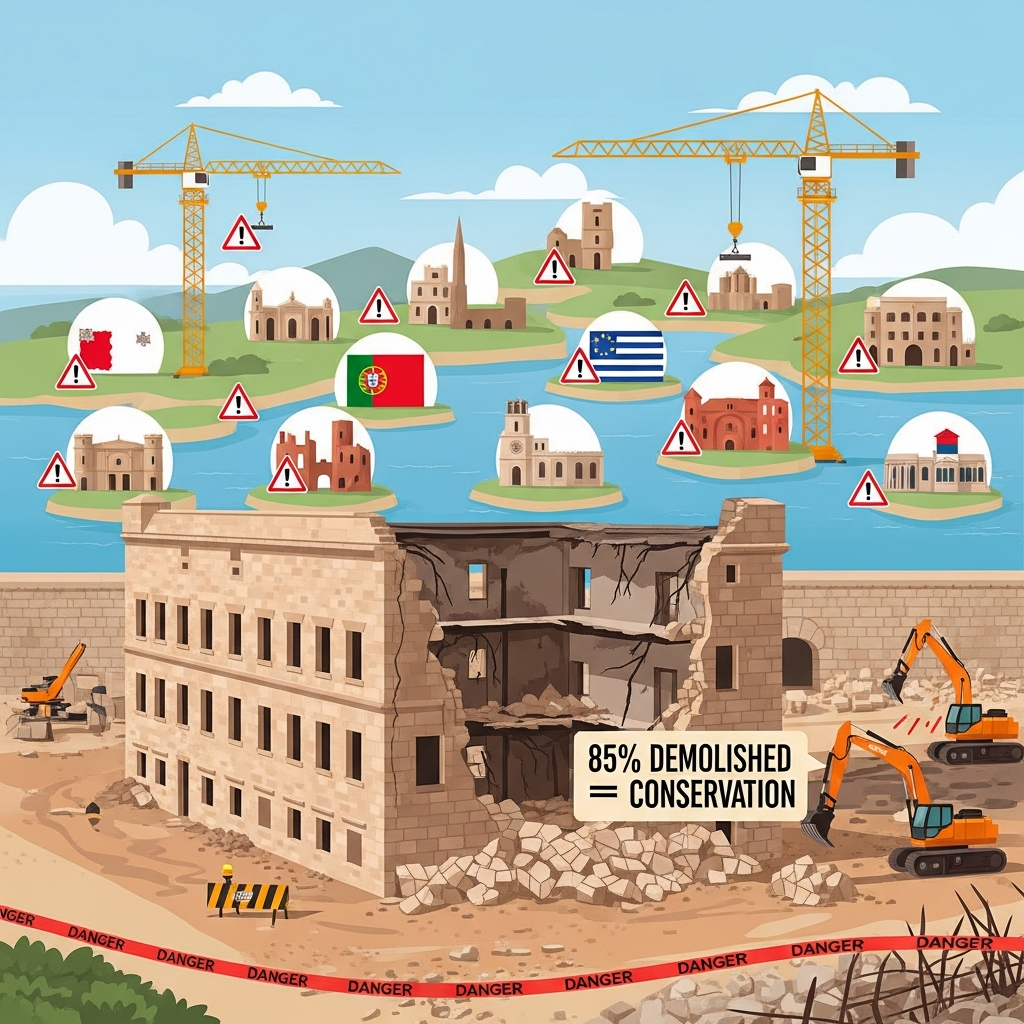
Fort Chambray, located on the island of Gozo in Malta, is an 1843 stone barracks complex that British forces constructed as a key strategic node in their Mediterranean defense architecture, representing a significant chapter in European military history and colonial-era construction. In 2024, Malta's Planning Authority approved a scheme allowing the demolition of 85% of the historic structure to make way for a five-star hotel and 105 luxury residential units, with the surviving 15% nominally designated as the preserved component of the project. The NGO Din l-Art Helwa mounted an immediate legal challenge, but on April 30, 2026, a Maltese tribunal issued a comprehensive dismissal of their first appeal, leaving only a second appeal — currently in progress — as the remaining domestic legal avenue. Legal observers in Malta widely expect the second appeal to face the same fate, given the tribunal's unambiguous ruling and the current government's clear pro-development policy stance. What makes this case so structurally dangerous as a precedent is not just the specific outcome but the template it creates: once demolish 85%, preserve 15% is institutionally ratified as a legitimate heritage intervention, every subsequent development project can cite it as justification for increasingly aggressive site clearances framed as conservation work. If Fort Chambray goes forward as currently planned, it will stand as the most symbolically damaging failure in Europa Nostra's 13-year history, and its precedent will reverberate through heritage law debates across Europe for the next decade.
Greece's Amorgos — A 3,500-Year-Old Minoan City vs. a Modern Port
On the Cycladic island of Amorgos in the Aegean Sea, the village of Katapola contains the remnants of an ancient Minoan city dating back approximately 3,500 years, recognized by international archaeologists as one of the most historically significant Bronze Age sites in the entire Cyclades island chain. The Greek government's push to expand the local port infrastructure has placed this site under direct physical threat, with construction-related vibrations, ground disruption, and changes to coastal hydrology all carrying documented risk of irreversible structural damage to the ancient remains. Archaeologists and geologists have jointly warned that even indirect disturbance from port construction could destabilize foundations and subsurface deposits that have survived intact for millennia, making any damage effectively permanent. The contradiction here is striking: Greece has built an entire global brand identity around its ancient civilization, and yet its own infrastructure investment agenda is putting one of its most significant Bronze Age sites at direct physical risk. The Environmental Impact Assessment is expected to produce a final decision by summer 2026, and the outcome will serve as a direct precedent for dozens of similar conflicts between infrastructure development and heritage protection across the Mediterranean basin. Amorgos's additional profile as the filming location of Luc Besson's The Big Blue adds an unexpected international dimension, meaning that any demolition of the Minoan site would face not just archaeological condemnation but global cultural outrage from audiences who know and love the island's identity.
Five Sites Across Europe — Systematic Neglect as Heritage Policy
Of the seven sites on Europa Nostra's 2026 list, five are not being threatened by active development pressure — they are simply being abandoned, slowly and systematically, by the governments and communities responsible for them. Hungary's Fabri watermill in Péked faces repeated flooding damage and accelerating structural collapse. Luxembourg's Bloer Hall in Esch-sur-Alzette cannot secure basic maintenance funding despite its architectural significance. Portugal's Millas gunpowder factory in Seixal, a significant artifact of industrial-era history, is being consumed by vegetation, while Romania's Santa Maria Orlea Reformed Church is losing irreplaceable medieval frescoes to moisture and cracking. Serbia's Weifert brewery in Pančevo — a masterpiece of 19th-century industrial architecture — has sat unprotected for decades, exposed to flooding and extreme weather events that compound its deterioration every year. The common thread running through all five is the same pattern of deliberate budgetary omission: Europe invests billions in the preservation of its most glamorous and tourist-friendly heritage while systematically starving military, industrial, and religious heritage that does not fit the promotional narrative. This is not resource scarcity — it is selective cultural memory institutionalized through budget choices, and the 2026 list is documentary evidence of that selection process actively destroying irreplaceable history.
Europa Nostra's €10,000 Grant — Symbolic Funding for a Structural Crisis
The direct financial support Europa Nostra provides to each site on its Most Endangered list is approximately €10,000 — an amount that does not cover the cost of a single expert consultant's week-long site assessment at many of these locations. Against the backdrop of Fort Chambray's estimated full preservation cost in the tens of millions of euros, the €10,000 grant reads less as meaningful support and more as a gesture designed to maintain the appearance of institutional engagement without the substance of it. The broader EU budget picture confirms that this is not Europa Nostra's failure alone but a reflection of the entire European institutional approach to cultural heritage. The Creative Europe program's annual budget allocates approximately €50 million to direct heritage preservation out of a total envelope of roughly €2.4 billion, while the Common Agricultural Policy distributes approximately €55 billion per year. By that comparison, the EU spends more on farm subsidies for a single mid-sized agricultural region than it allocates for the preservation of cultural heritage across the entire continent. Until that fundamental budget imbalance is addressed — which will require a political coalition powerful enough to take on agriculture and infrastructure lobbying simultaneously — the annual Europa Nostra list will remain a ritual of alarm without the financial tools required to actually respond to the alarm it is raising.
Development Law vs. Heritage Law — A Legal Hierarchy That Guarantees Failure
In the majority of European Union member states, heritage protection statutes occupy a structurally weaker position in the legal hierarchy than planning and development codes, meaning that once a developer successfully navigates the administrative approval process, heritage protection arguments face enormous hurdles in court and frequently lose. Malta's tribunal dismissal of Din l-Art Helwa's appeal was not an aberration but a predictable output of a system where the legal architecture was never designed to stop compliant development projects. Most of the heritage protection laws currently on the books across Europe were drafted in the middle decades of the 20th century, long before transnational development capital had the resources, legal sophistication, and regulatory arbitrage capabilities to systematically circumvent national heritage frameworks. The law as written simply does not contemplate a scenario where a private developer backed by billions in international capital can legally demolish a nationally significant heritage site while the government watches helplessly from the sidelines. If the Fort Chambray case were to escalate to the European Court of Human Rights — which remains a live possibility at roughly a 15% probability — it could produce the first continent-level legal ruling directly addressing the tension between heritage conservation rights and development property rights, which would carry immediate persuasive weight in domestic legal proceedings across all 27 EU member states.
Positive & Negative Analysis
Positive Aspects
- Europa Nostra's 13-Year Track Record — A System That Has Actually Worked
Europa Nostra's partnership with the European Investment Bank has produced a genuinely functional early warning system for European heritage over 13 years, flagging 91 sites in distress and securing preservation outcomes for a meaningful portion of them. When international attention concentrates on a specific site, the political cost of governmental inaction rises — and in multiple documented cases, that cost has been high enough to produce real policy changes. The 2016 listing of a Romanian Orthodox church led directly to full-scale restoration financed through EU structural funds, and a 2018 Turkish historic market building avoided demolition after an international campaign amplified by the Most Endangered designation. These are not flukes — they represent a repeating mechanism where reputational pressure on governments translates into budgetary and administrative action. The program's 13-year longevity is itself meaningful evidence that European civil society maintains a real, durable commitment to heritage preservation, and that the political will to respond exists and can be activated under the right conditions. Without this system, significantly more of Europe's at-risk heritage would already be gone, and the institutional infrastructure for future campaigns would be far weaker.
- Civil Society's Legal Capacity Is Growing — And More Coordinated Than Ever
The willingness of Din l-Art Helwa — a single NGO operating in a country of 530,000 people — to mount and sustain a legal battle against both the Maltese government and a well-resourced international developer demonstrates that civil society heritage advocacy has real institutional muscle, even when it faces structurally unfavorable legal conditions. The significance of this extends well beyond Malta's courts and the Fort Chambray case. Even if both appeals fail, the legal arguments constructed, the evidentiary record assembled, and the international coalitions activated in this battle become immediately usable templates for the next fight — in Portugal, in Romania, in Serbia, in any European country where development pressure meets heritage resistance. European heritage NGOs are increasingly building cross-border coordination infrastructure, sharing legal strategies, advocacy frameworks, and technical expertise in real time across national boundaries. That growing transnational solidarity is one of the most structurally significant positive developments in the heritage preservation ecosystem, and it is building the kind of durable institutional capacity that short-term funding fights cannot easily dismantle.
- Digital Preservation Technology Is Changing What "Loss" Means
The rapid advancement of 3D scanning, photogrammetry, and Building Information Modeling means that even when physical demolition becomes unavoidable, the architectural and historical information embedded in a structure can now be preserved with near-complete fidelity in digital form. The ongoing 3D scanning of the Minoan city on Amorgos is a concrete example of this shift: whatever happens to the physical site, the archaeological record will survive in a form that supports future research, education, virtual experience, and — if conditions ever change — potential physical reconstruction. The economic case for digital preservation is also strengthening rapidly, with unit costs projected to reach approximately 40% of current levels by 2028, making comprehensive digital documentation of at-risk sites economically viable at a scale that was impossible five years ago. Digital archives are not a substitute for the physical presence of historic structures, but they are increasingly valuable complements that transform the meaning of heritage loss from total erasure to permanent documentation with future-use potential. The technology's rapid cost decline also suggests that digital preservation will shift from a supplementary tool to a standard baseline requirement in heritage management practice within the next five to seven years.
- Heritage Conservation Is Becoming a Social Movement — And Gaining Political Weight
The convergence of heritage preservation advocacy with environmental activism, climate justice, and community self-determination movements is transforming the political profile of cultural conservation in ways that significantly expand its institutional reach and political leverage. When heritage preservation is framed solely as a concern for specialists and history enthusiasts, it commands limited political attention and even less budgetary priority. When it is framed as a dimension of climate justice — because extreme weather is destroying irreplaceable cultural assets — or as a dimension of community rights, it recruits constituencies that heritage campaigns alone would never reach. This broader framing is increasingly evident in European Parliament debates and in the legislative agenda of multiple member state parliaments, where heritage-related provisions are being attached to climate legislation and urban planning reform bills. If this trend continues, the lobbying coalition behind the next EU Multi-annual Financial Framework negotiation will be considerably stronger than the one that produced the current underfunded Creative Europe structure, and the political arithmetic around heritage budget increases will look meaningfully different.
Concerns
- Structural Underfunding Is Chronic — And the Budget Math Does Not Work
Europa Nostra's €10,000 direct grant to each designated site is the clearest possible symbol of how catastrophically underfunded European heritage preservation has become as a policy priority. The gap between this figure and the actual cost of preserving a site like Fort Chambray — where full conservation would run to tens of millions of euros — is so large that it calls into question whether the grant is meant to actually help or merely to demonstrate institutional attention. The broader EU budget structure confirms that this underfunding is systemic and not incidental. The Common Agricultural Policy distributes roughly €55 billion annually, while Creative Europe's total envelope is around €2.4 billion with direct heritage preservation receiving perhaps €50 million of that. By comparison, that €50 million is less than the annual player transfer budget of a mid-table European football club. Even if the next MFF delivers a 1.5 times increase in heritage funding — which is the realistic optimistic projection — the resulting €75 million annually still falls far short of what is required to meaningfully address the scale of at-risk heritage across a continent of 450 million people. The structural budget imbalance has been embedded in EU institutional politics for decades and will not be resolved by advocacy campaigns alone.
- Heritage Law Is Structurally Outmatched by Development Capital
The legal framework governing heritage protection across most of Europe was designed in an era when the primary threat to historic structures was neglect and physical deterioration — not sophisticated international development capital capable of legally navigating around every statutory protection through compliant administrative procedure. In most EU member states, heritage protection statutes are subordinate to planning and development codes in the formal legal hierarchy, meaning that developers who complete the required approvals process can often proceed with demolition even when heritage organizations and local communities object. Malta's tribunal dismissal of Din l-Art Helwa's appeal was the legally logical outcome of a system built this way, not a surprising judicial error. The ECHR route theoretically offers a higher-level judicial review, but the process is slow, expensive, and deeply uncertain — and physical demolition can proceed while the legal machinery grinds forward at its own pace. Reforming this legal hierarchy to give heritage protection statutory priority over development rights would require legislative action in multiple member states simultaneously, coordinated by EU-level framework legislation that does not currently exist and would face fierce opposition from property development and real estate lobbying interests.
- Rural Depopulation Is Killing Heritage Faster Than Any Developer
Five of the seven sites on the 2026 Europa Nostra list are not under attack from developers — they are simply being forgotten by communities that no longer have the economic or demographic capacity to care for them. Sites like Hungary's Fabri watermill and Serbia's Weifert brewery are deteriorating because the communities around them have lost the resources and population needed to maintain them. This is arguably a more intractable problem than development pressure, because it has no adversary and no legal remedy. You cannot litigate against neglect, and you cannot file a court injunction against a declining tax base or an aging population. The depopulation of Europe's rural and small-city regions is accelerating across multiple member states, and as it does, hundreds — potentially thousands — of heritage sites not currently on any endangered list are steadily losing the human infrastructure required to keep them standing. The solution requires coordinated action across rural economic development policy, heritage funding, and regional planning — a policy integration that does not exist at any level of European governance, and without which the next Europa Nostra list will include many sites that were not on anyone's radar in 2026.
- Climate Change Is Compounding Every Other Heritage Risk Simultaneously
The extreme weather events that swept across Europe in 2024 and 2025 — record flooding, intense storms, prolonged drought cycles followed by sudden heavy precipitation — inflicted severe and in some cases irreversible damage on heritage structures that were already operating at the margins of structural viability. Hungary's Fabri watermill has absorbed repeated flood damage that is accelerating its structural deterioration at a rate that outpaces any realistic preservation timeline. Romania's Santa Maria Orlea Reformed Church is losing its medieval frescoes to accelerating moisture stress from abnormal precipitation patterns that have intensified in recent years. Serbia's Weifert brewery, long exposed to extreme weather without protection, now requires restoration work whose cost grows faster each year it goes unaddressed. Climate scientists project that the frequency of extreme weather events in Europe will be approximately 1.5 times current levels by 2030, meaning that many heritage sites not currently classified as at risk will face acute structural threats within a decade. The compounding interaction of climate stress, chronic underfunding, and rural depopulation creates a crisis multiplier that the current European heritage preservation system — designed for simpler and slower-moving threats — simply was not built to handle at this scale and speed.
Outlook
In the next six months, the single most consequential moment is the outcome of Fort Chambray's second appeal. I put the odds of rejection at roughly 70%. The Maltese tribunal already dismissed the first appeal comprehensively, and the current Maltese government has made no secret of its pro-development posture. If the appeal fails, the developer is likely to break ground on full-scale demolition before the end of 2026. That would make this the most dramatic and contested failure in Europa Nostra's 13-year history — the moment the program's highest-profile advocacy effort ends not in preservation but in a demolition crane arriving on site.
There's roughly a 15% chance the case escalates to the European Court of Human Rights (ECHR), which would delay construction by at least one to two years and introduce a genuinely unpredictable legal variable into the picture. Din l-Art Helwa has reportedly been building connections with European-level legal support networks, which means even a domestic loss might open a second front under European human rights law. Whatever the outcome, this six-month window will define the trajectory of heritage preservation advocacy across the continent for years to come. The precedent Fort Chambray sets — in whichever direction it falls — will be cited in courtrooms and planning offices from Lisbon to Bucharest.
The situation in Greece is equally time-sensitive. The port expansion project at Katapola on Amorgos island is currently moving through the Environmental Impact Assessment process, with the Greek government committing to a final decision by summer 2026. My read is that Greece will handle this more carefully than Malta did. Greece has built its entire global tourism brand on the promise of ancient civilization — being labeled a destroyer of Minoan heritage is a reputational risk the government genuinely cannot afford. Amorgos is globally recognizable as the filming location of Luc Besson's The Big Blue, which amplifies the international visibility of any controversy. I'd put the probability of the project being scaled back or redirected to an alternative harbor location at around 40%, contingent on strong pushback from the archaeological community and civil society during the EIA review period. A full cancellation is politically unrealistic given Greece's infrastructure investment agenda, but a significantly reduced approval is the most plausible near-term outcome. This EIA decision will set a direct precedent for dozens of similar development-versus-preservation conflicts elsewhere in the Mediterranean.
In the medium term — roughly 2027 to 2028 — there's a genuine structural inflection point on the horizon. The next EU Multi-annual Financial Framework kicks in at the start of 2027, which means negotiations are already well underway. The current Creative Europe program runs at roughly €2.4 billion over seven years, with direct heritage preservation receiving an estimated €50 million annually. Europa Nostra and the European Heritage Alliance have launched formal lobbying campaigns calling for that heritage allocation to triple in the next MFF. Realistically, I expect political compromise to land somewhere between 1.5 times and 2 times the current level — maybe €75 million to €100 million per year. The reason I'm not more optimistic is structural: EU budget politics are dominated by agriculture, digital transformation, and the Green Deal, and cultural heritage consistently loses in those turf wars. An increase to €75 million would be meaningful progress, but it still would not come close to covering the scale of the problem. Fort Chambray alone could consume that in a single year.
Legal reform is the other major medium-term variable. If the Fort Chambray case does reach the ECHR, it could produce a landmark ruling with continent-wide implications — essentially, a judicial reckoning with the question of how much weight cultural heritage rights should carry against development and property rights. I expect that kind of high-profile ruling to trigger heritage law reform debates in at least three to four EU member states by 2028. Mediterranean nations like Malta, Greece, and Portugal are the most likely candidates for new statutory requirements — something like mandatory independent heritage impact assessments before large-scale demolition approvals can proceed. But law reform is slow by nature. The actual legislative changes could take several additional years to pass and enter into force, and in the meantime all already-approved development projects continue under the existing legal framework. There's also a macroeconomic headwind to consider: European real estate markets are showing renewed overheating signs as the 2025 to 2026 interest rate cutting cycle plays out. Development pressure may be accelerating faster than legal reforms can keep up with, which means the medium-term outlook for heritage sites in high-value coastal and urban locations looks genuinely precarious.
Looking further out — 2028 to 2031 — I believe the paradigm of European heritage preservation will have to undergo a fundamental transformation. The current model is reactive by design: governments designate sites, owners bear maintenance responsibility, NGOs sound the alarm when crisis hits. This is essentially a framework designed in the 19th century that has never been rebuilt for 21st-century threats. What I expect to emerge during this period is a serious shift toward preventive conservation — the same conceptual revolution that transformed medicine from treatment-centered to prevention-centered. In practice, this means AI-powered structural monitoring, satellite remote sensing, and IoT sensor networks embedded in cultural sites to track deterioration in real time, before it reaches crisis level. Italy's Pompeii site is already running drone and sensor-based preventive monitoring as a pilot program, and the technology cost trajectory suggests unit costs will fall to around 40% of current levels by 2028, making broad deployment realistic. I project that 15 to 20% of Europe's major heritage sites will have some form of digital monitoring infrastructure in place by 2030 — not enough to solve the systemic problem, but a meaningful start toward a more proactive preservation culture.
The longer-term wild card is what I'd call heritage finance — the emergence of cultural heritage preservation as a recognized asset class for impact investing and social bonds. Right now, heritage funding is almost entirely dependent on public budgets and small-scale philanthropy, which is not a sustainable model at the scale required. I expect ESG investing's Social category to formally incorporate cultural heritage preservation between 2027 and 2030, opening the door to private capital flows through impact investment vehicles and heritage-linked bonds. The World Bank's 2025 issuance of heritage-linked bonds and the European Investment Bank's publicly announced review of similar instruments are early signals of this shift. If this market develops to even €500 million annually, it would dwarf Europa Nostra's current grant program and fundamentally change the funding landscape. The risk is that ESG fatigue — already spreading through institutional investment circles — could reach the heritage sector before these instruments mature. A wave of heritage-washing could follow, where corporations sponsor photo opportunities at historic sites while contributing nothing substantive to actual preservation work.
Let me lay out the three scenarios I find most plausible. The optimistic case — roughly 20% probability — involves Fort Chambray's second appeal ultimately succeeding, the next EU MFF tripling the heritage budget, and at least three member states enacting meaningful heritage law reform before 2029. In this scenario, more than half of the 2026 Europa Nostra sites end up secured with genuine conservation plans, and the program's next years record the highest success rates in its history. The base case — roughly 55% probability — has Fort Chambray largely demolished, but the shock of that outcome catalyzes a 1.5 times budget increase in the MFF and triggers partial legal reform in two or three countries, with two or three of the seven 2026 sites genuinely saved. The pessimistic scenario — about 25% probability — involves no meaningful budget increase, continued legal paralysis, and five or more of the seven sites damaged or destroyed beyond recovery within five years. If that worst case materializes, the fundamental credibility of the Europa Nostra program faces serious questions, and broader civil society momentum around heritage preservation could fracture in ways that take a generation to repair.
The wildest of wild cards is a viral moment. When Notre-Dame de Paris caught fire in 2019, more than €1 billion in donations poured in from around the world within 48 hours. If Fort Chambray's demolition gets captured on video that goes massively viral, or if a major streaming platform produces a compelling documentary reaching a global audience, the calculus could shift dramatically. I think this is unlikely for Fort Chambray specifically — Notre-Dame was one of the most recognizable buildings on earth, and most people have never heard of Fort Chambray. But the underlying dynamic is real: heritage preservation's biggest enemy is invisibility, and its most powerful ally is human attention. One concrete suggestion before I close — if you're planning a trip to Europe, consider adding one of these seven sites to your itinerary. Tourism is one of the most powerful preservation incentives that exists. Your footsteps are a vote, and the front line of preservation is wherever people choose to show up.
Sources / References
- Full 2026 7 Most Endangered selection with background and per-site documentation — Europa Nostra Official Announcement
- Official EU announcement and EU-level policy context — European Commission Culture Directorate
- Malta NGO protest and Fort Chambray demolition approval reporting (May 2026) — The Shift News
- Tribunal dismissal of NGO appeal on Fort Chambray redevelopment (April 2026) — Malta Independent
- Fort Chambray site analysis and full 13-year program history — 7 Most Endangered EU
- Comparative analysis of all six countries and seven endangered sites — Travel and Tour World
- Academic structural analysis of European heritage preservation system failures — Heritage Research Hub