
Abandoned Capital, 1,300 Years of Farmland — Why Asuka-Fujiwara Survived So Perfectly
Summary
The Asuka-Fujiwara Archaeological Ruins and Related Properties were inscribed on the UNESCO World Heritage List on July 26, 2026, at the 48th session of the World Heritage Committee in Busan, South Korea, under Decision 48 COM 8B.19, becoming Japan's 27th World Heritage Site. The serial nomination encompasses 19 component properties in Nara Prefecture that document Japan's transformation from a loosely connected polity into a centralized state governed by legal codes, spanning the late 6th to early 8th century, with inscription criteria (ii) and (iii) formally recognizing the critical role of cultural exchange with China and the Korean Peninsula. What makes this site structurally distinctive — and historically significant — is that most of its archaeological evidence lies underground rather than standing visibly above it, a quality that contributed to a 19-year gap between tentative listing in 2007 and final inscription. Fujiwara-kyo, Japan's first systematically planned capital completed in 694 CE with a minimum estimated area of approximately 25 km², was abandoned after just 16 years when the court relocated to Heijo-kyo in 710 CE, inadvertently sealing the urban fabric beneath agricultural land for over a millennium. The Kitora Tomb's celestial map — described by Japan Heritage Portal as "at present the oldest such precise star map known anywhere in East Asia" — represents the depth of astronomical and cultural knowledge transferred from the continent during the Asuka period's civilizational leap. This inscription is read as a meaningful shift in World Heritage valuation: from the primacy of visual grandeur to the primacy of what survives as evidence, a reorientation with implications for archaeological site recognition worldwide.
Key Points
What an "Invisible" World Heritage Site Means for the System
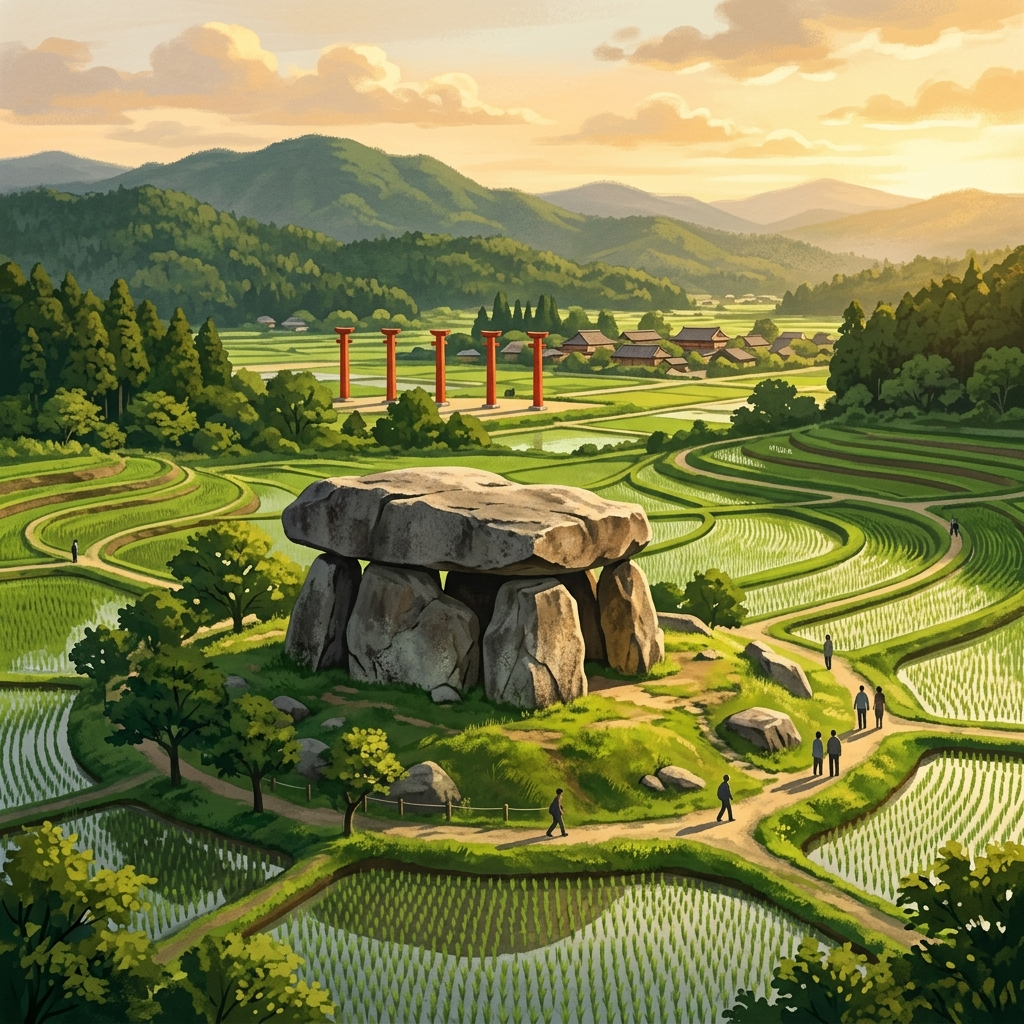
Asuka-Fujiwara stands as one of the most structurally unusual inscriptions in World Heritage history: a site where most of the archaeological evidence lies below ground rather than above it. The majority of significant features are buried, with excavated areas reburied after study and interpreted through non-invasive surface markers — meaning the visual experience of visiting amounts to little more than open fields and interpretive signs. Visual immediacy, which sites like Himeji Castle or Kyoto's temples deploy effortlessly, is entirely absent here. It is generally understood that sites with strong visual impact carry a structural advantage in World Heritage assessments, and the 19 years between tentative listing in 2007 and inscription in 2026 reflects this disadvantage with some clarity. But Asuka ultimately made the case, and in doing so established an important institutional precedent: the World Heritage system can recognize sites whose entire value is evidentiary rather than spectacular. For the many archaeologically significant but visually unremarkable sites around the world waiting for recognition — particularly in regions facing development pressure — Asuka's inscription opens a real and defensible pathway. The principle now formally endorsed by UNESCO is that heritage value does not require visual performance: surviving as complete buried evidence is sufficient on its own terms.
Cultural Import and the Paradox of Asuka's Originality
UNESCO's criterion (ii) explicitly cites "the important interchange of human values with the contemporary power centers of China and the Korean Peninsula" — a formal international acknowledgment that Asuka-era cultural achievements were fundamentally built on deliberate continental import rather than internal invention. The 17-Article Constitution traditionally dated to 604 CE drew on Buddhist and Confucian thought; the Taika Reform of 645–646 was a comprehensive adoption of the Tang Chinese administrative model; the grid-plan design of Fujiwara-kyo replicated continental urban planning principles that had been refined over centuries. Scholars broadly agree that craftspeople, monks, and scholars from Baekje and Goguryeo were central to this process of cultural transfer. The Kitora Tomb's celestial map reproduces the Chinese constellation system on a burial chamber ceiling, making the continental connection physically concrete and visible. What I find essential here is that none of this constitutes an absence of originality — it represents originality's actual mechanism: taking borrowed frameworks and recombining them within a new cultural context is precisely how cultural creation works across human history. The Asuka period absorbed continental inputs and produced a distinctly Japanese legal system, religious architecture, and royal cosmology. UNESCO recognizing "interchange" itself as a criterion of World Heritage value is an institutional endorsement of a more honest and more productive understanding of how civilizations actually develop.
The Kitora Star Map: Astronomical Precision and the Debate Over Its Origins
The celestial map on the ceiling of the Kitora Tomb is described by Japan Heritage Portal as "at present the oldest such precise star map known anywhere in East Asia," making it one of the most scientifically significant objects in the entire Asuka-Fujiwara nomination. The map depicts the celestial equator, the ecliptic, and the 28 lunar mansions along with additional constellations, demonstrating a level of astronomical precision that required serious scholarly knowledge placed in the service of royal authority. The question of where the underlying observations were made has generated active academic debate: Professor Soma's theory points to a Chinese observation at 34°N latitude dated to between 240 and 520 CE; Professor Nakamura's theory places observations at the same latitude but earlier, between 120 and 40 BCE; and Professor Miyajima's theory proposes an observation origin in Pyongyang or Seoul around 65 BCE. Whatever the resolution of this scholarly debate, the observations were almost certainly made on the continent rather than in Japan. But the act of inscribing that astronomical data on the ceiling of a burial chamber to symbolize the cosmic authority of the ruling house was an entirely Japanese act of cultural recontextualization — borrowing the sky's map to claim legitimacy over the earth. With World Heritage inscription directing international attention to this site, the academic debate over the Kitora map is likely to attract new research investment and cross-border scholarly collaboration across East Asian astronomy history.
Takamatsuzuka and Kitora: Mural Preservation as a Global Conservation Challenge
The polychrome burial murals of Takamatsuzuka and Kitora tombs are the only surviving examples of polychrome kofun murals in Japan, making them irreplaceable physical evidence of the artistic connections between the Asuka period and the contemporary continental world. Mold damage to the Takamatsuzuka murals, which accelerated dramatically after 2001, forced the Agency for Cultural Affairs to declare on-site preservation impossible in 2005 — a sobering demonstration of how vulnerable underground painted surfaces are to microclimate changes driven by external factors including visitor activity. In 2007, the unprecedented decision was made to physically separate and relocate the stone chambers to climate-controlled facilities, where research toward eventual reinstatement is being conducted by the Tokyo National Research Institute for Cultural Properties. UNESCO's World Heritage Committee recommended that Japan continue this preservation and restoration research as part of the inscription decision, elevating it to an ongoing international obligation. If the restoration work succeeds in returning the murals to their original chambers, it will provide a globally applicable solution to the recurring problem of underground mural preservation in humid climates — a breakthrough with direct relevance for comparable sites in Korea, China, and beyond. The outcome of this research over the next several years will determine not only whether Asuka's murals can return to their original context, but whether the concept of heritage "authenticity" can accommodate a site whose most visually striking elements currently exist in a different physical location.
Fujiwara-kyo: The Planned Capital That Became a Time Capsule Through Abandonment
Fujiwara-kyo, completed in 694 CE, was Japan's first systematically designed grid-plan capital city, with an estimated minimum area of approximately 25 km² according to the Nara National Research Institute for Cultural Properties — making it larger than both Heijo-kyo at 24 km² and Heian-kyo at 23 km², its better-known successors. Its construction represented the physical culmination of a century of intensive learning from the Tang Chinese model, combining palace precincts, administrative zones, and a grid of ward blocks organized along a central boulevard in a form that drew directly on continental urban design traditions. Yet this ambitious capital was abandoned after just 16 years when the court relocated to Heijo-kyo in 710 CE, and the structures that had defined it were demolished or left to decay. Agricultural land replaced the urban fabric, and the entire city disappeared beneath the soil. Counterintuitively, that process of abandonment proved to be the most effective act of preservation in Japanese archaeological history: buried beneath farmland for 1,300 years, the archaeological record of Fujiwara-kyo survived in extraordinary completeness while the Tang capital Chang'an and later Japanese capitals were substantially altered by continuous occupation. The UNESCO inscription decision acknowledges this directly, noting that the site's authenticity derives partly from post-abandonment agricultural use and subsequent post-excavation reburial. It stands as a striking inversion of conventional heritage logic: the most powerful force of preservation was not curation or construction, but the simple act of being forgotten.
Positive & Negative Analysis
Positive Aspects
- International Spotlight on Southern Nara's Tourism Potential
World Heritage inscription gives the Asuka, Kashihara, and Sakurai region of southern Nara a level of international visibility that no promotional campaign could replicate independently. Japan's travel itineraries have long defaulted to a Kyoto-Tokyo-Osaka axis, leaving Asuka — the civilizational origin point of Japan — largely unknown to international visitors despite its extraordinary historical depth. Nara City data already shows foreign visitors reaching 3.517 million in 2025 (+18.1% year-on-year) with tourism consumption at ¥152.7 billion (+19.2%), reflecting a region already on a strong upward trajectory before this inscription. With Japan's total inbound visitors projected at 41.4 million for 2026 per JTB Research, and a clear trend toward geographic dispersal from major cities into regional destinations, Asuka is structurally positioned to capture a meaningful share of this growth. The site's unique narrative — Japan's first Buddhist temple, first planned capital, an astronomical map on the Kitora ceiling that is the oldest known in East Asia — provides storytelling material that no other Japanese destination can replicate. For travelers seeking depth over spectacle, Asuka offers a compelling alternative to the visually saturated Kyoto circuit, and World Heritage status is the most powerful initial signal to direct that audience toward southern Nara.
- Catalyzing Comparative East Asian Ancient History Research
Criterion (iii)'s recognition of Asuka-Fujiwara as "testimony to the cultural tradition of ancient East Asian capital formation" creates a scholarly mandate for comparative research across Korea, China, and Japan that extends well beyond Japan's national academic community. The Kitora Tomb star map's ongoing debate over observation origin — spanning Chinese and Korean Peninsula theories — is exactly the kind of multinational research puzzle that benefits from formal UNESCO recognition and the international attention it brings to funding bodies and research institutions. The formal acknowledgment in criterion (ii) that Asuka-era achievement emerged from "interchange of human values with the contemporary power centers of China and the Korean Peninsula" positions this inscription as an official endorsement of an integrated East Asian ancient history that transcends national narratives. The recognition of Asuka-dera as Japan's first Buddhist temple adds a new formal point of reference for research on the transmission routes of Buddhism across East Asia. The framing of "shared exchange" rather than "national achievement" creates an opportunity for historical scholarship to build connection rather than rivalry, and UNESCO's recognition provides the institutional foundation for that conversation to happen at the highest level of international cultural governance.
- Establishing a Global Precedent for Archaeological Site Recognition
The inscription of Asuka-Fujiwara establishes a meaningful precedent in World Heritage practice: a site where almost all evidence is underground, with no significant standing structures above ground, can qualify for inscription based solely on the completeness and significance of its buried archaeological record. This matters far beyond Japan, because there are many archaeologically significant sites worldwide that have been disadvantaged in nomination processes by the absence of visual spectacle. The UNESCO decision's acknowledgment of post-excavation reburial with non-invasive surface interpretation as a valid form of heritage management also provides a practical model for sites that have chosen preservation over permanent public display. Taken together, these elements signal a willingness in the World Heritage system to expand its definitional framework — to recognize that heritage value can be entirely evidentiary, residing in what lies below ground rather than what stands above it. For regions across Asia, Africa, and Latin America where development pressure threatens significant but visually unremarkable archaeological sites, this precedent offers a more inclusive and defensible standard for arguing the case for protection. The broader effect may be to reorient global conservation debate from the "what does it look like" question toward the "what does it tell us" question — a shift that serves the discipline of archaeology and the cause of global heritage protection alike.
- Potential for Breakthrough in Underground Mural Preservation Technology
The UNESCO committee's recommendation that Japan continue preservation and restoration research on the Takamatsuzuka and Kitora murals, combined with the international attention that World Heritage inscription generates, creates real conditions for a technical breakthrough in one of the most persistently difficult challenges in cultural heritage conservation. The problem of preserving polychrome painted surfaces in underground humid environments from biological degradation is not unique to Asuka; it recurs at painted burial sites across East Asia, Southeast Asia, and beyond. If the ongoing work at the Tokyo National Research Institute for Cultural Properties produces a replicable method for eliminating mold and biological contamination without damaging painted surfaces — and for stabilizing the microclimate of a returned stone chamber against future recolonization — this would be a contribution to global heritage conservation methodology of the first order. The international visibility of the problem, now amplified by World Heritage inscription, increases the likelihood of attracting research collaboration, external funding, and expertise from beyond Japan's domestic conservation community. A successful reinstatement of the murals to their original chambers would also create a defining narrative moment for the site — the day the separated murals came home — with the potential to draw global media coverage and redefine Asuka's international profile in a way no conventional tourism promotion could achieve.
Concerns
- The Gap Between Inscription Expectations and the Empirical Record
The assumption that World Heritage inscription automatically generates significant tourism growth is not well supported by the available data, and Asuka's policymakers would be unwise to rely on it. Niigata University research comparing 10 Japanese World Heritage sites found that only two — the Shirakami Mountains and Nikko — showed statistically significant visitor increases after inscription, with the remaining eight showing minimal or negligible effects. Hiraizumi, inscribed in 2011, recorded a visitor increase of just 1.5% in the inscription year — effectively demonstrating that the world's highest heritage designation can fail to convert into measurable tourism growth. Asuka faces structural constraints closely comparable to Hiraizumi: considerable distance from major urban centers, limited visual appeal for general tourists, and insufficient tourism infrastructure to support rapid growth even if it were to materialize. Relying primarily on the World Heritage label without simultaneous and substantial investment in content, interpretation, and accessibility improvement risks producing exactly this outcome — inflated expectations followed by the gradual realization that the title alone does not bring visitors or persuade them to stay. The policy lesson from Hiraizumi and similar cases is direct: inscription is an opportunity, not an outcome, and translating that opportunity into actual tourism development requires active, well-resourced intervention rather than passive faith in the power of the designation.
- Structural Limits on Visitor Capacity and Interpretive Accessibility
Asuka-Fujiwara has an inherent structural constraint that no amount of marketing can fully overcome: it is a site where the primary evidence is underground and cannot be seen, and where appreciating the significance of what is there requires substantial prior knowledge or skilled real-time interpretation. The 19 component properties are dispersed over a wide rural area, requiring considerable time and independent mobility to visit comprehensively. Most of the major archaeological zones are under excavation restrictions or have been reburied post-excavation, making the physical experience fundamentally different from what most international tourists associate with a World Heritage Site. Visitors who arrive expecting visual drama comparable to Himeji Castle or Kyoto's Nishi Hongan-ji and encounter empty fields and interpretive signage instead are likely to leave dissatisfied, regardless of how historically significant the site genuinely is. The knowledge gap problem — the fact that Asuka's value is entirely latent until you understand what you're looking at — means that the quality of interpretive content is essentially the product being offered. High-quality multilingual interpretation in English, Korean, and Mandarin is currently minimal, and without serious investment in this area, World Heritage inscription will consistently fail to convert awareness into satisfying visits. This is not a problem that physical infrastructure investment alone can solve; it requires intellectual and creative investment in storytelling and experiential design.
- Conservation Risk Amplification Under Increased Visitor Pressure
The history of the Takamatsuzuka murals demonstrates with painful clarity that increased human activity in and around underground heritage sites can create direct and serious preservation threats that are difficult to reverse once they take hold. Mold damage that accelerated after 2001 forced the Agency for Cultural Affairs to declare on-site preservation of the murals impossible in 2005, eventually requiring the unprecedented physical separation of the stone chambers in 2007. This sequence illustrates how microclimate changes driven by external human activity — ground compression from foot traffic, alterations to local drainage patterns, changes to ambient humidity driven by nearby construction or land-use change — can rapidly destabilize the environmental equilibrium that underground sites depend on. World Heritage inscription, if it succeeds in substantially increasing visitor volumes, will intensify precisely these pressures — not only on already-excavated and studied areas, but potentially on the unexcavated portions of the serial nomination that have not yet been subjected to detailed archaeological assessment. UNESCO's committee attached seven recommendations to the inscription, including the development of a disaster risk strategy, acknowledging that the protective framework is not yet comprehensive. Managing the tension between meaningful public access and protection from the damage that access creates will become significantly more demanding after inscription, not less.
- Tourism Infrastructure Deficit and the Risk of Overtourism at Limited Capacity
Asuka Village and the surrounding area currently lacks the accommodation, transportation, and service infrastructure necessary to absorb a rapid increase in visitor volumes without disruption to both the site and the local community. The region sits more than 30 km south of central Nara City; Kintetsu Railway access is available but on-site transportation relies heavily on cycling and walking. In a scenario where inscription generates a rapid short-term surge in visitor numbers — analogous to Yakushima's trajectory from roughly 240,000 visitors before inscription to a peak of approximately 400,000, a 67% increase, followed by serious overtourism complications — the archaeological sensitivity of Asuka means that carrying capacity is not simply a question of visitor satisfaction but of heritage preservation itself. Infrastructure investment that lags behind demand can simultaneously damage the site, burden local communities through overcrowding and pricing pressures, and degrade the quality of the very visitor experience that generated demand in the first place. Without a proactive, coordinated tourism management plan developed and resourced in the immediate post-inscription period, Nara Prefecture risks replicating the Yakushima pattern in a context where the consequences of getting it wrong are archaeological rather than merely ecological. The lesson is clear: World Heritage status demands an immediate governance response, not a wait-and-see approach.
Outlook
In the immediate term — the first six months following inscription — there will clearly be a measurable uptick in awareness and visit interest in the Asuka region. The macro conditions are favorable: Japan's total inbound visitors reached a record 36.87 million in 2024 per JNTO data, with Japan's foreign tourism consumption hitting an unprecedented ¥8.14 trillion that same year. JTB Research projects inbound visits to reach 41.4 million in 2026, with one of the defining trends being the geographic dispersal of tourists from major urban hubs into regional destinations. Asuka is precisely the kind of site positioned to benefit from that dispersal trend. Nara City's own data shows that total visitors reached 16.08 million in 2025 (+8.2%), a record, with foreign visitors climbing to 3.517 million (+18.1%) and foreign overnight stays growing to 569,000 (+27.9%). World Heritage inscription adds an internationally recognized endorsement on top of this already-growing baseline. In particular, how Asuka's distinctive historical narrative resonates with the Korean market — which grew by more than 60% in 2024 compared to the prior year — and the U.S. market will be a critical variable determining the pace of short-term growth.
That said, real barriers must be crossed before initial interest translates into sustained visitation. Asuka sits more than 30 km south of central Nara City, in a rural setting accessible by Kintetsu Railway but lacking substantial accommodation or tourist convenience infrastructure. The 19 component properties are dispersed across a wide area, making a comprehensive visit difficult to accomplish in a single day. And perhaps most importantly, the fundamentally archaeological nature of the site — where most of what matters is underground and invisible — means that casual tourism, the kind that works for Kyoto or Tokyo, will simply not work here. The most critical short-term task is positioning Asuka as a destination for deep cultural tourism: a place where the reward is not visual spectacle but meaningful encounter with a foundational moment in human civilization. Achieving that positioning requires a step-change in the quality of on-site interpretation programs and digital content. I think the first six months after inscription represent a golden window for defining the direction of this site's tourism strategy — one that Nara Prefecture and the communities of Asuka Village need to use deliberately and well.
In the medium term — roughly six months to two years out — the trajectory of Japan's broader inbound tourism market and Asuka's ability to differentiate itself from established nearby attractions will be the deciding factors. Japan's 2024 inbound record of 36.87 million had already exceeded the pre-pandemic peak of 31.88 million from 2019 by 15.6%, and the consensus is that this growth has further runway. The Dai-ichi Life Research Institute projects continued recovery from Korean inbound and stable growth from Taiwan and the United States through 2027. Within this rising tide, the question is whether Asuka can carve out a position distinct from the saturated Kyoto-Nara sightseeing circuit. I think Asuka's greatest point of differentiation is, paradoxically, the very thing that delayed its inscription: there is nothing to photograph here. That makes it the anti-Kyoto — not a place to collect images, but a place to understand something. Knowledge-based experiential tourism is not a niche; it is a growing segment with high spending per visitor and low tolerance for surface-level engagement. Japan Tourism Agency's regional dispersal policy aligns perfectly with this framing, and the 19.2% growth in Nara City tourism consumption from ¥128 billion in 2024 to ¥152.7 billion in 2025 represents a base that Asuka could share if the right strategies are implemented. Strategic partnerships with Kintetsu Railway and inclusion of Asuka in Kyoto-Nara regional tourism packages will be central to medium-term success.
Here is where cold realism is necessary. The Niigata University research data is unambiguous: of 10 Japanese World Heritage sites studied, only the Shirakami Mountains and Nikko showed statistically meaningful visitor increases after inscription. Hiraizumi, inscribed in 2011, recorded just 1.5% visitor growth in its inscription year. The World Heritage label does not automatically generate a tourism boom. For Asuka, the structural similarities to Hiraizumi — rural location, minimal visual impact, weak tourism infrastructure — suggest that a purely label-dependent approach will produce Hiraizumi-like results. Furthermore, the Yakushima case illustrates a different risk: it went from roughly 240,000 visitors before inscription to a peak of approximately 400,000 — a 67% increase — before overtourism problems became serious. A rapid, unmanaged surge in visitors is, if anything, a worse outcome for Asuka than gradual growth, given the site's archaeological sensitivity and limited carrying capacity. The difference between Hiraizumi's underwhelming trajectory and a genuinely positive outcome for Asuka will be determined by active investment in content, interpretation, and accessibility — not by the inscription itself.
Looking further ahead — two to five years — the most decisive factor for Asuka's long-term significance is whether technology can solve the "invisible heritage" problem. I think augmented reality holds real promise here. If visitors can stand in what appears to be an empty field and see, through AR on a smartphone or dedicated device, the full grid of Fujiwara-kyo as it stood around 700 CE — the palace precincts, the Suzaku Avenue central boulevard, the rhythmic pattern of ward blocks extending to the horizon — this becomes a category of experience available nowhere else on earth. No existing World Heritage Site can offer the combination of genuine 1,300-year archaeological completeness and full-scale digital reconstruction of an entire lost capital. The 3D simulation of how Ishibutai Kofun's approximately 2,300 tons of megaliths were transported and assembled, or the projection of the Kitora star map's constellations onto the night sky through AR, are equally achievable and equally compelling. The apparent weakness of "nothing to see" becomes, in the hands of immersive technology, a powerful competitive advantage: the emptiness is precisely what makes the digital reconstruction so dramatic. Pompeii and the Athenian Agora have already demonstrated that AR-enhanced archaeology is viable as a tourist product. The question for Asuka is whether Nara Prefecture has the investment will and execution capability to move early in this space. A successful full-scale digital reconstruction of Fujiwara-kyo's approximately 25 km² could establish a new global standard for archaeological heritage tourism.
The outcome of the mural restoration research will also matter significantly over the long term. The UNESCO committee's recommendation that Japan continue preservation and restoration research on the Takamatsuzuka and Kitora murals, combined with the international attention that World Heritage inscription brings, creates real conditions for a meaningful technical advance in one of the most persistent challenges in cultural heritage conservation. The problem — preserving polychrome painted surfaces in underground humid environments against biological degradation — recurs at painted burial sites across East Asia and beyond. If the ongoing work at the Tokyo National Research Institute for Cultural Properties produces a replicable solution for eliminating mold without damaging painted surfaces, and for stabilizing the microclimate of a returned stone chamber sufficiently to prevent future colonization, this would be a contribution to global conservation methodology of the first order. International visibility, amplified by World Heritage inscription, increases the likelihood of drawing research collaboration, funding, and expertise from beyond Japan's domestic conservation community. A successful reinstatement of the murals to their original chambers would also create a powerful narrative moment for the site — redefining Asuka's international profile in a way no marketing campaign could replicate.
Mapping out the scenarios: in the optimistic case, Asuka establishes itself as an internationally recognized model of deep cultural tourism. AR-based reconstruction experiences are successfully developed and deployed, southern Nara's tourism infrastructure is incrementally improved, and a Japan ancient history corridor linking Kyoto, Nara, and Asuka becomes an established travel itinerary for culturally engaged international visitors. Mural restoration achieves a technical breakthrough that generates international academic and media attention. Visitor growth is moderate in scale but high in quality — measured volumes, high engagement, strong per-visit spending, and minimal overtourism pressure. The base-case scenario sees an initial uptick in awareness and visits after inscription followed by moderate, gradual growth — roughly the Hiraizumi trajectory, with Asuka becoming a respected regional destination for dedicated history travelers without achieving mass-tourism volumes. The pessimistic scenario involves inadequate investment in interpretation and content, rapid post-inscription disillusionment as visitors discover "there's nothing to see," and infrastructure pressure generating the same overtourism aftermath that followed Yakushima's inscription — except with even less carrying capacity. Which scenario materializes will depend directly on the investment decisions of Nara Prefecture, national cultural agencies, and local communities in the period right after inscription. Whether the ¥152.7 billion in 2025 Nara City tourism consumption expands into southern Nara or stays concentrated in the historic urban core is the single most important near-term indicator of Asuka's trajectory.
There are also macro risks that could undermine all of these scenarios. A significant strengthening of the yen, which would increase travel costs for Japan's primary inbound markets, could dampen overall inbound growth and hit emerging regional destinations like Asuka hardest, since they lack the name-brand recognition that sustains Kyoto or Tokyo even in less favorable conditions. A global economic slowdown, geopolitical disruption in East Asia, or another large-scale public health event could similarly compress inbound volumes at exactly the moment Asuka needs them to grow. For readers who are considering a visit: I genuinely recommend Asuka in spring or autumn, ideally by bicycle — the rental infrastructure is already there — moving slowly between sites rather than trying to cover them all in a rush. Don't go expecting dramatic visuals. Go knowing that Japan's original legal framework, its first Buddhist architecture, and the astronomical knowledge that shaped its royal ideology are all embedded in the ground beneath you. When you stand on Ishibutai Kofun's approximately 2,300-ton stack of megaliths and grasp that this was built in the early 7th century by the most powerful political family of the age, the absence of anything more theatrical becomes irrelevant. The depth is already there, waiting for the person who knows where to look.
Finally, I want to note that this inscription carries implications for East Asian cultural diplomacy that shouldn't be underestimated. UNESCO criterion (ii)'s explicit citation of "interchange of human values with the contemporary power centers of China and the Korean Peninsula" is, at the level of an international institution, a formal recognition that the ancient histories of Japan, Korea, and China cannot be cleanly separated from one another. If the scholarly debate over the Kitora star map's observation location proceeds constructively — as an international research puzzle rather than a territorial dispute over cultural ownership — and if Asuka-dera's Baekje-influenced Buddhist architecture becomes a shared cultural reference point rather than a flashpoint for national claims, there is real potential for this inscription to support a shift from ancient-history rivalry toward shared civilizational heritage. This is admittedly an optimistic scenario requiring both political will and scholarly maturity from all sides. But the fact that an international body has now formally recognized "cultural exchange" between Korea, China, and Japan as the basis for a World Heritage inscription creates at minimum a framework for exactly that kind of conversation. The 48th World Heritage Committee session took place in Busan, South Korea — a geographic detail that adds its own layer of resonance to an inscription premised on the depth of ancient Korean-Japanese cultural connection. I hope this nomination becomes a catalyst for scholarship built on shared heritage rather than on national competition over the past.
Sources / References
- UNESCO Decision 48 COM 8B.19 — Official UNESCO World Heritage Committee inscription decision, confirming criteria (ii) and (iii) and the 19 component properties — UNESCO Decision 48 COM 8B.19
- Jiji Press/Adnkronos — July 26, 2026 inscription announcement, including ICOMOS mural preservation recommendation — Jiji Press/Adnkronos
- Bernama/Kyodo — Japan's 27th World Heritage Site, confirmation of Kitora star map "oldest in East Asia" description — Bernama/Kyodo
- Nippon.com — Detailed overview of Asuka-Fujiwara, Ishibutai Kofun estimated 2,300 tons, Fujiwara-kyo background — Nippon.com
- Japan Heritage Portal — Kitora star map official description: "at present the oldest such precise star map known anywhere in East Asia" — Japan Heritage Portal
- Wikipedia/nabunken — Fujiwara-kyo minimum area ~25 km² (citing Nara National Research Institute for Cultural Properties), comparison with Heijo-kyo and Heian-kyo — Wikipedia/nabunken
- Niigata University Academic Paper — Comparative tourism effects study of 10 Japanese World Heritage sites; Yakushima and Hiraizumi visitor data — Niigata University Academic Paper
- JTB Research — 2026 Japan inbound visitor forecast of 41.4 million; regional tourism dispersal trends — JTB Research