
Let's Be Honest: You Don't Actually Own Your Switch 2 Games
Summary
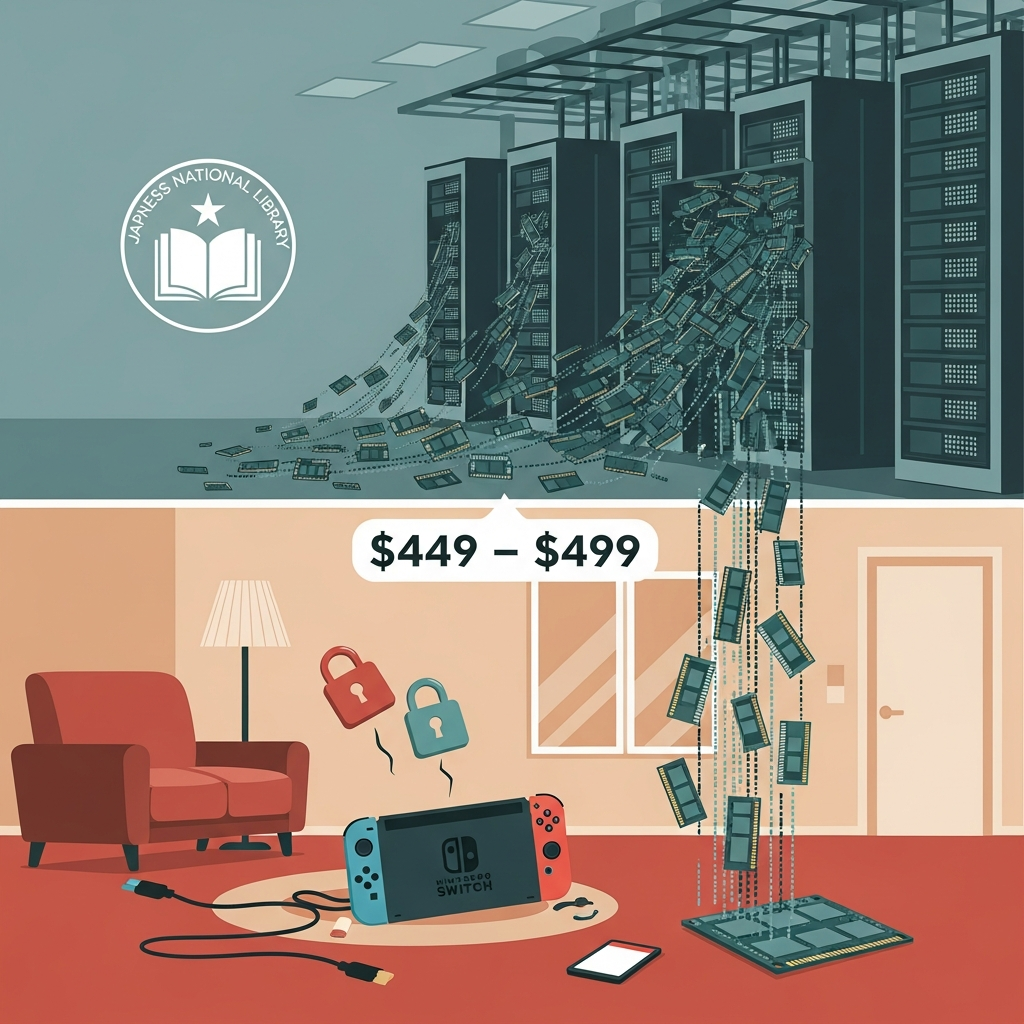
The Nintendo Switch 2 shattered records by selling 3.5 million units in just four days, marking the fastest-selling console in Nintendo history, yet within months the same device became a flashpoint for two intersecting crises that threaten the entire gaming industry. The explosive growth of AI data centers — with companies like Microsoft, Google, Amazon, and Meta collectively pouring over $300 billion annually into AI infrastructure — has driven DRAM prices up more than 40% since 2025, forcing Nintendo to raise its U.S. price from $449.99 to $499.99 and Japan's price from ¥49,980 to ¥59,980. What makes this situation far more alarming than a simple price hike is Nintendo's response: Game Key Cards, a physical-looking package that contains no game data and requires an internet download to function, effectively stripping consumers of the ownership rights they believe they are purchasing. Japan's National Diet Library has already refused to archive Game Key Cards on the grounds that they are "not content themselves," raising the specter of an entire generation of games disappearing from the historical record. Together, the AI chip crunch, the ownership erosion, and the production cuts of 30% paint a picture not of isolated corporate decisions but of a structural collision between AI infrastructure capitalism and the gaming ecosystem.
Key Points
AI Data Center Demand Is Directly Inflating the Price of Your Gaming Console
Big Tech's AI infrastructure buildout — Microsoft alone committed over $80 billion to data centers in 2025, with the combined AI spend of Microsoft, Google, Amazon, and Meta exceeding $300 billion annually — has set off an intense competition for DRAM memory that consumer electronics manufacturers simply cannot win. Memory producers like Samsung, SK Hynix, and Micron have restructured their production priorities to maximize higher-margin AI supply contracts, leaving general-purpose DRAM supply constrained and expensive. DRAM prices rose more than 40% from 2025 benchmarks, forcing Nintendo to push the Switch 2 to $499.99 in the U.S. and ¥59,980 in Japan, while Sony faced the same pressure and raised PlayStation 5 pricing by up to $150 in key markets. The structural logic here is that Nintendo and Sony were never the targets — they are collateral damage from an upstream resource war they had no leverage to win. This is what could be called "incidental displacement": no individual actor is behaving badly, but the emergent outcome systematically disadvantages consumer electronics manufacturers and ultimately the end consumer. This dynamic is particularly difficult to address through conventional regulation because there is no single bad actor to sanction, no monopolist to break up — just a market allocating scarce resources toward their highest-valued use, with gaming left holding the bill.
Game Key Cards Are Selling You the Illusion of Ownership
Nintendo's Game Key Card is designed to look and feel exactly like a traditional cartridge: same dimensions, same packaging aesthetic, same satisfying weight in your hand. But there is no game data stored inside the card — what you are buying is a download code in a plastic shell, and accessing that game requires an active internet connection and functioning Nintendo servers. This eliminates two of the most fundamental benefits physical media traditionally offered consumers: offline independence and permanent ownership. The account-locking mechanism means you cannot lend the card to a friend, trade it in at a game store, or sell it to another player, effectively destroying the used-game economy for Switch 2 titles while presenting itself as a physical purchase. When Nintendo's Wii online services shut down, digitally purchased titles simply ceased to exist; the Switch 2's Game Key Cards expose so-called "physical" buyers to the exact same risk. The broader principle here is that we are witnessing the "ownership illusion" breach physical media — something tangible and holdable that is, in practice, functionally indistinguishable from a DRM-locked digital license. This is a qualitatively new form of consumer misdirection, and the fact that it arrives inside a familiar-feeling physical package makes it more insidious than a straightforward digital-only purchase would be.
Japan's National Diet Library Refusal Signals a Cultural Preservation Emergency
Japan's National Diet Library — the country's equivalent of the U.S. Library of Congress — announced it would not include Game Key Cards in its mandatory national collection, determining that they constitute a "medium for accessing content rather than content itself," and the implications of that decision extend far beyond Japan. The NDL has a legal mandate to preserve a copy of every published work; if Game Key Cards fall outside that mandate, the Switch 2 generation of games will not receive official government archiving. If the Library of Congress, the British Library, and other national institutions follow the same reasoning, an entire generation of commercially successful, culturally significant games could vanish from any institutional archive within a decade of their release. Nonprofit organizations like the Video Game History Foundation and Internet Archive are trying to fill this gap, but server-authenticated titles present nearly insurmountable technical and legal challenges — archiving software that requires an active server connection is technically complex, and the legal exposure under current copyright frameworks is substantial. The historical irony is acute: games are gaining recognition as legitimate artistic and cultural artifacts precisely at the moment their preservation infrastructure is being dismantled by the same commercial forces driving their commercial success.
Production Cuts Could Trigger a Dangerous Spiral in the Switch 2 Ecosystem
A 30% production cut for the fastest-selling console in Nintendo's history within its first year is, to be blunt, extraordinary evidence that the chip shortage is not temporary friction but a structural constraint on what Nintendo can actually build. The immediate consumer impact is straightforward: resellers are flipping Switch 2 units for $100 to $200 over retail, effectively taxing fans who missed the initial allocation. But the deeper problem is what production constraints do to third-party publisher confidence — companies like EA, Ubisoft, and Capcom make resource allocation decisions based in part on the size of the installed base they can sell into, and a console that is physically scarce is a console with a smaller addressable market. If major publishers deprioritize Switch 2 development in favor of platforms with larger and more predictable supply, the resulting software gap weakens consumer demand further, which is the classic hardware-software doom loop that has buried more than one promising console in gaming history. Nintendo's own IP catalog, however beloved, cannot single-handedly sustain a rich software ecosystem for an extended period, and the production situation is putting that ecosystem at real risk.
The AI Chip Shortage Has Forced a Reckoning Over Who Actually Owns Digital Goods
The Game Key Card controversy is ultimately a stress test of an assumption baked into digital commerce for decades — the assumption that purchasing something entitles you to own it. Music completed the shift from physical CDs to access-based streaming, film and television moved from DVDs to subscription platforms, and e-books replaced physical books in many households. Gaming was the last major entertainment category where physical ownership remained the default for a significant consumer segment, and the AI chip crunch appears to be the catalyst finally breaking that last holdout. The EU's Digital Markets Act, France's precedent-setting court rulings on digital resale rights, and California's emerging digital ownership legislation represent early institutional responses to this problem, but the pace of legal change is far slower than the pace of commercial transformation. The risk is that by the time consumer-protective legislation takes effect, there will no longer be a physical market left to protect — and the question of who actually owns digital goods will be settled not by law but by industry default, with consumers having lost the debate before they realized it was happening.
Positive & Negative Analysis
Positive Aspects
- Nintendo Is Actually Listening to Its Community — and That Matters
In stark contrast to Sony and Microsoft, who have largely treated the transition to digital distribution as a fait accompli and consumer objections as background noise, Nintendo has publicly committed to running a formal consumer satisfaction survey specifically about Game Key Cards. Nintendo's official communications have explicitly stated that physical software remains a core business for the company, which is a meaningfully different posture than its rivals have taken. For a gaming company whose brand identity is built on the idea that it puts players first, that public acknowledgment creates a documented accountability moment the community can hold Nintendo to. The feedback loop between consumer pressure and corporate policy is genuinely visible here in a way it rarely is in the gaming industry, and there is a non-trivial chance that the survey results produce a meaningful rollback of Game Key Card usage for major titles. That precedent — fan pushback actually changing hardware strategy — would reverberate across the entire industry and send a clear signal to Sony and Microsoft that digital conversion cannot simply be imposed over consumer objection without real commercial consequences. Nintendo's willingness to ask the question publicly suggests the company genuinely understands what is at stake for its long-term brand equity, and that self-awareness is a meaningful differentiator.
- The Environmental Case for Game Key Cards Is Real and Shouldn't Be Dismissed
Serious reservations about the ownership implications of Game Key Cards notwithstanding, intellectually honest analysis requires acknowledging that traditional cartridges carry a substantial environmental footprint that deserves to be part of this conversation. Every physical cartridge requires embedded NAND flash memory chips, a controller IC, a circuit board, and a plastic housing — all of which require raw material extraction, manufacturing energy, and international logistics shipping to get from factory to store shelf. Eliminating those components dramatically reduces the per-unit carbon cost of distributing a game, and given that the gaming industry ships hundreds of millions of physical units annually, the aggregate reduction in material consumption and transport emissions is not a trivial number. ESG criteria are increasingly central to institutional investment decisions and regulatory compliance requirements, and a genuine reduction in gaming's physical waste stream is something that deserves acknowledgment alongside the ownership concerns. The environmental upside does not excuse the consumer rights problems — ownership erosion and environmental benefit are not a trade-off any consumer was asked to accept — but it does mean the transition is not purely negative from a societal standpoint.
- AI Demand Is Accelerating the Memory Technology Roadmap in Ways That Eventually Benefit Gamers
The same AI infrastructure investment that is making game consoles more expensive today is also driving the fastest sustained investment cycle in semiconductor history, and that investment will eventually benefit the consumer products that follow in its wake. Samsung and SK Hynix are channeling extraordinary capital into DDR6 and HBM4 development, with roadmaps pulled forward by roughly one to two years compared to pre-AI projections, because hyperscaler demand is funding the R&D that would otherwise proceed much more slowly. When those technologies trickle down into consumer hardware — which typically happens two to three console generations after AI data center adoption — gamers will benefit from dramatically faster, more efficient, and ultimately more cost-effective memory. Near-zero load times, real-time streaming of ultra-high-resolution textures, and vastly more expansive and detailed open-world environments all become technically and economically viable as next-generation memory matures and commoditizes. The short-term pain of the chip shortage is real, but the innovation pipeline it is funding carries a genuine long-term payoff for the quality of gaming experiences it will eventually enable.
- Nintendo's Brand Loyalty Gives It More Room to Course-Correct Than Any Other Console Maker
Four days, 3.5 million units — in the face of a confirmed price increase that was widely reported before launch day. That number tells you something important about the depth of Nintendo's relationship with its audience that no other gaming brand can claim with comparable conviction, because the fans didn't leave and they showed up anyway. That extraordinary reservoir of consumer goodwill represents a genuine strategic asset precisely because it gives Nintendo the runway to reverse course on Game Key Cards without catastrophic commercial consequences, in a way that a brand with less accumulated trust simply could not afford. When Nintendo makes a wrong turn, its community has demonstrated repeatedly that it is uniquely disposed to respond positively when the company shows it genuinely hears them — from the Wii U's struggles to the Switch's triumphant comeback. That dynamic creates a real possibility of a consumer-friendly resolution to the current crisis, one that Sony and Microsoft, having spent more of their trust reserves through years of digital-first decisions made over consumer objections, are in a much weaker position to pursue.
Concerns
- This Price Hike Almost Certainly Won't Be the Last One
AI infrastructure investment shows no signs of decelerating through 2026, and the pipeline of new data center capacity coming online in the second half of this year will add demand pressure on DRAM rather than relieve it. If prices climb another 15 to 20 percent by 2027, Nintendo faces the arithmetic reality of another price increase — potentially taking the Switch 2 to $549 or even $599. The Sony PlayStation 3 launched at $599 in 2006 and was widely considered a market disaster that set Sony's console division back by years; that price point represents a genuine psychological barrier for mainstream consumers that does not adjust smoothly for inflation in consumer perception. A premium gaming console approaching $600 risks transforming gaming from a broadly accessible entertainment category into a discretionary luxury consumed primarily by higher-income households, disproportionately pricing out students, younger gamers, and economically constrained fans who have historically formed the backbone of gaming's culture and community. If gaming loses its democratic accessibility — the core idea that almost anyone can afford to participate — it loses something fundamental about what made it culturally significant in the first place.
- Game Key Cards Eliminate the Used-Game Economy and Make Every Game More Expensive in Real Terms
The second-hand game market is an essential financial mechanism for millions of gamers, and Game Key Cards eliminate it at the structural level rather than as an incidental side effect. Under the traditional model, a player could buy a game at $60 to $70, complete it over a few weeks, resell it for $25 to $35, and arrive at an effective play cost somewhere between $30 and $40. Game Key Cards break this entirely: once registered to an account, the card has zero resale value, making the full purchase price the permanent and total cost of having accessed the game. For the individual gamer, this effectively doubles the real cost of gaming over a typical year of play. The aggregate economic impact is staggering — the U.S. used-game market alone is estimated at approximately $4 billion annually, representing real purchasing power that currently flows back to consumers and would instead simply be extracted from them under a Game Key Card-only regime. Retailers like GameStop that depend on used-game trade-ins face existential business model disruption, along with the jobs and local retail ecosystems those businesses support in hundreds of communities.
- The Cultural Preservation Crisis Will Outlast Every Other Problem on This List
In ten years, most people will have largely moved on from the price increases, and GameStop's struggles will be a historical footnote. The cultural preservation failure, if it materializes at the scale Japan's National Diet Library decision suggests it might, will be permanent and irreversible rather than temporary and manageable. Video Game History Foundation data already estimates that 87 percent of classic games have no legal commercial availability whatsoever, and if the Switch 2 generation adds to that statistic rather than reversing it — through server shutdowns, absent institutional archiving, and legally insurmountable barriers to emulation — the scholarly and cultural record of one of gaming's most commercially prolific eras will be fragmentary at best. The deep irony is that games are finally gaining recognition as legitimate cultural artifacts worthy of serious academic study and museum-quality preservation at precisely the moment the preservation infrastructure for the current generation is quietly collapsing. Future researchers attempting to understand the Switch 2 era will face obstacles not unlike those confronting medieval historians working around lost manuscripts — except that in this case, the loss is entirely preventable, and we are making the decision to allow it right now.
- Production Cuts Create an Ecosystem Doom Loop That Could Undermine Long-Term Success
A 30% production cut does not just mean consumers have a harder time finding the hardware; it means every third-party publisher adjusts its investment calculus for the platform accordingly, and those adjustments compound over time. The question EA's executives ask is not "is the Switch 2 a great console?" — it is "how large is the addressable market, and how predictably is it growing?" — and a console constrained by supply shortages gives an unsatisfying answer to both questions. When production constraints suppress installed base growth below projections, the expected return on a major Switch 2-exclusive title decreases, and publishers redirect development resources toward platforms with larger and more stable audiences, triggering the classic hardware-software doom loop that has ended more than a few promising console careers. Nintendo has escaped this trap before on the strength of its exclusive IP portfolio, but the original Switch thrived in part because of a healthy third-party ecosystem built on a rapidly expanding installed base that the current production situation puts seriously at risk. Scalper premiums of $100 to $200 over retail add another persistent layer of friction that converts potential new fans into frustrated non-buyers, and that reputational cost accumulates regardless of whether Nintendo is technically responsible for secondary market pricing.
Outlook
So where does all of this go from here? Let me break it down across short-, medium-, and long-term windows, and lay out the realistic range of outcomes within each.
In the near term, the most significant event to watch is the September 1 U.S. price increase going into effect. Japan already absorbed its hike on May 25, and early data suggests weekly Switch 2 sales dropped 15 to 20 percent in the immediate aftermath of that change. The U.S. market is roughly twice Japan's size, so the shockwave will be proportionally larger. My estimate is that Switch 2 Q4 2026 sales will come in 25 to 30 percent below the comparable prior-year period, though the holiday window in November and December will provide temporary relief via Christmas gifting demand and Black Friday promotions. That seasonal bounce won't reverse the underlying trend, but it will make the headline numbers look slightly less alarming than they actually are.
The Game Key Card debate is going to get louder before it gets quieter. Nintendo is currently running a consumer satisfaction survey on the issue, with results expected sometime in Q3 2026. That survey's findings matter enormously. If Nintendo announces a significant rollback of Game Key Card usage, expect a positive stock reaction and meaningfully improved community sentiment. If the company signals it intends to maintain or expand the format, expect organized boycott campaigns to emerge on Reddit, major gaming forums, and across gaming media. My best guess is that Nintendo threads the needle with a tiered approach: flagship AAA titles — Mario, Zelda, Metroid — stay on physical cartridges, while mid-tier and indie releases move to Game Key Card format. That compromise won't fully satisfy either camp, but it is the most economically defensible position Nintendo can take right now.
On the memory supply side, near-term conditions are only getting worse before they improve. Microsoft's three new data center campuses and Google's Arizona and Texas expansions are all scheduled to come online in H2 2026, adding further DRAM demand at a time when existing supply is already strained. Every gaming hardware maker — Sony, Valve with Steam Deck, even peripheral manufacturers like Logitech — faces the same component cost pressure Nintendo is dealing with. In the spot market, DRAM prices could add another 10 to 15 percent on top of current levels before any supply relief materializes.
Moving to the medium term, I expect the pricing structure of the console gaming market to be fundamentally different by end-2027 than it is today. The current $499 ceiling on premium consoles is unlikely to hold if DRAM prices continue trending upward. Nintendo could face another round of increases — potentially to $549 or even $599 — by mid-2027. For historical context, the PlayStation 3 launched at $599 in 2006 and faced brutal market resistance that arguably set Sony's first-party division back by years. The psychological resistance at $600 is real and persistent regardless of how inflation adjusts the nominal figure over time. The risk of console gaming becoming a luxury hobby for higher-income households is not theoretical; it is directionally where the numbers are pointing.
The ownership and preservation debate will escalate into the legal and regulatory arena over the medium term. The EU's Digital Markets Act creates a natural legislative vehicle for a "digital game resale rights" provision, and I think the probability of something like that passing before 2028 is meaningful — around 40 to 50 percent given the current trajectory. In the U.S., California legislation is still in early stages, but regulatory momentum in one of the world's largest gaming markets tends to ripple nationally. If Europe establishes binding resale rights for digital games, Nintendo's Game Key Card system faces an existential legal challenge, since account-locked licenses are structurally incompatible with mandated resale rights. That legal friction alone could force a significant product strategy rethink.
There is genuine medium-term relief on the semiconductor supply side, though timing complicates the story. Samsung and SK Hynix are actively separating their AI-grade HBM production lines from commodity DRAM production, with the segregation targeted for completion around late 2027. When that infrastructure separation takes effect, general-purpose DRAM prices could fall 20 to 30 percent from peak levels, dramatically improving the economics for consumer electronics manufacturers. The complication is that by late 2027, the Game Key Card transition may already be substantially complete. Once the distribution infrastructure for a format is established, the business incentive to reverse course diminishes sharply — the cost savings are already embedded in the margin structure.
Looking at the long-term picture from 2028 onward, the gaming industry's business model could look genuinely unrecognizable compared to today. Cloud gaming is the wildcard that changes every assumption in the analysis. Nvidia GeForce NOW, Xbox Cloud Gaming, and PlayStation Now, combined with 5G and the eventual rollout of 6G infrastructure, make it plausible that within five to seven years a meaningful share of gaming happens without any local hardware at all. In that world, "do you own your games?" becomes an even more abstract question than it is today. Nintendo's position in that landscape depends critically on whether the combination of exclusive IPs and hardware novelty is sufficient to command a premium in a subscription-dominated ecosystem.
The cultural preservation crisis will only deepen on a long enough timeline, and that is the outcome I find hardest to accept with equanimity. Japan's National Diet Library refusal to archive Game Key Cards is a data point, not an isolated incident. If the Library of Congress, the British Library, and the Bibliothèque nationale de France apply the same reasoning, the result is a systematic archive gap spanning the most commercially prolific era in gaming history. The Video Game History Foundation estimates that roughly 87 percent of classic games are already out of commercial availability. The Switch 2 generation risks adding to that statistic rather than reversing it. The next generation of game scholars who try to understand what 2026-era games actually felt like to play may find a substantial portion of the library simply inaccessible — servers down, no legal emulation path, no institutional preservation. I call this a "digital dark age" scenario, and the conditions for it are being actively constructed right now.
Now let me lay out three explicit scenarios. The bull case — best outcome — has memory supply recovering faster than expected, Nintendo pulling back sharply on Game Key Cards following strongly negative survey results, and EU regulatory frameworks establishing clear digital ownership protections. In this scenario, the Switch 2's price comes back down toward $450 by mid-2027, physical cartridges remain the dominant format for major titles, and the preservation crisis gets partially addressed through new archiving legislation. I'd assign this scenario roughly 25 percent probability.
The base case — most likely outcome — is a gradual stabilization where DRAM prices ease modestly by H2 2027 but Switch 2 pricing stays at $499, Game Key Cards account for 40 to 50 percent of the catalog, and regulatory action begins but does not fully materialize until 2028 or later. Consumer adaptation sets in, the used-game market contracts substantially but does not disappear entirely, and Nintendo maintains its core fan base while losing some price-sensitive buyers to mobile and cloud alternatives. I'd put base case probability at roughly 50 percent.
The bear case — worst outcome — has AI infrastructure investment accelerating further through 2027, pushing DRAM prices up another 20 percent, Nintendo raising prices to $549 or abandoning physical distribution almost entirely, and preservation bodies giving up on server-authenticated software as too legally and technically fraught to address. In this scenario, console gaming loses meaningful market share to mobile and cloud alternatives, the Switch 2 library becomes one of the least-preserved console generations in history, and the used-game market effectively ceases to exist across all major platforms. That is roughly 25 percent probability in my estimation.
Before wrapping up, let me address where my analysis could be wrong. The most important counterscenario is AI bubble deflation. A meaningful number of analysts believe that current AI infrastructure investment levels are fundamentally unsustainable — that the revenue these data centers generate cannot justify the capital being poured into them. If the AI bubble deflates significantly by 2027, DRAM demand from hyperscalers could drop sharply, freeing up significant supply for consumer electronics. In that world, Nintendo's chip shortage problem would resolve itself. But here's the uncomfortable follow-on question: would Nintendo reverse course on Game Key Cards even if the cost pressure disappeared? By then, consumers will have habituated to the format, the distribution infrastructure will be established, and the financial benefits of eliminating the resale market will remain real regardless of memory prices. I think the honest answer is no — the business incentives that favor Game Key Cards outlast the supply-chain crisis that originally justified them. That structural lock-in is what makes this a one-way ratchet, not a temporary detour.
To everyone reading this: if there are physical cartridge versions of games you genuinely love, buy them while that option still exists. To Nintendo: the Game Key Card may save manufacturing costs short-term, but it is actively spending down the trust and goodwill that constitute your most valuable long-term asset, and the community survey you launched is a good start — but only a start. To regulators: the window for meaningful digital ownership legislation is open right now, because five years from now physical game distribution may no longer exist, and you will have lost the leverage to protect something that is no longer there to protect. This era may genuinely be the final chapter of physical game ownership, and most people won't realize it until it's already over.
Sources / References
- Nintendo Switch 2 Price Hike as Sales Fall Amid Memory Crunch — CNBC
- Nintendo Switch 2 Price Increase Linked to AI Data Center Boom and RAM Memory Shortage — Fast Company
- Switch 2's Controversial Game Key Cards Prove to Be a Preservation Nightmare as Japan's National Library Refuses to Archive Them — GamesRadar
- Nintendo Switch 2 Game Key Card Physical Media Controversy — Game Rant
- Nintendo Officially Cuts Switch 2 Production Amid Low Sales in 2026 — CBR
- Nintendo Switch 2 Price Hike Linked to AI Memory Chip Crisis — Eastern Herald
- Nintendo Switch 2 Global Price Hike September 2026 Details — Nintendo Inquirer