
'But the AI Said It' — The Day That Defense Got Shredded in a German Courtroom
Summary
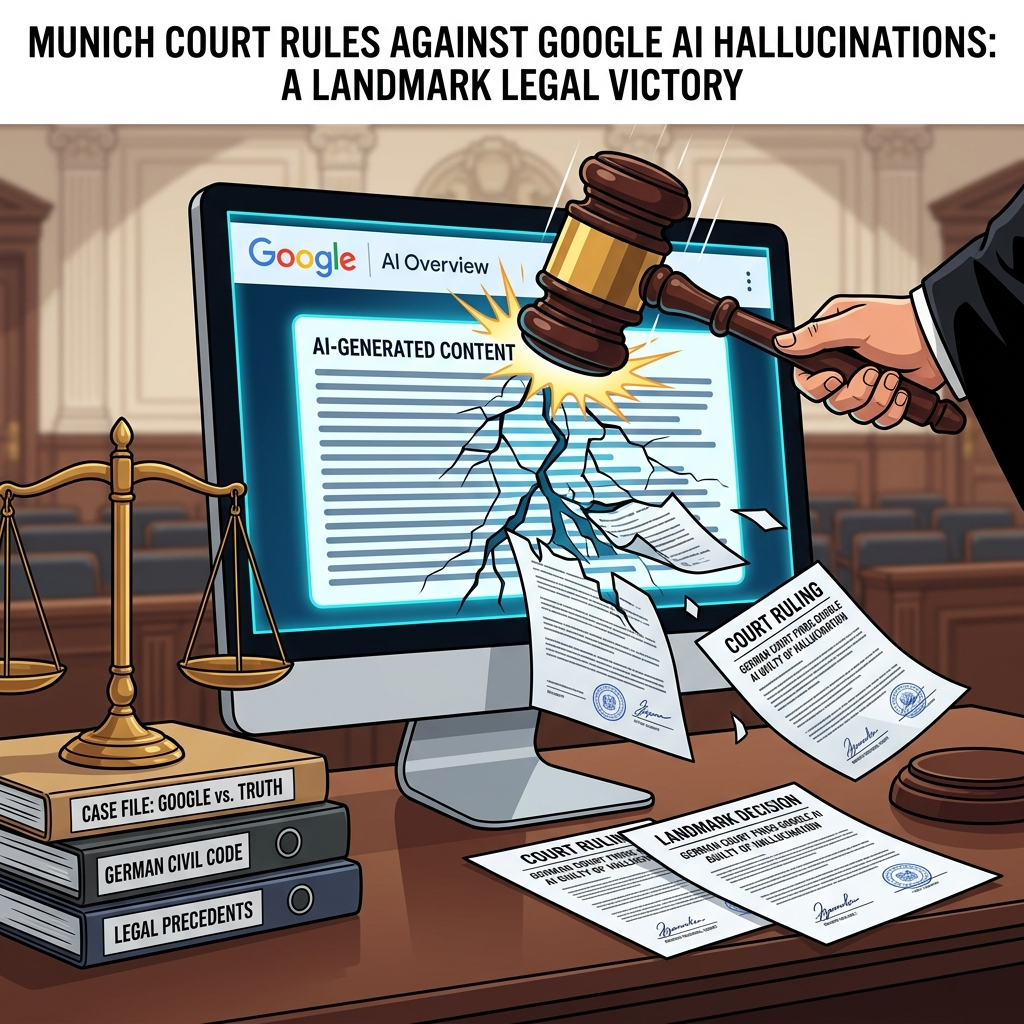
A Munich district court ruled on May 28, 2026 that Google's AI Overviews constitute the company's own original speech — not third-party content — making Google directly liable for six fabricated claims that falsely labeled two Munich publishers, Verlagshaus24 and GeraMond, as fraudulent businesses operating subscription traps and billing scams. The court rejected the application of traditional search engine immunity principles, finding that a system which evaluates disparate sources and generates "an independent, new, substantive statement" belongs to a fundamentally different legal category than a link aggregator, and therefore cannot shelter behind platform immunity doctrines built for passive conduits. Penalties under the ruling include fines of up to 250,000 euros per violation and up to two years in prison for executives — stakes that become staggering when applied to a platform serving 2.5 billion monthly users whose 9% error rate produces approximately 57 million inaccurate answers per hour. The ruling's core principle — if you built the AI, deployed it, and control its algorithm, you legally own its speech — applies with identical force to ChatGPT Search, Perplexity, Microsoft Copilot, and every other generative AI search product currently operating at scale. Just as the 1995 Stratton Oakmont v. Prodigy verdict unexpectedly created the Section 230 immunity framework that shaped 30 years of internet law, the Munich ruling appears positioned to trigger the development of an entirely new legal category for AI-generated content — one that sits between publisher and platform in ways 20th-century law was never designed to handle.
Key Points
The Legal Logic That Rewrote Internet Law
When the Munich district court ruled that Google's AI Overviews constitute "Google's own speech," it wasn't making a rhetorical observation — it was establishing a legal principle with extraordinary systemic reach. The court's reasoning pivots on three connected findings: Google built the AI, Google deployed it to users, and Google maintains exclusive algorithmic control over how the system generates its outputs. Because the system evaluates multiple third-party sources, synthesizes them, and produces what the court called "an independent, new, substantive statement," it is legally indistinguishable from any other original speech act directly attributable to its creator. This distinction — between passively hosting third-party content and actively generating novel content — is the exact hinge on which 30 years of internet liability law turns, and the Munich court applied that distinction precisely and deliberately. The ruling draws on German civil law (BGB Sections 1004 and 823) and the EU's Digital Services Act, grounding liability in frameworks that predate AI and will therefore be difficult to narrowly contain through AI-specific legislative exceptions. For the first time in any jurisdiction, a court explicitly held that generative AI outputs are the legal speech of their deployer — and that principle, once established in a binding ruling, does not stay in Munich.
When 91% Accuracy Becomes 57 Million Wrong Answers Per Hour
The 91% accuracy figure that Google's AI Overviews achieves on independent benchmark testing sounds plausible — even reassuring — until you apply it to the system's actual operational scale, and then it becomes genuinely alarming. Google processes approximately five trillion searches per year, and AI Overviews appear on 48% of those queries, meaning the AI is producing synthesized responses at a volume no human editorial team has ever remotely approached. At a 9% error rate applied to that volume, the arithmetic is brutal: roughly 57 million inaccurate answers are served every single hour, around the clock, to 2.5 billion monthly users who have no reliable mechanism for identifying which answers contain false information. The Next Web's analysis adds a compounding structural problem: 56% of AI Overview responses classified as "correct" still cite sources that don't actually support the specific claims being made, meaning the citation system — the credibility signal — is itself unreliable the majority of the time. This is not a fringe problem affecting edge cases; it is a structural defect operating at civilizational scale. The Munich ruling was triggered by false claims about two publishers, but the same underlying defect misfires in millions of searches per day across every topic category imaginable.
Thirty Years of Section 230 — And the First Major Crack in the Foundation
Section 230 of the Communications Decency Act was born as a panic response to the 1995 Stratton Oakmont v. Prodigy ruling, which held that Prodigy had made itself legally equivalent to a publisher by moderating its message board content and therefore bore defamation liability. The 26 words Congress produced — granting platforms immunity from liability for third-party content — became the foundational charter of the modern internet economy, sheltering Google, Facebook, Twitter, Reddit, and every other platform from accountability for what users posted using their services. For three decades, "we didn't write this, a user or algorithm surfaced it" was a legally viable defense that companies of all sizes relied on as the bedrock of their legal strategy. AI Overviews break that defense by doing something categorically different: not surfacing what others wrote, but generating something new from what others wrote. Moody's has explicitly analyzed that AI chatbots creating original content fall outside Section 230's intended protection, and the Munich court reached the same conclusion through European civil law. The 2026 Trump America AI Act includes a Section 230 repeal provision, and 72 countries are developing parallel AI liability frameworks. The 30-year era of automatic platform immunity for internet content has entered its terminal phase — and the Munich ruling is the first significant crack in the foundation.
This Invoice Is for Everyone, Not Just Google
Google received the first legal hit because it holds 92% of global AI search traffic and therefore presents the largest surface area for harm — but the legal logic embedded in the Munich ruling doesn't stop at Google's infrastructure. ChatGPT Search showed a 73% accuracy failure rate in independent testing — 146 failures in 200 queries — a figure that would generate massive liability exposure under the Munich standard if applied uniformly. Perplexity AI exhibits a particularly insidious hallucination pattern: it cites real, verifiable URLs while fabricating the content those sources allegedly contain, which passes casual credibility checks far more effectively than a completely invented citation would. Across 26 major LLMs currently publicly available, hallucination rates range from 22% at the low end to 94% at the high end — and even the best frontier models in 2026 show error rates between 3.1% and 19.1% on real-world benchmarks. The principle that underlies Munich — you built it, deployed it, control the algorithm, and therefore own the speech it produces — applies with equal legal force to Copilot, Gemini, Grok, Perplexity, and every other AI search product operating at meaningful scale. The 1,450-plus documented AI hallucination legal cases already in global databases represent the pre-Munich baseline, and the post-Munich caseload is going to be substantially larger.
The Innovation Debate: Why Real Accountability Doesn't Kill Progress
The most serious objection to the Munich ruling's implications is that extending publisher-level liability to AI systems will freeze innovation by creating legal risks that only the largest companies can afford to navigate — and this concern has genuine substance that deserves a real response. The AEI's specific warning — that AI liability regimes create structural advantages for large incumbents and corresponding disadvantages for startups and open-source projects — describes a real asymmetry: Google can absorb millions in litigation costs as a quarterly rounding error, while a 20-person AI startup faces a fundamentally different risk calculus where a single lawsuit could drive it to bankruptcy before trial. But the counterargument is compelling on its own terms: what does innovation without accountability actually produce? AI Frontiers frames it directly — accountability-free incentive structures produce race-to-the-bottom behavior, where companies capture first-mover advantages while externalizing safety costs onto the public at large. The GDPR analogy holds up: dire predictions of European tech collapse in 2018 gave way to billions invested in privacy infrastructure and privacy technology emerging as a standalone growth sector. When liability is well-designed — graduated by company size, proportional to deployment scale, and clear in its standards — it redirects innovation toward safety rather than suppressing it, and the AI safety technology sector that will emerge from this legal reckoning will be larger and more valuable than most current forecasts anticipate.
Positive & Negative Analysis
Positive Aspects
- Real Financial Incentive to Finally Fix the Accuracy Problem
Legal accountability creates an economic incentive structure that market pressure alone has failed to generate over the AI industry's first decade of mainstream deployment. Under the EU AI Act, violations tied to AI Overviews can theoretically expose Alphabet to penalties of up to 7% of global revenue — which at $402.8 billion in 2025 revenue amounts to a theoretical ceiling of approximately $28 billion. No CFO treats that exposure as a rounding error, and no board-level risk committee ignores it. The GDPR provides the most relevant historical precedent: when it took effect in 2018, tech companies invested billions in data protection infrastructure, privacy technology emerged as a standalone growth industry, and users ended up with materially stronger protections than any voluntary commitment had ever delivered. Mandatory hallucination-rate disclosure and accuracy improvement targets, backed by real financial penalties with real enforcement, will redirect R&D priorities in ways that user demand and competitive pressure have simply not managed to achieve in the years since AI search became mainstream. Accountability transforms accuracy from a marketing claim into a business survival issue — and that shift benefits every user of AI search products regardless of which company they use.
- The First Legal Pathway for Victims of AI Defamation
Before the Munich ruling, people and organizations harmed by AI hallucinations had almost no viable legal recourse anywhere in the world. The standard corporate defense — "the AI made an error, it's a known technical limitation, please check the source links" — functioned as a complete answer, legally and practically, with no meaningful accountability attached. The Munich ruling dismantles that defense by establishing that AI outputs are the deployer's legal speech, carrying full accountability for that designation. Victims can now pursue defamation claims against AI companies using standard civil law frameworks rather than waiting for AI-specific legislation that may take years to arrive in their jurisdiction. The 250,000-euro per-violation penalty and up to two-year prison term for executives aren't merely theoretical — they create a credible deterrent that fundamentally changes the cost-benefit analysis AI companies make when deciding how aggressively to invest in accuracy improvement. Verlagshaus24 and GeraMond's decision to litigate created a legal instrument that every subsequent victim of AI-generated defamation can now pick up and use in European courts. That matters enormously, and it did not exist before May 28, 2026.
- Pushing the Entire AI Industry Toward Transparency Standards
The combination of the Munich ruling and EU AI Act Article 50 creates conditions under which transparency about AI-generated content becomes unavoidable rather than optional or aspirational. Companies will need to label AI-generated content, disclose system accuracy metrics publicly, and provide users with meaningful mechanisms to understand and challenge AI-generated claims about them or their businesses. This transparency obligation, once established as a legal requirement in the EU, will face strong pressure to become a global standard — exactly the way GDPR cookie consent requirements didn't remain confined to Europe but effectively reshaped how every major website handles user consent globally, regardless of whether those sites had European users as a primary audience. Displaying confidence levels and error-rate disclosures alongside AI answers transforms the information environment in ways that go beyond harm reduction: it builds the AI literacy infrastructure that allows users to engage more intelligently with these systems over time. A user who understands that an AI answer carries significant uncertainty engages with that information completely differently than a user who receives an authoritative-seeming response with no uncertainty indicators at all.
- A Concrete Model for Global AI Liability Harmonization
The Munich ruling's grounding in general civil law — German BGB provisions, EU DSA articles, EU fundamental rights frameworks — rather than AI-specific statutes makes its reasoning legally exportable to other jurisdictions in ways that more narrowly targeted rulings would not be. Legal systems in 72 countries are currently developing AI policies, often in fragmented and inconsistent ways that create compliance complexity for globally operating AI companies without producing coherent protection for users. A ruling that establishes liability through standard civil law frameworks gives courts in other countries a workable model that doesn't require waiting for their own legislatures to pass dedicated AI statutes. Multinational companies actually benefit from clearer international standards over the long run, because navigating 72 distinct bespoke regulatory regimes is more expensive, more uncertain, and more disruptive to product development than adhering to one well-designed global framework with predictable enforcement. The Munich ruling won't become that unified framework on its own, but it contributes a critical reference point — a worked judicial example demonstrating that existing law can reach AI-generated content through principled extension of established doctrines, before dedicated AI legislation is ready.
- The GDPR Pattern: Liability as Innovation Redirector, Not Innovation Killer
History provides a consistent and legible template for how liability regimes interact with emerging technology industries, and that template is not the story of innovation being suppressed. The automobile industry provides the most direct analogy: mandatory seatbelt requirements, airbag standards, and crashworthiness tests were each fiercely opposed at the time of their introduction, predicted to destroy manufacturer competitiveness, and ultimately embraced as genuine competitive differentiators that funded major engineering advances. GDPR followed the same arc for data privacy: catastrophic predictions from the industry gave way to significant compliance investment, followed by the emergence of privacy technology as its own growth sector and materially improved user outcomes relative to the voluntary-commitment era that preceded it. The Munich ruling is plausibly the AI industry's GDPR inflection point — the moment when legal accountability begins redirecting engineering priorities away from ship-fast-disclaim-errors and toward build-for-reliability. The AI safety technology sector — hallucination detection, confidence calibration, automated source verification — is going to be a major growth area over the next decade precisely because rulings like Munich make investing in it a business necessity rather than a voluntary choice. When the liability landscape changes, the innovation landscape follows — and the companies that lead the next wave of AI will be the ones that treated safety as a product feature, not a compliance checkbox.
Concerns
- AI Drowning in Disclaimers Becomes Practically Useless
The core value proposition of AI search is that it produces synthesized, actionable answers to complex queries — saving users the work of reading through multiple documents and extracting relevant information themselves. Publisher-level liability applied rigidly to every AI Overviews response creates powerful incentives for AI systems to retreat from that value proposition entirely, because confident synthesis is exactly what generates legal exposure under a publisher standard. Companies would rationally respond by prepending every substantive answer with multi-sentence liability disclaimers, refusing to engage with queries touching named individuals or businesses, and generally hedging every output to the point where "consult a professional for accurate information" becomes the system's default response to anything resembling a factual claim. A user who asks AI Overviews about a publisher's reputation and receives "I cannot verify the reputation of individual organizations and recommend consulting independent sources" has been given an answer functionally identical to no answer at all. The distinctive utility of AI search — confident, synthesized answers that save time — evaporates precisely when legal risk makes confident synthesis more legally dangerous than vague non-answers. That outcome serves neither users, publishers, nor the public interest in better information infrastructure.
- Structural Disadvantage Baked Into Every Startup's Business Plan
The AEI's warning deserves serious engagement rather than dismissal: AI liability regimes, unless very carefully designed, will systematically favor large incumbents and materially harm smaller competitors who cannot afford the legal infrastructure to navigate the exposure. Google's legal apparatus can absorb defamation lawsuits as routine operating costs, staff dedicated teams to monitor and respond to claims, and negotiate settlements at scale without existential risk to the business. A 20-person startup building a specialized AI search tool for a vertical market faces a completely different risk calculus, where even a weak lawsuit could consume enough management time and legal budget to destroy the company before trial is ever reached. The irony is that this dynamic makes the Munich ruling's practical consequences potentially the inverse of its stated intent: rather than imposing accountability on the companies most capable of investing in safety improvements, a uniformly applied liability standard clears the field for exactly those companies by making market entry prohibitively risky for all challengers. Open-source AI projects face even greater exposure, since they often lack corporate structures entirely and cannot predict or absorb liability in the way commercial entities can. Any serious AI liability framework must address this asymmetry with size-adjusted thresholds and startup safe harbor provisions, or it will produce the wrong winners.
- Regulatory Fragmentation Multiplies Costs Without Building a Coherent Standard
The Munich ruling is a German district court injunction — not a global regulation, not a European directive, not a multilateral treaty — and this jurisdictional particularity creates a substantial practical problem for globally deployed AI services. If Germany holds AI Overviews to publisher liability standards while the US retains Section 230 protection, Japan has its AI Promotion Act framework, South Korea its own emerging standards, and each of the 72 countries holding AI policies develops its own distinct interpretation, the compliance burden for any globally deployed AI product becomes nearly impossible to manage with coherence or consistency. Companies will respond with the tools available to them: geo-restricting features, building country-specific product variants that deliver uneven quality across markets, or withdrawing entirely from smaller markets where the revenue doesn't justify the compliance investment. None of those responses improves the situation for users in affected markets. Regulatory harmonization — a common international minimum standard for AI content liability with mutual recognition across jurisdictions — is the outcome that would make compliance feasible while maintaining global service quality, but achieving it historically requires exactly the kind of multilateral coordination that takes decades. In the interim, fragmentation creates costs and complexity that ultimately flow through to users as worse products or reduced access.
- Legal Risk Aversion Delays AI's Most Socially Valuable Applications
The categories where AI assistance could most transform human wellbeing — medicine, legal access, education, mental health support, consumer protection — are precisely the categories where the potential for harmful hallucinations is greatest and where liability exposure under the Munich standard would therefore be most acute. A liability framework that makes AI assistance in medical diagnosis or legal navigation prohibitively risky doesn't merely inconvenience AI companies; it delays access to potentially transformative tools for the people who need them most. Consider a reliable AI system that helps uninsured patients understand treatment options, or helps non-English-speaking immigrants navigate immigration legal processes — enormously valuable precisely for populations who currently lack access to expensive professional expertise. If legal liability makes deploying such systems too risky for their developers, those populations lose access to tools that could meaningfully improve their outcomes in ways traditional professional services have never reached them. Norton Rose Fulbright's finding that AI-related corporate legal exposure is growing at speeds that "entirely exceed initial projections" suggests companies are already becoming more conservative about AI deployment in sensitive domains. Overcorrection in liability design will make this worse rather than better, concentrating the benefits of AI in the lowest-risk, highest-margin applications.
- User Experience Degradation Could Undermine the AI Search Market Itself
There is a plausible scenario in which legal risk aversion produces not better AI search, but effectively no AI search worth using — and that scenario deserves explicit examination rather than dismissal. If AI Overviews become so heavily hedged, so restricted in what queries they will engage with confidently, and so cluttered with disclaimers that they provide less practical value than a traditional list of ten blue links, users will stop using them and return to older search patterns. Google's search advertising revenue was $224.5 billion in 2025 — 55.7% of Alphabet's total revenue — and the entire business model depends on search remaining valuable enough that users return billions of times per day. An AI search product that cannot give a confident answer about anything legally sensitive isn't valuable to users, isn't valuable to the advertisers who pay to appear alongside those answers, and isn't advancing the underlying goal of better information access for anyone. The Munich ruling, if it triggers overcorrection rather than calibrated and proportionate reform in the AI industry's response, could damage the very market it is trying to discipline. The right outcome is an AI system that is simultaneously more accurate and more useful — and achieving both simultaneously requires more nuanced policy design than a single injunction, however well-reasoned, can provide.
Outlook
The next six months will be the most active stretch of this legal story by far. August 2, 2026 is the date to watch: that's when EU AI Act Article 50's transparency obligations take effect, requiring explicit disclosure of AI-generated content to users. Combined with the Munich ruling, this creates a regulatory pincer movement on Google and every other AI search operator. One prong establishes that AI Overviews output is legally Google's own speech, carrying full publisher-level accountability; the other demands that anything generated by AI be labeled as such, regardless of its legal classification. Google will almost certainly appeal — the ruling is an injunction, not a final judgment, and credible arguments exist for narrowing or reversing it at higher court levels in Germany. But the appeal itself takes a minimum of six to twelve months, and during that entire window, plaintiff attorneys across Europe will be filing analogous cases using this ruling as their foundational precedent. My expectation is that at least 20 to 30 new AI hallucination lawsuits will be initiated in European courts in the second half of 2026 alone, with the Munich injunction cited in each filing as the decisive reference point.
The pace of AI-related litigation is already a documented acceleration, not merely a forecast. Damien Charlotin's legal hallucination database shows more than 1,450 global cases involving AI-generated harm already in the system, with some days recording AI-related rulings simultaneously in ten different courts across multiple continents. In just the first quarter of 2026, American courts imposed more than $145,000 in sanctions specifically related to AI hallucination incidents in legal proceedings. Norton Rose Fulbright's 2026 corporate litigation trends survey explicitly describes AI-related corporate legal exposure as "deepening at a rate that has entirely exceeded initial projections." The false citation problem in legal proceedings is particularly instructive: between April 2023 and May 2025, there were 120 documented instances of AI fabricating legal citations in court filings; by December 2025, that number had risen to 660 — a 5.5-fold increase in 18 months — with new incidents now emerging at four to five cases per day. The Munich ruling will function as an accelerant on a fire that was already spreading rapidly before May 28, 2026.
Over the medium term — roughly six months to two years out — the divergence between US and European regulatory frameworks will become a substantial operational headache for globally deployed AI services. In the United States, the Trump America AI Act introduced in March 2026 includes a Section 230 repeal provision, but at roughly 300 pages, the bill faces an uncertain and lengthy path through a divided Congress. Moody's has argued persuasively that AI chatbots were arguably outside Section 230's protection even before legislative reform — because the statute shields liability for third-party content, and AI-generated speech isn't third-party content — but establishing that interpretation through US case law requires years of litigation and appellate development. Europe already has the Munich precedent plus two active operational frameworks in the DSA and AI Act. With 72 countries holding explicit national AI policies and more than 1,100 AI-related bills introduced at the US state level in 2025 alone, of which roughly 100 passed, regulatory momentum has crossed the threshold where reversal feels genuinely unlikely. My read is that federal-level US legislation establishing minimum liability standards for AI-generated content will pass before the end of 2027, even if it's initially narrower than European standards.
These legal and regulatory shifts will, I believe, restructure parts of the AI industry in ways current analysis largely isn't capturing. Within one to two years, I expect to see "AI liability insurance" emerge as a distinct financial product — risk-transfer instruments specifically designed to hedge against hallucination-driven legal exposure. Insurers will require independent technical audits of AI system accuracy and safety practices before underwriting policies, which will in turn create real market demand for independent AI safety evaluation firms that don't yet exist at adequate scale. This is exactly the mechanism by which auto insurance historically drove vehicle safety engineering: accurate risk pricing created financial incentives for the engineering changes that reduced claims frequency and severity. Beyond insurance, Google will very likely modify AI Overviews' behavior specifically within Germany and the broader EU — probably through stronger mandatory source attribution, explicit uncertainty warnings on queries touching named individuals or companies, and possibly disabling AI Overviews entirely for high-risk query categories. Alphabet's search advertising revenue was $224.5 billion in 2025, representing 55.7% of its total revenue, and any legal vector that threatens the integrity of that product line becomes a board-level agenda item within quarters, not years.
Looking further ahead — two to five years out — I believe the enduring legacy of the Munich ruling will be the eventual creation of a third legal category for internet actors, positioned between publisher and platform and specifically designed to govern AI content generation systems. The publisher-platform binary was built to describe entities that either originate content with editorial intent or host content created by others. AI systems do neither cleanly: they generate original speech without any editorial intent, they synthesize from third-party sources without hosting those sources, and they operate at a probabilistic, non-deterministic scale that no human publisher has ever approached. The European Parliament's own research has flagged the complex and sometimes contradictory overlap between DSA and AI Act obligations around transparency, risk assessment, and content moderation — signaling that policymakers already recognize the existing legal taxonomy is insufficient for AI. My projection: by approximately 2028, at least the European Union will have formally defined an "AI Content Generator" legal status, carrying liability proportional to the system's degree of original content synthesis, with mandatory public disclosure of confidence levels and hallucination rates as core obligations. This category will serve the same foundational role for the AI economy that Section 230 served for the web economy — not perfect law, but the infrastructure that shapes what the technology is allowed to become.
At the deepest level, what the Munich ruling signals is a necessary and overdue change in the trust architecture between humans and AI systems. Today, users approach AI Overview answers with an ambient presumption of reliability — not because they have verified the information, but because the interface conveys authority and the source citations make it look well-founded. The Munich court specifically noted that users overwhelmingly do not click through to the source links at the bottom of AI Overviews — and research confirms this creates a paradox: citations create an impression of credibility that those citations often cannot support. Mandatory legal accountability will push AI systems toward something genuinely more useful: displaying confidence levels alongside claims, so users can distinguish "high confidence, corroborated by multiple independent sources" from "uncertain synthesis, please verify independently." Think of this as the nutrition label of the information age — it doesn't eliminate bad information, but it creates the infrastructure for informed engagement with AI-generated content. I believe that within five years, confidence-level transparency will be a standard feature of every major AI search interface, initially driven by legal requirements and eventually embraced as a genuine competitive differentiator. The hallucination disclosure mandate is coming; the only remaining question is whether it arrives through legislation, litigation, or both simultaneously.
Let me lay out three scenarios explicitly for how this plays out over the next two to three years. The bull case — which I assign roughly 25% probability — sees the Munich ruling upheld on appeal, EU AI Act enforcement deployed with real teeth, and Alphabet's theoretical exposure of up to $28 billion functioning as sufficient incentive to drive AI Overviews' accuracy from 91% toward 97% or 98%. In this scenario, hallucination rates across frontier models fall from the current 3.1% to 19.1% range toward sub-1% within three years, AI-specific liability frameworks emerge in both the EU and the US, and "responsible AI" becomes a genuine competitive differentiator rather than empty marketing language. AI safety technology — confidence calibration, hallucination detection, automated source verification — becomes a multi-billion-dollar standalone sector, funded by legal imperative and genuine market demand alike. This is the GDPR arc transposed to AI: predictions of catastrophe, followed by major compliance investment, followed by meaningfully better outcomes for users, followed by an entirely new industry built around what the legal requirements demanded.
The most probable scenario — roughly 50% probability — is what I would call regulatory fragmentation with limited adaptation. The Munich injunction gets partially narrowed on appeal, Google modifies AI Overviews only in Germany and perhaps a handful of other EU markets while leaving the global product largely unchanged, and US Section 230 reform stalls in legislative gridlock through 2028. AI hallucination lawsuits grow from 1,450-plus cases today to more than 3,000 by 2027, but the majority settle before judgment, with Google absorbing perhaps $500 million to $1 billion annually in hallucination-related settlement costs and legal fees as a line item in its operating budget. Meaningful structural changes in the product remain geographically constrained. The bear scenarios split in two distinct directions: excessive liability standards force AI systems into disclaimer-laden uselessness that drives users back to traditional link search; or Big Tech successfully contains the Munich ruling through appeals while US reform fails, leaving the legal window closed for another decade and hallucination victims without effective recourse. The EU's May 2026 Digital Omnibus agreement, which extended the AI Act high-risk compliance deadline to December 2027, is already a signal that regulatory rollback pressure is politically active and real. Bear probability combined: roughly 25%.
My outlook could obviously be wrong, and I want to be honest about the conditions that would break it. If frontier AI accuracy improves far faster than expected — dropping below 0.1% hallucination rates within two to three years — the entire legal liability debate may become moot before a dedicated framework is fully constructed. If Google discontinues AI Overviews in their current form and rebuilds from scratch with a fundamentally different product architecture, the Munich ruling's specific factual rationale may not transfer cleanly. But with hallucination rates across 26 major models currently ranging from 22% to 94%, and the best frontier models in 2026 still failing between 3.1% and 19.1% of the time, expecting the technical solution to arrive before the legal one strikes me as genuinely optimistic. On a practical level, if you own or operate a business, you should be checking regularly what AI Overviews and competing AI search products say about your company, and documenting any false claims immediately when you find them. The Munich ruling has opened a legal door that was firmly closed six months ago. You should know it exists, and if you find yourself on the wrong end of an AI hallucination, use it.
Sources / References
- Landmark German Ruling Declares Google's AI Overviews Are Google's Own Words — The Decoder
- German Court Holds Google Liable for AI Hallucination: Read the Full Decision — Transparency Coalition
- Google Is Liable for Its AI Overviews, German Court Rules — The Next Web
- Google AI Overviews: Analysis Suggests 600 Million Inaccurate Daily Answers — TechRepublic
- Google's AI Overviews Reach Over 2 Billion Monthly Users — Digiday
- EU AI Act 2026: Penalties, Risk Tiers and New Deadlines — DecodetheFuture
- Section 230 Immunity for AI Chatbot Lawsuits 2026 — Moody's
- AI Hallucination Cases Database — Damien Charlotin
- AI Watch: Global Regulatory Tracker — White & Case / OECD
- The Case for AI Liability — AI Frontiers