
The Reason Your PS5 Now Costs $900
Summary
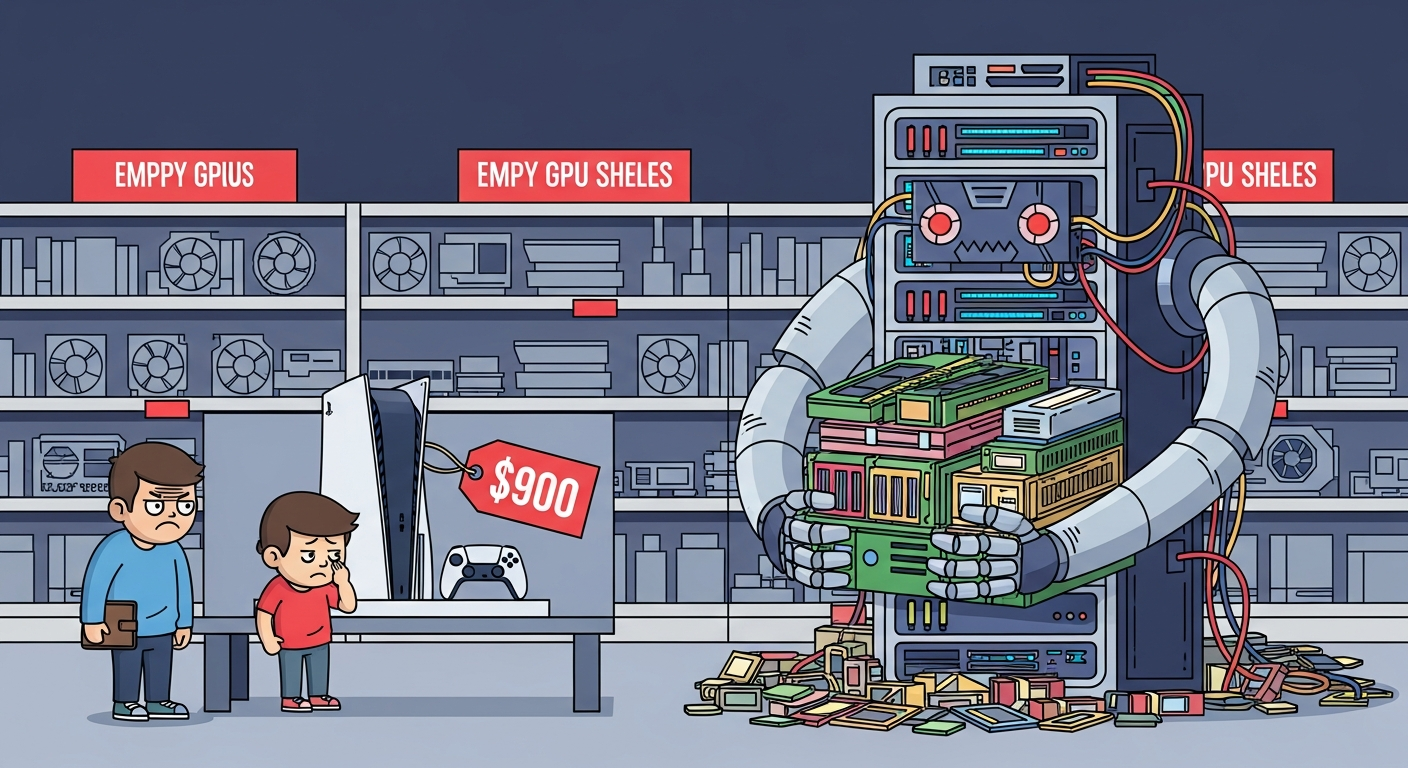
AI data centers now consume over half of all DRAM while HBM chips demand triple the wafer capacity of standard memory, driving a 172% year-over-year price surge that has pushed the PS5 Pro to $900. NVIDIA skipped a consumer GPU launch for the first time in 30 years, and Sony is weighing a PS6 delay to 2029. The structural root lies in a memory oligopoly where three firms control 95% of DRAM and have collectively pivoted to high-margin HBM.
Key Points
The 172% DRAM Spike Is an Oligopoly Story, Not Just an AI Story
TrendForce data shows DRAM prices surged 172% year-over-year, a figure that makes the 2020-2021 chip shortage look like a warm-up act. Data centers now account for over 50% of total DRAM consumption, while AI-specific HBM requires three times the wafer capacity per unit compared to standard DRAM — meaning every HBM chip produced displaces roughly three conventional memory modules. Samsung, SK Hynix, and Micron collectively control 95% of the global DRAM market, and all three have simultaneously pivoted their fabrication capacity toward high-margin HBM production.
This is the part that does not get enough attention. When three companies control virtually the entire supply and all three independently decide to chase the same high-margin product at the same time, the result is not a market correction — it is a structural supply collapse in every other segment. IDC projects PC shipments will decline 11.3% in 2026, driven significantly by surging memory costs. Gartner echoes this, warning that rising memory prices are reducing both PC and smartphone shipments globally. The gaming industry did not cause this crisis, but it is bearing the full weight of it.
The $900 PS5 Pro and the First Year Without a New Gaming GPU in 30 Years
Sony officially priced the PS5 Pro at $900 — its second price increase in under a year, roughly 30% above the original $699 launch price. That is not a premium tier; that is a luxury electronics price point. The PlayStation Blog announcement sparked immediate backlash, with consumers pointing out that $900 buys a decent gaming PC that at least comes with a monitor. Reddit's r/PS5 community was flooded with posts about switching platforms, and the lock-in effect that has historically kept console gamers loyal appears to be cracking under the sheer weight of the price tag.
On the GPU side, NVIDIA made history for all the wrong reasons. For the first time in the company's 30-year existence, 2026 will pass without a new consumer gaming graphics card. The RTX 50-series launched as an underwhelming refresh, and a genuine next-generation gaming GPU — the rumored RTX 60 series — is not expected until 2028 at the earliest. XDA Developers described this as the first year in three decades without a new Nvidia gaming GPU. Meanwhile, Sony is reportedly considering delaying the PS6 to 2029, which would mark the longest console generation gap in PlayStation history. The message from the hardware industry is unmistakable: gamers are no longer the priority customer.
The Supply Black Hole Where Memory Makers Went All-In on HBM
High Bandwidth Memory commands margins three to five times higher than commodity DRAM, and that differential has triggered a gold rush among all three major producers. SK Hynix now derives over 40% of its total DRAM revenue from HBM alone. The technology behind HBM — Through-Silicon Via stacking — yields dramatically fewer finished units per silicon wafer compared to conventional DRAM. TrendForce projects that AI will consume 20% of global DRAM wafer capacity by 2026, and Windows Central reports that AI data centers already use 70% of high-end DRAM production.
The math is brutal. Same wafer input, far less total memory output. Every percentage point of wafer capacity redirected to HBM is a percentage point permanently subtracted from the pool that feeds PCs, consoles, and smartphones. Samsung has warned explicitly about memory shortages, and IDC's Global Memory Shortage Crisis analysis frames this as a systemic issue rather than a temporary bottleneck. Bloomberg quoted Intel's CEO saying there will be 'no relief until 2028,' which means the gaming industry is staring down at least two more years of pricing pain before any structural improvement arrives.
The Gamer Exodus and the Collapse of Platform Loyalty
The $900 PS5 Pro announcement triggered something that years of console wars never managed — a genuine crisis of platform loyalty. Reddit's r/PS5, historically one of the most brand-loyal communities on the platform, was swamped with posts from longtime PlayStation users declaring their intention to switch to PC, Xbox Game Pass, or cloud gaming. The emotional currency of platform loyalty — accumulated trophy collections, friends lists, years of digital purchases — suddenly lost its grip when the asking price crossed the psychological $900 threshold.
Bloomberg's coverage framed the $900 PS5 Pro as a signal of what consumers can expect going forward, not an outlier. BCG's 2026 Video Gaming Report documents a measurable shift in player spending patterns, with a growing share of wallet moving from hardware purchases to subscription services and free-to-play ecosystems. The console gaming model — buy expensive hardware upfront, then buy games separately — was already under pressure from the subscription revolution. The memory crisis has accelerated that pressure into what increasingly looks like a structural break. When the hardware becomes unaffordable, the entire ecosystem built on top of it starts to wobble.
The Inevitable Acceleration Toward Cloud Gaming
Xbox Cloud Gaming, GeForce NOW, and PlayStation's streaming successor are all ramping up capacity at precisely the moment when hardware costs are pushing consumers toward alternatives. The value proposition has never been starker: $900 for a console that may be obsolete in three years, or $15 to $20 per month for a streaming subscription that offloads all the hardware costs to a data center. Intel's CEO has stated publicly that there will be no memory price relief until 2028, which means the window for cloud gaming to capture hardware refugees is wide open for at least two years.
The irony is poetic. The same AI data centers that created the memory shortage are also the infrastructure backbone that makes cloud gaming viable. The technology that made your console unaffordable is simultaneously building the platform that will replace it. Microsoft has been positioning Xbox as a services-first brand for years, and the memory crisis has handed them a tailwind they could not have engineered themselves. For gamers who cannot or will not pay $900, cloud gaming is not the future — it is the present. The question is no longer whether cloud gaming will displace hardware-centric gaming, but how quickly the transition will happen when the hardware itself has been priced beyond reach.
Positive & Negative Analysis
Positive Aspects
- An Accessibility Revolution Through Cloud Gaming
The memory crisis is doing what years of tech evangelism could not — it is making cloud gaming genuinely competitive with hardware ownership. When a PS5 Pro costs $900 and a cloud subscription costs $15 a month, the math speaks louder than any marketing campaign. Xbox Cloud Gaming, GeForce NOW, and PlayStation's streaming services are all expanding their libraries and improving latency, and the infrastructure investments being made by Microsoft, NVIDIA, and Sony in data center capacity will pay dividends for decades.
This forced migration could ultimately democratize gaming access in ways that the hardware model never could. A teenager in Lagos or Manila with a decent internet connection and a $200 phone could access the same AAA titles as someone with a $2,000 gaming PC. The irony is that AI — the very technology pricing gamers out of hardware — is funding the infrastructure that makes this possible. If cloud gaming reaches critical mass, the $900 console era may be remembered not as a crisis but as the catalyst that finally broke gaming's hardware dependency.
- Broad Technological Leaps From HBM Innovation
The HBM revolution is not just serving AI — the memory technologies being developed under the pressure of AI demand will eventually cascade into consumer products. Through-Silicon Via stacking, advanced packaging techniques, and higher bandwidth architectures developed for HBM4 and beyond will eventually find their way into next-generation consoles, gaming PCs, and mobile devices. The R&D spending that Samsung, SK Hynix, and Micron are pouring into memory technology right now is unprecedented in the industry's history.
When the AI investment cycle matures and fabrication capacity expands, the consumer market will inherit memory chips that are faster, more efficient, and more capable than anything the pre-AI era could have produced. The PS7 or the GPU generation after RTX 60 could feature memory bandwidth that would have been considered science fiction five years ago. The short-term pain is real, but the long-term technology dividend is substantial.
- Diversification of Gaming Business Models
The hardware pricing crisis is forcing the gaming industry to innovate beyond the traditional buy-the-box model. Subscription services like Xbox Game Pass and PlayStation Plus are evolving into comprehensive platforms rather than simple game libraries. Cloud-native game development — designing games specifically for streaming rather than porting console titles — is an emerging field that could produce entirely new genres and gameplay experiences impossible on local hardware.
BCG's 2026 Video Gaming Report highlights that player spending is increasingly shifting toward services, microtransactions, and subscription models. While this shift has its own concerns, the diversification of revenue streams makes the gaming industry more resilient overall. Studios that previously depended entirely on the console hardware cycle for their release calendar now have multiple pathways to reach players, reducing the existential risk that any single hardware shortage poses to the broader ecosystem.
- Growing Pressure for Memory Supply Chain Diversification
The current crisis is making the dangers of a three-company oligopoly impossible to ignore. Governments in the United States, the European Union, Japan, and South Korea are all accelerating semiconductor policy discussions, and the memory segment — long overshadowed by logic chip concerns — is finally receiving attention. The U.S. CHIPS Act and its equivalents in other jurisdictions are beginning to include provisions specifically targeting memory manufacturing capacity.
The geopolitical implications of having 95% of global DRAM controlled by companies in just two countries — South Korea and the United States — are driving interest in diversifying production to additional regions. If this crisis produces even a modest expansion of the memory manufacturing base over the next decade, the structural vulnerability that made the current shortage possible will be partially addressed. The gaming industry's pain today could contribute to a more resilient global semiconductor supply chain tomorrow.
- Democratization of AI-Powered Game Development Tools
The same AI infrastructure consuming all this memory is simultaneously producing development tools that are transforming how games are made. AI-powered asset generation, procedural content creation, NPC behavior systems, and automated testing tools are dramatically lowering the barrier to entry for game development. A small indie team with access to AI tools can now produce visual and narrative quality that previously required a hundred-person studio.
Unity and Unreal Engine are both integrating AI-assisted workflows into their core platforms, and dedicated AI game development tools are proliferating. The democratization of development capability means that even if the hardware market contracts, the creative output of the gaming industry could actually expand. More games, from more diverse creators, reaching audiences through cloud platforms rather than expensive hardware — that is a future where the net effect on gaming culture could be profoundly positive despite the hardware crisis.
Concerns
- The End of Hardware Ownership Culture and a Deepening Digital Divide
For three decades, gaming culture was built on the tangible experience of owning your hardware — unboxing a console, building a PC, displaying your setup. The $900 PS5 Pro does not just price out budget-conscious gamers; it threatens to eliminate an entire cultural tradition. When hardware becomes a luxury good, the gaming community splits into those who can afford to own and those who are forced to rent access through subscriptions.
This is not just a matter of nostalgia. Cloud gaming requires reliable high-speed internet, which remains unavailable or unaffordable for significant portions of the population, including rural communities in wealthy nations. The FCC estimates that approximately 24 million Americans lack access to broadband capable of supporting game streaming. The memory crisis is creating a two-tier gaming world — one for the affluent who can afford $900 consoles, and another for everyone else who must depend on infrastructure that does not yet universally exist.
- An Existential Threat to the Indie Game Ecosystem
Independent game developers have historically relied on affordable consumer hardware to reach their audience. When the installed base of current-generation consoles shrinks because fewer people can afford $900 entry points, the addressable market for indie titles contracts proportionally. Indie games are already fighting for visibility in oversaturated digital storefronts, and a smaller hardware base makes that fight exponentially harder.
Cloud gaming platforms, while theoretically accessible, tend to favor AAA titles with mass-market appeal in their curation and recommendation algorithms. The discovery problem that plagues indie developers on Steam and the PlayStation Store could be magnified on streaming platforms where engagement metrics drive what gets promoted. If the console installed base declines by even 15-20% due to pricing, the financial viability of mid-tier and indie studios — the creative engine of the gaming industry — faces serious jeopardy.
- Gaming Community Fragmentation and Brand Trust Collapse
The $900 PS5 Pro has done measurable damage to Sony's relationship with its core audience. Reddit sentiment analysis and social media monitoring show a sharp spike in negative sentiment following the pricing announcement, with longtime PlayStation loyalists publicly declaring their defection. When BCG's gaming report documents a shift in player spending away from hardware, it is measuring the early stages of a trust breakdown that could take a generation to repair.
Platform fragmentation — where the gaming audience splinters across PlayStation, Xbox, PC, cloud services, and mobile — makes it harder for developers to build cross-platform communities and harder for gamers to play with their friends. The social fabric of gaming, which depends on large numbers of people sharing the same platform, frays when economic pressure scatters players in different directions. The memory crisis is not just raising prices; it is dissolving the communal spaces where gaming culture lives.
- Ownership Risks and Service Termination Vulnerabilities of Cloud Gaming
The push toward cloud gaming carries a fundamental ownership problem that the industry has not resolved. When you buy a $900 console and a $70 game disc, you own both. When you subscribe to a cloud service, you own nothing — and the service can remove games from its library, change its pricing, or shut down entirely with little recourse for subscribers. Google Stadia's shutdown in 2023, which left users with nothing despite years of purchases, is the cautionary tale that the cloud gaming cheerleaders prefer not to mention.
The shift from ownership to access also creates long-term preservation concerns for gaming as a cultural medium. Physical media and local hardware allow games to be archived, modded, and replayed indefinitely. Cloud-only games that lose their server infrastructure simply cease to exist. If the memory crisis accelerates the transition to cloud-first gaming before the industry has addressed these ownership and preservation issues, an entire generation of games could be built on infrastructure that has no guaranteed permanence.
- The Risk of an Entrenched Memory Oligopoly With No Exit
Perhaps the most troubling long-term consequence is that the current crisis could actually strengthen the oligopoly rather than weaken it. Samsung, SK Hynix, and Micron are posting record margins on HBM sales, and those profits are being reinvested into expanding HBM capacity — not commodity DRAM capacity. The financial incentive to maintain the current production mix is overwhelming, and no market mechanism currently exists to force these companies to rebalance their output toward consumer memory.
New entrants face barriers that make the semiconductor industry one of the hardest markets in the world to break into — a single advanced memory fab costs $15 to $20 billion and takes three to four years to build. China's efforts to develop domestic DRAM capacity through CXMT and other initiatives have progressed but remain multiple technology generations behind the leaders. The realistic timeline for any meaningful diversification of the DRAM supply base is five to ten years at minimum, which means the gaming industry's dependence on three companies' production decisions is not going away anytime soon.
Outlook
The next six months are going to be rough, and there is no point sugarcoating it. Tom's Hardware reports DRAM prices have already surged 171% year-over-year, and every indicator suggests the trajectory is still pointing upward heading into late 2026 and early 2027. Intel's CEO has gone on record with Bloomberg saying there will be 'no relief until 2028,' and when the head of one of the world's largest semiconductor companies is that blunt about the timeline, it is worth taking seriously. The PS5 Pro sitting at $900 is not the ceiling — it is the new baseline. Sony's pricing reflects the reality that the memory components inside the console have become dramatically more expensive to source, and unless Samsung, SK Hynix, or Micron suddenly decide to redirect wafer capacity back to commodity DRAM, the economics do not change.
IDC's forecast of an 11.3% decline in global PC shipments for 2026 is the canary in the coal mine. Gartner's parallel warning about surging memory costs reducing both PC and smartphone shipments tells the same story from a different angle. This is not a localized disruption hitting one product category — it is a systemic supply reallocation that is repricing every consumer electronics segment that depends on DRAM. The gaming industry happens to be the most visible casualty because consoles are the most price-sensitive products in the memory-dependent ecosystem. A $50 increase on a $1,200 laptop is annoying but absorbable. A $200 increase on a console pushes it past the psychological pain threshold where consumers start looking for alternatives.
On the supply side, TrendForce's projection that AI will consume 20% of global DRAM wafer capacity in 2026 understates the full picture. Windows Central reports that AI data centers already command 70% of high-end DRAM production, and data centers broadly account for over 50% of total DRAM consumption. HBM's three-times wafer capacity requirement per unit means the effective displacement of commodity DRAM is even larger than the raw percentage suggests. When SK Hynix reports that HBM accounts for over 40% of its total DRAM revenue, it reveals how thoroughly the economic incentives have tilted away from the consumer market. Samsung's public warning about memory shortages and IDC's Global Memory Shortage Crisis analysis both point to the same conclusion: this is a structural shift, not a cyclical blip.
The short-term consumer response is already crystallizing. Cloud gaming subscriptions are going to see their biggest growth quarter in the industry's history between Q3 2026 and Q1 2027. Xbox Cloud Gaming, GeForce NOW, and PlayStation's streaming services are all expanding server capacity, and the value proposition of $15-20 per month versus $900 upfront has never been more compelling. Microsoft has been positioning Xbox as a services-first platform for years, and the memory crisis has validated that strategy in a way no marketing campaign could. For NVIDIA, the decision to skip a consumer gaming GPU in 2026 is not just a product cycle delay — it is a signal that the company's center of gravity has permanently shifted toward data center and AI customers. XDA Developers calling it the first year in three decades without a new Nvidia gaming GPU is not hyperbole; it is a milestone that marks the end of an era.
Moving into the medium-term window of late 2027 through 2028, the picture gets more complex. New DRAM fabrication capacity that was greenlit in 2024 and 2025 should begin coming online, which will provide some supply relief. But here is the critical caveat — most of that new capacity is being built specifically for HBM and high-value memory products, not commodity DRAM. Samsung's planned fab expansions in Pyeongtaek and Taylor, Texas, are optimized for advanced memory production. SK Hynix's new facility in Indiana, backed by CHIPS Act subsidies, is explicitly targeted at HBM manufacturing. The capacity is expanding, but it is expanding in the direction that serves AI customers, not gamers.
The gaming hardware market in 2027-2028 will likely bifurcate sharply. At the premium end, next-generation consoles and high-end GPUs will exist as luxury products with price points that reflect the true cost of memory. The rumored PS6, if it arrives by 2029, will almost certainly launch at $700 or higher — a price point that would have been unthinkable a decade ago but will seem normalized after two years of $900 PS5 Pros. At the accessible end, cloud gaming and handheld devices with minimal local memory requirements will serve the mass market. The middle ground — the $400-500 console that defined the PS4 and Xbox One era — may simply cease to exist as a viable product category.
NVIDIA's RTX 60-series, expected in 2028, will be the first major test of whether gaming GPU pricing can find a sustainable equilibrium in the post-AI-boom market. The RTX 50-series disappointed gamers precisely because it allocated too much of its value proposition to AI features rather than raw gaming performance. If the RTX 60-series follows the same pattern — prioritizing AI inference capabilities over frame rates — it will confirm that the GPU industry has permanently reprioritized its customer base. My estimate is that the RTX 6090, if it exists, will launch at $2,000 or above, with the midrange RTX 6070 starting at $600-700 — compared to the RTX 3070's $499 launch price just five years earlier.
The medium-term also brings the question of whether alternative memory technologies can offer any relief. CXL-attached memory pooling, which allows servers to share memory resources more efficiently, could reduce the per-unit demand for DRAM in data centers by 15-25%. MRAM and other emerging non-volatile memory technologies are progressing but remain years away from volume production at the densities needed for gaming applications. The more likely medium-term solution is not a technology breakthrough but a market correction — at some point, HBM margins will compress as capacity catches up with demand, and the incremental wafer allocated to HBM will become less profitable than the wafer allocated to commodity DRAM. That rebalancing point is where the consumer market gets relief, and my best estimate puts it somewhere in the second half of 2028.
Looking further ahead to 2029 through 2031, three scenarios define the range of outcomes.
The bull case assumes that DRAM capacity expansion proceeds faster than currently projected, potentially driven by aggressive CHIPS Act subsidies, new entrants like China's CXMT achieving volume production of competitive DRAM, and a cyclical downturn in AI infrastructure spending that frees up wafer capacity for consumer products. In this scenario, commodity DRAM prices normalize by late 2028, the PS6 launches in 2029 at $599 with competitive specs, and NVIDIA returns to launching consumer-focused gaming GPUs on an annual cadence. Cloud gaming and traditional hardware coexist as complementary channels rather than substitutes. The gaming industry experiences a V-shaped recovery, with pent-up demand from the shortage years fueling a hardware upgrade supercycle in 2029-2030. I put the probability of this scenario at approximately 20%. It requires multiple things to go right simultaneously, and the structural incentives currently favor continued HBM prioritization.
The base case is the most likely path. Memory supply gradually improves through 2028-2029 as new fab capacity comes online, but the improvement primarily benefits the server and AI markets. Consumer memory prices decline from their 2026-2027 peaks but stabilize at levels 40-60% above pre-crisis baselines. The PS6 launches in late 2029 at $699-749, and console gaming survives but as a smaller market than it was in the PS4 era. Cloud gaming captures 25-30% of the total gaming market by 2030, up from an estimated 8-10% today. NVIDIA maintains its dual focus on AI and gaming, with consumer GPUs positioned as a secondary priority. The three-company DRAM oligopoly remains intact, and periodic supply crunches become a recurring feature of the consumer electronics landscape every four to six years as AI demand continues to grow in waves. I assign this scenario a probability of approximately 55%.
The bear case envisions a prolonged and deepening crisis. If AI infrastructure spending accelerates beyond current projections — driven by AGI breakthroughs, sovereign AI initiatives, or another wave of corporate AI adoption — the competition for memory capacity intensifies rather than easing. Samsung, SK Hynix, and Micron continue to prioritize HBM and high-value memory products, and commodity DRAM prices remain elevated through 2030 and beyond. The PS6 is delayed to 2030 or later, and when it finally launches, it carries a price tag above $800 that limits its installed base to a fraction of the PS4's 117 million units. NVIDIA effectively exits the consumer GPU market, licensing its architecture to partners who produce budget-oriented cards while the company focuses entirely on data center products. Console gaming as a mass-market entertainment medium enters terminal decline, replaced by a combination of cloud gaming, mobile gaming, and retro hardware. The physical game store disappears entirely by 2031. I put this scenario at 25% probability. It sounds extreme, but consider that three years ago, the idea of a $900 PS5 and no new NVIDIA gaming GPU would have sounded equally extreme.
Across all three scenarios, several structural trends are irreversible. First, the era of the $400 console is over. Memory economics have permanently shifted the cost structure of gaming hardware upward, and no amount of console-war competition between Sony and Microsoft can overcome the underlying silicon costs. Second, cloud gaming's share of the total market will grow regardless of how the memory crisis resolves, because the infrastructure investments being made today create capabilities that persist even after prices normalize. Third, the relationship between the gaming industry and the semiconductor industry has fundamentally changed — gamers are now a secondary customer, and the pricing, product cycles, and technology roadmaps of memory and GPU manufacturers will reflect that reality for the foreseeable future.
The numbers worth watching over the next two years are these: the HBM-to-commodity DRAM wafer allocation ratio at each of the big three manufacturers, which will signal when the rebalancing begins; Sony's PS5 Pro sell-through rate at $900, which will determine whether the market accepts luxury-tier console pricing; cloud gaming subscriber growth rates, which will indicate how quickly the transition from ownership to access is proceeding; and the first major new DRAM fab completion date, which will mark the earliest possible inflection point for supply relief. Bloomberg's reporting on Intel's 2028 timeline, TrendForce's wafer capacity tracking, and IDC's quarterly shipment data will be the most reliable leading indicators.
The uncomfortable truth at the bottom of all this analysis is straightforward. The memory industry discovered that selling premium chips to AI companies is dramatically more profitable than selling commodity chips to gamers, and the market is behaving exactly as economic theory predicts it should. Gamers are experiencing the consequences of being the less profitable customer in a supply-constrained market controlled by three companies. The crisis will eventually ease — supply always catches up with demand given enough time and capital — but the gaming industry that emerges on the other side will look fundamentally different from the one that went in. The $900 PS5 Pro is not an anomaly to be corrected. It is the first chapter of a new normal.
One final dimension that deserves attention is the geopolitical layer beneath the market dynamics. The United States and South Korea together host the headquarters of all three DRAM oligopoly members, and the ongoing semiconductor trade restrictions between the U.S. and China add another variable to the supply equation. China's CXMT is investing heavily in domestic DRAM production, but export controls on advanced lithography equipment have constrained its ability to manufacture cutting-edge memory. If those restrictions tighten further — which is plausible given the current geopolitical trajectory — the timeline for any meaningful supply diversification extends even further. Conversely, if diplomatic conditions shift and Chinese DRAM production ramps faster than expected, the additional supply could be the wildcard that breaks the shortage earlier than anyone currently forecasts. The CHIPS Act investments in the U.S. and similar programs in the EU and Japan are designed to address exactly this concentration risk, but fabrication facilities take three to five years to build and certify. The gaming industry is caught in the crossfire of a geopolitical contest it has no ability to influence, and the resolution of that contest will shape the memory market's structure for the next decade. For gamers wondering when their hobby stops feeling like a luxury tax, the honest answer is: it depends on decisions being made in boardrooms and government offices that have never once considered the price of a PlayStation.
Sources / References
- DRAM Price Surge — 172% Year-over-Year Increase in Memory Pricing — TrendForce
- Global DRAM Market Share Analysis — Samsung, SK Hynix, Micron 95% Control — TrendForce
- PS5 Pro $900 Official Pricing Announcement — PlayStation Blog
- SK Hynix HBM Revenue Surpasses 40% of Total DRAM Sales — SK Hynix Investor Relations
- Xbox Cloud Gaming, GeForce NOW Expansion Plans and Subscriber Growth — Microsoft / NVIDIA
- Sony Reportedly Considering PS6 Delay to 2029 — Bloomberg
- RTX 50-Series Launch Analysis and Consumer Reception — Tom's Hardware
- Intel CEO States 'No Relief Until 2028' for Memory Market — Bloomberg
- DRAM Prices Surge 171% Year-over-Year Amid AI Demand — Tom's Hardware
- AI to Consume 20% of Global DRAM Wafer Capacity in 2026 — TrendForce
- AI Datacenters Use 70% of High-End DRAM Production — Windows Central
- 2026 Global PC Shipment Forecast — 11.3% Decline Projected — IDC
- Surging Memory Costs Reduce PC and Smartphone Shipments Globally — Gartner
- PS5 Pro at $900 Shows the Consumer Cost of the Memory Crunch — Bloomberg
- First Year in Three Decades Without a New Nvidia Consumer Gaming GPU — XDA Developers
- Samsung Warns of Deepening Memory Shortages Across Product Lines — Network World
- Global Memory Shortage Crisis — Structural Market Analysis — IDC
- Video Gaming Report 2026 — Player Spending and Platform Shifts — BCG (Boston Consulting Group)