
Technology

Fire 15,000 People and Watch Your Stock Jump 3% — Big Tech Just Found the Cruelest Formula in Capitalism
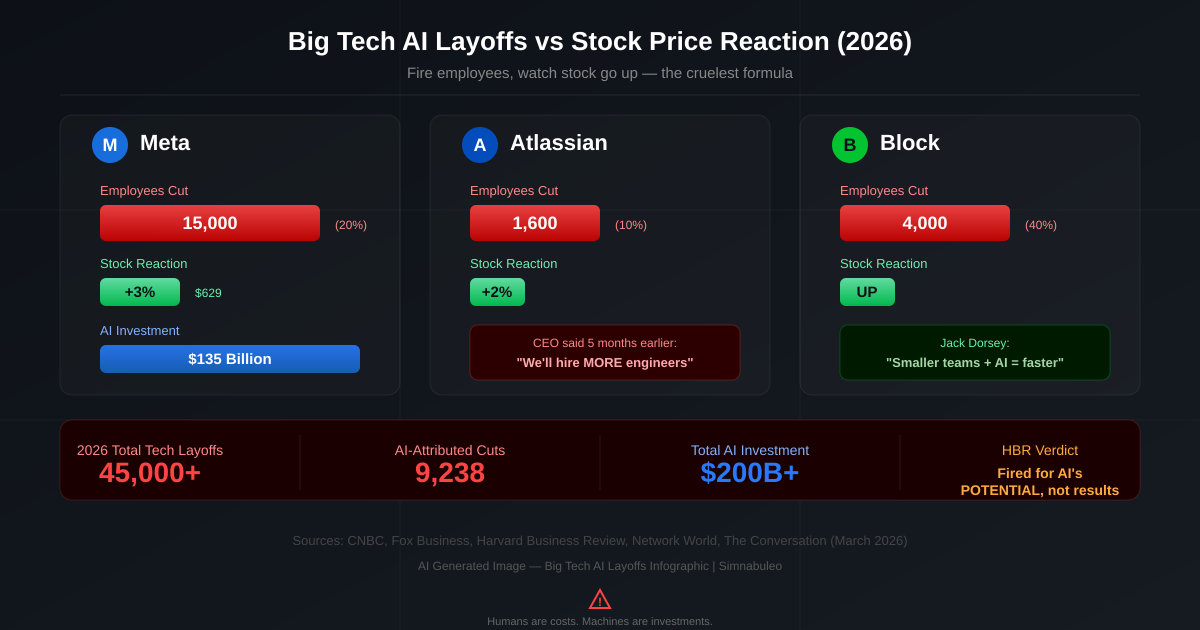
(AI-generated images) Big Tech AI Layoffs vs Stock Price Reaction Infographic — Meta, Atlassian, Block comparison

Summary

When Meta announced plans to cut 20% of its workforce, the stock went up. Atlassian and Block followed the same playbook. Big Tech's real AI strategy in 2026 may not be innovation — it may be redefining humans as a line item to be optimized away.

Key Points

1

The Era Where Layoff Announcements Boost Stock Prices

On March 16, 2026, when reports emerged that Meta was considering cutting roughly 15,000 employees — about 20% of its workforce — the stock immediately jumped nearly 3%. This is not a simple market reaction. Wall Street interprets workforce reduction as 'efficiency improvement' and AI investment expansion as 'growth driver.' When Atlassian laid off 1,600, stock rose 2%. When Block cut 4,000, stock went up. Harvard Business Review noted that companies are laying off workers because of AI's potential — not its performance.

2

$135B — The Unrealistic Scale of AI Spending

Meta has pledged between $115 billion and $135 billion in AI-related capital expenditure for 2026 — nearly double what it spent in 2025. The problem is that nobody can clearly answer what returns this astronomical investment is actually generating. The 15,000-person layoff could save roughly $6 billion — just 4.4% of the $135 billion investment.

3

"You Said You'd Hire MORE Five Months Ago" — CEO Flip-Flops

Atlassian CEO Mike Cannon-Brookes said in October 2025 that the tech industry would need more engineers over the next five years. He pledged to hire more graduates in 2025 and 2026. Five months later, he cut 1,600 people. More than 900 were from R&D. Nobody is verifying whether AI is actually doing the work of the people who were fired.

4

The Death of Junior Developers — AI's First Victims

The most vulnerable group in this layoff wave is entry-level and junior employees. Industry analysts warn that as AI absorbs repetitive tasks traditionally assigned to junior staff, unemployment among recent graduates could climb into the mid-30% range. In 10 years, we face a paradox: a shortage of skilled workers caused by the very automation that was supposed to make work more efficient.

5

2026 Is Year One of 'AI-Justified Layoffs'

As of March 2026, more than 45,000 people have been laid off in the tech industry alone. Roughly 9,238 of those cuts have been directly attributed to AI adoption and automation-driven restructuring. The Conversation's analysis: Big Tech is using AI as a 'blanket justification' for mass layoffs, with a significant gap between actual AI deployment and the scale of firings.

Positive & Negative Analysis

Positive Aspects

  • AI infrastructure investment secures long-term competitive advantage

    Meta's $135B investment is a long-term bet on future platforms. As Nvidia projected at GTC 2026 with a $1T chip market on the horizon, companies that secure AI infrastructure first will dominate the next decade.

  • Opportunity to streamline bloated organizational structures

    During the pandemic era (2020-2022), Big Tech companies went on massive hiring sprees, leading to organizational bloat. Trimming excess headcount has a certain corporate hygiene logic, regardless of whether AI is the stated reason.

  • Evidence that AI tools genuinely boost productivity

    GitHub research shows 85% of developers already use AI coding tools, with accumulating data showing AI-augmented teams produce significantly more output.

  • Triggers social awareness and policy discussions

    The massive AI layoff wave inevitably accelerates discussions about social safety nets and labor policies. The EU is already discussing regulatory frameworks for AI's impact on employment.

Concerns

  • Firing humans based on AI's potential, not proven performance

    As Harvard Business Review pointed out, companies are laying off workers because of AI's potential — not its performance. There isn't sufficient empirical evidence that AI can fully replace these roles.

  • Stock price incentive structure rewards layoffs

    When Meta announced layoffs, stock jumped 3%. CEO compensation packages are tied to stock price, meaning layoffs directly enrich executives. This incentive structure gives CEOs zero motivation to minimize job cuts.

  • The first rung of the career ladder is disappearing

    AI absorbing junior-level repetitive tasks means the future talent pipeline is being destroyed. Today's senior developers can leverage AI because they built foundations during their junior years. Remove that opportunity and we face a skilled-worker shortage paradox in a decade.

  • The gap between CEO promises and actions destroys trust

    Atlassian's CEO promised to hire more engineers five months before cutting 1,600 people. Employees made life decisions based on those promises. How can anyone trust Big Tech leadership after such whiplash?

  • AI justification may be masking real restructuring motives

    Big Tech is using AI as a blanket justification for mass layoffs, with a significant gap between actual AI deployment levels and the scale of firings. Of 45,000 cuts, how many jobs has AI actually replaced? Nobody is tracking this.

Outlook

In the short term, this layoff wave likely hasn't peaked. Once Meta's 15,000 cuts go through, other companies will follow under the banner of "benchmarking." 24/7 Wall Street has warned that Meta's 20% layoff rumor is coming for other companies next. As AI infrastructure investment competition intensifies, cost-cutting pressure grows — and the first exit for that pressure is always headcount. It wouldn't be surprising if total tech layoffs exceed 100,000 by the end of the first half of 2026.

In the medium term — six months to two years — two paths diverge. In the optimistic scenario, AI investments start generating real revenue, and new AI-native job categories emerge at scale: AI prompt engineers, AI safety auditors, AI ethics consultants, AI agent managers. In the pessimistic scenario, the $135 billion fails to deliver expected returns, laid-off workers can't find new positions, and the remaining employees are trapped in "exploitative efficiency" — fewer people doing more work. If Meta's investment doesn't show visible ROI by 2027, it will be recorded as one of the most expensive gambles in corporate history.

In the long term — three to five years — this is the opening act of the largest labor market transformation since the Industrial Revolution. Previous revolutions replaced physical labor; AI replaces cognitive labor. Coding, analysis, writing, design — these were the core of "good jobs." When these roles get redefined by AI, the critical question is whether there exists a next rung on the ladder for displaced workers.

Scenario analysis: Bull case — AI productivity revolution materializes, GDP growth accelerates, displaced workers find higher-value roles in the new AI ecosystem. Probability: roughly 25%. Base case — AI investments partially deliver, some roles genuinely get replaced while most workers find modified positions, accompanied by a painful 2-3 year adjustment period. Probability: roughly 50%. Bear case — the AI investment bubble bursts, companies need to rehire but skilled workers have already moved to other industries, and an economic downturn compounds the damage. Probability: roughly 25%.

One thing is certain: what we need right now isn't rosy promises — it's cold, hard verification. Is AI actually performing the work of the employees who were fired? What's happening to the workload and satisfaction of those who remain? What's the actual ROI on these investments? This data needs to be transparently disclosed. Otherwise, we're simply witnessing the most sophisticated version of exploitation yet invented: cutting humans to pump stock prices.

Sources / References

Related Perspectives

Technology

Congrats on Buying Subnautica 2 — You're Already the Product

Subnautica 2 shattered Steam Early Access records by selling two million copies and reaching 460,000 peak concurrent users within its first 12 hours on sale, yet this milestone was almost immediately eclipsed by the discovery that four separate telemetry pipelines were actively transmitting player data before users had ever been shown the EULA consent screen. Before a single "I Agree" button was clicked, the game had automatically generated a Krafton account, an Epic Online Services session, a device hardware fingerprint, and a Sentry error-tracking session — conduct that privacy regulators argue lacks any lawful basis under GDPR Article 6. The EULA itself compounded the problem with a cascade of aggressively one-sided provisions: a $50 maximum damages cap that renders the publisher functionally immune from accountability, a license termination clause triggered by VPN use, a "reputational harm" termination clause designed to suppress public criticism, and a flat prohibition on class-action lawsuits. Publisher Krafton carries serious pre-existing credibility deficits, having allegedly engineered layoffs to evade a $250 million bonus obligation owed to Unknown Worlds developers, then reportedly deployed a ChatGPT-generated legal strategy to defend that decision — a gambit that ended in a court defeat and the revocation of Krafton's Steam publisher status entirely. EU consumers have launched formal GDPR complaints, and the forthcoming EU Digital Fairness Act (Q4 2026) positions this incident as a potential regulatory inflection point for the gaming industry's longstanding covert surveillance practices.

Technology

Mythos Didn't Create a New Threat — It Just Mapped the Minefield We've Been Living On for Decades

Anthropic's Mythos model demonstrated an unprecedented capacity for autonomous vulnerability discovery, successfully identifying over 300 security flaws in Firefox and autonomously exploiting a 17-year-old remote code execution bug in FreeBSD without human intervention, sending shockwaves through the global cybersecurity community. Rather than releasing the model, Anthropic launched Project Glasswing — a restricted-access program granting only a dozen Big Tech partners the ability to leverage its defensive capabilities — igniting fierce debate over whether this constitutes genuine safety leadership or a form of technological monopolization. The London School of Economics' analysis on the "myth of containment" argues systematically that restricting access to AI capabilities has historically never succeeded, positioning Anthropic's closed approach as a first step rather than a viable long-term strategy. At the heart of this controversy is a fundamental reframing: Mythos did not invent new dangers but rather illuminated the structural fragility of global digital infrastructure built on decades of unpatched legacy code and accumulated technical debt. The real Vulnpocalypse is not a future AI attack scenario — it is the bill arriving for decades of deferred maintenance, and the urgent questions now center on whether defensive AI will be democratized or locked behind corporate walls for decades to come.

Technology

GTA 6 Isn't Skipping PC — It's Just Making Sure You Buy It Twice

Take-Two Interactive CEO Strauss Zelnick justified GTA 6's console-only launch — with no PC release date in sight — by claiming that "console players are GTA's core audience," a statement that immediately ignited a worldwide controversy among PC gaming communities and prompted widespread accusations of platform discrimination. GTA 5's own 12-year revenue record directly dismantles that framing: of the game's 190 million lifetime units sold, the PC version alone accounted for approximately 34 million copies — roughly 18% of total sales — generating an estimated $1.4 billion in incremental operating income from a platform that didn't even receive the game until 18 months after the console launch. This analysis identifies and dissects the two real drivers concealed beneath the "console-first" surface argument: a deliberately engineered double-dip revenue architecture that monetizes the same consumer twice across separate release windows, and a Sony PlayStation marketing co-funding arrangement that Zelnick himself openly confirmed in a May 2026 interview, transforming the release calendar from a strategic choice into a contractual obligation. The piece also examines the 12-year behavioral loop in which PC gamers reliably express outrage and then reliably purchase the game anyway — a data-verified cycle that makes this strategy commercially self-sustaining and structurally resistant to public pressure campaigns. The conclusion is that "console-first" is not an expression of market analysis but a self-fulfilling marketing sequence, and that the true "core audience" in Take-Two's strategic language simply means whoever is prepared to pay for the same game twice.

Technology

Your Game Library Evaporates Every 30 Days — Sony's Quiet Redefinition of "Ownership"

PlayStation's silent introduction of a mandatory 30-day online authentication requirement for digitally purchased games in March 2026 detonated a firestorm across the global gaming community and forced a long-overdue reckoning with how digital ownership actually functions in the modern economy. The incident revealed what has always been legally true but commercially obscured: clicking buy on a digital storefront transfers not ownership but a revocable license of indefinite duration, and the seller retains the ability to restrict or terminate access at any point thereafter. This structural flaw is not confined to gaming—it pervades every corner of the digital economy, from Amazon Kindle libraries to Adobe Creative Cloud subscriptions, and the same catastrophic access-loss scenario applies to all of them equally. On both sides of the Atlantic, legislative responses are accelerating: California AB 2426 took effect in January 2025 requiring transparent license disclosures, the EU Stop Killing Games initiative gathered 1.4 million signatures and earned a favorable parliamentary hearing in April 2026, and France's UFC-Que Choisir filed suit against Ubisoft over The Crew server shutdown. The PlayStation DRM episode stands as a potential inflection point—a moment when the hidden asymmetry of the access economy finally became visible enough to drive structural change, provided consumer attention can outlast the next major game release cycle.

Technology

OpenAI Has No Moat — The Day a $3.48 AI Beat the $30 One

DeepSeek V4's public release on April 24, 2026, delivered a triple shock to the global AI industry, simultaneously demonstrating the limits of American semiconductor export controls, shattering premium AI pricing conventions, and igniting a landmark intellectual property dispute. The model's successful training of a 1.6-trillion-parameter frontier system on Huawei's Ascend 950PR chips — hardware that American restrictions were explicitly designed to make unavailable — constitutes the most direct empirical challenge yet to the containment strategy underpinning Washington's AI policy. At $3.48 per million tokens, DeepSeek V4-Pro's API pricing is approximately one-tenth that of OpenAI's GPT-5.2, representing not a competitive discount but a structural signal that AI is transitioning from a scarce premium product to commoditized, utility-grade infrastructure. Concurrent accusations from Anthropic and OpenAI — alleging that 24,000 fraudulent accounts were used to harvest 16 million proprietary conversations for model distillation — have raised fundamental questions about the boundaries of intellectual property in an era where open-source AI models freely circulate. These converging disruptions point toward a fundamental restructuring of the AI industry's competitive landscape, business models, and geopolitical alignments that will reshape everything from API pricing strategy to chip export policy over the next two to five years.

SimNabuleo AI

AI Riffs on the World — AI perspectives at your fingertips

simcreatio [email protected]

Content on this site is based on AI analysis and is reviewed and processed by people, though some inaccuracies may occur.

© 2026 simcreatio(심크리티오), JAEKYEONG SIM(심재경)

enko