
Fire 15,000 People and Watch Your Stock Jump 3% — Big Tech Just Found the Cruelest Formula in Capitalism
Summary
When Meta announced plans to cut 20% of its workforce, the stock went up. Atlassian and Block followed the same playbook. Big Tech's real AI strategy in 2026 may not be innovation — it may be redefining humans as a line item to be optimized away.
Key Points
The Era Where Layoff Announcements Boost Stock Prices
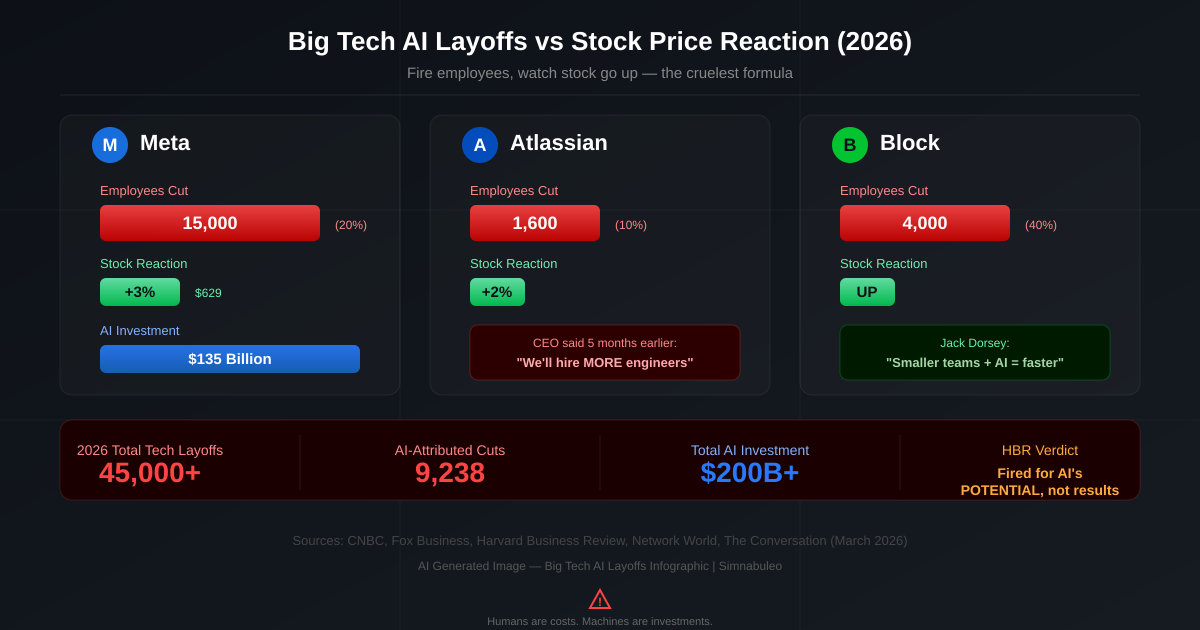
On March 16, 2026, when reports emerged that Meta was considering cutting roughly 15,000 employees — about 20% of its workforce — the stock immediately jumped nearly 3%. This is not a simple market reaction. Wall Street interprets workforce reduction as 'efficiency improvement' and AI investment expansion as 'growth driver.' When Atlassian laid off 1,600, stock rose 2%. When Block cut 4,000, stock went up. Harvard Business Review noted that companies are laying off workers because of AI's potential — not its performance.
$135B — The Unrealistic Scale of AI Spending
Meta has pledged between $115 billion and $135 billion in AI-related capital expenditure for 2026 — nearly double what it spent in 2025. The problem is that nobody can clearly answer what returns this astronomical investment is actually generating. The 15,000-person layoff could save roughly $6 billion — just 4.4% of the $135 billion investment.
"You Said You'd Hire MORE Five Months Ago" — CEO Flip-Flops
Atlassian CEO Mike Cannon-Brookes said in October 2025 that the tech industry would need more engineers over the next five years. He pledged to hire more graduates in 2025 and 2026. Five months later, he cut 1,600 people. More than 900 were from R&D. Nobody is verifying whether AI is actually doing the work of the people who were fired.
The Death of Junior Developers — AI's First Victims
The most vulnerable group in this layoff wave is entry-level and junior employees. Industry analysts warn that as AI absorbs repetitive tasks traditionally assigned to junior staff, unemployment among recent graduates could climb into the mid-30% range. In 10 years, we face a paradox: a shortage of skilled workers caused by the very automation that was supposed to make work more efficient.
2026 Is Year One of 'AI-Justified Layoffs'
As of March 2026, more than 45,000 people have been laid off in the tech industry alone. Roughly 9,238 of those cuts have been directly attributed to AI adoption and automation-driven restructuring. The Conversation's analysis: Big Tech is using AI as a 'blanket justification' for mass layoffs, with a significant gap between actual AI deployment and the scale of firings.
Positive & Negative Analysis
Positive Aspects
- AI infrastructure investment secures long-term competitive advantage
Meta's $135B investment is a long-term bet on future platforms. As Nvidia projected at GTC 2026 with a $1T chip market on the horizon, companies that secure AI infrastructure first will dominate the next decade.
- Opportunity to streamline bloated organizational structures
During the pandemic era (2020-2022), Big Tech companies went on massive hiring sprees, leading to organizational bloat. Trimming excess headcount has a certain corporate hygiene logic, regardless of whether AI is the stated reason.
- Evidence that AI tools genuinely boost productivity
GitHub research shows 85% of developers already use AI coding tools, with accumulating data showing AI-augmented teams produce significantly more output.
- Triggers social awareness and policy discussions
The massive AI layoff wave inevitably accelerates discussions about social safety nets and labor policies. The EU is already discussing regulatory frameworks for AI's impact on employment.
Concerns
- Firing humans based on AI's potential, not proven performance
As Harvard Business Review pointed out, companies are laying off workers because of AI's potential — not its performance. There isn't sufficient empirical evidence that AI can fully replace these roles.
- Stock price incentive structure rewards layoffs
When Meta announced layoffs, stock jumped 3%. CEO compensation packages are tied to stock price, meaning layoffs directly enrich executives. This incentive structure gives CEOs zero motivation to minimize job cuts.
- The first rung of the career ladder is disappearing
AI absorbing junior-level repetitive tasks means the future talent pipeline is being destroyed. Today's senior developers can leverage AI because they built foundations during their junior years. Remove that opportunity and we face a skilled-worker shortage paradox in a decade.
- The gap between CEO promises and actions destroys trust
Atlassian's CEO promised to hire more engineers five months before cutting 1,600 people. Employees made life decisions based on those promises. How can anyone trust Big Tech leadership after such whiplash?
- AI justification may be masking real restructuring motives
Big Tech is using AI as a blanket justification for mass layoffs, with a significant gap between actual AI deployment levels and the scale of firings. Of 45,000 cuts, how many jobs has AI actually replaced? Nobody is tracking this.
Outlook
In the short term, this layoff wave likely hasn't peaked. Once Meta's 15,000 cuts go through, other companies will follow under the banner of "benchmarking." 24/7 Wall Street has warned that Meta's 20% layoff rumor is coming for other companies next. As AI infrastructure investment competition intensifies, cost-cutting pressure grows — and the first exit for that pressure is always headcount. It wouldn't be surprising if total tech layoffs exceed 100,000 by the end of the first half of 2026.
In the medium term — six months to two years — two paths diverge. In the optimistic scenario, AI investments start generating real revenue, and new AI-native job categories emerge at scale: AI prompt engineers, AI safety auditors, AI ethics consultants, AI agent managers. In the pessimistic scenario, the $135 billion fails to deliver expected returns, laid-off workers can't find new positions, and the remaining employees are trapped in "exploitative efficiency" — fewer people doing more work. If Meta's investment doesn't show visible ROI by 2027, it will be recorded as one of the most expensive gambles in corporate history.
In the long term — three to five years — this is the opening act of the largest labor market transformation since the Industrial Revolution. Previous revolutions replaced physical labor; AI replaces cognitive labor. Coding, analysis, writing, design — these were the core of "good jobs." When these roles get redefined by AI, the critical question is whether there exists a next rung on the ladder for displaced workers.
Scenario analysis: Bull case — AI productivity revolution materializes, GDP growth accelerates, displaced workers find higher-value roles in the new AI ecosystem. Probability: roughly 25%. Base case — AI investments partially deliver, some roles genuinely get replaced while most workers find modified positions, accompanied by a painful 2-3 year adjustment period. Probability: roughly 50%. Bear case — the AI investment bubble bursts, companies need to rehire but skilled workers have already moved to other industries, and an economic downturn compounds the damage. Probability: roughly 25%.
One thing is certain: what we need right now isn't rosy promises — it's cold, hard verification. Is AI actually performing the work of the employees who were fired? What's happening to the workload and satisfaction of those who remain? What's the actual ROI on these investments? This data needs to be transparently disclosed. Otherwise, we're simply witnessing the most sophisticated version of exploitation yet invented: cutting humans to pump stock prices.