
A $321B Industry Is Firing Its Own Builders — The Ugly Truth Behind Gaming's Layoff Massacre
Summary
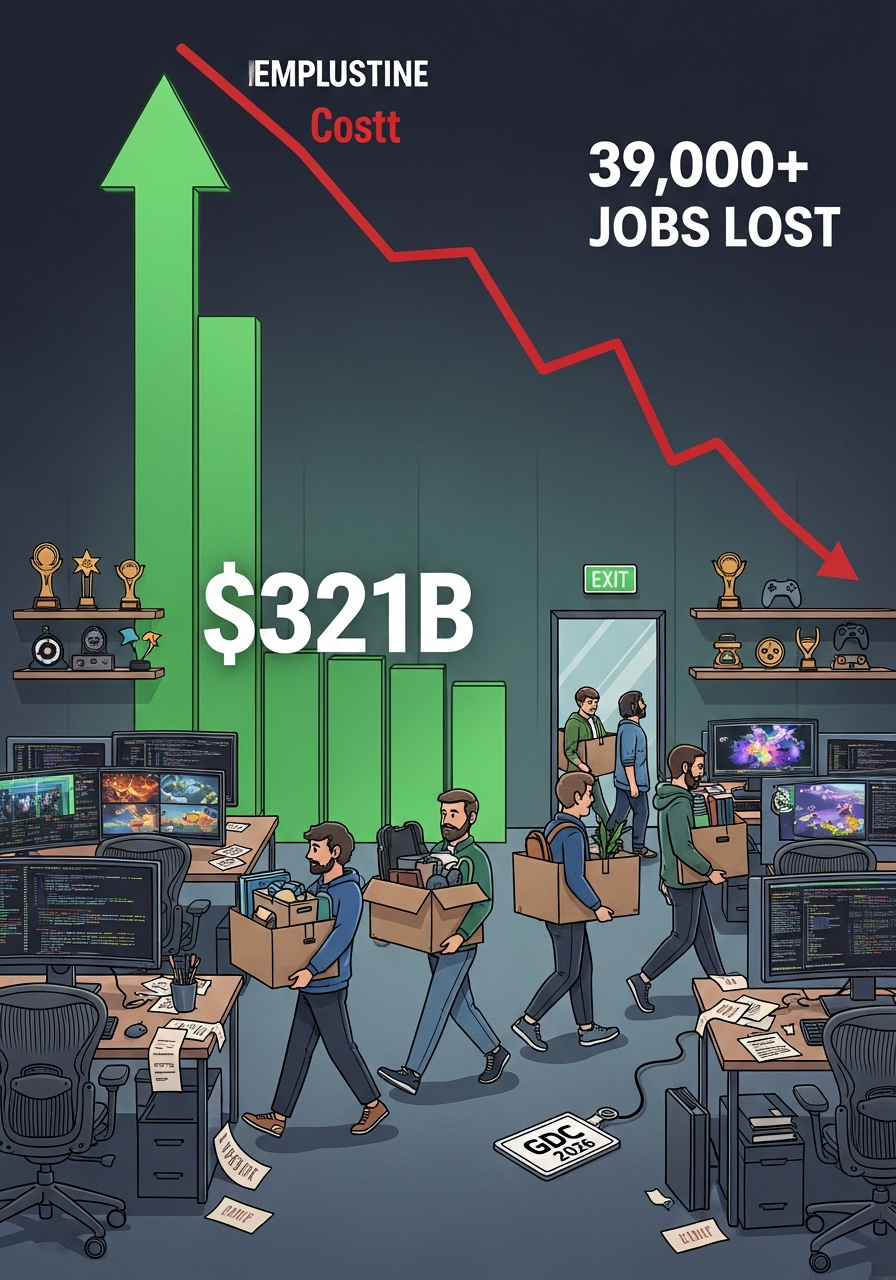
Record gaming revenue, yet 33,600+ developers fired in three years. GDC 2026 reveals 1 in 3 faced layoffs. The dream job is now a dangerous career.
Key Points
The Revenue-Layoff Paradox — $321B vs 33,600 Workers
The global gaming market is now larger than the film, music, and streaming industries combined. According to PwC's projected figures — which include hardware and services — the industry reached $321 billion in revenue, while Newzoo's core gaming market estimate stands at $197 billion for 2025. Either way, it's a record. And yet, over the same three-year span from 2022 to 2024, more than 33,600 developers lost their jobs. EA laid off the team behind Battlefield 6 shortly after the franchise posted its highest-ever sales figures, a move that symbolizes the structural disconnect between revenue growth and job security in this industry. The problem isn't a lack of money — it's a profit distribution system skewed heavily toward shareholder dividends and executive compensation. This paradox isn't unique to gaming; it reflects a broader trend of labor devaluation across the entire technology sector.
The Structural Collapse of the Live-Service Model
Epic Games laying off over 1,000 employees and shutting down three Fortnite modes was the defining event that exposed the limits of the live-service model. According to Bloomberg, Fortnite's monthly playtime on PlayStation dropped from roughly 21 hours to 16 hours, while broader platform data showed similar declines from 29 to 15.4 hours. The model of 'constantly pumping out content to retain users' is fundamentally unsustainable — each season demands more content than the last, creating a structure that resembles a Ponzi scheme. The pandemic-era boom merely masked this reality; the mathematical limits of live-service were built in from the start. Tim Sweeney himself said 'this isn't about AI,' but in doing so, he effectively admitted that the business model itself had failed.
GDC 2026 Exposes the Grim Reality Facing Developers
The GDC 2026 State of the Game Industry survey put hard numbers to what everyone in the industry already felt. One in three American game developers experienced layoffs in the past two years. Of those who were let go, 48 percent failed to find new employment. Perhaps the most damning statistic: 74 percent of students expressed anxiety about entering the gaming industry as a career. The image of gaming as a 'dream job' has been completely inverted into 'dangerous career.' These numbers signal more than short-term talent drain — they represent a structural crisis that could shrink the pipeline of talent flowing into the industry for the next five to ten years. An industry that keeps growing while its workers keep leaving is a paradox that has now become reality.
Publisher Greed — Krafton's ChatGPT Termination Letter
The Krafton-Unknown Worlds saga showed just how far publisher greed can stretch. According to Fortune's reporting, Krafton fired the CEO of Unknown Worlds — the studio behind Subnautica 2 — allegedly to avoid paying a promised bonus package worth approximately $250 million. The termination notice, reports indicated, was drafted using ChatGPT. A decision that fundamentally alters a person's life, delegated to a chatbot. This incident crystallizes the core of the gaming industry crisis: it's not about revenue — it's about how profits are distributed. Developers are treated as disposable components, and the culture of expendability operates at an institutional level. A Delaware court eventually reinstated the CEO, but the damage to trust was already done.
Gaming Is Repeating Hollywood's Mistakes
Blockbuster dependency, crunch culture, absent unions, and structural exploitation of creators — the gaming industry is following the exact path Hollywood walked before it. Hollywood went through the 2023 WGA and SAG-AFTRA strikes, a massive labor dispute that ultimately produced at least minimal protections for workers. The gaming industry has nothing comparable. If the pattern of 33,600-plus layoffs and a 48 percent re-employment failure rate continues, the probability of a similar large-scale labor dispute erupting in gaming between 2028 and 2030 exceeds 60 percent. The warning signs are already visible: unions have formed at Sega of America, ZeniMax, and Activision's QA division. According to Engadget, North American video game workers now have an industry-wide union. The precedent has been set — the question is how far it will spread.
Positive & Negative Analysis
Positive Aspects
- A Potential Golden Age for the Indie Game Ecosystem
Every wave of mass layoffs sends experienced developers out of corporate studios and into the indie scene. Senior programmers, veteran art directors, and seasoned designers who built AAA franchises are now founding their own studios with smaller teams and sharper creative visions. Steam's indie game segment generated approximately $4.4 billion in 2025, accounting for roughly 25 percent of total platform revenue — a figure that reflects approximately 19 percent growth year over year. If these newly formed studios begin releasing their first titles in 2027 to 2028, the indie market could see a surge in quality that rivals anything the AAA space can offer.
- A Catalyst for the Game Developer Labor Movement
The layoff crisis has done more for unionization efforts in gaming than decades of crunch culture complaints ever did. When one in three developers has personally experienced a layoff, the abstract appeal of collective bargaining becomes urgently concrete. Unions have already been established at several studios under the Microsoft-Activision Blizzard umbrella, and the UK's IWGB game workers branch is expanding its activities. According to Engadget, North American game workers now have an industry-wide union. By late 2027, union votes are expected at least three to four of the top ten US publishers.
- Gaming Technology Spreading to Non-Gaming Sectors
Displaced game developers don't just disappear — they carry world-class skills in real-time rendering, physics simulation, AI behavior systems, and user experience design into other industries. Healthcare, education, defense, architecture, and automotive sectors are all actively recruiting talent with gaming backgrounds. The same expertise that builds immersive game worlds can power surgical training simulations, architectural walkthroughs, and military training environments.
- A Realistic Recalibration of Industry Career Expectations
For decades, the gaming industry traded on the 'dream job' mythology to justify below-market salaries, mandatory crunch, and precarious employment conditions. The current crisis, however brutal, is forcing a necessary recalibration. Students and aspiring developers now enter the field with clear eyes about the risks involved, which means those who do commit are more likely to demand fair compensation and reasonable working conditions from the start.
Concerns
- A 48 Percent Re-Employment Failure Rate Is Hemorrhaging Talent
Nearly half of laid-off game developers have not found new jobs. This isn't a temporary dip — it's a structural talent drain. The skills these developers possess are highly specialized: proprietary engine expertise, platform-specific optimization knowledge, and years of institutional wisdom about what makes games work. When these people leave the industry permanently — moving to fintech, enterprise software, or leaving tech entirely — that knowledge is gone forever.
- AI Is Raising the Entry Barrier for Junior Developers
As publishers integrate AI tools into development pipelines — from background asset generation to QA automation to NPC dialogue writing — the first roles to be eliminated or consolidated are entry-level positions. Junior artists, assistant designers, and QA testers have historically served as the on-ramp into the industry. If AI absorbs these roles, the pathway from student to professional developer narrows dramatically. Ubisoft has already introduced AI pipelines for background asset creation, and EA is expanding QA automation tools.
- The Paradoxical Intensification of Crunch Culture
Fewer developers doing the same amount of work means more crunch, not less. When studios lay off 20 to 30 percent of their workforce but maintain the same release schedules and content cadences, the remaining team absorbs the burden. AI tools are marketed as productivity multipliers that compensate for smaller teams, but in practice they often add new responsibilities on top of existing workloads.
- The Structuring of Project-Based Employment and the Collapse of Benefits
The gaming industry is rapidly moving toward Hollywood-style project-based employment, where developers work on one-to-three-year contracts rather than holding permanent positions. While this model offers studios flexibility, it strips workers of health insurance continuity, retirement plan contributions, and the basic stability that enables long-term career planning.
- The Risk of Retreating Game Diversity and Creativity
When publishers respond to financial pressure by cutting staff and relying more heavily on AI and outsourcing, the first casualties are creative risk-taking and artistic experimentation. Smaller teams with tighter budgets gravitate toward proven formulas — sequels, remakes, and genre-safe designs that minimize financial risk. The experimental mid-tier game is disappearing from the AAA landscape.
Outlook
Looking at the next three to six months, the wave of layoffs is far from over. At least three to five more major layoff announcements are expected in the first half of 2026. As performance settlements for titles launched in the second half of 2025 wrap up in Q1, teams behind underperforming projects become restructuring targets. EA's layoffs at Battlefield-related studios already marked the beginning of this pattern. Following Epic Games' 1,000-person layoff, other publishers are likely to jump on the 'we need to optimize too' bandwagon. On Wall Street, the pattern of stock prices rising after layoff announcements has been repeating itself, making it easy for CFOs to justify layoffs as 'rational decisions for shareholder value.'
The restructuring of the live-service market will also accelerate in this window. Fortnite's closure of three modes was just the beginning. At least five to eight mid-tier live-service games are expected to shut down or switch to maintenance mode within the first half of 2026. According to Bloomberg, Fortnite's monthly play time on PlayStation dropped from roughly 21 hours to 16 hours, while broader platform data showed similar declines from 29 to 15.4 hours.
Moving to the six-month to two-year mid-term outlook, this is when the gaming industry's employment structure fundamentally transforms. By 2027, average full-time headcount at AAA studios is expected to shrink 30 to 40 percent compared to 2021 levels. Outsourcing, contract workers, and AI tools will fill the gap. Unionization efforts will also reach meaningful scale during this period. By late 2027, union votes are expected at least three to four of the top ten US publishers.
Looking at the two-to-five-year long-term outlook, the probability of the gaming industry experiencing a Hollywood-style large-scale labor dispute between 2028 and 2030 is estimated at over 60 percent. In the bull case (20% probability), unionization spreads rapidly and employment stabilizes from 2028 onward. In the base case (50% probability), layoffs continue through mid-2027 then gradually subside, but full-time employment ratios never recover. In the bear case (30% probability), rapid AI advancement reduces demand for entry-to-mid-level developers by an additional 40 to 50 percent.
Sources / References
- GDC 2026 State of the Game Industry Survey Results — BusinessWire / GDC
- Epic Games Lays Off Over 1,000 People, Shuts Down Fortnite Modes — Game Informer
- Krafton's Subnautica ChatGPT Firing and Delaware Court Ruling — Fortune
- Indie Games Accounted for 25% of Steam's Revenue in 2025 — NotebookCheck
- Video Game Workers in North America Now Have an Industry-Wide Union — Engadget