
Medals for Immigrants, Green Cards for None — America's Tech Supremacy Is Sabotaging Itself
Summary
On October 8, 2026, the Trump administration awarded National Medals of Science to Elon Musk, Sergey Brin, Jensen Huang, and Lisa Su, and National Medals of Technology and Innovation to Satya Nadella and Michael Dell — five of the six born outside the United States — while on the very same day announcing the suspension of eight companies including Microsoft and Adobe from the PERM labor certification program. PERM, or Permanent Labor Certification, is the critical first administrative step for H-1B visa holders to obtain employer-sponsored green cards, meaning the suspension severs the path to permanent residency without touching the work visa itself. With over 65% of leading U.S. AI researchers being foreign-born according to MacroPolo and NeurIPS 2024 data, and 59% of American unicorn companies founded by immigrants per NFAP's 2026 report, these two actions on a single day expose a profound structural contradiction at the heart of American technology policy. China has simultaneously surpassed the United States in the concentration of top AI researchers — 40.6% versus 34.2% according to Carnegie Endowment for International Peace data — and launched its K Visa program alongside the Qiming talent initiative to actively recruit global researchers. This analysis argues that the coincidence of the medals ceremony and the PERM suspension is not a diplomatic misstep but a window into a deeper incoherence: the United States is officially celebrating the immigrant talent that built its tech supremacy while systematically narrowing the pathways that would allow the next generation of immigrant talent to do the same. The unresolved question — whether America genuinely welcomes immigrant talent or is only comfortable celebrating the immigrants who already succeeded — may define the competitive trajectory of American technology for the next decade.
Key Points
The Paradox of One Day: Medal Ceremony and PERM Suspension at the Same Time
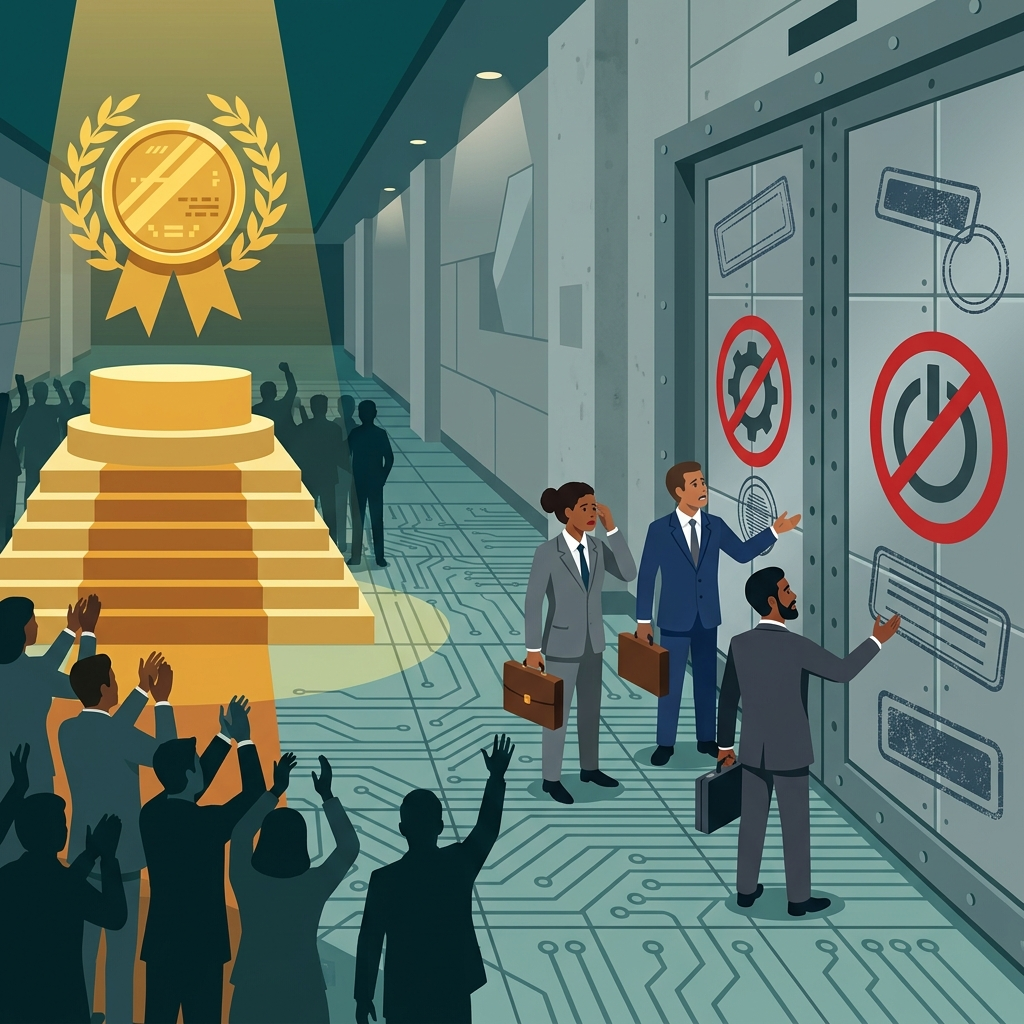
On October 8, 2026, the Trump administration awarded the National Medal of Science to Elon Musk, Sergey Brin, Jensen Huang, and Lisa Su, and the National Medal of Technology and Innovation to Satya Nadella and Michael Dell — officially recognizing the contribution of immigrant-origin tech leaders at the highest national level. Five of the six recipients were born outside the United States: Musk in South Africa, Brin in Moscow, Huang in Taipei, Su in Tainan, and Nadella in Hyderabad. The companies they built — Google, Nvidia, AMD, Tesla, SpaceX, Microsoft — are the defining institutions of American technological power and the front lines of global AI competition. On the very same day, hours later, VP Vance announced the suspension of eight companies including Microsoft and Adobe from the PERM labor certification program — the critical first step for foreign professionals to obtain employer-sponsored green cards — citing allegations of fraud and willful misrepresentation. Because PERM is the gateway to permanent residency for H-1B visa holders, this action effectively closes the door on the next generation of immigrant technologists seeking to build lasting careers in America, while H-1B status itself remains intact. The simultaneous occurrence of these two actions — honoring the immigrant past of American tech supremacy while structurally blocking its immigrant future — compresses into a single date the fundamental self-contradiction of U.S. technology policy, revealing that different parts of the same government are pursuing irreconcilable objectives without coordination.
The Rapid Contraction of H-1B: Compounding Regulatory Pressure
The PERM suspension is not an isolated action but the latest addition to a sustained multi-year tightening of the foreign professional employment system. H-1B lottery registrations have fallen from 780,884 in FY2024 to 211,600 in FY2027 — a 73% drop in four years — with FY2026 seeing 343,981 registrations, down 38.5% from FY2024. A wage-level-weighted selection system was introduced in February 2026, prioritizing higher-paying positions in the lottery. A $100,000 H-1B fee executive order was struck down by a Massachusetts federal court in June 2026, and the First Circuit Court of Appeals denied the government's stay request in July — but the White House responded by issuing a proclamation in September 2026 extending the fee policy through September 21, 2027. USCIS has separately proposed a fee rule of over $103,000 for cap-subject H-1B petitions, creating a second parallel track toward the same outcome. Each of these moves, viewed in isolation, may have an articulable rationale; cumulatively, they send a powerful and unambiguous signal to global talent that the United States does not welcome foreign professionals — and that signal's behavioral effect on application decisions may prove more powerful than any individual regulatory measure. The FY2027 second lottery being unnecessary due to insufficient registrations is perhaps the starkest single data point showing how far this contraction has already gone.
Blunt Instrument: IT Outsourcers and Cutting-Edge Tech Firms Treated as One
The composition of the eight companies targeted in the PERM suspension creates perhaps the most serious precision failure in the entire action. Cognizant, Infosys, Tata Consultancy Services, Wipro, HCL, and Capgemini are IT outsourcing and staffing firms — and they are indeed the type of entities at the center of H-1B wage criticism. EPI's 2020 research found that 60% of DOL-approved H-1B positions were paid below the regional median wage, and HCL was specifically flagged for at least $95 million in unpaid wages to foreign workers. These findings provide a basis for regulatory scrutiny of the outsourcing model. Microsoft and Adobe, however, operate in an entirely different dimension: they conduct world-class AI research, develop proprietary technology products, and employ PhD-level researchers who produce globally significant work. Grouping these two categories of employers under the same administrative action treats fundamentally different problems as interchangeable, which they are not. Vance claimed Microsoft laid off around 6,000 U.S. workers while relying on over 6,300 H-1B workers — a claim Microsoft disputed, stating that "the vast majority of Microsoft employees in the United States are Americans" and that H-1B workers receive equivalent compensation. The precision failure here is the defining weakness of this action: targeting systemic outsourcing abuse is a legitimate policy goal, but doing so with a blunt instrument that simultaneously sweeps in the companies producing America's most critical AI capabilities is not precision policy — it is collateral damage.
The Data Behind America's Deep Dependency on Immigrant AI Talent
The numbers documenting America's reliance on immigrant talent in advanced technology are not estimates — they are surveys and institutional records, and they paint a consistent picture. MacroPolo and NeurIPS 2024 data show over 65% of AI researchers at leading U.S. universities and institutions are foreign-born, up from roughly 40% in 2010; 76% of NeurIPS 2024 paper authors affiliated with U.S. institutions were not educated at American undergraduate programs. NSF's 2026 report confirms that of roughly 36 million U.S. STEM workers, 22% are foreign-born; among STEM doctoral degree holders the figure rises to 43%; among computer science and mathematics PhDs it reaches 58%. NFAP's 2026 report shows 455 of 775 American unicorn companies — 59% — were founded by immigrants, with a combined value of $5 trillion and an average of 833 jobs per company. MacroPolo data further shows that 72% of AI researchers with Chinese undergraduate backgrounds and 80% with Indian undergraduate backgrounds currently work in the United States. These are not marginal contributors — they form the quantitative core of America's most economically and strategically significant sector, and any policy that disrupts the pipeline bringing them here and enabling them to stay carries direct structural risk to American competitiveness in the domains that will define the next decade.
China's Rise and the Reshaping of the Global AI Talent War
The global AI talent competition has shifted in ways that make America's current policy direction particularly poorly timed. The Carnegie Endowment for International Peace's 2025 report, tracking top-tier AI researcher affiliations through NeurIPS author data, shows China's share surging from 27.1% in 2022 to 40.6% in 2025 — while the United States fell from 46.4% to 34.2% over the same period, meaning China surpassed the U.S. in this metric for the first time. At the same time, China launched its K Visa in October 2025, designed specifically for STEM professionals and removing the employer-sponsorship requirement that makes H-1B holders structurally dependent on their employers. The Qiming program offers top-tier researchers signing bonuses ranging from hundreds of thousands to over half a million dollars — a level of financial recruitment that signals a serious, resourced commitment to pulling global talent. The Carnegie report also notes that 87 of 100 Chinese-affiliated AI researchers who were in the U.S. in 2019 were still there as of 2025, demonstrating that America's research environment retains genuine pull — but retention rates are not immutable, and policy signals have behavioral consequences. While the United States narrows its pathways, China is actively competing for the exact same pool of globally mobile researchers, and the early statistical evidence suggests that competition is already producing results.
Positive & Negative Analysis
Positive Aspects
- Official Recognition That Immigrant Talent Built American Tech Supremacy
The October 8 medal ceremony represents the U.S. government making an unambiguous public record — at the highest institutional level — that immigrant-origin individuals are responsible for building the companies at the core of American technological power. Five of six recipients born outside the United States, receiving the National Medal of Science and the National Medal of Technology and Innovation: this is not a rhetorical gesture but a formal national acknowledgment. NFAP's 2026 data that 59% of American unicorn companies were immigrant-founded, representing $5 trillion in total value, shows the economic reality this ceremony reflects. Whatever policy direction the administration pursues in immigration enforcement, this formal acknowledgment creates a permanent point of reference in policy debates — advocates for immigration reform will cite this ceremony and the composition of its recipients as evidence that immigrant talent pathways must be protected, not narrowed. The medals also carry a signal function for the global talent market: they communicate that the United States at some level still recognizes and values immigrant contribution at the highest levels of achievement. That signal does not fully offset the PERM suspension, but it represents a genuine, documented institutional acknowledgment that cannot easily be erased from the public record and will shape how future policymakers argue for or against talent-inclusive immigration reform.
- Structural Abuse in H-1B Gets Forced Into Public View
Whatever the policy shortcomings of the PERM suspension, it has succeeded in forcing a public reckoning with the structural vulnerabilities of the H-1B system that had long been documented but rarely addressed. EPI's finding that 60% of DOL-approved H-1B positions were paid below regional median wages, and HCL's $95 million in documented wage theft, represent real harms to real workers — both American workers who face wage competition from cheaper foreign labor, and foreign workers who are underpaid while being legally bound to a single employer. These issues had been raised by policy researchers for years without prompting significant reform. The PERM suspension, by making the subject politically unavoidable, creates the conditions under which Congress and the executive branch might actually be pressured to redesign the system with more surgical precision — targeting the staffing-model abuse while protecting genuine high-skill hiring. A clean, credible H-1B system with genuine wage protections would ultimately be more politically sustainable than the current system, which is vulnerable to exactly the kind of populist backlash that produced this suspension. The precondition for that reform is acknowledging the problem publicly, which this action has done, even if its chosen remedy is disproportionate.
- The Judiciary Is Demonstrating That It Will Check Executive Overreach
The legal system's response to the H-1B $100,000 fee order — struck down by a Massachusetts federal court in June 2026, with the First Circuit denying the government's stay motion in July — demonstrates that constitutional checks on executive immigration authority are functionally operational, not merely theoretical. This is a meaningful structural fact for foreign professionals and the companies that employ them: even when the administration pursues aggressive immigration restriction, the courts represent a genuine institutional brake. These rulings establish legal precedent that executive agencies cannot unilaterally impose extraordinary financial burdens on petitioners through proclamation alone, without the rulemaking process and legislative authority that formal fee changes require. If and when legal challenges to the PERM suspension are filed — and Wolfsdorf Immigration Law's analysis that allegations must be distinguished from final findings of wrongdoing provides a potential basis for such challenges — the judiciary's track record suggests those challenges would receive serious hearing. For global talent evaluating America as a destination, the existence of an independent judiciary willing to constrain administrative overreach is a meaningful part of the stability calculus. It reduces the probability of worst-case scenarios actualizing even when executive policy direction is hostile.
- America's Accumulated AI Ecosystem Has Real Resilience Against Short-Term Shocks
The depth of America's AI research ecosystem — built over decades through sustained public and private investment — is not fragile enough to be destabilized by a single policy cycle. Carnegie's data showing 87 of 100 Chinese-affiliated AI researchers still at American institutions as of 2025 quantifies the research environment's genuine pull: elite universities, world-class research labs, dense VC and startup networks, academic freedom, English as the global language of AI publication, and a culture of open collaboration are structural advantages that cannot be rapidly replicated or purchased. NSF's figure of 58% foreign-born among computer science and mathematics PhDs reflects a pipeline that has been robust for years, and that robustness does not evaporate overnight even under policy headwinds. NFAP's data that immigrant-founded unicorns average 833 jobs per company illustrates the compounding economic dynamism this ecosystem generates. Life-root factors — children's schools, spouses' careers, professional networks, real estate — create high switching costs for researchers already established in the United States, which is why the 87% retention figure holds even against a backdrop of policy uncertainty. These factors collectively mean that the United States has meaningful time to recalibrate before short-term policy damage becomes permanent structural damage — provided the recalibration actually happens.
Concerns
- Blocking the Green Card Path Creates Immediate Talent Flight Risk
The most direct and immediate harm of the PERM suspension is simple: it gives skilled professionals at eight major companies a concrete reason to leave the United States. H-1B status continues, but the path to permanent residency — to belonging in America in a legally and emotionally complete sense — has been suddenly severed for workers who built careers and lives here expecting that path to remain open. For a researcher or engineer who has been working at Microsoft for three years, planning to file PERM as the next step toward a green card, the calculus has fundamentally changed. Canada's Global Talent Stream can process visas in roughly two weeks. The UK offers its Global Talent visa. These options are no longer hypothetical alternatives — they are now actively more attractive than waiting in a state of unresolved uncertainty. The highest-value professionals face this choice with the most options, because they are the most globally mobile and the most recruitable. An engineer capable of building state-of-the-art AI systems at Microsoft is capable of doing the same at DeepMind London or the Vector Institute in Toronto. Once these individuals leave and build new professional networks, family routines, and community ties elsewhere, visa policy improvements in the United States will not easily bring them back — the switching cost in the other direction becomes just as high.
- America's Competitive Position in the Global Talent War Is Weakening
The PERM suspension arrives precisely as the competitive pressure on American talent dominance is at its most intense, making the timing as poor as possible from a strategic standpoint. China surpassing the United States in the share of top AI researchers — 40.6% to 34.2% per Carnegie data — is not merely a statistical curiosity; it reflects a real and sustained shift in where cutting-edge AI work is being done. China's K Visa and Qiming program are not future intentions — they are operational infrastructure designed specifically to pull talent from exactly the pool America's tightening policies are pushing away. H-1B registrations falling from 780,884 in FY2024 to 211,600 in FY2027 means the pipeline is already drying up even before the PERM suspension adds its discouraging effect. The MacroPolo data that 72% of China-educated and 80% of India-educated AI researchers currently work in the U.S. is a measure of current concentration, not guaranteed future retention — and the conditions for retention are precisely what immigration policy either supports or undermines. In a zero-sum global talent competition, every researcher who chooses Toronto or Shanghai over Seattle is a compounding loss, because research productivity, patents, startup formation, and ecosystem-building follow talent concentrations once they reach critical mass. The PERM suspension accelerates a process of competitive erosion that was already underway.
- Grouping Outsourcers With Innovators Creates Collateral Damage That Outlasts the Policy
The policy precision failure in the PERM suspension — treating IT staffing companies and world-class AI research firms as a single category of bad actor — creates collateral damage that will persist long after the specific suspension is resolved. Researchers and engineers at Microsoft's AI labs, Adobe's research divisions, and similar organizations who had nothing to do with the outsourcing wage practices at Cognizant or HCL are now trapped in the same administrative action. This is not a theoretical harm: it directly affects individual career trajectories, life decisions, and willingness to recommend the United States as a career destination to colleagues and students in their home countries. Global talent markets operate heavily on reputation and word-of-mouth within research communities, and the message this suspension sends through those networks — that even America's most elite and well-regarded tech companies are not safe from having their green card programs suspended — will shape decisions by talented students and researchers for years to come. The outsourcing model's abuses were real and worthy of enforcement; the remedy of sweeping in the country's most important AI employers alongside them is a classic case of collateral damage that undermines the policy's stated goal of protecting American workers, because it damages the very companies most responsible for American technological leadership.
- Policy Uncertainty Compounds Into Structural Deterrence Over Time
The long-term cost of the current environment is not any single measure — it is the accumulation of signals that collectively communicate an unwelcome message to global talent. PERM suspension, $100,000 fee executive order extended despite court rulings, USCIS proposing yet another $103,000 fee rule, H-1B lottery registrations down 73% over four years, wage-weighted selection disadvantaging mid-tier positions: each action taken alone could be argued as addressing a specific problem. Taken together, they form a pattern that the most capable international researchers — the ones with the most options — will read accurately and act on. The NSF data showing 76% of top U.S.-affiliated AI researchers are foreign-educated means this population is exactly the audience receiving these signals, and they are precisely the people with the analytical sophistication to interpret policy trends, not just current rules. The pipeline effect means the damage accumulates with a lag: a PhD student in Beijing or Mumbai deciding today not to apply to American graduate programs because the post-graduation permanency pathway looks unstable will not appear in American research output statistics for five to eight years. By the time that damage is visible in data, it will already be deeply embedded in the career trajectories of an entire cohort of researchers who chose differently. The cost of this deterrence effect is borne silently, distributed across thousands of individual decisions, and almost impossible to reverse once the cohort-level pattern has set.
Outlook
Looking at the short-term picture — the next six months, running roughly through April 2027 — let's start with the 180-day clock. Under 20 C.F.R. § 656.31(b), the initial PERM suspension window is up to 180 days, which puts a nominal review point around April 6, 2027. But given that Vance declared the suspension will "last as long as it needs to," the probability of a full lift within 180 days is low. The investigation rationale remains legally operational as long as the fraud inquiry is unresolved, and extensions are permitted under the same regulation. None of the eight targeted companies have filed legal challenges as of now — likely because a direct confrontation with the government carries its own regulatory risk, especially for companies like Microsoft and Adobe that hold significant government contracts in other business lines. For the H-1B professionals at those eight firms who were already queued for green cards, the immediate practical reality is that their path to permanence in America has become genuinely uncertain. Their work visas remain intact, but the next chapter — putting down real roots — is suddenly an open question, and many will begin exploring alternatives ranging from transferring to a different employer to considering Canada or the UK.
The psychological spillover to the broader H-1B market is the second short-term factor worth tracking closely. PERM directly affects only green card pathways, but it functions as a policy signal to anyone considering building a career in the United States. FY2027 H-1B registrations already fell to 211,600 — down from 780,884 in FY2024, a 73% collapse over four years. That number wasn't sitting still before the PERM suspension landed. Now, with PERM as an additional headwind, FY2028 registrations are likely to decline further. The $100,000 H-1B fee executive order was struck down by a Massachusetts federal court in June 2026 and the First Circuit denied the government's stay motion in July — but the White House issued a proclamation extending the fee policy through September 21, 2027 anyway. USCIS has separately proposed a fee rule exceeding $103,000. The pattern is clear: when courts block one avenue, the administration pursues another. For foreign professionals weighing their options, it no longer matters whether a specific rule is currently enjoined. What matters is the direction of travel — and that direction is unmistakably hostile.
Moving to the mid-term window of roughly six months to two years out, the dominant variable is the 2027 midterm elections. Immigration policy is reliably among the most combustible issues in American politics, and Vance's PERM announcement carried an unmistakable political-message dimension. Depending on which direction the midterms break, the intensity of the administration's immigration posture could shift — but neither major party is currently advocating for a sharp liberalization of H-1B pathways, so a swift reversal regardless of election outcome is unlikely. What's more probable is a continued tug-of-war between administrative action and judicial review, with no fundamental legislative reform. Companies will not wait for that resolution. The strategic shift toward building research capacity outside the United States — Canada, the UK, Singapore, Australia — will accelerate, and this kind of infrastructure investment is sticky. Once a research lab is built and staffed in Toronto or London, the institutional momentum doesn't reverse cleanly even when U.S. policy improves.
The mid-term global picture is equally important. America's regulatory tightening is happening precisely as competitor nations are moving in the opposite direction. Canada's Global Talent Stream promises two-week visa processing — a stark contrast to PERM timelines measured in months or years. China launched its K Visa in October 2025, targeting STEM professionals with a key structural advantage over H-1B: no employer sponsorship required. The Qiming program offers top-tier researchers signing bonuses in the range of hundreds of thousands to over half a million dollars. The Carnegie Endowment data already shows China's share of leading AI researchers surpassing the United States — 40.6% to 34.2% as of 2025. MacroPolo's data that 76% of U.S.-affiliated NeurIPS 2024 authors were not U.S.-educated undergrads means these researchers carry high mobility: they chose America once, and they can choose again. In a talent competition, when one side locks its doors, the other side's open doors become dramatically more attractive.
In the longer-term window of two to five years, the cumulative damage to America's AI research pipeline becomes the central story. NSF's 2026 data — 43% of STEM doctoral degree holders foreign-born, and 58% among computer science and mathematics PhDs — represents the output of a pipeline that has been running well. Layering on PERM suspension, H-1B registration collapse, and compounding fee uncertainty over a sustained period introduces a lag effect: talented students deciding today whether to apply to American graduate programs are doing so with a horizon of what life in America will look like in five to eight years. If the permanent residency pathway looks unstable, a growing share of top global talent will route toward Canada, the UK, or increasingly China. That choice today doesn't show up in American research output for three to five years — which is exactly what makes this risk easy to underestimate in the short run and potentially catastrophic to address once the data becomes visible.
Looking further, the question of whether this represents a structural turning point for American tech supremacy is one I take seriously — but not deterministically. The shift, if it comes, would not be a dramatic overnight collapse. It would look like slightly fewer top-tier graduate school applications each admissions cycle, a gradually declining share of NeurIPS and ICLR papers from U.S.-affiliated institutions, a slow drift in VC deal flow toward international research hubs. NFAP's figure that 59% of American unicorns were immigrant-founded could begin drifting downward — not in a single year, but as a five-year trend. Silicon Valley's gravitational pull is partly self-reinforcing: talent attracts capital, capital attracts talent, and startups spin out new startups. Weaken any link in that chain and the whole ecosystem's velocity slows in ways that don't show up cleanly in any single metric but compound over time.
The optimistic scenario is one where the PERM suspension, for all its bluntness, becomes a catalyst for genuine surgical reform. If Congress or a future administration uses the political momentum here to redesign the H-1B and PERM system — blocking real outsourcing abuses while creating faster, cleaner pathways for elite research talent — the current disruption could end up strengthening the overall system's legitimacy. The courts have already demonstrated they will check executive overreach on immigration fees, which means extreme worst-case outcomes have a meaningful procedural brake. The Carnegie data showing 87 of 100 Chinese-affiliated researchers still at American institutions as of 2025 confirms the research environment's structural pull remains powerful. And the sheer depth of America's AI ecosystem — elite research universities, deep VC networks, a culture of academic freedom and open publication — cannot be replicated quickly by policy alone anywhere in the world.
The base scenario, which I consider most likely given current trajectories, is that uncertainty persists for an extended period without resolution in either direction. The 180-day PERM review arrives and the suspension is effectively extended under the ongoing investigation rationale. H-1B registrations continue their downward trend, though perhaps more slowly. America's AI research quality is maintained in the short run by the existing talent base and its inertia. Companies accelerate the expansion of research outposts in Canada, the UK, and Singapore as a hedge — and Google, Microsoft, and others have already been doing exactly this. In this scenario, the United States does not lose AI leadership, but it moves from singular dominance to one major node among several. The NSF's 43% foreign-born STEM PhD figure begins a slow decline, noticed only by labor economists reviewing longitudinal data years from now.
The pessimistic scenario unfolds if the PERM suspension is extended indefinitely, additional restrictions stack on top of existing ones, and China's K Visa and Qiming program gain genuine operational traction. In this scenario, H-1B registrations fall below 200,000, the Carnegie data gap between China and the U.S. widens beyond 10 percentage points, and the NFAP unicorn ratio begins to decline. The most dangerous dynamic in this scenario is self-reinforcing: when top researchers leave, the collaborative networks of those who remain weaken, which reduces the research environment's attractiveness, which triggers further departures. AI research is peculiarly network-dense — losing a cluster of key nodes damages the entire ecosystem disproportionately, far more than a headcount reduction alone would suggest.
Where my forecast could be wrong: the United States could enact comprehensive H-1B reform that surgically targets outsourcing abuse while expanding and accelerating pathways for elite research talent, rendering the current disruption a short-term cost for long-term gain. China's programs could also underperform — academic freedom, English-language research culture, open information access, and transparent academic publishing are structural advantages no signing bonus can simply purchase. The life-root factor matters too: researchers with families, mortgages, and children in school have high switching costs, and the 87% retention figure reflects that reality. Ultimately, I believe American tech supremacy will not collapse from a single policy cycle — the accumulated assets are too deep. But the small, same-directional decisions stacking up — PERM suspension, fee hikes, registration collapse — are the kind of incremental erosion that, five years from now, becomes irreversible. The only path that avoids that outcome is a precision immigration policy: shut down the outsourcing-wage-suppression model with targeted enforcement, while widening the door for the elite talent who will build the next generation of American technology. Anything less than that precision leaves American tech supremacy running on borrowed time.
Sources / References
- Al Jazeera: Trump awards national medals to tech leaders — Al Jazeera — Al Jazeera: Trump awards national medals to tech leaders
- NBC News: Trump awards national medals of science and technology — NBC News — NBC News: Trump awards national medals of science and technology
- ABC News: Vance suspends Microsoft from green card program — ABC News — ABC News: Vance suspends Microsoft from green card program
- Wolfsdorf Immigration: DOL announces PERM suspensions — Wolfsdorf Immigration Law — Wolfsdorf Immigration: DOL announces PERM suspensions
- MacroPolo: America's Got AI Talent — MacroPolo (Paulson Institute) — MacroPolo: America's Got AI Talent
- AI Weekly: Carnegie - China passes US as top AI talent hub — AI Weekly / Carnegie Endowment — AI Weekly: Carnegie - China passes US as top AI talent hub
- NFAP: Immigrants and US Billion Dollar Companies — NFAP (National Foundation for American Policy) — NFAP: Immigrants and US Billion Dollar Companies
- CryptoBriefing: White House chip company profit sharing - no returns — CryptoBriefing — CryptoBriefing: White House chip company profit sharing - no returns
- NBC News: Dells' billions donation to Trump Accounts — NBC News — NBC News: Dells' billions donation to Trump Accounts