
If Tottenham Gets Relegated, the Premier League Finally Gets Real
Summary
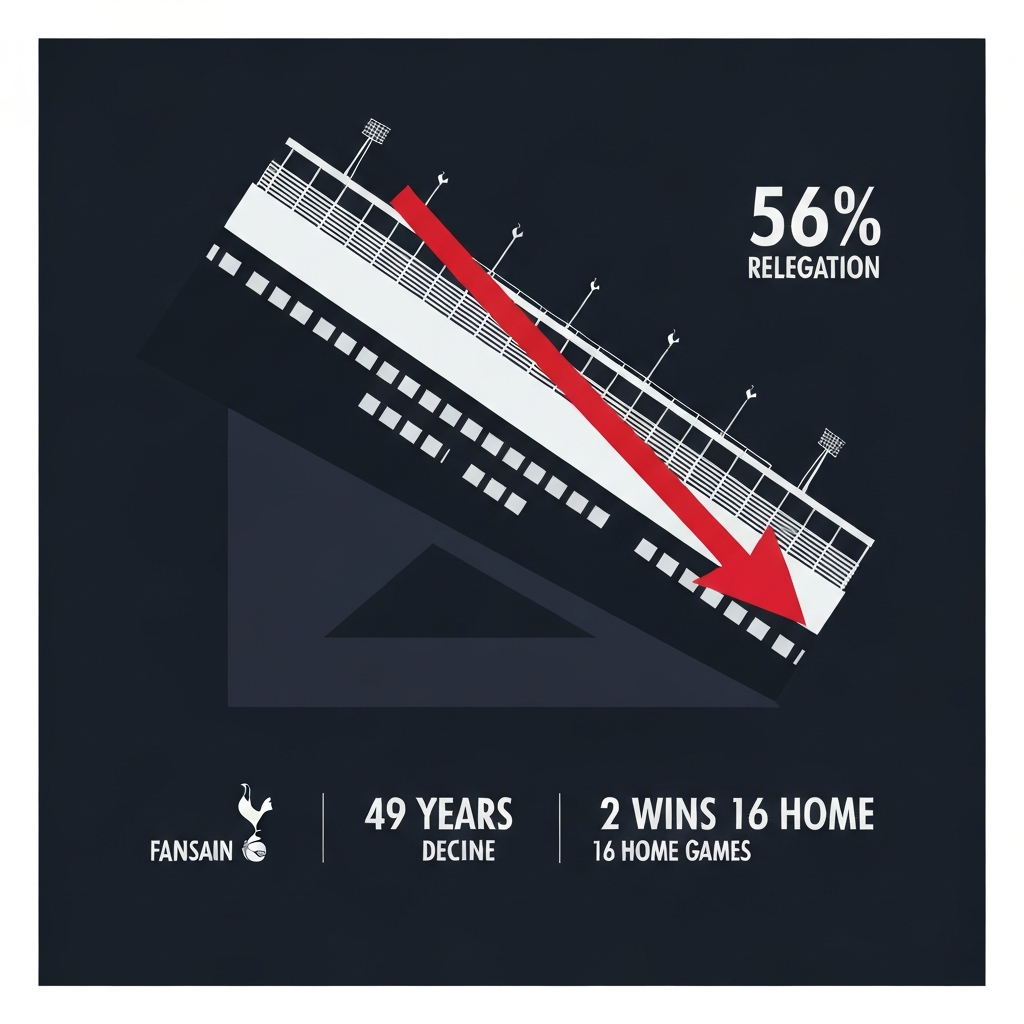
Tottenham Hotspur sit in the Premier League relegation zone with five matches remaining in the 2025-26 season, carrying a 56.58% probability of going down according to Opta's supercomputer — the first genuine second-tier threat the club has faced in 49 years. The team that reached the Champions League final in 2019 has since cycled through four managers in 12 months, recorded just two home wins from 16 attempts at one of the world's most expensive stadiums, and has not won a single league match since January 2026. This is not a run of bad form but a structural collapse — the direct consequence of chairman Daniel Levy's long-standing habit of treating stadium infrastructure as a substitute for sporting coherence, squad investment, and managerial continuity. The Big Six framework — that informal understanding that Manchester United, Liverpool, Arsenal, Chelsea, Manchester City, and Tottenham occupy a permanently protected upper tier — is being stress-tested in real time for the first time, and the Premier League's competitive identity depends on what happens next. I believe the honest, clarifying, and ultimately necessary outcome here is Tottenham's relegation, because English football needs living proof that no badge, no stadium, and no commercial empire can insulate a club from the consequences of bad management.
Key Points
Opta's 56.58% — What the Number Actually Means
The 56.58% relegation probability Opta assigned to Tottenham is not a margin-of-error fluctuation or a model quirk — it is a cold, evidence-based calculation that reflects a genuine statistical collapse. For a club of Tottenham's historical standing, a number above 50% is essentially without precedent in the Premier League era, and the underlying data makes it very hard to argue with. Tottenham have not won a league match since January 2026, making them the only top-flight club in England with that distinction as the season enters its final weeks. Their 15-match run without a league victory is the second-worst sequence in the club's entire recorded history, surpassed only by a stretch in the 1934-35 season — nearly a century ago. Most damning is the home record: just two wins from 16 matches at a stadium that cost approximately £1 billion to construct, the worst home record in the Premier League this season. When you stack those data points — the win-drought, the historically bad home form, the current table position — the Opta figure starts to look conservative rather than alarmist. This is not a model punishing bad luck. It is a model faithfully reflecting a documented, systematic failure of performance that has now extended across months.
Four Managers in Twelve Months — The Real Diagnosis
Postecoglou to Frank to Tudor to De Zerbi. Four managers in a single calendar year. I want to be direct about what this sequence actually means, because the coverage has tended to frame each appointment as a reasonable decision made under difficult circumstances rather than examining the pattern itself. In football, tactical identity — the shared understanding between players, coaches, and staff of how the team defends, attacks, presses, and transitions — requires a minimum of one full season to build and typically two or more to embed deeply enough to survive adversity. Every time a new manager arrives with a different system, players must unlearn the previous approach and begin rebuilding their tactical instincts from scratch. By the time the squad begins to function coherently, the manager is gone and the cycle starts again. This is not football management — it is startup culture applied to sport, the instinct to pivot and replace leadership on quarterly results that in football specifically produces the opposite of the intended effect. Daniel Levy has managed Tottenham as though sporting coherence is a variable that can be optimized in real time rather than a property that emerges only from sustained commitment. Roberto De Zerbi's own admission — that the boardroom relationship matters more than the relegation battle — is a remarkably candid diagnosis from inside the eye of the storm, and it points directly at the structural source of the failure.
The Billion-Pound Stadium Paradox
Tottenham Hotspur Stadium is objectively extraordinary. Built at approximately £1 billion and completed in 2019, it seats 62,000 in facilities that compare favorably with any sports venue in the world. It features a retractable pitch over a synthetic NFL surface, a micro-brewery, premium restaurant options, and has hosted NFL International Series games that sell out almost immediately. By every measure of infrastructure ambition, the project represents a success. The paradox — and I think this deserves to be called a paradox, because it is genuinely instructive rather than merely ironic — is that this extraordinary building has a zero correlation with the football being played inside it this season. Just two home league wins from 16. The world's most impressive backdrop for the Premier League's worst home record. This is the cleanest empirical demonstration available in contemporary football of a principle that every serious student of the sport already understands: the factors that actually determine football results — squad cohesion, tactical identity, psychological safety, consistent recruitment philosophy, trust between manager and board — cannot be purchased from an architect or financed through a bond offering. Manchester City and Arsenal both went through painful early periods after their stadium openings, but both clubs maintained sporting investment and managerial stability alongside infrastructure development. Tottenham built the building and appears to have forgotten that you also need to tend to the soul inside it.
The Big Six Myth and Why It Was Always Going to Break
The Big Six framework is a commercial construction more than a sporting reality, and it has been visibly fraying for several years before this crisis made it undeniable. Newcastle United, following the Saudi Public Investment Fund acquisition, are now a top-half club on resources and increasingly on results. Aston Villa under Unai Emery have delivered three consecutive seasons of upward trajectory and European football. Brighton, working with a sophisticated data-driven model, have punched well above their commercial weight to challenge for European spots repeatedly. These clubs have climbed the table in real time, which means the Big Six has already effectively ceased to exist as a stable sporting grouping — it is simply six clubs that retain the commercial and contractual legacy advantages of being perceived as elite. Tottenham's relegation crisis punctures this at the structural level, because a club cannot meaningfully claim Big Six status while sitting in 17th place with five games left. I think this collapse is genuinely healthy for the sport. A league where certain clubs are informally exempt from the worst consequence of failure is a league where those clubs are partially insulated from the accountability that produces improvement and sustains competitive quality. The same unpredictability that made Leicester's 2016 title so electrifying is what Tottenham's potential drop delivers from the opposite direction — both stories telling the same truth: the table is earned, not inherited.
De Zerbi's Dilemma — Talent Against the Wrong Structure
Roberto De Zerbi is one of the most technically sophisticated managers working in European football today. His time at Brighton is a well-documented case study in how to extract elite-level performance from a club without elite-level transfer budgets: positional play, intelligent pressing systems, and a clear tactical identity that survived opposition analysis because it was executed with genuine precision. At Marseille, he demonstrated the system was transferable across leagues and cultures. So what happens when a manager of that quality inherits a squad that has been tactically destabilized by four managerial changes, a group of players who no longer appear to trust any system or any project? The honest answer — which I suspect De Zerbi would give if he could speak without diplomatic constraint — is that individual managerial quality cannot overcome certain structural situations in the time available. Tim Sherwood's prediction that De Zerbi and most of the current playing squad will leave if Tottenham are relegated is not sensationalism: the financial logic is straightforward. Premier League TV distributions fall by more than 80% in the Championship, existing playing contracts cannot be maintained at Championship revenue levels, and no manager of De Zerbi's caliber is going to spend a season in the second division rebuilding a club whose problems originate in decisions he had no hand in making. The cruel conclusion is that De Zerbi's arrival was too late, too constrained, and dropped into a structural context that was already too broken to be fixed from the dugout alone.
Positive & Negative Analysis
Positive Aspects
- Shattering "Untouchable" Status Clears the Air Across the Whole Division
The practical effect of Tottenham facing genuine relegation is that it removes a layer of comfortable assumption from every other club in the Premier League. When lower-half clubs play the Big Six, the psychological dynamic has historically been asymmetric — the big club expects to win, the smaller club plays not to embarrass itself. That asymmetry collapses when the big club genuinely needs three points to survive, because survival pressure equalizes motivation in ways that marketing and legacy cannot replicate. Wolves, Crystal Palace, and Everton — clubs currently in lower-mid-table — approach a fixture against this version of Tottenham with genuine attacking ambition rather than defensive caution, and that produces better football on both sides. Beyond the immediate effect, the news that a Big Six club can actually go down resets the psychological ceiling for every club that has been told, implicitly or explicitly, that elite membership is not available to them. It tells Brentford, Brighton, and Bournemouth that squad coherence and managerial continuity matter more than commercial legacy. That is a clarifying, healthy signal — one that Leicester's 2016 title communicated from one direction and that Tottenham's 2026 crisis communicates from the other. Both moments carry the same essential message: the table is not a social hierarchy. It is a record of performance.
- Market Correction Without Waiting for Regulation to Catch Up
English football's regulatory architecture — the Financial Fair Play rules, the Profit and Sustainability Regulations, the newly established Independent Football Regulator — is reasonably capable of catching outright financial malpractice but essentially helpless in the face of management incompetence. No rule prevents a chairman from hiring and firing four managers in 12 months. No regulation punishes the decision to spend a billion pounds on a building while constraining the transfer budgets needed to build a competitive squad. The market, in the absence of adequate regulatory tools, has to do the accountability work itself. Tottenham's crisis is precisely that market doing its job: sending the most unambiguous possible signal that a specific set of management decisions has failed comprehensively. This is, in the long run, the correct functioning of a competitive system. The Premier League's commercial value depends on the quality of its competition, and the quality of competition depends on clubs having genuine incentives to make good decisions. When those decisions carry no ultimate consequences — when a Big Six badge absorbs failure indefinitely without correction — those incentives erode and the quality of the whole ecosystem suffers. A relegation is the sharpest incentive the system can produce.
- Psychological Liberation for the Rest of the Table
For years, the bottom half of the Premier League has organized itself partly around the assumption that certain opponents cannot be beaten consistently and should be approached with damage limitation as the primary objective. This defensive posture — treating a draw against a Big Six club as a positive result — is a well-documented feature of lower-table psychology, and it reduces the intensity and quality of a significant number of Premier League fixtures each season. Tottenham's genuine vulnerability breaks that calculation entirely. A club that has won two home league games all season cannot command the automatic defensive respect that its badge once generated. Smaller clubs begin to play for the win rather than the point, which means more shots, more open play, and more of the competition that the Premier League's global fanbase actually wants to watch. I believe this shift — multiplied across a full season's worth of fixtures — is visible in concrete statistics: average goals per match, shots on target, point-gap compression between positions. The psychological leveling of the field, when it happens through results rather than through regulation, is durable in a way that imposed parity never quite manages to be. Every club begins to believe in the possibility of every outcome, and that belief itself changes how they play.
- Championship Revival and a Storyline the EFL Has Never Had
If Tottenham are relegated, the 2026-27 Championship will be the most globally significant second-division campaign English football has ever staged. The narrative writes itself: international stars playing second-tier football, a 62,000-seat stadium hosting Middlesbrough and Sunderland, a global fanbase suddenly required to understand what promotion playoffs mean from the inside. The EFL has historically struggled to attract international broadcast attention outside a narrow window around the promotion playoff weekend. A Tottenham-in-the-Championship story generates global coverage that no other club currently in that division could come close to replicating. Beyond the spectacle, there is a structural opportunity. The gap between Premier League and Championship broadcast revenues — approximately 12:1 in the current deal structure — is one of the most destabilizing inequalities in English football. The presence of a globally recognized brand in the second tier gives the EFL a negotiating argument it has never previously had, and any upward revision of Championship broadcast values would benefit all 24 clubs in that league. Long-term, a small compression of that revenue gap reduces the financial trauma of relegation for every club, not just Tottenham.
- A Lasting Case Study in How Organizational Failure Actually Works
Regardless of how this season ends, the Tottenham crisis will be studied in football academies, business programs, and management consultancies for years. The core lesson is precise and transferable: infrastructure investment and organizational capability are not the same thing, and confusing them can produce catastrophic results even when the balance sheet looks healthy. Tottenham spent approximately £1 billion on a building while consistently under-investing in the intangible organizational qualities — coaching philosophy, squad identity, recruitment coherence, managerial trust — that actually produce football results. The clubs that have competed most effectively in the high-money Premier League era without the financial resources of the true elite share exactly one characteristic: coherent, sustained organizational thinking applied consistently over multiple seasons. Brentford's data-driven model, Brighton's analytical recruitment, Emery's patient project-building at Aston Villa — these are not accidents. They are the product of clear organizational vision held consistently over time. Tottenham had more money than all of them, a better ground than all of them, and international stars that none of them could attract. None of it was sufficient, because the organization producing the football was broken at its source.
Concerns
- The Fans and the Local Economy Absorb the Damage They Didn't Create
The most uncomfortable truth in all of this structural analysis is that the people bearing the greatest cost of Tottenham's potential relegation are not the chairman and not the commercial executives who designed the stadium strategy. They are the supporters who have attended every home match regardless of the scoreline, the roughly 42,000 season-ticket holders who paid among the highest prices in the Premier League, and the small-business owners in the Tottenham area whose economic survival is substantially tied to matchday traffic. Premier League clubs generate enormous local economic activity through home fixtures — the pubs, restaurants, merchandise vendors, and transport services within walking distance of the stadium depend on the eight or nine large-attendance home matches each season that draw supporters from outside the immediate area. When those matches become Championship fixtures, the economic impact on that community is real, immediate, and concentrated in the parts of the local economy that are least able to absorb it. North London's lower-income supporters and local businesses did not make the decisions that led here. They are bearing consequences created by decisions made in the boardroom, and I think that specific injustice deserves to be named separately from the structural argument about whether relegation is good for the league.
- Global Brand Damage Is Real and the Asian Market Exposure Is Significant
Tottenham's global commercial footprint rests on two foundations that are both directly threatened by relegation: the club's reputation as an attractive, progressive football club built during the Pochettino era, and — more recently, particularly across East and Southeast Asia — the presence of Son Heung-min. Son's impact on Tottenham's commercial position in South Korea, Japan, and the broader Asian market is genuinely transformative and has been systematically monetized through merchandise deals, broadcast arrangements, and commercial partnerships. A relegation changes that calculation in ways that are difficult to model precisely but impossible to dismiss. Son is extremely unlikely to remain at a Championship club — his age, his form, and his market value all point toward a move to a top-flight environment. The commercial structures built around his presence at a Premier League club will begin unwinding immediately. The Premier League, simultaneously, has built its global brand on the claim that it is the world's strongest competition — a claim that becomes harder to sustain when one of its most internationally recognized constituent brands disappears to the second tier. I believe the short-term brand damage to Tottenham and the reputational complication for the league are both real and both, in the end, recoverable. But recoverable is not the same as costless.
- The Financial Spiral Could Become Very Hard to Escape
Here is the number that should focus attention for any observer who believes Tottenham will simply bounce straight back from Championship football: the gap between Premier League broadcast distributions for a bottom-half club (roughly £100 million and above) and Championship distributions for a winner (roughly £8 million) is so vast that no operational cost-cutting makes it manageable. That revenue cliff arrives simultaneously with the loss of commercial partnership agreements linked to Premier League activation rights, the near-certain departure of players whose wage structures were designed for top-flight income levels, and the recruitment investment required to actually compete for promotion from a division that contains several well-resourced clubs targeting the same return ticket. The Leeds United comparison is often cited and is genuinely instructive: relegated in 2004, they did not return to the Premier League until 2020, a 16-year journey that took them through League One and into near-administration. Tottenham's situation differs in important ways — their stadium, global brand, and London location provide buffers Leeds never had. But the stadium itself is a complication Leeds never faced: the £1 billion financing was structured around Premier League income assumptions, meaning Championship revenues could produce a structural annual deficit that compounds across seasons, constraining transfer and wage investment precisely when promotion campaigns require it most.
- Relegation Doesn't Fix the Structural Problem — Only Ownership Change Does
I think this is the most important counterargument to my central thesis, and I hold it genuinely rather than reluctantly. Relegation is a consequence. It is not a cure. If Daniel Levy retains control of Tottenham after a relegation — which appears highly probable given his contractual position and the absence of any meaningful fan-ownership mechanism in English football — the same organizational pathology that created this crisis will continue in the Championship. The pattern across comparable cases is instructive. Sheffield Wednesday were relegated from the Premier League in 2000 and spent over two decades cycling between the Championship and League One without ever fundamentally changing the decision-making culture that had made them unable to compete at the top level. Levy has managed Tottenham for more than 20 years and has displayed consistent behavioral patterns throughout: fiscal restraint on player investment, tactical impatience with managers, and an apparent preference for commercial revenue optimization over sporting vision. None of those tendencies require a Premier League platform to persist. The genuinely corrective outcome — the one that would actually resolve the structural problem rather than just relocating it — is a change in ownership or governance at board level. English football's regulatory framework currently makes that outcome very difficult to mandate from outside.
- The "Spend or Else" Fear Could Backfire on the Wider League
Hidden inside the narrative of Tottenham's collapse is a perverse second-order risk that I think about carefully when considering the structural effects. If the primary lesson drawn from this crisis is that Tottenham failed because they did not spend aggressively enough on players — a simplification, but a tempting one available to anyone reading the surface-level story — then the rational response for every other Big Six chairman watching is to spend more. Chelsea have already demonstrated this impulse in extreme form under Todd Boehly, committing well over £1 billion to player acquisitions since taking over. If Tottenham's story is weaponized as evidence that under-investment in the squad kills clubs regardless of other factors, it hands a justification to the top of the wage spiral to accelerate further. That dynamic — elite clubs outspending out of fear rather than opportunity, driving salary and transfer fee inflation across the entire market — ultimately deepens the financial gulf between the established elite and the rest of the league. The Profit and Sustainability Rules are designed to prevent this, but their enforcement record against top-six clubs has been inconsistent enough that creative financial structures regularly find the edges. Tottenham's potential drop could paradoxically reinforce the structural inequality it superficially appears to correct.
Outlook
The immediate picture — the next one to six months — is brutally simple. Five football matches stand between Tottenham and the Championship. From what the data shows, surviving requires winning at least two of those five and drawing a third: a level of performance this squad has not managed across any comparable stretch since January. Roberto De Zerbi took charge with the squad in visible psychological difficulty, and the honest observation about managerial transitions is that tactical improvements typically require two to three weeks before they produce measurable results on the scoreboard. The first couple of games under De Zerbi were therefore the highest-pressure possible configuration: must-win situations before any new system has had meaningful time to be absorbed. I can construct a scenario in which Tottenham's survival instincts take over and they find enough in the final weeks to stay up. Football has produced stranger reversals. But the probability that this squad — winless since January, carrying four-manager worth of tactical confusion — will suddenly string together the results required sits somewhere below what the base math demands, and the Opta figure of 56.58% reflects exactly that assessment.
If Tottenham survive — which remains possible and I don't dismiss — the summer transfer window immediately becomes the most consequential moment in the club's recent history, and probably more important than the survival itself. A narrow escape that returns the club to business as usual under the same chairman with the same resource constraints would simply be a stay of execution rather than a resolution. The psychological trap here is real: when a club barely avoids relegation, the relief tends to overwhelm the urgency of structural reform. Decision-makers exhale, declare the crisis managed, and gradually drift back toward the habits that produced it. I actually believe a narrow survival could be more dangerous in the medium term than an immediate relegation, precisely because it removes the pressure for genuine change while leaving the underlying dysfunction untouched. If De Zerbi does not receive both meaningful transfer investment and genuine authority over recruitment decisions in the summer, the 2026-27 season starts from the same broken foundation.
Looking at the medium-term horizon — roughly six months to two years — three distinct scenarios emerge, and I want to be specific about the probability I assign to each because I think the honest version of this analysis requires genuine probability estimates rather than vague scenario gestures.
The optimistic scenario, which I put at around 20%, unfolds as follows. Tottenham survive the current season, Levy responds by providing De Zerbi with a transfer budget of at least £150 million across two windows, grants him real authority over recruitment, and commits publicly to a multi-season project. Under those conditions, De Zerbi's demonstrated ability to identify undervalued players, build a pressing system that survives opposition preparation, and extract consistent top-level performance from squads without elite financial resources could reasonably produce a top-half finish by 2026-27 and a return to European competition by 2028. Tottenham's infrastructure, London geography, and global commercial platform give De Zerbi tools that Brighton never had, meaning the ceiling for his approach at Spurs is substantially higher than anything he achieved on the south coast. The reason I assign only 20% to this scenario is not that the football logic is flawed — it is that it requires Levy to change management patterns that have been entirely consistent across more than two decades. The 2019 Champions League final was the optimal moment to make that structural investment, and Levy chose instead to hire José Mourinho. Pattern recognition suggests the pressure of a near-relegation will not produce the behavioral change that the peak of European competition did not.
The base scenario, which I put at around 50%, plays out like this. Tottenham survive the current season by the minimum margin, or alternatively are relegated and win the Championship in 2026-27, returning to the Premier League for 2027-28. Either way, they reestablish themselves as a 12th-to-15th place Premier League club — functionally redefined as a stable mid-table side rather than a Big Six contender. The parallels with the Everton trajectory of the past decade are uncomfortable but instructive: a historically significant club, a massive modern stadium, a global commercial platform, but no longer a credible Champions League aspirant, and occasionally facing the prospect of slipping below the waterline. The Big Six slot in this scenario transfers to Newcastle or Aston Villa on merit. Tottenham competes for the European conference spots while the clubs above them pull further away. For supporters who have spent years being assured that a first trophy in decades is imminent, this outcome is grinding. But the structural supports — London, 62,000-seat ground, international fanbase, Premier League television revenues — prevent the kind of catastrophic collapse that has ended other clubs, and I think this semi-decline is the most realistic long-term consequence of two decades of organizational drift.
The bear scenario, which I put at roughly 30%, is darker and more specific about its mechanism. Tottenham are relegated, and rather than achieving immediate promotion in 2026-27, they fall short in the playoffs or miss the automatic promotion places. Two or more seasons in the Championship follow. The Leeds United reference point is cited often and remains genuinely instructive despite the differences in context: relegated in 2004, not back in the Premier League until 2020, a 16-year journey that included League One and financial near-collapse. Tottenham's situation differs in their stadium, global brand, and London base. But the billion-pound stadium financing introduces a complication that Leeds never faced: a structural annual deficit that compounds across Championship seasons, constraining exactly the squad investment needed to mount the promotion challenge. If the core playing squad departs in the summer following relegation — which Sherwood predicts and which the financial and contractual logic strongly supports — the team contesting the Championship is substantially weaker than the team that finished 17th in the Premier League. Rebuilding under those constraints, with the same ownership and the same organizational tendencies, is genuinely difficult. If Tottenham cannot win the Championship at first attempt, the second and third years become progressively harder as the financial overhang deepens, and the Sheffield Wednesday trajectory — two decades cycling between Championship and League One — becomes a live possibility rather than a rhetorical warning.
On the longer horizon of two to five years, I think the Tottenham crisis will leave marks on English football that extend well beyond North London in ways that are worth taking seriously. The governance conversation is the most interesting to me. The Independent Football Regulator, currently being established under legislation passed in 2024, has a mandate focused primarily on financial sustainability and ownership suitability. The Tottenham case — a club with entirely sound finances in the traditional FFP sense, no immediate debt crisis, no financial malpractice — that has nonetheless been driven to the edge of relegation through management decisions represents a compelling argument for expanding the regulator's scope to include operational governance alongside financial auditing. A chairman who can fire four managers in twelve months without accountability, who can build a billion-pound stadium while constraining the sporting investment that would make that stadium relevant, and who faces no external mechanism of correction until the market itself provides one — that is a governance gap that the regulator, once fully operational, will be under pressure to address.
The Bundesliga's 50+1 ownership rule — requiring clubs to retain majority voting rights in the hands of their members, preventing any single private investor from acquiring controlling ownership — has historically been dismissed in England as incompatible with the Premier League's commercial model. The Tottenham case will revive that conversation with more urgency than it has previously received, because it is the cleanest available example of what happens when a club is managed as a personal commercial asset by an owner whose incentives diverge, even modestly, from purely sporting success. I don't expect 50+1 to be implemented in England in the near term. But I do expect meaningful fan representation in club governance to become a live legislative and regulatory issue in the immediate aftermath of a Tottenham relegation, and the clubs most resistant to that conversation will find it increasingly difficult to hold their position.
Finally, there is the question of what this crisis teaches football capital more broadly — the sovereign wealth funds, private equity vehicles, and high-net-worth individuals who have been acquiring football clubs throughout the 2020s on the assumption that money, applied at scale to player acquisition, reliably produces on-pitch success. Tottenham complicates that assumption at the crucial margin. The club has spent significant sums on players. It has the best stadium in England. It has international stars. And it is 17th in the Premier League with five games left. The lesson is not that money doesn't matter — it clearly does, and the clubs at the very top of the table prove it. The lesson is that money applied without coherent sporting vision, without managerial stability, and without the organizational patience that compound-interest quality actually requires produces exactly the chaos currently unfolding at Tottenham Hotspur. By 2028, I believe the phrase "doing a Tottenham" will have entered football vocabulary as shorthand for a specific, learnable failure mode: prioritizing the visible and measurable (the stadium, the transfer spend, the headline name) over the invisible and compounding (the coaching philosophy, the squad identity, the institutional trust). If that lesson is the lasting contribution of this painful season, English football will have got something valuable out of a genuinely sorry spectacle.
Sources / References
- Are Tottenham Getting Relegated? Stats and Charts — ESPN
- De Zerbi Believes Spurs Can Win Final Five Games to Stay Up — Sky Sports
- Tottenham on the Verge of Joining the List of Relegated Giants — beIN Sports
- Tottenham Will Lose De Zerbi and Most Players if Relegated, Predicts Sherwood — beIN Sports
- Premier League Predicted Final Table 2026 — Football365
- Premier League Permutations 2026 — Paddy Power News