
The Same Final Ticket That Was $1,600 in Qatar Just Hit $143,750 in America — FIFA's Dynamic Pricing Is Selling Football's Soul
Summary
FIFA, a self-proclaimed nonprofit, has introduced dynamic pricing to the World Cup for the first time in history. The result: final tickets at $143,750, prices up to 90x higher than Qatar, and 69 US Congress members writing a protest letter.
Key Points
Final Ticket at $143,750 — The Most Expensive World Cup Ever
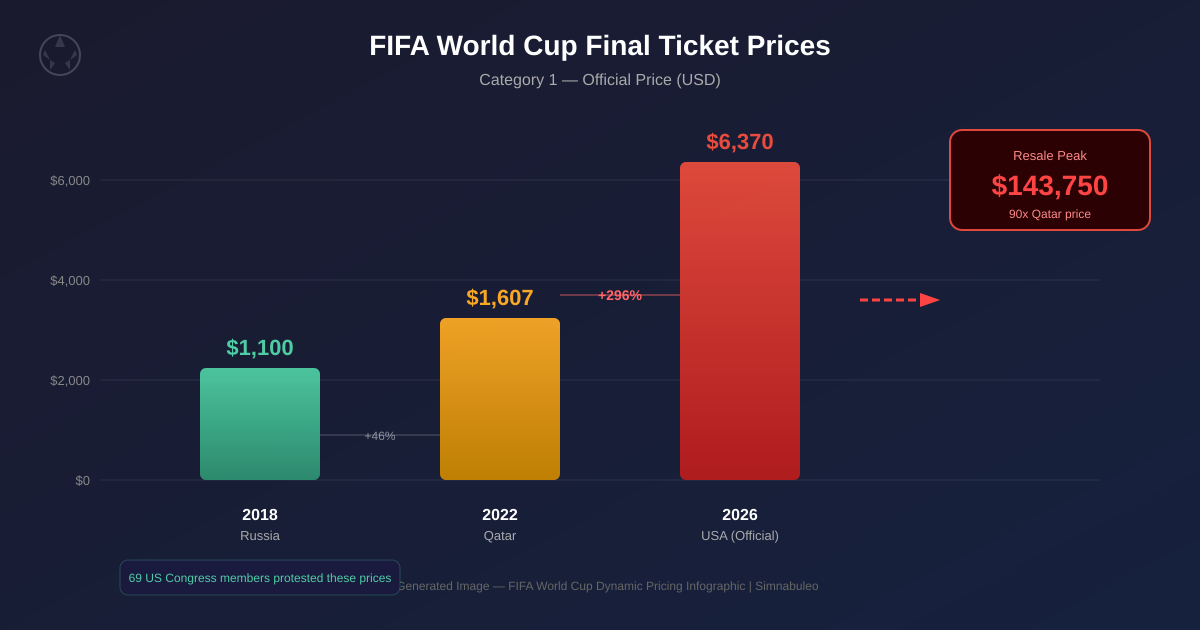
The 2026 North America World Cup is the most expensive ever. Category 1 final tickets start at $6,370 and soared to $143,750 on the resale platform — 4x the official Qatar price and 90x at peak. Group stage minimums jumped from $11 to $100 (9x), and opening match from $55 to $560 (10x).
FIFA Became the Official Scalper — The Reality of Dynamic Pricing
FIFA claims dynamic pricing recovers secondary market premiums through official channels, but in practice FIFA itself became the official scalper. FIFA earns commissions on $143,750 resale tickets on its own platform, with zero transparency about the pricing algorithm, triggers, or caps.
Why 69 US Congress Members Wrote to FIFA
A letter led by Representative Sydney Kamlager-Dove with 68 co-signers formally demanded FIFA withdraw dynamic pricing and reduce costs. This is the first time the US Congress has protested a foreign sports organization pricing policy.
A Nonprofit Organization With a $13 Billion Business
FIFA is a Swiss-based nonprofit projecting $11-13 billion in 2026 World Cup revenue. President Infantino earns $4.6M annually with a 33% raise while claiming 89% reinvestment into football development.
Excluding the Global South — Who Does Football Belong To?
Dynamic pricing effectively excludes Global South fans. For fans in Brazil, Mexico, Nigeria, and India, a $100 group stage ticket is a significant portion of monthly salary — add US flights, accommodation, and visa costs, and World Cup attendance becomes a privilege for the developed world.
Positive & Negative Analysis
Positive Aspects
- Recapturing secondary market premiums through official channels
Under fixed pricing, popular match tickets trade at multiples on the black market. Dynamic pricing recovers this premium through FIFA official channels, theoretically creating reinvestable funds for football development.
- Expanding football development reinvestment funds
The FIFA Forward program distributes $2.25B to 211 member federations. If increased ticket revenue feeds this program, it could materially contribute to expanding football globally.
- Reflecting market demand for an unprecedented-scale tournament
With 48 teams across 16 cities, fixed pricing struggles to handle overwhelming excess demand. Dynamic pricing balances supply and demand through price mechanisms.
- $60 Supporter Entry Tier creation
FIFA created a $60 per-match low-cost ticket category distributed through national federations to loyal fans, creating a pathway to attend even the final at below-market prices.
Concerns
- Complete lack of price transparency
FIFA discloses nothing about the dynamic pricing algorithm, price change triggers, or maximum caps. This opacity mirrors what triggered the UK government Ticketmaster investigation.
- $60 ticket ineffectiveness
Hundreds of $60 tickets in 60,000-80,000 seat stadiums is less than 0.5% of total seats. The odds of getting one approach a lottery.
- Structural destruction of global accessibility
$100 group stage tickets plus US travel costs make World Cup attendance effectively impossible for Global South fans, threatening football cultural identity.
- Contradiction between nonprofit status and revenue maximization
FIFA is a nonprofit pursuing $13B in revenue, paying its president $4.6M, and selling $140K tickets. Independent audits of reinvestment are lacking.
- Ignoring all precedent warnings
The UK investigated Ticketmaster after Oasis, Taylor Swift rejected dynamic pricing, and the term was a 2024 word-of-the-year finalist for negative perception. FIFA applied the same model anyway.
Outlook
One hundred and forty-three thousand, seven hundred and fifty dollars. For a single ticket to a football match. Let that number just sit there for a moment. That is enough money to buy a small apartment in most cities outside Manhattan, or two mid-range sedans, or four years of college tuition at a state university. And someone, somewhere, is actually paying that price to watch 22 people kick a ball for 90 minutes. But here is the part that really stings: this price was not set by a scalper on a street corner. It appeared on FIFA's own official resale platform. FIFA itself sanctioned this number. FIFA itself takes a cut.
The 2026 World Cup in North America was supposed to be the most ambitious tournament in history. The first-ever 48-team format. Three host nations. America hosting the final for the first time in 60 years. But the story that is actually dominating the conversation right now has nothing to do with football tactics or underdog nations. It is about money. Specifically, it is about FIFA's unprecedented decision to introduce dynamic pricing to World Cup tickets for the very first time.
Dynamic pricing is a concept most people already know from booking flights or hotel rooms. When demand goes up, so does the price. When demand drops, the price follows. In the American entertainment industry, this is standard operating procedure. Ticketmaster has been doing it for years. But FIFA decided to import this model wholesale into global football, and that decision has ignited a firestorm that shows no sign of dying down.
Football has always been, at its core, a working-class sport. The culture of watching football was born in the factory towns of 19th-century England, where workers would pile into local grounds on Saturday afternoons. Germany's Bundesliga still enforces the '50+1 rule' that ensures fans hold a majority stake in their clubs. The English Premier League caps away ticket prices at 30 pounds. South American barrabravas define stadium culture through raw, unfiltered passion that money cannot buy. FIFA's own slogan is "Football Unites the World" — not "Football Unites Those Who Can Afford It."
In September 2025, FIFA announced that dynamic pricing would be applied to all 2026 World Cup ticket sales. The moment that announcement dropped, prices started climbing. Football Supporters Europe called the pricing structure "extortionate." Fan groups across Europe demanded that ticket sales be halted. And the numbers that emerged in the following months made it clear just how far FIFA was willing to push.
The raw numbers tell a brutal story. At the 2022 Qatar World Cup, the best available seat for the final cost around $1,600. Four years earlier in Russia, it was $1,100. Those increases were gradual and predictable — the kind of inflation you grumble about but ultimately accept. In 2026, that orderly escalation went off a cliff. Category 1 final tickets launched at $6,370. On FIFA's official resale platform, they climbed to $143,750. That is four times the Qatar price at launch, and roughly 90 times at the peak.
Group stage tickets have not been spared either. The cheapest ticket available in Qatar was $11. In 2026, that same entry-level seat costs $100 — a ninefold increase. Opening match minimum pricing leapt from $55 to $560, a tenfold jump. This is not inflation. This is a deliberate structural transformation of how FIFA prices its product.
The most useful lens for understanding what happened here is cultural collision. Dynamic pricing is an American invention, perfected by Ticketmaster and normalized by decades of surge-priced concert tickets and sporting events. Even Taylor Swift explicitly refused to use dynamic pricing for her Eras Tour because of the toxic reputation it had earned. The Oasis reunion tour debacle in the UK was so severe that the British government launched an official investigation into Ticketmaster. The term "dynamic pricing" itself was a finalist for 2024's word of the year, specifically because of how negatively the public perceived it. And yet FIFA looked at all of that and said: let us apply this to the biggest sporting event on the planet.
Let me be direct about this. FIFA's adoption of dynamic pricing is one of the most hypocritical business decisions in the history of sports. FIFA is a nonprofit organization headquartered in Switzerland. Nonprofit. Read that word one more time. A nonprofit whose president earns $4.6 million annually (including a 33% raise), while the organization he leads sells individual tickets for $143,750. If this is what nonprofit means, the dictionary needs a rewrite.
The projected total revenue for the 2026 World Cup sits between $11 and $13 billion — roughly 50% higher than any previous edition. Ticket and hospitality revenue alone is expected to hit $3 billion. FIFA claims it reinvests 89% of revenue into football development, but there is a nagging suspicion that the "football development" line item includes more private jets for executives than grass pitches for children.
The deeper problem is the cultural rupture this creates. The World Cup was supposed to be the most universal cultural event on Earth. The one place where a kid from a Brazilian favela and a Wall Street banker could sit in the same stadium, watch the same match, and scream at the same moment. Dynamic pricing destroys that last remaining possibility. Between the $143,750 seat and the handful of $60 tickets per match, a class system forms inside the stadium itself. The football ground becomes an airport lounge.
There is a legitimate economic argument for dynamic pricing, and it would be intellectually dishonest to pretend otherwise. Under fixed pricing, tickets for high-demand matches sell out instantly and reappear on secondary markets at multiples of their face value. In that scenario, the premium goes entirely to scalpers. Dynamic pricing at least recaptures that premium through official channels. Economically speaking, consumer surplus transfers to the producer rather than disappearing into the black market. The money, in theory, stays in the system.
If FIFA genuinely channels dynamic pricing revenue into football development, the math could theoretically work in the sport's favor. The FIFA Forward program distributes $2.25 billion to 211 member federations, and those funds have demonstrably improved football infrastructure in underdeveloped nations. More revenue from premium pricing could mean more pitches in Africa, more coaching programs in Oceania, more youth academies in underserved communities. The irony would be rich — wealthy fans subsidizing global football access — but the outcome would be net positive.
The sheer scale of the 2026 tournament also provides context that cannot be ignored. Forty-eight teams across 16 cities, with the final at MetLife Stadium drawing from a metropolitan area of 20 million people. When Infantino declared that "every match is sold out," he may not have been bluffing. When demand overwhelms supply by this magnitude, price mechanisms are the market's natural response, and allocating seats to those who value them most is at least defensible from an efficiency standpoint.
FIFA's introduction of the $60 "Supporter Entry Tier" also deserves acknowledgment, even if the execution falls short. Distributed through national federations to loyal fans who have attended previous matches, these tickets create at least a narrow pathway for genuine supporters to attend even the final at below-market prices. It is not enough, but it is not nothing.
Every premise of the pro-dynamic-pricing argument, however, crumbles under scrutiny. The claim that dynamic pricing "takes money away from scalpers" is really just FIFA declaring that it wants to become the official scalper. When a ticket trades for $143,750 on FIFA's own platform and FIFA takes a commission, that is not eliminating the secondary market — it is institutionalizing it. This is profit maximization dressed up in the language of market efficiency.
The transparency problem is severe and largely unaddressed. Fans have no visibility into how the pricing algorithm works, what triggers price changes, whether there are caps, or whether waiting might result in lower prices. This is exactly the same opacity that triggered the UK government investigation into Ticketmaster after the Oasis fiasco. Consumers deserve to know why a price is what it is. FIFA provides no such information.
The $60 Supporter Entry Tier is functionally meaningless at scale. FIFA described the allocation as "hundreds" per match. In stadiums seating 60,000 to 80,000, hundreds means less than 0.5% of available seats. The probability of securing one of these tickets is closer to winning a lottery than buying a product. This is not a concession — it is a public relations fig leaf designed to create a talking point ("we offer affordable tickets too") without materially changing anything.
The global accessibility crisis is perhaps the most damaging consequence. For fans in Brazil, Mexico, Nigeria, or India, a $100 group stage ticket represents a significant portion of their monthly income — before accounting for flights to the United States, accommodation, and visa costs. The World Cup was supposed to be the event that transcended economic boundaries. Dynamic pricing transforms it into a privilege reserved for the developed world's upper-middle class and above. "Football Unites the World" becomes "Football Unites the World's Rich."
The intervention of 69 US Congress members underscores just how far this controversy has traveled. The letter, led by Representative Sydney Kamlager-Dove with 68 co-signers, formally requested that FIFA abandon dynamic pricing and reduce ticket costs. This is the first time in history that the US Congress has officially protested a foreign sports organization's pricing policy. When lawmakers start writing letters about football ticket prices, you know the issue has crossed from sports into consumer protection territory.
The trajectory of this controversy will be shaped by FIFA's response over the coming months. In the near term, with the tournament kicking off on June 11 — less than three months away — a fundamental restructuring of the pricing model is extremely unlikely. If "every match is sold out" is true, FIFA has zero economic incentive to lower prices. Minor adjustments might occur if Iran's potential boycott frees up tickets, if Congressional pressure intensifies, or if unsold premium inventory accumulates close to match day. But the architecture of dynamic pricing will remain intact for 2026.
The medium-term evaluation will depend heavily on the tournament experience itself. If the 2026 World Cup delivers record revenue and packed stadiums, dynamic pricing becomes the new normal for FIFA events. The 2028 European Championship and the 2030 World Cup would likely adopt similar models, locking in a permanent shift toward market-rate pricing for global football's biggest events. If, however, the stadiums feel sterile — filled with corporate suits and wealthy tourists rather than singing, chanting, flag-waving fans — the backlash could force other governing bodies like UEFA to maintain independent pricing policies as a competitive differentiator.
The long view places this controversy within a much larger current. Saudi Arabia's massive investment in European football, American private equity's acquisition spree of European clubs, and now FIFA's dynamic pricing represent different expressions of the same fundamental force: the financialization of football. The sport is being systematically reimagined as a global entertainment product, and the traditional bonds between football and local communities, between football and the working class, are weakening with every passing year.
The most optimistic scenario sees organized fan resistance and government regulation forcing meaningful constraints on dynamic pricing — price caps, transparency mandates, minimum allocations for low-income fans. The most pessimistic scenario sees the 2030 World Cup (hosted across Spain, Portugal, Morocco, Uruguay, Argentina, and Paraguay) deploying even more aggressive dynamic pricing, with final tickets breaking $200,000 and the World Cup completing its transformation into an exclusive luxury event.
The most likely path forward falls somewhere in between. The 2026 World Cup sets revenue records while simultaneously generating unprecedented fan dissatisfaction. FIFA maintains dynamic pricing for future events but expands the low-cost ticket allocation from the current 0.5% to something closer to 5-10%, with a price ceiling on the resale platform. No total victory, no total defeat — a characteristically FIFA resolution.
NPR recently posed the essential question: "Is there a more fair way to sell World Cup tickets?" Lottery allocation, expanded national federation quotas, price caps, digital identity verification to prevent resale — alternatives exist. The question is whether FIFA has the will to adopt them. And the numbers so far suggest the answer is no.
FIFA has answered the question of who football belongs to. It belongs to whoever pays the most. Dynamic pricing is simply the algorithmic automation of that answer. If the World Cup is going to resist its transformation from "global festival" to "global premium event," fan outrage needs to convert into organized action. The Congressional letter was a start, but only a start. In June 2026, the composition of the crowd at MetLife Stadium will deliver the final verdict on this debate. And right now, the smart money — quite literally — is on the wrong side of history.
Sources / References
- FIFA slashes some 2026 World Cup ticket prices after backlash — ESPN
- Fans slam FIFA, demand halt to extortionate 2026 World Cup ticket sales — Al Jazeera
- Is there a more fair way to sell World Cup tickets? — NPR
- Kamlager-Dove Pushes FIFA to Lower World Cup Ticket Prices — US House of Representatives
- How fans are becoming biggest casualties of FIFA expensive 2026 World Cup — Business Standard
- FIFA World Cup 2026 vs Qatar 2022: The astonishing 10-fold ticket price jump — Gulf News
- World Cup 2026 Ticket Prices Compared to Qatar and Russia — Sportscasting