
73 Years of Waiting — and Italy's F1 Hero Drives for Germany
Summary
After 15 rounds of the 2026 Formula 1 season, twenty-year-old Kimi Antonelli of Bologna leads the Drivers' Championship with 302 points and a 66-point advantage over teammate George Russell — closer to an Italian F1 world title than any driver since Alberto Ascari's Ferrari victory in 1953, a gap of 73 years. The milestone is undeniable: Antonelli has taken eight race victories including five consecutive wins from the Chinese to the Monaco Grand Prix, and his comeback from 19th on the grid to first place at Monza on September 6 marked the first Italian driver win at the Italian Grand Prix in 60 years. Yet the defining paradox of this season is that Ascari clinched his title with Scuderia Ferrari — the beating heart of Italian motorsport — while Antonelli campaigns for Mercedes, a German brand running out of Brackley, England, with the constructor standings showing Mercedes leading Ferrari by 160 points (538 vs. 378). Senior Italian figures from Pirelli Vice Chairman Marco Tronchetti Provera to Deputy Prime Minister Salvini have openly struggled to reconcile pride in their driver with pain over their team's performance, revealing a fracture in Italian national sports identity that no clean framing resolves. The earliest mathematical title clinch is calculated for Round 18, the United States Grand Prix at Austin on October 25, with 208 points still available across the eight remaining rounds. This analysis examines whether the nationality of a championship rightfully belongs to the driver — as all historical precedent insists it should — or whether Italy's singular relationship with Ferrari creates a paradox that pure logic alone cannot settle.
Key Points
The 73-Year Weight: What an Italian F1 Champion Actually Means
Alberto Ascari secured back-to-back F1 World Championships in 1952 and 1953, both times with Scuderia Ferrari, and no Italian driver has stood on the top step of the world championship podium since — a drought spanning seven decades. During those 73 years, non-Italian drivers claimed Ferrari world titles (Schumacher five times, Räikkönen once, Lauda twice), and Italian fans watched their national team hand the trophy to German, Finnish, and Austrian champions while their own countrymen remained without the ultimate prize. Antonelli, born August 25, 2006, in Bologna, now stands at the front of the championship with 302 points, eight wins, and a level of dominance in his second F1 season that has no meaningful recent parallel. His five consecutive victories from China through Monaco, combined with the stunning comeback win at Monza from 19th on the grid, have produced what Italian columnist Leo Turrini described as "the birth of a new idol" — a phrase that carries weight precisely because the gap since the last Italian idol of this magnitude is seven decades wide. If he clinches the title at Austin on October 25, he will do so as the youngest world champion in F1 history, shattering Sebastian Vettel's record of 23 years and 134 days by more than three years. Beyond the personal record, this represents a genuine generational handover for the entire sport — the moment the Hamilton-Verstappen era gives way to the 2000s-born drivers that Antonelli leads.
P19 to P1: The Monza Drive That Made the Argument
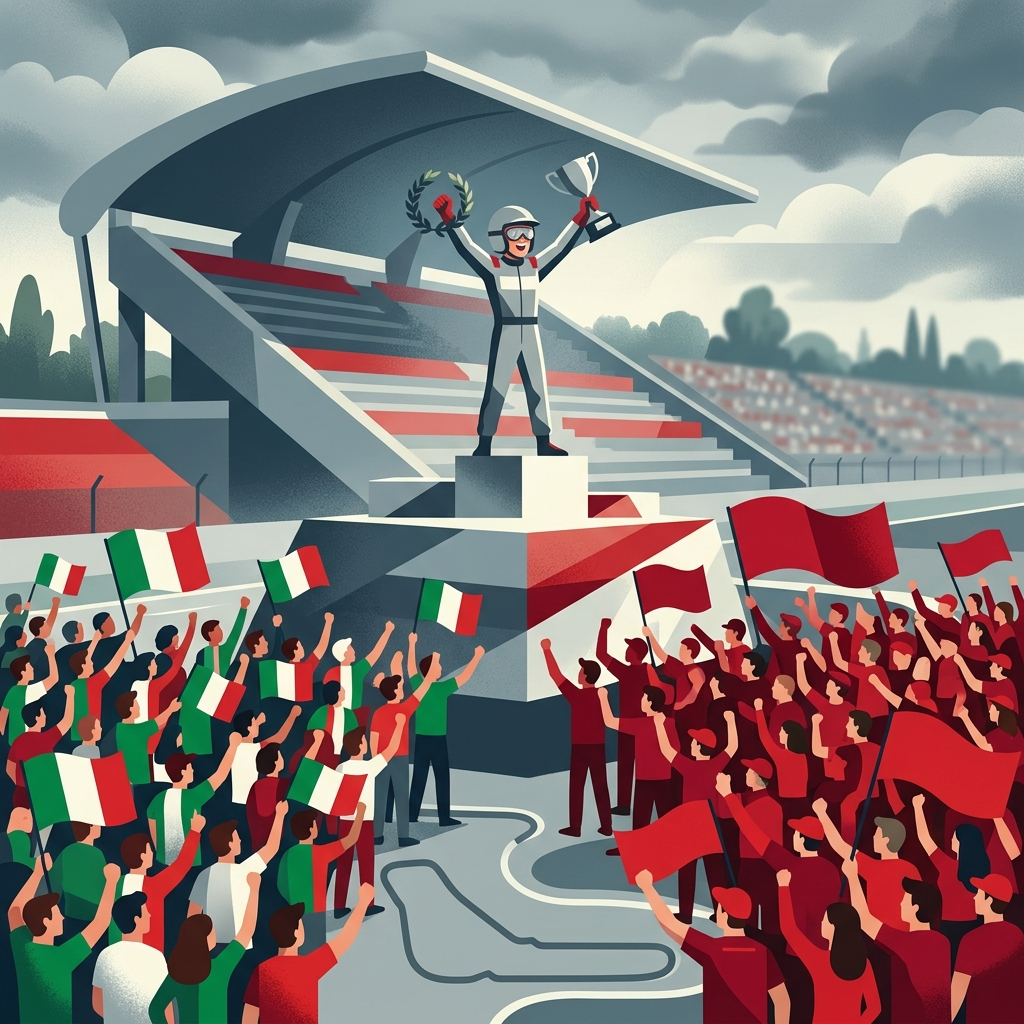
The Italian Grand Prix at Monza on September 6 is the single performance that best encapsulates what Antonelli is doing in 2026, and it deserves careful attention. Starting from 19th on the grid due to a power unit penalty — a position from which a points finish is normally considered a solid day's work — he spent 53 laps executing what automoto.it called "clean, aggressive and surgically precise overtaking," systematically working through the entire field until he crossed the line first, 3.857 seconds ahead of Russell. A late-race moment where he grazed the gravel trap and held on is the kind of scene that gets embedded permanently in a driver's legend. It was the first time an Italian driver had won the Italian Grand Prix since Ludovico Scarfiotti took Ferrari to victory at Monza in 1966 — a 60-year gap confirmed independently by both the Italian-language Wikipedia and automoto.it. The site marked the occasion by declaring "Kimi Antonelli's era has officially begun," and the reaction from the grandstands — packed Ferrari fans waving tricolore and Ferrari flags simultaneously at a silver car — captured the paradox in a single image that no editorial could have written better. This performance alone provides the most direct rebuttal to any "Mercedes made him" argument: starting from 19th, racing craft alone carries you to first.
Italy's Divided Heart: The Identity Crisis Nobody Ordered
The cultural dimension of this championship is what makes it genuinely extraordinary beyond the sporting statistics, and it begins with a single pre-race interview that accidentally mapped the entire national dilemma. Three days before the Italian Grand Prix, Pirelli Vice Chairman Marco Tronchetti Provera stated publicly: "It will be very special this year. Our heart will beat for two great passions — on one hand for the young genius Kimi Antonelli, on the other for the historic passion we all have for Ferrari." That sentence acknowledges, in the most diplomatically careful possible framing, that Italian hearts are not unified around this championship. ACI president Geronimo La Russa tried to bridge the gap with the "tricolore fiesta" framing — Italy wins either way, so there's no conflict — but Deputy PM Salvini's response to the direct question of his loyalties ("I have made my choice, but I won't tell you") told a more honest story about where Italian society actually stands. The most structurally revealing response came from F1 CEO Stefano Domenicali, himself Italian and a former Ferrari team principal: he praised Antonelli for "a special season" while simultaneously telling Ferrari that "the stormier the seas, the more determined the captain must be at the helm." The need to simultaneously celebrate and console within a single conversation is the clearest possible sign that the joy is incomplete. This fracture isn't about personalities — it's a structural feature of Italian sports culture that invested 73 years of national identity into a single constructor.
The 2026 Rules Revolution and the Loophole That Won't Be Forgotten
Understanding the 2026 technical overhaul is essential context for evaluating this championship fairly. The power unit now splits output roughly 50/50 between the 400kW internal combustion engine and the 350kW MGU-K electric motor, DRS was abolished in favor of Active Aero with Z-mode corners and X-mode straights, and the cars shed 30 kilograms from the previous specification. Max Verstappen, who had dominated the sport for four consecutive years, called the new cars "a bit more like Formula E on steroids" at February pre-season testing — and then dropped to sixth in the standings this season with 163 points, which tells its own story about the regulations' equalizing effect. Mercedes exploited a compression ratio measurement loophole in the early races, using thermal expansion at engine operating temperatures to exceed the 16:1 limit during racing; competitors estimated the advantage at roughly 0.3 seconds per lap, Wolff said "just 2-3 BHP," and Verstappen said "add a zero to that." The FIA implemented a fix from Monaco (June 1) onward requiring verification at 130 degrees Celsius. The critical post-ban fact: Antonelli won Monaco, Belgium, Italy, and Spain — four victories — after the loophole closed, while Russell, his teammate in the same car and conditions, went winless across the same stretch. The loophole existed; it does not explain who kept winning after it was gone.
The Title Window: Three Weekends That Will Define This Season
After the Azerbaijan Grand Prix, 208 points remain across eight rounds (Rounds 16 through 23), with Antonelli holding a 66-point lead. Round 16 is the relocated Bahrain Grand Prix at Malaysia's Sepang International Circuit on October 4, a high-temperature venue where electric energy efficiency and tire management are decisive advantages. Round 17 in Singapore on October 11 hosts the sixth and final sprint race of the season, offering a maximum 33-point weekend. The earliest mathematical clinch is Round 18 at Austin on October 25, which requires Antonelli to win all three upcoming rounds including the Singapore sprint while Russell scores zero — a scenario that would push the lead to 149 points with only 125 remaining. RacingNews365 calculated that an Austin clinch would make Antonelli world champion at 20 years, 2 months, and 1 day, more than three years younger than Vettel's record. Motorsport.com reported on September 27 that the Qatar (Round 22) and Abu Dhabi (Round 23) rounds remain "still uncertain" due to Middle East instability; if those two events are cancelled, a conditional Singapore clinch scenario opens because available remaining points would drop to approximately 100.
Positive & Negative Analysis
Positive Aspects
- A New Era of F1 Storytelling Begins
A twenty-year-old world champion doesn't just update the record books — it signals a complete generational handover in the sport's defining narrative structure. Vettel's youngest champion record at 23 years and 134 days was already considered a landmark; being beaten by more than three years means Antonelli isn't just young, he's from a categorically different generation of athletes. The Drive to Survive fanbase that discovered F1 through Netflix will find the Antonelli narrative irresistible: five consecutive wins to open the season, a P19-to-P1 comeback at Monza, and the layered cultural paradox of an Italian champion in a German-British car. Leo Turrini wrote of "the birth of a new idol," and from a pure storytelling standpoint, F1 couldn't have scripted a more compelling chapter transition at a more needed moment. The Hamilton-Verstappen duopoly ran for nearly a decade; fresh faces, new narratives, and first-time moments are exactly what keeps global sports audiences growing. Alongside Jannik Sinner in tennis, Antonelli is helping construct Italy's first genuinely multi-sport generation of global athletic icons in decades — and that has value well beyond the F1 paddock.
- Italian Sports Identity Gets a Chance to Expand Beyond Ferrari
For the first time in 73 years, Italy has the opportunity to anchor its F1 pride to a driver rather than a constructor, and that's actually a far more resilient long-term foundation. In football, Italian players compete for Real Madrid, Manchester City, and Arsenal while still representing the Azzurri national team — nobody questions whether their club employer dilutes their Italian identity. The same logic should apply to motorsport, but hasn't — until now. If Italian fans can internalize that Antonelli's nationality is theirs regardless of the badge on his steering wheel, the country's F1 identity becomes less hostage to any single team's technical fortunes in any given season. Sinner and Antonelli together suggest that Italy's new sporting pride is being anchored in individual excellence across multiple disciplines, which is a more sustainable and more expansive foundation than dependence on one brand's championship results. Whether Antonelli eventually moves to Ferrari or finishes his career at Mercedes, the national anthem played under the podium spotlights sounds the same either way.
- The 2026 Regulations Prove Electric Integration Can Enhance Racing
Whatever skepticism was leveled at the 50/50 ICE/MGU-K regulatory framework before the season — and Verstappen's "Formula E on steroids" line set the tone for pre-season doubt — the racing across 15 rounds has delivered genuinely competitive on-track action. The combination of Active Aero replacing DRS, 30kg of weight reduction, and the strategic complexity of managing two power sources simultaneously has added a new tactical dimension to race craft without destroying overtaking or spectacle. Antonelli's Monza comeback demonstrated that energy management during safety car phases now represents a decisive element, rewarding drivers who understand their car's electrical architecture at a deep level. The fact that four-time champion Verstappen dropped to sixth in the standings is itself strong evidence that the new rules genuinely reset the competitive hierarchy rather than simply reshuffling familiar order. F1's long-term commercial and environmental sustainability requires demonstrating that increased electrification doesn't compromise the sport's entertainment value, and the 2026 season is providing exactly that demonstration to a global audience.
- Mercedes' Junior Program Delivers Its Most Complete Vindication
The Antonelli trajectory — signed at twelve, developed through karting and the junior formulae, record-setting 150-point rookie season in 2025, now leading the championship in Year 2 — is the most efficient path from junior recruit to world championship contention in recent F1 history. The Red Bull young driver program produced Vettel and Verstappen; the McLaren system developed Norris; but the timeline from Antonelli's April 2019 Mercedes junior entry to his 2026 championship lead is compressed beyond any comparable case. His father Marco Antonelli's racing background through Antonelli Motorsport provided an important early foundation, but the structured, systematic support of a works team's full development apparatus is what accelerated that foundation into championship-level race craft. The comparison with Verstappen's dominant peak years at Red Bull is instructive: Red Bull also signed Max young and developed him through a structured feeder system, but even by Red Bull's standards, the pace at which Antonelli moved from junior program entry to championship lead in Year 2 of his F1 career is exceptional. Other teams watching this model have strong commercial incentive to increase their own junior program investment, and the knock-on effect for F1 grid quality over the next decade could be meaningful for the sport as a whole. For any team building a championship-contending program for the 2030s, the Mercedes-Antonelli pathway — early identification at twelve, structured progression, record-setting debut season, rapid championship contention — now stands as the benchmark against which all junior development philosophies will be measured.
- The Fanbase Alignment Around the Driver Story
The Netflix-era F1 fanbase is structurally different from the grandstand fanbase of twenty years ago — more global, more driver-centric, less team-loyal, and highly active on social media in real time. For these fans, the story of a twenty-year-old from Bologna fighting back from 19th at Monza is the entire product, and whether the car is silver or red is largely secondary to the human narrative. Italian broadcast data reportedly showing higher viewership for Antonelli's Monza win than during typical Ferrari-podium weekends reflects this shift in concrete commercial terms. The F1 commercial ecosystem — broadcast rights, sponsorship valuations, merchandise — will increasingly price Italian market value against Antonelli's personal trajectory rather than Ferrari's constructor results, creating a new commercial architecture that benefits from the driver-first engagement model. Across the full global fanbase, the combination of youth, Italian identity, technical drama, and unresolved cultural paradox gives this championship arc a range of story angles that a straightforward single-team dominance narrative could never match.
Concerns
- Ferrari's Structural Crisis Cuts Deep Into Italian Motorsport Pride
Mercedes leads the constructor standings by 160 points over Ferrari (538 vs. 378), and the 160-point gap is not simply a number — it represents the cumulative difference across 15 rounds between a team that adapted to the 2026 regulations effectively and one that has not, with no realistic prospect of closing that gap before the season ends. Ferrari's only victories this year came from Hamilton in Barcelona and Leclerc at Silverstone, and both owed more to opportunistic strategy and aggressive positioning than to clear pace superiority — Capelli himself acknowledged that Ferrari has not yet found the perfect setup for every Grand Prix. The Italian Grand Prix weekend at Monza was particularly stark: Leclerc suffered a major crash and retired while Antonelli drove to victory for Mercedes, leading automoto.it to describe it as a catastrophic weekend for the Maranello Scuderia. For Italian fans in Monza's grandstands, experiencing their national team being beaten by their national driver in the same race is an emotional conflict without a clean resolution — the applause and the disappointment are inseparable. Ferrari's path back to championship contention runs through a multi-season engineering project that realistically extends into 2027 at minimum, meaning the emotional split between Italian driver pride and Italian team anguish may deepen before it has any chance of healing. The particularly difficult aspect for the tifosi is that this divergence — their driver ascending while their team struggles — is happening in precisely the season that Italy had waited 73 years to celebrate.
- The Loophole Shadow Won't Disappear Quietly
The overlap between Antonelli's dominant early-season run — five wins from China through Monaco — and the period when Mercedes held a compression ratio loophole advantage creates a legitimate asterisk that critics will not let go quietly, regardless of what the post-ban statistics show. Competitors estimated the loophole provided roughly 0.3 seconds per lap, and while Antonelli's four post-ban wins are a powerful counter-argument, the opening streak occurred during the period when Mercedes had a regulatory edge over the entire field. The fact that Mercedes leads the constructor standings by 160 points means the car is still best-in-class, making it structurally difficult to fully isolate the driver's contribution from the machinery's advantage. Verstappen's "Formula E on steroids" critique of the 2026 regulations also feeds a narrative that the rule changes favored manufacturers with strong electrical integration experience — which describes Mercedes. A championship won in a dominant car, from a team with an early-season loophole in the record, will carry qualifications in some corners of the paddock and the press regardless of subsequent performances.
- Italy's Identity Fracture Could Deepen Before It Heals
As long as Antonelli wins in silver and Ferrari continues to struggle, the emotional division within Italian motorsport fandom will compound rather than resolve. Salvini's refusal to publicly choose between his driver and his team is politically convenient, but it also accurately maps the genuine ambivalence across Italian society, where Ferrari functions as a cultural institution that outlasts any individual driver's career arc. Tronchetti Provera's "two great passions" framing is intellectually honest but emotionally unsatisfying — when your passions compete directly with each other, claiming both simultaneously does not reduce the tension between them. Social media amplifies exactly this kind of unresolved cultural tension, converting a nuanced identity question into polarized camps with minimal room for the complexity the situation actually deserves. I genuinely worry that the weight of a 73-year national identity debate, placed on the shoulders of a twenty-year-old mid-championship, creates an unfair psychological burden on Antonelli at precisely the moment when he needs clarity and focus above everything else.
- Mercedes Dominance Risks Replicating the 2014–2020 Pattern
A championship race in which both P1 (302 points) and P2 (236 points) in the driver standings belong to the same constructor, and that constructor leads P2 in the constructors' championship by 160 points, raises legitimate questions about competitive balance in the 2026 regulatory framework. The 2014–2020 Mercedes era, during which the same team won the constructor title every single year, is widely regarded as having damaged F1's narrative appeal despite Hamilton's individual brilliance in that period. If the 2026 regulations — designed explicitly to reset the competitive hierarchy — have simply handed dominance to the team that adapted most effectively first, rather than enabling sustained multi-team competition, that's a regulatory design question worth asking openly. The FIA's mid-season intervention on the compression ratio loophole shows awareness of competitive balance concerns, but the constructor gap suggests one intervention was insufficient to truly level the field. Long-term commercial health in F1 depends on races with genuine uncertainty at the front, not predictable one-two results from the same garage.
- The Risk of Premature Celebration
Sixty-six points feels like a commanding lead — until you remember that the Azerbaijan Grand Prix, in a single weekend, trimmed that margin from 81 to 66 points. Four or five repetitions of a similar result pattern and the title picture changes substantially. The eight remaining rounds contain 208 points, meaning Russell, Hamilton, and Norris are all mathematically alive, and the back-half circuits include conditions that may not favor Mercedes as consistently as the first half of the season has. Barcelona's DNF — where a mechanical failure put Antonelli out of the points entirely — proved that zero-point weekends are not theoretical constructs but events that have already occurred once this season. The Motorsport.com report that Qatar and Abu Dhabi remain uncertain adds a scheduling variable that could compress or expand available points in unpredictable ways. Italian fans and media who have been building the "73 years, finally" narrative since the summer risk emotional overexposure: if the title does slip away in the final rounds, the resulting disappointment would be disproportionately amplified by the level of pre-celebration already invested in the outcome.
Outlook
The next race arrives sooner than the typical calendar gap would suggest. Round 16 is officially the Bahrain Grand Prix, relocated to Malaysia's Sepang International Circuit on October 4 due to ongoing Middle East conflict. Sepang is a high-temperature, high-humidity venue where tire management and energy deployment across long, punishing straights are the decisive variables. The 50/50 power unit architecture of the 2026 regulations rewards teams with efficient electrical energy recovery, and Mercedes has demonstrated throughout the season that their energy management is class-leading in hot and demanding conditions. In the most favorable scenario for Antonelli — he wins and Russell scores nothing — the championship lead extends to a maximum of 91 points. In the worst-case realistic scenario — Russell wins and Antonelli scores zero — the gap narrows to 41 points. The critical context is that the only race this season where Antonelli completely failed to score was the mechanical DNF in Barcelona, making a full zero-point result at Sepang possible in theory but far removed from the season's established pattern.
A week after Sepang, Round 17 brings the Singapore Grand Prix on October 11, and this weekend carries additional strategic significance: it hosts the sixth and final sprint race of the 2026 season. A sprint win (8 points) combined with a grand prix win (25 points) delivers a maximum 33-point weekend haul — the highest single-weekend ceiling in the entire calendar. If Antonelli sweeps both Sepang and Singapore including the sprint, his theoretical maximum combined points gain from those two weekends reaches 58 points, which could push his championship lead to as many as 124 points. Even in that scenario, however, a mathematical title clinch at Singapore alone remains out of reach, because the remaining rounds after Singapore still contain enough available points to keep the championship theoretically open without additional conditions.
A significant variable that any honest title clinch analysis must account for is the status of the calendar's final two rounds. Motorsport.com reported on September 27 that the Qatar Grand Prix (Round 22) and the Abu Dhabi Grand Prix (Round 23) remain "still uncertain" due to ongoing instability in the Middle East. If both events are cancelled, the total available points in the remaining schedule would drop from 208 to approximately 100. Under those compressed circumstances, a Singapore clinch becomes conditionally possible even without requiring Antonelli to sweep both pre-Singapore weekends while Russell scores zero simultaneously. This isn't a planning assumption — it's a live variable that could substantially accelerate the confirmation timeline, and anyone following the title race closely should track the geopolitical situation alongside the sporting calendar.
The most credible earliest clinch scenario centers on Round 18, the United States Grand Prix at Austin on October 25. The mathematical pathway requires Antonelli to win all three upcoming rounds — Sepang, Singapore including the sprint, and Austin — while Russell scores zero points across all three events. That combination would push Antonelli's lead to 149 points with only 125 remaining, creating a mathematically insurmountable gap. RacingNews365 has calculated that an Austin title confirmation would make Antonelli the youngest F1 world champion in history at 20 years, 2 months, and 1 day — shattering Sebastian Vettel's record of 23 years and 134 days by more than three years. To put that in perspective: Vettel's record was already considered a landmark; beating it by more than three years represents a generational leap, not a marginal improvement.
Once the title question is settled — whenever that happens — the Italian motorsport conversation will pivot immediately to Ferrari's strategic response heading into 2027 and beyond. The constructor standings show Ferrari 160 points behind Mercedes, and the character of their two victories this season underscores the depth of the problem: Hamilton's win in Barcelona came via VSC strategy and aggressive positioning, while Leclerc's Silverstone victory hinged on a bold opening-lap move — neither was the result of straightforward pace superiority across a full race distance. Capelli's admission that Ferrari "hasn't yet found the perfect setup for every Grand Prix" points to a structural architecture problem, not a tuning issue. The 50/50 ICE/MGU-K split in the 2026 regulations may have exposed a weakness in Ferrari's electrical energy recovery efficiency that incremental updates cannot address. The honest assessment is that Ferrari's road back to championship contention is a multi-season engineering project, with 2027 being the earliest realistic target — and even that is not a guarantee.
The question of where Antonelli drives after his current Mercedes contract inevitably intensifies once a championship is secured, and Italian media have been getting well ahead of themselves already. Leo Turrini has been writing about "the day Antonelli wears red" as if it's a scheduled appointment rather than a possibility. In Italian fan communities, the Antonelli-to-Ferrari narrative is discussed with near-certainty. But the practical conditions for that transfer require several independent factors to align simultaneously: Ferrari needs to close the performance gap to Mercedes significantly, because a driver of Antonelli's caliber does not leave a championship-winning team for one that struggles; Antonelli himself would need a compelling reason to leave the organization that built him from age twelve; and Mercedes would need contractual circumstances that allow the departure. None of these conditions realistically align before the 2028-2029 contract renewal cycle. If and when they do — if Ferrari recovers and that window opens — the commercial and emotional value of "Italy's champion returning to Italy's team" would be extraordinary. But that story is several years away. The story happening right now, in silver, deserves to be told on its own terms.
Looking further down the road, Antonelli's championship has the potential to trigger a genuine shift in how F1's national identity structure operates commercially and culturally. The sport has traditionally been built around constructor nationality: Ferrari means Italy, McLaren and Williams mean Britain, Red Bull means Austria, and fan loyalty flows through team identity. Antonelli's case demonstrates that a driver's nationality can function as a stronger identity anchor than the team's, and this has real commercial implications. Italian sponsors and Italian broadcast rights holders are already beginning to price their deals based on Antonelli's personal trajectory rather than Ferrari's constructor results. The reported data point that Monza's Italian Grand Prix drew higher viewership for Antonelli's silver Mercedes victory than for typical Ferrari-podium weekends is a measurable signal that the fandom's center of gravity is already moving. If this pattern holds across the season and into future years, it changes how teams, broadcasters, and sponsors across the entire grid think about driver nationalism as a commercial asset.
There's a structural challenge embedded within Antonelli's success story that Italy's motorsport establishment needs to confront honestly. The 73-year gap since Ascari is not explained by a shortage of Italian talent — it reflects the absence of systematic, driver-focused development infrastructure within Italy itself. The country's motorsport investment has overwhelmingly gone into constructor excellence, above all Ferrari, rather than into programs designed to identify and nurture individual drivers from early ages. Antonelli had to enter a foreign team's junior program — Mercedes, headquartered in England — to receive the structured development that built him into a championship contender. That fact alone is an indictment of the domestic ecosystem's priorities. If Antonelli wins the title, the political mandate for the Automobile Club d'Italia and Italian government sporting bodies to invest seriously in domestic driver development programs will be the most consequential long-term legacy of this season. Done with ambition and consistency, it could lay the foundation for another Italian world champion within a decade.
I want to be honest about where this forecast could turn out to be wrong. If Antonelli experiences a sharp drop in form over the remaining rounds, or if Mercedes encounters repeated mechanical failures, a 66-point lead may prove less insulating than the current standing suggests. The 208 points still available across the remaining eight rounds keeps the door theoretically open for Russell, Hamilton, and even Norris — none of them can be mathematically eliminated from the title picture at this stage, and each Azerbaijan-style result (where Russell wins and Antonelli finishes lower) demonstrates how quickly individual weekends trim the gap. There's also the question of whether the 2026 regulations produce a convergence effect as the season progresses — teams across the grid continue developing their cars, and performance gaps that separated them in the opening rounds don't always hold into October and November. Ferrari's upgrade trajectory for the remaining eight rounds is another genuine variable; the Maranello team has shown flashes of real pace at specific circuits, and whatever hardware they bring to the back half of the calendar could shift the weekend-by-weekend picture in ways that accumulate over several events.
If this season has a natural turning point for the title picture, it runs through three consecutive weekends: Round 16 at Sepang on October 4, Round 17 in Singapore on October 11, and Round 18 at Austin on October 25. Whether Antonelli confirms the championship in Austin or the competition intensifies and extends the story further into the calendar, one thing is already beyond dispute: the central paradox of this season — an Italian driver chasing the first Italian F1 title in 73 years in a German-British car, with driver nationality, team nationality, and fan loyalty all pointing in different directions — will remain the most compelling narrative thread that the 2026 F1 season has produced. It will not resolve cleanly when the checkered flag falls in Austin or anywhere else. The question of who truly owns this championship, and what it means for Italy to celebrate it, will outlast the season itself.
Sources / References
- F1 Official 2026 Driver Standings — Formula 1
- Italian GP Race Report: Antonelli beats Russell with stunning comeback drive — Formula 1
- 2026 Azerbaijan Grand Prix race result and championship points — RaceFans
- When can Kimi Antonelli win the 2026 F1 Drivers' World Championship? — RacingNews365
- Mercedes faces F1 engine loophole ban at Monaco GP — Crash.net
- 2026 Italian Grand Prix — Wikipedia (Italian)
- Verstappen slams new F1 2026 cars as 'Formula E on steroids' — ESPN
- Why is the 2026 Bahrain Grand Prix taking place in Malaysia? — Motorsport.com
- Kimi Antonelli — Wikipedia
- Points permutations: When is the earliest Antonelli could win the World Championship — Formula 1