
Digital Feudalism Has Arrived — The Faceless Algorithm Lords and Their 400 Million Serfs
Summary
Platform labor — what I would call digital feudalism by another name — has placed between 154 million and 435 million workers worldwide under algorithmic control, stripping them of transparency over how their wages are set, their assignments distributed, or even whether their accounts will survive the morning. On June 12, 2026, the International Labour Organization adopted Convention No. 193, the world's first binding international standard for platform economy workers, passing with a decisive vote of 406 for, 8 against, and 36 abstentions — yet the United States, home to the world's most powerful platform companies, was among those eight opposing votes, leaving fundamental questions about the treaty's real-world enforceability. The algorithmic management systems powering this economy function as a digital maximization of 20th-century Taylorism: a faceless overseer that dictates everything from wage-setting to account deactivation while parent companies disclaim all employer liability under the label "independent contractor." The human cost is concrete — gig workers in Texas earn an effective $5.12 per hour after costs and taxes, and a single app UI change by Uber Eats and DoorDash erased $550 million in tips from New York City delivery workers in a matter of months. Whether Convention No. 193 marks a genuine first step toward labor liberation or merely provides algorithmic exploitation with a legal seal of approval will define the trajectory of global labor policy for years to come.
Key Points
The Historic Significance and Hard Limits of ILO Convention No. 193
Adopted on June 12, 2026, with a vote of 406 for, 8 against, and 36 abstentions, ILO Convention No. 193 marks the first time in history that platform economy workers have been recognized as a distinct protected class under binding international law. Before this convention existed, platform workers occupied a legal void — their status entirely dependent on the outcome of individual court cases in individual jurisdictions, with no international baseline to reference. The convention covers all platform workers regardless of employment classification, and it introduces the world's first binding international standards on algorithmic management, including obligations around disclosure, human review, and protection of organizing rights. That said, the US and New Zealand voted against it, and the UK and India abstained, leaving the world's most significant platform markets outside the treaty's direct reach. Asian Labour Review's warning that the convention risks becoming a "paper tiger" is grounded in precedent: ILO Convention No. 182 on child labor achieved 132 ratifications within three years of adoption, while Convention No. 169 on indigenous rights has sat at just 23 ratifications after three decades — the same convention could produce either trajectory, and the structural weaknesses in No. 193 make the pessimistic path entirely plausible. The convention's real impact will ultimately be determined not by the vote count in Geneva but by the diligence of domestic ratification, the quality of national implementing legislation, and the willingness of labor enforcement agencies to act on the new standards.
How Algorithmic Management Is Engineered to Extract Maximum Value From Minimum Accountability
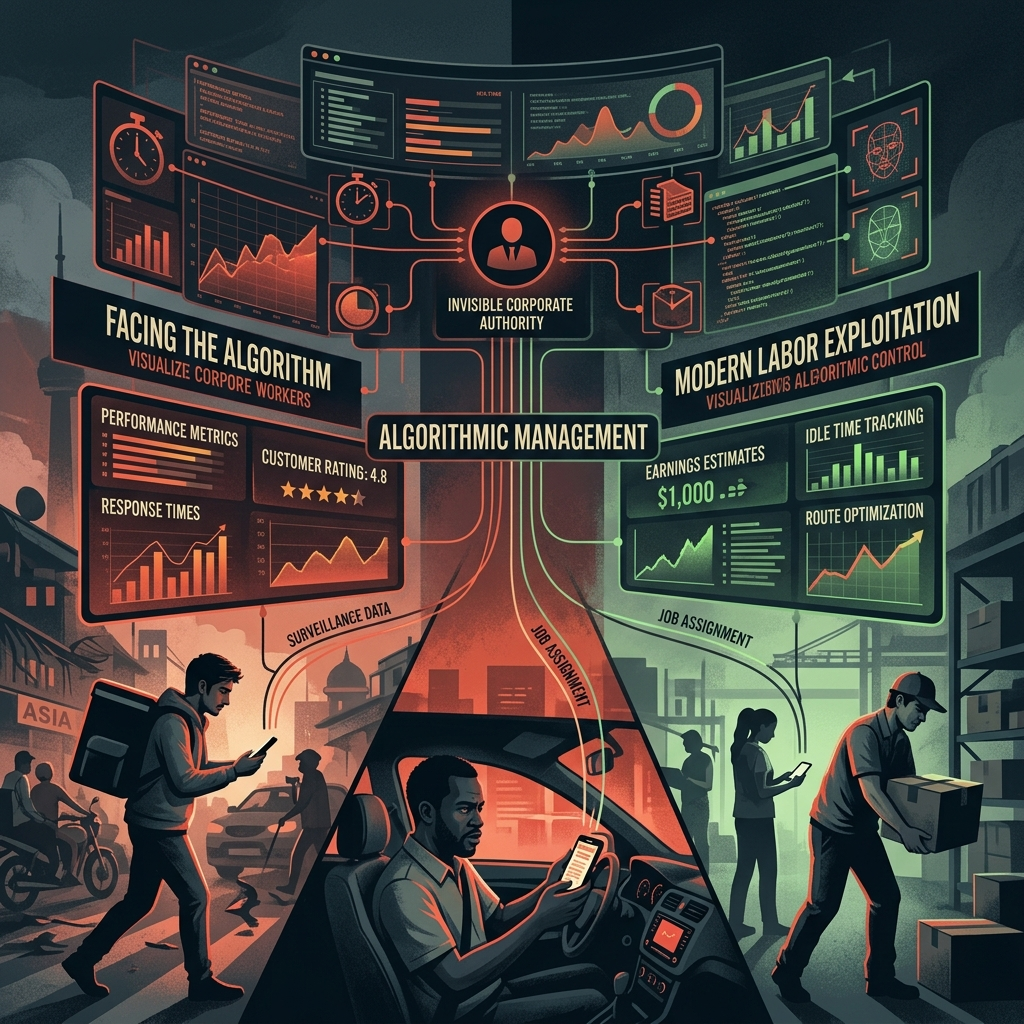
Algorithmic management systems represent what labor scholars have labeled "digital Taylorism" — the 1911 scientific management theory of Frederick Taylor, turbocharged by real-time data processing and stripped of any human accountability at the management level. Platform companies use GPS tracking, delivery speed monitoring, customer rating aggregation, acceptance rate requirements, and idle time penalties to exercise near-total control over how workers spend every minute of their time — all while legally classifying those workers as independent contractors who manage their own affairs. Human Rights Watch's survey of 127 platform workers found that more than 40 had experienced account deactivation firsthand, and that nearly half of those who appealed were ultimately vindicated — meaning the algorithm's false positive rate on one of the most consequential decisions it makes runs close to 50%. The NYC Department of Consumer and Worker Protection's investigation of Uber Eats and DoorDash documented how moving the tip prompt from pre-checkout to post-checkout caused average per-delivery tips to fall from $3.66 to $0.93, erasing $550 million in annual worker income through a single interface decision made without any worker consultation. Columbia Business School data showing platform fees at 42–60% of customer payments demonstrates that the revenue architecture is structurally designed to maximize the platform's take and minimize what flows to workers. The distinction between old-model Taylorism and its digital successor comes down to one fact: the factory foreman had a face, and that face became the organizing focus of the labor movement; the algorithm has no face, and that facelessness is its most powerful defense against organized resistance.
The US No Vote as the Opening Move in Platform Capitalism's Geopolitical Endgame
The United States casting one of the eight opposing votes against Convention No. 193 is not a policy disagreement in any normal sense — it is a declaration of strategic intent from the country that built and currently dominates the global platform economy. Uber reported 2024 revenue of $43.9 billion and net income of $9.8 billion; DoorDash carries an $81 billion market cap; together with Lyft and Amazon Flex, these companies represent the core of a business model whose profitability is structurally dependent on classifying workers as independent contractors rather than employees. Ratifying a convention that meaningfully strengthens worker classification would subject these companies to employment costs — social security contributions, benefits mandates, wage floors — that their current margin structures simply do not accommodate. Major US employment law firm Ogletree has already begun advising corporate clients on a dual-track compliance strategy: minimum standards in ratifying countries, unchanged independent contractor model in the US and other non-ratifying markets. That playbook creates a structural competitive disadvantage for companies operating only in ratifying countries, which in turn generates political pressure on their governments to keep transposition weak. The geopolitical core of this fight is not about labor policy — it is about who controls the rules for a market projected to reach $875 billion by 2030, and the US vote signals that American platform capital intends to keep writing those rules regardless of what is agreed in Geneva.
How Deliberate Language Dilution in the Convention Text Creates the Paper Tiger Risk
The gap between what Convention No. 193's advocates hoped for and what was actually adopted is best understood through the specific language changes made during the final negotiating sessions. Article 9's employment classification standard was weakened from "primarily by the facts" to "mainly by the facts among other elements" — a modification that preserves platforms' ability to invoke contractual language as a basis for denying an employment relationship, rather than being forced to face the economic reality of their control over workers. Article 10's wage protection was downgraded from "adequate wages" to compliance with "minimum wage standards," a change that offers little practical protection in jurisdictions where, as in Texas, the minimum wage allows effective earnings of $5.12 per hour after gig worker expenses. Article 15's human review requirement, originally framed as a direct platform obligation, was converted into a member-state obligation — softening the accountability chain. Most critically, the supporting Recommendation that would translate these principles into operational requirements was not adopted, leaving a two-to-three-year implementation vacuum during which platform companies will be free to establish self-serving interpretations of ambiguous obligations. The WIEGO representative's public framing of the result as "a negotiation, and this is a beginning" is diplomatically accurate — but it should not obscure the fact that what was negotiated away amounts to the practical enforcement machinery that would have made the convention's principles real.
The Reality Gap Between Convention Text and Lived Experience in the Global South
The most consequential test for Convention No. 193 is not in Brussels or Geneva — it is in the streets of Lagos, Nairobi, Mumbai, and Jakarta, where the growth of platform labor is fastest and worker protections are weakest. India's gig workforce is on course to nearly triple from 7.7 million to 23.5 million between 2020 and 2030, yet delivery workers in Delhi and Mumbai are routinely putting in 18-hour shifts for daily earnings of around $21.50 — a figure that does not account for vehicle costs or data expenses. In Nairobi, ride-hailing drivers report average monthly net earnings that place them firmly below a living wage, with 44% of inactive drivers on the platform having left specifically due to algorithmic account suspensions with no clear appeals mechanism. Research across Lagos and Accra documents drivers working 14-hour days who still only manage to earn 66% of a living wage after absorbing $1,200 in annual vehicle depreciation and spending 14% of income on mobile data required to receive work. The December 2025 national gig worker strikes in Delhi, Mumbai, Bengaluru, and Hyderabad were the largest collective action in the history of the Indian gig economy, driven by the combination of wage stagnation and total absence of social protection. For the convention to change any of this, ratification alone is insufficient — it requires robust domestic labor inspection capacity, accessible worker complaint mechanisms, and courts willing to enforce against well-resourced platform defendants, and it is precisely those institutional capacities that are most scarce in the countries where the need is greatest.
Positive & Negative Analysis
Positive Aspects
- First International Legal Recognition and a Protection Framework for All Platform Workers
ILO Convention No. 193 establishes, for the first time in history, a binding international standard that covers all platform workers regardless of how they are classified by the companies they work for. Before this convention existed, platform workers occupied a complete legal void in international law — their rights determined entirely by individual national court rulings with no common baseline. The fact that the convention applies across employment classifications means that even workers whose companies continue to call them independent contractors are entitled to its protections, which prevents the classification question from being weaponized to deny basic coverage entirely. WIEGO's Shaloni Hiriyur noted that "this wasn't a perfect convention, it was a negotiation, and this is a beginning" — and historically, every foundational labor protection started from a floor that contemporary observers found inadequate before subsequent rounds of advocacy raised the standard. With 545 online gig platforms based in 63 countries and operating in 186 countries, the existence of a universal international framework matters enormously as a baseline for domestic legislation even in countries that have not yet ratified. The convention gives labor advocates, litigators, and policymakers in every country a concrete international reference point to invoke when arguing for stronger domestic protections — and that leverage is real regardless of ratification status.
- World-First Mandatory International Standards for Algorithmic Transparency and Human Decision Review
Articles 13 through 16 of Convention No. 193 collectively constitute the world's first binding international standards on algorithmic management in the labor context, and that distinction carries genuine significance. Article 13 requires platforms to disclose their automated decision-making systems not just to individual workers but to worker representatives, enabling collective oversight rather than purely individual recourse — a meaningful structural difference from purely individual rights frameworks. Article 15's requirement for "appropriate human involvement" in consequential decisions like wage adjustments, account suspensions, and deactivations, combined with the right to request written explanations, directly addresses the near-50% false positive rate that Human Rights Watch's research found in algorithmic deactivation decisions. Article 14's prohibition on using algorithms to detect union activity or facilitate discrimination represents the world's first international-law protection of the right to organize in a digitally mediated employment context — a right that is foundational to any collective improvement in platform worker conditions. Privacy International has described this framework as "rewriting the rules of the game through transparency, accountability, and rights over personal data," and while enforcement will be the real test, the establishment of enforceable international norms in this space is a prerequisite for any enforcement to happen. The convention creates a legal foundation on which future, stronger algorithmic accountability measures can be built as technology and regulatory capacity develop.
- Synergy With EU Regulations Enables Early and Substantive Real-World Implementation
The EU Platform Work Directive (Directive 2024/2831), which entered into force in December 2024 with a national transposition deadline of December 2, 2026, gives the ILO convention a major boost by creating a high-standard implementation model that other countries can learn from and build on. The EU directive goes further than the convention in several important areas: it prohibits processing of emotional and psychological state data, bans data collection outside working hours, and forbids fully automated decision-making without a human override — provisions that set a ceiling well above the convention's floor. With 43 million platform workers in the EU already positioned to receive legal protections ahead of any ILO ratification timeline, the directive demonstrates at scale that stronger platform labor regulation is administratively feasible for governments that choose to enact it. The EU's detailed national transposition process will generate a library of legislative models that Brazil, Australia, Canada, and other ratification-inclined countries can adapt for their own legal systems, compressing the implementation learning curve significantly. If EU enforcement proves effective and the feared competitive harm to European businesses does not materialize, it will strengthen the political case for ratification in currently hesitant countries by providing empirical evidence that strong platform labor standards are compatible with a functioning digital economy.
- A Credible Ratification Wave Could Force Global Platforms to Voluntarily Raise Operating Standards
The coalition of countries that voiced strong support at the ILO General Conference — Brazil, Australia, Colombia, Mexico, Canada, and the African bloc — represents a substantial share of global platform market revenue outside the United States, and their ratification would create economic incentives for companies to standardize upward rather than maintain multiple compliance tracks. Uber and DoorDash generate significant revenues from non-US markets, and if the combined weight of ratifying countries reaches a tipping point, the cost of maintaining divergent operating standards across compliance zones will exceed the cost of a single global standard that meets the convention's requirements. Mexico completed pioneering legislation in 2024 that extends social security access to full-time gig workers meeting minimum income thresholds — a concrete legislative model that convention ratification could formalize and expand. The Philippines' labor organizations publicly called on their government to transpose the convention into domestic law as early as June 2026, signaling civil society momentum in Southeast Asia that could advance ratification in a region with significant and growing gig worker populations. ILO Convention No. 182 on child labor achieved 132 ratifications within three years of adoption because the moral case was clear and the coalition was broad — and while the platform labor convention faces more organized opposition, the same mechanism of ratification momentum creating market pressure on non-ratifying countries is available and potentially powerful.
- A Catalyst for a Fundamental Paradigm Shift in How Societies Define Labor Rights
Convention No. 193 does something that extends beyond its specific provisions: it places the question of "what does employment mean when an algorithm manages your work?" squarely onto the international legal agenda, and that framing shift has effects that will outlast any specific article or implementation timeline. The Friedrich Ebert Stiftung's concept of the "right to a human decision" — the principle that consequential decisions affecting people's livelihoods should always involve human judgment — is already being integrated into EU AI Act discussions in ways that connect algorithmic labor rights to broader digital citizenship rights. The gig economy's growth trajectory from $485 billion in 2025 to a projected $1.39 trillion by 2035 means the questions the convention raises will only become more economically central over time, not less. Courts in jurisdictions that have not ratified the convention will nonetheless cite its provisions as evidence of emerging international consensus when adjudicating platform worker cases — the convention's normative force flows through judicial reasoning regardless of formal ratification status. The long-term significance of Convention No. 193 may ultimately be less about its specific articles and more about its role in establishing the conceptual and legal vocabulary through which the global community decides what obligations platform capitalism owes to the people on whose labor it depends.
Concerns
- Strategic Language Dilution in Core Articles Creates Fundamental Protection Gaps
The most serious structural weakness in Convention No. 193 is the deliberate weakening of key provisions during the final negotiating sessions — weakening that was not accidental but the direct result of sustained industry pressure on delegations in Geneva. Article 9's employment classification standard was downgraded from "primarily by the facts" to "mainly by the facts among other elements," a change that preserves platforms' ability to use contractual language to deny employment relationships even when economic reality clearly points the other way, as Sangam Tripathi of the Asian Labour Review has argued in detail. Article 10's wage protection was reduced from "adequate wages" to mere compliance with "minimum wage standards" — a threshold that offers essentially no protection to workers in jurisdictions like Texas where, after expenses, gig workers already earn just $5.12 per hour. Article 12's social protection clause remains structurally dependent on employment classification, meaning that the convention's signature provision on social security can be entirely circumvented by the simple act of maintaining an independent contractor designation, producing no real change in access to benefits for the majority of workers it purports to cover. Article 15's human review requirement, initially framed as a direct platform obligation, was converted into an obligation for member states to ensure platforms provide such review — a subtle but consequential weakening of the accountability chain. Taken together, these modifications produce a convention that establishes a compliance floor so low that most existing platform practices already clear it without any change at all.
- US Non-Participation Structurally Embeds Regulatory Arbitrage Into the Global System
The United States voting against the convention and its near-certain refusal to ratify creates a durable structural problem that will undermine the convention's effectiveness even as ratification spreads. American platform companies operating in ratifying markets can now run a dual compliance strategy — minimum standards in countries where the convention has been ratified, unchanged independent contractor model in the US and other non-ratifying markets — a strategy that large US employment law firms like Ogletree are already publicly advising clients to pursue. This dual-track approach creates a competitive disadvantage for companies operating exclusively in ratifying countries, generating economic and political pressure on those governments to keep their implementing legislation weak enough to minimize the competitive gap. California's Proposition 22 is the template for what reverse legislation looks like in practice: the platform industry spent over $200 million on a ballot campaign that successfully classified ride-share drivers as contractors and pushed their effective hourly earnings down to $6.20, and there is nothing preventing that model from spreading to other US states or being adapted for use in other non-ratifying countries. Given that US-based platform companies reported combined revenues in the hundreds of billions for 2024 alone, the lobbying capital available to slow or reverse ratification processes in smaller economies is essentially unlimited relative to the resources those governments can deploy in response.
- Missing Recommendation Leaves a 2-to-3-Year Implementation Vacuum That Platforms Will Exploit
The convention's concrete implementation guidance — the Recommendation that was supposed to accompany it and translate its principles into operational requirements — was never adopted, leaving ratifying countries with principle-level obligations but no detailed playbook for turning those principles into legislation and enforcement practice. This gap means that the critical provisions of Articles 13 and 15 — algorithmic disclosure and human review requirements — will be interpreted without authoritative guidance during the precise period when early ratifiers are doing the most consequential legislative drafting. Platform companies and their legal teams will move quickly to establish self-serving interpretations of ambiguous language in that window, and once those interpretations are embedded in initial transposition legislation and regulatory guidance, they become very difficult to dislodge. The historical record on ILO conventions without accompanying Recommendations supports the concern: the quality and enforceability of domestic implementing legislation is materially lower when detailed operational guidance is absent. A two-to-three-year gap before the Recommendation is developed and adopted — assuming it eventually is — is long enough for the convention's ambiguities to be colonized by platform industry interpretations that may never be fully corrected. The Asian Labour Review's warning about a "paper tiger" outcome is grounded precisely in this dynamic, and the warning deserves to be taken seriously by advocates who might otherwise take comfort in the strong initial vote count.
- Trade Secret Classification Allows Platforms to Legally Hollow Out Algorithmic Transparency Obligations
Article 13's algorithmic transparency requirement sounds strong on paper, but platform companies retain the legal ability to classify their algorithmic systems as trade secrets — and that classification, under the domestic intellectual property law of most jurisdictions, provides a powerful defense against any meaningful disclosure obligation. The fundamental practical problem is that the convention does not define what an adequate disclosure of "automated decision-making systems" actually looks like, which means platforms can technically comply by providing high-level process descriptions while withholding every operational detail that would give workers or worker representatives genuine insight into how the system works. Pew Research data from 2021 showed that more than half of platform workers did not understand how their compensation was determined — and that information asymmetry is not a bug in the system, it is the mechanism through which algorithmic exploitation operates. The New York tip case demonstrates the point with precision: workers had no advance knowledge of the interface change, no understanding of how the change would affect their income, and no meaningful recourse after the fact, because the decision was made entirely within a system that those workers could not see or interrogate. Even in the EU, which has the strongest algorithmic accountability framework in the world, enforcement of transparency obligations against major platforms has been slow and contested, suggesting that the convention's weaker transparency provisions will face even more difficult implementation in less well-resourced legal systems. The technical complexity of modern machine learning models creates an additional layer of opacity: even a company that wanted to explain in plain language exactly how its algorithm makes decisions would face genuine difficulty doing so, and that complexity provides both cover for bad faith and a real obstacle to good-faith compliance.
- Platform Capital's Expanding Political Influence and the Growing Risk of Reverse Legislation
The gig economy's market trajectory — $485 billion in 2025, projected to reach $875 billion by 2030 and $1.39 trillion by 2035 — means that platform companies' political and lobbying influence will grow roughly in proportion to the market, creating a progressively more asymmetric power dynamic between industry and the regulatory frameworks designed to constrain it. Uber alone recorded $9.8 billion in net income in 2024 — resources that, directed at national ratification processes, can fund campaigns capable of shifting public opinion and buying legislative delay in markets where the political environment is amenable. California's Proposition 22 established a replicable model: raise $200 million in industry funding, run a sustained voter persuasion campaign emphasizing flexibility and innovation, and convert a worker protection initiative into reverse legislation that ultimately reduces worker pay. If that model is successfully adapted and deployed in other jurisdictions — particularly in Asia-Pacific markets where platform penetration is growing fastest — it could directly counteract each new ratification with a domestic political backlash that weakens implementation before it begins. The gender pay gap inside the gig economy — 30%, compared to 20% in traditional employment — is a data point that makes visible how the platform model amplifies existing structural inequality, and the fact that this inequality is growing alongside market size suggests that without enforceable external constraints, the trajectory runs in the wrong direction. The more the gig economy accounts for the overall labor market, the more platform companies' political leverage expands, which is precisely why the window for establishing effective regulation may be narrower than it appears.
Outlook
The next six months are the decisive proving ground for this convention's credibility. The single most important date on the calendar is December 2, 2026 — the EU's deadline for member states to transpose the Platform Work Directive into national law. How faithfully Germany, France, Spain, and their EU counterparts meet that deadline will directly set the pace of the broader ILO ratification wave. I estimate there is roughly a 70% probability that the key EU economies complete their national legislation on time. Brazil and Colombia, both of whom made strong support statements at the ILO General Conference, are well-positioned to launch domestic ratification procedures earlier than expected. Under President Lula, Brazil has made labor protection a centerpiece of its domestic agenda, making it the most likely candidate to become the first Latin American country to ratify the convention. The minimum two-country threshold required for the convention to enter into force could realistically be reached in the first half of 2027 — and at that moment, the convention stops being a declaration and becomes binding international law for the first time.
The platform industry's counteroffensive over these same six months will be formidable, and anyone expecting a smooth ratification path is underestimating the financial firepower arrayed against it. Uber's 2024 net income of $9.8 billion and DoorDash's $81 billion market cap represent the kind of capital that, when directed at national ratification processes, can substantially slow legislative timelines. In the United States, business-friendly states like Texas and Florida are likely to pursue reverse legislation that deepens the independent contractor classification — following the California Proposition 22 playbook, in which a $200 million-plus industry campaign successfully reclassified ride-share drivers and pushed their effective hourly wages down to $6.20. If that model spreads internationally, it becomes a direct political counterweight to each new ratification announcement. In India, the political fallout from the December 2025 national gig worker strikes continues to echo, and Karnataka state's algorithmic transparency bill is gaining momentum — the question of whether that pressure translates into federal legislation could define Asia's regulatory direction for the better part of a decade.
The years 2027 through 2028 will be the real inflection point, and I see three distinct scenarios developing in parallel. In the bull case, the EU completes its directive transposition successfully and a coalition of 10 to 15 countries — including Brazil, Australia, Colombia, Canada, and Mexico — ratifies the convention, driving it toward genuine global standard status. Because more than 70% of Uber and DoorDash's global revenue is generated outside the United States, a world in which most of their major markets have ratified would create strong economic incentives for those companies to voluntarily raise their global operating standards rather than maintain two divergent compliance tracks. In the base case, five to ten countries ratify, but the absence of the US, India, and the UK creates a structural regulatory arbitrage that becomes self-reinforcing — ratifying countries and their workers receive protection while non-ratifying countries gradually become preferred destinations for platform capital, widening the gap between them. In the bear case, the missing Recommendation produces implementation paralysis, ratification stalls at three to five countries, and Convention No. 193 joins the long shelf of ILO instruments that spend decades as aspirational text rather than lived reality for the people they were written to protect.
My personal probability assessment: base case 55%, bull case 25%, bear case 20%. The two variables with the greatest power to shift those odds are, first, whether the EU actually enforces rather than merely adopts its Platform Work Directive — there is a meaningful gap between transposition and enforcement — and second, the outcome of the 2028 US presidential election. A Democratic administration entering office in January 2029 would not ratify the ILO convention, but it could realistically pass federal gig worker protection legislation, which would reshape the global landscape by pulling the world's largest platform economy into a different regulatory orbit. A continuing Republican administration almost certainly preserves the current business model intact and provides platform companies with another four years of operational certainty in their home market. The EU's trajectory matters most in the near term; American politics matters most in the medium term.
Looking further out to 2029 through 2031, the gig economy's landscape will be fundamentally transformed — though not necessarily in workers' favor. With market projections pointing to $875 billion by 2030 and $1.39 trillion by 2035, and the World Economic Forum's estimate that gig work could represent 50% of all employment, the traditional binary of employer versus employee will stop mapping onto economic reality. I believe a third legal category — something along the lines of "platform-dependent worker" or "digital labor" — will emerge and gain legislative traction in this period. Several European countries are already experimenting with intermediate worker classifications, and the ILO convention's existence gives those experiments an international legal framework to reference and build from. Longer term, the most structurally significant development would be platform workers gaining meaningful collective bargaining rights through Article 14's union activity protections — because if those protections function as written, they enable a global solidarity network of platform worker organizations capable of sustaining pressure on holdout governments across borders and across election cycles.
The wildcard scenario is that technology itself becomes part of the solution rather than purely the problem. Blockchain-based decentralized platforms, if they achieve scale and network viability, could provide structural algorithmic transparency by design and bring platform fees down from the current 42–60% range to something in the 10–15% range. That would represent the most optimistic version of the bull case — and also the most uncertain, given the genuinely formidable network effects that legacy platforms have built over a decade of operation. On the opposite end of the spectrum, the darkest bear case involves autonomous vehicles and delivery robots eliminating the core gig labor categories before the convention's protections can meaningfully reach the workers who need them most. If limited commercial autonomy arrives in the early 2030s as projected, demand for human ride-hailing and delivery workers will begin to contract, and the remaining workers' bargaining position will weaken proportionally against the leverage of technological substitution. ILO Convention No. 182, which banned the worst forms of child labor, still coexists with a world containing 160 million child laborers today — a sobering reminder that international conventions and lived reality can remain very far apart for a very long time.
I should be honest about where I could be wrong. If India moves faster than anticipated and passes strong federal platform labor legislation, the cascade effect across a gig workforce growing toward 23.5 million by 2030 could rapidly push the base case toward bull case territory. In Kenya, the fact that 44% of inactive drivers left the platform due to algorithmic deactivations without a clear appeals process could crystallize into a broader African Union ratification drive that none of the current models are adequately pricing in. On the downside, a global recession would give governments convenient political cover to delay ratification under the banner of maintaining business-friendly conditions — exactly as advanced economies rolled back labor regulations in the wake of the 2008 financial crisis. Platform companies could also deploy a preemptive strategy of high-profile voluntary worker welfare programs timed to drain the political momentum for mandatory regulation before it reaches critical mass, effectively buying regulatory delay with corporate goodwill.
If you are working on a platform right now, here is what I would tell you directly: find out exactly what rights you already have over your own data, because in EU countries those rights are already law, and in convention-ratifying nations they will be law soon. The right to understand how an algorithm allocates your orders and calculates your rating is not an abstract principle — it is a concrete lever you can use. If you use platform services as a consumer, pay attention to whether your tips are actually reaching workers in full, because the New York case proved that one small screen adjustment can quietly erase $5,800 of annual income from a delivery worker's pocket with no announcement and no recourse. If you are an investor, the labor metrics buried inside platform companies' ESG reports are about to become far more material to valuations than they currently appear. This convention is not ceremonial paperwork. It is the opening move in a rewrite of the rules governing a $485 billion industry. One thing I am certain of, regardless of how the specific scenarios play out: the reality of 400 million people's livelihoods being controlled by a faceless algorithm cannot and will not remain unchanged forever.
Sources / References
- ILO 114th International Labour Conference — Convention No. 193 Adoption Official Statement — ILO
- ILO Adopts Landmark Treaty on Gig Work — Human Rights Watch
- Working Without Borders: The Promise and Peril of Online Gig Work — World Bank
- Algorithms of Exploitation: Rights Abuses in the Gig Economy — Human Rights Watch
- The Gig Trap: Algorithmic Wage and Labor Exploitation in Platform Work in the US — Human Rights Watch
- A Win for Platform Workers: ILO Convention No. 193 — OnLabor
- Verdict on ILO Convention: Paper Tiger Risk — Asian Labour Review
- ILO Adopts First Global Labor Standard for Platform Work: What U.S. Companies Need to Know — Ogletree
- ILC 2026: Platform Economy Convention — WIEGO
- Delivery Apps Have Stolen $550M from Workers by Changing How Customers Tip — NYC Streetsblog / NYC DCWP