
Korea's Fertility Rate Hit 0.99. Here's Why That's Not the Victory Lap Anyone's Claiming.
Summary
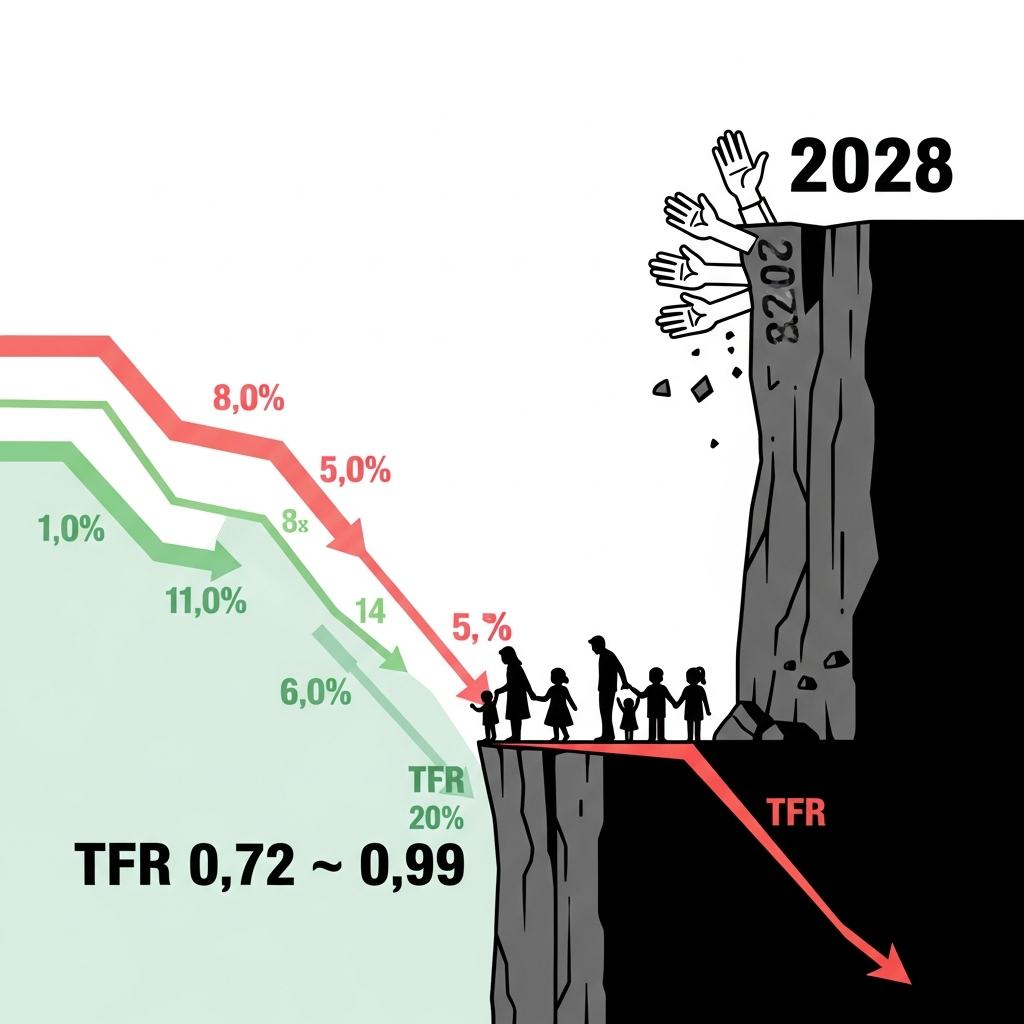
South Korea's total fertility rate climbed from a historic low of 0.72 to 0.99, sustaining 17 consecutive months of rising birth numbers that the government immediately framed as proof of its two-decade pro-natalist investment paying off. Demographic evidence, however, points to two temporary mechanisms rather than genuine behavioral change: a COVID-19 catch-up effect compressing years of deferred marriages and births into a narrow window, and a cohort size effect driven by the relatively large early-1990s birth generation currently at peak childbearing age. Korea's approximately 380 trillion won — roughly $270 billion — spent over 20 years on pro-natalist policy has failed to dismantle the structural barriers that make parenthood economically irrational for millions of young Koreans, including crushing housing costs, a private tutoring arms race, and persistent gender inequality in caregiving responsibilities. After 2028, when the significantly smaller post-1996 generation becomes the dominant childbearing cohort, total births will decline again as a mathematical certainty, independent of any policy input or individual reproductive intent. Misreading this statistical rebound as a breakthrough may cost Korea the narrow reform window it still holds, and the lessons from this demographic illusion are urgently relevant for every advanced economy already tracking below-replacement fertility.
Key Points
The 17-Month Rebound's Hidden Driver — The COVID Catch-Up Effect and Its Structural Limits
The 17-month consecutive increase in Korean births is primarily driven by a demographic mechanism called the catch-up effect, not by any genuine increase in the long-term desire for children or evidence that policy has shifted structural conditions. Between 2020 and 2022, the COVID-19 pandemic effectively froze Korean social life, causing enormous numbers of planned marriages and births to be postponed rather than permanently abandoned. That backlog is now arriving in compressed form across 2024 through 2026, producing a spike in absolute birth numbers that is real but fundamentally temporary in nature. The Conversation's demographic analysis makes this precise: the catch-up effect is by definition self-limiting, because once the delayed births have occurred, there is no additional reservoir of deferred reproductive decisions left to draw from. Japan experienced a structurally identical pattern during the mid-2000s — a brief rebound following a period of social disruption, celebrated at the time as a demographic turning point — before resuming its underlying downward trajectory and eventually dropping to levels even lower than those preceding the rebound. The crucial insight is that the catch-up effect doesn't expand the total pool of eventual parents; it simply shifts the timing of births that would have occurred anyway, concentrating them in a narrow window and leaving a relative void afterward. When that void arrives, likely beginning in 2027, the underlying trend reasserts itself with full force, and any policy momentum built on misinterpreting the catch-up as structural progress will have been dangerously squandered.
Why $270 Billion in Pro-Natalist Spending Failed to Address the Actual Problem
Korea's pro-natalist investment of approximately 380 trillion won — nearly $270 billion spent over 20 years starting in 2006 — represents one of the most sustained demographic interventions in modern history, and its failure to reverse the fertility decline carries important lessons for every government designing population policy today. The investment was not wasted through incompetence or poor intentions; it was structurally incapable of success because it targeted the symptoms of low fertility rather than its root causes. Cash payments, housing bonuses for newlyweds, and expanded childcare subsidies can shift the timing of births among people already inclined to have children, but as Think Global Health's analysis confirms, they cannot increase the total number of children a person decides to have over their lifetime. The actual barriers preventing childbearing in Korea are structural and self-reinforcing: raising a single child costs an estimated 350 million won, or roughly $275,000; buying an apartment in Seoul requires 15 to 20 years of combined household savings at current prices; private tutoring expenditures are the highest in the OECD, consuming 1 million won or more per month per child; and women who take parental leave face career setbacks that are among the most severe in the developed world. By contrast, countries that have maintained relatively healthy fertility rates — France near 1.8, Sweden near 1.6, Norway around 1.5 — share a common structural foundation: universal childcare that removes the cost burden from individual families, legally mandated and socially normalized paternity leave that distributes caregiving equitably, and housing markets that don't require nearly a generation of savings to access. Korea's failure was not a failure of financial generosity; it was a failure to replicate the structural conditions that actually make parenthood feel viable.
The Cohort Size Illusion — Why Korea's 1990s Generation Is Driving the Numbers, Not Policy
Alongside the catch-up effect, the second major driver of Korea's current birth increase is a purely arithmetic phenomenon that has nothing to do with policy success or behavioral change: the cohort size effect. Koreans born between approximately 1990 and 1995 represent a relatively large birth generation compared to the cohorts that followed them through Korea's already-declining fertility years. Today, those people are in their early to mid-30s — statistically the peak years of childbearing — and when a larger-than-average cohort occupies that age window simultaneously, total births increase even if individual fertility rates are flat or still declining. This mechanism generates a powerful statistical illusion: more babies are born, headlines celebrate, and politicians claim credit for policies that happen to be running alongside a demographic wave they had nothing to do with producing. The illusion will dissolve starting around 2028, when this large cohort ages out of peak fertility and is replaced by the post-1996 generation, which is approximately 15 to 20 percent smaller in absolute size due to Korea's own prior decades of low fertility. Statistics Korea's projections indicate this cohort transition effect alone could reduce annual births by 10 to 15 percent by 2030, independent of any change in per-person fertility rates. This is precisely what demographers mean when they describe the current rebound as a demographic illusion — the numbers are accurate, but they don't mean what they appear to mean without understanding the structural age distribution producing them.
Three Structural Walls That $270 Billion Couldn't Tear Down: Housing, Education, and Gender
The structural barriers preventing fertility recovery in Korea converge into three mutually reinforcing walls, and addressing any one of them in isolation has proven insufficient — the barriers interact in ways that make partial solutions feel meaningless to the people actually navigating them. The first wall is housing: Seoul apartment prices have exceeded 1 billion won for years, requiring 15 to 20 years of combined household income to purchase at median prices, and the private rental market has become nearly as inaccessible for young families seeking space. Young couples in Korea routinely delay marriage for years while building savings toward housing, and the prospect of affording a family-sized home in any major urban area within a reasonable timeframe isn't a realistic calculation for most working households. The second wall, as Bruin Political Review's research documents extensively, is private education spending, rooted in Korea's intensely competitive credential culture: a single child's tutoring costs can reach 1 million won or more per month, and social pressure makes these expenditures feel less like optional extras and more like mandatory survival costs in a hypercompetitive environment. The third wall is gender inequality in caregiving: Korean women who take time off for childcare face career penalties among the steepest in the developed world, and despite policy changes on paper, the social expectation that mothers bear the primary burden of caregiving remains largely intact in most workplaces and households. These three barriers are structurally linked in ways that make them exceptionally resistant to single-point interventions, which is precisely why 20 years and $270 billion couldn't move them.
Korea as the World's Demographic Canary — What Every Low-Fertility Country Must Internalize
Korea's fertility crisis is not a uniquely Korean pathology — it is the leading expression of a structural phenomenon that every advanced industrial society will eventually confront, and Korea's position at the front of this global wave gives its experience an importance far beyond its own population policy debates. Japan's TFR has already fallen to approximately 1.2 and continues declining despite decades of pro-natalist effort. China entered absolute population contraction in 2023, with its TFR near 1.0. Italy and Spain hover around 1.2 to 1.3, with no structural reversal in sight. Germany's comparatively higher 1.4 is substantially supported by immigration rather than domestic reproductive patterns. In each case, the underlying drivers — extreme urban housing costs, credential-driven education competition, and gender inequality in caregiving — are recognizable variants of the conditions producing Korea's extreme outcome. The World Bank and UN have explicitly identified Korea as the proverbial canary in the demographic coal mine, meaning the country is registering distress signals that other high-income societies will encounter on a slightly delayed timeline. The most dangerous possible response to Korea's 0.99 rebound would be for policymakers in Japan, Italy, China, or Germany to treat it as a success story worth emulating, and to replicate the cash-payment approach that comprehensively failed to address Korea's structural barriers. The lesson Korea's experience offers is not a model to copy; it is a cautionary roadmap of what to avoid.
Positive & Negative Analysis
Positive Aspects
- The Rebound Confirms That Reproductive Intent Hasn't Been Fully Extinguished
Perhaps the most genuinely reassuring signal embedded in the current rebound is what it tells us about the state of family formation aspirations among Korean adults. When the TFR hit 0.72 in 2023, some demographers openly questioned whether Korean society had reached a point of near-complete reproductive disengagement — a condition from which recovery would be effectively impossible within any foreseeable policy horizon. The 17-month rebound, even if driven primarily by temporary demographic mechanics, provides meaningful evidence against that most pessimistic interpretation. The fact that millions of couples who deferred marriage and childbearing during the pandemic eventually followed through on those intentions indicates that the underlying desire to form families has not been permanently replaced by an unconditional preference for childlessness. This distinction matters enormously for policy design, because a population that has delayed reproduction is considerably more responsive to structural improvements than one that has genuinely abandoned it as a life goal. Some recent Korean policies appear to have genuinely served as effective nudges: the 1 million won monthly parental benefit introduced in 2024, improved childcare service coverage, and enhanced parental leave compensation have likely helped hesitant couples act on intentions they already held but hadn't yet acted upon. While cash transfers cannot create reproductive intent where none exists, they can meaningfully reduce friction for those already inclined toward parenthood, and the rebound suggests that a meaningful portion of Korean couples were in exactly that position.
- Pro-Natalist Policy Has Demonstrated Real Nudge Value, Even If Not Structural Impact
A nuanced assessment of Korea's 380-trillion-won pro-natalist investment cannot stop at "it failed" — the more accurate conclusion is that it succeeded at the wrong level, and that distinction matters for designing what comes next. Cash transfers and targeted subsidies are demonstrably effective at nudging the timing of births: couples on the margin of a decision to have a child can be moved toward action by well-designed financial incentives, particularly when those incentives arrive alongside positive social signals. The 2024 parental benefit program and enhanced childcare subsidies appear to have contributed to pulling forward some births that would have occurred anyway, which is a real if temporary contribution to the current trend. Evidence from Sweden, France, and Norway also suggests that cash support, when combined with structural reform rather than used as a substitute for it, contributes meaningfully to fertility outcomes at the margin. Korea's mistake has been using the nudge as a permanent strategy rather than as a supplement to deeper structural change. Recognizing the genuine, limited effectiveness of cash policy is important because it avoids the opposite error of dismissing all government intervention as useless — the evidence points to a clear division of labor where structural reforms do the heavy lifting and targeted financial incentives add incremental support. The lesson isn't that cash doesn't work at all; it's that cash alone can never work enough to compensate for the structural conditions that make parenthood feel economically irrational.
- Korea Has Become an Involuntary Global Laboratory for What Does and Does Not Work in Population Policy
One genuinely constructive consequence of Korea's extreme demographic position is that it has made the country an unusually detailed and well-documented case study for population policy researchers and policymakers worldwide. The volume of rigorous international analysis now focused on Korea — from The Jakarta Post to CNN to academic researchers at OECD- and UN-affiliated institutions — has increased dramatically as the numbers have become more extreme and therefore more analytically informative. The core lesson being extracted from this sustained international analysis — that structural conditions consistently outperform cash transfers in determining long-term fertility trajectories — is now more widely understood and accepted across the global policy community than it was a decade ago. Comparative research contrasting Korea's failures with France's and Sweden's relative successes has produced increasingly clear evidence that housing affordability, paternity leave uptake rates, and childcare access are the dominant variables in fertility outcomes across high-income societies. Korea is paying an enormous price for generating this knowledge: the country's demographic situation is genuinely dire, and the human cost of the low-fertility years is real and ongoing. But if the lessons Korea is producing through its own experience help other countries avoid replicating the same costly mistakes, the contribution to global policy understanding has real and lasting value that extends far beyond Korea's own borders.
- The Crisis Is Shifting Public Framing From Individual Blame to Structural Accountability
A cultural shift in how Korean society understands the causes of low fertility represents one of the most significant, if frequently underreported, developments in the current period. The older dominant framing — "young people today are too individualistic and hedonistic to have families" — positioned the problem as a moral or attitudinal failure of individuals that could theoretically be corrected through persuasion, cultural pressure, or modest financial incentives. That framing not only failed to produce results, it actively prevented serious structural analysis by directing blame toward individuals rather than toward the environment those individuals are navigating. The emerging framing — "in this economic environment, how could rational people be expected to choose parenthood?" — correctly identifies the barriers as systemic rather than personal. This reorientation matters enormously for policy because it changes the implied solution: if the problem is individual attitudes, the solution is persuasion; if the problem is structural conditions, the solution is reform. Korean public discourse, particularly among younger generations who experience these barriers directly, has shifted decisively toward the structural analysis, and survey data shows strong consensus among Korean millennials and Gen Z that they would genuinely consider having children if housing were affordable, private tutoring pressure were reduced, and caregiving were more equitably distributed between partners. That consensus is a political resource that reform-minded policymakers could mobilize.
- The Pressure Is Generating Early, Necessary Conversations About Demographic Adaptation Strategies
One consequence of Korea facing the global demographic frontier is that Korean policymakers, researchers, and civil society organizations are beginning conversations about population decline adaptation strategies earlier than any other country — which, despite the painful circumstances that produced the urgency, may ultimately prove advantageous. The question of how to maintain economic vitality, social services, and geopolitical standing with a significantly smaller and older population is not one Korea can defer — it will be a practical necessity within a generation. Discussions already underway in Korea about expanded robotics and AI deployment to offset labor shortages, shrinking-cities planning frameworks for regions losing population fastest, productivity-led growth models that reduce dependence on labor force size, and fundamental redesign of pension and healthcare systems are all conversations that Japan, Germany, and China will need to have within the next 10 to 20 years. Korea is developing the institutional knowledge, policy vocabulary, and practical experience with these challenges in a window that will allow it to export expertise when other advanced economies reach the same inflection point. The crisis is forcing early preparation, and early preparation — even when the preparation itself is painful — consistently produces better adaptation outcomes than arriving at the same challenges unprepared and scrambling to catch up.
Concerns
- The Catch-Up Effect Will Exhaust Itself, and the Subsequent Drop Could Be Deeper Than the Original
The core structural risk embedded in the current rebound is that a catch-up effect is, by definition, finite. It is the release of pent-up reproductive demand built up during a period of disruption — in Korea's case, the COVID-19 pandemic years of 2020 to 2022. Once the deferred births that accumulated during those years have occurred, the reservoir empties, and the underlying long-term trend reasserts itself without the artificial boost. European demographic data from post-pandemic recoveries shows a consistent pattern: the catch-up spike is followed by a decline that often reaches levels below those preceding the disruption, because the catch-up effectively borrows from future birth cohorts and leaves a demographic gap in subsequent years. Korea's situation is particularly vulnerable to this dynamic because its underlying fertility trend — absent the catch-up effect and cohort size boost — is a deeply negative structural trajectory with few natural floors. When the catch-up exhaustion hits, likely beginning in 2027, Korea risks not merely returning to previous low levels but declining past them, potentially setting a new record below the 0.72 floor of 2023. The paradox of the current celebration is that it may create the political conditions for exactly this worst outcome: if the government treats the rebound as vindication rather than as a brief window, the catch-up exhaustion will arrive without any meaningful improvement in underlying structural conditions, making the subsequent decline steeper and any recovery harder to engineer.
- The Post-1996 Cohort Transition Is a Demographic Certainty That No Policy Can Override
Starting around 2028, Korea faces a structural demographic transition that operates independently of policy choices, economic conditions, or individual reproductive intentions: the post-1996 birth cohort — a generation born during Korea's already-low fertility years, and therefore smaller in absolute size than its predecessors — becomes the primary childbearing population. This generation is approximately 15 to 20 percent smaller than the 1990-to-1995 cohort that is currently driving the birth rebound, a difference that reflects the compounded effect of years of below-replacement fertility producing each successive smaller generation. That mathematical reduction in the parent pool translates directly into lower total births regardless of per-person fertility rates, and it represents a structural floor that no financial incentive or cultural campaign can lift. Statistics Korea's projections indicate this cohort transition effect alone could reduce annual births by 10 to 15 percent by 2030, independent of any change in individual fertility intentions. The consequences extend well beyond birth statistics: a smaller generation entering the workforce translates into reduced tax revenue, increased dependency ratios, strained pension systems, and diminished domestic market size, all compounding simultaneously and creating cascading fiscal pressures that affect the government's capacity to fund the very structural reforms that might help. This is the dimension of the demographic problem that is entirely beyond the reach of short-term policy intervention, and any government that fails to account for it while celebrating the current rebound is setting itself up for a preventable and deeply disruptive crisis.
- Policy Complacency Could Destroy the Last Viable Window for Structural Reform
The most consequential risk of misreading the current rebound as a policy success is the effect it will have on the political momentum required for genuine structural reform. Structural changes — credible housing cost stabilization, compulsory and socially normalized paternity leave with real career protection, meaningful public education investment that actually reduces private tutoring demand — are politically expensive and socially disruptive. They require sustained political will, which in democratic systems is generated by the perception of crisis and urgency. The 0.99 rebound, if treated as evidence that the current approach is working, will dilute exactly that sense of crisis at precisely the moment when Korea's reform window is narrowest. Korea's political history on this issue is instructive: the government has repeatedly used temporary improvements in birth statistics to justify reducing reform pressure, then returned to cash-injection strategies when the situation deteriorated again. This cycle has been running for 20 years without producing a structural change in the underlying conditions. The 2026-to-2027 period — the window before the cohort transition forces another decline — is plausibly the last meaningful opportunity to implement reforms that could have any material effect on the long-term trajectory before structural decline becomes dominant. Squandering that window by celebrating a rebound that demographers have clearly explained is temporary would not be a new mistake; it would be the same mistake, made one final time with the most severe consequences yet.
- The Fiscal Arithmetic of Rapid Aging Is Getting Worse Faster Than Fertility Numbers Are Improving
Korea crossed the threshold to a super-aged society — defined as more than 20 percent of the population aged 65 or older — in 2025, and the aging trajectory shows no moderation. The fiscal implications are severe and compounding: national pension obligations, health insurance expenditure, and long-term care costs are all growing at rates driven by demographics entirely disconnected from whatever the current fertility rate does in any given year. Even if the 0.99 rebound were sustained — which demographers expect it won't be — the children being born today will not enter the workforce for roughly 20 years, meaning they provide no near-term relief for the fiscal pressures being generated by the current aging wave. The government that has already spent 380 trillion won on pro-natalist programs faces intensifying pressure to allocate additional resources to elderly care, pension support, and healthcare, creating a direct competition for budget between programs aimed at potential future citizens and programs serving the existing aging population. This fiscal squeeze limits the government's capacity to invest in the structural reforms — subsidized housing, expanded public childcare, universal paternity leave — that might actually move the long-term fertility needle. The result is a structural trap in which the resources needed to fix the fertility problem are being consumed by the consequences of the same problem, and that feedback loop becomes harder to break with each passing year.
- The "Learned Helplessness" Narrative Could Become a Self-Fulfilling Demographic Prophecy
If the current rebound is followed — as demographic analysis suggests it will be — by a renewed decline to new record lows, the political and cultural consequences could prove as damaging as the demographic consequences themselves. A society that has spent 380 trillion won on the problem, experienced a celebrated rebound, and then watched the numbers fall again has a very strong incentive to conclude that low fertility is simply unsolvable — to adopt learned helplessness and redirect energy toward managing decline rather than attempting reversal. This narrative shift is not inherently wrong: realistic adaptation planning for population decline is genuinely necessary and long overdue. But there is a critical difference between preparing thoughtfully for inevitable demographic change and prematurely abandoning structural interventions that could still make a meaningful difference if actually implemented. If learned helplessness takes hold before genuine structural reforms have even been seriously attempted, Korea would be surrendering not to the actual limits of what's possible but to the limits of what its cash-payment strategy — which was never equal to the task — could achieve. The failure of an inadequate policy approach would be misattributed to the impossibility of the goal, producing not just policy failure but a permanent loss of the political will to try the more ambitious and structurally sound interventions that remain available. For other low-fertility countries watching Korea's trajectory carefully, this possibility may be the most cautionary lesson of all.
Outlook
Let me walk through where this goes from here. I'll break the trajectory into short-, medium-, and long-term frames, and for each I'll lay out what I see as the bull, base, and bear scenarios. Demographic forecasting is more reliable than most social science prediction, because the people who will be 30 years old in 2030 are already alive. You can count them. That makes population projections unusually concrete compared to economic or political forecasts, which depend on variables that don't yet exist. When demographers say something will happen, they're not guessing — they're doing arithmetic on people who are already born.
In the short term — roughly the second half of 2026 through the first half of 2027 — the current rebound will likely continue, though with diminishing momentum. The COVID catch-up effect hasn't fully exhausted itself, and the 1990-to-1994 birth cohort remains at or near peak fertility age. Under the base scenario, the annual TFR holds between 0.85 and 0.95 for 2026. Certain monthly readings may touch 1.0, which the government will announce with great fanfare. Under the bull scenario, strong additional policy packages — particularly around housing — could push the 2026 annual TFR toward 0.95 to 1.0, with psychological momentum compounding the demographic mechanics briefly. Under the bear scenario, catch-up fatigue begins showing as early as the second half of 2026, the annual TFR stagnates around 0.80, and the "rebound is over" narrative starts forming in the media. Any significant economic shock or additional rise in housing prices would accelerate the bear outcome considerably.
One thing short-term national numbers consistently obscure is the dramatic regional variation within Korea. Seoul's TFR remains far below the national average — likely somewhere in the range of 0.55 to 0.70 — while regional cities and rural areas are pulling the national figure upward. The reasons behind that divergence matter enormously for policy design: the calculus driving non-childbearing in Seoul is fundamentally different from the calculus in, say, Jeonbuk province. Designing pro-natalist policy based on the national average without accounting for these structural differences is a recipe for continued inefficiency. Seoul's housing market is the dominant variable in Seoul's fertility rate, and no amount of cash payments changes that equation. A national TFR of 0.99 that includes a Seoul figure of 0.60 is not a success story — it's a tale of two very different demographic realities wearing the same headline.
The medium term — 2027 into 2028 — is where the real reckoning arrives. This is when the catch-up effect runs dry and the cohort transition begins in earnest. The post-1996 generation starts becoming the dominant childbearing cohort, and they are roughly 15 to 20 percent smaller in absolute size than their predecessors. Under the base scenario, the annual TFR falls back to 0.75 to 0.85 by 2028, producing what demographers might call a double-dip: a brief rebound followed by resumed decline. Under the bull scenario, Korea uses the window of the current rebound to legislate genuine structural reforms — credible housing cost stabilization, compulsory paternity leave with career protection, meaningful public education investment that reduces private tutoring dependency — and manages to defend a TFR of 0.85 to 0.90 through 2028. I put the probability of this bull outcome at roughly 20 percent, given Korea's political track record on structural reform. Even optimists acknowledge that Korea has repeatedly failed to convert demographic alarm into structural legislative action.
The medium-term bear scenario is considerably darker. If the government treats the 0.99 rebound as confirmation that current policy is working and delays structural reform accordingly, the combination of catch-up exhaustion and cohort shrinkage could push the TFR below 0.70 — lower than the 2023 record low. The narrative risk in this scenario is severe: "We spent 380 trillion won, we had a rebound, and it still crashed" becomes a powerful argument for the position that low fertility is simply intractable. If that learned helplessness narrative takes hold at the political level, it triggers premature abandonment of pro-natalist policy at precisely the moment when structural reform would have a genuine chance of working. This is the scenario I find most dangerous — not because it is the most likely outcome, but because it forecloses other options in a way that is very difficult to reverse once it sets in politically and culturally.
Looking further out, from 2029 through 2031, Korea crosses into territory where population decline transitions from a future threat into an immediate daily reality. Korea's total population has technically been declining since 2020, but the pace has been slow enough that the effects remained largely abstract. After 2029, the annual population decline accelerates sharply. Statistics Korea's medium projection has the total population around 51 million in 2030 and falling by 150,000 to 200,000 people per year after that, reaching approximately 48 million by 2040 and 43 million by 2050. That is a 15 percent reduction in one generation, which carries profound implications for the labor force, the tax base, military capacity, and domestic market size. These are no longer hypothetical downstream effects — they are scheduled consequences of decisions already made or not made.
The long-term bull scenario requires Korea to substantially open immigration policy while simultaneously executing structural domestic reform, stabilizing the TFR somewhere between 0.9 and 1.1. Even in that scenario, total population decline is unavoidable — the math of past low fertility is already baked in — but the pace becomes manageable and the social system has time to adapt. Japan's recent, dramatic liberalization of immigration policy represents one possible template, though Korea's historically lower social tolerance for large-scale immigration would make direct replication difficult. I estimate the probability of this outcome at roughly 25 percent. The long-term bear scenario — TFR drops to 0.5 to 0.6, immigration remains limited, and the population falls below 40 million by 2050 — is genuinely extreme, but not mathematically impossible given current trend lines. In that case, the economic, geopolitical, and social consequences for Korea become civilizational in scale, and "Korean extinction" shifts from an extreme fringe prediction to a serious long-range projection.
History offers almost no direct precedent for what Korea is experiencing. Every significant population decline prior to this one was caused by external shocks: war, famine, epidemic disease. The Roman Empire's demographic decline, the post-Black Death population collapse in medieval Europe — those comparisons are occasionally invoked, but they don't actually parallel Korea's situation because the causes were external. What Korea is navigating is fundamentally different: a wealthy, technologically advanced, peaceful society voluntarily reproducing below replacement level for an extended and accelerating period. That makes Korea's situation simultaneously more preventable in theory and more difficult to address in practice, because the solution requires changing economic and social structures rather than simply surviving an external shock.
My most realistic base case runs as follows. The current rebound holds weakly through 2026 and 2027, with an annual TFR in the 0.85 to 0.95 range. Beginning in 2028, the cohort transition forces a renewed decline, returning the TFR to approximately 0.70 to 0.80 by 2030. At that point, the political consensus finally shifts toward a combination of immigration expansion and genuine structural domestic reform — both processes that will require years of debate and implementation before producing measurable demographic effects. In the interim, Korea will simultaneously begin developing adaptation strategies at scale: expanded robotics and AI deployment to compensate for labor force shrinkage, productivity-led economic models designed to maintain growth with a smaller working-age population, and shrinking-cities planning frameworks for regions that will lose population fastest. The core message of this base case is that Korea is likely to fail at reversing its fertility rate, but has a genuine opportunity to become the world's most innovative and instructive model for adapting to demographic contraction — and that second achievement may ultimately prove more globally valuable than the first would have been.
One honest counter-scenario deserves acknowledgment. The conditions under which my forecast proves wrong would involve a faster-than-anticipated values shift among Korea's youngest adults. If the cohort currently in their teens and early 20s develops substantially different attitudes toward family formation — if technology dramatically reduces childcare costs, if remote work permanently changes the economics of suburban and rural living, if housing innovation makes urban family life genuinely accessible — then the TFR could stabilize near or above 1.0 in ways current data doesn't support. I don't dismiss that possibility entirely. But policy cannot responsibly be built around miracle scenarios. The structural reforms described throughout this analysis are necessary under almost any forecast, and they become more expensive and harder to implement with every year of delay.
For those living in Korea: the macro numbers matter less than your own circumstances. Whether to have children is entirely your own decision, not a civic obligation. But for policymakers, corporate leaders, and educators — stop celebrating the 0.99. Instead, treat the next 12 to 24 months as the last meaningful window before the cohort math takes over. Retirement age extension, immigration policy design, AI and automation deployment, regional urban planning — all of this needs to start now, not after the next decline proves everyone right again. The cost of getting this window wrong is not measured in basis points of TFR. It is measured in decades of harder choices with fewer options.
Sources / References
- South Korea Welcomes Rare Baby Bump as Population Shrinks — The Jakarta Post
- South Korea Population Fertility Rate — CNN
- Korea's Monthly Fertility Rate Hits 0.99, Nearing 1.0 Threshold — Seoul Economic Daily
- South Korea's Birth Rate Is Rising but the Population Is Still Shrinking — The Conversation
- South Korea's Plan to Avoid Population Collapse — Think Global Health
- South Korea Fertility Rate — UPI
- The Price of Success: How South Korea's Obsession With Academic Success Is Fueling Its Birth Rate Crisis — Bruin Political Review