
Who's Buying a $900 Gaming Console? — Sony Is Turning Gaming Into a Rich Kid's Hobby
Summary
Sony's second consecutive price hike across the entire PS5 lineup in April 2026 has pushed the PS5 Pro to $899 and the disc edition to $649, shattering the longstanding console tradition of post-launch price reductions. The primary driver is an explosive surge in DRAM prices — up 171% year-over-year — fueled by insatiable memory demand from AI data centers, yet the structural shift runs deeper than component costs alone. A growing backlash against the 'luxurification of gaming' is spreading among consumers worldwide, as the digital divide increasingly determines who gets to participate in gaming culture based on household income.
Key Points
Two Hikes in One Year: An Unprecedented Price Reversal
Sony raised prices across all PS5 models by $50 in August 2025, then followed with another increase effective April 2, 2026 — $100 more for the disc and digital editions, and a staggering $150 for the PS5 Pro. The PS5 disc edition, which launched at $499 in November 2020, now costs $649 just five years later, while the PS5 Pro carries an $899 price tag approaching the psychological $1,000 barrier. This marks the first time in PlayStation history that a console has become more expensive after launch, breaking the industry's unwritten rule that hardware prices drop within 2-3 years of release. When the PS3 launched at $599 and was widely criticized as overpriced, few imagined the base PS5 would eventually surpass that infamous figure. Cumulatively, prices have risen 30% in just one year compared to mid-2025, with the disc edition up 30% and the digital edition up 50% from their original launch prices — numbers without precedent in console history.
How AI Is Raiding Gamers' Wallets
The fundamental cause of this price escalation is the AI data center construction boom and its devastating impact on memory semiconductor supply. Big Tech's AI data center investment is projected to reach $650 billion in 2026, and Samsung Electronics and SK Hynix have committed to supplying approximately 900,000 wafers per month — roughly 40% of global DRAM production — to OpenAI's Stargate project alone. As a result, conventional DRAM contract prices surged 90-95% quarter-over-quarter in Q1 2026, with average selling prices projected to climb 171% year-over-year. The cost of GDDR6 memory in each PS5 has skyrocketed, directly pressuring Sony's production costs. The irony is stark: the AI industry's growth is effectively extracting costs from gamers' pockets.
The Double Squeeze: Tariffs and Inflation
Memory prices are not the sole culprit. Changes in U.S. tariff policy have increased import costs for electronic components manufactured in Asia, while global inflation continues to drive up logistics and labor expenses. Sony's official statement referenced 'sustained pressures in the global economic environment,' signaling that multiple cost factors are at play simultaneously. Samsung Electronics has warned that 2026 memory supply shortages will make price increases across consoles and PC gaming hardware unavoidable. Nintendo Switch 2, despite launching at $449, already faces rumors of impending price hikes — confirming this is not a Sony-specific issue but a structural transformation affecting the entire console industry. The triple threat of tariffs, inflation, and the memory crisis is hitting the gaming sector all at once.
Consumer Backlash and Fracturing Platform Loyalty
The announcement triggered an immediate firestorm across global gaming communities, with the prevailing sentiment being 'how can old hardware keep getting more expensive?' Panic buying also emerged, with social media flooded by posts from consumers rushing to purchase PS5 Pros before the hike took effect. However, the long-term implications for PlayStation ecosystem loyalty are concerning. According to Circana, 38% of consumers said they would reduce full-price game purchases at launch if prices increased, while 34% indicated they would wait for discounts. Sony's ability to push through such pricing relies on its dominant position — over 92 million PS5 units shipped and a 72.4% current-generation market share — but this dominance is not guaranteed to last, and the company appears to be taking it for granted.
The Luxurification of Gaming and the Digital Divide
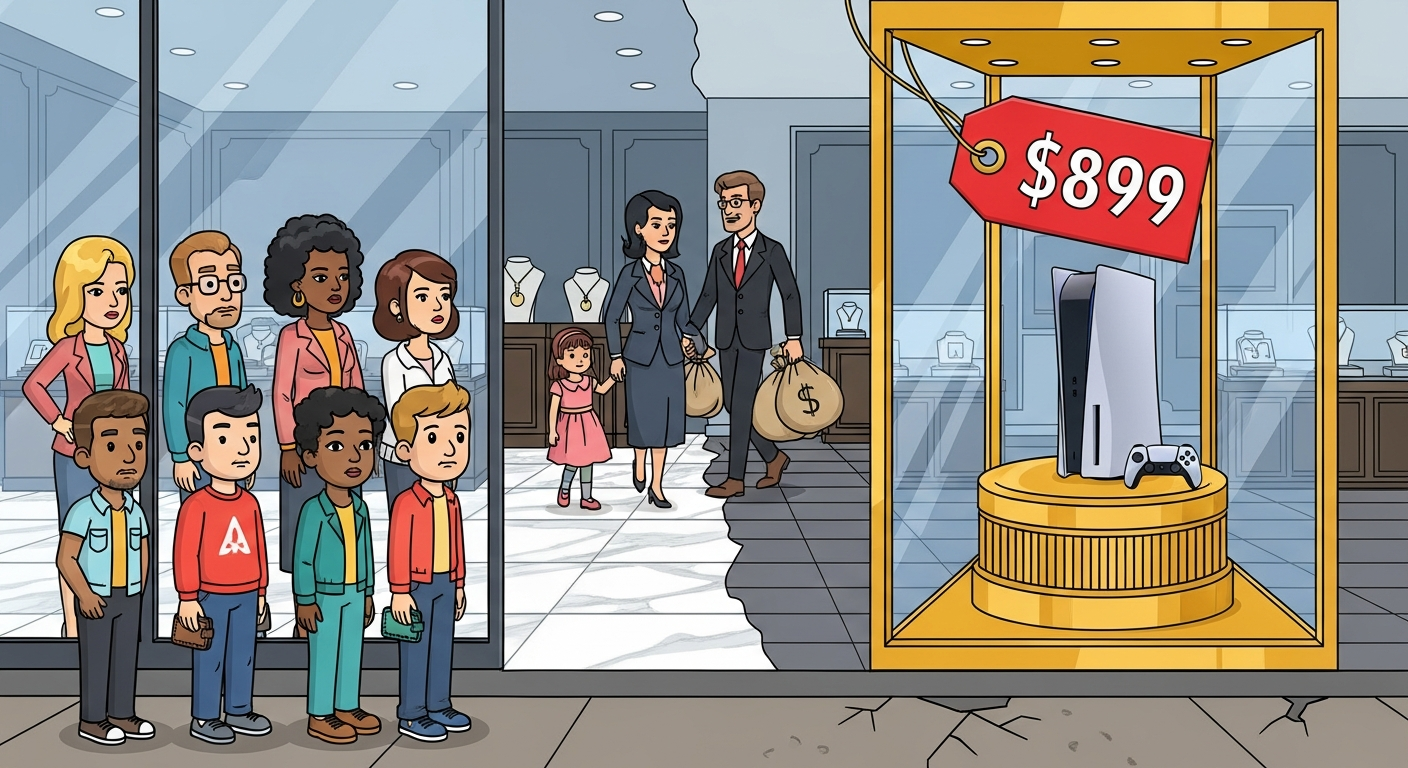
In a world where the PS5 Digital Edition costs $599, the disc edition $649, and the Pro $899, gaming can no longer claim to be 'entertainment for everyone.' Factor in $70 AAA titles, $60 annual PS Plus subscriptions, additional controllers, and accessories, and the startup cost of gaming easily exceeds $1,000. Italy's Il Sole 24 Ore ran a headline asking 'Will video gaming become a luxury?' — a question now resonating globally. Circana data reveals that in Q4 2025, 53% of gaming hardware purchasing households had annual incomes above $100,000, up sharply from 40% in Q1 2022. Households earning under $50,000 accounted for just 19% of buyers, demonstrating that gaming culture is already splitting along income lines in a structural polarization.
Sony's Calculus and an Industry in Transformation
From Sony's perspective, this price increase may have been unavoidable. Console manufacturers have traditionally operated on a 'razor-and-blades' model — selling hardware at or below cost and recouping profits through software and services. But when memory prices nearly quadruple in three months, maintaining this model would create unsustainable hardware losses. The PS5 was sold at a loss per unit from launch, only achieving profitability through falling component costs and manufacturing efficiencies. Now, with component costs at historic highs, Sony has limited options beyond passing costs to consumers. The risk is that this decision shrinks the overall console market pie — and the consequences will ultimately circle back to Sony itself.
Positive & Negative Analysis
Positive Aspects
- Corporate Survival Imperative
With DRAM prices surging 171%, Sony faces unprecedented cost pressure that could turn its hardware division into a money pit without price adjustments. This is a painful but arguably necessary decision for the sustainability of the console business.
- Proof of Market Dominance
The fact that Sony can push through such aggressive pricing reflects the strength of the PlayStation ecosystem's lock-in effect, backed by a 72.4% market share and over 92 million installed units. Paradoxically, the ability to raise prices this aggressively proves how powerful the brand's grip on consumers remains.
- Premium Strategy Precedent
Just as Apple has continuously raised iPhone prices while maintaining market position, Sony may be attempting to reposition the gaming console as a premium product. This could represent a strategic pivot toward focusing on high-value customer segments.
- Industry-Wide Wake-Up Call
Sony's price hikes have brought the AI data center and memory supply issues into the spotlight, sparking industry-wide discussions about how vulnerable gaming is to semiconductor supply chains. This could accelerate supply chain diversification and investment in alternative technologies long-term.
Concerns
- Blocking New Entrants, Shrinking the Market
A near-$900 console creates an effective barrier to entry for first-time gamers, particularly young people and lower-income households. This structurally reduces the total addressable market (TAM) for consoles and could ultimately erode Sony's own software and service revenue base.
- Income-Based Polarization of Gaming Culture
With 53% of hardware purchasers now from households earning over $100,000 and only 19% from under $50,000, gaming is already splitting along income lines. As gaming transitions from universal culture to class-stratified luxury, its value as a medium for social connection and shared experience diminishes.
- Accelerating Migration to Competing Platforms
With alternatives like Xbox Game Pass, Nintendo Switch 2, Steam Deck, and cloud gaming offering lower entry points, extreme price hikes risk pushing even loyal customers toward competitors. Circana's finding that 38% would cut spending and 34% would wait for sales are warning signs Sony should not ignore.
- Ignoring Historical Lessons
The PS3's $599 launch price led to sluggish early sales and significant market share losses — a lesson that seems forgotten as the PS5 disc edition now exceeds that infamous price point, carrying the same risks of consumer rejection.
- Permanent Death of the Price-Drop Expectation
For over 30 years, consumers could count on console prices falling after launch. The destruction of this expectation fundamentally damages consumer trust and will create price uncertainty that delays purchasing decisions for future console generations.
Outlook
The prospect of PS5 prices declining in the second half of 2026 is extremely low. The structural supply-demand imbalance in the memory semiconductor market will persist as long as the AI investment cycle continues, and neither tariffs nor inflation show signs of easing in the near term. If anything, additional price increases in late 2026 cannot be ruled out.
The fact that Nintendo Switch 2 is already facing price hike rumors despite its $449 launch price confirms this is an industry-wide structural shift, not a Sony-specific problem. Microsoft is also reportedly reviewing Xbox lineup pricing adjustments, making 2026 the year that the console pricing paradigm is fundamentally rewritten.
Consumer behavior shifts are already underway. As Circana data shows, the concentration of purchases among high-income households is intensifying, while middle- and lower-income gamers will increasingly migrate to used markets, cloud gaming, and mobile platforms. This signals a fundamental change in console gaming's identity as mass entertainment.
Long-term, this pricing policy could boomerang on Sony's own ecosystem. If installed base growth stalls, third-party developers will have less incentive to invest in PS5-exclusive titles, and if PS Plus subscriber growth slows, Sony's service revenue engine will sputter. That 72.4% market share is impressive, but it risks becoming 'a large slice of a shrinking pie.'
The most concerning scenario is the permanent entrenchment of gaming's digital divide. If gaming accessibility becomes determined by income level, the implications extend beyond market dynamics into cultural and social territory. The past 40 years of gaming's trajectory as a universal cultural medium that transcends generations could be reaching an inflection point.
Sources / References
- New Price Changes for PS5, PS5 Pro, and PlayStation Portal remote player — PlayStation Blog
- Sony Announces Gigantic PS5 Price Increases, Effective from April 2026 — Push Square
- Sony hikes PS5 prices by up to $150 citing pressures in global economy — CNBC
- DRAM prices skyrocket 171% year-over-year outpacing gold — Tom's Hardware
- AI Boom Fuels DRAM Shortage and Price Surge — IEEE Spectrum
- How Much Is Big Tech Spending on AI Computing? A Staggering $650 Billion in 2026 — Bloomberg
- The PS5 Price Hike Was Inevitable, But What Comes Next? — GameSpot
- Playstation price increase: Will video gaming become a luxury? — Il Sole 24 ORE
- One Chart Shows Buying an Old PlayStation Has Never Been This Expensive Before — Kotaku
- Game Console Launch Prices, Adjusted for Inflation (1975-2024) — Visual Capitalist