
USAID Closed Its Doors a Year Ago, and 600,000 People Have Died — The Price of Severing the Lifeline Kennedy Built
Summary
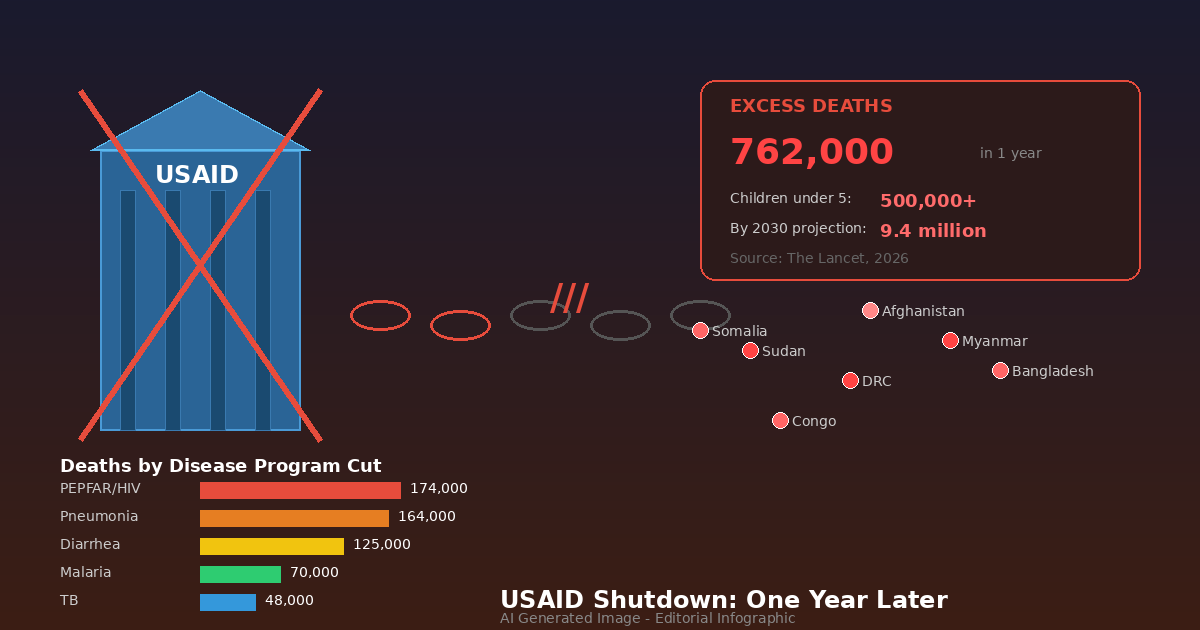
One year after the dissolution of USAID, the world's largest aid agency, 762,000 excess deaths have occurred — over 500,000 of them children under five. A Lancet study warns that 9.4 million could die by 2030. The collapse of the global humanitarian aid system is fueling epidemic risks, food crises, and a geopolitical power vacuum.
Key Points
USAID Dissolution and 762,000 Excess Deaths
On January 20, 2025 — the first day of Trump's second term — all US foreign aid was frozen, and USAID was subsequently dissolved. Eighty-three percent of its programs were cancelled. According to Boston University epidemiologist Brooke Nichols' tracking model, 262,000 adults and 518,000 children died in one year as a direct result. Harvard's Atul Gawande confirmed over 600,000 deaths, two-thirds of them children. PEPFAR cuts alone caused 158,000 adult and 16,000 child deaths. In the DRC, cholera deaths surged 361 percent from 409 to 1,888.
Lancet Study Projects 9.4 to 22.6 Million Deaths by 2030
The ISGlobal study published in The Lancet in February 2026 analyzed 133 countries and projected 9.4 million additional deaths by 2030 under a mild defunding scenario, including 2.5 million children under five. A more aggressive scenario raises the toll to 22.6 million with 5.4 million young children. Historical data showing USAID programs prevented 91 million deaths between 2001 and 2021 underpins these projections. A separate UCLA study estimated over 14 million preventable deaths from USAID defunding alone.
Global Aid Vacuum and Cascade Effect
The optimistic assumption that other nations would fill the USAID void has not materialized. Belgium, Canada, France, Germany, the Netherlands, New Zealand, Sweden, and the UK have all cut or announced cuts to 2026 aid budgets. US contributions to UN humanitarian assistance dropped from up to $17 billion annually to $2 billion. The UN Secretariat's 2026 core budget was cut by 15 percent with 19 percent staff reductions. Harvard's Fatema Sumar warned that donor nations worldwide are retrenching their aid commitments.
Epidemic Surveillance Collapse
USAID was a core funder of global epidemic surveillance systems. Early detection capabilities for Ebola, avian influenza, and coronavirus variants are weakening, while drug-resistant tuberculosis and malaria are already spreading. In Sudan, over 70 percent of community Emergency Response Rooms closed, severing food for 2.8 million people. In Myanmar, over 20 million people face disrupted humanitarian support. In Bangladesh, one million Rohingya refugees face acute malnutrition and disease.
Geopolitical Vacuum and Power Realignment
In Africa, the Middle East, and Southeast Asia where US aid has withdrawn, China's Belt and Road Initiative and Russia's security assistance are filling the gap. Aid is not mere charity but a diplomatic instrument, disease surveillance network, and conflict prevention mechanism. The US may have saved tens of billions annually, but has dismantled its own infrastructure of global influence. The House Foreign Affairs Committee has launched an investigation into the consequences of these decisions.
Positive & Negative Analysis
Positive Aspects
- Government fiscal efficiency
USAID operations consumed tens of billions of dollars annually, and bureaucratic inefficiencies in fund disbursement had been criticized by development economists for decades. The dissolution directly reduces US taxpayer burden and aligns with the DOGE administrative reform agenda. The argument for eliminating wasteful spending on unproven programs carries a degree of validity.
- Catalyst for local self-reliance
Aid dependency has been a central critique in development economics for decades. Since Zambian economist Dambisa Moyo's 'Dead Aid,' there has been vigorous debate that aid can weaken local governance. The long-term perspective that USAID withdrawal could catalyze recipient countries to build their own health systems and resource mobilization capabilities exists as a legitimate counterpoint.
- Accelerating multilateral aid transition
The structural vulnerability of global aid being overly dependent on a single US agency has been exposed, potentially strengthening the roles of the EU, Japan, South Korea, the World Bank, and the Global Fund. Multipolarization of aid governance could create a more stable global health system in the long run.
- Revitalizing aid transparency and accountability debate
The controversy around USAID's dissolution has created a global-level public discourse on aid effectiveness. Rigorous re-examination of which programs succeeded and which failed is underway. This process could contribute to designing better systems when aid is eventually restored.
Concerns
- Over 762,000 direct deaths
Independent research from Boston University and Harvard both confirm these figures. Antiretroviral treatment cessation killed 174,000 HIV/AIDS patients. Vaccine and medicine supply disruptions caused 164,000 pneumonia deaths, 125,000 diarrhea deaths, 70,000 malaria deaths, and 48,000 tuberculosis deaths among children and adults. These numbers are still rising.
- Global epidemic surveillance collapse risk
USAID was the core financial source for worldwide disease surveillance. Early detection capabilities for Ebola, avian influenza, and coronavirus variants have significantly weakened, with drug-resistant TB and malaria already spreading. As the 2020 COVID-19 pandemic proved, surveillance gaps in developing nations directly threaten developed countries. The next pandemic could spread undetected.
- Loss of US global soft power
Aid was a cornerstone of American diplomacy. China's Belt and Road Initiative and Russia's security assistance are rapidly filling the void in Africa and Southeast Asia. Analysis suggests the geopolitical influence and alliance relationships lost far outweigh the budgetary savings from USAID's dissolution in terms of long-term national security costs.
- Triggering famine-migration-instability spiral
The UN has classified 87 million people as priority humanitarian cases but has secured less than half the required $23 billion. Expanding famine drives mass migration, which heightens political tension in receiving countries, which in turn justifies further aid cuts. This vicious cycle is already affecting immigration politics in Europe and North America.
- Decades of child survival progress reversed
According to Oxfam analysis, if current trends continue, by 2030 one child under five will die every 40 seconds as a direct result of US aid cuts. Decades of progress in reducing global child mortality rates are at risk of reversal within just a few years. This represents a fundamental retreat from both the Millennium Development Goals and Sustainable Development Goals.
Outlook
The most realistic threat within the next six months is an epidemic crisis born from surveillance gaps. The key nodes of the global disease surveillance network that USAID sustained — Ebola monitoring stations in West Africa, avian influenza early warning systems in Southeast Asia, drug-resistant tuberculosis tracking systems in sub-Saharan Africa — are already experiencing functional degradation due to staff and equipment shortages. This is not a distant concern. As COVID-19 proved in 2020, a virus that starts in Congo reaches New York and Seoul within two weeks. Weakened surveillance capability translates directly into delayed initial response times, and a difference of days can determine whether thousands or millions die.
In the medium term, over the next six months to two years, the aid vacuum will almost certainly metastasize into food crises and mass displacement. The UN has already classified 87 million people as priority humanitarian cases, yet has secured less than half the $23 billion required. As famine spreads across Sudan, Ethiopia, Somalia, and Yemen, millions of refugees will be generated, moving toward Europe and North Africa. In Europe, anti-immigration sentiment is already fueling far-right politics, and the structural feedback loop — where aid cuts drive migration, and migration drives political justification for further aid cuts — is becoming entrenched. First-line host countries like Turkey, Jordan, and Kenya are reaching the limits of their social absorption capacity.
What also demands attention in the medium-term window is the realignment of aid governance. Who fills the void left by America? The European Union is currently the most active player, increasing its 2026 foreign aid budget by 8 percent year-over-year, but this covers less than 20 percent of the American shortfall. Japan and South Korea have modestly expanded ODA, but the scale is nowhere near sufficient to replace what USAID provided. Multilateral institutions like the World Bank and Global Fund are seeking to expand resources, but with their largest contributing nation pulling back, their operational viability is itself under threat. Meanwhile, China is strategically exploiting this vacuum, expanding infrastructure investment and health aid across Africa and Southeast Asia, rapidly replacing the soft power America built over decades.
Looking at the long-term horizon of two to five years, three scenarios emerge. The most optimistic scenario (bull case) envisions a congressional shift in the 2026 US midterm elections that partially restores aid funding. Representatives Brad Sherman and Gregory Meeks of the House Foreign Affairs Committee are already pushing legislation investigating USAID-related deaths, and if public opinion shifts, PEPFAR restoration could be prioritized. Under this scenario, additional deaths might be held below 5 million — though the 762,000 already lost cannot be reversed.
The baseline scenario (base case) sees the current trajectory of mild cuts persisting. The Lancet's 9.4 million projection becomes reality, including 2.5 million children under five. Global child mortality rates reverse their 2015-2024 downward trend, retreating to early 2000s levels. US global health leadership effectively ends, and while a multilateral system slowly reorganizes, the transitional gap persists for years. The tipping point where Chinese influence in Africa and Southeast Asia surpasses American influence could arrive around 2028-2029.
The worst-case scenario (bear case) sees global aid plummeting to below half of 2025 levels, resulting in 22.6 million additional deaths. In this scenario, a new pandemic emerges from surveillance gaps, or simultaneous large-scale famines erupt across East Africa and the Sahel. Five point four million children under five die, and the UN humanitarian system itself financially collapses. The refugee crisis drives European politics to extremes, accelerating the vicious cycle of further aid cuts. Oxfam's warning of one child dying every 40 seconds becomes the world we inhabit.
Regardless of which scenario materializes, one thing is clear: the consequences of USAID's dissolution have only just begun to manifest. The benefits of aid accumulated over decades, and their absence will wreak destruction over decades as well. The 762,000 deaths we are witnessing today are merely the first wave of the tsunami yet to come.
Sources / References
- Evaluating the impact of two decades of USAID interventions and projecting the effects of defunding on mortality up to 2030 — The Lancet
- USAID shutdown has led to hundreds of thousands of deaths — Harvard T.H. Chan School of Public Health
- One year on from dismantling of USAID, study projects global aid cuts could lead to 9.4 million deaths by 2030 — CNN
- Update on Lives Lost from USAID Cuts — Center for Global Development
- A Year After USAID Termination: The Impact Has Been Devastating — Capital & Main
- The human impact of cutting USAID — Oxfam America
- Research finds more than 14 million preventable deaths by 2030 if USAID defunding continues — UCLA Fielding School of Public Health