
Peru's Food Revolution Is the Most Delicious Exploitation — The 60-Cent Truth Behind a $200 Tasting Menu
Summary
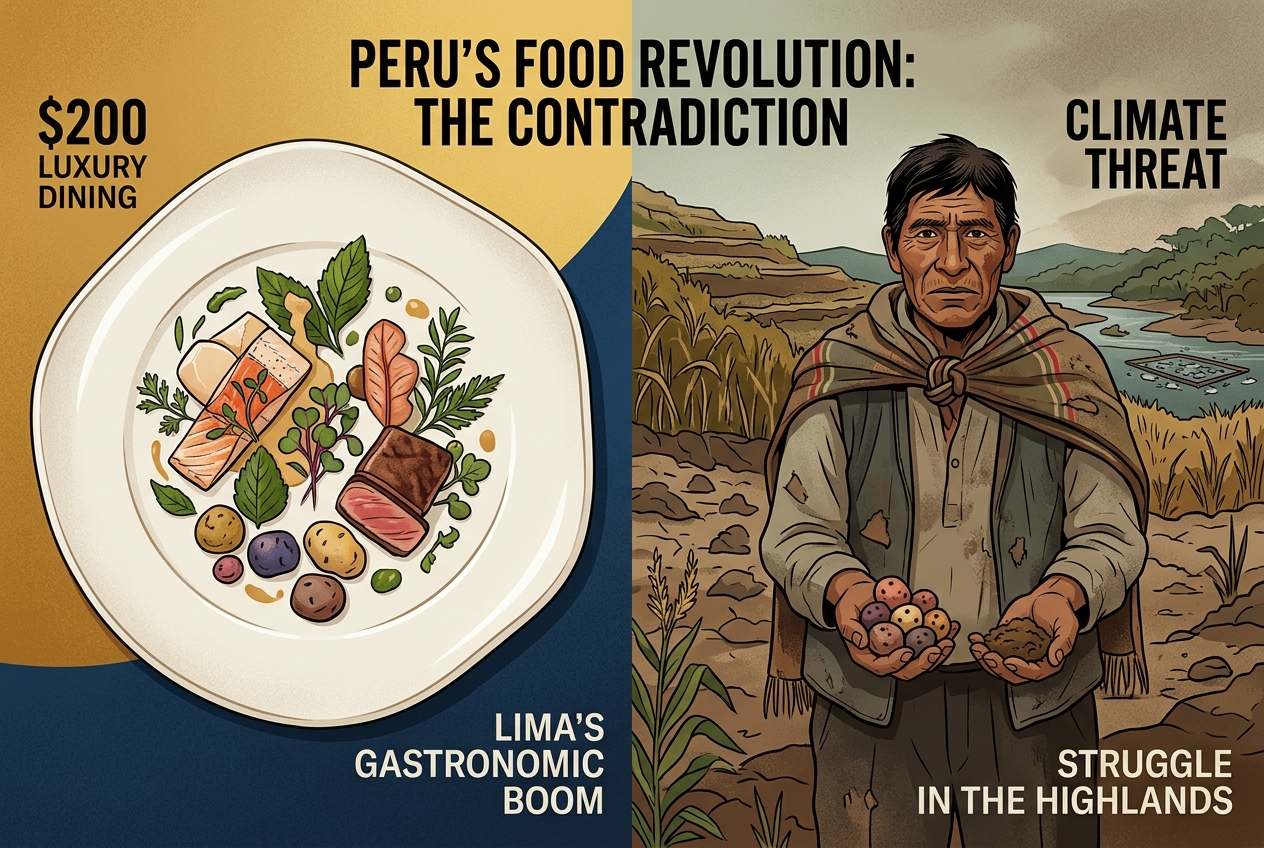
Peru's culinary revolution reached its apex in 2025 when Maido claimed the world's number one restaurant title and five Lima establishments simultaneously entered the World's 50 Best, yet this dazzling achievement conceals a structural paradox of historic proportions. While $200 Nikkei tasting menus earn global acclaim, the Andean smallholder farmers who supply their defining ingredients earn just 60 cents a day, trapped in a rural economy where 35.5 percent poverty and organic certification costs exceeding $2,500 per farm make high-value market access functionally impossible for the majority. The 51.7 percent of Peruvians — 17.6 million people — who experience moderate to severe food insecurity represent the invisible underside of a revolution celebrated loudly by the global culinary press. Climate change compounds the structural injustice: Amazon water temperatures have risen 0.6 to 0.7 degrees Celsius over four decades, aquaculture production crashed 25.43 percent in the 2023 drought alone, and 13 wild potato species face extinction by 2055, threatening the very ingredient base that gives Peruvian cuisine its world-defining identity. Peru's food revolution is not a completed project but a half-revolution — an aesthetic triumph floating on a foundation of structural inequality, waiting for the second act that determines whether it becomes a genuine transformation or history's most beautifully plated extraction story.
Key Points
The Structural Profit Distribution Gap Behind the World's Number One Restaurant
Maido's 2025 coronation as the world's best restaurant, alongside four other Lima establishments in the global top 50, has cemented Peru as fine dining's undisputed capital — yet this achievement masks a profit distribution structure as striking as the culinary accomplishment itself. Peru's tourism sector contributes $21.6 billion or 7.5 percent of GDP, with culinary tourism accounting for 12.4 percent of total tourism revenue, but rural poverty remains at 35.5 percent — roughly seven times Lima's urban poverty rate of 3.2 percent. Organic certification costs exceeding $2,500 per farm effectively bar most smallholders from accessing high-value markets directly, forcing them into middleman-dependent supply chains that capture a disproportionate share of already limited farmer incomes. Seventy percent of agricultural workers in Peru are smallholders, yet only 25 percent have access to credit, meaning the inequality cannot be overcome through individual effort alone — it requires structural intervention. The gap between Lima's celebrated dining rooms and the communities supplying their ingredients reveals that "revolution" is an overstatement: what has occurred is an aesthetic triumph that has yet to produce meaningful structural change in the lives of those at the bottom of the supply chain, and may have inadvertently obscured the urgency of doing so.
The Uncomfortable Truth About Nikkei Cuisine and Gastro-Politics
Nikkei cuisine's origin story — a natural fusion born from 125 years of Japanese immigration beginning in 1899 — is genuinely compelling, but the mechanics of its success reveal uncomfortable truths about power, representation, and who actually benefits when a food revolution happens. Professor Ayumi Takenaka's research at Waseda University demonstrates that Nikkei food "succeeded partly because of Peru's gastro-politics — how Peru's gastronomy was promoted, by whom, and for whom," placing the emphasis firmly on social capital and institutional access rather than culinary talent alone. Peru's approximately 200,000 Japanese-Peruvian community, one of the largest Japanese diasporas outside Japan, provided the financial resources and social status that underwrote Nikkei cuisine's rise to global prominence in ways that indigenous communities simply could not have replicated. The establishment of the Nikkei Gastronomy Association in 2016, with its revenue-generating annual festival, further institutionalized this success within an already privileged community, creating structures that concentrate economic benefits within a demographically narrow group. Indigenous traditional knowledge was "largely ignored in the transformation process," receiving neither recognition nor compensation for centuries of ingredient development and cultivation, while indigenous and Afro-Peruvian poverty rates exceed the national average by 78 percentage points — meaning those whose ancestral knowledge forms the foundation of the world's best restaurant's menu are systematically and measurably excluded from its economic rewards.
Climate Change Threatens the Very Ingredient Base of Peru's Food Revolution
The sustainability of Peru's food revolution ultimately depends not on rankings or media coverage but on whether climate change will destroy the ingredients that make it possible — and the early evidence is deeply troubling. The 2023 Amazon drought, the worst on record, saw Lake Tefe lose 75 percent of its surface area, water temperatures spike to 41 degrees Celsius from a normal 29 to 30, and oxygen levels crash to a dangerous 0.5 milligrams per liter, while Peru's total aquaculture production dropped 25.43 percent in a single devastating year. The Andean potato faces parallel threats: a 2025 PLOS ONE study found that late blight causes $6 billion in annual damage globally, while climate projections indicate 13 wild potato species face extinction by 2055, eroding the genetic diversity that has made Andean agriculture one of humanity's most remarkable food systems for millennia. Amazon water temperatures have risen 0.6 to 0.7 degrees Celsius over four decades, with projections of an additional 3 to 4 degrees this century, while Andean farmers have already been forced to shift cultivation from 3,800 meters to 4,000 to 4,100 meters elevation — an adaptation strategy that will eventually run out of altitude. The revolution's ingredient base is not hypothetically at risk; it is actively contracting, and the fine dining economy built on top of it proceeds as though this were someone else's problem to solve.
The Promise and Limits of Direct-Trade Models — Lessons from Mater Iniciativa
Chef Virgilio Martinez's Mater Iniciativa, founded in 2013, provides the most compelling evidence that Peru's food revolution can genuinely benefit rural communities rather than simply extracting value from them and calling it cultural celebration. The initiative has catalogued over 200 new ingredients, incorporated two Andean communities into seed bank programs, and applied the AYNI reciprocity framework — an Andean concept of mutual obligation and shared benefit — to restaurant supply chains in ways that create measurable economic value for farming families who had previously been locked out of the premium market. A 2025 SpringerOpen study independently confirmed that the Agroferias Campesinas direct-market model reduced post-harvest losses through shorter supply chains while strengthening small farmer productivity and market access, providing academic validation of the economic logic. However, even an APEGA staff member acknowledged that "the boom's impact has not reached small-scale subsistence farmers in remote areas," confirming that these successes, however real, remain structurally isolated from the majority of Peru's agricultural economy. Scaling direct-trade from isolated best practices to industry standard requires simultaneously addressing three interconnected barriers — organic certification cost subsidies, rural logistics infrastructure investment, and rebuilding trust eroded by decades of violence and displacement — none of which any single chef or restaurant initiative can resolve alone, making political will the ultimate bottleneck between the model that works and the revolution that hasn't happened yet.
The Food Insecurity Paradox — 51.7 Percent Go Hungry in the Nation Most Proud of Its Cuisine
The paradox documented in Professor Zakrzewska's research strikes at the heart of Peru's food revolution with a force that economic growth statistics cannot deflect. Forty-eight percent of Peruvians cite their cuisine as the nation's number one source of pride — a remarkable cultural identification that speaks to the deep emotional power of food — while simultaneously 17.6 million Peruvians, representing 51.7 percent of the population, experience moderate to severe food insecurity. Among children under 3, 43.7 percent suffer from anemia, and 12.1 percent of those under 5 have chronic malnutrition that will permanently affect their cognitive and physical development, compounding disadvantage across generations. Approximately 15,000 community kitchens serve 800,000 people daily, representing a massive community-level emergency response to a food system that does not actually feed the majority of the people whose labor and knowledge underpin its global success. Traditional ingredients like cuy — guinea pig — transformed into luxury preparations such as "cuy Pekines" have been priced beyond the reach of the indigenous communities who originally domesticated and consumed them, a pattern that repeats across multiple traditional ingredients and represents the revolution's distributional failure in its most concrete and painful form.
Positive & Negative Analysis
Positive Aspects
- Peru's Global Brand Transformation Through Culinary Soft Power
Peru's food revolution has accomplished what no diplomatic strategy or marketing campaign could have achieved independently: a fundamental repositioning of the country's international brand identity from historical destination to living culinary experience hub. Thirteen consecutive World Travel Award wins as "World's Leading Culinary Destination," combined with five Lima restaurants simultaneously in the global top 50, represents a concentration of culinary prestige unprecedented outside Paris and Tokyo, and entirely self-sustaining through reputation rather than advertising spend. The 2024 World Travel Awards recognized Peru simultaneously across food, culture, and sustainable tourism categories, elevating the country from a specific destination to a multi-dimensional experience platform that appeals to multiple travel motivations at once. With 3.3 million international visitors in 2024 generating over 31 billion soles in economic activity, tourism has become a structural pillar of Peru's national economy in a way that now reinforces itself through accumulated global reputation rather than requiring constant marketing investment. The global Peruvian restaurant market's projected growth from $8.4 billion in 2025 to $15.6 billion by 2034 at 7.1 percent CAGR confirms this brand value is durable and structural, with Latin America's 38.5 percent share of the global market in 2025 providing a solid regional foundation from which worldwide expansion is a logical extension rather than a speculative reach.
- Proven Viability of Direct-Trade Partnership Models
The significance of Mater Iniciativa lies not in its theoretical elegance but in its demonstrated operational success within the actual supply chain conditions of Andean Peru, where infrastructure deficits and trust deficits compound each other in ways that undermine most well-intentioned development programs. Over 200 newly catalogued ingredients, two Andean communities actively participating in seed bank programs, and the practical application of the AYNI reciprocity framework to restaurant supply chains collectively prove that high-end dining and smallholder agriculture can establish relationships that are genuinely mutually beneficial and that persist over time without requiring ongoing subsidization. The 2025 SpringerOpen study confirming that Agroferias Campesinas reduced post-harvest losses through shorter supply chains while strengthening small farmer productivity provides independent academic validation of the underlying economic logic rather than relying on anecdotal claims. Chef Martinez's foundational philosophy — "I don't believe a supplier should come to me, but that I should build a relationship with him, his land and products" — has moved from aspirational statement to functioning, replicable business model with documented outcomes. The central challenge is no longer model viability but scaling velocity and reach, and that distinction matters enormously: it means a proven template already exists for the rest of Peru's restaurant industry to adopt, waiting for the economic incentives and institutional support to reach a critical mass.
- Traditional Ingredient Discovery and Biodiversity Conservation
Whether deliberately designed or emerging as a secondary benefit of culinary innovation, Peru's food revolution has contributed meaningfully to the rediscovery, documentation, and commercial preservation of traditional ingredients that were approaching extinction before fine dining demand created economic rationale for their continued cultivation and protection. A significant number of the more than 200 ingredients catalogued by Mater Iniciativa had no recognized commercial value before the initiative documented them, meaning market demand literally created conservation incentives where none previously existed — a rare instance of market mechanisms working in favor of biodiversity rather than against it. The FONTAGRO 2025 project's mapping of over 12,000 genomic markers and identification of 10 drought-tolerance genes and 15 blight-resistance genes in traditional Andean crops represents scientifically significant work with global food security implications extending well beyond Peru's borders. The thousands of native potato varieties preserved in the Andes function as a global genetic resource reservoir whose value to agricultural resilience in a warming world is genuinely incalculable, and fine dining demand has assigned market value to what was previously considered subsistence-level agriculture. This represents a genuine case where commercial activity actively contributes to biodiversity conservation — a rare and valuable alignment of economic and ecological interests that deserves recognition within any honest accounting of the revolution's full impact.
- The Massive Economic Multiplier Effect of Culinary Tourism
WTTC data shows Peru's tourism sector contributed $21.6 billion or 7.5 percent of GDP in 2024, with projections reaching $34.3 billion by 2035 and directly supporting 1.4 million jobs across multiple sectors of the economy — a multiplier effect that extends far beyond the restaurant industry itself. International tourism spending hit $4.7 billion in 2024, rising 22 percent year over year, with culinary tourism representing 12.4 percent of total tourism revenue and that proportion continuing to grow as food-focused travel displaces purely sightseeing-based tourism among high-value travelers. The Mistura Lima 2025 festival alone generated over $3 million in direct economic impact from 180,000 visitors across four days, including 18,000 international guests whose spending cascaded through accommodation, transportation, retail, and services far beyond any single restaurant. The finding that 73 percent of luxury travel packages now include farm-to-table chef experiences signals that Peruvian food has transcended the category of mere dining to become a premium experiential product that anchors entire travel itineraries for the world's most economically valuable tourism demographic. These multipliers demonstrate that the value created by Peru's food revolution extends well beyond restaurant revenue, feeding families in sectors of the economy far removed from the fine dining world — even as the distribution of those benefits remains structurally unequal in ways that demand urgent attention.
- Nikkei Cuisine as a Remarkable Achievement in Diaspora Cultural Fusion
Setting aside the structural critiques — which are legitimate and demand engagement — Nikkei cuisine itself represents a genuinely remarkable cultural achievement that deserves honest recognition on its own terms rather than being entirely subsumed within a political analysis. Born from the "champuru" mixing culture of Okinawan immigrants who began arriving in 1899, this cuisine emerged organically as immigrant families substituted locally available Peruvian ingredients for unavailable Japanese staples, creating flavor combinations and techniques that belonged fully to neither origin culture and could not have existed within either one independently. Chef Tsumura's personal arc — the son of Japanese immigrants who trained in sushi technique in Osaka before returning to Lima to open Maido at age 28 — exemplifies how diaspora communities generate entirely new forms of cultural and economic value that enrich global culture precisely because they belong to neither origin. The establishment of the Nikkei Gastronomy Association in 2016 and its successful annual festival demonstrate institutional depth and community rootedness that extends far beyond any single restaurant's reputation or any individual chef's career. This remains a living demonstration of how cultural contact can produce something genuinely greater than the sum of its parts — a lesson whose implications extend well beyond gastronomy, whatever one's views on the broader structural questions the revolution raises.
Concerns
- Vertical Extraction Structure Concentrating Revolutionary Benefits Among Lima's Elite
The most fundamental problem with Peru's food revolution is the extreme geographic and class concentration of its benefits, which calls into question whether "revolution" is an appropriate description of what has actually occurred at a national level. Lima's top five restaurants absorb a disproportionate share of the $4.86 billion in international tourism revenue while ingredient-supplying communities in the Andean highlands face 53 percent poverty and the Amazon rainforest faces 43 percent — rates that have not significantly improved during the decade of Peru's culinary celebrity on the global stage. Rural farmers earning approximately $46 per month face organic certification costs of $2,500-plus, representing 4.5 times annual income and functioning as an effectively insurmountable class barrier to high-value market access for the vast majority of those who actually grow the celebrated ingredients. Professor Takenaka's research identifies that high-end fusion gastronomy "largely reflects the existing power hierarchies of the nation," meaning the food revolution has aesthetically repackaged existing socioeconomic inequality rather than disrupting it. The fact that 48 percent of Peruvians cite food as their primary source of national pride while 51.7 percent experience food insecurity is the starkest possible expression of this extraction dynamic: the revolution succeeded as a cultural symbol while failing as an economic redistributor for the majority of those whose labor and knowledge made it possible.
- Climate Change Posing an Existential Threat to Amazon and Andean Ingredient Supply
Climate change represents the single greatest structural risk to Peru's food revolution, threatening not merely its economic performance but the physical existence of the ingredients that define its identity and distinguish it from every other cuisine on earth. Amazon water temperatures have warmed 0.6 to 0.7 degrees Celsius over four decades, with projections of 3 to 4 additional degrees this century — a trajectory that, if sustained, will make significant portions of the Amazon's aquatic ecosystem uninhabitable for the species that Peruvian fine dining celebrates as irreplaceable. The 2023 drought demonstrated how rapidly this collapse can materialize in practice: Lake Tefe losing 75 percent of its surface area, temperatures reaching 41 degrees Celsius, oxygen crashing to 0.5 milligrams per liter, and aquaculture production plummeting 25.43 percent in a single year from a single extreme event. In the Andes, late blight causes $6 billion in annual damage globally, 13 wild potato species face extinction by 2055, and single El Nino events spike local inflation by 3.3 percentage points, destabilizing farming communities operating on subsistence margins with no financial buffer against volatility. The World Bank has explicitly warned that "family farming is one of the sectors most exposed to the impacts of climate change," and in Peru, where subsistence farming is the economic backbone of the regions with the most extreme poverty and food insecurity, this warning carries existential urgency for both the communities and the cuisine they sustain.
- Organic Certification Cost Barriers Trapping Smallholders in the Informal Economy
The $2,500-plus cost of organic certification — encompassing inspection fees, auditor travel, administrative processing, and annual renewal — constitutes a structural barrier that systematically excludes most Peruvian smallholders from the high-value supply chains that Peru's food revolution has created and from which its global prestige derives. For rural farmers earning approximately $46 monthly or $552 annually, this cost represents 4.5 times their annual income, making direct formal market access not merely challenging but structurally impossible without external subsidy or systemic intervention that currently does not exist at anything close to the required scale. This barrier locks farmers into informal middleman channels where pricing is opaque, margins are captured before reaching the grower, and the farmer has no leverage to negotiate improved terms regardless of how much their ingredients command at the restaurant end of the supply chain. Bloomberg 2026 reporting documents that infrastructure deficiencies cause fruits and wild botanical ingredients to "arrive bruised and unsellable at competitive markets," adding a compounding logistics barrier on top of the certification barrier that doubly excludes smallholders from the revolution's economic rewards. IFAD's $254 million investment in Peru explicitly targets these structural obstacles, but the root causes — "limited access to markets and financial services, fragmented land ownership, and lack of public goods and services" — are deeply embedded structural features that resist resolution within the short and medium timeframes that the culinary economy's current momentum demands.
- Uncompensated Extraction of Indigenous Traditional Knowledge and Cultural Invisibility
A substantial and largely unacknowledged portion of the ingredients, preparation techniques, and food system knowledge powering Peru's food revolution derives from traditional knowledge that indigenous communities developed and refined over millennia, yet this knowledge has been incorporated into the global fine dining economy with minimal recognition, compensation, or genuine benefit-sharing with the communities of origin. Takenaka's research documents that indigenous knowledge was "largely ignored in the transformation process" that elevated Peruvian cuisine to global prominence, with the economic benefits flowing primarily to urban, educated, and resource-endowed entrepreneurs rather than the knowledge holders who made the cuisine what it is. Traditional ingredients like cuy — guinea pig — transformed into luxury preparations such as "cuy Pekines" have been priced beyond the reach of the indigenous communities who originally domesticated and consumed them across generations, in a pattern that repeats across multiple traditional ingredients and represents knowledge extraction in its most literal and tangible form. Indigenous and Afro-Peruvian poverty rates exceed the national average by 78 percentage points, meaning those whose ancestral knowledge forms the foundation of the world's most celebrated cuisine are systematically and measurably excluded from the economic rewards that knowledge now generates at the highest levels of global gastronomy. This raises fundamental questions about intellectual property, cultural sovereignty, and intergenerational justice that the food revolution's celebratory narrative has consistently failed to engage with seriously, choosing instead to frame cultural fusion as a natural and mutually beneficial process when the distributional evidence suggests an entirely different story.
- Political Instability and Institutional Weakness Blocking Structural Reform
The structural inequalities embedded in Peru's food revolution cannot be resolved through restaurant initiatives alone — they require sustained, coordinated government intervention, but Peru's chronic political instability fundamentally undermines the institutional capacity for the multi-year policy commitments that structural transformation demands. Chef Martinez's warning that "weak institutions, limited regional support and inadequate infrastructure threaten the long-term stability of the food system" comes from someone who has spent more than a decade working at the precise intersection of fine dining and rural supply chains, and his concern reflects structural reality rather than individual pessimism or strategic complaint. IFAD explicitly identifies "limited state presence" as a core obstacle to rural development in Peru, while Bloomberg 2026 documents that "trust deficits eroded over decades of violence and displacement" create historical barriers to building the chef-farmer relationships that the direct-trade model requires to function at meaningful scale. The Andean highlands and Amazon regions, where poverty rates reach 53 and 43 percent respectively, suffer from fragmented land ownership and near-total absence of public services — conditions that no restaurant partnership or development initiative can compensate for at national scale, regardless of how well-intentioned or well-funded. Rural child labor rates of 24.5 percent — approximately six times the urban rate of 4.3 percent — demonstrate that structural vulnerability reproduces itself across generations, creating a compounding disadvantage that only sustained institutional intervention can interrupt, making political instability not merely frustrating but potentially decisive in determining whether Peru's food revolution remains permanently incomplete.
Outlook
In the short term — the next one to six months — Maido's number one ranking will send immediate shockwaves through Lima's culinary tourism ecosystem. When Central claimed the top spot in 2023, Lima saw a sharp surge in food tourism demand, and that pattern will repeat with even greater force following Maido's coronation. Reservation wait times at Lima's elite restaurants could easily stretch to six to twelve months. The 2024 baseline of $4.86 billion in international tourism revenue, already up 32.2 percent year over year, suggests the Maido effect could drive an additional 15 to 20 percent increase in culinary tourism specifically. With 59 percent of luxury travelers allocating more than 25 percent of their travel budgets to food experiences, high-end restaurant revenues in Lima are virtually guaranteed to climb sharply in the near term.
The real short-term question is what this demand surge does to the ingredient supply chain — and the honest answer is not much that's positive. Higher demand for Andean and Amazonian specialty ingredients does not come with upgraded supply infrastructure. Smallholders locked out of high-value markets by the $2,500-plus certification barrier remain dependent on middlemen, who now sit in an even stronger negotiating position as demand spikes. IFAD's $254 million investment across 12 Peru projects is a genuinely positive signal, but development investments measure their impact in years, not months. The painful irony is that Maido's success could actually widen the income gap between Lima's dining rooms and the farming communities supplying them before any corrective mechanism has time to engage.
In the medium term — roughly six months to two years out — the situation is shaped by two powerful forces on a collision course. On one side, the structural growth trajectory is real and accelerating: a global Peruvian restaurant market growing at 7.1 percent CAGR toward $15.6 billion by 2034, WTTC projections of Peru's total tourism contribution reaching $34.3 billion by 2035, and the economic logic of direct trade becoming increasingly attractive as authentic Peruvian ingredient premiums rise globally. Mater Iniciativa's AYNI framework and the Agroferias Campesinas model could reach a tipping point within this window, transitioning from celebrated exceptions to emerging standard practice as more restaurants recognize the commercial and reputational advantages of verified direct sourcing.
On the other side of this collision, climate stress intensifies progressively throughout this period. If the four-decade trend of 0.6 to 0.7 degrees Celsius warming in Amazon water temperatures continues, paiche aquaculture's economic break-even point could become dangerously precarious by around 2028. In the Andes, rainfall reductions of 20 to 40 percent and rising temperatures continue pushing potato cultivation to higher elevations. FONTAGRO's 2025 identification of 10 drought-tolerance genes and 15 blight-resistance genes is scientifically promising, but translating laboratory discoveries into seeds that farmers actually plant takes three to five years at minimum. The most realistic medium-term outlook is one where Lima restaurant revenues keep climbing while ingredient costs rise simultaneously, gradually exposing the supply chain fragility that optimistic food journalism has been papering over for a decade.
Looking at the long term — two to five years out — Peru's food ecosystem branches into three genuinely distinct futures. The bull case requires direct-trade models expanding to cover more than 30 percent of premium restaurant sourcing, FONTAGRO's blight-resistant varieties achieving commercialization with 15 to 20 percent yield improvements, and the Peruvian government introducing smallholder organic certification subsidies while reinvesting 2 to 3 percent of WTTC's projected $34.3 billion tourism contribution into climate adaptation infrastructure. In this scenario, the food revolution's benefits genuinely begin spreading beyond Lima's elite dining district and the gap between culinary prestige and rural poverty starts closing in a measurable way. I put the probability at roughly 20 to 25 percent — Peru's chronic political instability makes structural reforms of this magnitude unlikely within five years, though growing global ESG investment pressure and the ethical consumption trend among wealthy travelers could accelerate the timeline in ways that are genuinely hard to predict from today's vantage point.
The base case — which I assess at 50 to 55 percent probability — sees the current dual structure becoming permanently entrenched rather than resolved. Lima's fine dining scene continues thriving alongside global market growth, but the rural poverty rate of 35.5 percent doesn't drop below 30 percent, and food insecurity stays above 45 percent. Direct-trade expands modestly, reaching perhaps 10 to 15 percent of total supply chains, while the remaining 85 to 90 percent continues flowing through middlemen. Climate stress causes annual ingredient price increases of 2 to 3 percent, which premium restaurants absorb by raising menu prices, splitting the cost burden between consumers and farmers in a way that insulates the industry while doing nothing for the rural communities at the base of the supply chain. This is probably the most likely future for Peru's food revolution: a permanent coexistence of culinary brilliance and structural inequality, each feeding off the other in a stable but deeply unjust equilibrium that nobody has sufficient incentive to disrupt.
The bear case is genuinely frightening, and I believe it deserves more serious attention than the global food media typically gives it. If Amazon water temperatures rise an additional 3 to 4 degrees this century, paiche aquaculture becomes economically impossible — not difficult, not costly, impossible. The 2023 precedent, when aquaculture production crashed 25.43 percent in a single year from one drought event, shows precisely how fast these systems collapse when pushed past a threshold. If 13 wild potato species go extinct, the foundational genetic diversity of Andean ingredients disappears, and the materials that make Peruvian cuisine distinctively "Peruvian" begin vanishing from the supply chain. Restaurants pivot to substitutes, the "Peruvian-ness" brand value dilutes, and the $15.6 billion market projection becomes obsolete. I put this at 20 to 25 percent probability, but climate change's nonlinearity means the actual odds could be substantially higher than any linear model suggests. If this scenario materializes, it won't just affect Peru — it will send shockwaves through the $1.2 trillion global culinary tourism industry that has staked its future on "authenticity" and "terroir" as core value propositions.
I should be honest about where I could be wrong. If Peru's government commits to reinvesting a fixed percentage of tourism revenue into rural infrastructure, and if global climate action substantially achieves the Paris Agreement's 1.5 degree target, a meaningful portion of my structural critique would prove overstated. Technological breakthroughs could also outpace my projections — rapid commercialization of drought-resistant potato varieties or advances in recirculating aquaculture systems could dramatically reduce the bear case probability in ways that are genuinely difficult to model from today's vantage point. India's Green Revolution showed that structural food security problems can be partially overcome through coordinated technological investment, and that historical precedent is worth taking seriously rather than dismissing.
But looking honestly at current trajectories — Peru's political instability, the documented acceleration of climate impacts, the structural entrenchment of middleman supply chains — I assess structural inertia as significantly stronger than structural change momentum right now. My one concrete suggestion for anyone reading this: there is absolutely nothing wrong with enjoying Peruvian food. But when you sit down to that $200 tasting menu, take a real moment to think about the life of the person who grew the herb on your plate. If enough diners have that thought and act on it — demanding supply chain transparency, choosing restaurants with verified direct-trade relationships, selecting food tourism experiences that explicitly benefit farming communities — a real revolution might actually begin. The chefs cannot do it alone. The consumers have to want it first.
Sources / References
- Maido Named The World's Best Restaurant 2025 — World's 50 Best Restaurants
- Peru's gastronomic boom risks excluding the indigenous people whose food it celebrates — The Conversation
- Nikkei Food for Whom? Gastro-Politics and Culinary Representation in Peru — OpenEdition Journals
- How extreme droughts could redefine the future of Amazonian fish — Mongabay
- Climate-induced weather extremes and potato Late Blight — PLOS ONE
- After the Food Revolution: Peru Confronts Its Culinary Limits — Sri Lanka Guardian
- What Comes After Peru's Food Revolution? — Bloomberg
- Peru WTTC Tourism Contribution Data — Hotel News Resource
- IFAD Peru Rural Development — IFAD
- Extreme Poverty in Peru Rural Communities — Karikuy NGO
- Global Peruvian Restaurant Market Report — Marketintelo
- Mater Iniciativa — Circular Economy for Food
- Agroferias Campesinas and Sustainable Food Supply Chains — SpringerOpen