
Japan Just Slapped a "Foreigner Price Tag" on Tourism — And the Real Problem Goes Deeper Than Either Side Admits
Summary
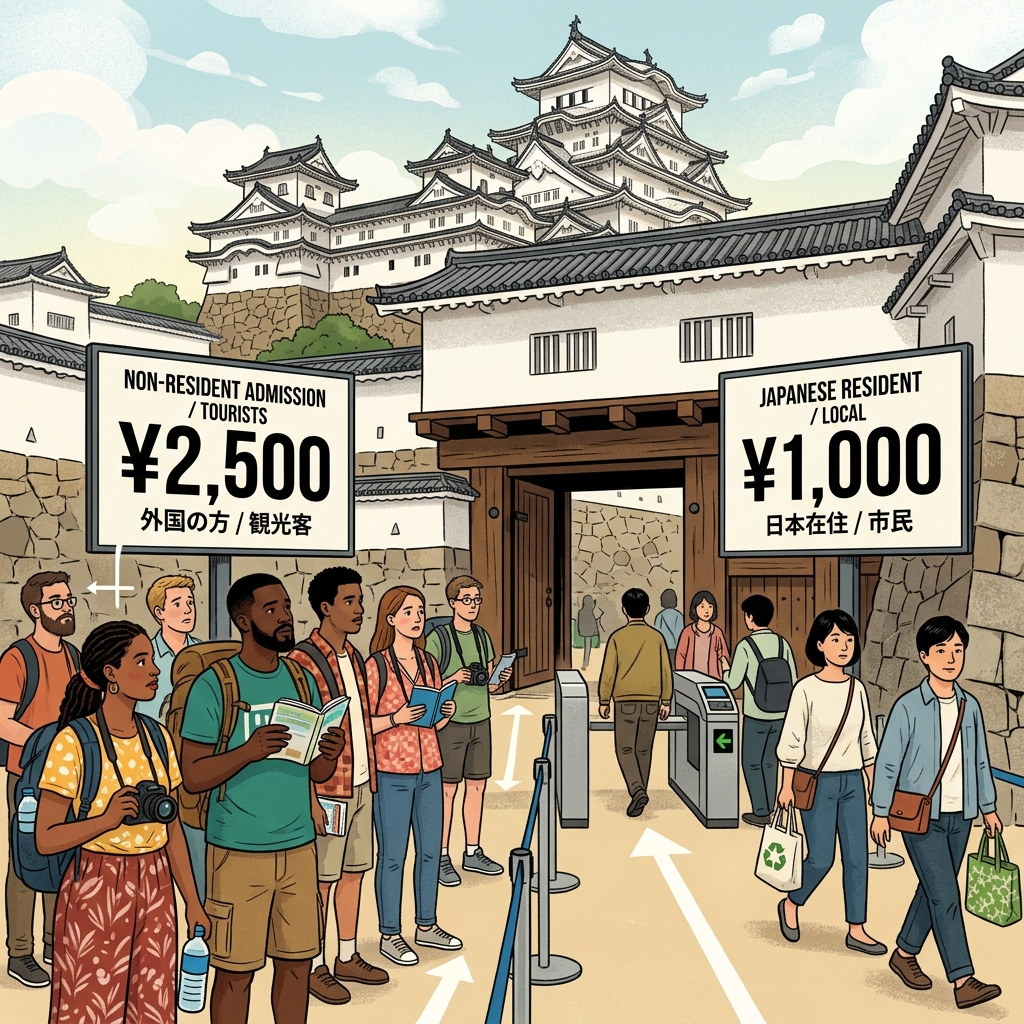
Japan's dual pricing system has rapidly escalated from a localized trial into a nationwide policy trend, with Himeji Castle already charging non-residents ¥2,500 versus ¥1,000 for city residents, Kyoto announcing plans for two-tier bus fares, and the national departure tax tripling from ¥1,000 to ¥3,000 effective July 1, 2026. The policy gained decisive empirical momentum at Himeji Castle, where a 17% drop in visitor numbers produced ticket revenue that nearly doubled to ¥270 million per month — projecting ¥2.2 billion annually — essentially converting skeptics and accelerating policy adoption across Japan's tourism community. The public debate has locked into a tired binary of "foreign discrimination versus fair cost-sharing," but both camps are aimed at the wrong target: the structural problem is that a flat dual-pricing surcharge is applied identically to a Korean budget traveler averaging ¥103,789 per trip and a German visitor spending ¥393,710, treating them as if they inhabit the same financial universe. In practice, dual pricing functions as a wealth-based sorting mechanism that systematically disadvantages nearby Asian budget travelers — South Koreans, Chinese, and Taiwanese — while presenting virtually no deterrent to high-spending Western visitors for whom ¥1,500 is barely background noise. This piece dissects the structural paradox at the core of Japan's dual pricing expansion, situates it within a global overtourism management context alongside the Louvre, Bali, and Rome, and models bull, base, and bear scenarios for Japanese tourism through 2030.
Key Points
The Himeji Castle Proof of Concept: Fewer Visitors, Far More Revenue
Himeji Castle launched its dual pricing structure on March 1, 2026, charging non-resident adults ¥2,500 while Himeji city residents pay ¥1,000, and the first-month results have become the most cited data point in Japan's entire tourism policy debate. Visitor numbers fell to approximately 140,000 — down 17% year-on-year — but ticket revenue reached ¥270 million, nearly double the prior year's figure, directly refuting the assumption that fewer visitors necessarily means less income. The city now projects FY2026 annual revenue at ¥2.2 billion, roughly ¥1 billion more than the previous year, and that additional funding is earmarked specifically for restoring the castle's 400-year-old walls and improving surrounding visitor infrastructure. What makes this result so consequential for Japan's broader tourism policy is that it validates the "earn less traffic, earn more money" premise that overtourism advocates have argued for years without hard domestic evidence. I see the Himeji model becoming the single most influential reference point for tourism sites across Japan, because it is the rare case that simultaneously satisfies the cultural heritage preservation argument and the overtourism reduction argument with real numbers. The revenue loop — where visitors pay more and that money directly maintains the asset they are visiting — is precisely the kind of defensible, self-sustaining model that other countries' tourist boards will study as closely as Japan's own.
The July 1 Departure Tax Triple — Tip of a Much Larger Iceberg
The departure tax increase from ¥1,000 to ¥3,000 on July 1 seems manageable in isolation, but understanding this as one piece of a much larger simultaneous cost structure is the key to grasping why it matters. In the same calendar year, Kyoto's accommodation tax has expanded from ¥200 to as high as ¥10,000 per night, Hokkaido's accommodation levy rose from ¥100 to ¥500 starting in April, the JR Pass 7-day ticket increases from ¥50,000 to ¥53,000 in October, and the tax refund system shifts from immediate point-of-sale exemption to a departure-gate reimbursement process in November. For a family of four, the departure tax alone now adds ¥12,000 to a trip's cost before a single admission surcharge or accommodation levy is counted. Japan's government estimates the departure tax increase will generate approximately ¥130 billion in annual additional revenue, with the funding directed toward overtourism management infrastructure and regional tourism development. The problem I see is not the individual reasonableness of any single measure — most of these changes have defensible rationales — but the compound psychological effect of all of them landing within a twelve-month window, creating the conditions for "Japan is now expensive" to shift from a fringe observation to a mainstream travel consensus.
The South Korean Visitor Paradox: Most Numerous, Lowest Per-Capita Spending
The per-capita spending data underlying Japan's dual pricing calculus is the most important and least-discussed element of this entire conversation, and it starts with South Korea's paradoxical position. At 9.5 million annual visitors, South Korea is Japan's largest single source market by a considerable margin — and yet Korean visitors average approximately ¥103,789 per trip, which is the lowest per-capita spending figure among major source markets. German visitors average ¥393,710, British visitors ¥390,319, and Australian visitors ¥390,048 — all roughly 3.8 times the Korean per-capita figure — creating a structural asymmetry that shapes everything about how dual pricing actually functions. A ¥1,500 admission surcharge at Himeji Castle represents about 0.4% of a German visitor's total trip budget, which is genuinely negligible; the same ¥1,500 represents more than 1.4% of a Korean budget traveler's total spend, and stacks across multiple sites per day. I'd argue this asymmetry is the most fundamental flaw in the dual pricing architecture: the system applies the same surcharge to visitors living in vastly different economic realities relative to their Japan travel budgets, which means it functions not as a uniform contribution but as a selective deterrent aimed squarely at the budget-sensitive end of the visitor spectrum. A truly "fair" system would need to account for spending capacity — but such a system is practically unimplementable, which leaves Japan with a blunt instrument producing unequal impacts.
Global Dual Pricing Is Now the New Normal, Not a Japanese Anomaly
Framing Japan's dual pricing expansion as a uniquely Japanese phenomenon — or uniquely problematic — ignores the broader global context in which this policy is developing, and that context fundamentally changes the evaluation. The Louvre raised entry prices 45% for non-EU visitors starting January 2026, moving from €22 to €32 and projecting €15-20 million in additional annual revenue; Bali has levied a $10 tourist-only tax since February 2024 and earned approximately $22 million from it in 2025; Rome's Trevi Fountain began charging tourists a €2 fee in February 2026 while exempting city residents entirely. The shared logic across all of these policies is that local taxpayers fund the maintenance of public infrastructure and heritage assets, visitors consume those assets without contributing to their upkeep, and a differential charge corrects that structural imbalance. I believe this global convergence provides Japan's residence-based dual pricing with substantial legal and ethical standing internationally, making it significantly harder to dismiss as discriminatory in any meaningful comparative framework. The important distinction I'd draw, however, is one of scale and comprehensiveness: the Louvre and Trevi Fountain operate single-site surcharges, while Japan is pursuing a systematic, multi-layer expansion across entry fees, transit, accommodation, and visa processing — a qualitatively different level of institutionalization that makes Japan's version worth watching as a potential global precedent.
Residence vs. Nationality — Why the Legal Line Changes Everything
The most consequential and most consistently misunderstood distinction in this entire debate is the difference between residence-based and nationality-based dual pricing — a line that is legally significant, ethically meaningful, and almost never properly drawn in popular coverage. Himeji Castle's structure charges ¥2,500 to non-residents and ¥1,000 to Himeji city residents, regardless of nationality: a foreign national living in Himeji pays ¥1,000, and a Japanese national living in Osaka pays ¥2,500. Consumer law specialist Kanda Mansaku stated clearly that residence-based dual pricing is legally defensible when rational grounds exist — such as local taxpayer contribution to the asset's maintenance — but nationality-based pricing would generate serious international legal exposure. The Japan Tourism Agency's expert panel, which launched in April 2026, is expected to publish formal guidelines by the end of FY2026 — March 2027 — and the content of those guidelines on exactly this question will determine how far dual pricing spreads and how internationally acceptable it becomes. I estimate a 70% probability that the guidelines will endorse only residence-based pricing and draw a firm line against nationality-based approaches, reflecting the conservative legal consensus. What concerns me is the pre-guideline vacuum: with no formal policy boundary in place, individual sites and municipalities are experimenting autonomously, and the risk of one high-profile case of sloppy nationality-adjacent pricing going viral is real and could inflict disproportionate brand damage relative to the underlying policy intent.
Positive & Negative Analysis
Positive Aspects
- Sustainable Funding for Cultural Heritage Preservation
Himeji Castle's dual pricing trial delivered the most compelling evidence yet that a differential fee structure can directly generate meaningful conservation funding without relying on government appropriations. The projected ¥1 billion in additional annual revenue — from a single castle — is being channeled into restoration of 400-year-old walls and visitor infrastructure, creating an asset-maintenance loop where visitor spending sustains the very site those visitors come to experience. Japan has hundreds of nationally designated cultural properties and historical monuments, many of which face escalating restoration costs that strain public budgets year after year, and the dual pricing model offers a self-funding alternative that scales with visitor demand. I see this as more than a revenue mechanism: it is a conceptual shift in how public cultural assets can be sustainably managed in an era of mass tourism, aligning the economic interests of both visitors and conservation in a way that traditional government funding structures do not. When the money generated by the differential fee is clearly and auditably directed to heritage maintenance — as appears to be the case at Himeji — the public and international legitimacy of the policy is substantially stronger than when the revenue disappears into a general municipal fund.
- Meaningful, Measurable Reduction in Overtourism Pressure
Himeji Castle's 17% visitor reduction in the first month of dual pricing implementation represents a direct, evidence-backed result for a problem that most overtourism interventions have struggled to demonstrate in practice. Kyoto University research shows that more than 80% of Kyoto residents report daily life disruption from tourist-driven crowding, and a national survey found over 60% of Japanese residents support charging visitors more — meaning the policy has unusually strong public backing by any democratic measurement. Fewer visitors at a popular site means shorter queues, reduced physical wear on structures and grounds, better photographic conditions, and a materially more enjoyable experience for the visitors who do come — turning quality of visit into a competitive feature rather than something that erodes with popularity. JTB's 2026 national forecast quantifies this dynamic precisely: visitors are expected to fall 2.8% to 41.4 million while total spending rises 0.6% to ¥9.6 trillion, demonstrating that the "quality over quantity" logic works at the aggregate level as well as the site level. I believe the transition from "maximize visitor count" to "optimize visitor experience" is ultimately better for both the sustainability of tourism sites and the satisfaction of the travelers who choose to visit them.
- Democratic Legitimacy: Japanese Residents Actually Want This
One aspect of Japan's dual pricing expansion that often gets lost in international coverage is that it reflects genuine, documented public demand from the people most directly affected by mass tourism. With over 60% of Japanese residents supporting additional charges for tourists in national surveys, and Kyoto University research documenting that more than 80% of Kyoto residents experience daily disruption, the policy has a democratic foundation that is actually stronger than many comparable tourism management interventions in other countries. Kyoto Mayor Matsui Koji framed the bus fare policy as a measure to create a sustainable city, signaling that this is understood locally as a quality-of-life issue for residents, not an economic extraction scheme. When destination communities turn against the tourism industry as a whole — as has happened in parts of Barcelona, Amsterdam, and Venice — the long-term health of tourism suffers far more severely than from any pricing adjustment. I'd argue that dual pricing, by giving residents a visible mechanism for cost recovery and crowd management, actually helps preserve the social license that tourism needs to function over the long term.
- International Policy Alignment — Japan Is Far From an Outlier
The global policy convergence on dual pricing and visitor levies in 2025-2026 gives Japan's approach a level of international normalization that makes it very difficult to challenge on principled grounds. The Louvre's 45% non-EU price increase, Bali's $10 tourist levy, and Rome's Trevi Fountain fee all reflect the same fundamental analysis: public assets are maintained by local taxpayers, high visitor volumes degrade those assets, and differential pricing corrects the subsidy that residents have been providing to foreign visitors. Japan's decision to involve an expert panel and develop formal JTA guidelines before broader national expansion signals a policy process that is more deliberate and legally grounded than many comparable examples globally. Consumer law specialist Kanda Mansaku's explicit endorsement of the residence-based pricing model's legality removes one significant vulnerability from the policy's architecture. I see this international alignment as providing Japan with meaningful defensive cover against diplomatic pushback: when the Louvre, Rome, and Bali are all operating similar structures simultaneously, the "Japan is discriminating" argument becomes significantly harder to sustain in any serious international policy forum.
Concerns
- Structural Risk of Losing Nearby Asian Budget Travelers Irreversibly
The most serious structural risk posed by Japan's dual pricing expansion is one that is almost never quantified correctly in public debate: the sheer arithmetic impossibility of replacing South Korea's 9.5 million annual visitors with high-spending Western tourists. Korean visitors average ¥103,789 per trip, generating approximately ¥986 billion in aggregate annual spending — a figure that would require Germany to send roughly five times its current visitor volume even at Germany's four-times-higher per-capita spend to replicate. South Korea, China at 910,000 visitors, and Taiwan at 680,000 visitors together represent the core of Japan's nearby Asian visitor base, and all of them skew toward the budget-conscious end of the visitor spectrum where dual pricing has disproportionate deterrent effect. A traveler quoted in Seoul Economic Daily put the emerging dynamic concisely: Japan used to be an easy choice because it was close and affordable — but now that "affordable" advantage is visibly eroding. I consider this the most dangerous blind spot in Japan's dual pricing strategy: the implicit assumption that high-value Western visitors can eventually substitute for the volume of nearby Asian visitors is empirically unsupportable, and the longer that assumption goes unexamined, the larger the gap between policy intention and actual outcome will grow.
- Emotional Backlash Creates Brand Damage That Data Alone Cannot Repair
Kyunghyang Shinmun's on-the-ground reporting on Korean traveler reactions surfaced something that the economic modeling of dual pricing consistently fails to capture: the primary irritant for many people was not the monetary amount of the surcharge, but the underlying social signal it sends — you should pay more simply for being here. Tourism purchasing behavior is substantially more emotional than rational, and the "not welcoming" brand association, once formed, is extraordinarily sticky and resistant to official clarification or policy repositioning. Japan's government messaging consistently frames the policy as "resident preference" rather than "foreigner exclusion," and that framing is legally and logically coherent — but it arrives as an explanation after the emotional reaction has already formed, which severely limits its persuasive impact. China's visitor numbers already dropped 45% in December 2025 compared to the prior year, and UBS has warned that if this trajectory continues, total visitor numbers could fall an additional 4% — a canary-in-the-coalmine signal for what emotionally driven avoidance behavior can do at scale. I believe the economic cost of long-term brand damage to Japan's tourism identity — potentially taking a decade to repair — will ultimately exceed the near-term revenue gains from differential pricing, particularly if one high-profile discrimination incident goes viral before the JTA guidelines establish clear legal guardrails.
- Multiple Simultaneous Cost Increases Create a Compounding Perception Tipping Point
The danger of Japan's 2026 policy calendar is not that any individual change is unreasonable — most can be individually justified — but that their simultaneous accumulation creates a compound psychological effect that will be experienced by travelers as a qualitative shift in Japan's value proposition. The departure tax triple, Kyoto's accommodation tax reaching ¥10,000, Hokkaido's accommodation levy increase, the JR Pass price hike in October, and the November tax refund system change all land in a single twelve-month window. A travel industry professional's assessment that "there is almost no itinerary where the JR Pass makes financial sense anymore" is the kind of signal that spreads rapidly through travel planning communities, social media, and guidebook updates, reshaping how prospective visitors perceive Japan before they even begin to budget for a trip. The family-of-four departure tax burden of ¥12,000 — before any accommodation, admission, or transit surcharges — is the kind of concrete number that circulates in planning conversations and becomes an anchor for the overall perception of Japan's affordability. I believe the critical perception tipping point — when "Japan is surprisingly expensive now" transitions from a fringe traveler complaint to a mainstream consensus — will arrive between 2027 and 2028, and once that shift occurs, reversing it will require a deliberate, sustained counter-messaging effort that Japan has not yet shown signs of preparing for.
- Built-In Contradiction with Japan's Official 60-Million-Visitor Target
Japan's government has set an official target of 60 million international visitors and ¥15 trillion in tourism revenue by 2030, but the dual pricing expansion and layered cost increases are operating in structural tension with both components of that target simultaneously. JTB's current 2026 forecast is 41.4 million visitors, leaving a gap of 18.6 million against the 2030 target — and dual pricing, by design, is intended to reduce visitor numbers, meaning the gap will likely widen rather than close as the policy matures. The quality over quantity implicit strategy — earning more per visitor while welcoming fewer total visitors — is logically coherent as a revenue optimization approach, but it is fundamentally incompatible with a visitor volume target that requires adding nearly 20 million more annual visitors from today's baseline. Japan's Tourism Agency's stated reconciliation of this contradiction — diverting visitors from congested urban centers to rural regions like Shikoku and Tohoku — is reasonable in theory but faces severe practical constraints, since those regions lack the tourism infrastructure, accommodation capacity, and international brand recognition to absorb millions of additional visitors in a short timeframe. I expect Japan to quietly revise its 2030 targets downward sometime in the 2027-2028 window, effectively acknowledging the incompatibility between the volume goal and the quality-selectivity approach that dual pricing represents.
- Collateral Damage to Surrounding Local Businesses Beyond the Admission Gate
The Himeji Castle revenue story is genuinely impressive, but it contains a distribution problem that the headline numbers obscure: the additional ¥1 billion in annual revenue accrues to the city administration and heritage conservation fund, while the 17% reduction in visitor foot traffic falls proportionally on the restaurants, souvenir shops, transportation providers, and accommodation businesses in the surrounding area. Admission fee revenue and visitor spending in the local economy are separate streams, and a policy that doubles the former while reducing the latter by 17% is not a uniform win for the tourism economy — it shifts benefit toward government while distributing cost to private sector operators who have no direct share in the dual pricing upside. WTTC data estimates that Japanese tourism directly employs over 6 million people, most of them in the retail, hospitality, and transport sectors that depend on visitor volume rather than admission fee revenue, meaning that visitor reduction impacts fall disproportionately on workers rather than policy administrators. When a temple's ticket window revenue rises and the noodle shop across the street simultaneously sees fewer customers, the aggregate economic welfare effect is considerably more complex than the headline admission revenue figure suggests. I believe any honest evaluation of dual pricing's effectiveness must include a comprehensive economic impact assessment of the surrounding commercial ecosystem — not just the admission gate — and Japan's current policy debate has so far been largely silent on this distributional dimension.
Outlook
Starting July 1, the visitors who will feel the impact most immediately are those from South Korea, China, and Taiwan — the largest group of nearby Asian budget travelers. A family of four now faces ¥12,000 in departure tax alone before a single admission surcharge or accommodation levy is added. When dual pricing at sites like Himeji Castle and the spreading Kyoto bus policy are factored in, the total cost of a single trip could rise 20% to 30% compared to pre-pandemic levels. I expect Korean flight bookings to Japan to fall somewhere between 5% and 10% year-on-year in the July-to-December window, because the single most compelling reason Korean travelers have historically chosen Japan — it's close and it's cheap — is losing one of its two defining advantages. That said, the yen's continued weakness introduces a meaningful offset: if the yen depreciates further past ¥155 to the dollar, the effective cost increase from the departure tax and dual pricing gets partially absorbed by favorable exchange rates. But relying on currency depreciation to prop up tourism competitiveness is an inherently unstable strategy, because any yen strengthening reversal would compound the price shock all at once.
The single most consequential near-term variable, beyond the July 1 departure tax itself, is the Japan Tourism Agency's dual pricing guideline process. An expert panel launched in April 2026 is expected to publish official guidelines before the end of FY2026 — meaning by March 2027. The content of those guidelines will determine the entire trajectory of dual pricing in Japan: specifically, whether only residence-based pricing is permitted or whether nationality-based pricing is also sanctioned. Consumer law specialist Kanda Mansaku has been explicit that nationality-based pricing would "cause significant ripple effects," so I put the probability of a conservative, residence-only ruling at around 70%. However, in the chaotic pre-guideline period — which is what we're living through right now — individual municipalities and tourism sites are running their own experiments with varying degrees of rigor. The risk is that one or two high-profile cases of sloppy, effectively nationality-based pricing go viral on international social media, generating the exact brand damage that a careful residence-based system was designed to avoid.
Looking at the medium term, the central question becomes whether Japan's "high-value tourism" strategy can actually deliver on its economic logic. Japan's luxury travel market is projected to nearly double from $40.3 million in 2025 to $85 million by 2034 at 8.65% annual compound growth, and visitors from Germany, the UK, and Australia consistently spend three to four times more per trip than Korean visitors. On that basis, the "quality over quantity" pivot makes economic sense in theory. I think it will work partially: in premium cultural tours, exclusive ryokan stays, and fine dining experiences, Japan's competitive position is genuinely world-class, and Western high-spending visitors do have strong inherent motivation to visit. The deeper attraction is real, and it doesn't diminish under dual pricing.
Here is where the fatal blind spot emerges, though. Even granting that Germany's visitors spend roughly ¥393,710 per person, the total German visitor count is a fraction of South Korea's 9.5 million. Nine-point-five million Koreans spending ¥103,789 each generates roughly ¥986 billion in aggregate spending. For Germany to replace that volume arithmetically, Germany would need to send five times or more visitors than it currently does — a scale increase that is simply implausible given the flight distance, travel cost, and cultural proximity factors involved. The math does not work. Japan can shift its visitor mix toward higher-spending nationalities at the margin, but it cannot replace the volume of Asian proximity visitors with Western long-haul travelers. I estimate that Japan's government will recognize this arithmetic constraint by mid-2027 and begin exploring supplemental programs — targeted discount packages or visa incentives specifically for nearby Asian source markets — as a partial correction to the dual pricing push.
The compounding effect of simultaneous cost increases creates a second medium-term risk: the tipping of public perception from "Japan is good value" to "Japan is expensive," a shift that, once embedded, is very hard to reverse. The Kyoto accommodation tax rising to as high as ¥10,000, the Hokkaido accommodation tax climbing from ¥100 to ¥500, the JR Pass 7-day jumping to ¥53,000, and the November shift in the tax refund system all pile onto the departure tax hike. JTB is already forecasting 2026 visitors at 41.4 million, leaving a gap of 18.6 million against the 2030 target of 60 million. If dual pricing continues to pressure the nearby Asian segment through 2027 and 2028, that gap will widen rather than close. I see the "Japan is expensive" perception tipping point arriving between 2027 and 2028, fundamentally rewriting the country's tourism brand identity that has been built over decades.
Looking further out, 2026 is shaping up as something like the global year zero for destination dual pricing. The Louvre's 45% non-EU surcharge, Bali's $10 tourist levy, Rome's Trevi Fountain fee, and Japan's cascading policy expansion are all happening simultaneously, reflecting the same underlying structural pressure: public assets are overwhelmed by tourism demand that residents did not consent to subsidize. I expect this trend to continue expanding through at least 2030. Barcelona, Amsterdam, and Venice are already aggressively implementing overtourism countermeasures, and dual pricing is the most administratively efficient instrument available. By 2028, I expect that more than half of the world's tourist destinations receiving 50 million or more annual visitors will operate some form of tiered pricing or foreign visitor levy. This is not a trend — it is the new permanent architecture of global tourism, and Japan is neither the outlier nor the leader. It is mid-pack in a movement that has become inevitable.
The most uncomfortable long-term scenario, and the one I think deserves the most serious attention, is the bifurcation of Japan tourism into two entirely separate tracks. As dual pricing logic spreads from admission fees to transportation, accommodation, and potentially dining experiences, foreign visitors could progressively face a systematic "tourist markup" across their entire trip. That would effectively create two Japans: a premium tourist-track Japan priced for Western high-spenders and long-haul visitors, and a local-life Japan priced for residents. This is not a hypothetical — Thailand, Bali, and parts of India have operated this kind of de facto dual economy for decades. What makes Japan's version potentially unprecedented is the scale and systematization: a developed-economy destination implementing tiered pricing across a comprehensive policy framework. With the luxury market growing at 8.65% annually, the economic incentives driving this bifurcation are real and powerful. By 2030, Japan tourism could be selling two genuinely different products to two genuinely different audiences.
The full scenario range breaks down this way. In the bull case, the Himeji Castle formula goes nationwide: visitors drop 10% to 15% annually but per-trip spending rises 30% to 50%, total tourism revenue hits the ¥15 trillion 2030 target anyway, and Japan becomes a global model for premium overtourism management — I put this probability at 25%. In the base case, dual pricing spreads in a managed way, the JTA guidelines provide guardrails, visitor numbers settle around 50 million by 2030, and total revenue lands at ¥12-13 trillion — this I give 50% probability. In the bear case, Korean and Chinese traveler departure accelerates beyond what Western high-spenders can numerically replace, total visitors decline to around 35 million, and the impact on the 7.7%-of-GDP tourism sector becomes measurable in macroeconomic terms — 25% probability. My forecasts could prove wrong if the yen depreciates further to ¥160 or beyond, substantially offsetting the real cost impact, or if Japan's rural tourism strategy successfully redirects visitors to lower-congestion regions like Shikoku and Tohoku. For travelers currently planning Japan trips: the ¥3,000 departure tax is unavoidable, but major national museums and many regional attractions remain on single pricing at least through 2031. Strategic routing can still protect much of the value case for visiting Japan — for now.
Sources / References
- International Tourist Tax — JNTO (Official Japan Tourism Agency)
- Japan Triples Tourist Tax Starting July 2026 — Jetsetter Guide
- Japan Drafts Dual Pricing Guidelines as Himeji Castle Posts Big Revenue Bump — Unseen Japan
- Japan Tourism Agency to launch panel on dual pricing targeting outsiders — The Japan Times
- Japan Welcomes Record 42.7 Million International Visitors in 2025 — Nippon.com
- International visitor spending in Japan amounted to record-high 9.5 trillion yen in 2025 — Travel Voice
- Japan's Travel and Tourism Sector to Surpass Previous Records in 2024 — WTTC
- Kyoto Plans Two-Tier Bus Pricing Amid Overtourism — Unseen Japan
- Louvre museum to charge non-Europeans more — Euronews
- Overtourism in Kyoto: Resident perceptions, emotional distress, and governance failure — ScienceDirect
- Japan to Triple Departure Tax to 3,000 Yen From July — Seoul Economic Daily