
Drinking Hot Water, Wearing Slippers, and Becoming Chinese — What Chinamaxxing Really Reveals About America
Summary
Behind Gen Z's Chinamaxxing trend lies a deeper story about cultural disillusionment and the quiet reversal of soft power
Key Points
IShowSpeed's China Visit Shattered American Perceptions
In March 2025, American influencer IShowSpeed live-streamed Shanghai and Chongqing's futuristic skylines, spotless streets, and advanced transit systems to millions of followers. American viewers were stunned by the staggering gap between how US media portrayed China and what it actually looked like. The clean cities and cutting-edge infrastructure were things they expected from their own country but never received. This live-streamed reality check became the ignition point for widespread curiosity about Chinese culture.
The TikTok Ban and RedNote Migration Created a Cultural Big Bang
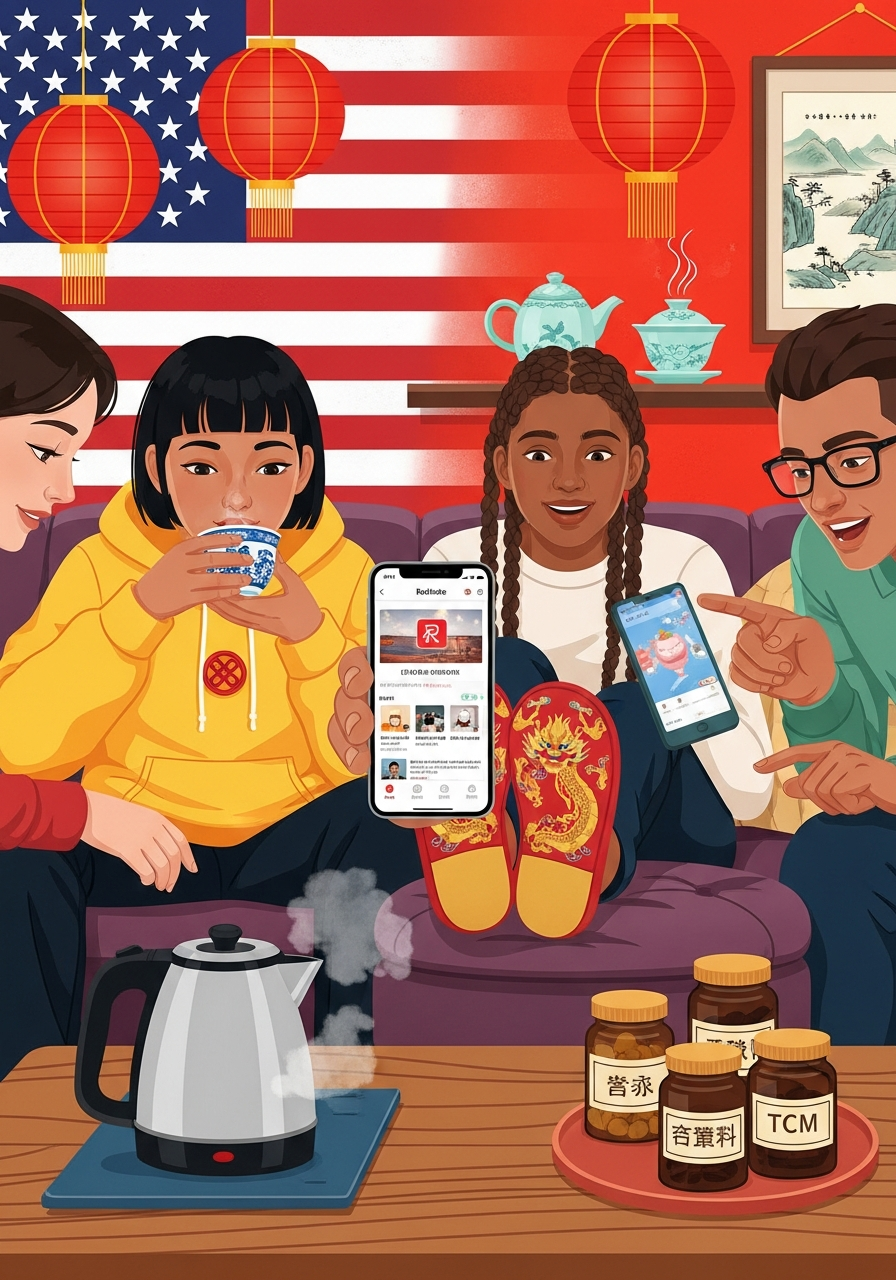
When the US government briefly banned TikTok in early 2025, hundreds of thousands of American users protested by migrating to Chinese social media app RedNote (Xiaohongshu). It hit number one on the Apple US App Store with over 700,000 sign-ups in a single week, creating the first direct connection between two previously separated online worlds. As American users interacted with actual Chinese users on RedNote, curiosity about Chinese culture exploded into what became the Chinamaxxing phenomenon.
Brand Finance Data Confirms America's Steepest Soft Power Decline
According to Brand Finance's Global Soft Power Index 2026, the United States recorded the steepest soft power decline of all 193 nations — down 4.6 points to 74.9, less than 1.5 points ahead of second-ranked China at 73.5. This global survey of over 150,000 respondents showed declining perceptions of American governance, friendliness, and commitment to collective goals. When American Gen Z says they want to become Chinese, this signals America losing its appeal more than China suddenly becoming attractive.
Cultural Appropriation Debate and Chinese-American Community's Complex Response
The sharpest criticism comes from Chinese-American communities. Their argument is simple: when they practiced these habits, nobody called them cool — they were mocked and discriminated against. Now white influencers do it and suddenly it is a trend. This mirrors the 2010s debate about the trendy appropriation of Black culture exactly. Stop AAPI Hate reported approximately 11,500 incidents between 2020 and 2022, making this cultural double standard all the more painful.
TCM Sales Surge 300-400% as Memes Drive Real Economic Impact
By Q1 2026, Western sales of Traditional Chinese Medicine products had surged 300-400% year-over-year. The Western TCM market is already worth 110 billion dollars and growing at 7.3% annually. Alongside TCM, demand for silk pajamas, precision-temperature electric kettles, and premium house slippers has spiked dramatically. This demonstrates how viral internet culture can translate into tangible consumer behavior changes and real market shifts.
The Dawn of Soft Power Multipolarization
If the 20th century was the era of Hollywood and Coca-Cola American soft power, the mid-21st century could become the era of TikTok and TCM-led Chinese soft power. The platforms that ignited Chinamaxxing — TikTok and RedNote — are both Chinese apps, creating an unintended digital pipeline for cultural transmission. While a complete reversal is unlikely as long as America retains Hollywood, Silicon Valley, and elite universities, the multipolarization of soft power is accelerating rapidly.
Positive & Negative Analysis
Positive Aspects
- Countering Anti-Asian Hate
By framing Chinese culture as cool, Chinamaxxing is at least partially softening negative stereotypes that surged during COVID-19. Stop AAPI Hate reported approximately 11,500 incidents between 2020 and 2022. While this does not solve structural racism, shifts in cultural favorability represent meaningful progress in combating anti-Asian sentiment.
- Genuine Health Habit Improvements
Though meme-originated, drinking hot water, maintaining indoor hygiene with house slippers, and adopting traditional exercises like Qigong are genuinely beneficial lifestyle changes. This represents a rare case where viral internet trends translate into real improvements in daily health practices and wellness routines.
- Direct People-to-People Cultural Exchange
Through the RedNote migration, ordinary American and Chinese citizens began talking directly without government or media filters for the first time. This grassroots connection could become a more powerful channel for mutual understanding than any diplomatic effort, potentially seeding lasting cross-cultural relationships.
- TCM Market Growth and East-West Wellness Integration
The Western TCM market at 110 billion dollars growing at 7.3% annually is being accelerated by Chinamaxxing. Combined with surging Mandarin learning demand, this opens possibilities for scientific research into East-West wellness integration and deeper cultural understanding beyond surface-level adoption.
Concerns
- Severe Cultural Decontextualization
On TikTok, TCM gets reduced to a checklist of habits. The foundational concepts — yin-yang, the five elements, qi, meridian theory — get discarded, leaving only what is hot on Instagram. This strips thousands of years of philosophical tradition down to consumable surface-level practices, removing all depth and meaning.
- Selective Blindness to Chinese Realities
Most Gen Z Americans doing Chinamaxxing do not mention China's internet censorship, social surveillance, or lack of political freedoms. The reality of 900 million people living on less than 2,000 yuan per month, the hukou system's urban-rural inequality, and the 996 work culture all fall outside Chinamaxxing's romanticized scope.
- Cultural Appropriation and Double Standards
When Chinese-Americans practiced these exact habits, they faced mockery and discrimination. Now that white influencers do the same things, it suddenly becomes trendy. This mirrors the exact pattern of the 2010s debate about Black culture appropriation and highlights persistent structural inequalities in whose cultural practices get celebrated versus ridiculed.
- Risk of Geopolitical Instrumentalization
As CNN analyzed, Chinamaxxing is a soft power boost for Beijing. The fact that TikTok and RedNote — the trend's main platforms — are both operated by Chinese companies deepens concerns about voluntary cultural adoption being leveraged geopolitically. A Taiwan Strait crisis could make enjoying Chinese culture politically sensitive overnight.
Outlook
Looking at where this heads, in the short term over the next one to six months, Chinamaxxing will likely maintain its viral momentum while deepening significantly. Signs of evolution from surface-level habits to deeper engagement — Mandarin learning, China travel, TCM clinic visits — are already emerging across multiple platforms. The Western TCM market is already worth 110 billion dollars and growing at 7.3% annually, and Chinamaxxing will accelerate this growth trajectory considerably. Duolingo has reportedly seen Mandarin learner sign-ups spike year-over-year, suggesting the trend is expanding beyond superficial memes into genuine cultural learning. Content creators are already pivoting from simple hot-water-drinking videos to deeper explorations of Chinese philosophy, cooking techniques, and traditional arts. But as with all viral trends, a peak will come. By summer 2026, Chinamaxxing as a meme will likely reach saturation as the novelty factor diminishes. However, the habits and interests already formed will not disappear overnight — they will simply evolve into less visible but more sustained practices.
In the medium term from six months to two years, the meme fades but its legacy remains in several possible scenarios. In the bull case, Chinamaxxing seeds genuine cultural exchange that transcends internet trends. RedNote-born grassroots connections persist and deepen, Mandarin learning demand surges through formal education channels, and scientific research into East-West wellness integration accelerates with institutional backing. Duolingo could see Mandarin enter its top three most-studied languages by 2027. American participation in Chinese cultural festivals and events could increase substantially, and clinical studies integrating TCM with Western medicine could gain momentum. In this scenario, Chinamaxxing would be remembered not as a passing internet trend but as a historic turning point in 21st-century East-West cultural exchange.
In the base case, which is considered most likely, the meme disappears but some practical changes stick. TCM clinics retain steady clientele built during the trend, hot water drinking becomes an ingrained habit for some Americans, and Chinese lifestyle products like precision kettles and silk pajamas maintain elevated demand. But the becoming Chinese narrative dies, absorbed into the broader and less politically charged category of Eastern wellness, following the same trajectory as the 2010s Japanese culture craze that evolved from becoming Japanese to simply enjoying Japanese food and minimalism. The cultural products will remain popular as consumer goods, but their connection to deeper Chinese cultural understanding will thin considerably.
In the bear case, further US-China deterioration politically stigmatizes Chinamaxxing entirely. A Taiwan Strait crisis, additional trade sanctions, or escalating military tensions could make enjoying Chinese culture politically sensitive virtually overnight. In America's increasingly polarized political environment, Chinamaxxing risks being framed as an anti-American act rather than innocent cultural exploration. This could trigger rapid decline in demand for Chinese cultural products and services, RedNote user exodus, and social media backlash against remaining Chinamaxxing content creators. Even so, the personal relationships formed and individual health habits adopted during the trend would not vanish completely.
In the long term over two to five years, the most fascinating question emerges: is the center of gravity of soft power truly shifting in a structural way? As Brand Finance data shows, the gap between American soft power at 74.9 and Chinese at 73.5 is already under 1.5 points and narrowing. If the 20th century was the era of Hollywood and Coca-Cola American soft power, could the mid-21st century become the era of TikTok and TCM-led Chinese soft power? A complete reversal is not foreseen, but accelerating multipolarization of soft power is clearly underway. As long as America retains Hollywood, Silicon Valley, and elite universities, it will not lose the top position — but Chinese culture's global penetration will keep strengthening through its own digital platforms. Fascinatingly, this mirrors the exact mechanism by which America spread the American Dream globally through Hollywood films in the mid-20th century — only the medium has changed from movie theaters to smartphones.
Ultimately, Chinamaxxing is not a triumph of Chinese culture — it is a warning that American culture needs deep self-reflection. Gen Z can drink hot water and wear slippers all they want, but what they are really searching for is not China. They are searching for what their country promised but failed to deliver — stability, efficient public systems, affordable healthcare, accessible housing, and genuine hope for the future. Drinking hot water will not fix the healthcare crisis, and wearing house slippers will not pass gun reform. What Chinamaxxing really reveals is that the young people of the world's most culturally powerful nation must seek comfort in another country's culture — because their own country's promises have grown hollow.
Sources / References
- Chinamaxxing: Gen Z Word of the Week — NPR
- Chinamaxxing: How Americans Are Embracing Chinese Culture as US Soft Power Declines — CNN
- What Is Chinamaxxing? Meet Gen Z New Trend About China — Newsweek
- TikTokers Are Becoming Chinese in a Trend Thats Part Parody and Part Politics — The Conversation
- Chinamaxxing: TikToks Campaign to Make Being Chinese Cool — Asia Times
- Global Soft Power Index 2026 — Brand Finance