
50 Best Just Landed in South America — Has Peru's Food Actually Become Real Soft Power?
Summary
The 50 Best Restaurants is heading to Lima, Peru for the first time in its 24-year history, marking the first time the event has been held in Peru and South America. For three decades, Peru has run one of the most deliberately engineered culinary branding campaigns in the world — anchored by chef Gastón Acurio's global vision and institutionalized through PromPerú and the Marca Perú national branding platform. The back-to-back world number one finishes by Central in 2023 and Maido in 2025 are the clearest evidence that the strategy worked at the highest level. Gastronomic tourism now accounts for 21.9% of Peru's tourism GDP, supports more than 388,000 jobs, and draws visitors who spend $196 more per trip and stay an average of 10 nights — a profile any tourism economy would want to cultivate. Yet the same boom has accelerated gentrification in Lima's Miraflores district, the 50 Best voting system carries structural biases that its own editorial staff openly acknowledges, and the economic rewards of this culinary revolution flow far more narrowly than the headline statistics suggest. This piece weighs Peru's food soft power project against its documented shadows, and asks what the global K-food push can realistically take from both the wins and the blind spots — because food can only become genuine national power when it improves the lives of the people who are actually doing the cooking.
Key Points
A Historic First: South America's Inaugural 50 Best Ceremony and the Brand Rebrand
The 50 Best Restaurants ceremony is coming to Lima, Peru on November 4, 2026 — the first time in its 24-year history that it will be held in South America. According to Mincetur and Andina, this is officially "the first time the event is held in Peru and South America," a distinction the Peruvian government has understandably highlighted as a milestone in the country's culinary diplomacy. The event was originally planned for Abu Dhabi, and the organizers have not publicly explained the venue change, leaving that detail as an interesting open question rather than a settled matter. This year also marks the first use of the new official name — "The 50 Best Restaurants," dropping the "World's" prefix — and a broader rebranding under "The 50," an umbrella that now covers restaurants, bars, hotels, and wineries together as a comprehensive hospitality platform. What makes the Lima ceremony particularly layered is that Maido, the 2025 world number one, will enter the Best of the Best Hall of Fame at this event, joining Central, which earned Hall of Fame status from its 2023 win. Lima thus becomes the first and only city with two Best of the Best restaurants simultaneously — a factual distinction no other city currently holds, and one that will be the central narrative in food media coverage throughout the fall season. The convergence of a historic venue, a landmark rebrand, and an unprecedented Hall of Fame moment in a single event makes November 4 a genuinely consequential date in the story of global culinary culture.
Peru's 30-Year Culinary Soft Power Architecture
Peru's rise to the top of the global restaurant world didn't happen organically — it was the product of three decades of intentional national strategy, a fact that distinguishes it from most other countries' culinary moments. Gastón Acurio articulated the vision early: in an Americas Quarterly interview, he described the mission as taking "this cultural patrimony — our cuisine — and promoting it throughout the world." His restaurant group has since expanded to 74 restaurants across 19 cities in 10 countries, according to Forbes Perú in October 2025, building a commercial footprint that functions as a distributed brand ambassador network around the world. The government matched that vision with institutional infrastructure: PromPerú and the Marca Perú platform were designed to embed cuisine as a deliberate pillar of Peru's international identity, and PromPerú's leadership described Peruvian food explicitly as a "strategic asset for the country's international promotion." Marca Perú achieved 100% domestic name recognition with 80% of Peruvians reporting national pride in the brand, per Brand Finance, and operates 1,408 active licenses spanning tourism, gastronomy, exports, and culture — the kind of institutional scale that turns a cultural moment into a durable brand. What makes this strategy particularly instructive for other countries is the three-way partnership between individual chef vision, sustained government backing, and a dedicated national branding institution. Peru's culinary ascent isn't primarily a story about talented chefs, though they are genuinely talented. It's a story about building the governance architecture to convert individual talent into sustained national brand equity over a long time horizon.
Measurable Economic Output from Gastronomic Tourism
Peru's food soft power strategy isn't only symbolic — it has produced economic outcomes that are measurable, substantial, and unusually specific. Official Mincetur statistics show that gastronomic tourism accounted for 21.9% of Peru's tourism GDP in 2024, generating 6,832 million soles, approximately 1.8 billion dollars. The sector supports more than 388,000 jobs, representing 29.6% of total tourism employment — a figure that spans not just fine dining restaurants but the broader hospitality, agriculture, and food education industries that have grown alongside the restaurant scene. A PromPerú visitor survey found 81% of international tourists rated local food experiences as among their most important activities in Peru, and 15% said gastronomy was their primary reason for visiting. The economic profile of gastronomic tourists is particularly strong: they spent an average of $1,237 per trip, $196 more than the typical visitor, and stayed an average of 10 nights — a longer stay that cascades into hotel revenues, transportation, regional excursions, and incidental spending. Peru has also been recognized as the world's leading culinary tourism destination by World Travel Awards 12 times, a record that demonstrates consistent brand performance rather than a one-year spike. The economic impact figures from comparable 50 Best events, as reported by Andina and Mincetur — $40.8 million in advertising value equivalent from Rio, 82 million interactions from Seoul — give a partial sense of what a major 50 Best ceremony contributes to media visibility and tourism awareness, even accounting for the promotional framing of these numbers.
Gastronomic Gentrification and the Unequal Distribution of Benefits
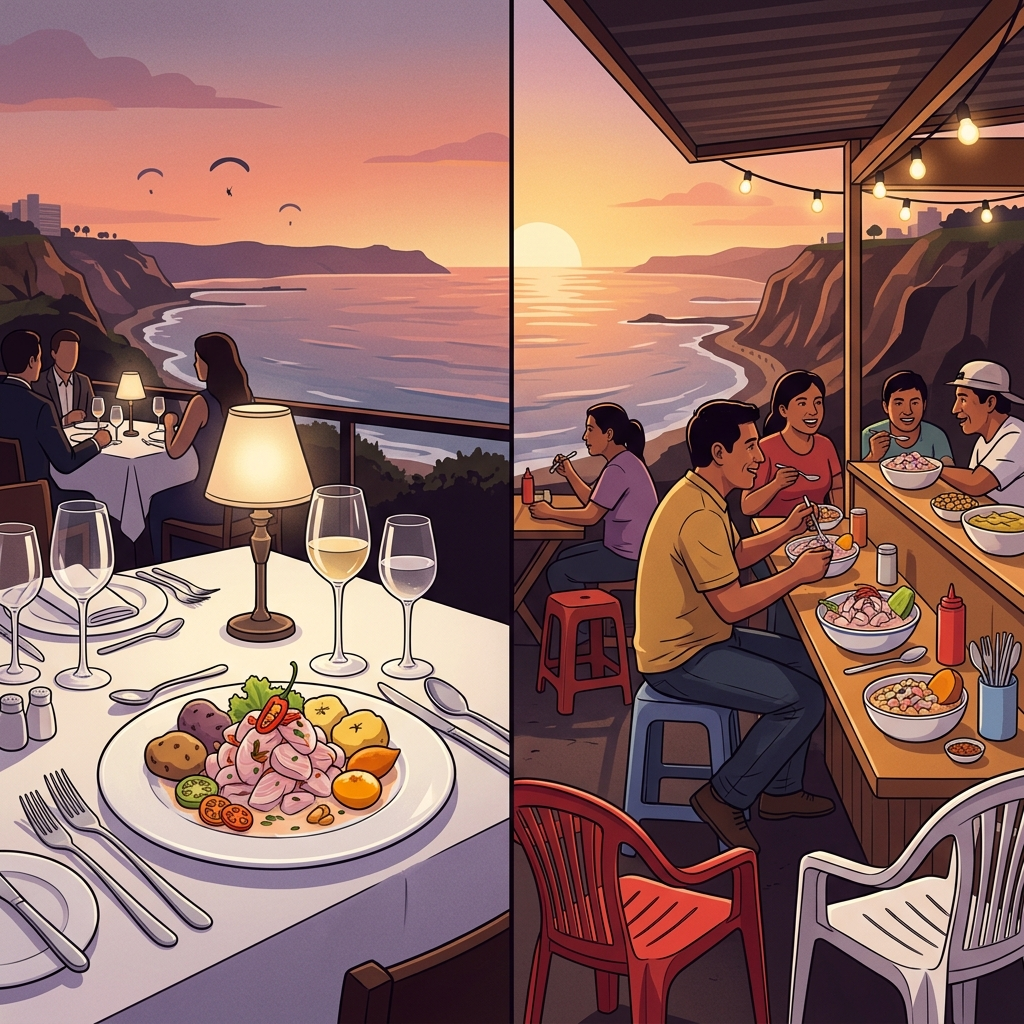
The most important structural tension in Peru's culinary success story is also the one most consistently absent from the celebratory coverage: the economic benefits of the gastronomy boom are sharply and unequally distributed, with the greatest gains accruing to a narrow segment of Lima's population while significant costs fall on others. Claux's 2024 ethnographic study, published in FLACSO's academic journal Íconos, documented that the gastronomy boom between 2012 and 2016 directly accelerated gentrification in Miraflores' Santa Cruz neighborhood — a process in which rising rents, driven by high-end restaurant openings, displaced longtime residents who had built their lives in that neighborhood. This isn't speculative critique; it's documented through field research in the specific neighborhood at the center of Lima's culinary renaissance. Maido's basic tasting menu at approximately 1,190 soles, per Forbes Brasil in June 2025, and Central's pricing in the hundreds of dollars range, make these restaurants inaccessible to the vast majority of Lima residents. Caja-Corrales et al. (2025) identified the mechanism explicitly: "gastronomic gentrification affects traditional culinary practices, local actors, and the symbolic meanings attached to food." Reyes Garcés, in Gastropolitics and the Specter of Race, goes further, arguing that the narrative of food erasing social barriers can actually reinforce existing racial and gender hierarchies rather than dissolve them. The suspension of the Mistura festival after 2019 — the most important mass-participation event in Peru's gastronomic calendar — underscores that the democratic dimension of the culinary revolution is fragile. Understanding this tension doesn't diminish Peru's achievements; it's the essential context for evaluating what kind of achievement it actually is.
The 50 Best Ranking: Structural Limitations and the Credibility Question
Any serious evaluation of Peru's culinary soft power has to engage honestly with the ranking system that currently anchors it — and that system has documented structural limitations that deserve examination rather than polite avoidance. Tasting Table's investigative analysis found the 972-person voter panel is predominantly white and male, and the regional vote allocation is difficult to defend on any geographic or demographic logic: the United States receives 108 votes while China and Korea together receive 36. There is no requirement for voters to demonstrate they have visited the restaurants they rank, which means the list is structurally more susceptible to reputation effects and social influence within food industry networks than to independently audited dining experience. The 50 Best group editor has publicly acknowledged: "We acknowledge that it's not definitive." That statement is notable for its honesty, but it also confirms that this is a poll of well-connected industry insiders rather than an objective audit — a meaningful distinction for a ranking that functions as a primary reference point for international culinary prestige. PromPerú is an official partner of the 2026 Lima ceremony, which creates a structural overlap between the national entity most invested in Peru's culinary reputation and the organization managing the ranking that anchors that reputation — a relationship worth noting even if no direct causal claim is warranted. A 2019 reform addressed some documented biases without fundamentally restructuring the voting architecture, and the ongoing rebrand to "The 50" is primarily a scope expansion rather than a methodology overhaul. Recognizing these limitations is not an argument against Peru's culinary achievements, which are genuine. It's a prerequisite for evaluating those achievements with proportional accuracy.
Positive & Negative Analysis
Positive Aspects
- Successful Economic Conversion of an Intangible Cultural Asset
Peru's most striking economic achievement is the successful conversion of cuisine — an intangible cultural resource — into a measurable, structural contributor to national economic output. Gastronomic tourism generating 21.9% of tourism GDP in 2024 is not a marginal or supplementary contribution; it's a pillar of the entire sector's value. The $196-per-trip premium gastronomic tourists pay over average visitors, combined with their average 10-night stay, positions them as the highest-value segment in Peru's tourism portfolio — the kind of visitor profile that generates cascading economic effects through accommodation, transportation, and regional spending. The 388,000-plus jobs representing 29.6% of total tourism employment confirm this is a labor market story, not just an elite restaurant story. The economic impact figures from comparable 50 Best events — $40.8 million in advertising value equivalent from Rio, 82 million interactions from Seoul, hotel revenue exceeding $750,000 from Las Vegas, and a total reach of 6 billion reported from Abu Dhabi — offer a partial preview of what Lima's global flagship event may generate in media visibility and tourism inflow, though these promotional metrics should be read with the understanding that they represent organizer and government estimates rather than independently verified data. The 12 World Travel Awards recognitions as the world's leading culinary destination represent sustained competitive performance that demonstrates the brand has compounded over time rather than peaking and fading. For countries watching Peru and considering similar investments, this is the clearest evidence that a deliberate culinary branding strategy can produce economic returns at national scale.
- An Original Culinary Genre and the Recovery of Cultural Self-Confidence
Peru's gastronomy revolution accomplished something that's rare in the modern food world: it didn't simply elevate existing traditions to fine dining status, but actually generated a genuinely new culinary genre recognized internationally. Nikkei cuisine — the creative fusion of Japanese and Peruvian traditions that Maido has brought to global prominence — is a form that didn't exist as an internationally recognized genre a generation ago. Central's approach of reconstructing Peru's extraordinary biodiversity altitude by altitude through a tasting menu format transformed the country's ecological wealth into cultural content in a way that has no direct precedent. These are new frameworks for how food can work as art, idea, and cultural statement, not iterations on French or Italian fine dining conventions. The contrast with Lima's restaurant scene of two decades ago — when French cuisine was the default prestige register for the city's finest restaurants — is a 180-degree reversal that happened in a compressed timeframe. Marca Perú's 80% national pride response, per Brand Finance, suggests this reversal has not remained confined to elite circles but has genuinely shifted how Peruvians understand their own national identity. Cultural self-confidence of this kind — the sense that your own traditions are world-class rather than provincial — is not something that appears in any economic calculation, but it may be the most durable and valuable outcome of the entire three-decade project.
- A Governance Model Worth Benchmarking
What distinguishes Peru's culinary strategy from most other countries' approaches is the tripartite governance architecture that made it work: individual chef vision, sustained government institutional support, and a dedicated national branding platform operating in coordinated alignment. Acurio provided the vision and the global commercial network. PromPerú and Marca Perú provided the policy infrastructure, the promotional machinery, and the institutional continuity that outlasts any individual administration. The explicit framing of cuisine as a "strategic asset for the country's international promotion," rather than merely a cultural soft story, signaled that food policy was being handled at the same level of seriousness as trade and investment policy. Marca Perú's 1,408 active licenses spanning tourism, gastronomy, exports, and culture show a platform architecture that can extend beyond food into a broader national brand ecosystem. The inclusion of PromPerú as an official partner of the 2026 Lima ceremony illustrates how the government continues to actively leverage major international events as amplification moments for the national brand strategy. For any country — Korea included — looking to build systematic culinary soft power rather than a collection of individually excellent restaurants, this governance model is the most directly instructive element of Peru's experience. The lesson isn't "have great chefs." The lesson is "build the institutional infrastructure to convert great chefs into durable national brand equity."
- Education Pipeline and Social Mobility Integration
Peru's food strategy deserves credit for attempting — however incompletely — to route some of the gastronomy boom's benefits toward the communities who might otherwise only experience it as displacement. Instituto de Cocina Pachacutec, founded by Acurio in a low-income Lima district in 2007, is the most direct embodiment of this intention: a culinary school in a neighborhood where the high-end restaurant economy would otherwise be a spectator experience. By around 2013, Americas Quarterly was reporting that Lima had more than 35 culinary education institutions operating — a supply-side development that shows the boom was generating institutional infrastructure, not just celebrated restaurants. The Mistura food festival's 506,531 attendees at its 2012 peak demonstrated that gastronomic culture could be organized as popular participation rather than elite spectatorship — a proof of concept that deserves to be revived. The 388,000-plus gastronomy-related jobs representing 29.6% of tourism employment indicate real labor market breadth across the skill and income spectrum, from fine dining kitchens to agricultural supply chains to culinary education. None of this fully addresses the structural inequality that Claux and Caja-Corrales document, and the Mistura suspension after 2019 is a real setback for the mass-participation dimension of the story. But the attempt to design social mobility into the project, rather than treating it purely as an elite branding exercise, is worth recognizing as something other countries consistently fail to do at all.
Concerns
- Gastronomic Gentrification and Community Displacement
The most consequential downside of Peru's gastronomy boom is the direct evidence that it has displaced the communities it supposedly celebrates. Claux's 2024 ethnographic research in Miraflores' Santa Cruz neighborhood, published in FLACSO's Íconos journal, documented that the 2012-2016 boom period saw rents climb sharply as high-end restaurants and bakeries moved into the neighborhood, pushing out the longtime residents who had built their lives there. This is not a speculative concern extrapolated from general gentrification theory; it's field-documented displacement in the specific neighborhood at the center of Lima's food renaissance. Maido's basic tasting menu at approximately 1,190 soles per Forbes Brasil and Central's pricing in the hundreds of dollars per person means the restaurants driving Lima's global reputation are financially inaccessible to the overwhelming majority of Lima residents. Caja-Corrales et al. (2025) articulated the mechanism: "gastronomic gentrification affects traditional culinary practices, local actors, and the symbolic meanings attached to food" — meaning the communities and practices that created the culinary heritage being celebrated are being materially harmed by the very celebration. Of the 175,049 gastronomic tourists recorded in 2023, 61% came from Latin America, and their average spend of $1,237 flows primarily into the upscale districts of Miraflores and Barranco rather than distributing across the city. The Mistura festival's effective suspension after 2019 removed the most visible instrument of popular participation in Peru's food culture. As long as this distributional gap persists and deepens, the "soft power" framing has a credibility problem at its core.
- Structural Bias and Commercial Entanglement in the Ranking System
The 50 Best ranking that Peru's culinary reputation depends most heavily on carries structural limitations significant enough to warrant direct examination. Tasting Table's investigative analysis documented a voter panel of 972 people that is predominantly white and male, with 108 votes allocated to the United States versus 36 combined for China and Korea — a regional distribution that reflects neither geographic proportion nor culinary tradition breadth. The absence of any requirement for voters to verify they've actually visited the restaurants they rank means the list is structurally dependent on reputation effects and industry social networks rather than independently verifiable dining experience. The 50 Best group editor's own statement — "We acknowledge that it's not definitive" — is an honest acknowledgment that this is an industry poll, not an objective audit, and that characterization matters for understanding what the ranking actually measures. PromPerú's position as official partner of the Lima ceremony creates a structural adjacency between the national entity most invested in Peru's culinary reputation and the organization managing the ranking that underpins that reputation. A 2019 methodology reform addressed some documented biases without resolving the underlying architecture. Countries that build their national branding strategies around this specific ranking are building on a foundation that its own administrators describe as non-definitive and that academic and journalistic critics have identified as structurally unrepresentative. Peru has the most to gain from the ranking's prestige and also, by that logic, the most exposure to any deterioration in the ranking's credibility.
- The Gap Between Promotional Metrics and Lived Economic Experience
The economic statistics that circulate in coverage of Peru's gastronomy boom deserve to be read with more scrutiny than they typically receive. The 50 Best event impact figures reported through Andina and Mincetur — Seoul's 82 million social interactions, Rio's $40.8 million in advertising value equivalent, Abu Dhabi's total reach of 6 billion — are produced by organizers and government partners whose institutional purpose is to demonstrate return on investment to their stakeholders. "Advertising value equivalent" and "total reach" are marketing metrics that measure media exposure, not economic activity in the neighborhoods hosting these events. The government's tourism employment figure of 388,000-plus jobs is a meaningful aggregate, but it tells us nothing about wage levels, contract stability, or working conditions behind that headline number — the factors that determine whether employment translates into actual economic wellbeing. The Mincetur statistics showing gastronomic tourism at 21.9% of tourism GDP are official figures produced by the ministry whose mandate includes demonstrating the success of its own programs. Peru's 2025 international visitor count remains 21.2% below pre-pandemic levels, a reminder that strong culinary branding doesn't fully compensate for other structural factors in travel decisions. And the distributional question — which neighborhoods and income levels actually capture the spending of the 175,049 gastronomic tourists who averaged $1,237 per trip — remains unanswered in the public data. The gap between macro success indicators and neighborhood-level economic experience is where the real story of Peru's food soft power lives, and it's a gap the current data architecture makes it very difficult to see clearly.
- The Gastronomy Narrative as a Screen for Persistent Social Hierarchies
One of the more uncomfortable aspects of Peru's culinary success story is the gap between the social equity narrative it projects and the social realities it may actually be reproducing. Reyes Garcés's academic work in Gastropolitics and the Specter of Race, published by Routledge, makes the pointed argument that Peru's gastronomy revolution — which explicitly presents food as a mechanism for bridging racial and class divides — can actually reinforce existing racial and gender hierarchies rather than dissolve them. The celebrated chefs who lead Lima's fine dining scene are predominantly urban, middle-class or above, and the Andean indigenous ingredients that have become the prestige content of their menus are often detached from the cultural contexts and communities that created them. This is what Caja-Corrales et al. identify as the erosion of "the symbolic meanings attached to food" — the culinary heritage is absorbed into a fine dining narrative while the communities who hold that heritage are priced out of the neighborhoods where it's being celebrated. The Mistura festival's suspension after 2019 removed what had been the most visible popular counterweight to this elite dynamic — the platform through which Peru's gastronomic culture could function as mass participation rather than elite spectatorship. The structural critique here isn't that Peru's chefs aren't genuinely talented or that the food isn't genuinely innovative. The critique is that the social bridge narrative the gastronomy revolution tells about itself may be obscuring the ways in which the revolution is reproducing, rather than dismantling, the hierarchies it claims to transcend.
Outlook
The November 4 ceremony at Lima's Teatro Municipal deserves to be thought through carefully on its own terms before getting to the bigger picture. Under the new 50 Best Restaurants branding, Maido will enter the Best of the Best Hall of Fame at this ceremony — which means it exits future competitive voting, and the 2026 ranking cycle becomes more open for the restaurants still in competition. The timing is almost cinematically perfect: Tsumura's restaurant receiving its highest honor in its own home city, before a global audience, in the same year Lima hosts the ceremony for the first time. Central already entered the Hall of Fame from its 2023 win. That makes Lima the only city in the world with two Best of the Best restaurants simultaneously — a factual distinction that will anchor the international food media narrative for the entire lead-up to November and the weeks that follow.
The day before the main ceremony — November 3 — hosts 50 Best Talks, which brings food industry professionals, investors, and media to Lima for conversations and connections that often produce more commercially durable outcomes than the headline event itself. The long-form coverage generated by attending food journalists, the documentary content, the social media output from visiting chefs eating their way through Lima in the days around the event — these amplification trails compound for weeks beyond a single night. With Kjolle ranked ninth and Mérito twenty-sixth in the 2025 list, and Maido now vacating the competitive ranking, Lima restaurants are positioned to make significant moves upward in 2026. Pía León has built her own distinct culinary narrative entirely independent of Martínez, which gives international food media a fresh angle to pursue — the next generation of Lima's ecosystem, rather than a repeat of the same two names.
On the short-term economic picture: Andina and Mincetur have documented impact figures from comparable events. Asia's 50 Best 2025 in Seoul generated 82 million interactions and 4.1 million video views. Latin America's 50 Best 2025 in Rio generated $40.8 million in advertising value equivalent. North America's 50 Best 2025 in Las Vegas produced over $750,000 in hotel and accommodation revenue alone. Abu Dhabi's MENA 50 Best 2024 reported a total reach of 6 billion. Lima is hosting the global flagship — not a regional competition — so the media scale should substantially exceed any of these regional benchmarks. I want to be transparent that all of these figures are produced by organizers and government partners for promotional purposes and should be read as maximum-favorable-interpretation metrics rather than independently audited economic data. The actual neighborhood-level impact on Lima will be more concentrated and likely smaller in absolute terms than the headline numbers suggest.
Looking at the medium-term tourism recovery picture: Mincetur reported 4,157,469 international visitors to Peru in 2025 — a 4.1% year-over-year increase, but still only 78.8% of pre-pandemic levels. Tourism Minister Jose Reyes has set an international tourist target of 4 million for 2026. First quarter 2026 showed 823,863 visitors, a 3.5% increase over the same period last year — the recovery trajectory is holding. The 50 Best ceremony arriving in November is well-positioned to accelerate momentum into year-end and influence early 2027 booking patterns. However, a real distributional risk exists: if the tourism surge concentrates in Miraflores and Barranco while leaving Cusco, Ica, and other Peruvian regions behind, the inequality problem I raised in the body gets structurally worse. Whether Peru's government has a strategy for routing the Lima ceremony's effects outward to other regions is one of the genuinely consequential policy questions in the months ahead.
The competitive landscape for culinary soft power has intensified significantly, and Peru is no longer running this race alone. Thailand's Global Thai program has methodically seeded Thai restaurants worldwide for years, building network effects that compound independently of any single event. Japan's washoku UNESCO intangible heritage designation elevated traditional food culture through an institutional legitimacy mechanism that no commercial ranking can replicate. Korea's K-food globalization policy is now riding K-culture's existing soft power infrastructure — a compounding network effect that Peru had to construct from scratch through food alone over three decades. The 50 Best's own rebrand from a single restaurant list to "The 50" — a comprehensive hospitality platform covering restaurants, bars, hotels, and wineries — changes the competitive dynamics in ways Peru should think carefully about. Peru is the clear leader in the restaurant category, but its position in bars, hotels, and wineries is far less developed. As the platform evolves toward a holistic hospitality index, Peru's current competitive advantage could narrow considerably.
The 50 Best organization itself is at a structural inflection point that directly affects the long-term value of any national investment in this platform. According to Restaurant Online, the 2026 rebrand to "The 50" is the first structural change since the organization's founding in 2002, with the Paris 50 Best Hotels 2026 serving as the inaugural ceremony under the new umbrella brand. The 2019 voting reform addressed some documented Western and gender biases in the methodology, but structural representation gaps remain — 108 votes for the US versus 36 combined for China and Korea is not resolved by a policy statement. The group editor's public acknowledgment that the ranking "is not definitive" invites further pressure for methodology reform that is already building. If 50 Best introduces mandatory visit verification or transparent voter identification, the ranking gains credibility it currently relies on reputation to sustain. But those same reforms would reduce the influence of government-sponsored partnerships like the one PromPerú currently holds. For Peru specifically, deeper 50 Best transparency is a double-edged outcome: more legitimate authority for the ranking, but less institutional leverage over how results unfold.
For K-food specifically, the Peru model offers something important that typically gets lost in the high-level analysis: the necessity of building food as an independent soft power axis, not merely a lifestyle accessory to a broader pop culture ecosystem. Korea's food currently circulates largely as a supplement to the K-culture ecosystem — K-drama characters eating tteokbokki is effective marketing, but if K-drama's global moment eventually fades, food loses part of its structural support along with it. Peru built cuisine as a standalone cultural pillar with its own institutional infrastructure, dedicated economic metrics, and international network — not as a tie-in product for something else. That independence is its most transferable lesson. Marca Perú's 100% domestic recognition and 80% national pride response, anchored specifically to food and cuisine, shows what dedicated culinary branding infrastructure can achieve over a generation. Korea has the food quality and the existing soft power network to match or exceed Peru's trajectory. The key move is deliberately funding culinary branding as its own strategic domain rather than treating it as a footnote in the hallyu content budget. Seoul's 82 million interactions from Asia's 50 Best 2025 is strong evidence that Korea already has the event infrastructure to anchor global culinary narratives when it chooses to.
Now, three scenarios for how this story develops. In the optimistic scenario, the Lima ceremony generates outsized global media attention, meaningfully accelerates Peru's tourism recovery past pre-pandemic levels, and the platform effect catalyzes culinary branding investments across Latin America, Southeast Asia, and West Africa that lift the entire field. PromPerú uses the exposure to push gastronomic tourism beyond Lima into regional Peru, distributing economic benefits more broadly and reducing the Miraflores concentration effect. The 50 Best evolves toward a more transparent, auditable methodology that increases the ranking's legitimacy, which in turn strengthens the long-term value of Peru's investment in the platform. Concrete policy responses to gentrification arrive before displacement dynamics become structurally irreversible. The Mistura festival, effectively dormant since 2019, finds a path back as a popular counterweight to the elite fine dining narrative and a signal that the gastronomic revolution is genuinely broad-based.
In the base scenario — which I think is the most probable outcome — the ceremony produces a strong but time-bounded media spike. Lima gets a measurable tourism boost in the first half of 2027, gastronomic tourism's share of Peru's tourism GDP holds or ticks slightly upward from 21.9%, and Lima's culinary reputation consolidates without a dramatic leap in its global standing. The gentrification dynamic continues without systematic policy intervention, and the distributional gap between Lima's showcase restaurant economy and its working-class food culture deepens quietly and without significant media attention. K-food and Thai food both make modest competitive gains in global culinary positioning. 50 Best makes incremental methodology adjustments that improve its transparency narrative while stopping short of structural reforms that would fully address the credibility gap its own editor acknowledged.
The pessimistic scenario deserves naming even if it's less likely. Academic criticism of gastronomic gentrification reaches international food media and becomes part of the Lima ceremony's narrative frame — the "world's best restaurants in a city that's displacing its own residents" story gains traction before or shortly after November. Simultaneously, 50 Best's methodology vulnerabilities get amplified by a high-profile challenge from a major food outlet or competing ranking. Peru's political volatility — the country has cycled through multiple presidents in recent years — creates operational or reputational friction in the lead-up to the ceremony. Premium travel demand softens globally, compressing the gastronomic tourist segment that the entire economic model depends on. The fact that Peru's 2025 visitor count remains 21.2% below pre-pandemic levels is a standing reminder that even strong culinary branding can't fully compensate for other structural friction in travel decisions.
My honest assessment is that the base scenario is the most likely, with the key variables being how Peru's government handles the gentrification problem — whether it introduces concrete policy before the issue becomes a reputational crisis — and whether the 50 Best platform's credibility holds or erodes through the next ranking cycle. For anyone watching this story from a food diplomacy or national branding perspective: don't just track the rankings. Track what happens to rent levels in Miraflores after November. Track whether Mistura or something like it comes back as a popular festival. Track whether the 388,000 jobs in gastronomic tourism show visible wage growth in household-level data. That's where the real story of Peru's food soft power will be written — not in a trophy cabinet at Teatro Municipal, but in the daily economics of the city that built it.
Sources / References
- The 50 Best Restaurants 2026 Lima — Official Announcement — The 50 Best (Official) — The 50 Best Restaurants 2026 Lima — Official Announcement
- Peru to Host The World's 50 Best Restaurants for First Time — Andina (Official Peruvian State News Agency) — Peru to Host The World's 50 Best Restaurants for First Time
- Peru's Gastronomic Tourism Economic Statistics — Mincetur Minister Statement — La República — Peru's Gastronomic Tourism Economic Statistics — Mincetur Minister Statement
- Gastón Acurio: Peru's Culinary Ambassador — Americas Quarterly — Gastón Acurio: Peru's Culinary Ambassador
- The World's 50 Best Restaurants Rankings: A Deep Dive — Tasting Table — The World's 50 Best Restaurants Rankings: A Deep Dive
- Gastronomic Gentrification Academic Study — Claux 2024 — FLACSO Íconos — Gastronomic Gentrification Academic Study — Claux 2024
- Acurio Restaurantes: 74 Restaurants in 10 Countries — Forbes Perú — Acurio Restaurantes: 74 Restaurants in 10 Countries
- How Much Does It Cost to Eat at the World's Best Restaurant in 2025? — Forbes Brasil — How Much Does It Cost to Eat at the World's Best Restaurant in 2025?
- More Than 175,000 Foreign Visitors Come to Peru for Gastronomic Tourism — Andina — More Than 175,000 Foreign Visitors Come to Peru for Gastronomic Tourism
- Gastropolitics and the Specter of Race: Stories of Capital, Culture, and Coloniality in Peru — Routledge — Gastropolitics and the Specter of Race: Stories of Capital, Culture, and Coloniality in Peru