
The Myth Costs $500M and the Truth Gets 37% — What Michael Jackson's Biopic Reveals About Hollywood's Real Business
Summary
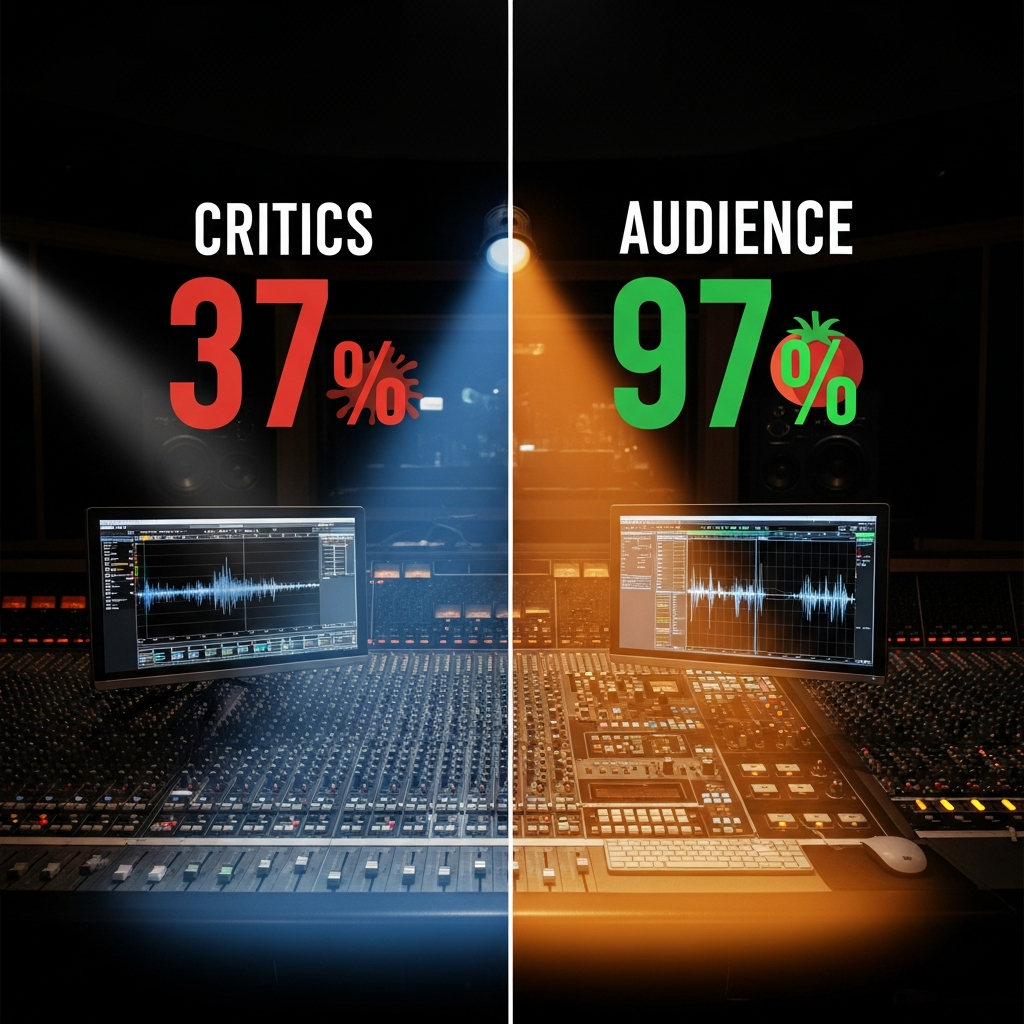
The Michael Jackson biographical film "Michael" has surpassed $500M at the global box office, establishing a new record for the biopic genre while generating an unprecedented 60-point divergence between critics (37%) and audiences (97%) on Rotten Tomatoes — a gap that reveals far more about Hollywood's industrial business model than it does about any aesthetic disagreement between professionals and general viewers. The Jackson Estate's dual role as producer and music licensor — with attorneys John Branca and Karen Langford overseeing narrative decisions and Michael's son Prince Jackson serving as co-producer — resulted in the surgical removal of the entire third act addressing the 1993 Jordan Chandler civil settlement, following a 2024 legal review that identified contractual clauses prohibiting his depiction in any film. This structural conflict of interest, in which a subject's estate controls both the creative narrative and the intellectual property essential to the film's commercial viability, represents a systemic failure of artistic independence that the industry will not merely tolerate but actively replicate across future productions involving other music legends. The film's commercial triumph demonstrates that audiences reliably prefer mythologized spectacles over complex biographical truth, a consumer preference already confirmed by Bohemian Rhapsody ($910M) and Elvis ($287M) and one that estate-led productions will now aggressively exploit as they expand to Prince, Whitney Houston, and Tupac. The estate producer model pioneered by "Michael" is positioned to become the genre standard for at least the next three to five years, accelerating a bifurcation between sanitized theatrical mythology and unauthorized streaming investigations while simultaneously privatizing the cultural memory of 20th-century public figures at industrial scale.
Key Points
The Fundamental Conflict of Interest in the Estate Producer Structure
The Michael Jackson Estate is a corporation generating hundreds of millions of dollars annually, with attorneys John Branca and Karen Langford holding legal fiduciary duties to maximize the value of the Michael Jackson brand — and those same attorneys took executive producer credits on this biographical film, a combination that makes narrative independence structurally impossible rather than merely difficult. The moment those attorneys accepted producer authority, the project's objective shifted from artistic truth to brand protection by contractual necessity rather than creative choice, because their legal obligations to the Estate's financial interests supersede any informal commitment to biographical accuracy. Prince Jackson's role as co-producer deepened this structural problem significantly: once a family member is embedded inside the production apparatus with formal credit and decision-making authority, critical perspective on the subject becomes organizationally impossible to maintain at any level of the production. Paris Jackson's $625,000 legal settlement against the Estate over attorney compensation reveals that even within Michael's own family, the Estate's management is a contested rather than unified entity — which means the film cannot credibly claim to represent a family consensus that does not factually exist. This is not an isolated conflict of interest within a single production: it is a systemic problem generated by the triangular relationship between estate corporation, family members with competing interests, and studio financial backing, and the $500M commercial validation of this structure means every future biopic involving a deceased music icon will face intensified industry pressure to replicate it. The Bohemian Rhapsody parallel — where Queen members served as producers and attracted similar sanitization critiques from film journalists — is instructive as a precursor, but "Michael" extended that structure by adding legally enforced content removal on top of producer control, a qualitative escalation that changes the stakes entirely and establishes a new industry precedent for biographical censorship through contractual mechanisms.
The Legal Precedent: Civil Settlement Clauses as Artistic Censorship
During the 2024 reshoots, Estate attorneys reviewed the 1993 civil settlement agreement with Jordan Chandler and identified a clause prohibiting his reference or depiction in any film — a discovery that triggered the complete restructuring of the film's entire third act at enormous additional production cost and irreversible creative disruption to a project already in its final stages. The June 2025 reshoots that followed generated tens of millions in additional expenditure and fundamentally altered the narrative architecture of a $200M production, removing the most commercially significant and historically documented period of Michael Jackson's adult life from its own authorized biography. This precedent establishes that a private civil settlement, agreed under entirely different circumstances and for entirely different purposes decades earlier, can function as a legally binding artistic veto over a major Hollywood production without any court oversight, public process, or disclosure obligation to the audience purchasing tickets. Future biopics involving controversial public figures will now contend with estates proactively reviewing historical settlement agreements for comparable restrictive clauses, effectively weaponizing civil litigation archives against biographical filmmaking as a standard preproduction practice and due diligence requirement. The First Amendment implications are significant and entirely unresolved: no court has yet ruled on whether estate-enforced content removal from biographical films constitutes a permissible contractual restriction or an unconstitutional restraint on artistic expression that serves the public interest, and until a definitive ruling arrives, the legal power of settlement clauses over biographical content is virtually unlimited in scope. This legal uncertainty creates a structural chill on biographical storytelling that operates below the level of public awareness and is all the more dangerous for its invisibility from outside the production process.
The 60-Point Critic-Audience Split and the Crisis of Film Criticism
The Rotten Tomatoes divergence of 60 points between critics (37%) and audiences (97%) is not a data point in an ongoing and healthy debate about taste — it is a historical anomaly reflecting two fundamentally incompatible evaluation frameworks operating simultaneously on the same commercial object. Critics applied the standard tools of professional film analysis: narrative structure and coherence, character complexity and development, thematic integrity, and the biographical responsibility to confront a subject's defining conflicts rather than strategically avoiding them. Audiences applied a different evaluative standard entirely: emotional engagement with the music in a theatrical setting, appreciation for Jaafar Jackson's physical and kinetic performance, and fan satisfaction with an artist they love presented at the scale and production quality their fandom has always felt the artist deserved. The historical acceleration of this gap across comparable productions makes the trend impossible to dismiss as random variation: Evita in 1997 produced a 15-point gap, Bohemian Rhapsody in 2018 generated 40 points, Elvis in 2022 showed 30 points, and Michael in 2026 has produced 60 points. As this gap widens over time, studio executives face decreasing financial incentive to engage meaningfully with critical reception during the production decision-making process, which removes the only institutional check on biographical quality below which no commercial film previously needed to fall. The longer-term consequence is not simply more bad biopics but the systematic transformation of film criticism from a consumer-guidance institution that influences viewing decisions into an internal industry discourse that general audiences have no practical reason to consult before purchasing a ticket.
The Commercial Validation and Contagion Risk of the Sanitized Biopic Formula
The pattern established by Bohemian Rhapsody — simplify a complex human being into heroic mythology, center the music as the primary audience draw, remove or significantly minimize the most difficult biographical conflicts, and activate the pre-existing global fanbase as a viral marketing force that no conventional advertising budget can replicate — has been confirmed and industrialized at even larger scale by Michael ($500M). This formula operates on economic logic that is genuinely difficult for any studio to resist: an existing fanbase of tens of millions functions as a zero-cost promotional engine that reduces marketing expenditure while simultaneously generating social media momentum with an authenticity that paid campaigns cannot produce. Lionsgate's active sequel development confirms the Estate model is being franchised rather than merely repeated as a one-time commercial experiment — and the Prince and Whitney Houston estates are reportedly monitoring the "Michael" results with considerable interest as a template for structuring their own biopic negotiations with major studios. I expect at least three formal estate-led biopic announcements before the end of 2026, with narrative approval rights codified more explicitly and enforceably than in the "Michael" deal, because the "Michael" precedent has demonstrated that audiences will not penalize studios for the arrangement. By 2028, estate-led productions will likely command approximately 50% of the biographical film genre's projected $4B annual global market — up from roughly 30% today — effectively crowding out the independently produced, critically rigorous biographical work that lacks estate cooperation and cannot secure essential music licensing access.
The Privatization of Cultural Memory and Its Threat to Public History
When an estate simultaneously controls music licensing rights and producer authority over a biographical film, the "official version" of a public figure's life becomes a corporate asset rather than a shared cultural record, and that transition has consequences extending far beyond any individual film's commercial performance. Making a Michael Jackson biographical film without his music is commercially and artistically impossible — the music catalog is the primary reason for the film's existence, its central audience draw, and its main competitive advantage over any unauthorized alternative — and accessing that catalog requires Estate approval, which in turn requires narrative concessions now legally codified in production agreements. This creates a chain of control in which the biographical account accessible to the broadest possible audience — the version that most people will encounter and accept as authoritative — has been filtered and approved by the entity with the greatest financial incentive to shape its conclusions. Independent documentary filmmakers and academic researchers can produce counternarratives, but they cannot compete with a $200M theatrical release for cultural reach, primary-source status in public memory, or the experiential authority of the theatrical event. As this model expands to other 20th-century icons whose estates control essential intellectual property, the cultural memory of an entire era is gradually transferred from shared public history into private ownership — and Paris Jackson's lawsuit, the director's sustained public silence, and the scale of the legal apparatus surrounding this production all point toward the same conclusion: biographical truth about famous people is increasingly a commodity owned by whoever holds the relevant copyright, and that is a genuinely new and troubling development in the relationship between commerce and collective historical memory.
Positive & Negative Analysis
Positive Aspects
- Commercial Proof That Biopics Can Be Blockbusters in the Streaming Era
The $500M global gross — including a domestic opening weekend of $97M that exceeded Oppenheimer's previous first-day record — demonstrates conclusively that substantial audiences still seek biographical films in theatrical settings even with premium streaming alternatives available at home on the same weekend. This commercial validation will push major studios to invest significantly larger production budgets in the genre, opening doors for biographical films with $150M to $200M production values that simply were not being greenlit five years ago when the genre was treated as a prestige niche rather than a reliable commercial category. Independent filmmakers and mid-career directors who specialize in character-driven biographical work gain meaningful leverage in pitching projects to studio executives, because the genre has now demonstrated the ability to compete with franchise tentpoles on box office terms rather than merely on awards-season prestige. The downstream employment effects across below-the-line production departments — cinematographers, production designers, costume departments, practical effects crews, and music supervisors — are genuinely positive, as large-scale biopic production creates sustained employment over extended production periods that episodic streaming productions cannot match in scale or duration. For the theatrical exhibition industry, which has been actively searching for reliable blockbuster categories since MCU superhero fatigue accelerated and audience attendance patterns shifted post-pandemic, the emergence of music biography as a consistent and scalable event-film genre represents a meaningful structural opportunity with demonstrable commercial sustainability across multiple productions.
- Jaafar Jackson's Performance as a Case Study in Unconventional Casting
Jaafar Jackson's portrayal of his uncle Michael represents something genuinely unprecedented in contemporary biographical cinema: a relatively unknown and commercially untested performer delivering a physically and musically convincing portrait of one of the most kinetically recognizable and scrutinized performers in entertainment history, without digital assistance, motion capture augmentation, or prosthetic enhancement of any kind. The combination of genetic physical similarity, shared family environment with the subject throughout his formative years, and demonstrable personal discipline in dance training produced a performance that earned genuine critical praise even from reviewers who found the film's structural decisions deeply compromised and its biographical approach intellectually dishonest. This achievement sends a clear signal to the casting decisions of future biographical productions: authentic physical and skill-based resemblance to the subject can outperform star power and conventional market recognition as a determinant of audience engagement, at least in music-driven biographical films where physical performance is central to the experience. For Jaafar personally, the film transformed him from a relatively unknown figure into an internationally recognized performer in a single release, establishing both acting credibility and renewed musical relevance through a performance that cannot be dismissed regardless of the structural limitations of the production around it. The broader industry implication is that biopic casting may increasingly reward performers who genuinely embody the physical, vocal, or athletic qualities of their subject — potentially opening pathways for non-traditional casting choices that Hollywood's conventional star-driven commercial system would otherwise systematically foreclose.
- Z Generation Cultural Bridge: Reintroducing a Catalog to New Listeners
The 340% spike in Michael Jackson streams on Spotify following the film's opening weekend is the most concrete and measurable evidence that "Michael" performed a genuine cultural transmission function, delivering a foundational catalog of popular music to listeners who had engaged with it only through cultural osmosis, algorithmic adjacency, and secondhand reference rather than direct, sustained, and emotionally engaged listening. For Generation Z audiences, Michael Jackson was a historical figure known primarily through meme formats, Halloween costume associations, documentary controversies consumed on streaming, and references embedded in other contemporary artists' work — not through the kind of immersive biographical and musical experience that converts casual awareness into active fandom and genuine listening. Hearing "Billie Jean," "Beat It," and "Thriller" in a theatrical environment with premium sound design and the biographical context the film provides made that music emotionally immediate in ways that algorithmic playlist delivery simply does not achieve, because the cinematic framing supplies the emotional scaffolding and historical significance that streaming algorithms cannot provide. Apple Music and YouTube Music reported comparable streaming increases following the release, and analysts tracking the stream data noted that numbers had not reverted to pre-release baselines several weeks after the opening, suggesting the generational engagement is durable and represents genuine new fandom formation rather than transient curiosity. The cultural heritage transmission function of biographical cinema — its unique capacity to make previous generations' artistic work feel personally immediate and historically significant to contemporary audiences — is one of the genre's most defensible contributions to shared cultural life, and "Michael" delivered it effectively regardless of what biographical content it chose to omit from the official narrative.
- Theatrical Sound as an Irreplaceable Experience for Music-Centric Films
The film's commercial performance, combined with audience survey data indicating that 78% of respondents cited the theatrical sound experience specifically as their primary motivation for attending in person rather than waiting for the home-streaming release, confirms that music-centric biographical films occupy a uniquely defensible commercial position in the increasingly competitive streaming environment. Premium cinema sound systems delivering what is functionally a stadium-scale musical performance — with spatial audio, subsonic elements, and the collective resonance of a full theatrical space — cannot be faithfully reproduced by home systems available at any consumer price point, and the experiential gap between the two delivery formats is most pronounced precisely with the kind of arena-era pop production that defines Michael Jackson's most iconic recordings. IMAX and Dolby Cinema screenings of "Michael" generated audience responses — spontaneous collective applause, audible emotional reactions, and what multiple venues reported as spontaneous singing during certain sequences — that are structurally incompatible with the isolated, private home-viewing context that streaming presupposes as its baseline user experience. For the cinema exhibition industry, which has spent considerable strategic energy searching for content categories that streaming services cannot substitute for at parity, this data provides a practical and immediately actionable roadmap: music biography is the genre that most effectively leverages what theatrical exhibition uniquely offers in terms of sensory experience, and studios and exhibition chains that coordinate on extended exclusive theatrical windows for music-centric releases will capture disproportionate returns from that competitive advantage over the coming years.
Concerns
- The Structural Erosion of Audience Trust in the Biopic Genre
The precedent of a major estate legally removing core biographical content from a film carrying a public figure's name represents a qualitative shift in genre credibility that no subsequent film's artistic quality can fully repair, because the doubt is now structural rather than production-specific. Once general audiences understand that any estate-produced biopic has passed through a legal content filter with no public disclosure requirement, the implicit trust that biographical cinema has historically relied upon — the audience's reasonable assumption that filmmakers attempted in good faith to tell the truth about their subject — becomes permanently conditional on information that audiences typically do not possess at the time of ticket purchase. Every future biopic will now be received against the background question: "What did the estate require them to remove, and how would the film change if that material were included?" This corrosive suspicion damages not only sanitized productions but genuinely rigorous ones made without estate involvement, because the genre currently lacks any mechanism for communicating to general audiences which films are editorially independent and which are contractually constrained. Filmmakers committed to honest biographical work will carry a significantly increased burden of credibility proof, and the critical vocabulary needed to distinguish "estate-controlled" from "estate-approved" from "estate-free" production does not yet exist in mainstream film discourse in a form that audiences can practically access before their viewing decision.
- The Effective Marginalization of Film Criticism as a Consumer Institution
The 60-point critic-audience gap is not merely symptomatic of divergent taste but of a deeper institutional dysfunction in which film criticism is systematically losing its social function as a practical guidance mechanism for general audiences making viewing decisions with limited time and money. When a film scores 37% with professional critics and still opens domestically to $97M in a single weekend, the industry draws one operationally significant conclusion: critical reception is irrelevant to commercial strategy and can be safely deprioritized throughout the production decision-making process, from green-light through final cut. The online discourse that surrounded "Michael's" opening accelerated and amplified this dynamic explicitly: within days of release, social media had successfully reframed the critical consensus as evidence of ideologically motivated bias against Michael Jackson personally, rather than professional evaluation of narrative craft, biographical integrity, and structural storytelling decisions. This reframing systematically converts structural critique into personal grievance and tribalism, making it socially costly and socially awkward for ordinary audience members to cite professional reviews as a reason to reconsider attending a film that their social network has enthusiastically embraced and is actively promoting through organic word-of-mouth. The long-term institutional consequence is an industry operating without any effective quality floor — when critics demonstrably do not influence commercial outcomes in the biographical genre, no studio has a financial reason to maintain even a minimal threshold of narrative integrity as a commercial prerequisite, and quality standards for the entire production ecosystem degrade accordingly.
- The Normalization of Historical Distortion as Routine Business Practice
The most dangerous legacy of "Michael" is not the specific content it omitted — that is a finite and knowable harm — but the precedent it established that using a civil settlement agreement to remove inconvenient historical content from a biographical film is a normal and legally defensible business decision rather than an ethical violation of the implicit contract biographical cinema makes with its audience. The legal reasoning supporting this decision is internally coherent enough to survive public scrutiny: a settlement clause is a binding contractual obligation, the Estate has legally enforceable duties it must honor, and the content removal is executed through legitimate legal channels rather than covert suppression. The problem is that normalizing this reasoning means historical distortion at commercial scale becomes just another production budget line item and legal affairs department checklist item, rather than a breach of the trust relationship between biographical filmmakers and the public they serve. As this model expands systematically to other estates managing other cultural icons, we approach a structural condition in which the cultural memory of major public figures is routinely edited by interested parties before reaching mass audiences, at a scale and with a reach that independent documentary counternarratives or academic scholarship simply cannot match in cultural penetration or perceived authority.
- The Sequel's Structural Trap and the Inevitable Escalation of Distortion
Lionsgate's active development of a sequel creates a production challenge with no structurally clean solution and escalating ethical stakes: Part Two must cover the period from the early 1990s onwards, which means it must navigate the 1993 allegations, the 2003 Neverland trial, the 2005 acquittal, and the 2009 death — the very events and circumstances that Part One erased by simply stopping its timeline before they occurred. The timeline excuse that made Part One's omissions commercially defensible and publicly palatable has entirely expired. Part Two will have to actively construct a narrative that covers this extensively and publicly documented period while satisfying the same civil settlement constraints that gutted Part One's third act, requiring not merely strategic omission of inconvenient material but the active reconstruction and reframing of events that are matters of public historical record available to any viewer who chooses to consult them. This is not a creative challenge that directorial skill, production budget, or clever screenplay construction can resolve — it is an ethical impossibility dressed in the practical language of production logistics. The $500M commercial success of Part One has created an incentive structure that makes the sequel's inevitable historical management both more financially motivated and more aggressively pursued than anything attempted in Part One, because the franchise's established value demands protection at every subsequent stage.
Outlook
The $500M success of "Michael" will not register as a box office footnote in industry memory — it will be read as a blueprint to be reverse-engineered, refined, and deployed across the Hollywood production pipeline with increasing systematic confidence. This film has fundamentally rewritten the operating rules of the biographical genre, and that rewriting will unfold in identifiable stages over the next five years as studios absorb the data and respond to what the market has validated. The estate producer model has been proven at blockbuster scale, and the film industry does not ignore proven commercial formulas, regardless of what critical institutions or cultural commentators say about them.
In the near term — the next six months — the clearest and most predictable development is a sequel timeline announcement. Lionsgate has every financial incentive to move quickly on a franchise now worth half a billion dollars, and I predict the director and broad structural outline of Part Two will be publicly announced by late 2026. That sequel will have to cover the period from 1990 onwards, which means the Estate must actively manage around the 1993 allegations, the 2003 Neverland trial, and the 2005 acquittal — events that Part One could simply avoid by stopping its timeline before they occurred. The "we didn't cover that era" excuse is no longer available for deployment. Simultaneously, the success of the estate producer model is already generating activity among other estates watching closely. Prince's representatives are reportedly in discussions with Universal. The Whitney Houston Estate is reportedly reconsidering its Sony partnership terms. I expect at least three major estate-led biopic announcements before the end of 2026, with contracts containing narrative approval rights even more explicitly codified than those governing the "Michael" production — because the "Michael" deal has now demonstrated that such rights are commercially sustainable.
Between six months and two years from now, the structural transformation of the biopic market will become undeniable to even skeptical observers. Studios will adopt the "Michael" playbook as a genre template with defined sequential steps: secure the estate partnership first, lock music licensing second, cast family-adjacent or estate-approved performers third, and minimize controversial elements as a fourth operating principle. The economic logic driving this adoption is overwhelming. An existing global fanbase functions as a zero-cost marketing channel — when fans generate viral momentum organically through social media, studio marketing spend is effectively cut in half while simultaneously reaching audiences that paid campaigns cannot authentically touch. The 97% audience score demonstrates not only that fan communities will accept the estate-approved narrative but that they will actively and aggressively defend it online against critics, creating a self-reinforcing promotional ecosystem that cannot be purchased at any price. Studios that bypass this model face competitive disadvantage on every financial metric, which means adoption will spread by market logic alone rather than through any industry-wide strategic coordination.
However, this same period will generate significant and organized counter-pressure. Streaming platforms including HBO and Netflix will recognize a genuine differentiation opportunity in the gap the estate model creates. A theatrical biopic scoring 37% with professional critics creates latent audience demand for "the version they didn't show you," and subscription streaming services with existing subscriber relationships are optimally positioned to deliver exactly that. I expect a notable surge in documentary projects explicitly positioning themselves as estate-free alternatives — productions that use public domain materials, news footage, and first-person interviews rather than licensed music, and that market themselves on precisely that distinction. The "Leaving Neverland" precedent from 2019 demonstrated that streaming documentary can generate enormous cultural impact and public conversation without any music licensing whatsoever. By 2027, I expect at least two major streaming platforms to have greenlit documentary series directly positioned as counternarratives to estate-controlled theatrical releases about the same subjects. This will formalize a bifurcated content ecosystem with clear commercial logic on both sides: mythology sells at the multiplex, investigation streams at home on subscription.
Regulatory bodies will not remain passive indefinitely in the face of this precedent. The use of a civil settlement clause as an artistic content veto has never been tested at this commercial scale, and the precedent will attract institutional scrutiny from content classification bodies and cultural policy institutions. I anticipate that organizations like the British Board of Film Classification and Australia's Classification Board will begin internal discussions about whether films with active estate-producer involvement and publicly documented content omissions should carry audience disclosure notices — effectively a "this production was subject to estate editorial control" label. This disclosure category does not currently exist in any regulatory framework, but "Michael" has generated the precise case study needed to make the argument for its creation. France, with its long tradition of cultural exception policy and state interest in biographical accuracy, could be the first jurisdiction to introduce such a requirement formally. An extension of the EU's Digital Services Act to encompass commercially distributed biographical films is a longer-horizon development but not implausible. By 2027, I believe at least one national regulatory body will have a formal proposal on the table addressing estate-controlled biographical content and its obligations to audience transparency.
Over the two-to-five-year horizon, the biopic genre will split into two structurally separate markets with no commercially viable middle ground surviving between them. At one pole: high-budget, estate-approved, fan-service theatrical spectacles producing $200M to $500M returns and 90%+ audience ratings. At the other pole: smaller-budget, independently produced, licensing-free or fair-use biopics from studios like A24 or NEON that explicitly position their editorial independence as the product differentiator. Films attempting to occupy the middle ground — reasonably honest and reasonably commercial, without full estate cooperation but without the independence posture either — will fail to satisfy either audience segment and will produce commercial underperformance that accelerates consolidation at the poles. This bifurcation will spread well beyond music biopics into sports legends, political figures, and business icons, wherever an estate or family corporation controls intellectual property rights essential to a credible biographical depiction. The Michael Jackson estate model is the template; the question is only how quickly other estates adopt its principles.
Here are the three scenarios I see for how this trajectory resolves. The bull case — 20% probability — posits that the extreme sanitization of "Michael" generates a consumer backlash strong enough to shift actual ticket-buying behavior. By 2028, an estate-free biopic clears $300M at the global box office and proves that authenticity commands real commercial value, breaking the feedback loop. This scenario requires Generation Z's stated and documented preference for "authentic" content to translate into collective cinema attendance decisions at a scale sufficient to move studio strategy — possible, but historically rare, because cultural preference surveys and actual purchasing behavior diverge significantly. The base case — 55% probability — is simple extrapolation of current trajectories: estate-led biopics continue producing $200M to $500M returns, critics continue awarding 30-50% scores, audiences continue rating at 90%+, and the 60-point gap normalizes as the genre's standard operating condition rather than an anomaly requiring explanation. The bear case — 25% probability — is biopic fatigue driven by oversupply: as with the MCU superhero cycle, overproduction eventually saturates audience appetite, and by 2029 a major estate-led production fails commercially — not because the estate model failed on its own terms but because the market became too saturated with structurally identical products. Genre cycles always end, and this one will too.
The cascade of downstream consequences from "Michael's" success operates at three distinct levels that compound over time. First order: other estates adopt the producer model and negotiate comparable narrative approval rights into their studio partnerships, expanding the number of estate-controlled productions in the pipeline. Second order: studios begin marketing "estate-approved" and "family-endorsed" as explicit commercial selling points rather than implicit reassurances, branding the official narrative against unauthorized alternatives — "the only official story" appears on posters as a deliberate differentiating claim designed to delegitimize competing accounts. Third order — and this is the development that most concerns me — the cultural memory of 20th-century public figures becomes privatized intellectual property at systematic commercial scale. The "official version" of Michael Jackson is now a corporate asset owned by the Estate. Every alternative narrative is by definition "unofficial" and carries that rhetorical disadvantage in public discourse. As this pattern expands across other icons, the collective cultural memory of an entire generation is gradually transformed from shared historical record into managed intellectual property — and that represents a genuinely new and underexamined front in the intellectual property conflicts of the 21st century.
On specific market projections: the biopic genre's annual global box office currently sits at approximately $2.5B, and I project growth to approximately $4B by 2028 driven by the commercial validation "Michael" has provided to major studio risk committees. Estate-led productions will expand from roughly 30% of that market to approximately 50% as other estates finalize their studio partnerships and pipeline their own approved productions. The average critic-audience score gap across the genre — currently around 25 points — will see at least five major releases per year exceeding a 35-point gap, becoming a structural feature rather than an outlier. Historical comparison makes the directional acceleration impossible to dismiss: Evita (1997) produced a 15-point gap, Bohemian Rhapsody (2018) generated 40 points, Elvis (2022) showed 30 points, Michael (2026) has established 60 points. If this trend continues at even a moderate linear rate, a film with an 80-point gap emerges sometime around 2029. At that threshold, the numerical divergence between professional critical evaluation and audience reception becomes so extreme that the two scores are effectively measuring entirely different phenomena, and film criticism as a consumer-guidance institution in the biographical genre will have ceased to function in any practical sense.
My projection could be wrong, and intellectual honesty requires acknowledging the specific conditions under which it fails. If the "Michael" sequel underperforms commercially despite the franchise infrastructure, the model's internal logic is disrupted and estate momentum slows. If a court rules that civil settlement clauses restricting biographical film depiction violate public interest principles, First Amendment considerations, or the right of the public to access accurate historical accounts, the legal veto weapon is neutralized and the structural advantage of the estate model collapses. Or if streaming documentary achieves sufficient cultural dominance to displace theatrical releases as the "official" narrative in public consciousness, the estate-controlled theatrical version loses its status as the primary cultural reference point.
None of these three reversal conditions appears probable as of 2026, but monitoring them is worthwhile investment of attention. In the meantime, here is the practical guidance for consuming biographical cinema going forward: check whether the producer list includes estate representatives or family members; identify who controls the music licensing and what that control requires in exchange; and note which periods of the subject's life are conspicuously absent from the film's timeline. These three checks will immediately distinguish a biography from a brand advertisement dressed in biographical clothing. "Michael" is the definitive textbook case on all three criteria simultaneously. More films structured identically are coming. Approach them with your media literacy fully engaged and your critical faculties intact — the estate business will not self-correct without sustained external pressure from critics, regulators, and an informed audience that knows what questions to ask.
Sources / References
- Michael Jackson Estate War: Paris Jackson's Legal Win — NBC News
- Michael Movie Reshoots: Removing Child Abuse Allegations — Variety
- Michael Jackson Biopic Controversy — Washington Post
- Michael Review: Jackson Biopic with Jaafar Jackson — Hollywood Reporter
- Michael Jackson Biopic: Biggest Box Office Sensation at $500M — Collider
- Michael Review: Sanitized and Dull Biopic — IndieWire
- Michael Jackson Movie Controversy Explained — Today